I. INTRODUCTION
The interlayers of layer-type material can insert various organic, inorganic materials and complex by the intercalated reaction, and form various intercalated compounds with special properties. This provides a special synthetic reaction space. Graphite intercalation compounds (GICs) are graphite derivatives, which contain other chemical species (intercalates) in their interlayer spaces. More than 100 intercalate species such as alkali metals, halogens, and metal chlorides have been found thus far.Reference Matsumoto, Oishi and Arii1 While inserting the other substances into the layers, some structural parametersReference Bai, Cai, You, Bai and Xiao2 of interlayer would be changed greatly. As charge transfer occurs between graphite planes and intercalates, the in-plane electrical conductivity of GIC becomes approximately 10 times higher than that of the host graphite.Reference Matsumoto, Oishi and Arii1
Dendrimer developed in the mid of 1980s is one kind of three-dimensional, monodisperse, highly ordered and covalent macromolecules,Reference Grayson and Fréchet3 which can control and design molecular size, shape, structure and function groups at the molecular level. With the development of nanotechnology, study of organic-inorganic nanocomposites has become a new subject in polymer material fields. It takes scholars a large amount of energy to undertake deeper researchReference Qu, Sun, Xiao, Shi and Jin4–Reference Kalaitzidou, Fukushima and Drzal6all over the world. The research of graphite/dendrimer and graphite intercalated composites are of great significance, not only in developing new intercalated reaction and materials, profound understanding of the mutually modified relation of intercalated compounds between subjects and objects, but also the mechanism of intercalated reaction and the kinetics. The excellent function of GICs and their products have its irreplaceable role in the performance of sealing,Reference Wang, Wang and Xue7 medical,Reference Yilmaz, Unlu and Varol8 flame retardant materialsReference Zhang, Song, Lu, Wang and Hu9, Reference Zhang, Hu, Song, Ni, Xing and Wang10 and electromagnetic shielding materials,Reference Al-Ghamdi and El-Tantawy11, Reference Xu, Huang, Yang, Shen, Tang and Huang12 which will develop toward high puffed rate, high strength, low-sulfur-or-no-sulfur direction along with the wide applications of functional materials.
With the development of computer technology, molecular force and molecular simulation algorithm, computer simulation in the materials field has entered a new stage. Especially, molecular dynamics (MD) simulation is a kind of basic method relating with material macroscopic properties and microscopic configuration, which can provide information that can not either be obtained or that is difficult to obtain by researchers in experimental process. But so far there has been no report about the research of the intercalated nanocomposite that has been used by MD simulation method.
This paper uses professional software to perform MD simulation and analyzes the results of the first-to-third generation (1G ∼ 3G) graphite/dendrimer intercalated nanocomposite material based on amine, butanediamine as the core. This new research method has important guiding significance to explore compound process and mechanism of the new graphite intercalated composite material, and makes the specific experiments smooth.
II. MD SIMULATIONS
A. Building the model
The simulations are performed by using classical MD technique with a modified version of the materials studio 3.2.Reference Matties and Hentschke13
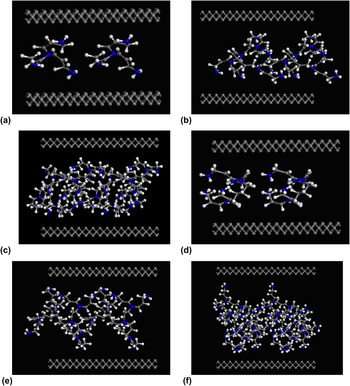
Atomistic calculations are performed using the condensed-phase optimized molecular potentials for atomistic simulation studies (COMPASS) force fieldReference Fouqueta, Johnsona, Hedgelandb, Jardineb, Ellisb and Allisonb14 and Discover module. First, we establish the first-to-third generations (1G ∼ 3G) of dendrimers centered by amine or butanediamine and based on the vinyl cyanide as the repeat units. Second, we can obtain the balance conformation by processing the module and making the 2 ns long MD simulation. Finally, choosing an equilibrated dendrimer and respectively placing it between layers of graphite, six different initial configurations of the dendrimers in the graphite layer were modeled (1–6) and shown in Fig. 1.
The initial configuration of the dendrimers in the graphite layer. The C, N and H atoms are in gray, blue and white colors, respectively.

Among these modules, two models of dendrimers were built under the Build function modules by monomer structure in software, the graphite was obtained by the perfectly cell cutting (110) plane. Finally three-layer models have been constructed.
B. MD simulation
In particular, we have used the COMPASS model, which is an ab initio force field enabling accurate and simultaneous prediction of structural, conformational, vibrational and thermophysical properties for a broad range of isolated molecules and systems.Reference Canetta and Maino15 During ideal vacuum conditions, we have used the constant-NVT ensemble, and also the Andersen thermostat,Reference Andersen16 in the interim, ParrinelloReference Parrinello and Rahman17 pressure control method. In the process of simulation, the interaction of nonbond uses truncated form based on atomic group, the truncated radius is 9.5 Å, the intermolecular interaction energy of the distance beyond truncation can be corrected by an average density approximation method. The starting velocity of each molecule obeyed the Maxwell-Boltzmann distributionReference Ito, Wang, Irle, Morokuma and Nakamura18 at 298 K initially. The Newton equation of motion is solved using velocity-Verlet time stepping scheme with an integration time step of 1 fs. Total simulation for 1 million steps, the first 300,000 steps for system balance, the rest 700,000 steps for statistical analysis, written into the trajectory files every 50 steps for one time, mechanical properties had been acquired by the MS3.2-introduced static model. All of the simulations were processed under the periodic boundary conditions.
III. RESULTS AND DISCUSSIONS
A. The microscopic configuration analysis of graphite/dendrimer composites
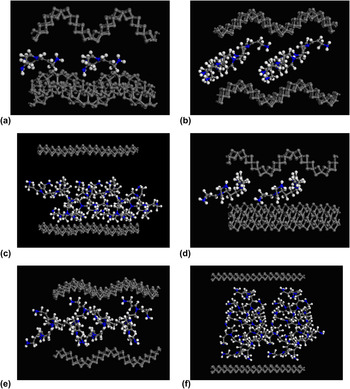
Compared with Fig. 1, the microscopic configuration of dendrimers changed obviously in Fig. 2, where the graphite layers-wrapped low-generation dendrimer changed more obviously. The graphite layers of Figs. 2(a) and 2(d) wrapped the dendrimer around it, which led to bending in vertical and horizontal directions, the main cause is that low-generation dendrimers have smaller volume, the graphite layers should convert obviously into deformation to make sure that it would be the lowest energy in the whole system. At the same time, the system was poor in stability, as seen with the SEMReference Zuo, Shen and Hou19 of similar intercalated composite materials, which proved this conclusion. In the process of volume growth, the dendrimer generation increased, the bending trend of the graphite layers decreased gradually. When the 3G dendrimer is wrapped in the graphite layers, there is almost no change in the graphite layer, the whole system can exist stably. It was predicted that this system had the lowest energy as against the low-generation dendrimer. At this point, the degree of damage of reticular layers structure of graphite is low; it is stronger in conductivityReference Otieno and Kim20 and flame retardancyReference Murariu, Dechief, Bonnaud, Paint, Gallos, Fontaine, Bourbigot and Dubois21 than the graphite intercalated composite materials that have changed in deformation.
The microscopic configuration of dendrimers, which were optimized by the COMPASS force field. The C, N and H atoms are in gray, blue and white colors, respectively.

B. Energy analysis
Computationally, total energy of a system is composed of potential energy and kinetic energy, the formula as follows:

In different systems, the power and function of the potential energy and kinetic energy are different, but total energy of the system is affected by both potential energy and kinetic energy.
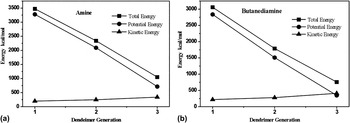
The energy change trend of graphite/dendrimer is shown in Fig. 3. It indicates that the decrease of potential energy dominates the decrease of total energy. However, although the kinetic energy shows increasing trend, it is not adequate to affect the decrease of total energy. Judging from the energy point of view, the energy order of graphite/dendrimer intercalated compound system centered with amine and butanediamine is 1G > 2G > 3G, which is related to the space configuration of system and molecular size; intra- and intermolecular interactionsReference Terao and Nakayama22 are also a major factor.
(a) Each energy change curves of 1G ∼ 3G graphite/dendrimers composite system centered by amine. (b) Each energy change curves of 1G ∼ 3G graphite/dendrimers composite system centered by butanediamine.

1. The analysis of potential energy
Potential energy contains all information of intermolecular interactions.Reference Yang23 The potential energy usage is given by Eq. (2),
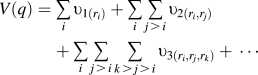
It mainly consists of two parts: bonding interaction and non bonding interaction in atoms. Among them, the bonding interaction has four parts: bond stretching, angular bending, torsion and inversion; the non bonding interaction has electrostatic energy, van der Waals and hydrogen bond energy. In this system, these four factors: bond stretching, angular bending, van der Waals and electrostatic energy make greater contribution to the compound system. Along with the increase of dendrimer volume, the deformation of graphite layers and dendrimer is reduced in space, system tends to be stable, the energy items that have the significant contributions to the system are reduced, and then the potential energy would be low, finally it leads to the decrease of the total energy of the system. According to the analysis above, the change of space microconfiguration of complex system is closely related to the interlayer substance volume and energy changes in composite system.
2. The analysis of kinetic energy
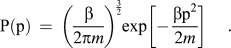
where P is the distribution of particle in space, p is momentum, and β is parameter related to the temperature.
Through the formula abovewe can further obtain the simple relation between temperature (T) and the average kinetic energy of every particle:

where kB refers to Boltzmann constant, equal to 1.38066 × 10⁻²³J/K. m for particle masses, vα is the component of particle velocity in α direction.
In practice, the kinetic energy of each particle is equal in thermostatic system. That is to say, under the condition of no change of particle quality, the kinetic energy of system will not change. And according to the kinetic energy formulaReference Frenkel and Smit24:

It shows when the quality and kinetic energy of every particle are unchanged, the total kinetic energy is related to the particle number (N). The larger the N is, the higher the total kinetic energy is. When the same molecule is inserted, the relation between kinetic energy and N will have linear relation. Figures 3(a) and 3(b) show that, with the dendrimer generation increased in the intercalated compound system, the change of kinetic energy basically shows a rising tendency. That is to say, the increase of kinetic energy is mainly caused by the increasing number of atoms in the system.
The differing principles involved in change of kinetic energy and potential energy respectively well explain the phenomenon of increase in the kinetic energy in the process of decrease of the total energy. The decrease of energy in the total system mainly depends on change of the potential energy in the system. When the generation of the dendrimer is less than 3G, the change of kinetic energy has little influence on the change of total energy. But we can predict that when dendrimer generation grows, the number of atoms in graphite layers will increase in geometric proportion, and will eventually increase the total energy of the system, which in turn enhances the system instability.
C. Radial distribution function
Radial Distribution Function (RDF) is also called Pair Correlation Function. It usually refers to the given coordinates of a particle and the probability distribution of other particles (how far from a given particle) in space. Therefore, the RDF can be used not only to study the ordering of substances, but also to describe the electronic correlation.
When the distance between one particle and the other particles is closed, the main characteristic of RDF is the piling state of atoms and the distance between bonds. For the nature of long-term, as the chance of finding atoms in a given distance is almost equal, so RDF gets slow with the increase of the distance in particles and finally tends to constant value. When defining the RDF, normalization condition is that when the distances between given particles and other particles tend to infinity, RDFs tend to a value of one. Therefore, generally for crystal, as crystal has orderly structure, RDF has a long-range peak whereas for amorphous substance, RDF has only a short-range peak.
Sometimes the same concept also needs to be used to describe the electronic correlation such as pair correlation of electrons, which refers to a particular electron, and observes the probability of other electrons appearing around this electron. Because there is coulomb repulsion among the electrons and the antisymmetrization effect of wave function, the concrete form of pair correlation is more complex; therefore, until now it has not been an accurate expression.
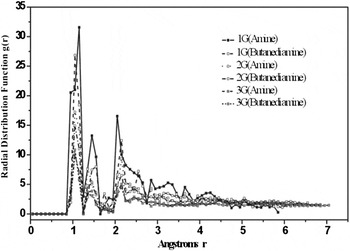
In this paper, optimized results of the COMPASS force field and analyzed function of MS3.2 are used to get six kinds of RDF models shown in Fig. 4. All the contributions of intra- and intermolecular interaction are contained in a single model.
The RDF of six kinds of intercalated composite materials.

Figure 4 shows two strong peaks between 0.085 ∼ 0.15 nm, which are attributed to chemical bonds of polymer chain itself, the respective strong and weak intensity of each peak is determined by the strong and weak forces of bonding interaction in the system. The g(r) between 0.20 ∼ 0.45 nm is mainly caused by intra- and intermolecular interaction innonbonding interaction, especially the strong peak between 0.20 ∼ 0.23 nm, it is caused by electrostatic energy and van der Waals which have the greater contribution to the system energy. Apparently, it can be inferred from the above that in different core dendrimer composite systems, the order of intra- and intermolecular interaction is 1G > 2G> 3G, that accord with the energy analysis results.
D. The interaction of graphite and dendrimer centered by amine or butanediamine
1G ∼ 3G dendrimers centered by amine, butanediamine in graphite intercalated composite materials have different performances. First in the micro-configuration, the volume of dendrimer centered by amine is less than that of butanediamine. To make the most stable state, it causes the larger bending deformation of the graphite layers invariably and Fig. 2 proved this point. There are further analysis results, it is this space volume and deformation that leads to the increase of potential energy in graphite/dendrimer system with the core of amine; On the other hand, according to the energy analysis result above, the dendrimer with butanediamine as the core has a number of atoms in the same generation, so its kinetic energy is larger than that of dendrimer with amine as the core. This shows that the change tendency of potential energy and kinetic energy accords with the change curve of energy in Fig. 3. By the analysis above, we can conclude that the potential energy of 1G ∼ 3G graphite/dendrimer composite system as the core of amine is greater than that of butanediamine whereas the kinetic energy changes opposite.
IV. CONCLUSION
We have performed a detailed classical MD study of the 1G ∼ 3G graphite/dendrimer composites centered by amine, butanediamines. This is the first report on the microscopic configuration of graphite/dendrimer composite and its energy change. The results of simulation research indicate that in the process of formation of GICs, low-generation dendrimers are not conducive to maintaining the lowest energy and the stable structure; therefore, the third-generation dendrimer is more suitable for inserting layer compound. At the same time, in the composite system of graphite/dendrimer, we find that the order of intra- and intermolecular interaction is 1G > 2G>3G. According to the results, it is estimated that when the generations of dendrimer increase to a certain extent, kinetic energy and total energy of complex system increase as well, which leads to system instability.
ACKNOWLEDGMENTS
The authors would like to thank the financial support from the Natural Science Foundation of Gansu Province (1010RJZA023), Technology R&D Program Plan of Gansu Province (1104GKCA019) and also supported by the fund of the State Key Laboratory of Solidification Processing in NWPU (SKLSP201011).