


1. Introduction
We are currently witnessing what many have characterized as a backlash against international law and courts. After a dramatic turn toward the ‘legalization’ of international relations (IR) in the twentieth century (Goldstein et al., Reference Goldstein, Kahler, Keohane and Slaughter2000), the mood seemed to sour in the twenty-first century (Voeten, Reference Voeten2020; Copelovitch et al., Reference Copelovitch, Hobolt and Walter2020; Walter, Reference Walter2021). In recent years, this backlash has taken hold: the United States (US) has blocked nominees to the World Trade Organization’s (WTO’s) appellate body (Bown and Keynes, Reference Bown and Keynes2020; Zaccaria, Reference Zaccaria2022); several countries have exited (or threatened to exit) the International Criminal Court (ICC) and human rights courts (Pauwelyn and Hamilton, Reference Pauwelyn and Hamilton2018; Helfer, Reference Helfer and Neuman2020); many have renegotiated or terminated bilateral investment treaties (BITs) (Peinhardt and Wellhausen, Reference Peinhardt and Wellhausen2016; Thompson et al., Reference Thompson, Broude and Haftel2019); and preferential trade agreements (PTAs) have been renamed, renegotiated, and scuppered outright.Footnote 1 Recent work suggests that this backlash is driven in large part by domestic factors, including the rise of populist and isolationist sentiment (Colantone and Stanig, Reference Colantone and Stanig2018; Voeten, Reference Voeten2020; Rodrik, Reference Rodrik2021; Norris and Inglehart, Reference Norris and Inglehart2019).Footnote 2
Yet international law is widely believed to provide benefits for countries and the world more generally. Advocates suggest that it helps countries realize joint gains, thereby promoting global peace, prosperity, and justice. For many, international law, even if imperfectly applied, is central to the ‘rules based’ international order that emerged after World War II (Ruggie, Reference Ruggie1992; Ikenberry, Reference Ikenberry2001; Lake et al., Reference Lake, Martin and Risse2021). Moreover, much theoretical work in IR begins from the premise that international law is self-enforcing because treaty-making represents a credible commitment to future beneficial cooperation (Axelrod, Reference Axelrod1984; Keohane, Reference Keohane1984; Fearon, Reference Fearon1997; Martin, Reference Martin2000; Simmons, Reference Simmons2000; Dai, Reference Dai2005; Goldstein et al., Reference Goldstein, Rivers and Tomz2007; Simmons, Reference Simmons2009; Carrubba, Reference Carrubba2009). Public opinion data further suggest that many publics remain supportive of international cooperation (Walter, Reference Walter2021; Pew, 2024), and numerous studies show that support of international law and organizations varies considerably across countries and over time (Chapman and Chaudoin, Reference Chapman and Chaudoin2020; Dellmuth et al., Reference Dellmuth, Scholte, Tallberg and Verhaegen2022).
A key puzzle is understanding why some members of the public seemingly reject international law despite the benefits. Prominent theories in IR rely on the assumption that publics frequently favor international treaty-making, and support upholding obligations once made. However, if significant portions of the public oppose these obligations, we must reconsider why states submitted to them in the first place. Additionally, uncovering the drivers of public support for international law should help us understand whether the current backlash is epiphenomenal or likely to persist, which can contribute to debates on the rise of populism. Scholarship has begun to address this important puzzle. Specifically, recent studies show that elite cues have strong negative effects on citizens’ views toward international law and organizations (Dellmuth and Tallberg, Reference Dellmuth and Tallberg2021; Dellmuth et al., Reference Dellmuth, Scholte, Tallberg and Verhaegen2022). Moreover, research indicates that attitudes toward compliance with international law are conditional on a variety of individual characteristics (Chaudoin, Reference Chaudoin2014b; Guisinger and Saunders, Reference Guisinger and Saunders2017). New evidence also suggests that media coverage is biased towards amplifying these negative messages (Brutger and Strezhnev, Reference Brutger and Strezhnev2022).
In this paper, we build on this important, emerging literature by testing a simple yet foundational idea. Specifically, we evaluate how citizens respond to one of the core features of international law: its reciprocal nature. Put simply, the norm of reciprocity in international law is the principle that states should extend mutual obligations to one another. Our core claim is that informing citizens of this reciprocal structure – namely, that international law provides tools that their own country can use – will increase support relative to the potential costs of the obligations alone. In other words, citizens will respond positively to the notion that international law does not just impose costs, but also confers benefits by giving national actors access to international law for their (or their country’s) benefit.
To test our theory, we utilize a survey experiment in the US on views toward the controversial investor state dispute settlement (ISDS) system, which is included in over 3,000 international treaties and has been utilized over 1,250 times since the early 1990s. Our vignette asks respondents to weigh their favorability towards ISDS when the US is the respondent to a claim brought by foreign investors relative to when US-based investors use ISDS. We then provide some respondents information about the reciprocal use of ISDS either by US or global investors. This experimental design allows us to isolate the effect that information about reciprocity has on support for ISDS even when the US is a respondent (and hence faces a clear cost). Importantly, this also allows us to test for the effect of different forms of reciprocity by differentiating between ‘diffuse’ and ‘specific’ reciprocity (Keohane, Reference Keohane1986). Several results stand out. First, the public is highly supportive of international legal obligations when US actors utilize them, but are more skeptical when such obligations expose the US to costs in the form of litigation. This corroborates recent work demonstrating a home country bias in international law (Chapman and Chaudoin, Reference Chapman and Chaudoin2020; Brutger and Strezhnev, Reference Brutger and Strezhnev2022). Second, our results show that providing information about the reciprocal use of ISDS can dampen the negative effect of facing litigation. Importantly, however, this effect is asymmetric as it operates primarily through the specific reciprocity cue, as we do not find evidence for the diffuse reciprocity cue. Collectively these findings suggest that citizens are more willing to accept the costs of international law when they believe that it offers reciprocal benefits, but that these benefits must be concretely tied to their home country.
Our findings have important implications for the study of international law and relations as well as the investment regime. We add to a growing literature showing that public support for international law is affected by the information that people receive and build on this literature by showing that respondents are sensitive not only to the potential costs of international law but also to its benefits. Specifically, information about one defining feature of international law – its reciprocal application – can help mitigate concerns about the costs. Importantly, however, the effect operates through information about specific rather than diffuse reciprocity, suggesting that activating public support for international law requires concrete appeals. While it may seem intuitive that highlighting the benefits of international law increase support, our findings show that this effect is conditional. Reciprocity does not uniformly increase support and appears to matter when individuals perceive international law as potentially costly and only then if the benefits are tied to their home country. This refines existing work on negativity bias and public opinion by showing that positive information can mitigate opposition, but only under certain informational conditions. That we find these results in the ISDS context at all is itself noteworthy, as widespread public backlash, even in capital exporting states, has led to a pullback from the regime in recent years (Lugg et al., Reference Lugg and Scott2025; Schultz and Dupont, Reference Schultz, Dupont, Rezadoost, Hofer and Istrefi2026). Taken together, this suggests that the observed backlash is not being driven by a fundamental antagonism towards the idea of international law, but could reflect a failure to communicate its benefits in sufficiently concrete terms.
2. International Law
2.1 The Benefits of International Law
If we rewind to the latter part of the twentieth century, the mood towards international law was one of excitement. As observers noted an increase in ‘legalization’ across international relations, scholars developed a strong theoretical foundation, touting the many benefits of international law (Goldstein et al., Reference Goldstein, Kahler, Keohane and Slaughter2000). At the broadest level, rationalist and functionalist theories argue that international law – whether via treaties, international organizations (IOs), or through custom – helps states realize joint gains (Keohane, Reference Keohane1984; Lipson, Reference Lipson1991; Simmons, Reference Simmons2000; Keohane et al., Reference Keohane, Moravcsik and Slaughter2000; Guzman, Reference Guzman2008). Moreover, states can select among legal instruments, such as hard or soft law and formal or informal institutions, and also choose specific design features that help them address different cooperation problems (Abbott and Snidal, Reference Abbott and Snidal2000; Vabulas and Snidal, Reference Vabulas and Snidal2013; Koremenos et al., Reference Koremenos, Lipson and Snidal2001; Zangl, Reference Zangl2008).Footnote 3
Beyond the aggregate benefits, research suggests that international law has domestic bases of support. Building upon the framework of Fearon (Reference Fearon1997), scholarship suggests that international law helps states credibly commit by raising the ex-post cost of reneging on commitments (Leeds, Reference Leeds1999; Simmons and Danner, Reference Simmons and Danner2010; Chaudoin, Reference Chaudoin2014a), and by generating costs through legalized dispute settlement (Elkins et al., Reference Elkins, Guzman and Simmons2006; Zangl, Reference Zangl2008). Other studies argue that international law raises the cost of defection by providing information about countries’ reputations, which can be useful to both domestic and international audiences (Simmons, Reference Simmons2000; Mansfield and Milner, Reference Mansfield and Milne2012; Dreher et al., Reference Dreher, Mikosch and Voigt2015; Arias et al., Reference Arias, Hollyer and Rosendorff2018). Importantly, scholarship also shows that compliance with international law has domestic distributional implications, which can lead to lobbying and other actions by pro-compliance constituencies in democracies (Dai, Reference Dai2005; Reference Dai2006).
2.2 Public Opinion and the Costs of International Law
Understanding the factors that affect public opinion towards international law is important, especially if domestic political mechanisms play a key role determining whether states enter into – and comply with – international legal obligations. Currently, scholarship has generated mixed results, finding areas of support for international law alongside areas of limited support or even antagonism.
On the positive side of the ledger, studies show that the public supports compliance with existing international obligations in a variety of contexts (Chilton, Reference Chilton2014; Strezhnev et al., Reference Strezhnev, Simmons and Kim2019; Elsig and Spilker, Reference Elsig and G.2024; Kuzushima et al., Reference Kuzushima, McElwain and Shiraito2024; Chaudoin, Reference Chaudoin2014b).Footnote 4 Other work demonstrates that attitudes towards international institutions more broadly are often positive. For example, in 2024, 60% of Americans said that the US ‘benefits from being a member of the UN’, and the average favorability across 24 countries was 63% (Fetterolf, Reference Fetterolf2024; Fagan, Reference Fagan2024). Similarly, when asked in 2024 whether the US should promote human rights globally, 65% responded in the affirmative, and a plurality suggested that working through IOs was desirable (Telhami, Reference Telhami2024).Footnote 5
Yet, by its very nature, international law imposes obligations on countries. A core feature of how international law functions is that it defines permitted and prohibited behaviors and establishes expectations that violations will have consequences (Keohane, Reference Keohane1986; Goldstein et al., Reference Goldstein, Kahler, Keohane and Slaughter2000; Shaw, Reference Shaw2008; Guzman, Reference Guzman2008). In this sense, international law imposes ‘sovereignty costs’ on states, which increase as states grant more authority to supranational bodies (Abbott and Snidal, Reference Abbott and Snidal2000, 436–437). Moreover, most observers note that sovereignty costs are highest in issue areas where there is significant ‘judicialization’ (Alter et al., Reference Alter, Hafner-Burton and Helfer2019; Helfer, Reference Helfer, Dunoff and Pollack2013; Koremenos, Reference Koremenos2016).
In recent years, perceptions that international law impinges too deeply on sovereignty has seemingly generated a backlash (Norris, Reference Norris1997; Thompson et al., Reference Thompson, Broude and Haftel2019; Voeten, Reference Voeten2020). Most notably, the rise of populist and nationalist movements has led to the politicization of much of the legal architecture underpinning the liberal international order and international institutions more broadly (Copelovitch and Pevehouse, Reference Copelovitch and Pevehouse2019; Walter, Reference Walter2021; Lake et al., Reference Lake, Martin and Risse2021). Along with this, there have been efforts to withdraw from or renegotiate international legal commitments, or avoid making them in the first place (Peinhardt and Wellhausen, Reference Peinhardt and Wellhausen2016; von Borzyskowski and Vabulas, Reference von Borzyskowski and F.2019; Cooley and Nexon, Reference Cooley and Nexon2020).
To better understand these competing dynamics, scholars have begun to examine more closely how political debates influence views towards international law and organizations. For example, there is a vibrant research agenda on the legitimacy and legitimation of IOs (see Tallberg and Zurn, Reference Tallberg and Zürn2019).Footnote 6 These studies share the assumption that public debate, especially the cues, frames, and narratives supplied by elites (and IOs themselves), can affect citizens’ views. Studies of IO legitimacy examine the ‘intensity’, ‘tone’, and ‘narratives’ present in public debate (Tallberg and Zurn, Reference Tallberg and Zürn2019) as well as individual characteristics, including political values, social identification, and economic self-interest (see Dellmuth et al., Reference Dellmuth, Scholte, Tallberg and Verhaegen2022, ch 6; Brutger and Clark, Reference Brutger and Clark2023). In the specific realm of international law, scholars have evaluated the efficacy of elite cues versus international legal appeals (Strezhnev, Simmons, and Kim, Reference Strezhnev, Simmons and Kim2019) and others have adopted a competing frames approach, showing, for example, that human rights frames help explain support for the ICC (Zvobgo, Reference Zvobgo2019), and that citizens respond negatively to legal investigations into their own country relative to ones abroad (Chapman and Chaudoin, Reference Chapman and Chaudoin2020).
One common thread is that negative messages seem to be particularly potent. For example, Dellmuth and Tallberg (Reference Dellmuth and Tallberg2021) uncover a ‘negativity bias’ in elite cues. The source of this effect is debated with some arguing that it is rooted in human psychology. Prospect theory suggests that people are more sensitive to losses than gains and research in psychology shows that negative emotions evoke stronger opinions than positive ones (see Druckman, Reference Druckman2004; Druckman and McDermott, Reference Druckman and McDermott2008; Johnson and Tierney, Reference Johnson and Tierney2018). Another key insight from this literature is that partisanship helps explain receptivity to elite cues (Brutger and Clark, Reference Brutger and Clark2023; Chapman and Li, Reference Chapman and Li2023). Similarly, media analyses argue that negative messages are often more prominent due to media selection logics (Brutger and Strezhnev, Reference Brutger and Strezhnev2022; Soroka and McAdams, Reference Soroka and McAdams2015; King and Lugg, Reference King and Lugg2023).
Taken together, recent research suggests that public opinion is not inherently antagonistic towards international law, but that the public is responsive to information such as elite cues, especially negative ones, and that these messages along with political opportunity structures can dramatically affect public debate (De Vries et al., Reference De Vries, Hobolt and Walter2021; Walter, Reference Walter2021; Lugg and Scott, Reference Lugg, Ganeson, Elsig, Chaisse and Jusoh2024). Importantly, recent research has also sought to better understand whether (and how) the characteristics of international law interact with these factors to affect public support. For example, Madsen et al., (Reference Madsen, Mayoral, Strezhnev and Voeten2022) show that subsidiarity does not seem to positively affect public support, whereas the involvement of domestic institutions in implementation does (Cheruvu and Krehbiel, Reference Cheruvu and Krehbiel2024). Other research suggests that compliance is driven by a respect for legal obligations rather than concern for shared global practices (Kuzushima et al., Reference Kuzushima, McElwain and Shiraito2024).
2.3 Reciprocity and Public Support for International Law
In this paper, we build upon emerging literature on public opinion toward international law by developing and empirically testing a simple proposition. Specifically, we argue that citizens are responsive to messages about both the costs and benefits of international law, but how they weigh these considerations is conditioned by a core feature of international law, namely its reciprocal nature. In this sense, we add to scholarship demonstrating that citizens’ views towards international law are impacted by messages emphasizing self-interested calculations, such as whether the application of international law is seemingly helping or hurting their country. These studies show that individuals often support international dispute resolution if their country is perceived as the ‘winner’, whereas they are less supportive if they perceive their country as a ‘loser’ (see Chapman and Chaudoin, Reference Chapman and Chaudoin2020; Brutger and Strezhnev, Reference Brutger and Strezhnev2022). Yet, beyond this important dichotomy, we also contend that citizens consider whether the law is applied in a reciprocal fashion. In other words, citizens also care about whether international law represents an ‘iterated game’ where their country stands to gain in the longer term (Axelrod, Reference Axelrod1984; Carrubba, Reference Carrubba2009).
Scholarship suggests that international law is more likely to be an equilibrium outcome when countries view their interactions as extending into the future. Reciprocity is a key mechanism – though it varies widely in how it applies across different contexts – that helps induce cooperation in repeated interactions (Keohane, Reference Keohane1984; Snidal, Reference Snidal1985; Fearon, Reference Fearon1998; Goldsmith and Posner, Reference Goldsmith and Posner2005; Carrubba, Reference Carrubba2009). By establishing a focal point for cooperation, helping states monitor defection, and creating costs for noncompliance, international legal agreements help states achieve joint gains. For this to be effective in the long run, however, international legal agreements have to be reciprocal, such that all parties are bound by similar rules, and there must be mechanisms for other states or external actors to impose costs for non-compliance (Axelrod, Reference Axelrod1984; Parisi and Ghei, Reference Parisi and Ghei2003; Guzman, Reference Guzman2008). Importantly, studies of international courts suggest that one key way reciprocity induces cooperation is through domestic political channels. For example, Dai (Reference Dai2005) shows that pro-compliance domestic constituencies with distributional concerns can influence government policy, and Carrubba (Reference Carrubba2009) shows formally that for an international court to acquire independence, it must gain domestic legitimacy by credibly demonstrating to the public that it provides benefits.
Here, we conceptualize reciprocity broadly as the expectation that the legal rights and obligations of international law apply to all parties, and that failure to comply is likely to result in a withdrawal of corresponding benefits or the imposition of penalties. Although reciprocity is not in itself a specific legal principle, much of international law and cooperation is premised on it, such that Paris and Ghei (Reference Parisi and Ghei2003, 105) suggest that ‘norms of reciprocity have emerged as meta-rules for international law…’. In an influential essay, Keohane (Reference Keohane1986, 4) argues that there are two types of reciprocity. The first, ‘specific reciprocity’, refers to ‘situations in which specified partners exchange items of equivalent value in a strictly delimited sequence’, and where ‘if any obligations exist, they are clearly specified in terms of rights and duties of particular actors’. The second, ‘diffuse reciprocity’ applies in situations where ‘the definition of equivalence is less precise … one’s partners may be viewed as a group … and the sequence of events is less narrowly bounded’.
Our core argument is that when individuals are informed that international law applies only in a single instance (if the game is effectively ‘single-shot’ in the parlance of game theory), then the relevant piece of information reduces to which country ‘won’. Citizens will approve if they think their country won and disapprove if they think they lost. However, this changes if international law is presented as being reciprocal. When international law is represented as a system of repeated interactions that establishes rules and procedures that apply to all parties, and when there are similar consequences should those rules be abrogated, citizens are more likely to understand how this creates benefits for their country. This is the core logic of Carrubba’s (Reference Carrubba2009) model of the endogenous development of international law, which posits that an imperfectly informed public can use compliance with legal rulings as a way to learn whether an international court creates social benefits. This mechanism is likely to be strongest in democracies, especially when there are constituencies that have distributional concerns with compliance (Dai, Reference Dai2006). In sum, if citizens are given information highlighting the reciprocal nature of international law, many of them will be persuaded that their country receives some of the surplus benefits of international cooperation.
This framework assumes that individuals rely on the most relevant sociotropic lens available when they evaluate international law. In other words, because matters of international law are often distant – both objectively and cognitively – and because the details can be quite arcane, individuals will default to thinking about the costs and benefits in relation to the most relevant social group. For matters of international law, this means that the public will frequently adopt a nationalistic lens. The easiest heuristic is to ask, ‘Does my country benefit?’ or ‘Does another country benefit?’. Importantly, for this effect to be operative, we do not have to assume that individuals are hyper-nationalistic, uniformly sociotropic, or that they do not also hold egalitarian or cosmopolitan views. Rather, we assume that on matters pertaining to international law, individuals prioritize their group identities, which is the easiest and most relevant distinction. This logic is firmly rooted in the behavioral sciences (Kinder and Kiewiet, Reference Kinder and Kiewiet1981; Mansfield and Mutz, Reference Mansfield and Mutz2009; Chua, Reference Chua2019). Moreover, in the present context, we do not have to assume that the public is fully informed (Carrubba, Reference Carrubba2009). In sum, we assume that individuals care about the benefits from cooperation codified in international law, such that when international law is implemented and therefore enters public debate, the easiest distributional consideration is to distinguish between actors from their country relative to actors from other countries.
With respect to international dispute settlement what this means is that citizens will react differently depending on the information they receive across two different dimensions. A first dimension relates to the nationality of the actors that are defendant and claimant respectively, whereas a second dimension relates to whether the interaction is reciprocal and the nature of the reciprocity. In the present case, we examine these dynamics in the context of the regime for the protection of foreign investment, which at its core includes a widely used system of investor–state dispute settlement or ISDS.Footnote 7 These ISDS provisions are included in the majority of over 3,000 international investment agreements (IIAs) signed by countries, and to date over 1,300 cases have been filed, with over 958 decided, making this one of the most active areas of judicialization in international relations (UNCTAD, 2024). Moreover, the regime has important distributional implications as claims and awards frequently exceed a billion dollars (UNCTAD, 2024) and being exposed to litigation can dampen investment (Allee and Peinhardt, Reference Allee and Peinhardt2011).Footnote 8
This regime also has desirable features because it represents a conservative test of our theory. First, it has been heavily politicized in recent years, in large part due to concerns about the costs (Peinhardt and Wellhausen, Reference Peinhardt and Wellhausen2016). Thus, to the extent that the public has been exposed to ISDS through the media, they are likely to have encountered mostly negative information (Brutger and Srezhnev, Reference Brutger and Strezhnev2022). Second, because the regime functions such that investors sue states, rather than states sue states, we have strong reasons to think that citizens are likely to be more influenced by the negative cue, their country is being sued, rather than the positive cue, ‘An investor from their country sued.’
Our theoretical framework implies the following hypotheses. First, we expect that the nationality of the claimant and respondent should affect public support.
Hypothesis 1: US citizens will be less supportive of ISDS when the US government is being sued than when a US-based investor is suing a foreign government.
The notion that individuals are sensitive to the costs of international cooperation is shared across studies which look at public opinion toward foreign policy. In the realm of international law, Chapman and Chaudoin (Reference Chapman and Chaudoin2020) show that citizens are less supportive of ICC investigations in their own country than ones abroad, and Brutger and Strezhnev (Reference Brutger and Strezhnev2022) show that citizens react negatively to instances where their country is the state party in an investment dispute. Where we add to this scholarship is by theorizing about how the publics’ understanding of these costs is likely to change when individuals are given more information about how international law creates benefits.
Specifically, our theoretical framework suggests that information about the reciprocal use of international law should change the way the public responds. We theorize that reciprocity can vary based on how diffuse or specific it is, which is consistent with theoretical discussions (e.g., Keohane, Reference Keohane1986). The key distinction between diffuse and specific reciprocity involves consideration of the parties, the good being exchanged, and the manner in which the actors interact (Keohane, Reference Keohane1986, 4). Therefore, in order to assess the impact of ‘diffuse reciprocity’ we test whether the public is more supportive of international law, on average, when they are told that investors around the world make regular use of ISDS. This encourages respondents to think about international law as something that helps establish economic cooperation globally, which they will then include in their consideration of the costs and benefits.
Hypothesis 2: US Citizens will be more supportive of ISDS when they are given information about the use of ISDS globally.
A second, more precise type of reciprocity narrows the scope of the actors who benefit as well as provides specifics about time frame and the value of cooperation. In this case, we argue that giving respondents cues about US investors utilizing ISDS will prompt respondents to think about reciprocity as providing a country-specific benefit, making the benefits of cooperation over time more salient. Importantly, this is also ecologically valid, as US investors have filed over 200 cases against foreign governments (UNCTAD, 2024). We theorize that the public will be more supportive of ISDS, on average, when they are given information about investors from their country regularly using the system. This will spur them to think about how international law creates a system that serves to benefit the US specifically.
Hypothesis 3: US Citizens will be more supportive of ISDS when they are given information about US-based investors utilizing ISDS.
Finally, we also think that the most pronounced effect of specific reciprocity will be observed in cases where the US is sued but respondents are given information about US investors regularly using the system. Hypotheses 2 and 3 suggest that cues about reciprocity will positively affect support regardless of who is suing. Yet, we argue that the specific reciprocity cue is likely to be particularly strong in cases where respondents are given information that the US was the respondent to an ISDS case. The underlying logic is that concerns about the distributional implications of specific reciprocity are most likely activated in cases where the US faces a clear cost (is being sued), whereas this cue will be less relevant in cases where the US is already receiving a clear benefit (a US firm was suing). Moreover, we expect that the specific reciprocity treatment is likely to be more impactful when the US is being sued than the diffuse reciprocity cue. This motivates the hypothesis below.
Hypothesis 4: The negative effect of foreign investors suing the US government is diminished when citizens are given information about US investors utilizing ISDS.
3. Survey Design
To test our hypotheses, we fielded an online survey experiment in summer of 2023.Footnote 9 We obtained a final sample of 2,227 individuals living in the US (adults aged 18+) through Lucid Theorem.Footnote 10, Footnote 11 The survey first prompted respondents to answer questions regarding their opinions about politics as well as an attention check.Footnote 12 This was followed by the experimental component of the survey that aims to gauge respondents’ views towards the use of ISDS while varying information about the litigants and targets as well as the prior use of the mechanism by global or local investors. We should note that in the vignette we use ‘sue(d)’ rather than the technically correct ‘file(d),’ and ‘court’ rather than ‘tribunal,’ in order to aid respondent comprehension. Respondents read about a hypothetical ISDS case between the US and South Korea. The description of the case is as follows:
“A [U.S.-based/South Korea-based] company recently sued the [government of South Korea/U.S. government] at an international tribunal under a procedure commonly known as investor state dispute settlement (ISDS). This procedure allows companies from one country to sue other countries’ governments for alleged violations of international law at courts such as the World Bank’s International Centre for the Settlement of Investment Disputes.”
“The [U.S./South Korean] company alleges that the [government of South Korea/U.S. government] violated its international legal obligations by passing domestic legislation that unfairly decreased the value of their investment by over $1 billion dollars.”
This part of the vignette contains two treatments in which we randomly assign either a US firm suing the South Korean government or a South Korean firm suing the US government. These treatments identify the claimants and respondent involved in the case. We intentionally chose South Korea, an ally and significant economic partner of the US, to limit the possibility that responses are affected by respondents’ assessments of the general relationship between the two countries rather than the direction of the suit.Footnote 13, Footnote 14 The existence of strong investment ties between the two countries also makes this a realistic scenario – investors from both states could conceivably file an ISDS case under the US–Korea Free Trade Agreement. This first part of the experimental set-up is similar to that found in Brutger and Strezhnev (Reference Brutger and Strezhnev2022), except that it differs in terms of the actors, the setting (bilateral versus trilateral), and how the treatment is administered; we present a vignette whereas they use a mock-article and a vignette in separate experiments.
To this, we add two additional treatments to inform respondents about the prior use of ISDS by global (diffuse reciprocity) or US firms (specific reciprocity). This design allows us to identify the effect of different forms of reciprocity in a plausible scenario where both sides could use ISDS. Note that the baseline does not contain any additional information regarding prior use. These treatments read as follows:Footnote 15
“{Baseline-no additional information}/Using this system, firms around the world have successfully sued foreign governments over 275 times, often resulting in sizable financial settlement to cover losses incurred doing business in other countries/Using this system, US firms have successfully sued foreign governments over 30 times, often resulting in sizable financial settlements to cover losses incurred doing business in other countries.”
Respondents are randomly assigned to either the baseline condition or one of the two treatments regarding prior use of ISDS. The inclusion of these treatments leads to a 2x3 factorial design.
After reading about the hypothetical case, respondents were prompted to answer post-treatment questions. Our primary outcome question asks: ‘To what extent do you agree that companies should be able to sue other governments for breaches of international law using the investor state dispute settlement (ISDS) procedure?’. We dichotomize the outcome in our main analysis to distinguish between respondents who express support (those who indicate that they strongly or somewhat agree) and those who do not.Footnote 16 While this simplifies the outcome, it allows us to focus on the key theoretical distinction of interest between support and non-support. In the Appendix, we report supplemental results using the original five-point scale.
4. Results
4.1 Pairwise Analysis
Since our hypotheses specify predictions about differences in support across randomly assigned treatment groups, we first evaluate those using pairwise t-tests, which identify the average treatment effects without imposing additional modeling assumptions. For Hypothesis 4 (H4), we initially assess whether there is a subgroup effect among respondents who read that the US government is being sued by South Korea, based on whether they also received information about US firms benefitting from ISDS. We then use multivariate regression models to jointly estimate all treatment effects and fully identify whether there is an interaction effect across both the US sues and South Korea sues groups. In other words, for Hypothesis 4 the initial comparison is focused on respondents who read that the US government is being sued, whereas the regression models allow us to assess whether information about US firms’ use of ISDS moderates support across the litigant nationality treatments.Footnote 17 Consistent with the directional nature of our hypotheses, we primarily report estimates from one-tailed tests.Footnote 18
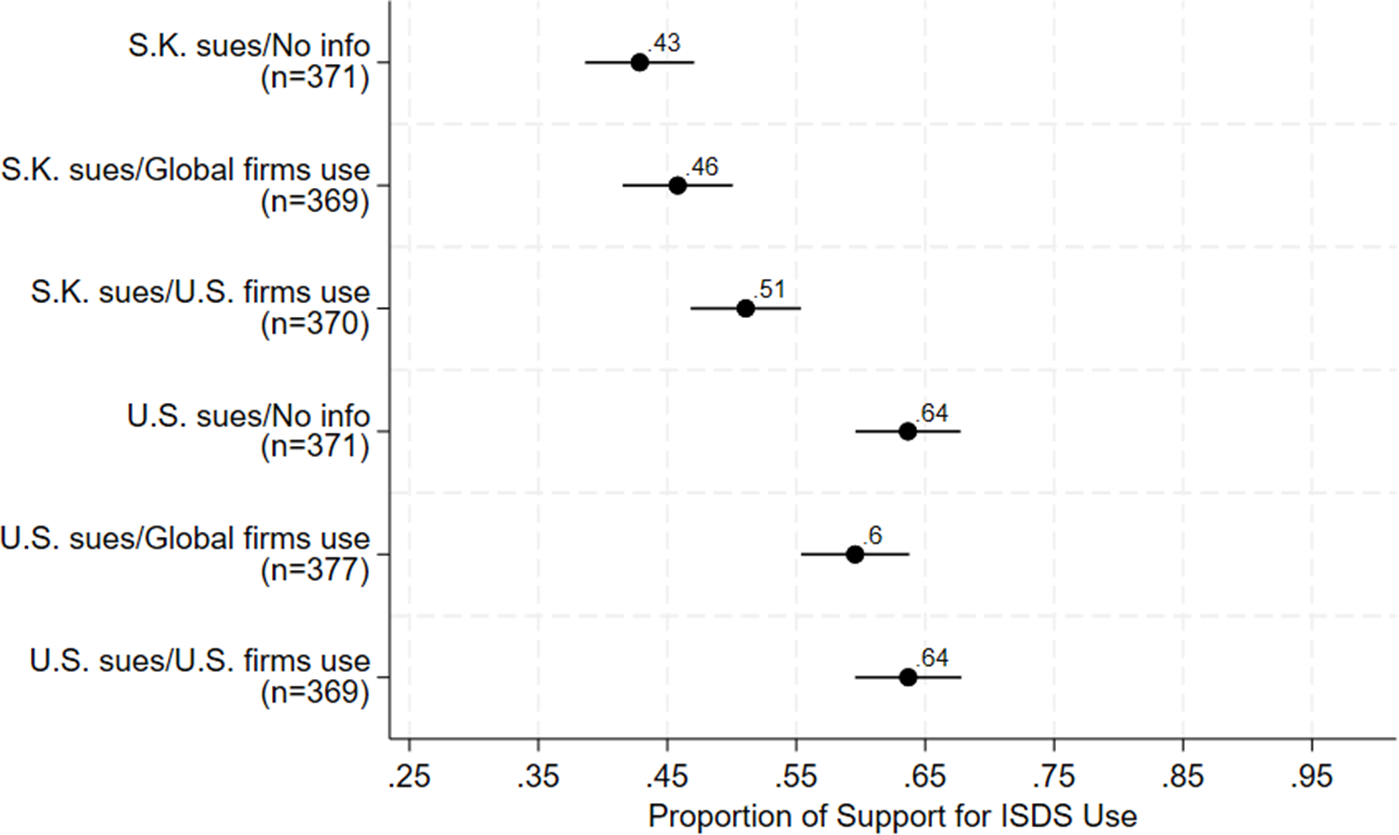
Figure 1 reports the proportion of respondents who support the use of ISDS under each combination of treatment conditions with 90% confidence intervals. In line with our general expectations, individuals in the US clearly appear more supportive of the use of ISDS when they are informed that a US firm is suing the South Korean government, relative to when they are informed that the US government is being sued by a South Korean firm, and regardless of what additional information they receive regarding past usage of ISDS. For our analysis of Hypothesis 1 (H1), we compare the difference in average support between these groups (‘S.K. sues’ vs. ‘U.S. sues’). Average support for ISDS among those in the ‘S.K. sues’ group is 46.6%. By contrast, average support for ISDS among those in the ‘U.S. sues’ group is considerably higher at 62.3%. The difference between these groups is statistically significant under a one-tailed test (p<0.001) providing support for H1.
Public support for ISDS across experimental treatments.

For our analysis of Hypothesis 2 (H2), we compare whether individuals are significantly more supportive of ISDS when they are informed about the use of ISDS globally in comparison to when they receive no additional information about its usage. Support for ISDS among those who received no information about its prior use is 53.3%. Contrary to H2, support among respondents who are informed of the global prevalence of ISDS is nearly the same at 52.7%. In other words, respondents’ views of ISDS are not influenced by information about its use globally. This null is theoretically meaningful as it suggests that abstract or global-level information about the use of international law is potentially insufficient to shift public attitudes.
Turning to Hypothesis 3 (H3), we first assess whether individuals are more supportive of ISDS when they are informed that US firms have used the mechanism in the past, compared to when they are provided with no additional information. Support among respondents in the ‘U.S. firms use’ group is 57.4%. Although support is higher than in the control group (53.3%) and aligns with the theoretical expectation, the difference does not meet conventional thresholds for statistical significance. However, when we compare the ‘US firms use’ group to the average level of support across both the control and ‘Global firms use’ groups, the difference is statistically significant under a one-tailed test (p<.05). Although our intended comparison was to the baseline condition alone, we interpret this broader comparison as suggestive support for H3.
H4 suggests that learning about US firms’ use of ISDS (specific reciprocity) will reduce the negative effect of reading that the US is being sued under ISDS, relative to when respondents lack such information. Before turning to the full identification of the interaction, we first assess whether respondents who received both the ‘S.K. sues’ and ‘U.S. firms use’ treatments are more supportive of ISDS relative to those who received the ‘S.K. sues’ treatment with no additional information. This comparison aligns with the underlying intuition of our theory. Support for ISDS is higher among the former group (51.1%) than the latter (42.9%), shifting overall support from below to above a majority. This difference is statistically significant (p<.01, one-tailed test) and consistent with the rationale behind H4.
4.2 Regression Analysis
To jointly estimate the causal effects of the randomized treatments, we regress support for ISDS on the treatment conditions. Here, we report results from linear probability models on the dichotomized outcome with robust standard errors. Analyses using the original five-point Likert scale and other specifications are discussed in the next section and fully reported in the Appendix.
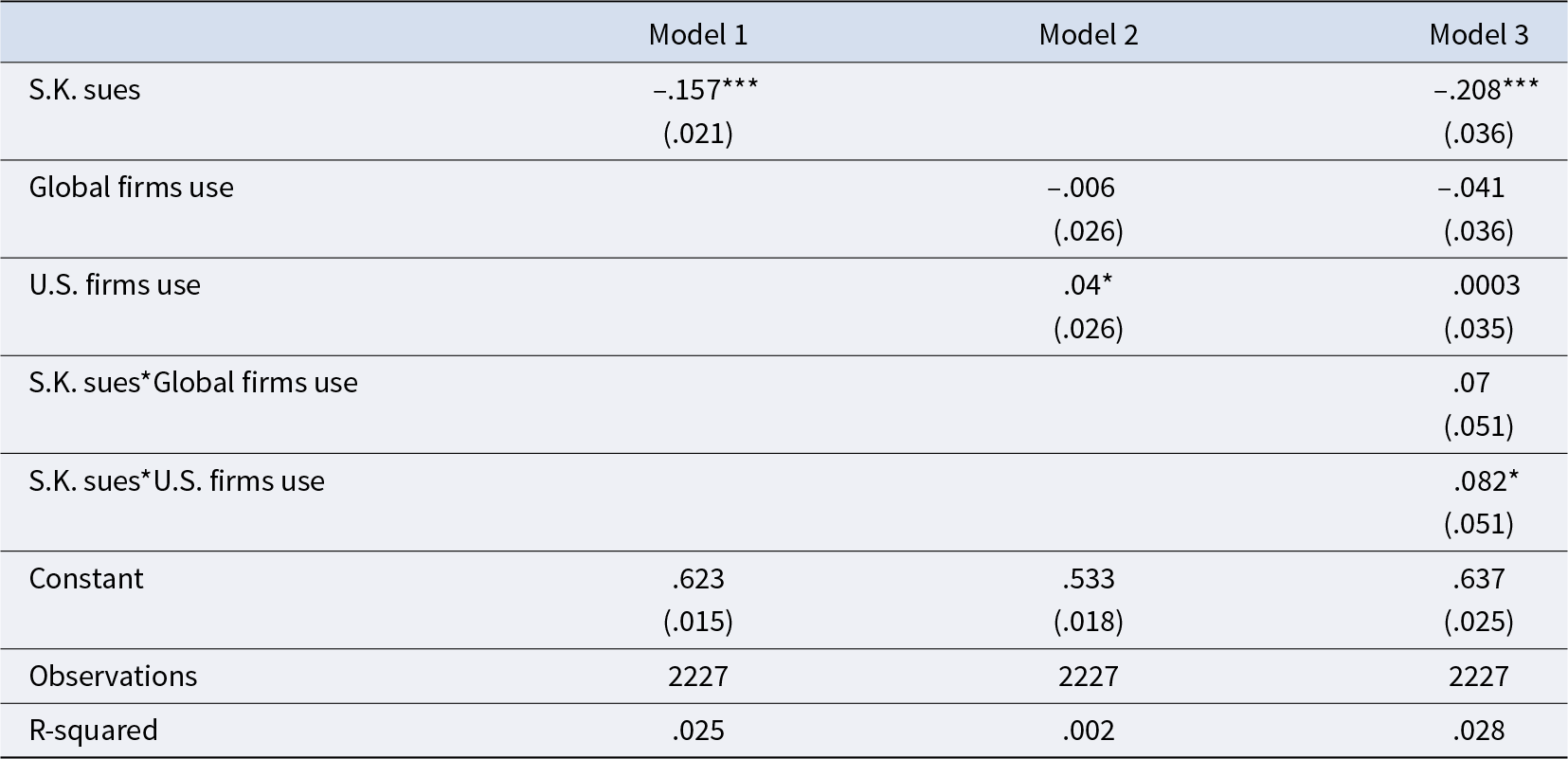
Table 1 displays results from three models corresponding to our four hypotheses, which align closely with the pairwise comparisons. Model 1 estimates the effect of being informed that a South Korean firm is suing the US government. The coefficient for ‘S.K. sues’ is negative and statistically significant under a one-tailed test, providing support for H1. Model 2 incorporates indicators for the treatments providing information about the prior use of ISDS by either US or global firms. Consistent with the pairwise analysis, and contrary to H2, the coefficient for the ‘Global firms use’ treatment is negative and not statistically distinguishable from zero. By contrast, the estimated effect of ‘U.S. firms use’ is positive, as predicted by H3, though it does not reach the p < .05 threshold. To evaluate H4, Model 3 includes interaction terms between the treatments identifying the litigant firm’s host state and each of the treatments providing information about ISDS use by US or global firms. This specification allows us to identify the joint effect of the ‘S.K. sues’ and ‘U.S. firms use’ treatments and thus test whether the negative effect of being sued is moderated by information about US firms’ prior use of ISDS.
Regression Analysis of Treatment Effects on ISDS Support

Table 1 Long description
Three regression models estimate how “S. K. sues,” measures of firm use (global and U. S.), and their interactions relate to ISDS support, using 2,227 observations in each model. “S. K. sues” is negative and statistically significant in Model 1 (minus 0.157) and in Model 3 (minus 0.208). In Model 2, global firms’ use is near zero (minus 0.006) while U. S. firms’ use is small and weakly positive (0.04). In Model 3, the main effects for global firms’ use (minus 0.041) and U. S. firms’ use (about zero) are not statistically significant. The interaction between “S. K. sues” and global firms’ use is positive (0.07) but not statistically significant, while the interaction with U. S. firms’ use is positive (0.082) and weakly supported. Model fit is low across all models, with R-squared values from 0.002 to 0.028, so effects should be interpreted as modest in explanatory power. Constants range from 0.533 to 0.637, indicating baseline predicted support levels when predictors are at their reference values.
Notes: Robust standard errors reported in parentheses. Stars reflect one-tailed p-values for pre-registered hypotheses only. *** p<.01, ** p<.05, * p<.1.
Consistent with H1, Model 3 shows that the main effect of the ‘S.K. sues’ treatment is negative and statistically significant. For H4, we focus on the interaction between the ‘S.K. sues’ and ‘U.S. firms use’ conditions, which indicates whether information about US firms’ use of ISDS moderates the decline in support when the US is being sued. This interaction can be interpreted as a difference-in-differences estimate of the treatment effect. In Model 3, the coefficient for ‘S.K. sues*U.S. firms use’ is positive but only marginally significant (p<0.10, one-tailed). Nonetheless, the direction of the effect remains consistent with the conditional relationship hypothesized in H4.
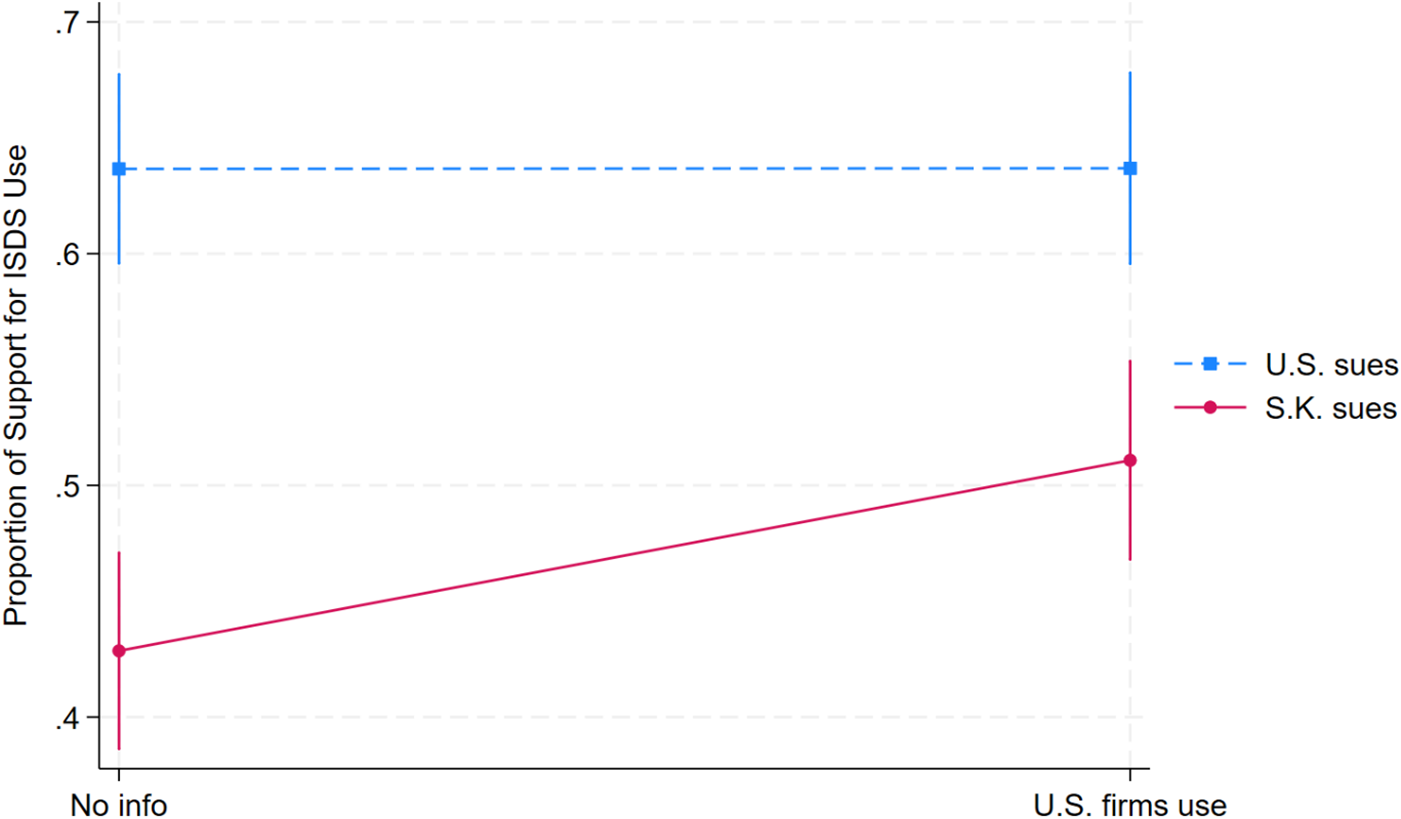
To further examine the extent to which information about US firms’ use of ISDS reduces the negative effect of being informed that the US is being sued, Figure 2 plots the marginal effect for this interaction. The figure more clearly illustrates the dynamic. When individuals read that the US is being sued and also learn that US firms have previously used ISDS, support for ISDS increases by approximately eight percentage points. As before, support under this condition moves to above a majority. Although these respondents remain less supportive than those informed that a US firm is suing South Korea, the difference between these groups narrows considerably as expected: from 20.7 percentage points when no additional information is provided to just 12.6 percentage points when respondents receive information about use by US firms (a 39% decrease). This result is substantively meaningful and consistent with our argument that reciprocity-based framing can reduce public opposition when foreign investors initiate claims against the US.
Effect of US firm info on support for ISDS by who sues.

4.3 Additional Analyses
To check the consistency of our findings, we conducted additional analyses and present these results in the Appendix. We first assess whether the results hold under alternative modeling choices and specifications of the outcome measure. Specifically, we re-estimated the main models using logistic regression with the dichotomized outcome as well as ordered logistic regression with the original five-point Likert scale. These results, shown in Tables A4–A5, are consistent with the main analysis in both the direction and relative size of the treatment effects.
We further estimated models that include pre-treatment respondent covariates to assess whether the results are sensitive to the inclusion of controls and to adjust for any imbalance across treatment groups. As shown in Table A6, the results remain consistent when respondent characteristics are included in the models, with the interaction ‘S.K. sues*U.S. firms use’ reaching statistical significance at p<.05 (one-tailed) in this specification. We highlight the results for several of these covariates in the discussion below.
Because detecting interaction effects generally requires larger sample sizes and our study is limited in power for detecting the full interaction consistent with H4, we re-estimate Model 3 using the specification recommended by Lin (2013).Footnote 19 This approach incorporates covariates and their interactions with the treatments, which can improve efficiency and yield more precise estimates of the treatment effects when covariates meaningfully account for variation in the outcome. Table A7 reports these results, and Figure A1 displays the marginal effects for the main interaction. The results from this adjustment remain consistent with H4. As in the main analysis, the interaction term is positive and marginally significant (p < .10, one-tailed), and the marginal effects continue to indicate a substantively meaningful conditional relationship.
Even though we do not preregister hypotheses related to respondent characteristics, their inclusion in the models yields several interesting results. We note at the outset that theoretical expectations regarding partisanship are indeterminate: ISDS has been politicized by the right and left in the US and elsewhere, yielding no clear directional prediction. With that caveat in mind, we find that right-leaning individuals are less supportive of ISDS than other respondents. This suggests that right-leaning respondents’ concerns over sovereignty may outweigh their traditionally pro-business inclinations, and potentially overpower left-leaning respondents’ concerns over corporate influence. In contrast, support for ISDS is higher among respondents who believe the US is the greatest country and among those who think the US can trust other countries. Support is also greater among younger, male, and college-educated individuals. We leave a fuller interpretation of these patterns to future research, as they raise important questions about how individual characteristics influence views on international law broadly and on ISDS more specifically.
Finally, we also analyze respondents’ answers to a second post-treatment question about ISDS from our survey. This question asked respondents ‘To what extent do you agree that the US government should include investor state dispute settlement provisions in future international economic agreements with other countries?’.Footnote 20 The results lend further support to the first hypothesis: respondents are significantly more supportive of the inclusion of ISDS in future agreements when informed that firms in the US are suing another state than when the US is being sued. By contrast, additional information about the use of ISDS by US or global firms did not have an effect on responses to this question.
5. Discussion
Overall, our results lend support to several of our core theoretical conjectures. First, they align with recent research indicating that the public views international law through a country-centric lens: when it seems that their country is adversely affected, opinions are negative; however, when national actors appear to benefit, support emerges. Importantly, this finding replicates a key characteristic of Brutger and Strezhnev (Reference Brutger and Strezhnev2022) using different treatment combinations and a different setting. Taken together, this suggests that citizens consider how international law (and international institutions more broadly) impacts their country, especially in the short term. When given information about a clear cost – such as their country being sued – individuals respond negatively (see Chapman and Chaudoin, Reference Chapman and Chaudoin2020). In contrast, people show considerable support for international law when US firms are utilizing it, suggesting that the public is not inherently antagonistic toward the concept of law but is sensitive to distributional considerations.
Beyond this, the results also show that information about the reciprocal use of international law affects public support, even in this hard case. In our view, this suggests that experimental designs that incorporate information about how international law functions in principle – e.g., that it can be used reciprocally by the parties – can help offset concerns with costs. Individuals, beyond simply caring about whether or not their country is winning or losing, also consider whether international law can be reciprocally accessed, at least when provided with appropriate cues. When their country is clearly benefitting, reciprocity seems to make little difference. But when their country bears a clear cost, cues about US firms regularly utilizing the same legal system can alleviate such concerns. This asymmetry suggests that information about the benefits of international law are not uniformly persuasive, and that targeted information that links benefits directly to the home country can meaningfully shape attitudes. In fact, our point estimates suggest that a majority of US respondents, approximately 51% in this study, are supportive of ISDS when the US is being sued, but only if they are told that US investors are active users of the regime.
This study is not without limitations. For one, ISDS is a specific area of international law with its own idiosyncrasies. For example, one potential reason why Hypotheses 2 and 3 lacked support is that the treatment may have required that individuals equate the well-being of investors with that of their country, or consider how a legalized investment regime might generate broader benefits such as cross-national investment or economic growth. Our experimental design did not include this information, which we believe made our study conservative. Moreover, countries such as the US have historically been considered as beneficiaries of the regime, as ISDS is frequently included in north–south agreements where the majority of covered FDI flows from one country, exposing some global south countries to arbitration asymmetrically (Moehlecke and Wellhausen, Reference Moehlecke and Wellhausen2022). Thus, even though the regime has been politicized in the US, ISDS itself has plausibly provided asymmetric benefits. Including information about this asymmetry would provide a test of whether awareness of historic US benefits also conditions support for the regime. Future studies could also employ a similar design in a setting where both actors are countries, such as in the trade regime, which may lead respondents to view the outcome as generating a more tangible public benefit. Moreover, although we view the choice of South Korea as enabling us to isolate key mechanisms of our theory, results might differ in other contexts.Footnote 21
Additionally, other studies suggest that informational treatments are most efficacious among respondents without strong prior beliefs (Chaudoin, Reference Chaudoin2014b). This may explain the null finding for the reciprocity treatments when US investors sue: information about an additional benefit is unlikely to further increase support among those already inclined to favor ISDS. By contrast, our finding that a message about specific reciprocity increases support, when the US is being sued, is consistent with the idea that skeptical respondents are more persuadable (Cheruvu and Krehbiel, Reference Cheruvu and Krehbiel2024). Finally, although our survey design aims to capture the iterated nature of international interactions, it does not directly incorporate this dynamism into the experimental design. Future studies could employ panel or multi-wave designs to more directly model how respondents update in response to new information over time.
6. Conclusion
In this paper, we add to the emerging literature on public opinion toward international law by using a survey design that considers how respondents weigh the benefits and costs of international law. We make two core claims. Our first claim is that the public cares about ‘who’ the target is of international law’s application; when they perceive their country is the target, and consequently faces potential or actual costs, they will be more negative. In these cases, people react to the most readily available heuristic, which is whether their country stands to benefit (or not). In line with recent studies, we find strong support for this first claim (Chapman and Chaudoin, Reference Chapman and Chaudoin2020; Brutger and Strezhnev, Reference Brutger and Strezhnev2022). We also make a second claim, which is that the publics’ views should also be affected by receiving information about a core feature of international law – its reciprocal application over time. This serves as an important empirical test of theoretical propositions about how international institutions and law create benefits for countries (Axelrod, Reference Axelrod1984; Carrubba, Reference Carrubba2009). More specifically, we theorize that the public will be responsive to messages which emphasize either the use of international law by other actors globally, which we term ‘diffuse reciprocity’, or when international law is used by national actors, which we term ‘specific reciprocity’. Our empirical analysis yields interesting results. The results show that respondents consider cues evoking specific reciprocity, but do so only when their country is the target of arbitration. This suggests that concerns about the costs of international law can potentially be offset when people know more about its reciprocal use. Yet, at the same time, the findings make clear that such effects are conditional rather than general. Information about reciprocity does not work uniformly; rather, it is effective when it highlights nationally specific benefits in instances where individuals would otherwise perceive costs.
Our findings have important implications. First, they suggest that individuals’ views on international law are malleable, rather than inherently positive or negative. The public cares about ‘who’ is benefitting (or losing). We think that this maps onto theoretical approaches that emphasize the distributional implications of international cooperation, as well as theoretical discussions suggesting that public opinion is important for the development and functioning of international law (Carrubba, Reference Carrubba2009). These considerations are important not just for policymakers but also for public debate. This sheds light on why critics can find traction when they politicize international cooperation by claiming that others countries ‘won’. This is particularly notable in the investment regime. As has been widely documented, the US has historically been seen as a net beneficiary, as the regime has disproportionally exposed global south countries to arbitration (Moehlecke and Wellhausen, Reference Moehlecke and Wellhausen2022) and the rules were often written by global north countries (Alschner and Skougarevskiy, Reference Alschner and Skougarevskiy2016). The fact that public skepticism towards ISDS is widespread in the developed world is therefore somewhat puzzling, suggesting that the connection between objective and perceived benefits is not automatic. Our results speak to this: support is conditional both on what side of a dispute you are on, but also on receiving concrete information about the potential benefits of the regime, rather than more abstract or diffuse appeals. Future studies could unpack this further by isolating whether citizens are responding to perceptions of material gains or losses, blows to status or reputation, or concerns over sovereignty, as well as incorporating additional contextual factors about the regime or specific cases.
Second, our findings show that information about reciprocity can potentially allay public concerns about the costs of international law. This suggests that proponents can do more to explain how international law works, including by emphasizing reciprocity. This adds to studies showing that IOs themselves can help self-legitimize through public information campaigns (Dingwerth et al., Reference Dingwerth, Schmidtke and Weise2020; Schmidtke and Lenz, Reference Schmidtke and Lenz2024; Lenz and Söderbaum, Reference Lenz and Söderbaum2023). Research shows that liberals and individuals who are supportive of internationalism are especially receptive to this type of messaging, but it may be more difficult to move attitudes on the right, which tend to be more responsive to messages from domestic sources (Chapman and Li, Reference Chapman and Li2023). Moreover, this does not necessarily address the fact that media bias likely amplifies stories about the costs of international law (Brutger and Strezhnev, Reference Brutger and Clark2023) or that political entrepreneurs may have incentives to politicize it (De Vries et al., Reference De Vries, Hobolt and Walter2021).
Third, our theory and results suggest that it is fruitful to think further about how to experimentally address core characteristics of international institutions and law. There is considerable debate among experimentalists over the degree to which abstraction is desirable relative to detail and how this affects our ability to generalize (see Brutger et al., Reference Brutger, Kertzer, Renshon, Tingley and Weiss2023). We agree that this is of key importance. Here we have sought to join recent efforts that investigate how fundamental characteristics of international law affect public support, including recent work that looks at subsidiarity and domestic implementation (Madsen et al., Reference Madsen, Mayoral, Strezhnev and Voeten2022; Cheruvu and Krehbiel, Reference Cheruvu and Krehbiel2024). In our case, we show that respondents consider cues about reciprocity, which is one of the core mechanisms through which international law is thought to create benefits for countries and their citizens.
We hope that future work will examine further how reciprocity affects public opinion in this and other domains of international law. Crucially, our experimental results demonstrate that individuals respond to some but not all types of reciprocity cues. That we find any positive effect is itself noteworthy given both the controversy surrounding ISDS and the indirect nature of the reciprocal benefits, suggesting that reciprocity might be more efficacious in other contexts.Footnote 22 Beyond applying reciprocity more broadly, we also think it would be useful to better understand why reciprocity activates support. One possibility is that it is purely instrumental: by extending the shadow of the future, information about reciprocity helps individuals understand how international law generates material benefits. At the same time, this result could also be driven by disposition, with specific reciprocity activating in-group favoritism. We hope that future research can help adjudicate between these different possibilities.
Supplementary material
The supplementary material for this article can be found at https://doi.org/10.1017/S1474745626101566
Data availability statement
The data that support the findings of this study are available at the WTR Data verse.
Lugg, Andrew; Jared Oestman, Reference Lugg and Oestman2026, ‘Replication Data for: ‘Reciprocity in international law: Evidence from investor–state dispute settlement’, https://doi.org/10.7910/DVN/7WGXMN, Harvard Dataverse.
Acknowledgements
We thank the editors and reviewers at World Trade Review for their constructive feedback, and Terrence Chapman, Stephen Chaudoin, Sarah Croco Manfred Elsig, Kirthana Ganeson, Seungjun Kim, Jared McDonald, Rodrigo Polanco, Marine Roux, and Jack Zhang for helpful comments. We also thank participants at APSA in 2024 and the World Trade Institute Brown Bag in 2024.


 Open access

