Introduction
Around 60% of residents in nursing homes have dementia (Seitz et al., Reference Seitz, Purandare and Conn2010). Despite variations across settings, nursing homes are generally lacking in activities, especially for residents with dementia. Although participation may be inhibited by apathy, residents with dementia can be encouraged to participate in various activities and they do experience positive affect from participation (Chung, Reference Chung2004; Schreiner et al., Reference Schreiner, Yamamoto and Shiotani2005). Epidemiological studies in healthy adults have consistently found the beneficial effects of leisure activities (in particular physical and intellectual activities) in terms of lowering the risk of dementia over time (Fratiglioni and Wang, Reference Fratiglioni and Wang2007). However, whether leisure activities can slow down the rate of dementia progression remains unknown. The nursing home, with its preponderance of older adults with dementia and lack of activity, is a suitable setting for investigating such a research question.
We conducted a cluster-randomized open-label controlled trial on the effects of mahjong (a.k.a. mah-jongg, a mental activity) and Tai Chi (physical activity) in nursing home residents in Hong Kong. These activities were chosen because of their popularity and appeal in Chinese societies, thus enhancing compliance and participation, and because of their demanding and “complex” nature (Hertzog et al., Reference Hertzog, Kramer, Wilson and Lindenberger2008; Klusmann et al., Reference Klusmann2010), thus enriching the environment with potential benefits on neuroplasticity for the residents in the nursing homes (Volkers and Scherder, Reference Volkers and Scherder2011). In this connection, it may be useful to distinguish between leisure activities and training activities, which often involve unfamiliar tasks that may be difficult for those low in cognitive resources and may appear to be uninteresting to the participants (Cheng et al., Reference Cheng2014). We hypothesized that mahjong and Tai Chi would lead to slower rates of increase in dementia severity as indicated by Clinical Dementia Rating (CDR) over time, relative to simple handicraft as control.
Methods
Study design and participants
To avoid treatment contamination within nursing homes, residents in nine nursing homes were randomized by home by the principal investigator into one of three experimental conditions, namely mahjong (n = 36), seated Tai Chi (n = 39), and simple handicrafts (control; n = 35), with a restriction of an equal number of homes in each condition. Participants were enrolled by nursing home staff prior to randomization. With four repeated measurements (see below), time-level intraclass correlation = 0.05, ratio of Level 2 random slope residual variance to the sum of Level 1 residual variance and Levels 2 and 3 random intercept residual variance = 0.20, three clusters per treatment condition and n = 11 per cluster were sufficient to detect a small treatment by time interaction effect (Cohen's d = 0.30) at α = 0.05 and power = 0.80 (Murray et al., Reference Murray, Blitstein, Hannan, Baker and Lytle2007; Heo and Leon, Reference Heo and Leon2009).
Inclusion criteria were Mini-Mental State Examination (MMSE; Folstein et al., Reference Folstein, Folstein and McHugh1975) = 10–24 and CDR ≥ 0.5 (Morris, Reference Morris1993). Exclusion criteria were contraindication for exercise/group activities (e.g. audio/visual impairment, being bedbound, moderate-to-severe parkinsonism) or regular participation in any of the three activities in the past 3 months. Informed consent was obtained from family members, with assent from the participants. Ethics approval was obtained from the Ethics Subcommittee of the Research Committee, City University of Hong Kong, and the Central Research Committee, Hong Kong Institute of Education.
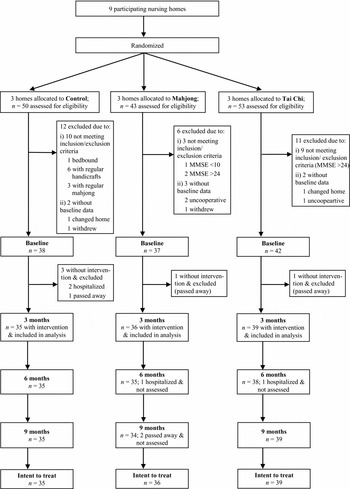
An open-label trial was necessitated because it was not possible to mask activities. Tai Chi was practiced in a sitting position due to the frailty of the participants. For the handicraft group, participants connected beads to create shapes, which was less mentally and physically demanding than mahjong and Tai Chi but provides control for the effect of activity initiation as well as attention and social activity. All activities were conducted in small groups (mahjong was played among three to four persons) for one hour three times a week for 12 weeks, and were led by research staff for the purpose of standardization across homes. The trial was registered with the Chinese Clinical Trial Registry (ChiCTR-TRC-09000374). The trial protocol may be found elsewhere (Cheng et al., Reference Cheng2014) or obtained from the first author. Figure 1 shows the study flow chart.
Flow diagram of the study.

Measures
Following recent recommendations to use the CDR sum-of-box (CDR-SB) score (Berg et al., Reference Berg1988) as the primary endpoint for clinical trials (Coley et al., Reference Coley, Andrieu, Jaros, Weiner, Cedarbaum and Vellas2011; Cedarbaum et al., Reference Cedarbaum2013), we re-analyzed data from a trial that collected the CDR at 0 (baseline), 3 (post-intervention), 6, 9, 12, and 15 months. However, because of flu epidemics affecting the homes between 9 and 15 months, leading to significant difficulties in data collection and interpretation, we report data up to 9 months only (Cheng et al., Reference Cheng2014). Data collection up to 9 months took place between February, 2008 and May, 2009.
The CDR assesses the extent to which cognitive impairment affects six performance domains, namely memory, orientation, judgment and problem-solving, community affairs, home and hobbies, and personal care. Each of the six domains was rated on a scale of 0–3, and their summation becomes the CDR-SB. Although the global CDR is a widely used measure of dementia severity, more recent research suggests that the CDR-SB is an equally valid measure of severity for dementias in general, with 0 = no dementia, 0.5–4.0 = questionable cognitive impairment, 4.5–9.0 = mild dementia, 9.5–15.5 = moderate dementia, and ≥16.0 = severe (O'Bryant et al., Reference O'Bryant2010).
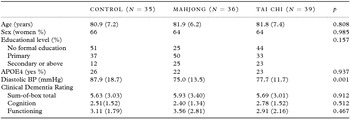
All CDRs were performed by an experienced CDR rater to ensure standardization across participants and across time. Besides, apolipoprotein E genotype based on the restriction fragment length polymorphism approach and demographic data were collected at baseline. Lipids, blood pressure, glucose, peak expiratory flow, neuropsychiatric symptoms (Cummings, Reference Cummings1997), and medical history were obtained at all time points. All assessments, other than demographic data, medical history, CDR, and neuropsychiatric symptoms, were conducted by a registered nurse during early morning after the participants had had 12-hour fasting. None of the measures, except diastolic blood pressure, were significantly different across groups at baseline. Table 1 shows selected sample characteristics at baseline that were the focus of this study whereas more sample characteristics can be found in Cheng et al. (Reference Cheng2014).
Selected baseline sample characteristics

Note: Other than sex (df = 2) and education (df = 4) for which χ 2 tests were used, all p values were based on analysis of variance with 2 and 107 degrees of freedom.
Statistical analysis
Because of the multilevel data structure (i.e. repeated measurements at Level 1 nested within individuals at Level 2, who were in turn nested within homes at Level 3), we performed intent-to-treat analysis using mixed-effects regression in Stata version 11.1 (StataCorp, College Station, TX). The full information maximum likelihood method was used for model estimation, in which the conditional distribution of missing data given the data observed were incorporated to yield unbiased estimates of the parameters. Following existing recommendations for analyzing longitudinal data in clinical trials (Fitzmaurice et al., Reference Fitzmaurice, Laird and Ware2011), we modeled the effect of time at Level 1 and within-person covariance over time using an unstructured model. The intercepts and time's effect were specified to vary randomly at home and participant levels, whereas treatments were specified as fixed effects. Time was centered and treatment x time interactions were tested to see whether the upward trend of CDR-SB differed by treatment. As there were three treatment groups, two dummy variables for mahjong and Tai Chi were created with control as the reference group. Finally, we selected covariates by examining correlations between the outcome variables and age, sex, education, apolipoprotein E ε4 allele (APOE4; 0 = absent, 1 = present), chronic illnesses, blood pressure, lipids, glucose, peak expiratory flow, neuropsychiatric symptoms, cholinesterase inhibitors (0 = no, 1 = yes), falls (0 = no, 1 = yes), and dementia diagnosis (0 = vascular, 1 = others). (Stroke was not analyzed as there was no stroke incident among the participants during the study period.) As a result, educational attainment and APOE4 were included as covariates (fixed effects) as they were the only measures significantly correlated with any outcome variable. Diastolic blood pressure (time-varying) was included also due to preexisting group difference. Following Cedarbaum and colleagues (Reference Cedarbaum2013), we analyzed the cognitive (memory, orientation, and judgment and problem-solving) and functional (community affairs, home and hobbies, and personal care) component scores of the CDR-SB in a supplementary analysis so as to ascertain whether any overall treatment effect was due to effect on one or the other components, or both.
Results
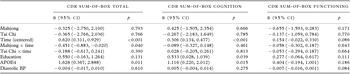
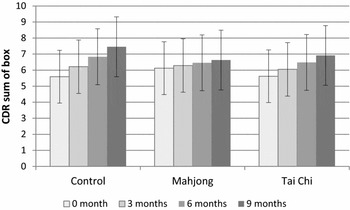
At baseline, all groups had, on average, CDR-SB scores at the lower spectrum of the mild dementia range (Table 1). No significant difference in baseline CDR-SB scores was found, F(2, 107) = 0.09, p = 0.912. Among control participants, CDR-SB increased by 1.86 (95% CI = 0.93, 2.79) points over 9 months. Regression results showed that there was no significant effect whatsoever by Tai Chi, but mahjong had a significant interaction with time on CDR-SB (Table 2). This interaction term was negative, meaning that the mahjong participants tended to have lower CDR-SB over time than control participants, despite the general trend of increasing CDR-SB scores over time (i.e. the positive main effect of time). The mean CDR-SB scores over time, adjusted for education, APOE4, and diastolic blood pressure, are presented in Figure 2. By 9 months, mahjong differed from control by –0.83 points (95% CI = −3.47, 1.82; d = −0.10; Z = −0.61, p = 0.541) on the CDR-SB measure. Thus, despite the overall interaction with time, at no time point was the difference between mahjong and control statistically significant. Supplementary analysis did not reveal any significant effect of mahjong on either of the CDR-SB components.
Multilevel regression models

Note: Diastolic BP was a time-varying covariate; BP = blood pressure.
CDR sum-of-box (total) means adjusted for education, APOE4, and diastolic blood pressure; error bars denote 95% CI.

Discussion
A limitation of the study was the relatively short follow-up period. Within this period, the CDR-SB scores increased in control participants were similar to the range reported in large-scale surveys of people with dementia over similar intervals (Rossetti et al., Reference Rossetti, Cullum, Hynan and Lacritz2010), suggesting that the control group connecting beads provided a good reference to assess the effects of the intervention groups. Compared with control, mahjong, but not Tai Chi, led to a slower increase in CDR-SB, and hence less dementia progression over time. This effect could not be attributed to mahjong having differential effects on the cognitive and the functional components of the CDR-SB. Besides being a cognitive activity, mahjong has a social component that might contribute toward a more generalized effect. However, the effect of mahjong on CDR-SB was small. Taken together, the results are best interpreted to suggest that mahjong (and perhaps other complex mental activity as well) can lead to a slightly slower rate of progression of impairments in residents with dementia; the effect was generalized and was not specific to cognition or daily functioning. However, although the control group had worsened over this 9-month interval, the CDR-SB scores remained nonetheless within the mild dementia range. With a longer time frame, we might see control participants progressing to moderate dementia while mahjong participants remained as mild. A longer-term trial is therefore needed.
The negative finding concerning Tai Chi diverged from a recent study in which community-dwelling older adults with amnestic mild cognitive impairment or CDR = 0.5 demonstrated lower CDR-SB or lower likelihood of conversion to CDR ≥ 1 (i.e. mild dementia or worse) after practicing Tai Chi versus a toning and stretching exercise (Lam et al., Reference Lam2011; Lam et al., Reference Lam2012). However, one should take caution in making direct comparisons between the two studies as the conditions of the participants, the form of Tai Chi practiced, the setting, and the outcome measure were different. Perhaps the seated Tai Chi would not yield effects similar to those of the traditional standing form with more challenging movements (a question yet to be tested in research), but it is a limitation at the heart of any activity intervention – the activity has to be appropriate to the participants concerned. In principle, it should not be over- or under-challenging in order to enhance engagement, which will be key to bringing out the therapeutic effects of the activity, if any. However, it is also possible that Tai Chi may not be as cognitively stimulating as mahjong; in mahjong, every game and move are, at least in principle, novel, whereas Tai Chi is characterized by acquisition and practicing the same set of movements again and again.
Moreover, a recent review of randomized controlled trials suggests that physical exercise can slow the rate of cognitive decline in those with Alzheimer's disease (Farina et al., Reference Farina, Rusted and Tabet2014). Like Cheng and colleagues (Reference Cheng2014), these studies examined global cognition (such as MMSE and Alzheimer's Disease Assessment Scale-Cognitive Subscale) or measures of specific cognitive abilities. The results are difficult to compare due to the specific rating method of the CDR. Because of the rating method, the CDR-SB may not be as sensitive to changes as these measures and more studies on using CDR as the outcome measure are needed.
As expected, APOE4 was associated with cognitive decline but education was associated with more severe ratings on the CDR-SB (cognitive and total) over time. The effect of education appeared to be consistent with the observation that those with better cognitive reserve have a compressed pathology and tend to show more rapid decline after the emergence of symptoms (Andel et al., Reference Andel, Vigen, Mack, Clark and Gatz2006; Bruandet et al., Reference Bruandet2008). On the whole, this study showed how different risk factors predicted short-term decline in nursing home residents with dementia and how providing opportunities for engagement in cognitive activities in the homes modulate this decline.
Notwithstanding the limitation of an open label trial (i.e. the rater not being blind to the assignment status), the results suggest that complex cognitive activities that require active processing of novel information and that are also pleasant and rewarding, as exemplified by mahjong in this study, may lead to small but significant improvements in everyday functioning, especially from the point of view of residents and family members. Importantly, such activities may be readily incorporated into the daily routines of institutions for the benefit of the residents. As Kurz et al. (Reference Kurz, Clare and Lautenschlager2013) put it, these interventions may be “(adding) life to years,” despite how small the effects are. Policies and practices that support the administration of cognitive activities of sufficient intensity are needed in long-term-care settings.
Conflict of interest
None.
Description of authors’ roles
STC is the principal investigator and led study design, data analysis, and writing the paper. PKC and STC designed the study protocol and managed the project together. YQS performed APOE genotyping. JHML assisted STC in data analysis. ECSY assisted in the recruitment of study settings and in training the CDR rater.
Acknowledgments
We are indebted to William Tsang for making the sitting Yang-style Tai Chi available for the study to the nursing homes and Isabella Chan for assistance in data collection. This study was supported by Competitive Earmarked Research Grant No. HKIEd141307 of the Research Grants Council of Hong Kong to Sheung-Tak Cheng. The funding source had no involvement in any part of the project.