Introduction
…that's the hardest thing I've ever had to do, to look at a man and, you know, know that I'm saying, you know, I don't think you should live. (Former Texas capital juror)
The theory is simple. When a juror empathizes with a capital defendant, she is less likely to condemn him to death and more likely to sentence him to life imprisonment. But the capital sentencing process systematically distances jurors from defendants, making empathy difficult, if not impossible… That's the theory. It's also the prevailing wisdom, at least in academic circles. (Garvey Reference Garvey2000:26)
I begin with this admission from a former death penalty juror, that the conjunctive acts of literally facing a man and sending him to death were the most difficult of his life. This article probes the meaning of his quandary, asking how it is possible that one human being can sentence another to die. Prevailing legal theory claims that death sentences are facilitated in part by distance forged between jurors and defendants (Garvey Reference Garvey2000; Bandes Reference Bandes2009). This article analyzes jury decision-making in Texas death penalty trials in order to explore this claim,Footnote 1 arguing that language provides tools for this distancing process.
The analyses below reveals three communicative phenomena that contribute to this distancing: (i) the positioning of bodies in court, (ii) demonstrative reference, and (iii) constructions of grammatical agency. Through these tactics, jurors develop degrees of moral and cultural distance (cf. Haney Reference Haney1997), which arguably allow jurors to justify their sentencing decisions (Garvey Reference Garvey2000). These distancing tactics, furthermore, are facilitated by democratic legal ideologies of rational, dispassionate decision-making (Krause Reference Krause2011), which are conveyed to jurors during trial in the form of authoritative legal pronouncements (Garvey Reference Garvey2000:32). Jurors' embodied, emotional, and empathic interactions with defendants, however, often harshly conflict with such legal ideologies. My analysis probes jurors' navigations of these tumultuous waters, in which powerful legal and moral ideologies rise up against emotionally affecting interactional moments.
The death penalty in Texas
Collection of data for this project involved fifteen months of ethnographic fieldwork in several diverse counties across Texas.Footnote 2 This included, first, participant observation in four capital trials,Footnote 3 in which I was engaged from the start of jury selection to the reading of the sentencing verdicts. I received permission to audio record one of these trials and obtained court transcripts of the other three. Second, I audio recorded postverdict interviews with jurors who served on the four cases in which I participated, as well as jurors from additional cases. In total, I interviewed twenty-one jurors from nine death penalty cases. These interviews often occurred only days or weeks after the trials had concluded. Working from these data sources, I compared courtroom interactions with jurors' interviews using qualitative linguistic and linguistic anthropological methods (see Duranti Reference Duranti1997; Bernard Reference Bernard2006; Sidnell Reference Sidnell, Hornberger and McKay2010). Given the impossibility of access to actual capital jury deliberations,Footnote 4 this comparative approach provides the clearest available window into jurors' decision-making.
The jury decision-making structure in Texas death penalty trials is as follows. In 1972, the Supreme Court ruled in Furman v. Georgia (408 US 238) that the implementation of the death penalty in the US was arbitrary to the extent of violating the 8th Amendment prohibition against cruel and unusual punishment and was thus in need of revision. The death penalty was suspended country-wide for four years until, in Gregg v. Georgia (428 US 153 (1976)), constitutionally acceptable sentencing guidelines were established. In response, states implemented bifurcated trials, which include separate guilt/innocence and sentencing phases. During the guilt/innocence phase of a trial, the facts of the crime are presented. Jurors then deliberate on whether to convict the defendant of capital murder or some lesser charge or to acquit. If the defendant is convicted of capital murder, an entirely new presentation of evidence begins (often lasting longer than the first stage). The same jurors hear this next trial stage and then must decide the punishment. Their only two sentencing options at this point are life without the possibility of parole (LWOP)Footnote 5 or death by lethal injection.
In Texas sentencing deliberations, jurors are not asked directly whether they sentence the defendant to death or to LWOP. Instead, they are instructed to answer two “special issue” questions,Footnote 6 which lead jurors to one of the two sentencing options. The first of these is commonly referred to as the “future danger” question:
Do you find from the evidence beyond a reasonable doubt that there is a probability that the defendant would commit criminal acts of violence that would constitute a continuing threat to society?
The second or “mitigation” question reads as follows:
Do you find from the evidence, taking into consideration all of the evidence, including the circumstances of the offense, the defendant's character and background, and the personal moral culpability of the defendant, that there is a sufficient mitigating circumstance or circumstances to warrant that a sentence of life imprisonment rather than a death sentence be imposed?
If the jurors unanimously answer “yes” to question one and “no” to question two,Footnote 7 the defendant receives a death sentence. Texas jurors are thus never explicitly asked whether they will put the defendant to death; the death sentence is mediated by these special issue questions.
As a result of this trial structure, especially given the scope of the special issue questions and their aim to encourage jurors to consider the individual lives of defendants, jurors are faced with a barrage of information about defendants, in addition to sharing the courtroom with themFootnote 8 for, in many cases, weeks or months. Furthermore, because of the finality of the death penalty, the evidence presented during the sentencing phase of trials is of a qualitatively different character than that in the guilt/innocence portion. In the guilt phase of capital trials, jurors are fact-finders; they decide whether or not the facts of the defendant's case satisfy all of the requirements of a legal category of crime. In the punishment phase, however, jurors' decisions do not address whether a particular act fits a determined set of legal rules. Jurors must decide, rather, on the “moral condition” of the defendant and whether this renders him deserving of the death penalty (Weisberg Reference Weisberg1983:303).
This opens the sentencing phase to diverse forms of evidence, such as victim impact testimony and mitigation evidence about the defendant's childhood, potential mental illnesses, drug abuse, physical abuse, or any other detail of his life that might keep a juror from imposing a death sentence (Cheng Reference Cheng2010). Thus not merely the act, but also the person himself is on trial, making this decision an “intensely moral, subjective matter that seems to defy the designers of general formulas for legal decision” (Weisberg Reference Weisberg1983:308). As my data reveal, jurors indeed rely on a vast array of information when making these subjective decisions. As previous studies of jury decision-making have found, jurors' verdicts in any case are based on much more than “facts” and applicable legal rules (Manzo Reference Manzo1993, Reference Manzo1996; Maynard & Manzo Reference Maynard and Manzo1993; Conley & Conley Reference Conley and Conley2009); jurors are also intensely attuned to embodied, interactional details within trials and use such details when determining whether a defendant should live or die.
Embodiment, language, and rationality in legal decision-making
Scholars of law have argued that legal categories and the nature of legal decision-making erase the involvement of actual persons in the practices of law. Many have argued, for instance, that post-Enlightenment models of justice are “depersonalized” (Laster & O'Malley Reference Laster and O'Malley1996), and, as a result, deny persons—and their human experiences, affect, and bodies—recognition and legitimacy (Noonan Reference Noonan1976; Henderson Reference Henderson1987:1575–76). Consideration of the actual practices that make up legal trials reveals that despite this depersonalized model of justice (and often in conversation with it), persons, including their embodied experiences such as empathy and emotion, are central to legal reasoning (Henderson Reference Henderson1988; Marcus Reference Marcus2002; Feigenson & Park Reference Feigenson and Park2006; Bandes Reference Bandes2009).
By focusing on the linguistic and paralinguistic components of jurors' capital verdicts, this research breaks new ground in jury decision-making, studies of language and law, and the death penalty. In addition to the few extant linguistic studies of actual jury deliberations (Manzo Reference Manzo1993, Reference Manzo1996; Maynard & Manzo Reference Maynard and Manzo1993; Conley & Conley Reference Conley and Conley2009), my analysis helps to close a major lacuna in jury research, namely, the impact on jurors' decision-making of communicative (especially embodied) practices during trials (cf. Goodwin Reference Goodwin1994; Matoesian Reference Matoesian2000). As Manzo (Reference Manzo1996) has demonstrated, embodied actions such as eye gaze and emotional reactions to others present in trials are crucial to how jurors interpret defendants' moral and legal accountability. These practices, however, are not easily fit into the textual schema by which legal professionals define evidence. This requires that we view trials as more than a collection of transcripts and be more attentive to the extra-verbal and interpersonal actions that are also critical parts of legal practices. Examining legal decision-making in this way challenges the archetypical agent of democracy (Rawls Reference Rawls1997; Marcus Reference Marcus2002), often represented as the ideal juror—the “individual rational man” (Laster & O'Malley Reference Laster and O'Malley1996:33; Toulmin Reference Toulmin2003)—for whom rationality is considered distinct from embodied experiences such as emotion. The legal subject in practice, however, whether a defendant or juror, is intersubjectively and bodily entwined with others throughout the course of a trial. These facts of legal decision-making fly in the face of well-established legal ideologies (which jurors often cited) that decision-making should be objective, universally applicable, and based merely on facts and law. My analysis resides within the folds of this contradiction, examining how jurors negotiate its contours.
Empathy, proximity, and language
In accordance with their ideas of what legal reasoning should look like (cf. Manzo Reference Manzo1993), jurors attempt “objectivity” by using legal language to maintain emotional distance between themselves and defendants. This process of distancing is amplified in death penalty trials. Psychologist Craig Haney (Reference Haney2004) found that capital jurors work to establish an “empathic divide” between themselves and defendants; this provides the moral leeway necessary to commit another person to death (cf. Garvey Reference Garvey2000). According to this logic, empathy and distance are inversely related. In any act of killing, the closer you are physically to your potential victim, the more capacity for empathy and, thus, the harder it is to kill (Kelman Reference Kelman1973; Lifton Reference Lifton1986; Grossman Reference Grossman2009).
The relationship between proximity and empathy has long occupied psychologists interested in understanding empathic experiences. In Milgram's (Reference Milgram1974) classic study, for example, subjects were told they were administering electric shocks to unknown others. The increased immediacy of the “victim,” manipulated through physical, vocal, and tactile access, decreased the subjects' likelihood of administering the shock. Studies such as this suggest that the capacity for empathy is affected by our physical access and proximity to others. Just as physical distance alters empathic experiences with others, linguistic forms may also interact with our experiences of empathy through their ability to position people and things within contexts of talk (cf. Ochs Reference Ochs2012). The analyses below reveal how particular forms of linguistic distance, like physical distance, can mediate our experiences of others.
Authoritative legal language: Negotiating rationality and empathy
Throughout their trial experiences, capital jurors receive contradictory models of legal decision-making, some of which hold to the rational, objective ideal of law, others of which allow for experiential processes such as empathy and emotion (Massaro Reference Massaro1989; Bandes Reference Bandes2009). Jurors are in general more receptive to the former. Models of legal objectivity thus serve as a backdrop for the distancing practices jurors employ in order to facilitate their decisions for death (cf. Garvey Reference Garvey2000).
The language of Texas death-penalty litigation, which includes jury instructions, statutes, case law, and trial discourse, exhibits these contradictory components of the death-penalty schema. On one hand, jurors are repeatedly instructed that they must remain impartial and unbiased throughout the case, and, above all, follow the law (cf. Manzo Reference Manzo1993). On the other hand, they are charged with making an “intensely moral, subjective” decision that defies legal rules (Weisberg Reference Weisberg1983:308). Jurors receive these contradictory messages throughout the trial process, from judges' and attorneys' talk during jury selection to the written instructions they bring with them into the jury room.
More specifically, certain aspects of this authoritative legal discourse are designed to restrict emotion and empathy. Both guilt/innocence and sentencing-phase written instructions, for instance, state, “You are charged that it is only from the witness stand that the jury is permitted to receive evidence regarding this case,”Footnote 9 an instruction that jurors in all kinds of criminal trials routinely receive. Jurors are further instructed that “you are to deliberate only on the evidence that is properly before you in this trial and to give this case individual deliberation based on only the evidence admitted before you.” Punishment-specific instructions during death-penalty cases also often specify that “[y]ou are… not to be swayed by mere sentiment, conjecture, sympathy, passion, prejudice, public opinion or public feeling in considering all of the evidence before you”—the so-called sympathy clause (Bandes Reference Bandes2009:495–96).
Despite these legal warnings against relying on personal feelings, jurors are also informed that they necessarily bring with them into the courtroom their own experiences and knowledge. Manzo outlines these contradictory messages in multiple legal contexts, according to which jurors of all types are expected to base their decisions on “the law” alone, while they are simultaneously instructed to rely on their “common sense” when making decisions (1993:268). These directives are related to a general concern among attorneys and legal scholars that reliance on “extra-legal” factors will bias jurors' decisions (Belote Reference Belote1986; Manzo Reference Manzo1993).
Examples from capital trials in Texas illustrate that despite legal restrictions designed to limit jurors' reliance on these extra-legal factors, they are necessary resources for their deliberations (Manzo Reference Manzo1993). As one judge instructed orally during jury selection: “We come in here with lifetime experience,” which “leaves us with certain impressions, leaves marks on us.” He conceded that these will ultimately color the decisions that jurors make. Furthermore, the second “special issue” question jurors must answer in penalty deliberations requires them to consider, in addition to “evidence” in a strict legal sense, a somewhat nebulous range of related information:
Do you find from the evidence… including the circumstances of the offense, the defendant's character and background, and the personal moral culpability of the defendant…
According to this question, then, jurors are required to assess the defendant's character and moral culpability, which can be based on anything they deem relevant. This expands the realm of legal decision-making well beyond the idealized model of fact-finding and objectivity (Bandes Reference Bandes2009).
Despite explicit permission to make individual, moral decisions based on a bevy of potentially extra-legal information, jurors often asserted in interviews that their decisions should be based solely on things labeled as evidence and sanctioned as such by the court. According to this logic, “good jurors” are thought to purge extra-legal factors, such as personal experience and emotions, from their decision-making processes (Manzo Reference Manzo1993:286). Death-penalty jurors in particular evoke ideologies of law as objective and rational in order to distance themselves from their individual, impassioned experiences and thus justify their decisions for death, citing a variety of authoritative sources for these justifications. In example (1) below, drawn from a postverdict interview, a juror emphasizes the importance of relying on legal instructions alone in making his decision for death.
(1) Okay. As you can imagine, any case like this deals a lot with emotion. In other words, I am fairly unemotional but, it is very difficult to sit there and listen to someone's grey-haired old daddy beg you not to kill their boy. And try to take blame for the way he turned out and you know he may be right. However, the charge specif- that we as jurors, every one of us, swore to, on the oa- on the day of our oath, the charge said that we would only let evidence guide us. We would not let supposition, emotion, prejudice, I forget the other term but something like that, okay. So, you you must try to put your emotion aside as much as you can and only go on what is presented as evidence.
This juror expresses his emotional difficulty when faced with a father sitting in front of him on the stand, begging him not to kill his “boy.” He brings his audience (me) into this experiential moment, using the present infinitive (“to sit there and listen”) to place himself physically in his seat in the jury box and aurally in contact with the father on the witness stand. Severing his proximity to this moment with “however” and shifting to the past tense (“swore;” “the charge said”), the juror then claims he was able to put this emotional experience aside by relying on authority derived from multiple legal sources.
To justify this stance, the juror cites the instructions handed down by the judge, which, he claims, reiterated the oath's insistence on utilizing evidence alone in making a decision. The testimony of a father, however, is well within the scope of a defendant's character and background, an expressly permitted resource for jurors' decisions. Despite or perhaps as a result of this legal ambiguity—according to which a father's emotions on the stand may or may not be “evidence”—this juror reduces his legal obligation to objective decision-making, eliding any emotional reactions to testimony in court. In this passage, he utilizes legal authority from his oath and instructions to put distance between his decision-making process and his experience in trial; this distance helps facilitate his final verdict for death.
Language and death penalty decisions: Three examples of communicative distance
Following from the contradictory messages of capital law examined above, the succeeding excerpts illuminate precisely how death penalty jurors struggle, often emotionally, with the conflict between literally facing defendants throughout a case and then having to distort, diminish, or negate these interactions in order to engage in legal decision-making that they consider in many cases to be rational, emotionless, and based on “facts” alone. The analyses below demonstrate that three communicative practices in particular play a significant role in resolving these moral conflicts and creating distance between jurors and defendants. Through these practices, jurors negotiate their relative proximity and distance to both defendants and their decisions in order that they can live with the decision that someone else will die.
(i) Jurors respond to the positioning of bodies in trial when making their decisions and often manipulate interactional distance between themselves and defendants.
(ii) Deixis serves to create moral and psychic distance between jurors and defendants.
(iii) Jurors and other trial participants cite nonhuman grammatical agents in their decisions for death or, alternatively, eliminate agents altogether in their grammatical constructions regarding their decisions. These constructions of agency thus serve to distance jurors from their own decisions for death.
Positioning of bodies
Trials are social encounters, as highlighted previously, and as such involve often repeated face-to-face contact between jurors and defendants. In this sense, the participants in a trial are in constant “dialogue” with one another (Hollan & Throop Reference Hollan, Throop, Hollan and Throop2010:3), though not a dialogue that necessarily involves spoken language. Rather, jurors visually interact with defendants within the “contextual configuration” (Goodwin Reference Goodwin2000:1489) of the trial, which includes a variety of bodies and material aspects of the environment. In death penalty trials, this contextual configuration is institutionally mediated in order to manipulate ways in which jurors encounter defendants. These mediations have demonstrable effects on jurors' interpretations of defendants' behavior, intentions, and morality.
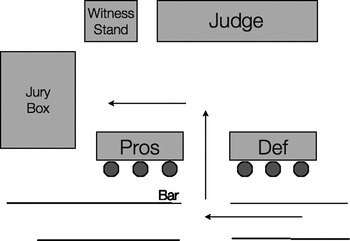
Body positioning within the built environment of the courtroom is designed to allow or disallow jurors certain kinds of sensorial access to defendants. Figure 1 depicts the arrangement of one courtroom in Texas, and is a fairly typical representation of the spatial arrangements of persons in courtrooms in general.
Typical courtroom layout.

In front of the bar – the physical divider between the audience and the court professionals – two tables are placed next to each other. At one sits the prosecution team, usually two or three attorneys, and at the other are the two defense attorneys and the defendant, who is seated at the right hand of the defense table. The defendant usually wears a suit that either his family or his lawyers purchased or borrowed for him.Footnote 10 He is not cuffed or restrained in any visible way,Footnote 11 a deliberate attempt by the court not to have the defendant's appearance sway the jurors. Because of this specific presentation of the defendant in court, many jurors told me that when they first came into the courtroom for jury selection, they thought the defendant was one of the attorneys. I made the same mistake once as well.
Implicated within this positioning of bodies is the opportunity for eye contact between the defendant and others in the courtroom. In this particular courtroom, the jurors processed directly in front of the defendant as they came and went, giving him unimpeded visual access to them. Courtroom procedure required that they enter and leave the courtroom after the defendant was already seated in his place. A number of jurors remarked on the defendant's ready ability to look at them and attempt eye contact as they entered and exited. Many of them actively avoided his gaze, some women going so far as to ask the judge to instruct the defendant not to “stare” at them because it made them uncomfortable. Such actions serve as distancing tactics, in that jurors explicitly avoid meeting the defendants' eyes, a behavior often argued to serve as the basis for empathic engagement (Enfield & Levinson Reference Enfield and Levinson2006; Ochs & Solomon Reference Ochs and Solomon2010; Dadds, Allen, Oliver, Faulkner, Legge, Moul, Woolgar, & Scott Reference Dadds, Allen, Oliver, Faulkner, Legge, Moul, Woolgar and Scott2012).
This may seem a minor point, but it was a major topic of discussion within my juror interviews. An element of the trial not caught on record and certainly not part of the “evidence,” the defendant's gaze is present and real in the jurors' trial experiences. In fact, during jury selection, attorneys, especially prosecutors, often require the potential jurors to look directly at the defendant and state whether they could sentence him to death. This tactic makes some potential jurors revise their previous statements that they could give the death penalty and disqualify themselves. Jurors' comments on defendants' eye contact or lack thereof suggest that they are constructing their own rules regarding the amount and appropriateness of eye gaze and its communication of one's morality and degree of remorse. Thus any manipulation of this access to the face or jurors' intentional attempts to avoid it serves as a device through which jurors can distance themselves from the defendant's human self (cf. Levinas Reference Levinas1969, Reference Levinas and Cohen1985).
Demonstrative references to defendants
Deixis is a primary linguistic resource through which our experiences of others are mediated. “Pure” deictic forms (Buhler Reference Buhler, Jarvella and Klein1934/1982) were first described by linguists as situating a given referent within a spatial universe that is related specifically to the context of talk (e.g. Lyons Reference Lyons1977; Fillmore Reference Fillmore, Jarvella and Klein1982; Hanks Reference Hanks1990). In this framework, deictic terms such as this or that, here or there, place a referent in a relationship of distance and are categorized according to whether they denote a proximal or distal positioning of the speaker to the object referred to (or something along a proximal-distal continuum)—that encoding more distance than its alternative, this.
Linguists have expanded the deictic notion of spatial proximity to include other dimensions, such as social and affective distance (Ostman Reference Ostman, Shibatani and Thompson1995). These deictic forms, referred to as “emotional” (Lakoff Reference Lakoff1974; Ostman Reference Ostman, Shibatani and Thompson1995) or “empathetic” (Lyons Reference Lyons1977) deixis, can display the level of empathy or involvement a speaker has with a referent (Duranti Reference Duranti1984; Ostman Reference Ostman, Shibatani and Thompson1995; Cornish Reference Cornish2001; Stivers Reference Stivers, Enfield and Stivers2007). Enfield similarly expands the discussion of deictic meaning, illuminating how demonstratives specifically encode meaning not just within physical space, but “interactional space” as well, which includes interlocutors' construals of space as “controlled, possessed, shared, separated” by one another (2003:88–89).
The following analysis examines one specific type of deictic phenomena: jurors' demonstrative references to defendants (such as this guy). In addition to, or perhaps in place of, encoding distance, deictic forms such as demonstratives have been described as solving the “coordination problem” in discourse (Schelling Reference Schelling1960; Lewis Reference Lewis1969; Clark, Schreuder, & Buttrick Reference Clark, Schreuder and Buttrick1983), that is, indicating to an interlocutor which of something is being referred to (Enfield Reference Enfield2003:86). Enfield describes a situation in Lao speech, in which the more specific demonstrative form nii is used when a referent is located within the interlocutors' “shared here-space.” In this case, he argues, use of the less-specific form (which he seems to map onto English distal forms) would be “semantically confusing” (2003:106). In his model, proximal forms do not necessarily express a “here” location, but that the referent is already salient in the interactional space of the interlocutors (2003:115).
The cases I examine seem to negate Enfield's logic. They include instances of anaphora, in which the defendant—as referent—has been established as a focus of the conversation, and yet a prototypically distal form (i.e. that —Enfield's “not here”) is used to refer to him. As such, they also defy explanation via Sacks & Schegloff's (Reference Sacks, Schegloff and Psathas1979) “recognitional vs. nonreferential” framework, which assumes that a demonstrative form will most likely be used when a speaker assumes that her recipient(s) do not know the referent. In all of my analytic instances, the defendant had already been referred to multiple times during the context of talk, usually with “he,” sometimes by his first or last name, and sometimes as “the defendant,” and was thus known by the recipients (either the trial audience or me, as interviewer). My analysis is thus more in line with explanations such as Stivers' (Reference Stivers, Enfield and Stivers2007:68), which posits that referring expressions are about much more than recognition. More specifically, since the default form of recognitional person reference in English is a name (Schegloff Reference Schegloff and Fox1996), something else about the context of talk and the positioning of the referent within it is achieved by violating this axiom.
I am left to ask what pragmatic action is being achieved through the use of these dispreferred demonstrative forms. For this I turn to analyses such as Duranti's (Reference Duranti1984) discussion of empathetic deixis, in which demonstratives are seen to display affective relationships among speakers and those they refer to. He argues that in Italian conversation, the demonstratives questo/a ‘this’ and quello/a ‘that,’ when used instead of personal pronouns, display lack of empathy or negative affect toward the person being referred to. Included in the “interactional space” constituted through deixis, therefore, is the moral world created through talk. Ochs & Capps (Reference Ochs and Capps1995) provide a compelling account of the encoding of this moral spatiality through language in their discussion of the deictic “here” as used in personal narratives about agoraphobia. They argue that the agoraphobic person's use of “here” in narratives of trauma creates an “emotional space,” bringing temporally and spatially remote events into the presence of her and her interlocutors (Ochs & Capps Reference Ochs and Capps1995:61–62). Deixis thus mediates our relationships with entities and persons of which we speak by positioning these beings within a “lived space,” which our “interests, cares, and attention define” (1995:63).
My data revealed that jurors most frequently referred to defendants with demonstrative noun phrases (e.g. that defendant) in contexts of dehumanization. These acts of dehumanization were often embedded within attempts to justify, for jurors especially, sentences of death. This implies that these particular forms of reference in these specific contexts provide sources for jurors to distance themselves from defendants in order to cast them out of their moral universe, aiding them in justifying their death sentences.
The following examples are drawn from interviews with capital jurors after they had completed their trials and sentenced defendants. In the first interview excerpt, a juror (whose jury committed their defendant to death) literally denies humanness to the defendant by characterizing him as having no heart. I had just asked her what made her first consider the death penalty a likely punishment during the trial.
(2) …cause the first thing he did he shot her in the stomach. And then we did the, that he was guilty, the- this guy doesn't have a heart. So, that's when I thought because he killed an in- an infant in somebody's (body).
It is clear that this is an example of a recognizable referent, as the defendant is first referred to in this spate of talk as “he.” This text thus illustrates an example of repair into a demonstrative form when referring to a defendant: the juror begins with a reference form starting with “the,” correcting herself and ultimately settling on the form “this guy.” This repair highlights the intensifying function of the demonstrative reference form (e.g. Hirschova Reference Hirschova1988), bringing particular focus to the defendant and to the action being accomplished through the reference (Stivers Reference Stivers, Enfield and Stivers2007): dissociating the juror from the defendant who she depicts as nonhuman. This may be a moral distancing, in that she does not want to associate herself with such a being. It may also be a cognitive distancing, in that she cannot comprehend a person committing such an act, and thus this guy marks cognitive distance between herself and the referent and his associated actions.
Using an unmarked reference form in this context, such as the personal pronoun “he,” would be consistent with a picture of the referent as unremarkable, fitting into normal social categories. But this defendant, having shot a pregnant woman in the stomach, arguably should not be included in those categories. The juror uses this dehumanizing expression to reflect on the moment she realized her desire to sentence him to death (“so that's when I thought”). Throughout my interviews, jurors used this kind of formulation when constituting defendants as nonhuman in the course of justifying their death sentences.
Text (3) illustrates even more explicitly the discursive construction of defendants as beings outside of normal categories of persons.
(3) a normal person wouldn't have done what he did, and you see this guy that is kind of non-emotional either direction, and you see him as kind of as not as a normal person. Not that he's crazy, but that it's just like, he could, he was totally separated from- from what you'd think normal emotions would be.
Again, the juror quoted above uses “this guy” to refer to the defendant in a recognitional discursive context, as he had just referred to the defendant as “he.” The distance created through the demonstrative reference form “this guy” parallels this juror's conceptualization of metaphoric distance: “he was totally separated from… normal emotions.” Here this juror relies on a defendant's lack of emotion to make a moral judgment about him, thus adhering to part of the judge's sentencing instructions. Despite the legal tendency to objectify defendants and disregard apparently subjective concerns such as feeling, this juror uses emotion to characterize the defendant as a type (“not as a normal person”).
Text (4) illustrates how employing several different deictic forms, in conjunction with other reference forms, can differentially position a referent throughout the same span of discourse. It is drawn from an interview with a juror who is unique, not in the sense that he voted for death, but because after the trial he became an activist of sorts, speaking in a variety of venues about the need for life without parole, an option his jury did not have. He also visited the defendant in prison after the trial's conclusion and has remained in contact with him, which is extremely rare. He thus has much greater personal familiarity with the defendant than most jurors do. This excerpt illustrates an interplay of relations of physical proximity with deicticly marked discursive relationships, and how these help construct the juror's depiction of the defendant.
(4) But when you're confronted with it, it's not like anything I could have ever imagined because you read newspaper accounts or you watch on TV and you think, well that person, you know, they just need to be, you know, eliminated. And let me tell you, from the graphic pictures we saw, this would fall [laughing] in that category. But, you know, then you realize there's a real human being. Did he stumble, fall, and even if he did, just the mere fact of loading a shotgun and putting somebody in that position I mean is that, that's pretty serious!… it was very interesting to meet Bobby, and he's a very gentle soul, and we, as Bobby says, we're two sides of the same coin. We were educated probably within a mile and a half of each other. And, you know, we knew the same streets and things like that. When you start talking about it it's like frightening [laughing] how close we all are. And this is as far as you think two people would be. But then you start to see the similarities. That's truly interesting.
In this example, the juror's deictic terms mirror his ruminations about proximity between people and the sense of similarity he derives from such geographical and social proximity. He reflects on these similarities in the course of humanizing the defendant, as his musing range from classes of people who commit heinous crimes to the defendant as an individual human being. His linguistic choices mark this transition, suggesting a connection among empathy (allowing oneself to take on the perspective of another), proximity, and humanization.
At first, the juror invokes a normalized view that anyone who commits murder should be “eliminated” and that such an act is not commensurate with “imaginable” categories of actions. With this typological classification, “that person,” the juror does not refer to a particular defendant, but describes an unidentified token of the type of person who would commit horrible crimes that demand the death penalty. In making such a potentially inflammatory statement, that someone be eliminated, this juror also distances himself from the telling by using the indefinite and generalized subject “you” rather than “I” (“you think…”). This linguistic distancing is accomplished in part through the demonstrative construction “that person,” which, in all discussions of demonstrative usage, indicates something or someone “not here” (Enfield Reference Enfield2003), placing the referent outside the (potentially moral) imaginative space of the speaker and interlocutor (cf. Stivers Reference Stivers, Enfield and Stivers2007).
There then follows a phenomenological shift, whereby the juror moves from generalizing about a type of criminal to formulating a humanizing description: “There's a real human being.” The anaphoric reference to “he” in the next sentence suggests that this description is evoking the defendant individually. The juror then alludes to the crime, as the defendant loads his shotgun and points it at “somebody.” While the defendant has been individualized, the victim and crime take on a generalized tone, beginning with “the mere fact of”—the juror seems not to be describing the defendant's individual crime per se, but again evoking the category of criminal persons and acts described previously.
The juror then positions the defendant as an actual person when referencing their face-to-face meeting. He refers to him with the recognitional form: his first name, Bobby.Footnote 12 With this name, he invokes Bobby specifically, bringing him into the room, as it were, by reporting his words (“as Bobby says”). He then employs the inclusive pronoun “we” to describe their similar upbringings. Their geographic proximity as children allows the juror to recognize their commonalities and shared knowledge and facilitates empathic understanding with Bobby's situation. Despite the differences in the moral boundaries of this juror's and defendant's typical actions, prompting the juror to state that “this is as far as you think two people would be,” he finds closeness to the defendant based in their growing up within a mile and half of each other. He concludes with an unnerved generalization about humanity based in proximity, that it's “frightening… how close we all are.”
Constructions of agency
In the emotionally traumatic context of sentencing a person to death, jurors not only distance themselves from defendants, but from the act of sentencing as well. Because capital juries' verdicts for death must be unanimous, each juror must vote individually for a death sentence for a verdict to be rendered. Capital jurors thus place tremendous weight on their individual decisions. Their interview responses, however, suggest ways in which they manage distance between themselves and their sentencing decisions through constructions of grammatical agency. Marking agency in particular ways allows jurors to mitigate expressions of responsibility for another person's death. Though grammatical agency cannot be automatically mapped onto cultural ideologies of personal responsibility (Duranti Reference Duranti and Duranti2004), the examples below reveal the work that constructions of agency accomplish in conjunction with the message being conveyed through the content of the talk: that jurors are not ultimately responsible for defendants' sentences.
The statements of judges and attorneys as well as written legal language provide jurors with authoritative models for distancing themselves from their punishment decisions (cf. Erickson, Lind, Johnson, & O'Barr Reference Erickson, Lind, Johnson and O'Barr1978). Given the difficulty of capital jurors' task and the ambiguous and contradictory information they receive from a variety of sources, jurors constantly look to their written instructions and other legal language for verification of their actions and, in particular, for ways to deny “personal moral responsibility” for their decisions (Hoffman Reference Hoffman1995; Garvey Reference Garvey2000). The deletion of active grammatical agents, which is common to legal language, has been shown to increase misunderstanding of jury instructions (Charrow, Crandall, & Charrow Reference Charrow, Crandall, Charrow, Kittredge and Lehrberger1982). This confounding aspect of agency elision is thus doubly significant in Texas capital cases, in which jurors rely on this very language to make sense of their decisions.
The framing of the “special issues” in Texas capital trials allows and in fact encourages jurors to attenuate their own responsibility for life and death sentences. Based on postverdict interviews with capital jurors from multiple states, Haney, Sontag, & Costanzo (Reference Haney, Sontag and Costanzo1994:166) found that the special-issue framework, as opposed to the “weighing” system used in most states, does in fact allow jurors to distance themselves emotionally from the reality of their decisions. As outlined previously, Texas capital jurors do not vote directly for a life or death sentence. Rather, they are instructed to answer the two “special issue questions.” The jurors thus never pronounce an actual sentence on the defendant. The jury foreman merely signs his name on the instructions next to “yes” or “no” for each of the special issue questions. The jury then processes into the courtroom, after which the judge reads the verdict sheet aloud and pronounces a sentence on the defendant—either death by lethal injection or life without parole.
This sentencing structure leaves room for ambiguity as to jurors' actual involvement in administering a sentence. In text (5), one juror comments on this fact during his interview, unsure of who is ultimately responsible for the sentence he gave.
(5) Um, and make the recommendation whether we're the final authority or not I I think the judge can overrule sentence guide- a excuse me sentencing at some point but, I think the jury decides guilt or innocence, and then at least makes the recommendation for penalty.
This juror identifies his role in the guilt/innocence decision through an agentive construction typical to English: the jury (as agent and subject) decides the guilt or innocence of the defendant (as object of this act of deciding). After some consternation (marked through the hedges “I think” and “at least”), he concludes that jurors merely make a recommendation to the judge regarding sentencing, rather than being the “deciders.” In reality, however, the judge has no discretion in this regard. He or she merely presents the sentencing verdict to the defendant and has no power to overrule it.Footnote 13 The structure of the jury charge, however, makes this juror's interpretation possible, as it does not ask jurors to give the defendant a particular sentence. The judge connects the dots, so to speak, when pronouncing the sentence, stating the implications of the “special issue” answers after the verdict is read. It is also important to note that this juror refers to “the jury” as a whole as the responsible party for the decision, not himself as an individual. Jurors often refer to their collective responsibility for their decisions; however, as mentioned above, capital jurors (and the Supreme Court)Footnote 14 consider heavily their individual roles in the process, as all verdicts must be unanimous.
The language of jury instructions increases the ambiguity regarding responsibility for sentencing, as it potentially forges linguistic distance between jurors and the act of sentencing a defendant. The following texts, drawn from written jury instructions in one Texas case, suggest that jurors are not the ultimate agents in sentencing defendants. Who, then, is responsible for sentencing? Most legal language, jury instructions included, cites either the “Court” (the judge) or the circumstances of the crime itself as the primary agents in determining a defendants' sentence. Texts (6)–(8) are presented in the order they appear on the jury charge. These texts display that the grammatical formulation of agency in jury instructions reinforce Texas' structuring of the sentencing decision, in which jurors are not given ultimate responsibility.
(6) You have found the Defendant guilty of the offense of capital murder. As a result of that finding of guilt, and in order for the Court to assess a proper punishment, it is now necessary for you to determine… the answers to certain questions…
Text (6) is the first time in these instructions the punishment is specifically mentioned. The “Court” (judge), which serves as grammatical agent of the action (“assess[ing] a proper punishment”), is identified as the primary authority over a defendant's punishment. It is relevant to note that the judge—a person—is consistently referred to as the “Court”—a thing. This underscores the legal model that a death sentence is something that emerges from interpersonal institutional actions, rather than human decisions. Jurors' responsibility is then limited in this passage to determining “answers to certain questions.” The causal chain represented here is thus that jurors find guilt and answer questions, after which the judge determines a punishment. Only later will the potential death of the defendant occur, which is never referenced explicitly.
In text (7), in contrast, the “evidence” is positioned as agent of the sentencing decision, as it directs the jurors toward or against imposing the death penalty.
(7) Evidence of the background or character or the circumstances of the offense that militates for or mitigates against the imposition of the death penalty.
In this part of the instructions, the jurors' involvement in imposing death is attenuated in two ways. First, “the evidence” is constructed as the responsible agent that “militates for” or “mitigates against” death. Second, the actual act of sentencing, “the imposition,” is nominalized, which further eliminates a human agent from the action (Billig Reference Billig2008). This reading corresponds with findings that capital jurors rely disproportionately on the characteristics of the crime, rather than the defendant, when assessing punishment (Geimer & Amsterdam Reference Geimer and Amsterdam1989).
Finally, in text (8), the jurors are reminded again that it is the Court that actually imposes the sentence.
(8) You are instructed under the law applicable in this case, if the jury answers that a circumstance or circumstances warrant that a sentence of life imprisonment without the possibility of parole rather than a death sentence be imposed, the Court will sentence the defendant to imprisonment in the institutional division of the Texas Department of Criminal Justice for life without the possibility of parole.
This instruction begins as a second-person appeal to “you;” the switch to the third person “the jury” impersonalizes the reference to jurors' answers to the special issue questions, thus distancing the individual juror from her decision. The Court is then represented as the agent of sentencing the defendant (“the court will sentence the defendant”) and the jurors are again relegated to answering the special-issue questions (“the jury answers”). Their human agency is further attenuated in that “circumstances,” rather than their decisions, are said to warrant the imposition of a particular sentence.
After the jurors have deliberated, the judge pronounces a sentence to the defendant and all in the courtroom, during which he or she reiterates the formulations of agency from the jury charge. In text (9), a judge (reading from a document) addresses the courtroom.
(9) … a jury having answered in the affirmative special issue number one, also having answered in the affirmative special issue number two, and having answered in the negative as to special issue number three,Footnote 15I assess your punishment as death by lethal injection.
In this proclamation, jurors are again positioned as responsible for answering the special-issue questions, while the judge assesses the punishment. The ultimate authority for sentencing, it can be assumed, is thereby placed in the hands of the judge.
In addition to the language of the instructions, attorneys' language during jury selection socializes jurors into mitigating their role in sentencing defendants. Text (10) is drawn from a prosecutor's statements to jurors during jury selection. His summation of the decision-making process recapitulates the formulation of agency revealed in the jury instructions: the special issue framework exculpates jurors from ultimate responsibility for sentencing a defendant.
(10) You feel a little more comfortable after the judge explained these issues and the process you go through. It's not just a yes or no where you decide. What you're doing is you're basically answering the question.
This structure, he explains, makes the decision easier on jurors. They do not have to “decide,” but, rather, merely answer the question.
Not surprisingly, given these legal models, jurors' interview responses express mitigated forms of agency when discussing their decisions. They often cite, for example, a nonhuman, abstract agent as controlling the sentencing process. This corresponds with Haney and colleagues' (Reference Haney, Sontag and Costanzo1994:160) findings that capital jurors in multiple states tend to abdicate responsibility for their decisions to the “law,” the judge, or their instructions, ultimately evading the “life and death consequences” of their verdicts. In text (11), a juror explains to me how he justified sentencing a defendant to death.
(11) I determined going into this that I was going to do exactly what the state asked me to do. At the end of the day that would be the only way I would feel good about it… Whatever the state asks, I'm going to rigidly abide by it.
This juror emphatically bestows the responsibility for his sentencing decision on “the state,” a nonhuman, institutional representation of the criminal laws of Texas.
Many others jurors followed similar logic in talking about their decisions, citing other abstract entities, such as the law or a generalized “they,” as the responsible agents for the decision that is made. Identifying agents as nonanimate entities is a common practice in English; this grammatical option allows an event that probably involved human agency to be framed as if it did not (Duranti Reference Duranti and Duranti2004:464). In texts (12)–(14), drawn from three separate juror interviews, jurors locate responsibility for their decisions in nonhuman or abstract entities.
(12) But it's not a, deciding that isn't a judgment based on what I feel. It's based on what the charge says. It's based on the law.
(13) They don't want, you know they don't want someone who is not a continuing threat to be put to death.
(14) Make a good decision, not for yourself, not for, for what the state of Texas is asking you to do and they're not asking you to put him to death. They're asking you to be very careful about what you decide…
In text (12), the juror attributes his decision to what the “charge” and the “law” determine. He is willing to put aside his own feelings in order to honor this authority. In texts (13) and (14), the juror cites the generic “they,” understood perhaps as the state, or the lawyers, or some other manifestations of legal authority, as the source of authority for sentencing decisions. In text (14), the juror explicitly denies that sentencing decisions are under the purview of the individual juror, citing the state of Texas as the agent.
In contrast to these mitigating expressions, attorneys occasionally urge jurors to step out of this distancing framework and consider the decision they may make in a very individual, direct manner. In text (15), for example, a prosecutor questions a potential juror during jury selection.
(15) P: Take a look at Mr. Jackson [the defendant] over here. Can you see him?
J: Yes.
P: Okay. What I'd like to know is whether or not you could personally participate in a decision where these three questions are answered in such a way that he receive the death penalty? Could you do that?
J: Yes.
…
J: No.
P: You don't think you could participate in that process- personally participate in that process?
J: No I don't.
In this prosecutor's shrewd line of questioning, he conflates a number of the tactics for manipulating proximity and distance I have discussed throughout this article. First, he asks the juror to look the defendant in the eye, collapsing the physical distance between the juror in the witness stand and the defendant seated at the defense table. In this request, he refers to the defendant by his name, rather than with a distancing reference form often used by prosecutors. Once the juror and defendant have engaged each other's faces, the attorney asks whether the juror could handle being “personally” responsible for a decision that would give this very person the death penalty. After first proposing that he could, this juror eventually denies his ability to do so thus disqualifying himself from the jury—the prosecutor's ultimate goal with this line of questioning.
Conclusions
Returning to the problem posed at the beginning of the article—how it is that one human being can sentence another to death—the preceding analyses have illustrated the central place language occupies in jurors' reflections on this seemingly impossible task. Through a variety of linguistic practices, jurors distance themselves from defendants and from their own decisions in order to help justify their sentences for death.
Certain communicative practices, as mediators of proximity among interlocutors, discursive content, and context, thus aid in the mediation of moral and psychological distance among interlocutors and referents of discourse. It is in this sense that language is inseparable from our understanding of the subjective experiences of persons and especially how these are related to and constituted through our perceptual access to others. It follows logically that legal decision-making—itself made of language—is inseparable from these subjective experiences as well. Moreover, scholars such as Hanks (Reference Hanks1990) and Husserl (Reference Husserl1969) remind us that both deixis and empathy are oriented to the speaking and feeling ego; the other is always emplaced and understood through the self (and vice versa). Thus jurors hold an extreme power load, in that the defendant's character and fate, while partially located in his own embodied action, is sifted through the jurors' own subjectivities and experiences.
The US legal system has intricate structures in place to shape how these subjective experiences are transformed into legal sanctions. These structures are the foundations on which our democratic justice system rests with its embedded ideologies of objectivity, neutrality, and universal application. Jurors recognize, however, that when engaged face-to-face with another person, no matter how many institutional regulations are in place to make the decision easier, denying someone their life is no easy task. I return to the juror quoted at the start:
that's the hardest thing I've ever had to do, to look at a man and, you know, know that I'm saying, you know, I don't think you should live.
This basic source for empathic understanding, the meeting of eyes (Levinas Reference Levinas1969, Reference Levinas and Cohen1985), caused unease for this juror in giving the death penalty. Despite this unease, however, he voted for death. Jurors point to physical or emotional cues that were conspicuously absent in their interactions with or experiences of defendants to justify their decision to give him death. They linguistically mark their reflections on these with distancing forms, further severing their experiential connections with defendants. As we saw in the final analytic example above (text 15), however, looking at a defendant's face can deter a juror from involving himself in the process of having to choose a death sentence.
The defendant's fate thus lies, as Levinas would predict, both in the presence and the vulnerability of his face to the jurors, especially as it is mediated through the procedures and practices of capital trials. Jurors rely on the legal authority of evidence and rationality to distance themselves from the humanity of defendants and bar emotion and empathy from their decisions. Some jurors in fact use this logic to convince others holding out for life to change their minds. The legal institution thus provides jurors with the language and attitudes that enable them to restrain their empathy towards another human being, in order that they may live with the decision that someone else will die.
It has been argued that the capital sentencing structure in general throughout the US obfuscates the real nature of jurors' decisions (Haney et al. Reference Haney, Sontag and Costanzo1994). We have seen this to be the case in terms of the special-issue sentencing framework used in Texas trials. In addition, the communicative practices described above provide jurors with emotional “shields” (1994:172) from the life and death consequences of their decisions. A lens on the interactive aspects of the capital punishment system reveals a cluster of distancing practices that transforms human decision-making into a “depersonalized act of the state” (Zimring & Hawkins Reference Zimring and Hawkins1986:104).