Introduction
This research note builds on the empirical research in Canada regarding the impact of the federal system on the durability of party attachments. We extend the “party system congruency” analysis set out by previous scholars by testing a series of hypotheses. First, provinces where the provincial party system is congruent with the federal party system will have a greater proportion of federal partisans than non-congruent provinces. Second, federal partisan attachment will be strongest in provinces with congruent systems. Lastly, both the prominence and strength of federal partisanship will be highest for provincial partisans living in congruent provinces. The results, based on data from the Comparative Provincial Election Project (CPEP), offer little support for our hypotheses overall, once again challenging the utility of the party system congruency thesis in the Canadian context.Footnote 1 However, we do find some indication of conditional effects when we take into account provincial partisanship, albeit in the opposite direction of what we hypothesize. As a point of departure, we begin with a brief overview of the congruency thesis and past work in the Canadian context that has considered the impact dissimilar federal-provincial party systems have on partisanship.
The Party System Congruency Thesis
The party system congruency thesis emphasizes the impact of symmetry (or not) of federal and provincial party systems on party vote choice and attachments. Congruent party systems—where the parties competing for power mirror each other at both the federal and provincial level—should facilitate consistent voting and partisan identification because voters do not have to discern between different parties with varying labels at each level. Furthermore, the overlapping sytems should serve as a reinforcing mechanism, not only encouraging partisanship across levels, but also increasing the strength of these attachments.
The study of partisanship in multilevel government contexts has received considerable attention from scholars. Early work on partisan identification in Canada presented a picture of “flexibility” (Meisel, Reference Meisel1975). A durable partisan, according the Harold Clarke and colleagues (Reference Clarke, Jenson, LeDuc and Pammett1979; Reference Clarke, Jenson, LeDuc and Pammett1984; Reference Clarke, LeDuc, Jenson and Pammet1991; Reference Clarke, Jenson, LeDuc and Pammett1996), meets three critera: identifies very or fairly strongly with a party, maintains a continuing attachment to the party over time, and identifies with the same party at both the federal and provincial levels (see also LeDuc et al., Reference LeDuc, Clarke, Jenson and Pammett1980). Election data from the 1960s, 1970s and early 1980s suggested that Canadians were far more flexible in their partisan attachments than their American counterparts, and some scholars attributed this inherent flexibility to Canada's federal structure: meeting the third criterion of consistency was made more difficult in the Canadian case because of the context of having “two political worlds” that both voters and political parties inhabit (Blake, Reference Blake1982; Blake et al., Reference Blake, Elkins and Johnston.1985; Elkins and Simeon, Reference Elkins and Simeon1980; Smith, Reference Smith and Thorburn1967). In other words, the disjuncture between provincial and federal party systems inhibited easy congruence along partisan lines. Consequently, an increasing number of voters not only identified weakly and switched their votes from one election to another, but also split their partisan loyalties across the federal-provincial divide (Bowler, Reference Bowler1990; Clarke and Stewart, Reference Clarke and Stewart1987; Courtney and Smith, Reference Courtney and Smith1966: 344; Jensen, Reference Jenson1975; Perlin and Peppin, Reference Perlin and Peppin1971: 281; Stewart and Clarke, Reference Stewart and Clarke1998: 100).
There have been challenges to the characterization of Canadians as flexible partisans, with a number of scholars arguing that Canadian voters are actually more durable than initially presumed. This over-emphasis on flexiblity has been attributed, among other things, to measurement error (Johnston, Reference Johnston1992), the conflation of “inconsistent” identification across the levels with unstable voting behaviour at a single level (Blake, Reference Blake1982), and the uniqueness of Canada's highly decentralized federation which makes dual partianships far more rational here than in other federal systems (Gidengil et al., Reference Gidengil, Nevitte, Blais, Everitt and Fournier2012: 55). However, even after accounting for these possibilities, Canada remains somewhat of an outlier, particularly when partisan inconsistency is compared to other federal countries, such as Australia (Johnston, Reference Johnston2013).
One explanation for the relatively high inconsistency in Canada reflects voters’ keen ability to make discernable differences between federal and provincial political issues (Blake, Reference Blake1982; Blake et al., Reference Blake, Elkins and Johnston.1985; Perlin and Peppin, Reference Perlin and Peppin1971; but see Cutler, Reference Cutler2008). Martinez (Reference Martinez1990) took a similar position by arguing that only voters with some political sophistication would be attuned to variance between political parties, and split partisanships would be a natural result of their sharper cognitive abilities. Patterns of historical party development also matter here (Johnston, Reference Johnston, Elkins and Simeon1980, Reference Johnston2013; Uslaner, Reference Uslaner1990), as political party innovation and experimentation was more likely to occur at the sub-national level, substantially affecting the dissimilarity of party choices offered to voters at the provincial versus the federal level.Footnote 2
The effect of congruent or incongruent party systems themselves on partisanship (where parties with identical partisan complexions compete at both the federal and provincial level) is an area that has received less attention. Studies have noted that party preferences at one level affect those at the other (Clough, Reference Clough2007; Stewart and Clark, Reference Stewart and Clarke1998). Clough's analysis found that, particularly for New Democrat and Progressive Conservative identifiers, provincial party preference affected their federal party support (2007: 794). The effect of partisan reinforcement on voting consistency across the levels was also a line of inquiry undertaken by Martinez (Reference Martinez1990). Using data from the 1974–1979 Canadian National Election Panel Study, Martinez found that provinces with similar party systems (such as New Brunswick) had the highest reinforcement effect. On the other hand, British Columbia—the most dissimilar provincial system at the time—had the lowest reinforcement on voting consistency (1990: 840).
A fuller, and more recent, treatment of the effects of party system congruence was undertaken by Stephenson and Bélanger's examination (2009) of party support and vote choice in Ontario and Quebec using provincial level data. These scholars found a surprising degree of voter loyalty across the levels, reinforcing Clough's findings (2007) that provincial preferences impact federal preferences both in partisanship and vote choice. Furthermore, Stephenson and Bélanger noted that their results held across both provinces despite the differences in party system congruency between Ontario (which replicates the federal system) and Quebec (which is less congruent) (2009: 11).
This research note offers a re-examination of the explanatory potential of party system congruency using a new and rich provincial dataset that will extend the base for comparison across eight provinces. Our focus, however, is not on vote choice per se, but on partisan identification. Our intent is that this analysis will both update and extend earlier work regarding the effect of party system symmetry or asymmetry on partisanship in Canada.
Methodology
As noted, we draw upon information collected through CPEP that includes data collected following eight Canadian provincial elections from 2011 through 2013, asking a standard set of questions to residents within each province.Footnote 3 The CPEP data were collected following each provincial election from 2011 through 2013, asking a standard set of questions to residents within each province. This rich collection of comparative data allows us to examine the extent of provincial and federal partisan congruence as well as the strength of partisanship within and across provinces. The congruency thesis suggests that partisanship will be most prominent in provinces that have similar party systems across levels: Newfoundland and Labrador (NL), Prince Edward Island (PE), Ontario (ON) and Manitoba (MB). We treat Quebec (QC), Saskatchewan (SK), Alberta (AB) and British Columbia (BC) as non-congruent provinces.Footnote 4
A second consideration reflects the strength of the partisan attachment. Not only do we expect partisanship to be more prevalent in provinces with party systems that match their federal counterparts, we also expect the strength of the party attachment to be strongest in these provinces. In both cases our reasoning is similar: the overlapping systems are expected to reinforce partisan attachment (Martinez, Reference Martinez1990), amplifying the attraction to parties that share similar provincial and federal labels. As such, we expect both the likelihood of holding federal partisan ties and the strength of these ties to be strongest for individuals living in congruent provinces who identify with a provincial party relative to provincial non-identifiers. Based on these expectations, we put forth the following four hypotheses:
H1:
Provinces where the provincial party system is congruent with the federal party system will have a greater proportion of federal partisans compared to non-congruent provinces.
H2:
Federal partisanship will be more likely for provincial partisans living in congruent provinces relative to provincial non-partisans.
H3:
Federal partisan attachment will be stronger in provinces with congruent systems.
H4:
Federal partisan attachment will be stronger for provincial partisans living in congruent provinces relative to provincial non-partisans.
Results
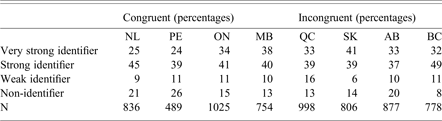
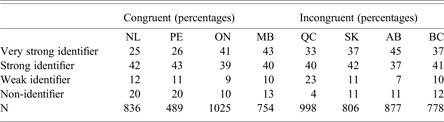
To test our hypotheses, we begin with a series of descriptive tables outlining the percentage of partisans and the strength of their partisan attachment at the provincial and federal level.Footnote 5 These results are reported in Table 1 (provincial partisanship) and Table 2 (federal partisanship).
Provincial Partisanship Levels by Province

Note: Cells report percentage of provincial (non) partisans according to strength of attachment for all parties with total number of cases for each province reported in the bottom row. The following CPEP question was used to measure provincial partisanship: “In PROVINCIAL politics, do you usually think of yourself as a: [LIST OF PROVINCIAL PARTIES]?” Respondents indicating an affiliation were then asked a follow-up question to assess partisan strength: “How strongly do you support this party? Very strongly, fairly strongly, or not very strongly?”
Federal Partisanship Levels by Province
Note: Cells report percentage of federal (non) partisans according to strength of attachment for all parties with total number of cases for each province reported in the bottom row. The following CPEP question was used to measure federal partisanship: “In FEDERAL politics, do you usually think of yourself as a: Liberal, Conservative, New Democrat, [Bloc Québécois – QC ONLY], Green, or none of these?” Respondents indicating an affiliation were then asked a follow-up question to assess partisan strength: “How strongly do you support this party? Very strongly, fairly strongly, or not very strongly?”
Based on the results in Table 1 and Table 2, it is clear that both the level and strength of partisanship varies considerably across provinces. For example, examining the percentage of non-identifiers at the provincial level, we find nearly a 20-percentage point gap between those claiming no provincial identification in PE (26%) and non-identifiers in BC (8%). Given our expectations regarding the reinforcing effect of having similar party options at both the provincial and federal levels, it is surprising to find that the two Atlantic provinces, PE and NL, both with a long history of stable, congruent party systems with low provincial party fractionalization, have the largest proportion of non-partisans (21% and 26%, respectively; see Table 1).Footnote 6 Similarly, it is the two Atlantic provinces where we find the lowest proportion of individuals claiming very strong provincial partisan identification (25% in NL and 24% in PE). These early results, particularly the findings from the two island provinces, appear to contradict the party system congruency thesis.
The results from SK further challenge the notion that congruent party systems should produce the strongest partisan identifiers (Table 1). This prairie province yields the greatest percentage of very strong provincial identifiers; in fact, 80 per cent of SK residents (second only to BC) claim a strong or very strong provincial party identification. If offering voters similar party choices at the provincial and federal level helps individuals develop stronger partisans affiliations, it is not evident from these preliminary provincial partisanship results. Voters in the four provinces with political party systems that diverge from the federal level are seemingly indistinguishable from their provincial counterparts residing in congruent systems with regard to both the percentage of provincial partisans and the strength of this attachment.
Turning to federal party identification, a similar pattern is observed. Once again, it is PE and NL that yield the lowest proportion of partisans (Table 2). Somewhat unexpectedly, QC appears to have the largest proportion of partisans, with only 4 per cent of QC residents claiming no federal affiliation. A partial explanation for this may be found in the overly large proportion of QC respondents that claimed only a weak identification, 23 per cent, nearly double all other provinces in this category. Once again, NL and PE are found to have the smallest proportion of strong or very strong federal identifiers, 67 per cent and 69 per cent respectively. In SK (79%), AB (82%) and BC (78%), we find similar levels of strong or very strong partisans relative to their ON (80%) and MB (83%) counterparts, with partisan levels and strength in the non-congruent provinces somewhat greater than the levels observed in congruent NL and PE. Combined with the results from the provincial partisan metrics, these descriptive tables offer no support for the congruency thesis or hypotheses 1 and 3.
While the summary data are informative, they fail to take into account provincial differences in socio-demographic composition, for example, or conditional effects that may be relevant for one province but not another. In order to fully test our thesis of cross-province and cross-level partisanship, we move to a multivariate analysis. In doing so, we offer a richer understanding of the factors that influence partisanship and the strength of this attachment. Furthermore, with the multivariate setup, we can also test hypotheses 2 and 4 by incorporating a series of interaction effects to explore, by province, the impact of partisanship at one level on partisanship at the other level.
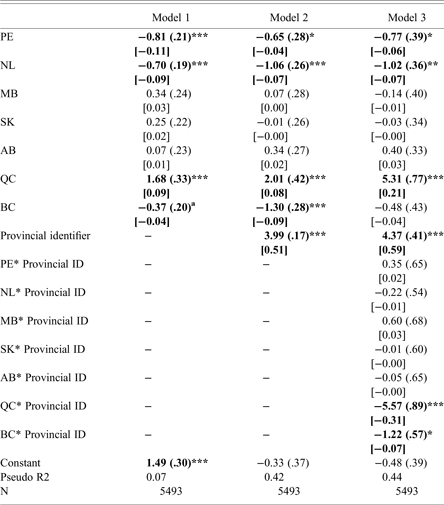
To test whether individuals in provinces where the provincial party system is congruent with the federal party system will have a greater number of federal partisans than individuals in non-congruent provinces (H1), we employ a logistic regression model to estimate federal partisanship (partisan = 1), regardless of the strength of the attachment. In all models, we control for individual level characteristics that may influence partisanship. Following from existing work (see, for example, Almond and Verba, Reference Almond and Verba1963; Bartels, Reference Bartels1996; Berelson et al., Reference Berelson, Lazarsfeld and McPhee1954; Blais et al., Reference Blais, Gidengil, Nadeau and Nevitte2002; Cross, Reference Cross2004; Gidengil et al., Reference Gidengil, Nevitte, Blais, Everitt and Fournier2012), we control for age (age = the respondent's age in years), sex (female = 1), education (high school dropout = 1; university graduate = 1), religious affiliation (Catholic = 1; Protestant = 1), visible minorities (=1), marital status (married or couple = 1), children living in the house (= 1), union membership (union members = 1) and income (low income quartile = 1; high income quartile = 1).Footnote 7 We also include two measures of ideology: an index tapping moral traditionalism and a second index capturing positions on free market.Footnote 8 To assess federal partisan level differences across provinces, we add dichotomous variables for each province.Footnote 9 We set ON, the largest congruent province, as our reference category. The results provide us with a metric to consider levels of federal partisanship, net of differences in the socio-demographic make-up, across provinces. These results are presented as Model 1 in Table 3.Footnote 10
Federal Partisanship by Province and Provincial Partisanship
Note: Cells contain logistic regression coefficients with robust standard errors reported in parentheses. All models include controls for socio-demographic charteristics and ideology (not reported – see Appendix 2). Marginal effects/discrete change reported in square brackets.
*** p < .001 ** p < .01 * p < .05 a p < .10
Referring to the provincial indicators, we find four provinces—two “congruent” (PE and NL) and two “non-congruent” (QC and BC)—that differ significantly from ON, our reference category. In PE and NL there is a lower probability of federal partisanship, relative to Ontario: 11 percentage points, and nine percentage points respectively.Footnote 11 The result from BC is the only one that fits with our expectations. BC residents are four percentage points less likely to hold federal partisan attachments compared to their counterparts living in ON. Interestingly, and contrary to the congruency thesis, the probability of identifying with a federal party is significantly greater, by nine percentage points, in QC. Along with the null results in SK and AB, the findings from QC offer no support for our first hypothesis; with the exception of BC, we find no indication that individuals living in congruent provinces are more likely to claim federal partisan ties.
To further explore the impact of congruency, we add a dummy variable for provincial partisans (provincial identifier = 1) to our model (Table 3, Model 2). The results show that provincial partisanship affects federal membership: identifying with a political party at the provincial level boosts the chances of identifying with a federal party by 51 percentage points, net of socio-demographic characteristics, ideology, and province of residence. However, the addition of this variable has little impact on our provincial measures; controlling for provincial identification, we find similar, significantly lower levels of federal identification in BC, PE, and NL while a positive relationship between QC and federal party identification remains (Table 3, Model 2). To isolate the impact of provincial identification by province and test our second hypothesis (that federal partisanship will be more likely for provincial partisans living in congruent provinces relative to their provincial non-partisan counterparts), we interact each of our provincial variables with provincial identification. These results are presented as Model 3 in Table 3.
With the inclusion of the interaction terms, the provincial constituent terms indicate the impact of living in each province, relative to ON, for individuals who do not have provincial partisan ties (provincial identification = 0). The provincial party identification constituent term is the effect of holding a provincial partisan affiliation when the provincial variable is set to 0. In other words, the provincial identification constituent term represents provincial partisans in ON. Each of the interaction terms represents the combined effect of living in the respective province and holding provincial partisan ties.
Beginning with the provincial metrics, we see that in PE and NL, individuals without provincial party affiliations are significantly less likely to claim federal partisanship, relative to their ON counterparts. However, the non-significant interaction terms for these provinces, along with MB, runs counter to our expectation that federal partisanship will be more likely for provincial partisans living in congruent provinces relative to their provincial non-partisan counterparts.
With regard to the provincial variables, QC residency appears to be the outlier. The results show that individuals living in QC that do not hold provincial attachments are significantly more likely (an increase of 21 percentage points), to have federal ties. Looking at the interaction term for QC residency and provincial party affiliation reveals a statistically significant difference between provincial partisans and non-partisans: the 21 percentage point increase in the probability of holding federal partisanship for QC residents who do not claim a provincial affiliation is reversed in the case of QC provincial partisans, with the interaction yielding a drop in the probability of holding federal party ties of 31 points (Table 3, Model 3). These results offer insight into the somewhat unexpected relationship observed above. While QC residents may appear to be more likely than their provincial counterparts to have federal party affiliations, this relationship is conditional, limited to individuals who do not hold provincial partisan ties. We find similar results for BC provincial partisans. Together, these findings suggest provincial identifiers in non-congruent provinces are less likely to hold a federal party affiliation relative to provincial non-identifiers. However, while these findings provide a glimmer of support for the congruency thesis, they do little to support our second hypothesis; as noted above, we find no evidence to support our assumption of higher levels of federal partisanship for provincial partisans living in congruent provinces relative to their provincial non-partisan counterparts.
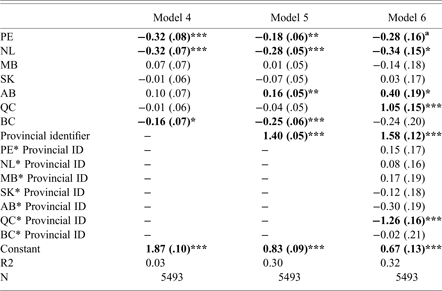
Is it possible that the lack of support for the congruency thesis reflects our somewhat inclusive measure of partisanship? Might we find support for our expectations if we take into account the strength of the party attachment? To test our third hypothesis, that federal partisan attachment will be strongest in provinces with party system symmetry, we can model federal partisan strength (0 to 3, with 0 = no identification and 3 = very strong identification) controlling for socio-demographic characteristics, ideology, province, and provincial partisanship. In these models we treat partisan strength as a continuous variable and employ linear regression (OLS).Footnote 12 The results from our initial assessment are reported in Table 4, Model 4.Footnote 13
Strength of Federal Partisanship by Province and Provincial Partisanship
Note: Cells contain OLS regression coefficients with robust standard errors reported in parentheses. All models include controls for socio-demographic charteristics and ideology (not reported – see Appendix 3).
*** p < .001 ** p < .01 * p < .05 a p < .10
Similar to our results above, we once again find that party system congruency has very little impact on federal partisan strength. Relative to ON, we find significantly weaker levels of federal partisan attachment in PE and NL (Table 4, Model 4). The results for BC fit expectations, with residency in this province reducing federal partisan strength. However, in all other provinces we find no indication that provincial-federal congruency boosts (or weakens) the strength of federal partisan attachments. Overall, the results run counter to our hypothesis: with the exception of BC, we find no evidence that the strength of federal partisan attachment is stronger in provinces with party system symmetry. As a final examination of the implications of provincial-federal congruency, we add provincial partisanship (Table 4, Model 5) and the interaction of provincial partisanship with each province (Table 4, Model 6) to test our fourth hypothesis.
The addition of provincial partisanship does little to advance the congruency thesis. If anything, the positive and statistically significant coefficient for AB suggests the very opposite, with residents of this non-congruent province exhibiting stronger federal partisan ties relative to their ON counterparts once we control for provincial partisanship (Table 4, Model 5). While the positive and statistically significant provincial partisan coefficient shows provincial partisans to be more apt to hold stronger federal partisan ties, the change in the provincial variables with the addition of this control suggest that the size of this effect could indeed vary by province. To test this possibility, we turn to our interaction model (Table 4, Model 6).
Contrary to hypothesis 4, the non-significant interaction effects in PE, NL, and MB offer no evidence that the strength of federal partisan attachment is stronger for provincial partisans living in congruent provinces relative to their provincial non-partisan counterparts (Table 4, Model 6). However, we do find a stronger federal partisan attachment for provincial non-partisans in AB and QC. In only one province, QC, do we find the combined effect of holding a provincial party affiliation and living in a non-congruent province significantly decreases federal partisan strength. Similar to the results above, we find little support for our hypothesis or the congruency thesis.
Conclusion
This research set out to assess the validity of the congruency thesis in Canada. The results from our analyses revealed that party system symmetry has little impact on federal partisanship. BC may be the exception. In BC we find fewer federal identifiers and weaker levels of federal identification (Table 2; Table 3, Model 1; Table 4, Model 4). In accordance with the congruency thesis, lower levels of federal identification in BC are only found to be significant for provincial identifiers (Table 3, Model 3), although a similar conditional effect is not observed for federal identification strength.
Surprisingly, and contrary to the congruency thesis, our initial results found QC residents to be more likely to hold federal partisan ties relative to their ON counterparts (Table 2; Table 3, Model 1). However, further analysis revealed that this unexpected result did not hold for QC provincial partisans; instead, living in this incongruent province depressed both their federal partisan attachment and the strength of that attachment, as the congruency thesis would suggest.
The evidence marshaled for PE and NL also challenges the congruency thesis. In repeated tests of federal partisanship levels and strength in these provinces we find fewer federal partisans and weaker federal identifiers. If sharing parties at the federal and provincial level does encourage partisanship, it is not apparent in these provinces.
While we recognize that this study considers only a single point in time, we believe it is an important contribution to earlier evidence that investigated the validity of the congruency thesis. We encourage future work to further explore the nature of these relationships. For example, we do not test the matter of party loyalty and consistent voting in congruent or incongruent provinces (Stephenson and Bélanger, Reference Stephenson and Bélanger2009). While partisanship as a whole does not conform to provincial party symmetry with the federal level, it is possible that particular parties benefit from congruence. Previous work on party memberships suggests that there may be a case to be explored here (Sayers and Koop, Reference Sayers and Koop2005). This research has also not delved into the myriad reasons why the provincial party systems have developed in a way that has resulted in congruency or not with the federal system. Varying provincial political cultures, electoral systems and parties themselves (among others) have all played a part in creating different patterns of competition at the sub-national level in Canada. Exploring these factors in addition to the historical development of the various provincial systems would certainly add to this work. For now, we hope that our contribution sheds additional light on the “two worlds” of Canadian politics, and prompts further consideration of the underlying factors and mechanisms that affect partisanship in a multilevel context.
Appendix 1: Federal Partisanship by Federal-Provincial Party System Congruency
Appendix 2: Federal Partisanship by Province and Provincial Partisanship
Appendix 3: Strength of Federal Partisanship by Province and Provincial Partisanship