Introduction
Barium titanate (BaTiO3 [BT]) was discovered in the 1940s during World War II.Reference Jona and Shirane1 Before the emergence of Pb(Zr,Ti)O3 (PZT) in the late 1950s, BT had been the most important known piezoelectric material due to its piezoelectric coefficient (induced polarization per unit stress applied to the material) d 33 = 120–190 pC/N, which is significantly higher than that of older piezoelectric materials such as triglycine sulfate (TGS), potassium dihydrogen phosphate (KDP), and quartz. However, compared to PZT, which shows outstanding piezoelectricity with d 33 = 300–600 pC/N, BT and BT-based materials appeared to be “mediocre” in terms of both piezoelectricity and T C (Curie temperature, approximately 130°C). Thus, they were soon replaced by PZT in piezoelectric applications.Reference Jaffe2 It should be noted that although pure BT can show higher piezoelectricity in some special forms such as single crystals,Reference Sluka, Tagantsev, Damjanovic, Gureev and Setter3,Reference Wada, Yako, Kakemoto, Tsurumi and Kiguchi4 textured polycrystals,Reference Wada, Takeda, Muraishi, Kakemoto, Tsurumi and Kimura5 or fine-grain/domain ceramics,Reference Karaki, Yan, Miyamoto and Adachi6,Reference Shen and Li7 it is challenging to achieve PZT-like, intrinsically high piezoelectricity in simple chemically modified BT-based ceramics.
The Pb-free surge over the past 20 years has revived significant research on the piezoelectricity of BT-based materials, in an attempt to discover a BT-based ceramic that is comparable to PZT in piezoelectric characteristics.Reference Sluka, Tagantsev, Damjanovic, Gureev and Setter3–Reference Budimir, Damjanovic and Setter9 In 2009, Liu and Ren reported large piezoelectric response for the Ba(Zr,Ti)O3-(Ba,Ca)TiO3 (BZT-BCT) ceramic system with a d 33 coefficient larger than 600 pC/N, which is comparable to soft PZT ceramics with high sensitivity and permittivity.Reference Liu and Ren10 These ceramics are made by a standard solid-state reaction method and are random polycrystals, suggesting that the high piezoelectricity stems from its inherent effect. Further studies have shown that similar values of high piezoelectricity are also present in a generic class of BT-based materials, including Ba(Sn,Ti)O3-(Ba,Ca)TiO3 (BTS-BCT) and Ba(Hf,Ti)O3-(Ba,Ca)TiO3 (BHT-BCT).Reference Xue, Zhou and Bao11,Reference Zhou, Liu and Xue12 In contrast to the mediocre piezoelectricity of BT-based ceramics reported over the past 60 years, such soft-PZT-like piezoelectricity in BT-based ceramics came as a surprise to the piezoelectric community, as it can be a potential replacement for Pb-based piezoelectric materials. Significant efforts have thus been made toward understanding and explaining this phenomenon.Reference Acosta, Novak and Jo13–Reference Zhao, Ke and Wang29 In the following, we provide a brief review of the state-of-the-art key results and our current understanding. A more comprehensive review can be found in Reference Acosta, Novak and RojasReference 30.
Generic phase diagram of BaTiO3-based systems
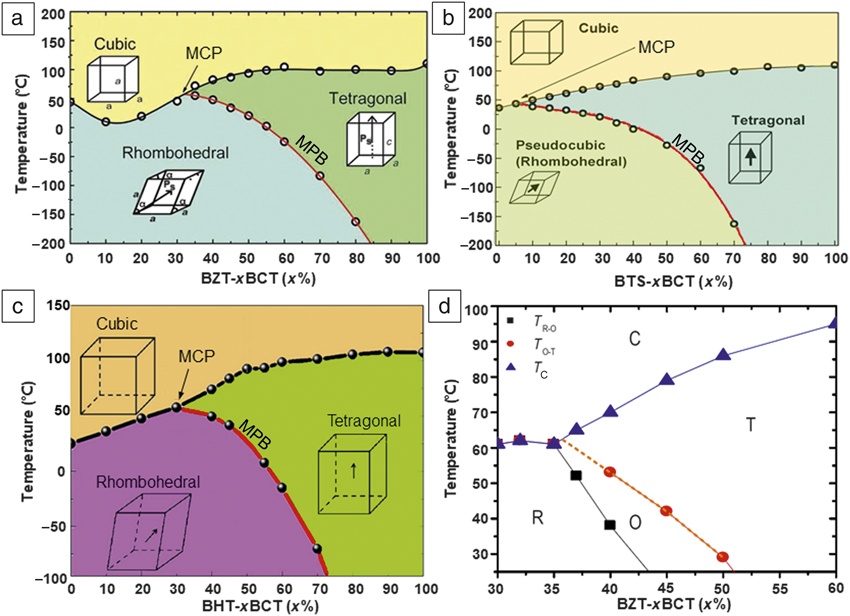
High-performance BaTiO3-based systems (BZT-BCT, BST-BCT, BHT-BCT) exhibit similar phase diagrams, as shown in Figure 1a–c.Reference Liu and Ren10–Reference Zhou, Liu and Xue12 They all exhibit a PZT-like phase diagram characterized by a morphotropic phase boundary (MPB) (shown in Figure 1) separating two ferroelectric phases (tetragonal [T] and rhombohedral [R]).Reference Liu and Ren10,Reference Ehmke, Ehrlich, Blendell and Bowman31–Reference Gao, Zhang, Xue, Kimoto, Song, Zhong and Ren34 As highlighted in Figure 1a–c, the most important feature of the phase diagrams in this generic class of materials is that MPB starts from a multiphase coexisting point (MCP) in the phase diagrams, where cubic (C), tetragonal (T), and rhombohedral (R) phases meet. We will show how the MCP results in important consequences that account for the high piezoelectricity of this new class of BT-based materials.
Generic phase diagram of BaTiO3-based systems. (a) Phase diagram of Ba(Zr,Ti)O3-(Ba,Ca)TiO3 (BZT-BCT).Reference Liu and Ren10 (b) Phase diagram of Ba(Sn, Ti)O3-(Ba,Ca)TiO3 (BTS-BCT)Reference Xue, Zhou and Bao11 and (c) Ba(Hf,Ti)O3-(Ba,Ca)TiO3 (BHT-BCT).Reference Zhou, Liu and Xue12 (d) Modified phase diagram of BZT-BCT,Reference Acosta, Novak and Jo13 which amends the Liu–Ren phase diagram by adding an intermediate orthorhombic phase (O). Note: MCP, multiphase coexisting point; MPB, morphotropic phase boundary; R, rhombohedral; T, tetragonal; C, cubic; T R-O, transition temperature of R to O phase; T O-T, transition temperature of O to T phase; T C, Curie temperature; Ps, spontaneous polarization.

More detailed recent investigations suggest the existence of a bridging orthorhombic (O) phase in BZT-BCT between the T and R phases at MPB such that the MPB is not a line, but an extended O phaseReference Keeble, Benabdallah, Thomas, Maglione and Kreisel35–Reference Zhukov, Acosta, Genenko and Seggern38 (Figure 1d). It is likely that the bridging O phase also exists in BTS-BCT and BHT-BCT systems and further studies need to verify this hypothesis.
Interestingly, the research development in BZT-BCT is similar to that of PZT, where MPB was initially reported to be a line separating the R and T phases, but later turned out to be a bridging monoclinic phase.Reference Noheda, Cox and Shirane39 The existence of bridging O phase at the MPB suggests that the MCP is not a C-T-R triple point, but a C-T-O-R multiphase coexisting point. It should be noted that there is some uncertainty as to whether the MCP is a point or an extended region.Reference Acosta, Novak and Jo13,Reference Acosta, Khakpash, Someya, Novak, Jo, Nagata, Rossetti and Rödel14 Further research is needed to clarify this.
Properties in relation to MPB and MCP
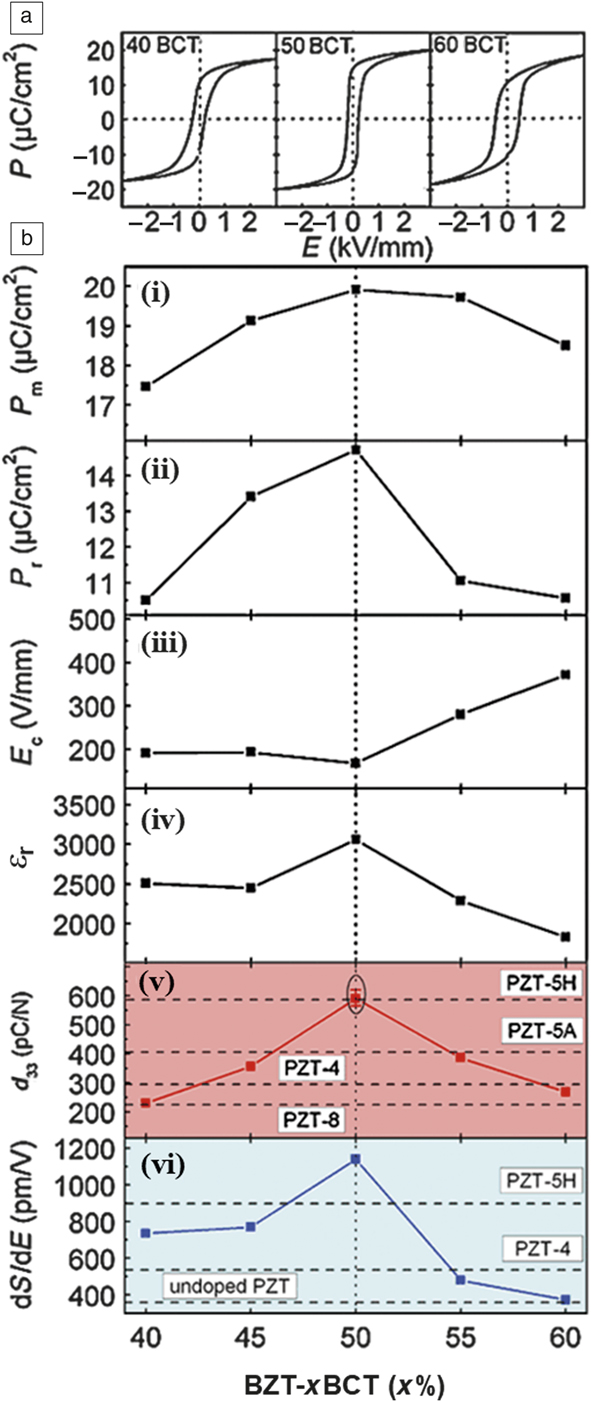
Figure 2 shows an example in BZT-BCT of ferroelectricity, dielectric permittivity, and more importantly, piezoelectricity, showing maximum values around the MPB composition;Reference Liu and Ren10 similar results have been found for BTS-BCT and BHT-BCT.Reference Xue, Zhou and Bao11,Reference Zhou, Liu and Xue12 In these systems, the optimal d 33 at the MPB can reach 500–620 pC/N, comparable to that of soft PZT. It is also found that the permittivity peaks at the MCP, with εr ∼ 25,000,10 which is much higher than the value for pure BT ceramic (∼10,000).Reference Gao, Hu, Wang, Liu, Zhang, Ke, Zhong, Zhao and Ren40 This suggests that the MCP is the most field-susceptible location in the phase diagram.
Ferroeletricity, dielectric permittivity, and piezoelectricity of (1-x%)Ba(Zr0.2Ti0.8)O3-x%(Ba0.7Ca0.3)TiO3 (BZT-xBCT) around the morphotropic phase boundary (MPB) composition.Reference Liu and Ren10 (a) (Left to right) Hysteresis loops of BZT-40 BCT, BZT-50 BCT, and BZT-60 BCT, respectively. (b[i]) Saturation polarization P m, (b[ii]) Remnant polarization P r, (b[iii]) coercive field E c, (b[iv]) permittivity εr, (b[v]) piezoelectric coefficients d 33, and (b[vi]) converse piezoelectric coefficient dS/dE. These coefficients show maximums at the MPB composition (dashed lines in the figures indicate the value of d 33 or dS/dE of PZT-5H, PZT-5A, PZT-4, and PZT-8, which are commercialized PZT ceramics that differ in piezoelectric properties, depending on their specific applications) Note: P, polarization, S, strain; E, electric field.

Since BT and BT-based ceramics normally do not show high piezoelectricity, the anomalously high piezoelectricity observed for BZT-BCT generic systems needs an explanation. Much effort has been made in an attempt to answer this important question.Reference Gao, Hu, Zhang, Li, Zhang, Wang, Hao, Zhong and Ren19–Reference Zhao, Ke and Wang29 Factors such as elastic softening,Reference Acosta, Novak and Jo13,Reference Acosta, Khakpash, Someya, Novak, Jo, Nagata, Rossetti and Rödel14,Reference Benabdallah, Simon, Khemakhem, Elissalde and Maglione16–Reference Xue, Gao, Zhou, Ding, Sun, Lookman and Ren18 high domain wall mobility,Reference Gao, Hu, Zhang, Li, Zhang, Wang, Hao, Zhong and Ren19,Reference Tutuncu, Li, Bowman and Jones20 phase instability,Reference Brandt, Acosta, Koruza and Webber15,Reference Wang, Wang, Li, Xu, Hou, Cao, Feng and Fei21 and degree of polingReference Acosta, Khakpash, Someya, Novak, Jo, Nagata, Rossetti and Rödel14,Reference Ehmke, Glaum, Hoffman, Blendell and Bowman22 have been considered, but no single factor is considered deterministic. The role of these factors in improving the piezoelectric performance has been summarized in recent reviews.Reference Acosta, Novak and Rojas30,Reference Gao, Xue, Liu, Zhou and Ren41 In the following, we show that the high piezoelectricity of the BZT-BCT generic systems stems from the MCP in the system, and this explains why normal BT and other BT-based systems do not show impressive piezoelectricity (in a random polycrystalline form).
Tricriticality and microstructural anomaly at the MCP
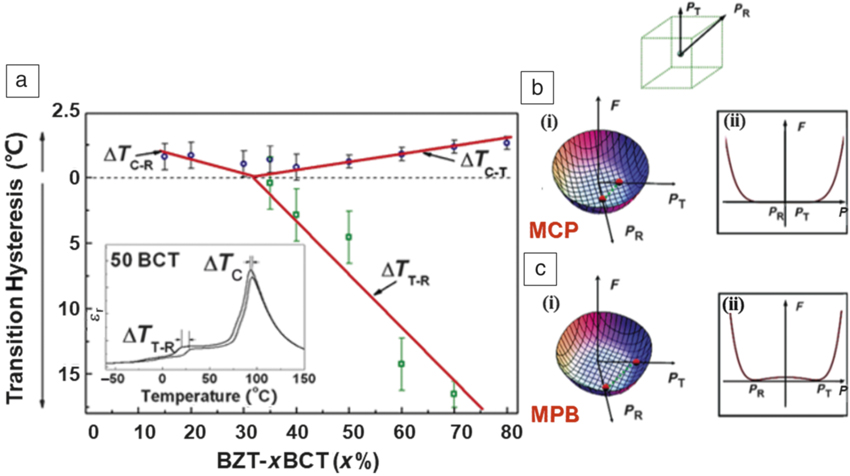
Figure 3a shows that the MCP is not merely a point where C, T, R, and O phases meet; it is a tricritical point (i.e., a point where the first-order transition crosses over into a second-order transition), as characterized by vanishing transition hysteresis and latent heat.Reference Liu and Ren10,Reference Gao, Ye, Hu, Ke, Zhong, Li, Zhang, Wang, Wang, Wang, Liu, Xiao and Ren42 This means that at the MCP, no energy barrier exists among the four phases; thus this situation corresponds to a flat or frying-pan-shaped free-energy landscape,Reference Liu and Ren10 as shown in Figure 3b(i–ii). The MPB, starting from the MCP, partially inherits this low anisotropy feature and thus generates high d 33 at the MPB composition. This makes a difference between the BZT-BCT generic systems and other BT-based systems and thus provides an explanation for the unexpectedly high piezoelectricity in such systems.
Tricritical behavior of (1-x%)Ba(Zr0.2Ti0.8)O3-x%(Ba0.7Ca0.3)TiO3 (BZT-xBCT) ceramic and the associated free-energy landscape. (a) Thermal hysteresis of the three transitions (C-T, C-R, and T-R) for BZT-xBCT ceramic nearly vanishes when approaching the multiphase coexisting point (MCP), and the inset shows measurement of thermal hysteresis for BZT-50BCT using heating and cooling permittivity–temperature (εr–T) curves. (b[i–ii]) MCP tricritical point showing flat free-energy landscape between P T and P R. (c[i–ii]) Morphotropic phase boundary (MPB) composition at room temperature showing low, but nonvanishing, free-energy landscape between P T and P R.Reference Liu and Ren10 Note; C, cubic; T, tetragonal; R, rhombohedral; PZT, Pb(Zr, Ti)O3; P T, axis for tetragonal polarization; P R, axis for rhombohedral polarization; ΔT C, thermal hysteresis for Curie temperature; ΔT T-R, thermal hysteresis for T-R transition temperature (indicated by green data); ΔT C-T, thermal hysteresis for C-T transition temperature (indicated by blue data); ΔT C-R, thermal hysteresis for C-R transition temperature (indicated by blue data); F, free energy.

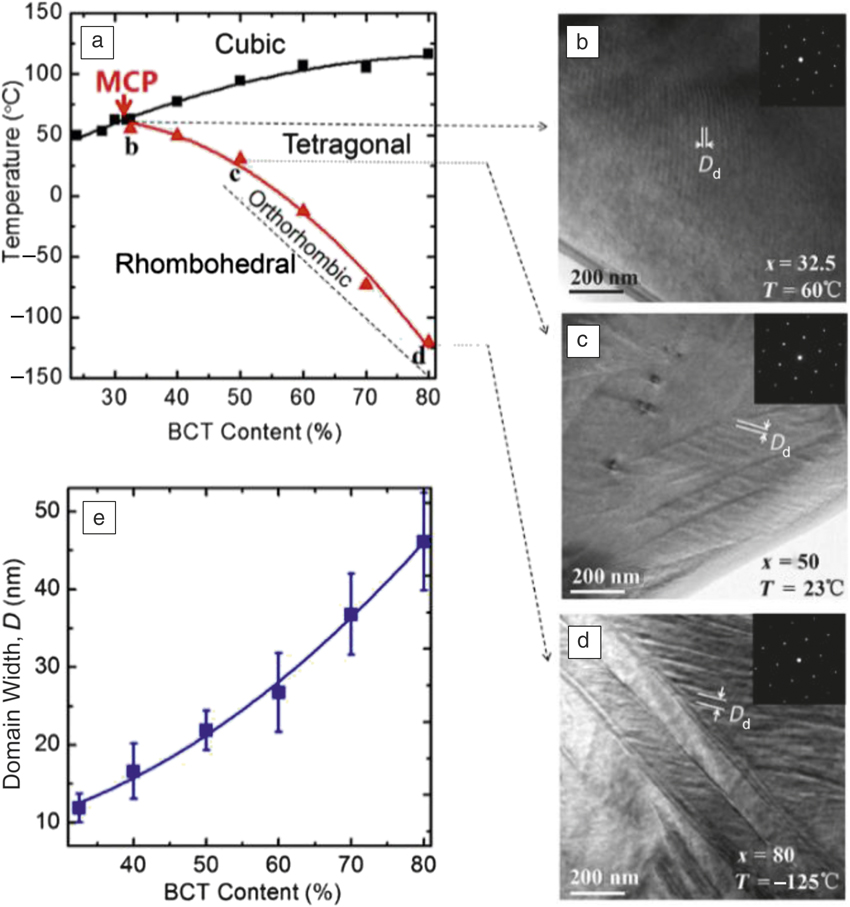
Figure 4 shows that the tricriticality of the MCP yields interesting microstructural featuresReference Gao, Hu, Wang, Liu, Zhang, Ke, Zhong, Zhao and Ren40–Reference Gao, Liu, Wang, Hu, Yan, Ke, Zhong, He and Ren44 not seen in standard BT-based materials. At the MCP (the tricritical point), mottled nanodomains appear with blurred boundaries and miniaturized domains (Figure 4b),Reference Gao, Hu, Wang, Liu, Zhang, Ke, Zhong, Zhao and Ren40,Reference Gao, Ye, Hu, Ke, Zhong, Li, Zhang, Wang, Wang, Wang, Liu, Xiao and Ren42 contrasting with large regular domains in the off-MCP compositions. The isotropic nanodomains at the MCP are consistent with the vanishing polarization anisotropy or vanishing energy barrier.Reference Gao, Ye, Hu, Ke, Zhong, Li, Zhang, Wang, Wang, Wang, Liu, Xiao and Ren42 Such a microstructure is an indication of the flat free-energy landscape shown in Figure 3. The off-MCP compositions show a hierarchical domain structure at the MPB in BZT-BCT,Reference Gao, Xue, Wang, Wang, Zhang, Wu, Guo, Bao, Zhou and Liu33,Reference Gao, Zhang, Xue, Kimoto, Song, Zhong and Ren34,Reference Guo, Zhou, Ren and Tan45–Reference Xue, Zhou, Gao, Ding and Ren49 which indicates low but nonvanishing polarization anisotropyReference Liu and Ren10 (as shown in Figure 3c[i–ii]). Therefore, the high piezoelectric performance at the MPB seems to stem from the vanishing polarization anisotropy at MCP.
Transmission electron microscope (TEM) observations for domain structures of (1-x%)Ba(Zr0.2Ti0.8)O3-x%(Ba0.7Ca0.3)TiO3 (BZT-xBCT) on a morphotropic phase boundary (MPB) line approaching the multiphase coexisting point (MCP) tricritical point.Reference Gao, Ye, Hu, Ke, Zhong, Li, Zhang, Wang, Wang, Wang, Liu, Xiao and Ren42 (a) Phase diagram for BZT-BCT ((Ba0.7Ca0.3)TiO3) showing the locations (points b, c, and d) of the TEM observations. (b) At MCP tricritical point, mottled nanodomains appear with blurred boundaries. (c–d) Off-MCP compositions show hierarchical domain structure at MPB in BZT-xBCT at (c) x = 50% and (d) x = 80%. The diffraction patterns in (b–d) indicate that all images were viewed from the same crystallographic orientation. (e) Domain width decreases on approaching MCP. Note: T, temperature; D d, domain width.

Modeling
Much effort has been made to understand the observed experimental phenomena using Landau–Devonshire-type phenomenological models,Reference Porta and Lookman50–Reference Yang, Ke and Wang52 in which the free energy of the system can be expressed in the form of a polynomial with respect to a so-called order parameter that is the spontaneous polarization. However, to date, there is no predictive theory that can explain why BZT-BCT generic systems show a tricritical MCP and high piezoelectricity, whereas normal BT-based materials do not. This is at the heart of the problem and awaits future theoretical efforts.
Summary
We have briefly reviewed the phase diagrams, piezoelectric properties, microstructure, and theoretical modeling of BZT-BCT-type generic systems. The role of the multiphase coexisting point (MCP) and the MPB region starting from a MCP in enhancing the piezoelectric performance is highlighted. A better understanding of the observed high piezoelectricity in the hitherto “mediocre” BT-based piezoelectric materials may be transferable to the understanding and development of high-performance Pb-free piezoelectric materials in other systems.Reference Gao, Hao, Ren, Kimoto, Fang, Li, Wang, Zhong, Li and Ren53,Reference Gao, Ren, Zhang, Hao, Fang, Zhang, Dai, Hu, Wang, Zhong and Li54
Acknowledgments
We thank Y. Wang, W.F. Liu, C. Zhou, L. Zhang, Y. Liu, and Z. He for helpful discussion, and gratefully acknowledge the support of the National Basic Research Program of China (Grant No. 2012CB619401), the National Natural Science Foundation of China (Grant Nos. 51571156, 51321003, 51302209, 51431007, and 51320105014), and the Program for Changjiang Scholars and Innovative Research Team in University (IRT13034). J.G. acknowledges the Fundamental Research Funds for the Central Universities for financial support. X.R. acknowledges support from the JSPS Kakenhi Grant.

Jinghui Gao is an associate professor in the State Key Laboratory of Electrical Insulation and Power Equipment at Xi’an Jiaotong University, China. He received his PhD degree from Xi’an Jiaotong University in 2012. He completed a joint program at the National Institute for Materials Science, Japan (2009–2012). His current research interests focus on functional dielectric materials and correlated microstructural characterization. He has published more than 50 papers in peer-reviewed journals (with more than 1100 citations). Gao can be reached by email at gaojinghui@mail.xjtu.edu.cn.

Xiaoqin Ke is a lecturer at the Frontier Institute of Science and Technology at Xi’an Jiaotong University, China. She received her PhD degree from the Department of Materials Science and Engineering at The Ohio State University in 2014. Her research interests focus on modeling and design of ferroelectric and ferromagnetic materials. She has published approximately 20 papers in this field. Ke can be reached by email at kexiaoqin@xjtu.edu.cn.

Matias Acosta is a Feodor Lynen Fellow at the University of Cambridge, UK. He received his materials engineering degree from the Sabato Institute, Argentina, in 2011. He obtained his doctoral degree in materials science from the Technical University of Darmstadt, Germany, in 2015. His research interests include synthesis and characterization of piezoelectric and ionic conductor ceramics and thin films. Acosta is also the curator of Global Shapers Cambridge Hub (Global Shapers is an initiative of the World Economic Forum), where he leads projects at the interface between science, diplomacy, and policy. He has received 13 international awards/distinctions. He has published more than 30 articles (>1000 citations), two pending patents, and one book. Acosta can be reached by email at ma771@cam.ac.uk.

Julia Glaum is an adjunct associate professor in FACET (Functional Materials and Materials Chemistry Research Group) in the Department of Materials Science and Engineering at the Norwegian University of Science and Technology, Norway. She received her PhD degree from the Technische Universität Darmstadt, Germany, in 2010, and completed postdoctoral research at the University of New South Wales, Australia, holding a Discovery Early Career Researcher Award. In 2015, she was awarded a Marie-Curie Individual Fellowship by the European Research Council. Her research focuses on functional biomedical materials as well as fundamental switching phenomena in ferroelectric and relaxor-based systems. She has published approximately 50 papers and has been cited more than 1000 times. Glaum can be reached by email at julia.glaum@ntnu.no.

Xiaobing Ren is a professor at the Frontier Institute of Science and Technology at Xi’an Jiaotong University, China, and a managing researcher at the National Institute for Materials Science, Japan. His research interests focus on a wide range of ferroic materials, from ferroelectric/piezoelectric materials to shape-memory alloys to magnetostrictive materials. He has published more than 200 papers. His papers have been cited more than 11,000 times. He has received the Outstanding Young Researcher Award of The Japan Institute of Metals and Materials (1998), the Tsukuba Outstanding Young Scientist Prize (2005), the Meritorious Award of The Japan Institute of Metals and Materials (2011), and the National Natural Science Prize of China (2016). Ren can be reached by email at ren.xiaobing@nims.go.jp.