In 2019, tens of thousands of Hong Kongers flooded the streets to protest the government’s proposal of a highly controversial extradition bill. While the government eventually suspended the legislative process, in the following year Beijing enacted a national security law (NSL) to quell meaningful dissenting voices in the special administrative region. Democratic regimes around the world are facing an autocratization crisis.Footnote 1 The renewed interest of political science in democratic backsliding has looked at established democracies worldwide and the internal causes behind their democratic decline.Footnote 2 However, autocratization can also be an external threat from an autocratic state trying to assimilate a peripheral democracy.Footnote 3 Here, we investigate the following research questions: what role does identity threat play in shaping voter turnout? How does this relationship evolve during times of authoritarian transition? In the case of Hong Kong, why did Hong Kongers, when faced with institutional autocratization, want to participate more in politics?
Building on social identity theory and its application to mass political behaviour, we argue that threats to identity and their impact on voter turnout are contingent on the degree of autocratization.Footnote 4 We posit that critical threats against Hong Konger identity, so long as voting is still perceived as a meaningful act to some extent, are more likely to increase participation in elections, despite ongoing autocratization and rapid assimilation. This expectation is rooted in our understanding that imminent autocratization shifts the meaning of political participation. When a democracy, partial or full, undergoes a systemic change during which institutions become less free and fair, voting becomes a symbolic act of resistance and a form of political action in support of democracy and in opposition to autocratization.Footnote 5
To test our theoretical argument, we focus on Hong Kong, a formerly semi-autonomous city that has been experiencing increasing autocratization over the past decades. Hong Kong was never a full democracy, but it did once enjoy key major civil liberties and political rights, such as freedom of speech, freedom of the press and largely free and fair elections for some positions in both the local district councils and the Legislative Council, the city’s legislature.Footnote 6
However, 2019 marked a critical shift for Hong Kong’s semi-democratic institutions, when the government proposed an extradition bill that would have allowed the transfer of fugitives from Hong Kong to mainland China. The proposal triggered mass protests and even violent resistance from civil society. In response, Beijing enacted an all-encompassing NSL the following year to constrain the opposition. As a result, all of Hong Kong’s semi-democratic features were faced with imminent autocratization.Footnote 7 Studies have shown that, prior to 2019, Beijing’s weakening of Hong Kong’s democratic system increased Hong Kongers’ likelihood of participating in contentious political activities, such as protesting, but had no effect on their propensity to vote.Footnote 8 In what follows, we build on previous studies and interrogate how threats to Hong Konger identity mobilize voter propensity, even under conditions of authoritarian transition. Our study also contributes to the renewed debates in political science on democratic backsliding by considering the relationship between identity threat and political behaviour during an autocratizing Hong Kong. This case, situated in a region often neglected in backsliding debates, serves as a critical example of autocratization and may be useful for theory building in comparative politics.
As part of our research, we fielded three survey experiments that prime threat against Hong Konger identity, each conducted during a distinct phase of Hong Kong’s autocratization process. The political context and timing of when we fielded our three waves were crucial; it is rare to implement three studies during an autocratic transition. Our data are unique in that they were gathered before, during and after Hong Kong’s critical autocratization process and rapid assimilation with the People’s Republic of China (PRC). In our first experiment, fielded at the beginning of 2019 before Hong Kong’s most extreme autocratization policies were implemented, identity threat had no impact on voter turnout propensity. However, when we fielded a second identical experiment after the government proposed the new extradition bill, exemplifying a time beginning to be characterized more by autocratization, identity threat increased the likelihood of voter turnout relative to a neutral control group. A third experiment, fielded a week before the imposition of the 2020 NSL during a period of extreme and critical autocratization, yielded a similar pattern: an identity threat prime also increased voter propensity.
The findings from our experiments suggest a paradox: citizens’ propensity to vote actually increases when they are facing a shrinking opportunity to participate in formal politics. The more autocratic Hong Kong was expected to become, the more likely citizens were to utilize every form of political participation to block or defer the autocratization process, including voting. Even though voting may have become less likely to influence political or policy outcomes, the diminishing opportunity to participate in relatively free and fair elections may have motivated Hong Kong citizens to vote as a symbolic act of defending their social groups against the threat of democratic backsliding.
Defining Autocratization
At its most basic conceptualization, autocratization is the formal opposite of democratization. It is a process of regime change during which formal and informal institutions become less liberal, less open and more restrictive.Footnote 9 It is the “process of regime change towards autocracy that entails a modification of the formal and informal institutions regulating political participation, public contestation and executive limitation. Specifically, it consists of the weakening of executive constraints, civil and individual liberties, political rights, restriction of political competition, and in the limitation of political participation.”Footnote 10 Political science’s renewed interest in autocratization focuses on how elites and leaders in democracies such as Turkey, Hungary or the United States are pushing institutions towards this illiberal trend.Footnote 11 Other studies have looked at historic trends across the world to show that we are currently living through a third wave of global autocratization.Footnote 12
In 2024 alone, autocratization spiked to new levels. One study estimates that 38 per cent of the world’s population live in autocratizing states. For the first time since 2001, democratic states are no longer in the majority.Footnote 13 Before 2024, states such as Hungary, Brazil and India were already showing signs of autocratization through limiting press freedom and altering other fundamental democratic norms. Despite the drastic increase in autocratization since 2019, protests in response to authoritarian turns have also reached new heights. From Sudan to Poland, protests in support of democracy were key highlights, despite their governments’ authoritarian trends.Footnote 14
Several characteristics of autocratization are consistent across cases. These include civil society becoming illiberal and democratic elections becoming less free and fair. However, where these autocratic threats originate can vary, as they may be internal or external.Footnote 15 An important difference in how autocratic threats manifest in places like Hungary or Brazil versus places like Hong Kong or Taiwan is whether those threats are externally or internally generated. In Hungary and Brazil, autocratic threats come from internal politicians who were democratically elected and then push for illiberal changes. In Hong Kong and Taiwan, autocratic threats come externally from the national government of the PRC, which explicitly seeks to weaken their democratic institutions in order to incorporate these peripheral polities into the PRC’s more central political framework.Footnote 16 While Taiwan is able to maintain its democratic institutions, it faces a similar type of autocratic threat from the PRC that Hong Kong faces.Footnote 17 Although autocratic change in Hungary or Brazil has similar consequences for its citizens’ right to participate in politics, there is still a sovereign country called Hungary or Brazil, regardless of the regime. For Hong Kong, however, autocratization has the potential to fully eliminate its status as a semi-autonomous polity. Unlike cases of autocratization where an autocrat was democratically elected and then weakened the democratic system, Hong Kong was never fully democratic and instead had autocratization imposed exernally by the PRC rather than through internal elected officials. These varying antecedents of autocratization help explain how and why there is so much variation in autocratization. There is, however, one feature that they all share: electoral institutions exist to varying degrees, and these systems are perceived to be legitimate by the voters. This also highlights an important scope condition: autocratization does not itself increase voter turnout; it can only do so as long as there are democratic institutions that are deemed legitimate by citizens.
Identity Threat and Voter Mobilization during Times of Autocratization
Social identity theorist Henri Tajfel argues that individuals think of themselves within groups and that these self-affiliated groups have value and meaning.Footnote 18 Group identities become especially salient when groups come under threat.Footnote 19 These threats do not necessarily need to be tangible; they can range from financial or territorial losses to merely symbolic losses.Footnote 20 Previous research suggests a link between regional autonomy and Hong Kongers’ willingness to participate in contentious politics, specifically for those who identify as Hong Konger but not Chinese.Footnote 21 When self-identified Hong Kongers sense threats of autocratization, they feel a stronger attachment to their group identity as Hong Kongers. Once this sentiment is activated, it mobilizes them to take action to defend the status and position of the group to which they feel closely connected. As a result, Hong Kongers are more likely to participate in various types of contentious political participation, including protesting. Various other studies have contributed to the analysis of contentious action taken by Hong Kongers in the face of threats.Footnote 22 One type of political action that has not been previously linked to identity threat is willingness to vote.Footnote 23
There is a growing literature examining the protest–voting nexus in authoritarian regimes.Footnote 24 For instance, scholars have found that in Russia, exposure to opposition protests led to a drop in the vote share of the ruling party and dampened support for the regime in general.Footnote 25 On the other hand, scholars have found that participants in episodes of protests may consider extending their resistance to the electoral realm by running as candidates themselves.Footnote 26 Hence, scholars should pay attention to how agents of resistance “frequently develop and engage in mundane and cumulative repertoires of resistance against autocratization.”Footnote 27 This research intervenes in this debate by examining the relations between identity threat and voter mobilization during times of autocratization.
We argue that under ongoing autocratization, identity threat among Hong Kongers increases the likelihood of voter participation. Hong Kongers not only take to the streets to protest but also vote on behalf of their identified groups.Footnote 28 For example, one study finds a positive relationship between protest exposure and voter turnout during Hong Kong’s 2019 elections among those who identify as Hong Konger.Footnote 29 Following symbolic and expressive approaches to political behaviour, political action is not necessarily driven solely by the masses’ desire to change policy outcomes.Footnote 30 Instead, it becomes more likely among individuals from marginalized groups who seek to defend their group and, ultimately, maintain their own sense of self.Footnote 31 In line with other political science research, we argue here that Hong Kong has entered an era of imminent autocratization since the 2019 extradition bill was proposed.Footnote 32
Case Selection: Dynamics of Autocratization and Identity Threat in Hong Kong
What does ongoing autocratization look like in the context of Hong Kong? In the early years of British rule, the colony did not establish democratic institutions. However, from the 1970s, residents began to enjoy partial freedoms, such as freedom of speech and expression. When the British and Chinese governments began to negotiate the city’s future political arrangements in the early 1980s, civil society was galvanized, and the local democratization movement began to take shape.Footnote 33 Yet, after the handover in 1997, when Hong Kong became a special administrative region under the sovereign rule of the PRC, democratic transition was severely constrained as the implementation of substantive democratic reforms was repeatedly delayed by Beijing.Footnote 34 A form of hybrid regime, or electoral authoritarianism, was formed and concretized: while regular elections were held at the local level and for some seats in the Legislative Council, fairness was not guaranteed.Footnote 35 For instance, gerrymandering was used to undermine the electoral performance of the opposition.Footnote 36 Nevertheless, civil society was still able to enjoy partial freedom of expression, such as freedom of protest and most other rights enjoyed in liberal democracies. Since then, Hong Kong has slowly undergone political assimilation into the PRC through various economic, cultural and political policies.Footnote 37
Prior to the proposal of the extradition bill in 2019 and the subsequent implementation of the NSL in 2020, Hong Kong was slowly moving along the autocratization spectrum, a pathway characterized with protests and civil society organizing. Besides autocratization, repeated attempts were made to assimilate Hong Kong into the mainland. When the Hong Kong government attempted to implement assimilative measures, or when democratization was delayed, Hong Kongers rose to the challenge and mobilized large-scale protests. For example, in 2012, thousands turned out to protest against a national education curriculum proposed by the government. The proposed curriculum was widely criticized as an attempt by the government to impose a restrictive Chinese national identity on students. Two years later, in 2014, tens of thousands occupied two districts in the city to fight for full democracy, but the attempt failed.Footnote 38 In the face of PRC-driven autocratization and assimilation, Hong Kongers resorted to contentious political activities.
For decades, the identity categories of “Chinese” and “Hong Konger” were not mutually exclusive among the citizens of Hong Kong. For instance, during the Beijing Olympics in 2008, identification with the category of “Chinese” surged among citizens in Hong Kong. However, since then, following the government’s induced rapid assimilation with the mainland and the emergence of related conflicts between local residents and mainland tourists and immigrants, the national and local identities have drifted apart.Footnote 39 In the 2010s, several new political parties and groups, such as Hong Kong Indigenous, were formed to directly confront the identity threat. These organizations advocated localism, explicitly rejected the Chinese identity and successfully garnered a degree of popular support. Indeed, both the protests in 2012 and the occupation in 2014 were characterized by the participation of a younger generation that advocated a stronger Hong Konger identity.Footnote 40
In 2019, autocratization efforts became more extreme. The Hong Kong government proposed an extradition bill to amend the Fugitive Offenders Ordinance, which would have allowed residents of the special administrative region to be extradited to the mainland, which at the time was formally a separate jurisdiction. The potential implications of this change meant that anyone in Hong Kong could be sent to the mainland at Beijing’s request. Many feared that this would fundamentally alter their right to dissent against Beijing, prompting mass protests from civil society against the bill. Early protests, however, were met with police brutality. As in Catalonia, state repression galvanized broader mobilization, leading to massive protests in which, at one point, more than a million protesters marched in the streets, as well as radicalization and the creation of new forms of solidarity among protesters.Footnote 41 While the movement successfully forced the government to back down on the bill, Beijing doubled down on completely dismantling the city’s opposition and civil society. In 2020, the PRC central government swiftly passed and implemented the NSL. This law was vague and made opposition to Beijing de facto illegal. It became a “black box” law to quell dissidents and structurally altered Hong Kong into an illiberal civil society.Footnote 42 The draconian nature of the NSL effectively silenced most, if not all, dissident voices. Since then, the PRC’s policies towards Hong Kong have been characterized as explicit autocratization.Footnote 43
The attack on free speech and the right to protest was not the only structural change after 2019. Hong Kong’s semi-democratic system also took an autocratic turn. After the 2019 local election, elected officials sympathetic to the protests were disqualified from their seats by the government; some were later arrested and jailed for their political stances.Footnote 44 After the introduction of the NSL, legislative and local elections can no longer be considered partly free and fair. Instead, candidates are required to undergo unprecedented screening by a government-appointed committee to ensure that they are “patriots” – i.e. people who would obey Beijing’s call. Pro-democracy or pro-movement politicians are not only disqualified from running but may also face imprisonment for participating.Footnote 45 The number of directly electable seats at the legislature was also reduced from 35 to 20. Subsequently, some major opposition activists and politicians were rounded up and detained in a series of mass arrests. The NSL has changed Hong Kong’s political system into a more autocratic one.
Autocratization had been an ongoing process in Hong Kong long before 2019; however, a shift occurred after the proposal of the extradition bill in 2019. We posit that the three different periods in which our survey experiment was conducted represent three distinct, albeit short, phases in Hong Kong’s autocratization process: Hong Kong before the extradition episode, after the proposal of the extradition bill and, finally, Hong Kong after the introduction of the NSL. These were not randomly selected times but rather periods that reflect clear changes in the fundamental nature of the PRC’s heavy-handed control over Hong Kong. Before 2019, Hong Kong still maintained a relative but meaningful level of partial democracy. But after the 2019 events surrounding the extradition bill, the PRC’s policies became critically more autocratic by completely dismantling Hong Kong’s semi-democratic institutions. Hong Kong was quickly becoming assimilated into the PRC. With the introduction of the NSL, Hong Kong’s full autocratization and assimilation are now well underway. Put simply, during an era of extreme and imminent autocratization, we expect an activated relationship between identity threat and electoral modes of political behaviour.
Hypotheses
We derive three hypotheses from our theoretical expectations regarding how threats to identity affect voter turnout during autocratization. First, priming a threat against Hong Konger identity should have no effect on turnout propensity among Hong Kongers prior to the proposed extradition bill in 2019 (H1). However, priming this same identity threat should have a positive effect on the likelihood of Hong Kongers’ voter turnout after the proposal of the extradition bill (H2). We also expect that the mobilizing effect of Hong Konger identity threat on voter turnout should be unique to those most likely to perceive this changing political context as a threat, Hong Kongers, as compared to those who identify as Chinese (H3).
Methodological Approach and Data Collection
We tested our hypotheses regarding the conditional relationship between identity threat and voter turnout propensity by fielding three survey experiments across different periods of autocratic transition in Hong Kong. Given that experimental data and opportunities for causal inference are already scarce in semi-autonomous regions, our series of experiments also provides leverage over the temporal salience of autocratic potential for voter mobilization, as they were conducted during Hong Kong’s rapidly changing political landscape.
Study 1 and Study 2 were identical in terms of procedure and identity threat treatment. The only difference was the timing and political context under which the studies were fielded. Study 1 (Wave 1) was fielded when the extradition bill was being initially debated in the legislature in May 2019. An identical Study 2 (Wave 2) was fielded in January 2020 after the government had tried to force through the extradition bill proposal. Study 3 introduced a comparable identity threat prime to serve as a robustness test of our previous results and was completed in June 2020, just before the passage of the NSL. Even though the primes for Studies 1 and 2 were different to that for Study 3, the independent variable we set out to test in these experiments was constant – that is, the effect of identity threat on turnout propensity during autocratization.
Common to all three studies is how we measured our dependent variable, voter turnout likelihood. We are careful to not describe our dependent variable as voter turnout itself. This is because, in experimental studies, we cannot measure definitive voter turnout, even in a self-reported format, since actual turnout cannot vary within the span of a ten-minute survey experiment. However, even though we focus on the intention to vote, we move the needle forward in the scholarly understanding of electoral behaviour – particularly in comparative perspective where empirical data are scarce in hybrid regimes and, additionally, in regions where democratic institutions are undergoing autocratization. After random assignment to either an identity threat or control condition, we measured voter turnout propensity by asking our respondents to indicate how likely they were to vote in the upcoming Legislative Council election. We coded likely voters as 1 and unlikely voters as 0.
Prior to randomization, we asked standard demographic questions related to age, gender, political party affiliation, political engagement, education and income. A supplementary table in the online Appendix displays balance tests between the treatment and control group in all three of our experiments, as well as the standard deviation. We observed relative balance between the treatment and control groups based on standard demographics. For all three experiments, Table 1 displays the date of the study’s completion and the sample sizes for each of the treatment and control groups by group identity. This allows us to analyse how identity threat affects voter turnout propensity across different authoritarian contexts, as well as by group identification (Hong Konger versus Chinese-identified; see Hypothesis 3). Across three experiments, we present results for n=2,166 citizens of Hong Kong. All experiments were fielded by the same survey sampling firm, Dynata, previously known as Survey Sampling International.
Sample Sizes Across Experimental Waves

Table 1 Long description
The table presents sample sizes for Hong Kongers and Chinese participants across three experimental waves, distinguishing between treatment and control groups. In Wave 1, Hong Kongers had 298 in treatment and 288 in control, while Chinese participants had 40 in treatment and 36 in control. Wave 2 saw a slight decrease for Hong Kongers, with 276 in treatment and 272 in control, and a similar trend for Chinese participants, with 29 in treatment and 32 in control. Wave 3 showed an increase for Hong Kongers, with 376 in treatment and 397 in control, and for Chinese participants, with 63 in treatment and 59 in control. Overall, Hong Kongers consistently had larger sample sizes than Chinese participants, with Wave 3 showing the highest numbers for both groups.
Notes: N sizes in each experimental condition cell. Total sample size for all three experiments is N=2,166 (n=1,907 Hong Kongers; N=259 Chinese Identifying).
Results
Study 1 and Study 2: identity threat and voter turnout across different periods of autocratization
Our experiment design proceeds as follows. Hong Kongers randomly assigned to an identity threat treatment group were tasked with watching a video that signalled the physical assimilation of Hong Kong. It detailed the construction and opening of a high-speed rail terminal in West Kowloon, in the heart of Hong Kong. In some sections within the terminal, mainland China’s laws would be enforced. The control group was asked to watch a video of similar length, which was simply a weekly weather forecast report in Hong Kong. After each of the experimental conditions was completed, respondents were asked about their likelihood of voting in the upcoming Legislative Council election. We fielded this identical study two times in order to examine the relationship between identity threat and turnout likelihood across different political contexts.
To assess the effect on voter turnout likelihood, we first conducted a difference-in-means test comparing Hong Kongers in the treatment group with those in the control group. We then ran the same difference-in-means tests separately among respondents who identified as Chinese. The results are reported in Table 2.
Voter Turnout Propensity by Experimental and Identity Groups Across Wave 1 and Wave 2

Table 2 Long description
The table measures voter turnout propensity among Hong Kongers and Chinese across two waves, comparing treatment and control groups. In Wave 1, Hong Kongers in the treatment group had a 2.88% higher turnout propensity than the control group, while Chinese in the treatment group had a 6.67% lower turnout propensity. In Wave 2, Hong Kongers in the treatment group showed a significant increase of 7.40% in turnout propensity compared to the control group, whereas the Chinese treatment group showed a decrease of 2.91%. The data suggests a positive effect of the identity threat treatment on Hong Kongers' voter turnout propensity in Wave 2, while the effect on Chinese participants was negative in both waves.
Notes: For difference-in-means, positive values indicate that participants in the identity threat treatment reported a greater likelihood of turning out to vote in the future than those in the control condition.
Table 2 shows that, prior to the major debates of the extradition bill, identity threat, albeit positive, exerted a very small mobilizing effect on turnout likelihood among Hong Kongers (∼+3 points, p=0.48). This provides support for our first hypothesis. Turning to Chinese identifiers, this threat did not positively influence voting likelihood. The results indicate that individuals identifying as Chinese in the threat treatment were actually less likely to report a higher estimate of turning out to vote compared to Chinese identifiers in the weather control group (-7 points, p=0.56).
However, when we fielded the same experiment a second time in January 2020, after the government had tried to force through the extradition bill proposal, identity threat began to increase motivation to turnout to vote. Table 2 also presents the results for Wave 2. While the baseline propensity to vote had increased drastically (Hong Konger Wave 1 Control Baseline = 58 per cent and Hong Konger Wave 2 Control Baseline = 72 per cent), identity threat still had a much larger effect on voter turnout likelihood after the extradition bill was proposed than before it. Prior to Wave 1, there was a three-point effect of identity threat; after the proposal of the extradition bill, there was a seven-point difference between our identity threat treatment group and the control condition in terms of turnout propensity in Wave 2. The effect of an identical identity threat prime on voter turnout likelihood more than doubled in Wave 2 compared to Wave 1, even though the baseline for turning out to vote was already much higher to begin with among Hong Kongers following the introduction of the extradition bill in Wave 2. The threat treatment had little discernible influence on Chinese identifiers when it came to a propensity to vote in the upcoming Legislative Council election.Footnote 46
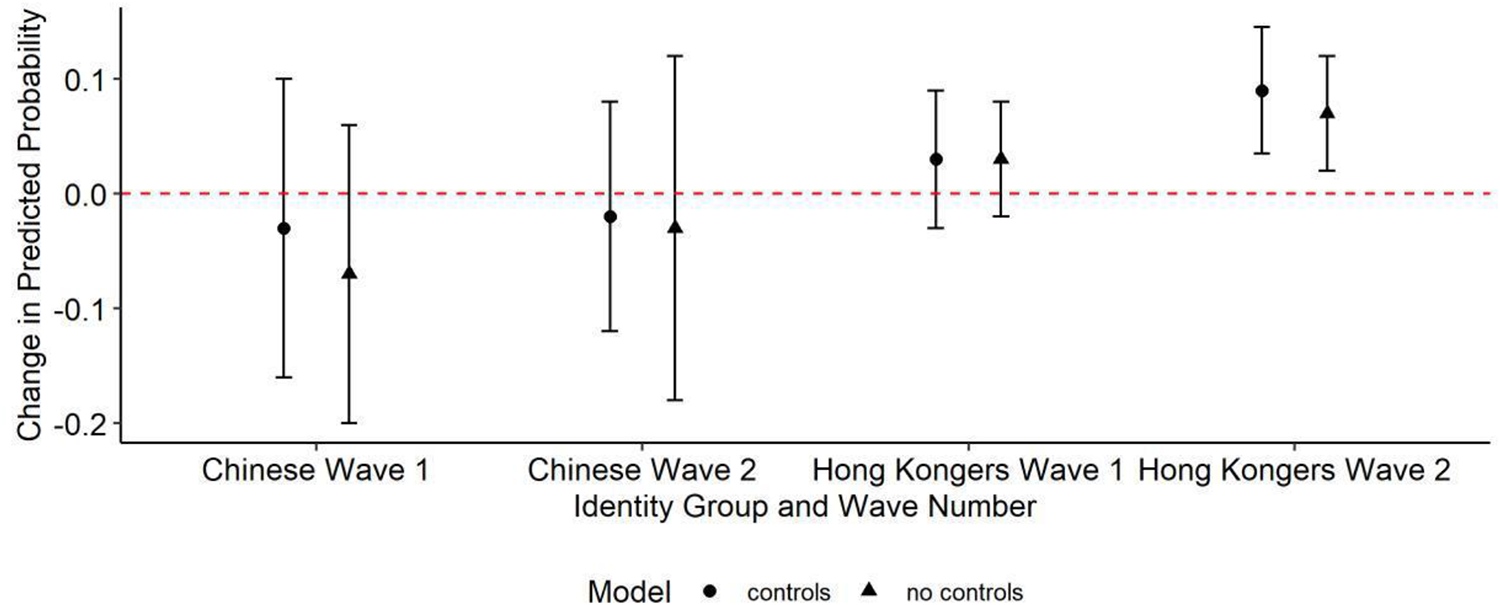
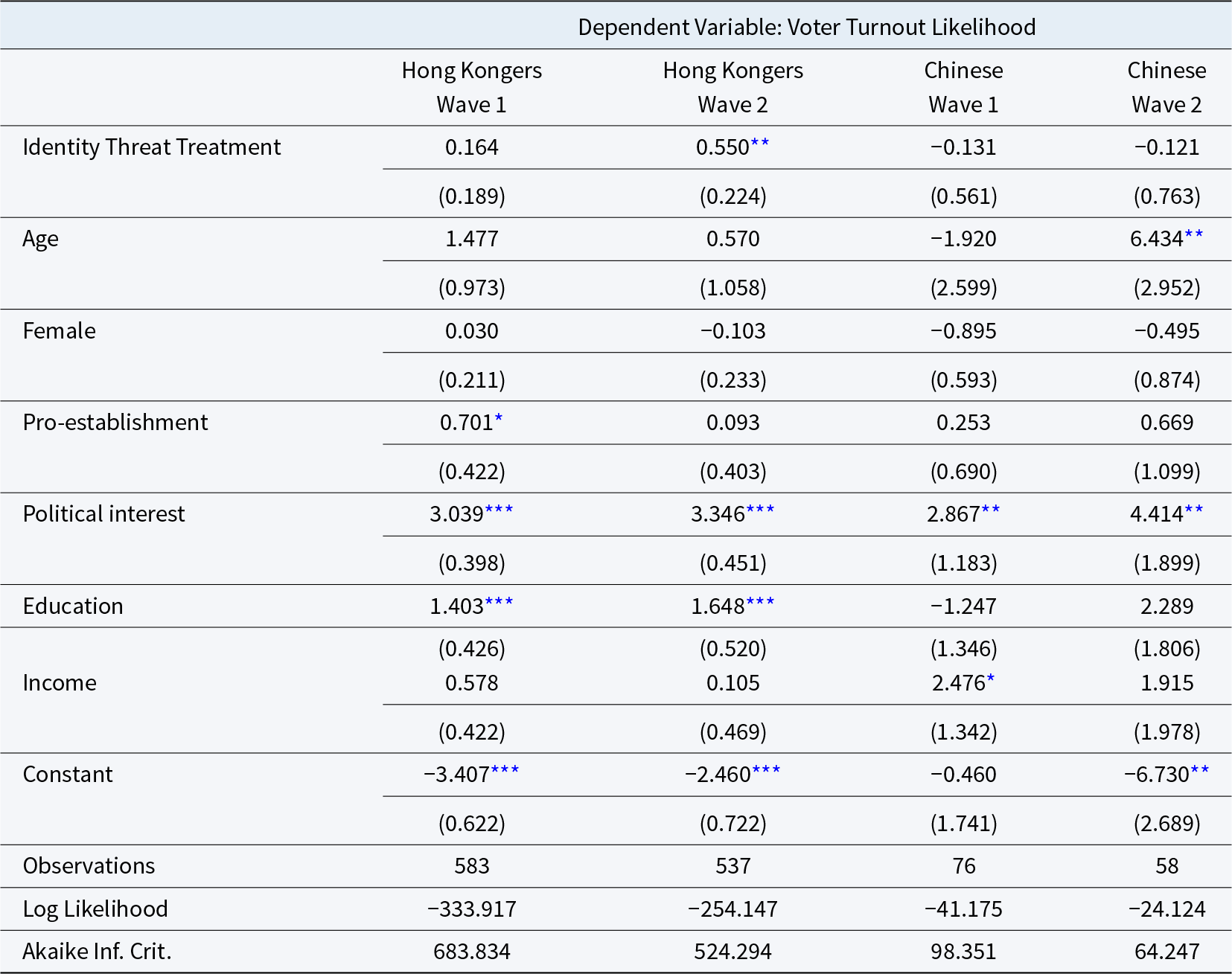
Figure 1 summarizes the marginal effects of identity threat on voter turnout likelihood, estimated from models with and without covariates, across identity groups and over time. Full models are also reported in Table 3. The results demonstrate that this assimilation identity threat has no mobilizing effect on turnout propensity for Chinese identifiers (and perhaps even demonstrates a demobilizing effect) in Waves 1 and 2, regardless of model specification.Footnote 47 Further, the positive effect of identity threat on turnout likelihood appears after the extradition bill proposal, which ushered in an unprecedented era of autocratization in Hong Kong. After accounting for covariates in Wave 2, Hong Kongers in the treatment were nearly nine points more likely than those in the control group to report a strong likelihood of voting. The results of our experimental studies pre- and post- extradition bill events provide some evidence for the unique autocratic conditions under which identity threats can become an impetus for voting in elections.
Identity Threat Treatment Effect on Voter Turnout Likelihood by Identity Group and Wave Number

Figure 1 Long description
The graph shows change in predicted probability on the y-axis and identity group and wave number on the x-axis. It includes data points for Chinese Wave 1, Chinese Wave 2, Hong Kongers Wave 1 and Hong Kongers Wave 2. Each group has two data points: one for controls (circle) and one for no controls (triangle). Error bars are present for each data point, indicating variability. The red dashed line represents zero change in predicted probability. The legend identifies the symbols used for models with controls and no controls.
Effects of Identity Threat on Voter Turnout by Identity and Wave

Table 3 Long description
The table examines the impact of identity threat on voter turnout likelihood among Hong Kongers and Chinese across two waves. Political interest consistently shows a strong positive effect on turnout likelihood, with coefficients of 3.039 and 3.346 for Hong Kongers, and 2.867 and 4.414 for Chinese, all statistically significant. Education also positively influences Hong Kongers' turnout, with coefficients of 1.403 and 1.648, both significant at p<0.01. In contrast, identity threat treatment has a significant positive effect only for Hong Kongers in Wave 2, with a coefficient of 0.550. Age and income show varied effects across groups and waves, with some coefficients reaching significance. The constant terms indicate baseline turnout likelihood, with negative values suggesting low baseline turnout. Observations and model fit statistics vary, reflecting differences in sample size and model performance.
Notes: Logistic regression coefficients with standard errors in parentheses. Models disaggregate by identity group and wave.
* p<0.1; **p<0.05; ***p<0.01.
Study 3: Additional experimental evidence on identity threat and voter turnout propensity during autocratization
In a third experiment, we fielded an additional experimental prime for identity threat in an alternative, non-video format. When considering identity threat in Hong Kong, we drew on scholarship that notes that threats can take on different forms, and as such, we decided on an identity threat treatment that was more politically explicit and, indeed, realistic and relevant to the situation in Hong Kong at the time.Footnote 48 In June 2020, we conducted this third survey experiment one week before the passing of the NSL (which systematically changed Hong Kong’s freedom of speech and freedom of protest). Half of our respondents were again randomly assigned to an identity threat treatment condition that came sequentially before the voter turnout likelihood question. Here, we presented subjects with a vignette that described how the passage of the NSL illustrated an increasing blurring between Hong Kong and mainland China.
In one vignette, we informed participants that, “On May 18, 2020, the National People’s Congress proposed to legislate a national security law in Hong Kong. Those in Hong Kong who undermine the power or authority of the central Chinese government or affiliate with behaviour that would endanger national security would be subject to criminal offences. China could further set up its own political institutions in Hong Kong to strengthen enforcement of this national security law.” We then displayed a photo of the National People’s Congress, where the decision to implement the NSL was under consideration just a few days prior to the fielding of the survey experiment. The photo was presented with the caption (originally in Chinese): “On May 28, 2020, the National People’s Congress approved a resolution to advance the legislation of the National Security Law. Some argue that this legislation will enhance Hong Kong’s safety and political stability by curbing behaviour and activities that threaten national security.” After respondents in the identity threat treatment were presented with the vignettes, turnout propensity was measured. The control group underwent these two stages but in reverse order. Respondents in the control group were asked about their likelihood to vote in the 2020 Legislative Council election before being shown the vignettes, so that the autocratization vignettes could not affect their responses to voter turnout propensity.
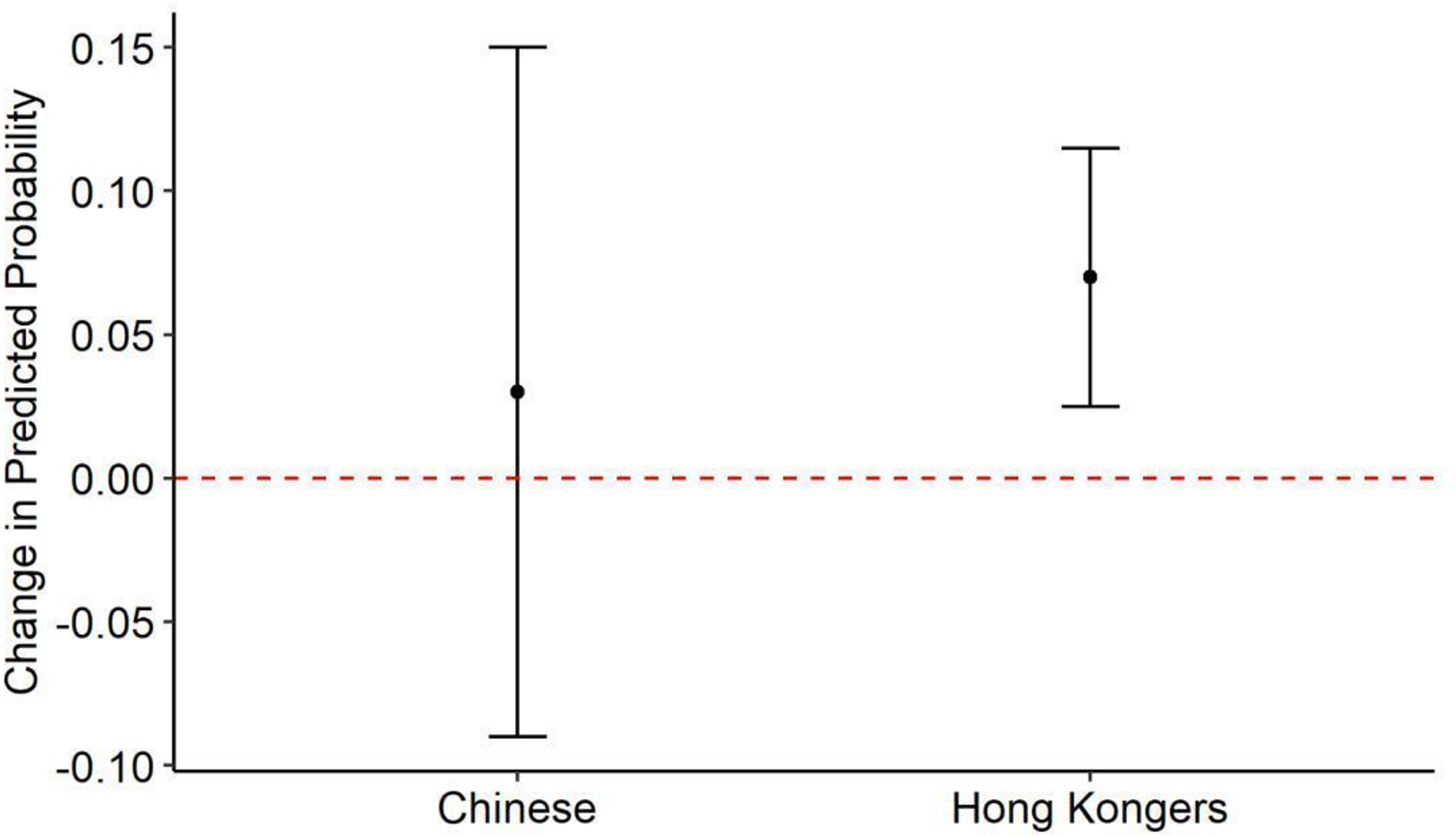
Figure 2 presents the results of the Wave 3 survey experiment, which again tested the potential for voter mobilization in response to this identity threat during a critical period of autocratization. We ran similar differences-in-means tests separately for Chinese-identifying and Hong Konger-identifying respondents. The results show that while there was a positive although uncertain effect of identity threat on voter turnout likelihood among Chinese respondents, Hong Kongers were far more likely to vote in elections due to this alternative identity threat. Compared to Hong Kongers in the control group, Hong Kongers who were primed to think about how the National Security Law would blur the boundary between Hong Kong and mainland China were about seven points more likely to report turning out to vote in the then upcoming Legislative Council election. The marginal effect of this identity threat prime estimated in Wave 3 among Hong Kongers is similar to the effect of the identity threat prime from Wave 2, and both are much larger in magnitude than the effect in Wave 1.
National Security Law Identity Threat Treatment on Turnout Propensity by Identity Group (Wave 3 Only)

Figure 2 Long description
The graph shows the change in predicted probability on the y-axis, ranging from negative 0.10 to 0.15. Two groups are compared: Chinese and Hong Kongers, labeled on the x-axis. Each group has a point with error bars indicating variability. The Chinese group shows a wider range of change, while the Hong Kongers have a narrower range. A dashed horizontal line is present at zero, indicating a baseline for comparison.
Discussion
Our results show that identity threat had no effect on voter turnout among Hong Kongers in the Wave 1 experiment, which was conducted before the events surrounding the extradition bill began. However, after the events in relation to the advent of the extradition bill proposal and Hong Kong’s rapid shift towards extreme autocratization under the PRC, replicating the same experiment yielded a different outcome: the same identity threat significantly increased Hong Kongers’ likelihood of voting (Wave 2). In the Wave 3 experiment, which was conducted close to the eve of the passage of the NSL, we utilized an alternative method for experimentally priming identity threat, and our results were consistent. We find strong support for our first and second hypotheses. Identity threat increased voter turnout among Hong Kongers, especially during periods of explicit autocratization. We also show that the political salience of this identity threat is group specific, providing support for our third hypothesis. Regardless of the experimental prime, wave or time period when the experiments were conducted, this identity threat does not as strongly or as confidently mobilize Chinese-identifying individuals in Hong Kong to participate in elections. Our results on identity threat and voter turnout during authoritarian transition are concentrated among those who specifically identify as Hong Konger.
Our experimental results suggest a paradox between the propensity to engage in formal politics and a shrinking space or opportunity for political participation that ought to be more fully explored. Previous research has found that assimilation mobilized Hong Kongers to engage in informal forms of political action, such as protesting, but not necessarily in conventional modes of politics, such as voting. Here, we find support that identity-based threats also can motivate Hong Kongers to re-include formal modes of political involvement, such as electoral participation, as part of their contention repertoire. We find evidence that voting as political activism is more likely when the transition to an autocratic regime becomes imminent.
We argue that voting as an act of political resistance was activated during this era of Hong Kong’s rapid assimilation into PRC institutions. Voter participation became a symbolic action in addition to just an instrumental means to a political end.Footnote 49 To vote meant to express an identity as a Hong Konger. The election was not only about deciding who would become elected officials but also about symbolically supporting an identity group. Hong Kongers voted to show support for their identity group and to defend the partially democratic political system during a time when the opportunity to use such a tactic and resist was shrinking. Before, voting was not necessarily a primary way for activists to push back against autocratization.Footnote 50 During this extreme time of autocratization, however, when the ability to vote in relatively free and fair elections diminishes, one way to demonstrate resistance to this structural change is to participate in them.
It is worth noting that 2019 was not the first instance of autocratization, nor the first time it led to a spike in voter turnout.Footnote 51 At least three other notable instances in Hong Kong’s recent past also follow this pattern. First, in 2003, following Beijing’s recommendation, the Hong Kong government introduced a proposal to enact national security ordinances.Footnote 52 Civil society responded with mass protests and high voter turnout in the next election. Another attempt at explicit autocratization was made in 2012, when the government proposed to adopt a new national education curriculum requiring schools to teach a “patriotic education” that focused on the PRC and Chinese identity. The proposal also triggered mass protests and another high level of voter turnout in the following election.Footnote 53 Finally, the 2014 Umbrella Movement, protesting Beijing’s refusal to grant universal suffrage to Hong Kongers, again saw mass protests and subsequent high voter turnout in the next Legislative Council election.Footnote 54 Our findings offer a possible explanation for these three historical instances in Hong Kong of voter turnout mobilization.
Our results help to explain the outcome of Hong Kong’s 2019 District Council elections. The local elections made headlines around the world not only because of the massive voter turnout but also because they were a clear expression of civil society’s discontent. In the past, voter turnout rates for District Council elections were around 40 per cent; in 2019, there was an unprecedented turnout rate of more than 70 per cent.Footnote 55 The elections also set a record for new voter registrations leading up to polling day and saw the highest voter turnout in the history of Hong Kong local elections. Before the local election, pro-democracy politicians held 124 seats in the local councils, while the pro-Beijing side held 331 seats. In the 2019 election, the pro-democracy camp won 388 seats (86 per cent of the seats returned by direct election) and Beijing held on to just 89 seats. The 2019 election also served as a way for civil society to legitimize the protests. In order to demonstrate to both Hong Kong and Beijing that civil society largely supported the protests, citizens voted for pro-democratic politicians, turning lower-level elections into something much more symbolically meaningful.
Participation in the 2019 election was not just a typical instance of voting; it was an electoral moment that allowed Hong Kongers to collectively express their identity, support democracy and resist the PRC’s enforced assimilation.Footnote 56 It is important to note that Hong Kongers’ increased propensity to vote did not necessarily come at the expense of contentious political participation. Hong Kongers did not treat protesting and voting as mutually exclusive tactics. In the face of autocratization, they were not less inclined to engage in informal political participation such as protest. Instead, their willingness to participate in formal politics increased simultaneously. Multiple avenues and modes of political participation can be used in tandem.
Conclusion
Our findings have several critical implications for the literature on authoritarianism, identity politics and political behaviour. First, we find that identity groups who feel threatened under certain conditions mobilize to vote. This is especially significant because foundational scholarship in political behaviour generally finds that identity-based considerations tend to mobilize marginalized communities towards contentious rather than formal modes of political participation.Footnote 57 We add to this literature with our finding that the relationship between identity threat and voter turnout becomes particularly apparent in times of explicit democratic decay. Hong Konger-identifying Hong Kongers already felt a sense of identity threat from less existential autocratization policies. However, when their fundamental political rights come under threat, we find that minority groups may mobilize to engage in formal electoral means of political resistance.
Our paper also provides an important methodological contribution by running multi-wave experiments in Hong Kong, where causal identification is less common. We demonstrate that the results of experiments are time sensitive and can differ across time and political contexts. If and where possible, we urge researchers to replicate studies over time in similar case studies. This finding also carries implications for social movement studies and scholars of political opportunity structure.Footnote 58 The opportunity for Hong Kongers to participate in politics before autocratization was diminishing. Voting may not have been something many Hong Kongers felt strongly about before 2019, but as opportunities to participate in both formal and informal politics began to close, they increasingly used every available avenue. Autocratization may push civil society to make use of all forms of political participation before structural changes eliminate these channels of political expression. Although the external conditions under which Hong Kong autocratized may be different from other cases, our findings can still inform how civil society may respond to autocratization across cases where democratic institutions exist and are deemed meaningful by citizens.
We must also note the transitory nature of our findings and how they relate to the scope conditions of this paper’s argument. In response to Hong Kong’s autocratic turn in 2019, voter turnout in Hong Kong reached a record high, despite democratic backsliding. The unprecedented victory of the pro-democracy camp in the 2019 District Council elections spurred Beijing to implement structural changes that thoroughly autocratized Hong Kong’s electoral system.Footnote 59 Today, elections in Hong Kong are no longer fair or free. People’s right to protest has become severely limited, and those who openly oppose autocratization face arrest, jail time and fines, for example. In other words, once autocratization has transformed a system so that it is no longer meaningfully democratic, or even safe to participate in politically, we suspect that the effects we identify in this paper may differ. Hong Kong is no longer autocratizing; it has, to a large extent, already autocratized. As such, our results, which suggest identity threat-driven mobilization of voter turnout, may be capturing only one specific moment in time.
This research may be of interest to scholars studying a larger universe of cases. These include peripheral states facing external autocratic threats, such as Ukraine and Taiwan.Footnote 60 Both places have seen a rise in political action from civil society in response to autocratizing forces attempting to weaken their own democratic institutions. Our study suggests that scholars of Taiwan and Ukraine may consider investigating the conditional effect of identity-based threats on political participation in light of the increased authoritarian pressures both polities face. In a world where autocratization is an ongoing force for so many democracies, our findings help us to gain a better understanding of how citizens of contested states may respond politically during times of autocratization. Hong Kong’s case carries important implications for other regional states facing imminent autocratization and lessons for social scientists who want to understand how civil societies will respond in the face of democratic backsliding.
We conducted our three experiments before Hong Kong’s NSL came into effect. Our final survey experiment was fielded a week before the implementation of the NSL; this is perhaps one of the last time scholars and researchers may be able to safely conduct a social scientific study gauging mass political orientations, attitudes and behaviour in Hong Kong without putting respondents in harm’s way. Now that Hong Kong has structurally changed, we are unlikely to see high voter turnout similar to that in 2019 again. Indeed, the voter turnout for the 2021 Legislative Council election actually ended up around 30 per cent, a record low. What we found in our survey experiment, and what we saw in real life during the 2019 elections, was a moment of democratic resistance that is unlikely to be seen again in Hong Kong’s near future. This raises a paradox. Our study demonstrated that identity-based threats signalled to Hong Kongers to vote as a desperate act of democracy during extreme autocratization. Now that autocratic measures have been more thoroughly imposed on the electoral system, elections no longer bear even a semblance of being even partially free and fair, nor do they serve as a meaningful channel to resist further autocratization. Voter turnout in Hong Kong will likely never be the same again.
Supplementary material
The supplementary material for this article can be found at https://doi.org/10.1017/S0305741026102288.
Funding
The work has been generously funded by various sources, including the Long US–China Institute and the Jack W. Peltason Center for the Study of Democracy at the University of California, Irvine.
Competing interests
None.
Lev NACHMAN is an assistant professor in the Graduate Institute of National Development at National Taiwan University. His research focuses on political participation in Taiwan and Hong Kong, US–Taiwan relations and cross-Strait politics.
Nathan Kar Ming CHAN is an assistant professor in the department of political science at Loyola Marymount University. His research focuses on how identities shape political participation and public opinion.
Chit Wai John MOK is a research assistant professor at the department of applied social sciences, The Hong Kong Polytechnic University. He received his PhD from the department of sociology at the University of California, Irvine. His research focuses on sociology of culture, sociology of religion, institution and organization, and Chinese societies.