


Introduction
The landscape of psychological services in England has been transformed via the introduction of the Improving Access to Psychological Therapies (IAPT) programme. IAPT was introduced as a response to the Depression Report (Layard et al., Reference Layard, Bell, Clark, Knapp, Meacher and Priebe2006) highlighting the scarcity of availability of evidence-based psychological therapies for common mental health problems. A frequent criticism from patients of mental services has also been the lack of accessibility to evidence-based psychological interventions (Turpin, Richards, Hope and Duffy, Reference Turpin, Richards, Hope and Duffy2008). The core philosophy of IAPT is the delivery of treatments consistent with the National Institute for Health and Clinical Excellence (NICE) guidelines for depression and anxiety (Clark, Reference Clark2011). Nascent IAPT organizational models were evaluated via demonstration sites in 2006 (Clark et al., Reference Clark, Layard, Smithies, Richards, Suckling and Wright2009; Parry et al., Reference Parry, Barkham, Brazier, Dent-Brown, Hardy and Kendrick2011) and then rolled out nationally in 2008 (CSIP Choice and Access Team, 2008). NICE recommends the provision of stepped-care service delivery models for the treatment of mild–moderate depression and anxiety disorders (excluding PTSD and social anxiety). Reviews comparing stepped care with usual or enhanced usual care favour stepped care (Firth, Barkham and Kellett, Reference Firth, Barkham and Kellett2014).
SC was developed to provide a clinically effective and organizationally efficient approach to treating common mental health problems (White, Reference White2008). The SC approach is defined by its “low contact-high volume” psychoeducational low intensity group-based approach. This is in contrast to the “high contact-low volume” approach of high intensity one-to-one therapies (Brown, Elliott and Butler, Reference Brown, Elliott and Butler2006). Psychoeducation is amongst the most effective of the range of evidenced-based practices across mental health disorders (Lukens and McFarlane, Reference Lukens and McFarlane2004). In IAPT services, psychoeducational interventions are delivered by Psychological Well-Being Practitioners (PWPs) at step 2 of the stepped care service delivery model (CSIP, 2008). The role of the PWP is that of delivering protocol driven care as a “coach” as opposed to therapist (Turpin, Reference Turpin2010). In one-to-one low intensity work there have been three estimates thus far of the size of the PWP therapist effect. These range from 1% (Ali et al., Reference Ali, Littlewood, McMillan, Delgadillo, Miranda and Croudace2014) to 7–9 % (Green, Barkham, Kellett and Saxon, Reference Green, Barkham, Kellett and Saxon2014; Firth, Barkham, Kellett and Saxon, Reference Firth, Barkham, Kellett and Saxon2015).
The initial development of SC stimulated a broad range of evidence in terms of satisfaction, acceptability, clinical effectiveness/efficacy, organizational efficiency and durability of effect. SC users report high satisfaction rates (Houghton and Saxon, Reference Houghton and Saxon2007; Kellett, Newman, Matthews and Swift, Reference Kellett, Newman, Matthews and Swift2004), with 96% highly recommending the treatment to others (White, Reference White1995). Kellett, Clarke and Matthews (Reference Kellett, Clarke and Matthews2007a) reported a dropout rate of 31%. White, Keenan and Brooks (Reference White, Keenan and Brooks1995) tested the efficacy of SC in a trial with a passive control group. Post-intervention, SC showed highly significant changes compared to wait-list. Kellett et al. (Reference Kellett, Clarke and Matthews2007a) benchmarked SC outcomes against individual CBT and individual psychodynamic-interpersonal psychotherapy at step 3 to find few differences. Attendees show significant and reliable changes over the course of SC, with a 50% reduction in anxiety and depression (Wood, Kitchiner and Bisson, Reference Wood, Kitchiner and Bisson2005; Joice and Mercer, Reference Joice and Mercer2010). Kellett et al. (Reference Kellett, Newman, Matthews and Swift2004) found that applying practice-based selection criteria improved outcomes and Kellett et al. (Reference Kellett, Clarke and Matthews2007b) stated that SC was organizationally efficient due both to the high patient:facilitator ratios and also the low rates requiring further input. Gains are maintained in both the short (White et al., Reference White, Keenan and Brooks1995; White and Keenan-Ross, Reference White and Keenan-Ross1997; Kellett et al., Reference Kellett, Clarke and Matthews2007a; Van Deale, Reference Van Deale2013) and also in the long-term (White, Reference White1998).
Since this initial work, research regarding SC has atrophied - this has occurred despite SC being adopted as a common psychoeducational intervention within IAPT. A schism has occurred between the popularity of the SC approach and the standard of the contemporary evidence. The present research is novel in being the first to report SC outcomes from an IAPT service and also consider factors that moderate outcome. The aims were: (1) to assess SC acceptability and effectiveness and (2) understand the moderating role of deprivation, presenting problem, dual delivery of interventions and problem severity.
Method
Design and context
A pre–post design examined the effectiveness and acceptability of SC as an intervention for patients presenting with common mental health problems at step 2 of a citywide IAPT service in the North of England.
Participants
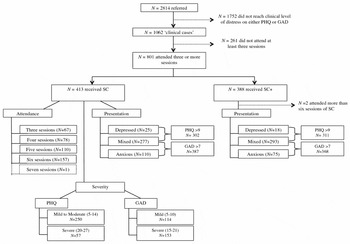
N = 2814 patients (1813 females) attended SC. The total number of patients referred to the service during this period was N = 42,968. Ages ranged from 16–88 years, with a mean age of 44.27 years (SD=13.85). Of the 2814 participants, 1062 were considered to be “clinical cases” at the start of SC, meaning that they scored above clinical cut-off on the PHQ or the GAD (or both). To be considered as having received an adequate dose of SC, patients need to have attended three or more sessions and this categorically defined attendance. All analyses of effectiveness were based upon the sample of N = 801 “clinical cases” (see Measures section) who attended SC (i.e. 3+ sessions). A number of these patients also received additional help within the IAPT service during SC. Participants who received other interventions were therefore considered part of a “SC+” research sample (N = 388), versus a SC only sample (N = 413). Attendees scoring above clinical cut-offs on both PHQ-9 and GAD-7 (see Measures section), were coded as comorbid anxiety and depression. If a patient scored above clinical cut-off on GAD-7 and not the PHQ-9, they were considered to have an anxiety disorder (and visa versa for the PHQ-9 and depression). Figure 1 details the various research samples.
Defining the patient population and access/uptake of Stress Control.

Measures and outcomes
The Patient Health Questionnaire (PHQ-9; Kroenke and Spitzer, Reference Kroenke and Spitzer2002; clinical caseness score = 10) and the Generalized Anxiety Disorder-7 (GAD-7; Spitzer, Kroenke, Williams and Lowe, Reference Spitzer, Kroenke, Williams and Löwe2006; clinical caseness score = 8) are valid and reliable case identifiers and also outcome measures of depression and anxiety. The criteria for clinical change occurring during SC was a GAD-7 final score <8 and/or a PHQ-9 score <10, as is used to define moving to recovery rates in IAPT (Gyani, Shafran, Layard and Clark, Reference Gyani, Shafran, Layard and Clark2013). Reliable change calculations (Evans, Margison and Barkham, Reference Evans, Margison and Barkham1998) were employed to investigate whether reliable improvements/deteriorations occurred. A change of 6 points (PHQ-9) and 4 points (GAD-7) in either direction represented a reliable change (increase equals deterioration and decrease equals improvement). Deprivation was measured using the Index of Multiple Deprivation 2010 (IMD, Department for Communities and Local Government, 2011a, b). The IMD is an aggregation of deprivation indices (income, employment, health and disability, education, skills/training, barriers to housing and services, crime and living environment). Postcodes were used to establish IMD rank; a higher rank (0-100) indicates an area with higher proportion of people living in deprivation.
Intervention
Patients attended SC through two routes: (1) referred to IAPT from GPs and screened by PWPs who offered SC as an intervention option within the suite of low intensity treatments; or (2) via self-referral through gaining knowledge of SC through the service website, posters, leaflets or word of mouth. All participants were required to book on to SC prior to attending. The specific nature of the other interventions received was not recorded for SC+ participants, but at step 2 was cCBT (“Beating the Blues” and “FearFighter”), one to one PWP work or healthy living workshops. Patients that were also stepped up to step 3 interventions received CBT, counselling, group behavioural activation or couples therapy. It was not possible to determine whether extra therapeutic interventions from outside of the service (e.g. private therapy) also occurred. SC is intended as a stand-alone intervention and so patients were discouraged from accessing other IAPT interventions simultaneously.
SC was delivered using the White (Reference White2000) treatment model, which superseded the White and Keenan (Reference White and Keenan1990) approach. The White (Reference White2000) approach entails providing psychoeducative low intensity cognitive behaviourally informed self-help for patients across the anxiety disorders, with a management of depressed mood component. Sessions are didactic and patients are informed that they can simply attend, listen and complete the exercises in the form of a ‘night-class,’ as opposed to a group therapy. Patients can attend SC with carers/friends/family should this facilitate engagement (White, Reference White2000). SC was delivered in community settings and often outside of normal office hours, in order to enable uptake and reduce stigma (White, Reference White2000). Thirty-eight groups ran between October 2009-April 2014. Group size ranged from 23–106, with a mean size of N = 74. SC groups were predominantly run by two PWPs at any one time. Each session lasted for 2 hours, 20 minutes of which was devoted to a comfort-break, entailing a total treatment time of 9 hours. SC ran weekly over six sessions containing the following elements: week 1, introduction to psychoeducation and the cognitive behavioural model; week 2, management of physiology; week 3, management of mental events; week 4, management of behaviour; week 5, management of panic attacks and sleep; and week 6, self-care. At the end of each session, material for the next session was distributed containing homework exercises. At the final session, relapse prevention materials were distributed. Participants were not followed-up if they missed sessions and were not reviewed on completion.
Results
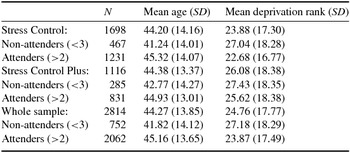
Out of a total sample of N = 2814 patients, 2062 (73.3%) attended SC (i.e. 3+ sessions). In terms of total patients referred to the IAPT service (see Method), SC saw 6.55% of referrals. Figure 1 contains a summary of the research samples and associated attendance rates and Table 1 describes the demographics and deprivation ranks. Patients who attended <3 SC sessions were typically younger than those who attended full SC (t(2812) = 5.694, p < .001, d = 0.24) and also lived in areas of greater deprivation (t(2798) = 4.295, p < .001, d = 0.19). In terms of those patients that met caseness criteria prior to intervention, N = 801 (75.4%) attended more than three SC sessions.
Age and deprivation ranks for whole sample and subgroups

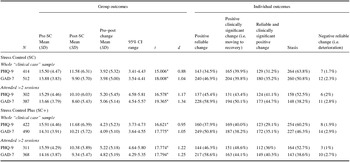
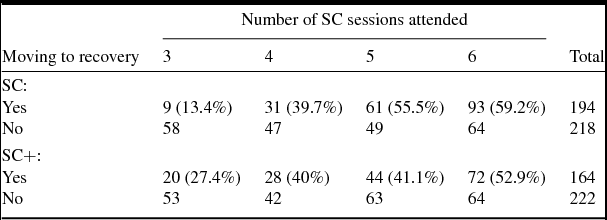
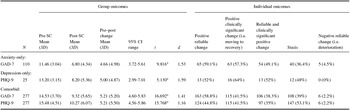
Table 2 reports the group outcomes and the individual outcome rates for the SC and SC+ samples. There was no association between purity of intervention and whether or not patients moved to recovery. Patients that received SC+ lived in areas of greater deprivation (t(781.16) = 1.975, p<.05, d = 0.14). In order to evidence the effectiveness of SC as an intervention in its own right, the subsequent analysis excluded the SC+ sample. Of the N = 413 SC only patients, 194 (47.1%) moved to recovery. Table 3 reports the recovery rate by session attendance analysis. When patients attended all SC sessions, the recovery rate was 59.2%, with a significant association between number of sessions attended and movement to recovery (χ2 (3) = 44.537, p < .001). The recovery ratio increased proportionally with attendance; the odds in favour of recovery were 9.06 times higher if all sessions were attended. There was no significant difference in GAD-7 scores at preintervention between those who attended <3 sessions and those who attended full SC (t(109.042) = 0.71, ns). However, patients at assessment who then went on to attend <3 sessions had significantly higher PHQ-9 scores (t(222) = 2.839, p <.01, d = 0.42) than those who attended full SC. Patients who attended less SC lived in areas of greater deprivation than who attended full SC (t(222) = 2.175, p < .05, d = 0.32).
Group and individual outcomes rates for the SC and the SC+ research samples

p < .001*
Recovery rates by session attendance

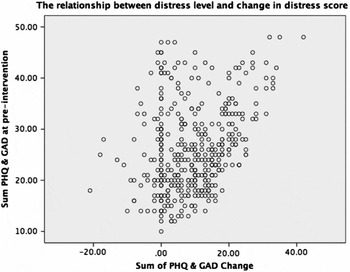
Table 4 reports recovery rates and reliable change by presentation. Patients with either depression or anxiety were more likely to move to recovery than those with co-morbidity (χ2 (2) = 10.901, p < .01). Depression presentations were 2.5 times and anxiety presentations 1.89 times more likely to move to recovery. Of the 387 patients who met caseness on the GAD-7 before SC (the anxiety and comorbid samples), 228 (58.9%) reliably improved and N = 11 (2.8%) reliably deteriorated. Of the N = 302 meeting depression caseness criteria (the depression and comorbid samples), 137 (45.4%) reliably improved and N= 6 (2%) reliably deteriorated (depression). Figure 2 displays a scatter plot showing that presentation severity was significantly correlated with change in distress score following SC (r(412) = 0.298, p < .001).
Recovery and reliable change rates by clinical presentation

p < .001*
Scatter plot of relationships between pre-intervention distress and amount of change pre–post SC

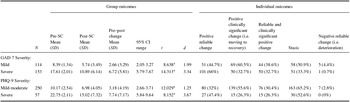
Table 5 reports SC outcomes by severity. “Severely depressed” patients prior to intervention showed a significantly greater reduction in depression than those categorized with “mild to moderate depression” (t(64.963) = 4.621, p <.001, d = 1.09). Recovery rates were higher for patients in the “mild to moderate depression” category; 55.6% moved to recovery in comparison to 26.3% in the “severe depression” cluster (χ2 (1) = 15.922, p < .001). A similar pattern was also apparent for anxiety outcomes. “Severely anxious” patients showed significantly greater improvement than those presenting with mild anxiety (t(248.88) = 7.235, p < .001, d = 1.23). Recovery rates were higher for those with mild anxiety: 60.5% moved to recovery, whereas 32.7% of the severe anxiety cluster recovered (χ2 (1) = 20.504, p < .001). A biserial correlation found that deprivation was significantly related to moving to recovery (rb = .142; p < .005). Patients who did not move to recovery were more deprived; 2% of variance in recovery status was accounted for by deprivation (rb 2 = .02).
Recovery and reliable change rates by initial presentation severity

p < .001*
Discussion
This study has provided contemporary IAPT evidence of the uptake and effectiveness of SC and investigated the role of moderating factors. SC was delivered as an intervention to nearly 7% of total referrals to the service, indicating the prominence of the intervention and the important plurality of other service provision. SC was well tolerated in terms of attendance; more than 70 % attended at least three SC sessions, with attendance rates higher for those with preintervention clinically significant distress. Rates were higher than extant attendance evidence (e.g. Kellett et al., Reference Kellett, Clarke and Matthews2007a). Those patients that dropped out of SC before attending at least three sessions lived in areas of greater deprivation. SC appears comparatively clinically equivalent to the other IAPT interventions (Gyani, Shafran, Layard and Clark, Reference Gyani, Shafran, Layard and Clark2013) and produced higher recovery rates than the Green et al. (Reference Green, Barkham, Kellett and Saxon2014) and Firth et al. (Reference Firth, Barkham, Kellett and Saxon2015) analyses of one-to-one PWP work. This may be due to the rapid and overt normalizing effect of attending a large group (Kellett et al., Reference Kellett, Clarke and Matthews2007a). When SC was delivered as the sole intervention, then recovery rates were higher than for those who also received a supplementary intervention (i.e. the SC+ research sample).This should not be construed as an interference effect, as those who received extra intervention were found to have higher levels of distress preintervention, in addition to living in areas of higher deprivation.
Analysis of the impact of attendance on outcome showed a clear pattern, as recovery rates were higher when patients attended more sessions. For example, 59.2% of participants who attended all SC sessions moved to recovery, whereas only 13.4% of those who attended three sessions did so. Recovery rates were similar to extant SC evidence, with 47.1% of those who attended at least three sessions moving to recovery. Patients who presented with a single mental health concern (i.e. the depression-only or anxiety-only research samples) had enhanced recovery rates. There was a higher proportion of reliable change for anxiety as opposed to depression. This is perhaps because SC contains a greater anxiety management, as opposed to mood management, component (Kellett et al., Reference Kellett, Clarke and Matthews2007b).
The study highlights the importance of attendance in relation to generating positive outcomes, as chance of recovery increased with number of sessions attended. Strategies to maintain engagement with patients at risk of dropping out of SC need to be developed and evaluated. A trial could compare attendance for SC groups that have an attendance intervention embedded within them with TAU rates. Strategies for increasing attendance might be the antibiotic metaphor of “finishing the course of treatment” and informing patients that chance of recovery more than doubles when they fully attend. Future research is also required to discover the reasons why patients dropout and studies employing qualitative methods would be at a premium. Similarly, the reasons why patients receive more than one intervention also need investigating. It is possible that screening PWPs felt overwhelmed when highly symptomatic and deprived patients attended and therefore attempted to “rescue” the patient through offering multiple provision (Stean, Reference Stean2014). The findings related to IMD rank suggest a relationship between living in areas of higher deprivation and both lower attendance and poorer outcomes. This suggests that the socio-economic context impinges on outcomes and that a “perfect storm” can be created of deprivation being associated with poor attendance and then associated poorer outcomes. Methods to engage people from such areas are again vitally important to develop and evaluate.
The separate analyses for depression and anxiety severity at assessment showed a similar pattern: for both measures, the moving to recovery rates were higher for patients reporting milder symptom distress. SC was designed for people with mild to moderate common mental health problems and Kellett et al. (Reference Kellett, Newman, Matthews and Swift2004) showed that selection of less severe cases improved outcomes. However, SC in this evaluation was delivered to patients across the spectrum of presentation severities. Across both outcome measures, the average reduction in scores was around double in the severe presentation group, when compared with the mild to moderate group. This finding suggests that SC may provide a pragmatic approach to meeting the needs of patients experiencing a range of distress. Solely focusing on moving to recovery rates might suggest that SC is not effective for people with more severe presentations, and therefore IAPT services need to consistently factor in reliable change calculations to supplement moving to recovery rates. Consistency of adherence to the treatment model could also be called into question, as the intervention was predominantly facilitated by different PWPs with varying levels of experience. This could also be interpreted as evidence that SC can be facilitated effectively by a variety of staff. There is a need to develop a competency measure for delivery of low intensity cognitive behaviour therapy. The lack of follow-up data in the current study is a weakness, particularly as contemporary evidence concerning durability of SC effects is required.
In conclusion, SC appears to be a well-tolerated and effective intervention for patients presenting to IAPT services and treated at step 2 with a large-group psychoeducational approach. SC can be delivered to groups of up to 150 services users by two PWPs, at a total time investment of 24 hours clinical contact time. This further endorses SC as an organizationally efficient intervention (Kellett et al., Reference Kellett, Clarke and Matthews2007a). Attendance appeared important regarding outcome and people who dropped out tended to live in areas of higher deprivation. IAPT services need to adopt and evaluate “in reach” strategies to such communities to ensure equality of access. This would ensure that living in an area of deprivation does not also mean that the chances of benefiting from an evidenced based psychological intervention are also suppressed.
Acknowledgements
Conflict of interest: The authors have no conflicts of interest with respect to this publication.



Comments
No Comments have been published for this article.