Introduction
One of the roots of advanced practice (AP) in healthcare developed in the 19th century with the specialty practice of nurse anaesthesia.Reference Hameric, Spyros and Hanson1 This area of expertise developed due to the outbreak of the American Civil War requiring newly discovered chloroform to be delivered with the assistance of nurses during surgery.Reference Hameric, Spyros and Hanson1 This example highlights where AP in healthcare can arise due to political, social and economic environments necessitating the need for professionals other than physicians to carry out medical interventions that were routinely undertaken by physicians.Reference Hameric, Spyros and Hanson1
In the United Kingdom, AP roles in radiotherapy were driven by a mixture of demographic shortages of key staff, as well as a shift in Governmental directives to ensure that patient pathways were more seamless.Reference Eddy2–4 The patient has been put at the centre of the process and the drive to enhance patient-centered care is enabled by utilising radiographers to expand their scope of practice and take part in the multidisciplinary team decision making.4
Although Canada, currently, is not faced with the staff shortages and government policy changes as there are in the United Kingdom, there has been recent interest in AP driven primarily by radiation therapist (RT) satisfaction and the desire to enhance patient care.5, Reference Eddy6 This interest and research led to the Canadian Association of Medical Radiation Technologists (CAMRT) definition of AP as:
…a professional role that requires post-degree/diploma educational preparation in combination with clinical skills acquisition to fulfill the requirements of the job. Elements of the role may be outside the established scope of the technologists practice and may overlap current areas of responsibility of another health care professional… (Professional Practice, Advanced Practice)7
This author purports that research should be performed in other areas of Canada to broaden the evidence base. In this author's home province, British Columbia (BC), discussion regarding AP has come to a virtual standstill and opportunities for research have not been explored either by the BC professional association or by management.
Anecdotal evidence suggests many RTs in BC are looking to enhance their practice through higher education, research, and are eager to take on increased responsibilities. In addition, numerous RTs in BC are working towards or have completed their Master degree, and it is worrisome that if these ambitious, goal-oriented people are not fully utilised they may become dissatisfied with their current position and seek other avenues where there is a role that is congruent with their expertise.
Research in the United Kingdom has revealed that increased responsibilities and challenging work can lead to greater satisfaction, which can lead to greater recruitment and retention of radiographers.Reference Probst and Griffiths8
Currently, there are only three levels of RT positions in BC. Each centre in BC has a limited number of positions higher than an RT:
RT—requires a diploma and/or degree in radiation therapy. Duties include: implementing external and internal radiation treatment prescriptions; providing patient education; and performing manual and computerised calculations.
Resource therapist—requires completion of a post-graduate program in radiation therapy or an equivalent combination of education. Duties include: providing leadership in terms of team building and mentoring staff; supports RTs, radiation oncologists, nurses, and the chief radiation therapist by being a knowledge and clinical resource; and providing quality improvement initiatives and reports.
Clinical educator—is the same level as a resource therapist. This position requires a diploma and/or degree in radiation therapy plus a certificate/diploma in adult education or an equivalent combination of education, training and experience. Duties include: implementing and providing clinical education to the radiation therapy staff and students.
Treatment module leader—requires completion of a post-graduate program in radiation therapy or an equivalent combination of education and completion of a management program. Duties include: providing leadership and supervision of radiation therapy staff.
This research aimed to add to the Canadian and international perspective of AP, and is aimed to act as a base for further studies to build on in order to potentially move the idea of RT AP forward in BC and Canada.
The research questions:
How closely aligned are the RTs in BC definitions of AP with the literature and Canadian model definitions of AP?
What do the RTs in BC consider to be personal barriers and benefits to the implementation of AP?
What do the RTs in BC consider to be barriers and benefits to the Radiation Therapy profession to the implementation of AP?
What do the RTs in BC consider to be the benefits to the RT patient to the implementation of AP?
Research design
This is a quantitative study that aims to access a wide and diverse range of RTs to gather intelligence on AP. Questionnaires were used as a cost-effective way to study this large group of professionals and variables such as attitudes and opinions were explored looking for any relationships between the variables.Reference Cozby9
An exploratory approach to ascertain opinions and attitudes towards AP was generated by developing a questionnaire. ‘In basic research, many important variables, including attitudes, current emotional states and self-reports of behaviours, are most easily studied using questionnaires or interviews’ (p. 92).Reference Cozby9
Likert scales have been criticised for oversimplifying the subjectivity of attitudes by scoring, for example, strongly disagree as 5 and strongly agree as 1, which is said to be too rigid, prescriptive and inappropriate statistically.Reference Bond and Fox10 However, after thoroughly analysing the questions for this research questionnaire, it was found that all questions have the same relative difficulty, therefore, the principal investigator (PI) felt it was appropriate to analyse the questions using the scale of 1 to 5, with 3 being neutral.
Closed-ended questions were included in the questionnaire; however, no open-ended questions were used because in BC, the PI felt they may cause confusion. This is because AP is a new concept and potentially the participant may not be able to answer.Reference Cozby9
An on-line questionnaire was sent to the entire population of 266 RTs that practiced in BC throughout five cancer clinics from March to May 2009. Two reminders at 3-week intervals were sent. Closed ended, Likert type (where applicable) questions were utilised to assess attitudes and opinions. Questions such as age range, level of education and years of experience were asked to assess correlations in attitudes.
The questionnaire development was informed by a literature review of AP. This resulted in 22 closed-ended questions, which utilised a five-point Likert scale, ranging from 1 (strongly agree) to 5 (strongly disagree). A pilot study was undertaken to assess the readability, ease, validity, understanding and relevance of the questionnaire. Most of the terms were familiar to respondents, which aided in reliability and the pilot study indicated where questions needed to be revised. This was piloted on a group of 20 RTs working in BC that included: managers, educators, resource therapists and RTs. Data from the pilot study were not included in the final analysis.
Ethical considerations
This study poses minimal risk to participants and none of the questions were seen as personally sensitive. Ethics approval was granted by the University of British Columbia—British Columbia Cancer Agency Research Ethics Board.
Data analysis
For each aspect of AP (i.e., personal barriers, personal benefits, professional barriers, professional benefits and patient benefits), it was calculated if respondents in different categories of demographics (i.e., years qualified, education, age, gender, positions and work status) gave different responses. If the null hypothesis (that all respondents in different categories of demographics had the same attitude to each aspect of AP) was rejected by the Kruskal–Wallis rank sum test, the Wilcoxon rank sum test was used to do pair-wise comparisons. The Bonferroni correction was then used to adjust the p-values. All tests were set to a 5% level of significance.
Questions regarding personal barriers, personal benefits, professional barriers and professional benefits were each summed to create a score for each group, that is, personal barrier items were summed to create a cumulative score regarding personal barriers. Strongly agree was given a score of 5, whereas strongly disagree was given a score of 1.
No statistically significant differences were found between responses to each aspect of AP (personal barriers and benefits, professional barriers and benefits and patient benefits) and years qualified, age, gender and work status. There were also no statistically significant differences in level of education and responses towards AP personal barriers, AP professional benefits and AP patient benefits. However, there was a statistically significant difference in level of education and responses towards personal benefits. Respondents with a Master level of education gave higher response scores to AP personal benefits (Kruskal–Wallis rank sum test p = 0·009032).
The Wilcoxon rank sum test was used to do pair-wise comparisons among different education levels. The Wilcoxon rank sum test addresses the null hypothesis that the response scores of two different groups have the same distribution (i.e., same response). By the Bonferroni correction, the p-values are compared with α/6 (α is the desired significance level of 0·05). Hence, the response between Diploma and Master, and Bachelor and Master are different. However, the p-value for the comparison between Certification and Master is a little larger than 0·05/6 = 0·00833. This result is not consistent with what is shown in Figure 1, where the response scores of Master are larger than that of Certification in general. This may be due to the conservativeness of the Bonferroni correction, or the small sample size for each group (12 respondents for Certification and five for Master).
Response scores to personal benefits by respondents with different education levels.

There was also a statistically significant difference in level of education and responses towards professional barriers. Respondents with a Diploma in RT gave the highest response scores to professional barriers (Kruskal–Wallis rank sum test p = 0·02105). Figure 2 shows that Diploma and Bachelor have different responses to Professional Barriers; however, Figure 2 indicates that Diploma should have a different response from all other three education levels, but only one pair of difference is suggested by the statistical tests. One reason for this may be that the sample size for Master and Certification are small, compared with Diploma and Bachelor; thus, the statistical test with a small sample size may not be quite powerful enough to suggest a level of difference.
Response scores to professional barriers by respondents with different education levels.
In terms of position in the RT department and responses to each aspect of AP, the respondents in resource therapist/educator, chief therapist and management are very few. The statistical tests with very few samples have very low power and could be misleading when these few samples are not representative of the population.
Not all respondents completely answered all questions, but the missing rate is not high. In each part of the previous analysis, respondents with incomplete responses were removed and the analysis was carried out based on the complete data.
Results
Numbers in the following tables were rounded off to get whole percentages.
Respondent demographics
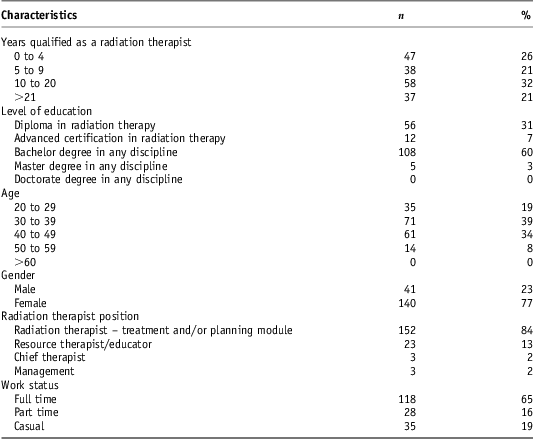
A total of 183 questionnaires were completed for a response rate of 69%. Table 1 presents a complete description of respondent demographics. More than 50% of respondents had 10 to over 21 years of experience, 60% had a Bachelor degree in some discipline, over 70% identified themselves between the ages of 30–49, and over three quarters were female (77%). The majority were RTs working in the treatment or planning module (84%). And most respondents worked full time (65%).
Respondent demographics
AP definitions
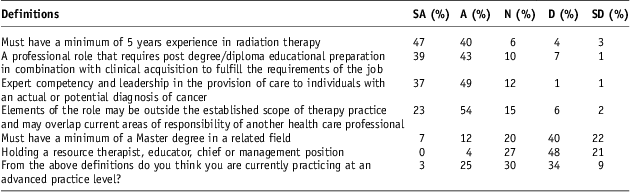
As described in Table 2, the majority of respondents agreed that the definition of AP is: a professional role that requires post-degree/diploma educational preparation (43%); a role that may be outside the scope of therapy practice (54%); expert competency and leadership (49%); and a minimum of 5-year experience in RT (40%). However, most respondents disagreed that an advanced practitioner must have a minimum of a Master degree (40%) and hold a resource therapist, educator, chief or management position (48%). The majority of respondents also disagreed (34%) that they were currently practicing at an AP level.
Advanced practice definitions
Abbreviations: SA = strongly agree; A = agree; N = neutral; D = disagree; SD = strongly disagree.
AP tasks
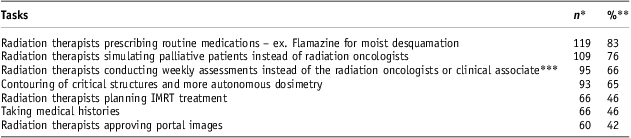
Table 3 lists the following tasks that are considered AP: prescribing routine medications (83%); simulating palliative patients (76%); conducting weekly assessments (66%); contouring critical structures (65%); taking medical histories (46%); planning intensity-modulated radiation therapy (IMRT) treatment (46%); and approving portal images (42%).
Advanced practice tasks
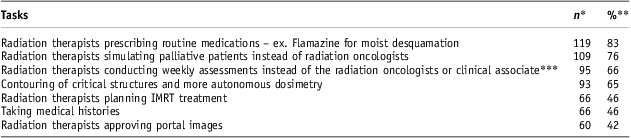
*n = number of respondents who agreed with the task being Advanced Practice.
**% = n divided by number of respondents that answered most questions (144).
***Weekly assessments = weekly treatment reviews.
Abbreviation: IMRT, intensity-modulated radiation therapy.
AP personal barriers
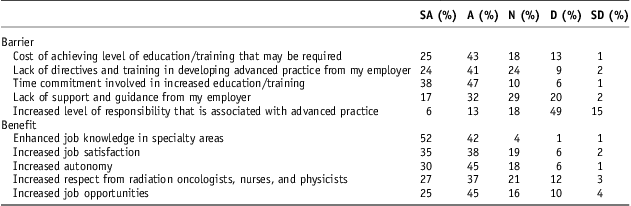
As described in Table 4, most respondents agreed that personal barriers in becoming an advanced practitioner are: cost (43%) and time (47%) in achieving the level of education/training required; lack of support and guidance from one's employer (32%); and lack of directives and training from one's employer in developing AP (41%). However, most respondents disagreed that increased level of responsibility that is associated with AP (49%) is a personal barrier.
Advanced practice personal barriers and benefits
Abbreviations: SA = strongly agree; A = agree; N = neutral; D = disagree; SD = strongly disagree.
AP personal benefits
Table 4 depicts that most respondents either strongly agreed or agreed that the following are personal benefits in becoming an advanced practitioner: job opportunities (70%); job satisfaction (73%); knowledge in specialty areas (94%); autonomy (75%); and respect from radiation oncologists, nurses and physicists (64%).
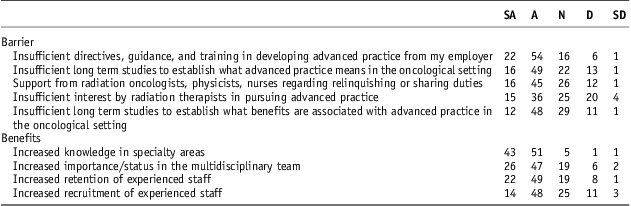
AP professional barriers
As described in Table 5, the majority of respondents indicated that barriers for the RT profession in achieving AP are: support from radiation oncologists, physicists and nurses regarding relinquishing or sharing duties (45%); insufficient long-term studies to establish what AP means (49%) and what benefits are associated with AP (48%); insufficient directives, guidance and training from one's employer (54%); and insufficient interest by RTs (36%).
Advanced practice professional barriers and benefits
Abbreviations: SA = strongly agree; A = agree; N = neutral; D = disagree; SD = strongly disagree.
AP professional benefits
Table 5 depicts the majority of respondents agreed that recruitment of staff (48%), retention of staff (49%), knowledge in specialty areas (51%) and importance/status in the multidisciplinary team (47%) are benefits for the radiation therapy profession in achieving AP.
AP patient benefits
In reference to how AP benefits the radiation therapy patient (see Table 6), the overwhelming majority of respondents either strongly agreed or agreed that enhanced patient care due to collaborative practice (81%) and increased/specialised knowledge (82%) are important benefits to the patient.
Advanced practice patient benefits

Abbreviations: SA = strongly agree; A = agree; N = neutral; D = disagree; SD = strongly disagree.
Discussion
AP definitions
The CAMRT definition of AP is:
…a professional role that requires post-degree/diploma educational preparation in combination with clinical skills acquisition to fulfill the requirements of the job. Elements of the role may be outside the established scope of the technologists practice and may overlap current areas of responsibility of another health care professional… (Professional Practice, Advanced Practice)Reference Probst and Griffiths8
More than three quarters of respondents of the survey either agreed or strongly agreed with the above definition of AP thus indicating that BC RTs are aware and in agreement with how AP is defined from a Canadian perspective. Respondents were asked to rate their agreement with definitions from the literature on AP and the Canadian model of AP in order to ascertain their knowledge of AP. This is an important component of the questionnaire because it would be difficult to interpret the results of the questionnaire in regard to personal and professional barriers and benefits of AP if respondents were not able to conceptualise and understand the term AP. This is perhaps in contrast to Bolderston et al.'s survey that sought Canadian managers’ opinions on the current state of AP in their clinics. Questions were asked such as: what AP roles their staff were currently in, what roles they see their staff holding in the future, how these roles are supported/budgeted and barriers and benefits of these roles. Focus groups were subsequently used with managers to build on the information gleaned from the survey. What became clear was there was still confusion with regard to the concept and definition of AP,Reference Bolderston, Smoke, Harnett, Lewis and Wenz11 arguably making the results difficult to interpret and validate if the managers did not understand the concept behind the questions being asked. Other studies have also shown where a concept such as AP is new; understanding it fully becomes problematical, not only within your own professional group, but also across other professional groups and boundaries.Reference Griffin and Melby12 The information garnered from both the Canadian and other studies are useful; indicating perhaps that further research is needed in defining AP in Canada, and developing a universal definition that can easily be understood and interpreted by both managers and practitioners.
Although survey respondents agreed with the CAMRT's definition of AP, the majority disagreed that an advanced practitioner must have a minimum of a Master degree. This in part contrasts with the literature and other professional body recommendations. Here there is often the suggestion that an advanced practitioner must have, or be working towards a Master degree. The definitions are somewhat less specific as they broadly state that some type of post-degree/diploma education is required.Reference Hameric, Spyros and Hanson1, 5, 7, Reference Cozby9, Reference Carper and Haas13, Reference Lynch, Cope and Murphy-Ende14 Although respondents appear adamant that a Master degree is not required, the lack of clarity in terms of education and training required may add to the difficulty in conceptualising and thus achieving AP status.Reference Eddy15, Reference White, Lee, Wong, Lee and Cheung16
Although respondents to the survey did not feel that a Master's education is required, the overwhelming majority did feel that a minimum of 5 years experience in RT is required. Although the number of years of experience is not explicitly stated in AP definitions from the literature, many definitions use the word ‘experienced’ when describing an advanced practitioner.Reference Hameric, Spyros and Hanson1, Reference Griffin and Melby12, Reference Snaith and Hardy17, Reference Martino and Odle18 Again, a functional definition of AP that explicitly states what ‘experienced’ means would be highly beneficial to those aspiring to achieve AP status. It may be that there could be benchmark standards set against specific roles that would give practitioners something to work towards in terms of building up a skill base for a role.
Although respondents consider experience important, they do not believe AP requires holding a resource therapist, educator, chief or management position. Respondents disagreement with this statement can be interpreted either as an AP role is independent of a ‘supervisory’ position or that being in a ‘supervisory’ position does not make one an advanced practitioner. Either way, this disagreement again can be interpreted as aligning with the CAMRT definition of AP as well as other definitions in the literature that do not maintain that AP requires holding a higher order ‘supervisory’ position.4, 5, 7, Reference Martino and Odle18, Reference Hardy and Snaith19
The majority of respondents felt that they were not currently practicing at an AP level. However, some did indicate they were either neutral (30%) or felt that they were practicing at an AP level (25%). Although these results are open to interpretation, and useful conclusions are difficult to draw out without undertaking follow-up interviews, this author suggests that the lack of open discussion and dialogue about AP in BC has contributed to the lack of clarity about the role and what it may be about. As a result, respondents to this questionnaire did not have any external baseline or confirmation from management or the BC government regarding if they are practicing at an AP level. Eddy asserts how important it is to try and have very similar functional definitions of AP within the profession to ensure comprehension of radiographers, managers, physicians, policy holders and stakeholders.Reference Eddy15 In addition, universal pathways should be devised to exemplify progression from radiographer through to advanced practitioner and describing what this means in practice.Reference Eddy15, Reference Snaith and Hardy17
What tasks could be deemed as AP?
Different tasks are considered AP in different countries, and even between different clinics within the same country or province. Tasks such as RTs approving portal images, planning IMRT treatment and contouring critical structures are tasks that RTs in BC routinely perform and have been performing for some time. However, RTs in Hong Kong (as of 2005) do not perform these tasks and as a result are considered AP.Reference White, Lee, Wong, Lee and Cheung16 Tasks such as RTs conducting weekly assessments, prescribing routine medications, simulating palliative patients and taking medical histories are tasks that RTs in BC do not routinely perform and are considered AP in the United Kingdom, Hong Kong, United States and Ontario.5, Reference White, Lee, Wong, Lee and Cheung16, Reference Martino and Odle18–Reference Hogg20 The literature was searched to capture all possible tasks undertaken and perhaps regarded as AP and then these were incorporated into the questionnaire. These tasks were included in the questionnaire to distinguish if BC RT's view tasks they are performing as AP in comparison with tasks they are not performing. The results indicate that the majority of RT's view tasks they are not routinely performing, specifically prescribing routine medications as AP. However, many respondents also view tasks they are already performing such as planning IMRT treatment as AP. This author purports that those respondents who believe they are currently practicing at an AP level (see AP definitions discussion above) may have answered in the affirmative regarding tasks that BC RTs currently perform as being AP. This again may be due to lack of clarity from the BC government and management as to what tasks constitutes AP in BC. These same phenomena of lack of clarity and guidance from one's employer as to what tasks are considered AP is seen around the world and again begs for a global functional definition of AP in the radiological sciences.Reference Eddy15, Reference Snaith and Hardy17, Reference Martino and Odle18, Reference Bolderston21
AP—what are the personal barriers?
Respondents overwhelmingly agreed or strongly agreed that cost and time required in achieving the level of education/training required are personal barriers in becoming an advanced practitioner. This finding is in agreement with studies that found that lack of time and cost were the main deterrents in radiographers participating in continuing professional development (CPD).Reference Palarm, Jones and Gilchrist22, Reference Henwood and Huggett23 Palarm et al. found that a number of radiographers expected their employer to provide the resources in terms of time and money in furthering their professional development.Reference Palarm, Jones and Gilchrist22 The researchers speculated that if time and money were not provided, this group of radiographers would not willingly partake in CPD.Reference Palarm, Jones and Gilchrist22 Similarly, it can be postulated that RTs in BC believe that employers do not provide the time and money to pursue the education/training required in becoming an advanced practitioner and as a result cost and time become large personal barriers in achieving AP.
In addition, the majority of respondents agreed that lack of support, guidance, directives and training from one's employer are personal barriers in becoming an advanced practitioner. White et al. and Pickett et al. also found there are no clear guidelines or training models in developing the radiographer AP role.Reference White, Lee, Wong, Lee and Cheung16, Reference Pickett, Waterstram-Rich and Turner24 Eddy similarly finds that clear guidelines, frameworks and training requirements need to be in place and continually modified as the AP role evolves in the ever-changing field of the radiological sciences.Reference Eddy15
Although time, cost, lack of support and training are considered personal barriers by BC RTs, the increased level of responsibility that is associated with AP is not. This finding is not surprising in that other studies found that increased level of responsibility associated with AP was actually viewed as a benefit that lead to job satisfaction.Reference Collins, Jones, McDonnell, Read, Jones and Cameron25, Reference Willson26 These findings are in agreement with Hertzburg et al.'s motivation of work theory, which maintains that increased level of responsibility is an intrinsic condition that leads to job satisfaction.Reference Hertzburg, Mausner and Synderman27
AP—what are the personal benefits?
RTs in BC overwhelmingly either strongly agreed or agreed that job opportunities, job satisfaction, increased job knowledge in specialty areas, autonomy, and respect from radiation oncologists, nurses and physicists are personal benefits in becoming an advanced practitioner. Many other studies have also shown nurses and radiographers support AP due to increased professional opportunities.Reference Eddy6, Reference Martino and Odle18, Reference Bolderston21, Reference Collins, Jones, McDonnell, Read, Jones and Cameron25, Reference Willson26 Bolderston's exploratory case study of Canadian radiographers revealed that enhancing professional image, garnering respect and improved opportunities are key benefits in AP.Reference Bolderston21 In addition, Collins et al.'s study of nurses and professions allied to medicine (PAM's) holding an innovative or non-traditional role found a high degree of job satisfaction from holding these posts where job satisfaction stemmed from increased autonomy, responsibility and managing one's own caseloads.Reference Collins, Jones, McDonnell, Read, Jones and Cameron25
It was found in the current study that respondents with a Master degree gave higher scores than respondents with less education to the personal benefits of AP. This is possibly because respondents with Master-level education already hold or aspire to hold a higher order or innovative position (i.e., resource therapist/educator) and thus find more benefits associated with this position in terms of increased autonomy, respect from professional colleagues, knowledge in specialty areas and job opportunities.
AP—what are the professional barriers?
As evidenced by the results from this questionnaire regarding perceptions of the personal barriers, it is apparent that adequate guidelines and training are important in AP roles. However, where radiographers lack support from professional colleagues, and there is interprofessional rivalry the training may not occur, and knowledge may be withheld.Reference Eddy6 Medical dominance is cited as one of the main barriers for nurses and radiographers achieving AP status.Reference Hameric, Spyros and Hanson1, Reference White, Lee, Wong, Lee and Cheung16, Reference Curran28–Reference Sim, Zadnik and Radloff30 This was found in this author's study with the majority of respondents agreeing that an AP professional barrier is lack of support from radiation oncologists, physicists and where nurses are reluctant to relinquish or share duties.
Studies indicate that radiographer opinion of AP roles mainly comprise undertaking tasks traditionally held by physicians such as: film/portal imaging approval, assessing patients in review clinics, overseeing simulator procedures and prescribing and approving palliative treatment and plans.Reference Eddy6, Reference White, Lee, Wong, Lee and Cheung16, Reference Bolderston21, Reference Pickett, Waterstram-Rich and Turner24 Arguably by APs performing these tasks it becomes possible to increase both autonomy and decision making, which in turn can decrease medical dominance and power.Reference Eddy6, Reference White, Lee, Wong, Lee and Cheung16, Reference Bolderston31 Not all doctors are unsupportive of educating and training RTs to extend their roles, and there may be some confusion regarding new roles and responsibilities that need to be discussed within each organisation.Reference Eddy32 White et al.'s study found radiation oncologists, supported role development of radiographers in Hong KongReference White, Lee, Wong, Lee and Cheung16 and similarly, another applauds how radiographers reaching AP reduced a clinic's wait list, made the clinic run more efficiently and decreased patient anxiety.Reference Willson26
Questioning radiation oncologist's opinion of relinquishing and sharing duties with RTs in BC is an important area of future study.
In addition to other healthcare professionals relinquishing/sharing of duties being seen as a barrier to the RT profession in achieving AP, most respondents agreed that insufficient long-term studies that establish what AP means in the oncological setting and what benefits are associated with AP in the oncological setting are barriers for the RT profession in achieving AP. Similarly, researchers have criticised the lack of empirical data surrounding enhanced patient care due to AP and maintain that in order to fully recognise AP, research needs to be conducted to show improvement.Reference Harnett3, Reference White, Lee, Wong, Lee and Cheung16 Lack of sufficient longitudinal studies to establish what AP means in the oncological setting can also hinder support from stakeholders.Reference Eddy15
Lack of support from stakeholders, namely one's employer may be the reason for insufficient directives, guidance and training in developing AP which the majority of respondents in the current study also agreed was a barrier to the RT profession in achieving AP. This was also seen as a personal barrier in becoming an advanced practitioner in this study. In addition to insufficient support from one's employer, the majority of respondents agreed that insufficient interest by RTs in pursuing AP was a barrier for the RT profession in achieving AP. This was also found in a study of Ontario RTs.Reference Bolderston21 During interviews, respondents felt that not all RTs would be interested in pursuing AP and this choice should be respected.Reference Bolderston21 This barrier for the RT profession of insufficient interest could stem from personal barriers in becoming an advanced practitioner identified in the current study such as cost, time commitment and lack of support from one's employer. It just may not be worth it to some RTs to pursue AP if there are too many barriers in the way and as a result the RT profession suffers. Too many personal barriers may also be why respondents with a Diploma in RT gave higher scores to professional barriers than respondents with higher education. The obstacle of cost and time of achieving the level of education that is required to become an advanced practitioner may lead to insufficient interest of these Diploma-educated respondents. Or conversely, insufficient interest may cause the barriers of cost and time of achieving the level of education required to seem insurmountable. However, interestingly, there was no statistically significant difference found with respondents with a Diploma and respondents with higher education under the personal barriers of AP. One would think that cost and time would score higher for respondents with further to go in achieving the education required for AP status. This could be an area of future study in terms of interviews and focus groups to further explore this finding.
AP—what are the professional benefits?
The overwhelmingly majority of respondents agreed that increased recruitment and retention of experienced staff, increased knowledge in specialty areas and increased importance/status in the multidisciplinary team are benefits for the RT profession in achieving AP status. This is in accordance with many other studies that have found nurses and radiographers support AP due to increased professional opportunities.Reference Eddy6, Reference Martino and Odle18, Reference Bolderston21, Reference Collins, Jones, McDonnell, Read, Jones and Cameron25, Reference Willson26 It is not surprising that the above are viewed as professional benefits due to the personal benefits that were identified such as increased job opportunities, increased job satisfaction, enhanced job knowledge in specialty areas, autonomy and respect from colleagues identified under the above section ‘AP personal benefits’. Respondents may feel that personal benefits lead to professional benefits such as increased respect from colleagues leads to increased importance/status in the multidisciplinary team, or vice versa by professional benefits leading to personal benefits. Either way these findings are supported by job satisfaction theories and the findings from other job satisfaction studies.Reference Collins, Jones, McDonnell, Read, Jones and Cameron25–Reference Hertzburg, Mausner and Synderman27
AP—what are the patient benefits?
Respondents overwhelmingly either agreed or strongly agreed that enhanced patient care due to collaborative practice and increased/specialised knowledge are benefits to the RT patient in achieving AP. This finding is supported by Willson's study, which showed increased patient satisfaction, improved patient access, reduced wait times and faster results generated that decreased patient anxiety levels with the advent of AP.Reference Willson26 Similarly, collaborative practice is viewed by the National Health Services as having the potential to decrease wait lists and provide more comprehensive care to more people as demonstrated in the four-tier service delivery model.4 Developing and responding to the skill mix in cancer care can utilise the expertise of all team members.4, Reference Maluso-Bolton33 The four-tier model was developed in the United Kingdom in response to shortages of radiographers, radiologists and oncologists with the intention of improving patient care and radiographer retention and satisfaction through effective career development pathways.4
Although, BC at this time is not faced with shortages of radiographers and oncologists, the capacity to improve patient care should be a driving force in moving AP forward in BC. This author also predicts that with the aging population in BC, there is a very real potential for BC and Canada to face the same shortages of healthcare professionals as the United Kingdom in the near future, therefore it is extremely important that BC retains and recruits radiographers while searching for effective ways to decrease waitlists so more patients can be treated in a timely manner.
Study limitations
A triangulated data collection that included focus groups and interviews may have allowed for more in-depth exploration and allowed for stronger confirmation of the findings; however, time and resources did not allow for this depth of study at this time.Reference Tye and Ross34 Because of the fact that BC does not have any practicing advanced practitioners, this study was based on RT's perceptions rather than the actuality of the situation.
Conclusion
This research study is the first of its kind where RTs in BC had a chance to give their opinions of AP. BC RTs definitions of AP are closely aligned with the literature and Canadian model definitions of AP. However, BC RTs do not believe that a Master degree is needed to hold an AP position.
Many benefits and barriers to AP have been identified in the literature from throughout the world. The results of this study are very similar to other studies in that many benefits both personally and professionally and to the RT patient were identified. Increased autonomy, job satisfaction, recruitment and retention of staff and enhanced care due to collaborative practice are a few of the many benefits identified by the majority of respondents. This study also found that respondents with a Master degree gave higher scores than respondents with less education to the personal benefits of AP.
However, many of the same barriers identified in the literature were also found in this study. Cost, time commitment, lack of training and support from one's employer and medical staff were viewed as personal and/or professional barriers. In addition, BC does not have the same incentive as the United Kingdom to introduce AP due to staff shortages; however, this should not be used as an excuse to be left behind as the fields of oncology and radiation therapy move forward throughout the world.
This study clearly exemplifies that RTs in BC feel there are many benefits associated with AP and for this reason further research into how AP could improve patient care and relieve the pressure from medical staff should be pursued. A functional definition of AP coupled with clear training and guidelines are essential in moving AP forward in BC. Although there are many obstacles to overcome, the opportunities for enhanced patient care due to increased knowledge and professional development is an important reason for creating the advanced practitioner in BC.
Acknowledgements
The author would like to thank Angela Eddy for her guidance and encouragement during the entire research process. The author would also like to thank Joyce Kinamore whose love and support allowed this research study to be completed.