Introduction
Psychiatric disorders and traumatic brain injury (TBI) are leading causes of disability burden in individuals under 45 years (Langlois et al. Reference Langlois, Rutland-Brown and Wald2006; Baxter et al. Reference Baxter, Patton, Scott, Degenhardt and Whiteford2013). These conditions commonly co-occur, with reported psychiatric disorder frequencies ranging from 18.3% to 83.3% in the months and years post-injury (van Reekum et al. Reference van Reekum, Bolago, Finlayson, Garner and Links1996; Deb et al. Reference Deb, Lyons, Koutzoukis, Ali and McCarthy1999). Anxiety and mood disorders are most common, as in the general population (Kessler et al. Reference Kessler, Berglund, Demler, Jin, Merikangas and Walters2005; Osborn et al. Reference Osborn, Mathias and Fairweather-Schmidt2014; Mallya et al. Reference Mallya, Sutherland, Pongracic, Mainland and Ornstein2015). These disorders exacerbate TBI-related disability (Bryant et al. Reference Bryant, O'Donnell, Creamer, McFarlane, Clark and Silove2010), and increase health expenditure (Wei et al. Reference Wei, Sambamoorthi, Crystal and Findley2005) and carer burden (Koskinen, Reference Koskinen1998). Despite considerable research, the timing of onset, course and risk factors for psychiatric disorders following TBI remain uncertain.
Differences in study design, measures and sample characteristics (e.g. injury severity and time post-injury) have led to variability in reported rates of psychiatric disorders following TBI. Prospective studies have limited follow-up to the first year post-injury (Deb et al. Reference Deb, Lyons, Koutzoukis, Ali and McCarthy1999; Bryant et al. Reference Bryant, O'Donnell, Creamer, McFarlane, Clark and Silove2010; Gould et al. Reference Gould, Ponsford, Johnston and Schönberger2011b , Koponen et al. Reference Koponen, Taiminen, Hiekkanen and Tenovuo2011; Diaz et al. Reference Diaz, Schwarzbold, Thais, Hohl, Bertotti, Schmoeller, Nunes, Prediger, Linhares, Guarnieri and Walz2012), and/or focused on depression (Dikmen et al. Reference Dikmen, Bombardier, Machamer, Fann and Temkin2004; Jorge et al. Reference Jorge, Robinson, Moser, Tateno, Crespo-Facorro and Arndt2004; Bombardier et al. Reference Bombardier, Fann, Temkin, Esselman, Barber and Dikmen2010; Rao et al. Reference Rao, Bertrand, Rosenberg, Makley, Schretlen, Brandt and Mielke2010; Hart et al. Reference Hart, Hoffman, Pretz, Kennedy, Clark and Brenner2012), or patients with predominately mild TBI (Deb et al. Reference Deb, Lyons, Koutzoukis, Ali and McCarthy1999; McCauley et al. Reference McCauley, Boake, Levin, Contant and Song2001; Bryant et al. Reference Bryant, O'Donnell, Creamer, McFarlane, Clark and Silove2010). These studies report elevated rates of mood and anxiety disorders that increase throughout the first year, high co-morbidity between disorders and evidence for different patterns of onset by disorder type (Deb et al. Reference Deb, Lyons, Koutzoukis, Ali and McCarthy1999; Jorge et al. Reference Jorge, Robinson, Moser, Tateno, Crespo-Facorro and Arndt2004; Bryant et al. Reference Bryant, O'Donnell, Creamer, McFarlane, Clark and Silove2010; Gould et al. Reference Gould, Ponsford, Johnston and Schönberger2011b ; Koponen et al. Reference Koponen, Taiminen, Hiekkanen and Tenovuo2011; Diaz et al. Reference Diaz, Schwarzbold, Thais, Hohl, Bertotti, Schmoeller, Nunes, Prediger, Linhares, Guarnieri and Walz2012). For example, anxiety disorders appear to emerge earlier post-injury than mood disorders (Gould et al. Reference Gould, Ponsford, Johnston and Schönberger2011b ). Although prospective research is limited, rates of psychotic, somatoform, eating and adjustment disorders appear comparable with those in the general population (Gould et al. Reference Gould, Ponsford, Johnston and Schönberger2011b ).
Studies examining a range of disorders over longer time-frames have been cross-sectional (Fann et al. Reference Fann, Katon, Uomoto and Esselman1995; van Reekum et al. Reference van Reekum, Bolago, Finlayson, Garner and Links1996; Ashman et al. Reference Ashman, Spielman, Hibbard, Silver, Chandna and Gordon2004; Whelan-Goodinson et al. Reference Whelan-Goodinson, Ponsford, Johnston and Grant2009), retrospective (Hibbard et al. Reference Hibbard, Uysal, Kepler, Bogdany and Silver1998; Koponen et al. Reference Koponen, Taiminen, Portin, Himanen, Isoniemi, Heinonen, Hinkka and Tenovuo2002) or used medical records to ascertain diagnoses (Fann et al. Reference Fann, Burington, Leonetti, Jaffe, Katon and Thompson2004;Orlovska et al. Reference Orlovska, Pedersen, Benros, Mortensen, Agerbo and Nordentoft2014; Gibson & Purdy, Reference Gibson and Purdy2015); these methods preclude accurate examination of the timing of onset and the subsequent course of each disorder. As insight and memory impairments are common following TBI (Dikmen et al. Reference Dikmen, Corrigan, Levin, Machamer, Stiers and Weisskopf2009; Ham et al. Reference Ham, Bonnelle, Hellyer, Jilka, Robertson, Leech and Sharp2014), self-report of symptoms experienced over long periods has questionable validity. Although medical record reviews yield large sample sizes capable of investigating relatively small effects, this method prevents detection of cases not presenting to services, and relies on clinician-derived diagnoses rather than standardized psychiatric assessment tools. Therefore it is unclear whether rates of mood and anxiety disorders decline following the first year (Ashman et al. Reference Ashman, Spielman, Hibbard, Silver, Chandna and Gordon2004; Dikmen et al. Reference Dikmen, Bombardier, Machamer, Fann and Temkin2004; Fann et al. Reference Fann, Burington, Leonetti, Jaffe, Katon and Thompson2004; Orlovska et al. Reference Orlovska, Pedersen, Benros, Mortensen, Agerbo and Nordentoft2014), or continue to increase up to 5 years post-injury (Whelan-Goodinson et al. Reference Whelan-Goodinson, Ponsford, Johnston and Grant2009; Osborn et al. Reference Osborn, Mathias and Fairweather-Schmidt2014). Substance-use disorders appear to increase after the first year post-injury when recommendations to abstain from alcohol have lapsed (Ashman et al. Reference Ashman, Spielman, Hibbard, Silver, Chandna and Gordon2004; Fann et al. Reference Fann, Burington, Leonetti, Jaffe, Katon and Thompson2004). Elevated rates of post-injury psychotic disorders have been noted in population-based medical file reviews (Orlovska et al. Reference Orlovska, Pedersen, Benros, Mortensen, Agerbo and Nordentoft2014); however, these findings have not been replicated in prospective studies possibly due to limited periods of follow-up and low disorder base rates.
Given the high rates of post-injury psychiatric disorders it is important to understand the risk factors associated with their development and subsequent course; ideally individuals at risk would be identifiable early post-injury to provide opportunities for early or preventative intervention. Whilst aetiological mechanisms are difficult to ascertain, pre-existing vulnerability (e.g. genetic susceptibility and pre-injury disorder), injury-related changes and post-traumatic adaptive concerns are likely contributors (Jorge & Arciniegas, Reference Jorge and Arciniegas2014).
The influence of demographic factors on post-injury psychiatric disorders has not been established and may differ by diagnostic class. Some studies have found older age to increase risk for anxiety (Gil et al. Reference Gil, Caspi, Ben-Ari, Koren and Klein2005; Whelan-Goodinson et al. Reference Whelan-Goodinson, Ponsford, Schönberger and Johnston2010; Gould et al. Reference Gould, Ponsford, Johnston and Schönberger2011c ) and mood (Jorge et al. Reference Jorge, Robinson, Starkstein and Arndt1993; Rao et al. Reference Rao, Bertrand, Rosenberg, Makley, Schretlen, Brandt and Mielke2010) disorders, and younger age to increase risk for substance-use disorders (Whelan-Goodinson et al. Reference Whelan-Goodinson, Ponsford, Schönberger and Johnston2010); however, other studies have found no such associations (Hibbard et al. Reference Hibbard, Uysal, Kepler, Bogdany and Silver1998; Ashman et al. Reference Ashman, Spielman, Hibbard, Silver, Chandna and Gordon2004; Jorge et al. Reference Jorge, Robinson, Moser, Tateno, Crespo-Facorro and Arndt2004, Reference Jorge, Starkstein, Arndt, Moser, Crespo-Facorro and Robinson2005). Similarly, female gender has been associated with increased risk of anxiety (Hibbard et al. Reference Hibbard, Uysal, Kepler, Bogdany and Silver1998; Ashman et al. Reference Ashman, Spielman, Hibbard, Silver, Chandna and Gordon2004; Gould et al. Reference Gould, Ponsford, Johnston and Schönberger2011c ) and mood (Levin et al. Reference Levin, Brown, Song, McCauley, Boake, Contant, Goodman and Kotrla2001; Ashman et al. Reference Ashman, Spielman, Hibbard, Silver, Chandna and Gordon2004; Whelan-Goodinson et al. Reference Whelan-Goodinson, Ponsford, Schönberger and Johnston2010) disorders in some studies, but not in others (Deb et al. Reference Deb, Lyons, Koutzoukis, Ali and McCarthy1999; Koponen et al. Reference Koponen, Taiminen, Portin, Himanen, Isoniemi, Heinonen, Hinkka and Tenovuo2002, Reference Koponen, Taiminen, Hiekkanen and Tenovuo2011). One study has found male gender to increase risk of post-injury substance-use disorder (Ashman et al. Reference Ashman, Spielman, Hibbard, Silver, Chandna and Gordon2004). Lower education has emerged as a risk factor for depression in some studies (Deb et al. Reference Deb, Lyons, Koutzoukis, Ali and McCarthy1999; Whelan-Goodinson et al. Reference Whelan-Goodinson, Ponsford, Schönberger and Johnston2010), but not others (Jorge et al. Reference Jorge, Robinson, Moser, Tateno, Crespo-Facorro and Arndt2004; Gould et al. Reference Gould, Ponsford, Johnston and Schönberger2011c ), and does not appear to be associated with the development of post-injury anxiety disorders (Hibbard et al. Reference Hibbard, Uysal, Kepler, Bogdany and Silver1998; Whelan-Goodinson et al. Reference Whelan-Goodinson, Ponsford, Schönberger and Johnston2010).
Whilst rates of post-injury psychiatric disorders appear elevated for all individuals, the risk for those with a prior history appears to be higher (Hibbard et al. Reference Hibbard, Uysal, Kepler, Bogdany and Silver1998; Deb et al. Reference Deb, Lyons, Koutzoukis, Ali and McCarthy1999; Fann et al. Reference Fann, Burington, Leonetti, Jaffe, Katon and Thompson2004; Bombardier et al. Reference Bombardier, Fann, Temkin, Esselman, Barber and Dikmen2010; Gould et al. Reference Gould, Ponsford, Johnston and Schönberger2011b ). The timing of onset of post-injury disorders may also vary according to pre-injury psychiatric status. However, it is not clear whether pre-existing disorders re-emerge earlier or later post-injury than novel disorders (Fann et al. Reference Fann, Burington, Leonetti, Jaffe, Katon and Thompson2004; Gould et al. Reference Gould, Ponsford, Johnston and Schönberger2011b ). Although Hibbard et al.'s findings suggest that post-injury disorder resolution rates do not differ by pre-injury psychiatric status (Hibbard et al. Reference Hibbard, Uysal, Kepler, Bogdany and Silver1998), a prospective methodology would provide a more accurate assessment.
The majority of previous studies have found no evidence to suggest that TBI severity influences risk for post-injury psychiatric disorders (Koponen et al. Reference Koponen, Taiminen, Portin, Himanen, Isoniemi, Heinonen, Hinkka and Tenovuo2002; Ashman et al. Reference Ashman, Spielman, Hibbard, Silver, Chandna and Gordon2004; Whelan-Goodinson et al. Reference Whelan-Goodinson, Ponsford, Schönberger and Johnston2010; Gould et al. Reference Gould, Ponsford, Johnston and Schönberger2011c ). The presence and severity of bodily injury does not appear related to psychiatric disorders following TBI (Jorge et al. Reference Jorge, Robinson, Moser, Tateno, Crespo-Facorro and Arndt2004; Whelan-Goodinson et al. Reference Whelan-Goodinson, Ponsford, Schönberger and Johnston2010). However, one previous study found that sustaining a limb injury increased risk of psychiatric disorder by 6.4 times at 12 months post-injury (Gould et al. Reference Gould, Ponsford, Johnston and Schönberger2011c ). Therefore the relationship between accident-related limb injury and psychiatric disorders following TBI warrants further examination.
In summary, due to the methodological confines of previous studies, our understanding of psychiatric disorders following TBI is limited. There have been no true prospective investigations examining a wide range of psychiatric disorders beyond the first year post-injury. Such an investigation is warranted to determine whether there are critical periods in the development and remission of post-injury disorders over longer time-frames. This prospective study therefore aimed to investigate (1) the frequency, (2) patterns of co-morbidity and (3) trajectory of Diagnostic and Statistical Manual of Mental Disorders, 4th edition (DSM-IV) Axis I psychiatric disorders in the first 5 years post-injury, and to examine whether disorder trajectories differ according to (4) pre-injury psychiatric history status, and (5) other demographic and injury-related factors.
Method
Procedures
Hospital and university ethics approvals were obtained. Participants were recruited from consecutive TBI admissions to a hospital providing rehabilitation under a no-fault accident compensation system between 2005 and 2009. Patients were eligible if they had sustained a moderate to severe TBI, were aged between 16 and 80 years, had no prior TBI or other neurological disorder and had sufficient cognitive and English skills to complete assessments.
Patients were approached as in-patients when considered cognitively competent by their treating neuropsychologist. Written informed consent was obtained and baseline assessment conducted. Participants were reassessed prospectively at 3, 6 and 12 months, and 2, 3, 4 and 5 years post-injury; with each assessment examining diagnoses present since the previous assessment.
Measures
Demographic and injury information
Demographics and injury-related information was retrieved from medical records and supplemented by semi-structured interview. TBI severity was classified by prospectively assessed post-traumatic amnesia (PTA) duration, specifically: 1–7 days = moderate, 7 days = severe (Traumatic Brain Injury Taskforce, 2008).
Structured Clinical Interview for DSM-IV (SCID-I)
The SCID-I Research Version (First et al. Reference First, Spitzer, Gibbon and Williams2002) was used to diagnose Axis I psychiatric disorders. The SCID-I is a semi-structured interview with modules aligning with most major DSM-IV diagnostic classes, namely: mood, anxiety, substance-use, psychotic, eating, somatoform and adjustment disorders. At baseline, the SCID-I was administered twice to permit differentiation between disorders present prior to and since injury. Consistent with previous research, post-TBI disorders were not classified as due to a medical condition and diagnoses were not given for symptoms confined to PTA (Hibbard et al. Reference Hibbard, Uysal, Kepler, Bogdany and Silver1998; Ashman et al. Reference Ashman, Spielman, Hibbard, Silver, Chandna and Gordon2004; Gould et al. Reference Gould, Ponsford, Johnston and Schönberger2011b ). The post-traumatic stress disorder (PTSD) section was administered twice to differentiate re-experiencing symptoms associated with the injury-related event and other traumas.
In 72.0% of cases a significant other (e.g. family member) completed the SCID-I to corroborate participants’ pre- and post-injury psychiatric symptoms. The Longitudinal, Expert, All Data (LEAD) standard (Spitzer, Reference Spitzer1983) was used to establish final diagnoses based on participant and significant-other SCID-I interviews. Diagnoses documented in the recruiting hospital's medical records were only considered when evaluating pre-injury lifetime psychiatric disorders. In the vast majority of cases, documented diagnoses were consistent with diagnoses derived from the baseline SCID-I assessment. Medical records informed final diagnostic decision-making only in cases of pre-injury psychotic disorder; it is likely that impaired insight into symptoms experienced during earlier psychotic episodes precluded full disclosure during the baseline SCID-I assessment.
All interviewers had training in clinical psychology or neuropsychology and SCID administration, and attended regular case discussion meetings. Inter-rater reliability was performed between four interviewers on nine audio-recorded SCID-I interviews. Agreement averaged across interviewers on the presence or absence of a mood or anxiety disorder was κ = 1.00 and κ = 0.85, respectively, using the method outlined by Fleiss et al. (Reference Fleiss, Levin and Paik2003, p. 612).
Mental health service use
A semi-structured interview was administered at each follow-up to determine use of psychotropic medication, counselling and psychiatric hospitalization. This information was not considered in diagnostic decision making.
Statistical analysis
Data were analysed using IBM SPSS version 20 (USA) and Stata version 13 (USA). Axis I disorder frequencies were calculated for each follow-up period. Individual diagnoses were combined to calculate frequencies of each DSM-IV diagnostic class. Baseline, 3-, 6- and 12-month assessments were combined to represent the first year post-injury. We used χ 2 analyses to compare sample disorder frequencies with available Australian population rates (Australian Bureau of Statistics, 2009), which were adjusted for age and gender of the study sample. First-onset post-injury was defined as the first follow-up that the respective diagnostic class was given. Recurrent post-injury was defined as a diagnostic class present at a previous follow-up, denoting chronic or recurring course of disorder. Novel disorder was defined as a diagnostic class present since the injury not present prior to injury.
To allow for repeated measurements, logistic generalized estimating equations (GEE) with robust standard errors (Hanley et al. Reference Hanley, Negassa, Edwardes and Forrester2003) were used to estimate the probability of experiencing a post-injury psychiatric disorder by pre-injury history and year post-injury, controlling for gender, age at injury, years of education, days of PTA, and limb injury. Regressions were repeated for post-injury mood, anxiety and substance-use disorders.
Ethical standards
All procedures contributing to this work comply with the ethical standards of the relevant national and institutional committees on human experimentation and with the Helsinki Declaration of 1975, as revised in 2008.
Results
Participants
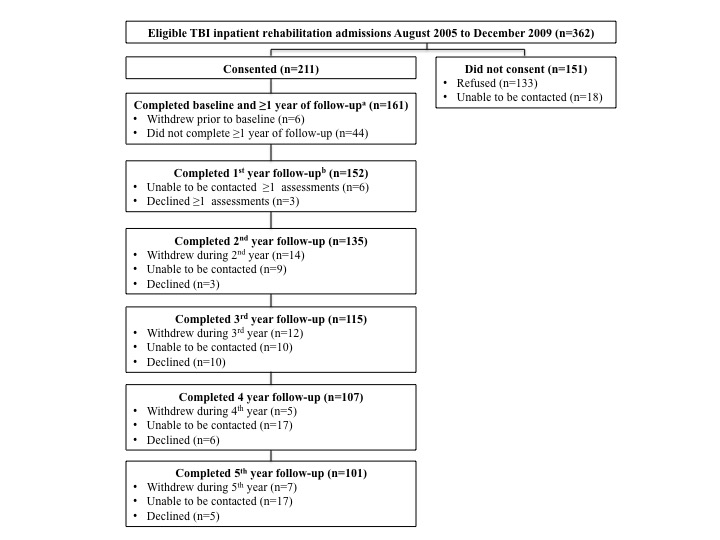
The flow of participants through the study is illustrated in online Supplementary Fig. S1. Although 211 patients consented to the study, only data from the 161 participants who completed baseline and 1 year or more of follow-up were included in analyses. There were no significant differences between these participants and those eligible but not recruited/included in age [t = −0.68, degrees of freedom (df) = 359, p = 0.50], gender (χ 2 = 0.38, df = 1, p = 0.54), Westmead PTA Scale severity category (χ 2 = 0.21, df = 1, p = 0.89), or Glasgow Coma Scale (GCS) severity category (χ 2 = 2.03, df = 2, p = 0.36). However, the included sample was more educated (t = −4.66, df = 345, p < 0.001). Despite gradual participant attrition over time, the included sample did not significantly differ in the aforementioned demographic and injury-related variables across follow-ups (all p > 0.20).
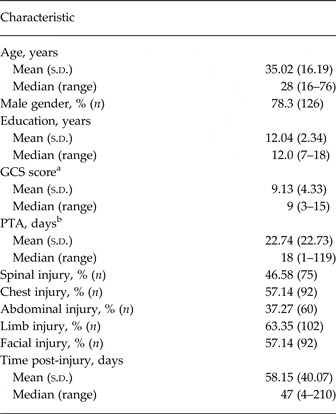
Table 1 presents participants’ baseline demographic and injury-related characteristics. The majority of participants were Australian born (88.1%) and in full-time work (62.8%) or study (14.7%) at the time of injury; 10.3% were employed part-time and 12.2% unemployed or retired. Approximately half were single (50.9%), 39.7% were married/de facto married, 8.1% separated/divorced, and 1.2% widowed. Motor-vehicle accidents were the predominant cause of injury (67.1%); other causes included: pedestrian (10.6%), fall (8.1%), workplace (5.6%), cyclist (3.7%), sporting accident (1.8%), and assault (1.2%). According to PTA duration, 31.2% had a moderate and 68.8% severe TBI; 37.7% had a GCS score of 13–15, 14.9% 9–12 and 47.4% 3–8.
Participant demographic and injury information at baseline (n = 161)

s.d., Standard deviation; GCS, Glasgow Coma Scale; PTA, post-traumatic amnesia.
a Missing data for seven participants.
b Missing data for one participant.
Frequency of Axis I disorders
Pre-injury
The majority of participants (59.0%) had one or more Axis I disorder prior to injury, with rates and patterns equivalent to adjusted lifetime rates in the Australian general population (Australian Bureau of Statistics, 2009; see online Supplementary Table S1). Substance use was the most common pre-injury diagnostic class, with 38.5% meeting criteria for an alcohol- or drug-use disorder. Rates of pre-injury mood and anxiety disorders were 23% and 21.7%, respectively. Pre-injury psychotic (4.3%), eating (3.7%), somatoform (0%) and adjustment (9.3%) disorders were relatively rare. Approximately one-third (31.7%) had received psychological counselling, 7.5% in-patient psychiatric care and 21.1% psychotropic medication prior to injury. Further, 30.4% reported a family history of psychiatric problems.
Post-injury
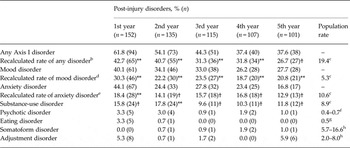
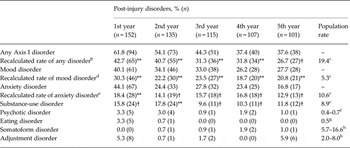
Table 2 presents the frequency of Axis I disorders during each follow-up post-injury, and comparative rates in the general population. Results of statistical comparisons with population rates are provided in online Supplementary Table S1.
Frequency of Axis I disorders each year post-injury and comparative 12-month rates in the general population a
a Results of statistical comparisons are provided in online Supplementary Table S1.
b Includes only substance-use disorders and the recalculated rates of mood and anxiety disorders.
c 12-month Australian population rates obtained from the Australian National Survey of Mental Health and Wellbeing (Australian Bureau of Statistics, 2009).
d Includes only major depressive disorder, dysthymic disorder and bipolar disorder.
e Includes only social phobia, post-traumatic stress disorder, panic disorder with/without agoraphobia, agoraphobia without panic disorder, obsessive compulsive disorder and generalized anxiety disorder.
f 12-month Australian population rate reported by Jablensky et al. (Reference Jablensky, McGrath, Herrman, Castle, Gureje, Evans, Carr, Morgan, Korten and Harvey2000).
g 12-month New Zealand population rate reported by Wells et al. (Reference Wells, Browne, Scott, McGee, Baxter and Kokaua2006).
h 12-month population rate reported in Diagnostic and Statistical Manual of Mental Disorders, 4th edition, text revision (DSM-IV-TR; American Psychiatric Association, 2000).
** p < 0.01.
† n.s. ( p > 0.01).
During the first 5 years post-injury 75.2% were diagnosed with one or more Axis I disorders. Post-injury disorders were more common amongst those with a pre-injury history (83.2%) than those without (63.6%) (χ 2 = 11.36, df = 1, p < 0.001). Similar disorder frequencies for males (77.0%) and females (71.4%) were observed (χ 2 = 0.46, df = 1, p = 0.50). As illustrated in Table 2, rates of any disorder peaked in the first year post-injury and gradually declined thereafter, reducing to a general population equivalent rate by the fifth year post-injury (see online Supplementary Table S1).
Mood and anxiety were the most common diagnostic classes during each follow-up period. Rates of mood disorder were significantly higher than in the Australian general population each year, whilst anxiety disorders were elevated only in the first year post-injury (see online Supplementary Table S1). Major depressive disorder (MDD) was the single most common diagnosis, presenting at rates between four and six times (18.7–28.3%) those in the general population (4.2%) over the 5-year period (see online Supplementary Table S1). A subsyndromal variant of MDD, diagnosed as depressive disorder not otherwise specified (NOS) was the next common mood disorder (6.5–15.8%), whilst dysthymia (0–2.0%) and bipolar disorder (0–3.1%) were relatively rare.
Anxiety disorder NOS was the most common anxiety diagnosis (10.3–34.2%), frequently characterized by subthreshold PTSD and/or generalized anxiety disorder (GAD) symptoms. Cases of PTSD-like anxiety NOS commonly did not meet the PTSD avoidance criterion, whilst cases of GAD-like anxiety NOS had symptoms confined to a major depressive episode precluding a concurrent GAD diagnosis. PTSD was the second most common anxiety disorder (5.0–13.2%), exceeding 12-month rates in the general population (3.5%) each year post-injury (see online Supplementary Table S1). Other anxiety disorders, including panic disorder (2.0–3.3%), agoraphobia (0.7–1.0%), obsessive–compulsive disorder (0.0–2.6%) and GAD (0.0–3.3%), were relatively uncommon and presented at rates similar to those found in the general population (Australian Bureau of Statistics, 2009).
Substance-use disorders were the third most common diagnostic class, presenting at higher rates than in the general population in the second year post-injury (see online Supplementary Table S1). Consistent with pre-injury patterns, alcohol-use disorders were most common (7.8–17.8%). Although low frequencies precluded statistical comparisons, rates of post-injury psychotic, eating, somatoform and adjustment disorders appeared comparable with rates reported in the general population.
Co-morbidity of Axis I disorders
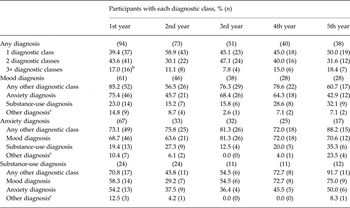
Table 3 presents the proportion of cases with one or more Axis I diagnostic class and rates of co-morbidity between classes of mood, anxiety and substance-use disorder, by follow-up period. On average across follow-up periods, approximately half had two or more diagnostic classes. Mood and anxiety disorders often presented co-morbidly and the majority of substance-use cases also had another class of disorder.
Co-morbidity associated with mood, anxiety and substance-use disorders a
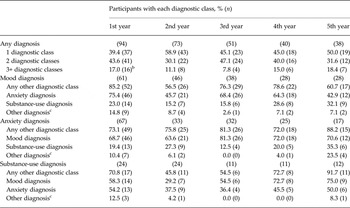
a The Table presents only those participants with the respective diagnostic class during each follow-up period; percentages represent the proportion of participants with the respective class of disorder during follow-up.
b One participant met criteria for four diagnostic classes, with all other participants having three.
c Psychotic, eating, somatoform and/or adjustment diagnosis.
Timing of first presentation and trajectory of post-injury disorders
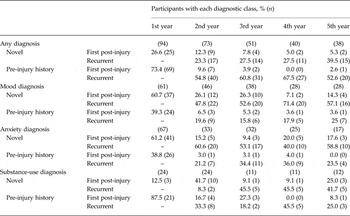
Table 4 presents the proportion of cases with a diagnosis that were: (1) first onset or (2) recurrent, by follow-up period and pre-injury history of each diagnostic class. As can been seen, the majority of cases with any disorder, and any mood, anxiety or substance-use disorder, emerged within the first year post-injury, with cases in subsequent years largely comprising those with recurrent or chronic disorders. Although not presented in Table 4, similar patterns for psychotic, eating and adjustment disorders were found, whilst all cases of somatoform disorder (n = 5) emerged between 2 and 5 years post-injury.
Proportion of cases presenting for the first time post-injury by pre-injury history of each diagnostic class a

a Novel = respective diagnostic class presenting post-injury not present pre-injury; pre-injury history = respective diagnostic class present pre-injury; first post-injury = timing of onset of diagnostic class post-injury; recurrent = diagnostic class first present at a previous follow-up; – = not applicable.
Overall, the majority with a post-injury disorder also had a pre-injury disorder. However, cases with a pre-injury disorder commonly experienced a different class of post-injury disorder; 37.0% had pre-injury diagnostic class only, 27.2% novel diagnostic class only and 35.8% both a pre-injury and novel diagnostic class. Cases of post-injury disorder with a pre-injury history were significantly more likely to present in the first year post-injury (85.1%) than novel cases (59.5%) (χ 2 = 9.58, df = 1, p < 0.01).
During the 5-year follow-up the majority of post-injury mood and anxiety disorders were novel. Of all post-injury mood disorder cases, 31.6% (n = 30) also had a pre-injury mood disorder, 32.6% (n = 31) a different class of pre-injury disorder and 35.8% (n = 34) no pre-injury disorder; the pattern for anxiety disorders was similar, with proportions of 34.1% (n = 30), 34.1% (n = 30) and 31.8% (n = 28), respectively. In contrast, the majority of substance-use disorder cases also had a substance-use disorder prior to injury (n = 29; 61.7%), whilst 12.7% (n = 6) had a different pre-injury diagnostic class, and 25.6% (n = 12) no pre-injury disorder. Cases of psychotic and eating disorders usually presented with a pre-injury history and re-emerged in the first year post-injury. The vast majority of adjustment and all somatoform disorders were novel, with no apparent temporal pattern of onset.
Rates of psychological treatment
All participants received in-patient and out-patient rehabilitative interventions (e.g. physiotherapy, speech therapy, occupational therapy, neuropsychology) as deemed appropriate by their treating team. On average across follow-ups, around two-thirds (range = 66.6–81.7%) with a diagnosis were receiving psychological intervention. Counselling was the most common intervention amongst participants with a disorder at each follow-up (36.2–79.2%), followed by psychotropic medication (31.0–43.7%), with relatively low rates of psychiatric in-patient admission (2.2–4.3%).
Factors associated with post-injury Axis I disorders
Table 5 presents the results of the logistic GEE model, which examined the likelihood of post-injury Axis I disorder by pre-injury history and time post-injury, with demographic and injury-related factors entered as covariates. Whilst GEE was chosen on the basis of ease of interpretation, random-effects regression analyses gave a consistent pattern of results.
Generalized estimating equation examining relationships between pre-injury and injury-related characteristics and post-injury Axis-I disorders a

OR, Odds ratio; CI, confidence interval; PTA, post-traumatic amnesia.
a Model based on 606 observations from 202 cases.
* p < 0.05, ** p < 0.01, *** p < 0.001.
The presence of a pre-injury disorder and an accident-related limb injury were significant predictors of post-injury Axis I disorder. Further, compared with the first year, the likelihood of disorder was significantly lower in subsequent years; when years was entered as a continuous variable, the odds of disorder decreased by 27% with each year post-injury [odds ratio (OR) 0.73, 95% confidence interval (CI) 0.65–0.83, p < 0.001]. There was a significant quadratic relationship between age at injury and post-injury disorder, whereby the likelihood of disorder increased with greater age up to 30 years and declined with greater age thereafter. Gender, education and PTA duration were not significantly associated with post-injury Axis I disorder.
The GEE model examining mood disorders indicated that a pre-injury mood disorder almost doubled the odds of a post-injury mood disorder (OR 1.95, 95% CI 1.02–3.72, p < 0.05). Further, when compared with the first year post-injury, the likelihood of mood disorder was significantly lower in the fourth year (OR 0.55, 95% CI 0.33–0.92, p < 0.05), but comparable in other years (all p > 0.05). Demographic and injury-related variables were not statistically significant in the model (all p > 0.10).
The results of the GEE model examining anxiety disorders indicated that a pre-injury anxiety disorder tripled the probability of post-injury anxiety disorder (OR 3.12, 95% CI 1.74–5.60, p < 0.001). Further, compared with the first year, the odds of having an anxiety disorder were significantly lower in the second (OR 0.39, 95% CI 0.26–0.59, p < 0.001), third (OR 0.46, 95% CI 0.30–0.72, p < 0.01), fourth (OR 0.36, 95% CI 0.21–0.61, p < 0.001) and fifth (OR 0.23, 95% CI 0.13–0.43, p < 0.001) years post-injury. When time was entered as a continuous variable, the odds of anxiety disorder decreased by 27% with each year post-injury (OR 0.73, 95% CI 0.63–0.84, p < 0.001). Demographic and injury-related variables were not significant in the model (all p > 0.05).
Finally, the results of the GEE model examining substance-use disorders indicated that pre-injury substance-use disorder doubled the odds of a post-injury substance-use disorder (OR 2.29, 95% CI 1.15–4.54, p < 0.05). Further, the odds of substance-use disorder decreased with female gender (OR 0.26, 95% CI 0.10–0.68, p < 0.01), older age at injury (OR 0.97, 95% CI 0.95–0.99, p < 0.05) and higher education (OR 0.80, 95% CI 0.66–0.96, p < 0.05). PTA duration, limb injury and time post-injury were not statistically significant in the model (all p > 0.05).
Discussion
In the present study, 161 individuals with moderate to severe TBI were prospectively evaluated for DSM-IV Axis I psychiatric disorders over the first 5 years post-injury. Findings confirmed the high frequency of psychiatric disorders following TBI, with 75.2% receiving one or more psychiatric diagnoses during the first 5 years, and 12-month frequencies higher than in the Australian general population up to the fourth year post-injury. The majority of cases first emerged within the first year post-injury, and declined thereafter. This finding supports the first year as being a high-risk period for the development of psychiatric disorders following TBI (Ashman et al. Reference Ashman, Spielman, Hibbard, Silver, Chandna and Gordon2004; Gould et al. Reference Gould, Ponsford, Johnston and Schönberger2011b ).
Mood and anxiety were the most common diagnostic classes post-injury and were co-morbid in approximately three in four cases, consistent with previous research (Deb et al. Reference Deb, Lyons, Koutzoukis, Ali and McCarthy1999; Whelan-Goodinson et al. Reference Whelan-Goodinson, Ponsford, Johnston and Grant2009; Gould et al. Reference Gould, Ponsford, Johnston and Schönberger2011b ). Although many cases received depression and anxiety disorder NOS diagnoses, MDD and PTSD were the most common classifiable mood and anxiety disorders, respectively. Cases of depression NOS comprised subthreshold MDD presentations, whilst cases of anxiety NOS largely comprised subthreshold PTSD and generalized anxiety. Mood and anxiety disorders commonly presented without a pre-injury history of these disorders. Relative to population rates, anxiety disorders were elevated only in the first year, whilst rates of mood disorder were at least four times greater up to 5 years post-injury. Therefore, post-injury mood disorders appear more chronic/recurrent in course than do anxiety disorders. This result is not surprising, given MDD has high rates of recurrence (i.e. 50% after first episode) in non-brain injured populations (Burcusa & Iacono, Reference Burcusa and Iacono2007).
Substance-use disorders were the third most common diagnostic class, commonly presenting with a pre-injury history and were associated with high rates of co-morbidity. The most common substance-use disorders were alcohol-related. Rates of substance-use disorder exceeded that in the general population during the second year post-injury. Whilst speculative, this result may reflect a return to pre-injury patterns of alcohol use after the treating hospital's recommended 12-month abstinence period, with decreasing levels of use in subsequent years once potential impacts of alcohol on injury-related changes (e.g. disinhibition) are realized.
This study found relatively low rates of psychotic disorders post-injury, falling within the lower band of previous reports in samples with TBI (Molloy et al. Reference Molloy, Conroy, Cotter and Cannon2011). Further, the majority of individuals with psychosis, and all of whom with schizophrenia post-injury, had a pre-injury history of the disorder. Therefore, this study found no evidence to suggest that TBI may precipitate the development of schizophrenia. Somatoform, eating and adjustment disorders were relatively uncommon, comparable with previous reports (Fann et al. Reference Fann, Burington, Leonetti, Jaffe, Katon and Thompson2004; Whelan-Goodinson et al. Reference Whelan-Goodinson, Ponsford, Johnston and Grant2009; Gould et al. Reference Gould, Ponsford, Johnston and Schönberger2011b ).
Consistent with studies examining shorter time-frames post-injury (Deb et al. Reference Deb, Lyons, Koutzoukis, Ali and McCarthy1999; Ashman et al. Reference Ashman, Spielman, Hibbard, Silver, Chandna and Gordon2004; Fann et al. Reference Fann, Burington, Leonetti, Jaffe, Katon and Thompson2004; Jorge et al. Reference Jorge, Robinson, Moser, Tateno, Crespo-Facorro and Arndt2004; Gould et al. Reference Gould, Ponsford, Johnston and Schönberger2011b ), a pre-injury psychiatric disorder was the strongest predictor of post-injury disorder during the 5-year follow-up period. Given that stressful life events and transitions are common precipitants to relapse, the experience of TBI and its recovery may trigger the recurrence or exacerbation of a pre-injury disorder (Burcusa & Iacono, Reference Burcusa and Iacono2007). However, whilst individuals with a pre-injury psychiatric history were significantly more likely to develop a post-injury disorder, two-thirds of these cases developed a diagnostic class not present prior to injury. Further, the majority without a psychiatric history also developed a disorder post-injury. Therefore, psychiatric presentations following TBI do not merely represent a continuation of pre-injury disorders into the post-injury period (Gould et al. Reference Gould, Ponsford, Johnston and Schönberger2011b ).
Limb injury emerged as the next strongest predictor of experiencing a psychiatric disorder in the first 5 years post-injury, as found previously by Gould et al. (Reference Gould, Ponsford, Johnston and Schönberger2011c ) at 12 months post-injury. Accident-related limb injuries are associated with greater pain and poorer psychosocial outcomes following TBI, both of which are associated with post-injury psychiatric disorders (Gould et al. Reference Gould, Ponsford, Johnston and Schonberger2011a , Reference Gould, Ponsford, Johnston and Schönberger c ). Therefore individuals with limb injuries may require additional support to manage pain and adjust to the psychosocial impact of their injury, such as reduced independence and ability to return to occupational and leisure activities.
In keeping with past findings, this study found no evidence to suggest that TBI severity influences risk for psychiatric disorder post-injury (Hibbard et al. Reference Hibbard, Uysal, Kepler, Bogdany and Silver1998; Deb et al. Reference Deb, Lyons, Koutzoukis, Ali and McCarthy1999; Koponen et al. Reference Koponen, Taiminen, Portin, Himanen, Isoniemi, Heinonen, Hinkka and Tenovuo2002; Gould et al. Reference Gould, Ponsford, Johnston and Schönberger2011 b). Further, this study found no effect of gender on the likelihood of developing a post-injury disorder, or a mood or anxiety disorder, specifically (Deb et al. Reference Deb, Lyons, Koutzoukis, Ali and McCarthy1999; Gould et al. Reference Gould, Ponsford, Johnston and Schönberger2011b ; Koponen et al. Reference Koponen, Taiminen, Hiekkanen and Tenovuo2011). In contrast, males were more than twice as likely to develop a post-injury substance-use disorder, which also declined in likelihood with increasing age and education level, as noted previously (Hibbard et al. Reference Hibbard, Uysal, Kepler, Bogdany and Silver1998; Jorge et al. Reference Jorge, Starkstein, Arndt, Moser, Crespo-Facorro and Robinson2005).
Certain limitations of this study must be acknowledged. The sample comprised predominately male motor-vehicle accident victims, who had access to comprehensive in-patient rehabilitation. Therefore the findings may not generalize to TBI patients with different mechanisms of injury or limited rehabilitation. There was gradual participant attrition over time, with around two-thirds of the initial sample completing the 5-year follow-up; therefore reported rates may not be fully representative. Further, we were unable to corroborate symptom reporting with a significant other for one-quarter of our participants.
Nonetheless, this is the largest prospective study to date to use a validated clinical interview to examine a range of psychiatric disorders following moderate to severe TBI, and the first to prospectively examine these outcomes over several years post-injury. Findings demonstrate that the first year is the critical period in the emergence of psychiatric disorders following TBI. Although previous studies have noted declining rates of disorders following the first year post-injury (Ashman et al. Reference Ashman, Spielman, Hibbard, Silver, Chandna and Gordon2004; Fann et al. Reference Fann, Burington, Leonetti, Jaffe, Katon and Thompson2004; Orlovska et al. Reference Orlovska, Pedersen, Benros, Mortensen, Agerbo and Nordentoft2014), this study has demonstrated this using a prospective methodology and illustrated that anxiety disorders decline more readily than do mood disorders. Further, this study has demonstrated that individuals with a pre-injury psychiatric history and/or an accident-related limb injury are high-risk groups for post-injury psychiatric disorders who may benefit from early intervention.
Given findings from retrospective studies indicating high rates of disorders for several decades post-injury (Koponen et al. Reference Koponen, Taiminen, Portin, Himanen, Isoniemi, Heinonen, Hinkka and Tenovuo2002), further follow-up with this cohort is imperative to understanding the very long-term trajectory of psychiatric disorders following TBI. Our understanding of the respective contributions of pre-injury characteristics, TBI-related neuropathology and post-injury adjustment concerns requires further investigation. As early intervention has the potential to shorten disorder duration and reduce the likelihood of reoccurrence, there is a need to strengthen the evidence base for effective psychological and pharmacological treatments in TBI populations.
Supplementary material
For supplementary material accompanying this paper visit http://dx.doi.org/10.1017/S0033291715002986
Acknowledgements
The authors acknowledge the important contributions of Sylvia Nguyen, Kate Cameron, Natalie Gracia, Mary Karamitsios and Celia Pias in data collection. This project was funded by the Transport Accident Commission (TAC), through the Institute for Safety, Compensation and Recovery Research (ISCRR).
Declaration of Interest
None.