Apreviously healthy 9-month-old male presented with 2 weeks of lethargy associated with cough and congestion followed by 1 day of progressive shortness of breath. On physical examination, the child was noted to have a gallop rhythm, hepatomegaly, and diminished peripheral pulses. The right upper extremity blood pressure was elevated at 160 mmHg with an upper-to-lower extremity gradient of 55–70 mmHg. A chest X-ray revealed cardiomegaly and pulmonary oedema. The electrocardiogram demonstrated normal sinus rhythm, right atrial enlargement, prominent mid-precordial voltages, and non-specific t-wave abnormality. His laboratory assessment revealed bicarbonate levels of 21 mM/L, normal renal function, and normal inflammatory markers. A respiratory viral antigen was positive for rhinovirus/enterovirus. The transthoracic echocardiogram revealed a severely dilated left ventricle with severely diminished systolic function, with shortening fraction of 11% and an ejection fraction of 19.5%, mild-to-moderate mitral regurgitation, and elevated left ventricular wall stress. The origin of the left coronary artery was normal. There was stenosis of the abdominal aorta at the level of the diaphragm with a peak gradient of 63 mmHg. The patient was admitted to the cardiac intensive care unit, placed on high-flow nasal cannula, milrinone, and diuretic therapy.
MRI demonstrated a posterior mediastinal mass involving the left paraspinal region from the level of the left inferior pulmonary vein to the diaphragm, which completely encased the aorta at this level. The narrowest diameter of the aorta at the level of T11–12 measured 2.5×2.9 mm. An open biopsy was consistent with a myofibroma. Owing to the intimate relationship of the tumour with the aorta, it was felt that he was at very high risk for surgery.
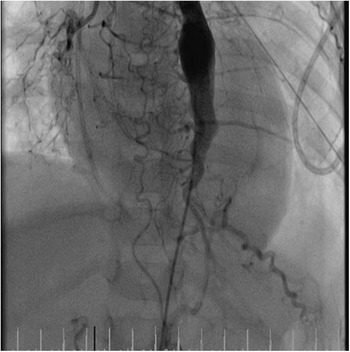
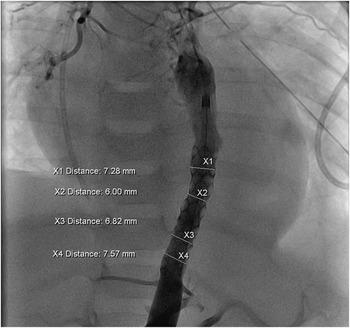
The patient was subsequently taken to the catheterisation laboratory where he had a 58-mmHg peak-to-peak gradient from the ascending aorta to the abdominal aorta. Angiography revealed long-segment narrowing and multiple areas of near-complete occlusion with collateral vessel formation (Fig 1). Balloon angioplasty using a 5.5-mm balloon to 6 atm was performed with resolution of the waist, but with little angiographic improvement; two 6×18 mm and one 6×12 mm Palmaz Blue stents (Cordis, J&J, Fremont, California, United States of America) were then deployed and dilated to 8 mm with no residual gradient. The narrowest post-intervention diameter was 6 mm, suggesting that a stent with more radial strength may have increased the luminal diameter further (Fig 2).
Thoracic aorta angiogram before intervention.

Thoracic aorta angiogram after intervention.

Following catheterisation, the patient was transitioned to captopril and furosemide and discharged home. His echocardiogram at 24 months of age demonstrated normal left ventricular size and systolic function, with a shortening fraction of 37.2% and an ejection fraction of 63%. The peak and mean gradients in the abdominal aorta were 44 and 15 mmHg, respectively. He is not on any anti-hypertensive medications. His CT scan at 15 months of age demonstrated no significant change in the myofibroma from the initial MRI.
Discussion
We summarise a case of a myofibroma producing extrinsic compression of the distal thoracic and abdominal aorta, leading to severe left ventricular systolic dysfunction, requiring intensive care and inotropic support. Myofibromas are the most common fibrous tumours of infancy. These tumours are rare in the general population, and the true incidence is unknown.Reference Gopal, Chahal, Al-Rifai, Eradi, Ninan and Nour 1 The lesions may be solitary or multicentric and are found in the skin, muscle, viscera, bone, and subcutaneous tissues. They typically have a benign course and some can spontaneously regress.Reference Oudijk, den Bakker and Hop 2 , Reference Wiswell, Davis, Cunnigham, Solenberger and Thomas 3 Visceral myofibromas, however, have a poor prognosis due to mass effect and are the rarest types occurring in only 3.5% of myofibromas.Reference Oudijk, den Bakker and Hop 2 – Reference Schurr and Moulsdale 4 The primary treatment is surgical resection, which is not always possible, as was the case in our patient.
Mid-aortic syndrome is defined as an obstructive lesion of the mid-aorta, regardless of aetiology, and was first described by Sen in 1963.Reference Sen, Kinare, Engineer and Parulkar 5 , Reference Porras, Stein and Ferguson 6 The diagnosis is extraordinarily rare and represents a heterogeneous collection of aetiologies. The largest series reported thus far is from a study by Porras et al,Reference Porras, Stein and Ferguson 6 with 53 patients in a 30-year experience, and included primary diagnoses of Williams syndrome, Takayasu arteritis, neurofibromatosis-1, Allagile syndrome, and Moya-Moya. The second largest series of 36 patients reported similar aetiologies, but also had three cases of large malignant tumours causing extrinsic compression of the aorta and visceral branches.Reference Tummolo, Marks and Stadermann 7 The types of tumours included neuroblastoma, congenital infantile fibrosarcoma, and retroperitoneal teratoma. Almost all patients present during childhood with a variable degree of systolic hypertension as a result of aortic and renal artery stenosis. Severe types can lead to encephalopathy, stroke, and congestive heart failure. Specifically, 10–25% of mid-aortic syndrome patients can have congestive heart failure on presentation.Reference Porras, Stein and Ferguson 6 , Reference Tummolo, Marks and Stadermann 7 Management options include medical anti-hypertensive therapy, percutaneous interventions including balloon dilation and stent placement, and/or surgery. Patient’s with the most severe disease are often <1 year of age and may benefit from percutaneous interventions as a palliative measure to delay surgery until the child is more mature.Reference Porras, Stein and Ferguson 6 Once the patient approaches adult size, the surgical options expand to include prosthetic conduits, which would otherwise have no growth potential if placed in a small child. In their 53 patients, Porras et al reported 35 patients who underwent percutaneous and/or surgical interventions with a 33% freedom from any re-intervention at 5 years. Further, following surgical intervention, freedom from any re-intervention at 10 years was 72%. The overall survival of the study population was 90% at 15 years.Reference Porras, Stein and Ferguson 6
Conclusion
To our knowledge, this is the first reported patient to develop mid-aortic syndrome as a result of a myofibroma. The patient likely had a slow, progressive tumour burden, given the extensive collaterals with a viral illness exacerbating his heart failure. The lesion responded well to endovascular therapy, indicating that the obstruction generated by this tumour is expandable. We anticipate that additional catheter-based interventions will be required in the form of stent re-dilation and re-stenting as a result of patient growth, stent stenosis, and/or worsening tumour burden. Although small pre-mounted stents are not designed to reach adult size, there are data suggesting that the struts can fracture and unzip at high pressure, with a reasonable chance of being amenable to further diameter expansion.Reference McElhinney, Marshall and Schievano 8 – Reference Sathanandam, Haddad and Subramanian 9 For this patient, transcatheter stent therapy for mid-aortic syndrome was a successful life-saving option and has provided an excellent intermediate term palliation.
Acknowledgement
None.
Financial Support
This research received no specific grant from any funding agency, commercial, or not-for-profit sectors.
Conflicts of Interest
None.
Ethical Standards
The authors assert that all procedures contributing to this work comply with the ethical standards of the relevant guidelines on human experimentation and with the Helsinki Declaration of 1975, as revised in 2008, and has been approved by the institutional committees.