1 Introduction
Phrasal verbs have attracted scholarly attention in terms of their diachronic development, their particular semantic and formal features, as well as their alleged association with the spoken, colloquial language. It is widely assumed that phrasal verbs tend to occur in informal, colloquial registers associated with speech, and are avoided in formal writing (see, e.g., Cowie & Mackin Reference Cowie and Mackin1975: iv; McArthur Reference McArthur1989: 40; Biber et al. Reference Biber, Johansson, Leech, Conrad and Finegan1999: 408–9; Huddleston & Pullum Reference Huddleston and Pullum2002: 284; Liu Reference Liu2011: 675). In fact, most of those who have learnt English as a second language have been often advised not to use phrasal verbs in formal contexts, as proscriptions against the use of phrasal verbs still pervade in contemporary grammars (see Brinton Reference Brinton1996). In Early Modern English (EModE), by contrast, phrasal verbs have been described as ‘stylistically neutral’ (Thim Reference Thim, Johnston, von Mengden and Thim2006a: 302, Reference Thim2012). Although not dismissing entirely the degree of formality as a relevant factor, Thim argues that in the period 1500–1700 the use of phrasal verbs in a particular text type is motivated principally by the subject matter of the writing. In his analysis he finds that the majority of the combinations in Everyday English Footnote 2 are literal, and that they are used mostly to denote physical movement as a means of narrating events (2006a: 303–4), so that in his view the (non-)use of phrasal verbs correlates with the semantic function of the text, rather than with its stylistic function. If Thim is right in this claim, phrasal verbs have apparently shifted from being stylistically neutral to becoming markers of colloquiality, and the change seems to have taken place at some point between the EModE period and the nineteenth century.
Taking as a point of departure Thim's (Reference Thim, Johnston, von Mengden and Thim2006a) findings about the stylistic neutrality of phrasal verbs in the EModE period, the purpose of this article is to analyse the formal features and distribution of phrasal verbs in the Old Bailey Corpus (OBC; see Huber et al. Reference Huber, Nissel, Maiwald and Widlitzki2012) from 1720 to 1913 to see whether these structures can be related to spoken and colloquial styles between the Late Modern English (LModE) period and the twentieth century, something which, to my knowledge, has not thus far been attempted. Although a number of works dealing with phrasal verbs in this rather extensive period of the English language have appeared recently,Footnote 3 further investigation is needed to shed light on the particular formal characteristics of phrasal verbs, as well as their alleged association with the spoken, colloquial language. In this article, findings from the OBC are compared with data obtained from ARCHER (A Representative Corpus of Historical English Registers, 1650–1990), especially with those text types which are closely related to the spoken medium, namely diaries, personal letters, drama and sermons (see section 3 below). Trial proceedings present some features that distinguish them from casual face-to-face conversation, although two elements make them particularly speech-like: they are highly interactive and are not pre-planned (Culpeper & Kytö Reference Culpeper and Kytö2010: 63–4). Thus, even though it cannot be claimed that court proceedings are a wholly faithful reflection of the spoken word, in the absence of recording devices at the time, they constitute one of the best available representations of the spoken language of the past, in that they contain ‘verbatim passages [which] are arguably as near as we can get to the spoken word of the period’ (Huber Reference Huber, Meurman-Solin and Nurmi2007). Given that the OBC stops at the year 1913, the evolution of phrasal verbs in this subgenre beyond this date was tracked through the legal cross-examinations included in the International Corpus of English (ICE-GB). Legal cross-examinations contain pre-planned discourse and are articulated following a particular structure and, hence, they are probably not the most accurate reflection of the spoken language in Present-day English (PDE), as compared, for example, to casual face-to-face conversation. However, in terms of content (the kind of exchanges and questioning produced in trials) they provide a good source for comparison with trial proceedings.
Therefore, this piece of research aims at filling a gap in the literature of phrasal verbs by describing the state of the art of these structures between 1650 and 1990 in the speech-related genres of three different corpora, providing the answers to some of the questions raised by Thim (Reference Thim2012) as to the colloquiality of phrasal verbs from 1700 onwards and emphasising the value of studying genres such as trial proceedings more closely. The article is structured as follows. Section 2 is concerned with the definition of phrasal verbs and the description of the main features which distinguish them from other verb–particle combinations. Section 3 introduces the design and structure of the corpora used and presents a classification of the genres analysed in terms of their proximity to the oral language and their degree of formality. Section 4 describes the methodology adopted for the extraction of examples from the corpora, and Section 5 presents the main corpus findings, focusing on the distribution and frequency of phrasal verbs and their formal features. Section 6 concludes with some final remarks and suggestions for further research.
2 What are phrasal verbs? Delimiting the scope of the study
Phrasal verbs are (partially) lexicalised combinations of a verb plus a particle of an adverbial nature which together form a lexical and semantic unit to some degree, such as put up in example (1) below. Thus, one of the main distinguishing features of phrasal verbs has to do with the nature of the post-verbal particle which ‘is best of all described as an adverb, but not as a preposition’ (Claridge Reference Claridge2000: 46), in comparison with prepositional verbs (see (2) below) and phrasal-prepositional verbs, which contain both an adverb and a preposition, as in (3) (see also Mitchell Reference Mitchell1958: 106, Heaton Reference Heaton1965: 45; Bolinger Reference Bolinger1971; Denison Reference Denison1981: 24–33, Reference Denison and Romaine1998: 222).
-
(1) More than 70,000 shopkeepers have been forced to put up the shutters in the past year. (British National Corpus [BNC] CH2 W_newsp_tabloid)
-
(2) So, I am looking after their interests. (BNC J9M S_meeting)
-
(3) Menzies was seething and he broke in on the last words. (BNC A0N W_fict_prose)
Phrasal verbs may be either transitive or intransitive. The distinction between transitive phrasal verbs and other verb–preposition combinations is rather simple, as one of the main distinguishing features of phrasal verbs is the fact that transitive combinations allow the particle to be placed either before or after the object, as in (4) below, something which is not possible in other verb–preposition combinations (see (5) and (6) below).
-
(4) They put [up] the shutters [up].
-
(5) I am looking [*their interests] after [their interests].
-
(6) He broke [*the last words] in [*the last words] on [the last words].
Syntactically speaking, intransitive combinations are more difficult to distinguish as particle movement is impossible. However, they show certain syntactic behaviour not allowed with verb plus adverb combinations: the particle may be preposed (see Quirk et al. Reference Quirk, Greenbaum, Leech and Svartvik1985: 1153; Huddleston & Pullum Reference Huddleston and Pullum2002: 284), compare (7) and (8), and adverbs can be inserted between the verb and the particle (see Bolinger Reference Bolinger1971: 11ff), compare (9) and (10):Footnote 4
-
(7) Out they went. Off came his shirt.
-
(8) *Outside he went.
-
(9) She turned completely around. My mental state just went totally up.
-
(10) *He went quickly outside.
Following Bolinger (Reference Bolinger1971), Makkai (Reference Makkai1972), Denison (Reference Denison1981) and Claridge (Reference Claridge2000), among others, I will consider both literal and idiomatic phrasal verbs. Since idiomaticity is a matter of degree it is not easy to establish a clear dividing line between what is a phrasal verb and what is not, using idiomaticity as a criterion. In fact, non-idiomatic combinations are ‘the core from which figurative types are ultimately derived’ (Claridge Reference Claridge2000: 47; see also Rodríguez-Puente Reference Rodríguez-Puente2012a and Brown & Palmer Reference Brown, Palmer, Adams, Brinton and Fulk2015). This view is not universally held, and indeed in the literature combinations of a verb and an adverb whose meaning is not opaque are often referred to as free combinations rather than as phrasal verbs (see, e.g., Live Reference Live1965; Fraser Reference Fraser1976; Quirk et al. Reference Quirk, Greenbaum, Leech and Svartvik1985: 1152, 1162–3). For my current purposes, and for the sake of comparisons with earlier periods, I consider as phrasal verbs those combinations containing a verb plus one of the adverbial particles in the list below.
aback, aboard, about, above, across, after, ahead, along, apart, around, aside, astray, asunder, away, back, behind, by, counter, down, forth, forward(s), home, in, off, on, out, over, past, round, through, to, together, under, up
This compendium of particles is based on the group of EModE particles included in Claridge (Reference Claridge2000: 46), developed from compilations provided by previous scholars (see Bolinger Reference Bolinger1971: 17–18; Cowie & Mackin Reference Cowie and Mackin1975; Fraser Reference Fraser1976; Quirk et al. Reference Quirk, Greenbaum, Leech and Svartvik1985: 1151), as well as on her own data. My list contains the 34 items illustrated above, but not the particle ashore, which is included by Claridge.Footnote 5 All the particles in the above list can form lexicalised combinations even in their literal senses (e.g. go out ‘exit’), and they can also provide the source for the formation of idiomatic meanings (e.g. bring home ‘make clear’).
3 Corpora and genre classification
3.1 Corpora used in the present study
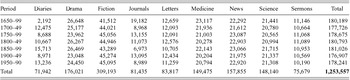
ARCHER 3.1 is a multi-genre historical corpus of British and American English covering the period 1650 to 1999. For the purposes of this study, I used the British section of the corpus (1650–1990), excluding the American section because it only covers three fifty-year subperiods (1750–99, 1850–99 and 1950–99). The British component is divided into seven fifty-year subperiods, with eight different genres represented in each of these (drama, fiction, journals/diaries, letters, medicine, news, science and sermons). Although diaries and journals appear as a single category in this version of the corpus, for a more perspicuous analysis, in line with Yáñez-Bouza (Reference Yáñez-Bouza2007, Reference Yáñez-Bouza2015), these two genres were analysed separately (see also Rodríguez-Puente Reference Rodríguez-Puente2013). The complete distribution of the British section of ARCHER 3.1, after splitting diaries and journals, can be seen in table 1.
Number of words of British English across genres in ARCHER

The OBC is a 14 million-word corpus based on the Proceedings of the Old Bailey, London's central criminal court, covering the period 1674 to 1913. The corpus includes trial proceedings from 1720 to 1913, that is, the written accounts of the actions, events and testimony of the participants in a trial.
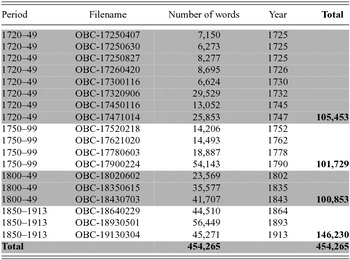
The results presented in this study are based on the analysis of a section of the OBC. Since my intention was to compare the data obtained from previous research carried out with ARCHER (Rodríguez-Puente Reference Rodríguez-Puente2013), I selected a number of files and organised them into four different periods which approximate to the fifty-year divisions in ARCHER, as can be seen in table 2.
Number of files and words per subperiod in the OBC

Taking advantage of the fact that the corpus is XML-tagged, I only considered the sections tagged as <speech>, that is, those which reproduce the verbatim words of the persons involved, whereas narrations of indirect speech are not part of my analysis.
Since the OBC does not contain data beyond 1913, in order to trace the more recent evolution of phrasal verbs in this genre, another subcorpus was used, namely the legal cross-examinations of the British component of the International Corpus of English from the 1990s (ICE-GB). The ICE-GB is a one-million word corpus of written and spoken English from 1990 to 1993. The subgenre legal cross-examinations is included among the public dialogues of the spoken section and contains 10 texts which total 21,352 words in all. Although colloquial, spoken language in PDE is probably best represented by casual face-to-face conversation, for our present purposes the legal cross-examinations of the ICE-GB provide a more realiable comparison to the data from the OBC, given that both record the direct testimony of participants in trials. It must be acknowledged, however, that my corpus data present a gap from 1913 to 1990 for this subgenre.
3.2 Genres in ARCHER and the OBC
According to Biber et al. (Reference Biber, Finegan, Atkinson, Beck, Burges, Burges, Kytö, Rissanen and Wright1994: 3), the genres in ARCHER can be classified into two major groups in terms of two criteria: written vs speech-based genres and formal vs informal genres. Speech-based texts are defined as ‘registers that have their origin in speech, even though they are preserved in writing’, including transcriptions of actual speech, such as town meetings, court testimony, as well as fictional and dramatic dialogues (Biber & Finegan Reference Biber, Finegan, Nevalainen and Kahlas-Tarkka1997: 253). Nevertheless, none of these registers really represents natural speech: ‘[d]ramatic and fictional dialogue are shaped by author's intuitions and stereotypes about conversation, while sermons are often written and then read. Thus, any claims about actual speech based on these samples must be extremely cautious’ (Biber et al. Reference Biber, Conrad and Reppen1998: 252–3).
A more precise categorisation of the text types in ARCHER and the OBC can be drawn along the parameters of classification established by Culpeper & Kytö (Reference Culpeper and Kytö2010). Thus, we can distinguish between two major groups of texts, speech-related texts (diaries, drama, letters, sermons and trial proceedings) and writing-based and writing-purposed texts (fiction, journals, news, medicine and science). The former group is further subdivided into three subgroups (see Culpeper & Kytö Reference Culpeper and Kytö2010: 17):
-
(a) Speech-like texts (letters and diaries). These are defined according to a scale consisting of features of communicative immediacy. Personal correspondence, for example, ‘is neither based on nor designed to be like speech; its claim to being “oral” or “colloquial” is solely that it contains features that are speech-like’ (Culpeper & Kytö Reference Culpeper and Kytö2010: 17).
-
(b) Speech-based texts (trial proceedings) are those ‘based on an actual “real-life” speech event’ (Culpeper & Kytö Reference Culpeper and Kytö2010: 17). They do not necessarily involve an accurate reproduction of a speech event, but are in most cases reproductions assisted by notes.
-
(c) Speech-purposed texts (drama and sermons) are designed to be articulated orally, either as monologues (sermons) or reproducing real-time interaction (drama).
Therefore, trial proceedings are classified in the terminology of Culpeper & Kytö (Reference Culpeper and Kytö2010: 17) within the category of speech-related text types, and more precisely within the subgroup of speech-based genres. Since ARCHER does not contain any speech-based text types,Footnote 6 the OBC provides a good source of examples which can be compared to other genres in ARCHER showing a certain degree of ‘speechlikeness’.
The reliability of trial proceedings as a linguistic and historical source has been addressed widely in the literature (see, among others, Culpeper & Kytö Reference Culpeper and Kytö2000, Reference Culpeper and Kytö2010; Kytö & Walker Reference Kytö and Walker2003; Huber Reference Huber, Meurman-Solin and Nurmi2007; Shoemaker Reference Shoemaker2008), in which one of the major criticisms has been the extent of scribal or editorial intervention.Footnote 7 The early proceedings tend to be rather sensationalist and judgmental, but the City of London gained control of the publication of the records from 1679, and from that point the tone of the proceedings becomes more objective. A key development was the change from publishing third-person summaries of testimonies (as happens in witness depositions) to first-person accounts from around 1712, when the proceedings started to include verbatim testimonies of prosecutors, witnesses and defendants, as well as judges’ comments and questions. Huber (Reference Huber, Meurman-Solin and Nurmi2007) analyses the shorthand method developed by Thomas Gurney, the scribe who recorded the proceedings at the Old Bailey from 1749 to 1770. He comes to the conclusion that the recording system and the publication of the proceedings immediately after each session are arguments in favour of an accurate portrayal of the spoken language, although he also acknowledges that being faithful to the spoken word was not always possible. Manipulation by scribes and publishers has also proved to be a crucial factor in the recording of bad language in the proceedings. Widlitzki & Huber (forthcoming) note that offensive language is less and less used in the proceedings over the 200-year span covered by the OBC and that the increase of municipal control over the proceedings between 1750 and the second half of the nineteenth century could be one of the reasons behind this. Similarly, the presence of examples in the proceedings in which the scribe makes use of non-standard spelling in an attempt to imitate the Irish accent of the speakers indicates that trial reports ‘are not a “clean” record of a speech event, linguistically speaking, but, rather, an interpretation of that speech event’ (Archer Reference Archer, Nevalainen and Traugott2012: 148).
According to Culpeper & Kytö (Reference Culpeper and Kytö2010: 63–4), trial proceedings and witness depositions are not entirely speech-like in a number of respects: in them, speech is regulated, the order of topics is predetermined, linguistic forms are prescribed, and language is always produced for a public audience and often on behalf of a collective audience (e.g. the court). Even so, trial proceedings present two main characteristics which make them particularly speech-like: they are highly interactive and are not preplanned. In Culpeper & Kytö’s study, comedy drama scores higher than trial proceedings on all speech-like aspects (Reference Culpeper and Kytö2010: 63–4, 142–57). However, it must be noted that Culpeper & Kytö’s (Reference Culpeper and Kytö2010) research refers to the Corpus of English Dialogues 1560–1760 (CED; see Kytö & Walker Reference Kytö and Walker2006), which differs from my corpus in two important respects. First, the trial proceedings contain some (though not many) explicit interventions by the scribe, such as the description of non-verbal behaviour, whereas the selection of texts from the OBC used in the present research contains only direct speech. Second, the dramatic works in the CED are exclusively comedy drama, whereas those in ARCHER represent a larger range of types.
In spite of the obvious drawbacks mentioned above, the main conclusion drawn from Huber's (Reference Huber, Meurman-Solin and Nurmi2007) analysis is that, although the proceedings cannot be described as faithful, word-by-word transcriptions, ‘they are still among the few and best sources we have of spoken language before the advent of mechanical recording’ (Huber Reference Huber, Meurman-Solin and Nurmi2007). Similarly, Culpeper & Kytö (Reference Culpeper and Kytö2000), who compare trial proceedings, witness depositions, prose fiction and drama as regards their reliability as faithful representations of speech, conclude that trial proceedings can be described as linguistically close to spoken face-to-face interaction. The advantage of the latter over other genres, such as drama, is that they are based on real, not imaginary speech (see also Kytö & Walker Reference Kytö and Walker2003: 225).
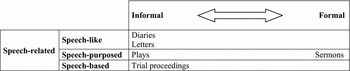
Figure 1 summarises the three speech-related genre categories established by Culpeper & Kytö (Reference Culpeper and Kytö2010) together with the text types which represent them in ARCHER and the OBC, although it must be borne in mind that speech-related texts and writing-based and writing-purposed texts do not constitute clear-cut sets, but rather interrelated and often overlapping categories.
Distribution of speech-based genres in ARCHER and the OBC according to the dimension of (in)formality and their speech-like characterisation

Figure 1 also displays a continuum showing the degree of (in)formality, with diaries, letters, drama and trial proceedings approaching the informal end and sermons situated at the formal end. Since this is a diachronic study, a note of caution seems in order regarding the scale of (in)formality represented in figure 1. Letters are a clear example of how the notion of formality in the seventeenth century differs from that of the twentieth century. Although LModE letters may seem to belong to the private sphere, during the eighteenth and nineteenth centuries they were very often read aloud to friends and relatives (Tieken-Boon van Ostade Reference Tieken-Boon van Ostade, Kastovsky and Mettinger2000, Reference Tieken-Boon van Ostade2005). For this reason, they cannot be considered spontaneous creations but rather the result of a very conscious process of writing, which followed a series of conventions laid out in a vast number of letter-writing manuals (see Anderson & Ehrenpreis Reference Anderson, Ehrenpreis, Anderson, Daghlian and Ehrenpreis1966; Nevalainen Reference Nevalainen, Diller and Görlach2001; Tieken-Boon van Ostade Reference Tieken-Boon van Ostade2009). Similarly, sermons, which represent a more formal and conservative religious discourse exhibiting archaic features, have become less informational and more involved from the seventeenth to the twentieth century (see Claridge & Wilson Reference Claridge, Wilson, Fanego, Méndez-Naya and Seoane2002: 25) in an attempt to develop a more charismatic and plain style (generally advocated by sermon manuals) showing a higher degree of involvement.
4 Methodology
The extraction of examples was different for the two corpora. With ARCHER the search for phrasal verbs was carried out automatically using WordSmith Tools (Scott Reference Scott2012). Given that this corpus is untagged, the searches had to be performed by looking for the individual particles listed in section 2 above, which was a very time-consuming process not least because most phrasal verb particles have homonymous prepositions.
The POS-tags in the OBC facilitated the extraction of phrasal verbs from this corpus. Using WordSmith Tools, the initial search included the tag <RP>, defined in the CLAWS tagsetFootnote 8 as ‘prep. adverb, particle (e.g about, in)’. However, a search like this would exclude adverbs such as away, behind, forward, past and together which can also be used to form phrasal verbs, and hence the tag <RL> was also included, which in the CLAWS tagset stands for ‘Locative adverb (e.g. alongside, forward)’.
5 Results
5.1. Frequency and distribution
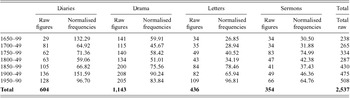
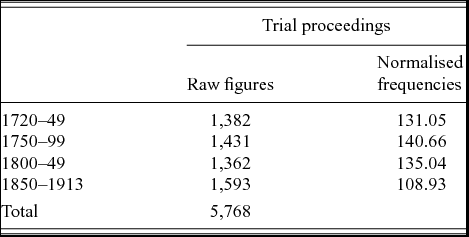
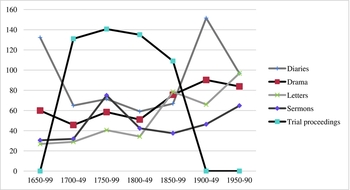
The procedure for the extraction of examples yielded a total of 2,537 examples in the speech-related genres of ARCHER and 5,768 in the trial proceedings from the OBC, distributed across periods and genres as shown in tables 3 and 4 respectively, and illustrated in figure 2.
Raw and normalised figures (per 10,000 words) of phrasal verbs in the speech-related genres of ARCHER

Raw and normalised figures (per 10,000 words) of phrasal verbs in the trial proceedings of the OBC

Distribution of phrasal verbs in the speech-based genres of ARCHER and the OBC (normalised frequencies per 10,000 words)

One of the most salient aspects in the data here is that trial proceedings score the highest in terms of the frequency of phrasal verbs in all the subperiods and genres analysed. My analysis was tested for statistical significance using the Kruskal-Wallis and Wilcoxon tests.Footnote 9 The application of the Kruskal-Wallis test confirms that variation between the genres is statistically significant,Footnote 10 and the pairwise comparisons from the Wilcoxon test are also statistically significant except in the following pairs: letters vs sermons (p=0.957) and diaries vs drama (p=0.07216).Footnote 11 Since trial proceedings are constituted by transcriptions of real (not constructed) speech (see section 3 above), this might be an indication that phrasal verbs were typical of the spoken language as early as the eighteenth and nineteenth centuries. Thus, according to Thim (Reference Thim, Johnston, von Mengden and Thim2006a), whereas the use of phrasal verbs in EModE does not correlate with the degree of orality of the text type, this is no longer the case in the LModE period. However, topic-related factors, as argued by Thim, must also be considered, since the type and number of combinations is also conditioned by the contents of the text (see section 5 below and, especially, Rodríguez-Puente Reference Rodríguez-Puente, Tÿrkkö, Kilpiö, Nevalainen and Rissanen2012b and Reference Rodríguez-Puente, Pfenninger, Timofeeva, Gardner, Honkapohja, Hundt and Schreier2014).
Figure 2 also shows that, although there is quite a lot of variation in the frequency of phrasal verbs from one subperiod to another in all the genres analysed, there is a general tendency for phrasal verb combinations to increase over time, except in trial proceedings. Notice that in the case of diaries the frequency of phrasal verbs in the period 1650–99 seems rather high because of a methodological problem arising from the division of the genre journals/diaries, by which the first corpus subperiod was left with only one diary, namely The Diary of the Rev. Henry Newcome (1661), as opposed to nine journals.Footnote 12
Considering all the genres together, the results of the Wilcoxon test show significance in the growth of phrasal verbs from the period 1800–49 to 1850–99 (p=0.004487), as well as globally from the period 1650–99 to 1950–90 (p=0.006864). Regarding individual genres, the development of phrasal verbs turned out to be non-significant in most cases, except for letters in the periods 1700–49 to 1750–99 (p=0.03769), 1800–49 to 1850–99 (p=0.007078) and 1900–49 to 1950–90 (p=0.02491). Looking at the results obtained from the first and the last corpus subperiods, the development of phrasal verbs is significant only in drama (p=0.02416) and letters (p=8.627e-07).
These findings agree with previous studies which have pointed out that phrasal verbs tend to grow in number both in British and American English from 1700 onwards, although with an interrupted, rather than a continuous, development (see Konishi Reference Konishi and Araki1958: 125; Spasov Reference Spasov1966: 125; Pelli Reference Pelli1976: 102; Martin Reference Martin1990; Claridge Reference Claridge2000; Wild Reference Wild2010: 227; Brown & Palmer Reference Brown, Palmer, Adams, Brinton and Fulk2015: 74–6). In the data from ARCHER and the OBC we observe that the growth of phrasal verbs slowed down between 1800 and 1849, a time which coincides with the great prescriptive period in the history of English. This deceleration may be related to the general preference for Latin forms promoted by the prescriptivist ideas of the time (see Claridge Reference Claridge2000: 178–9; Wild Reference Wild2010: 249).Footnote 13 Although not all prescriptivist grammarians proscribed phrasal verbs, their use was more frequently condemned than praised (see Wild Reference Wild2010: 90–3). However, given that the decline is very slight and statistically non-significant, an explanation based on the prescriptivist influence must remain speculative. It seems reasonable to think that normative works of the time may have had an effect on the historical development of phrasal verbs, although genre-specific diachronic shifts, as well as topic-related matters, among other factors, may also account for the ups and downs in the development of these constructions.
The halt in the growth of phrasal verbs is, nevertheless, temporary, and most scholars agree that phrasal verbs start to grow steadily from the nineteenth century onwards, not only in number but also in types (see Konishi Reference Konishi and Araki1958: 124; Spasov Reference Spasov1966: 18–22; Pelli Reference Pelli1976: 104; Martin Reference Martin1990: 102–4; Akimoto Reference Akimoto, Brinton and Akimoto1999: 222; Kytö & Smitterberg Reference Kytö, Smitterberg, Facchinetti and Rissanen2006: 219–21; Smitterberg Reference Smitterberg, Nevalainen, Taavitsainen, Pahta and Korhonen2008: 271; Wild Reference Wild2010: 228–9; see also section 5 below). Pelli accounts for the increase in the number of types by assuming that once a verb–particle construction becomes established the range of verbs eligible to take up a particle increases. This is demonstrated by the large number of verbs that occur only in the most recent subsections of his corpus (1976: 105).
These results are also in line with the findings by Biber & Finegan (Reference Biber and Finegan1989, Reference Biber, Finegan, Nevalainen and Kahlas-Tarkka1997), who show that in ARCHER the so-called expository, specialist genres, such as medical and scientific prose, acquired more literate characteristics from the seventeenth to the twentieth century, whereas the so-called popular written genres, such as diaries, drama, fiction, letters and news, developed towards more literate styles during the first half of the eighteenth century but reverted to a more oral style over time. Similar tendencies are observed by Smitterberg (Reference Smitterberg, Nevalainen, Taavitsainen, Pahta and Korhonen2008), Mair (Reference Mair and Ljung1997) and Hundt & Mair (Reference Hundt and Mair1999), who also note that in news the reversal to a more oral style took place later, during the second half of the twentieth century. Likewise, exploring the Corpus of Historical American English (COHA, 1810–2009; see Davies Reference Davies2010) Brown & Palmer (Reference Brown, Palmer, Adams, Brinton and Fulk2015: 78–80) observe higher frequencies of phrasal verbs in fiction than in other registers (magazines, newspapers and non-fiction). This has led some scholars to talk about a process of colloquialisation (incorporation of features of the spoken language into the written language) in some genres and decolloquialisation (text types becoming more literate in character and progressively excluding features of the spoken language) in others.
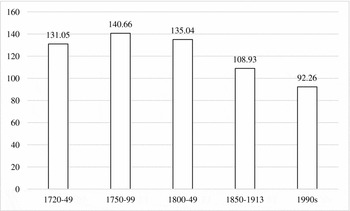
The evolution of phrasal verbs in trial proceedings beyond 1913 was considered by examining the legal cross-examinations of the British component of the ICE-GB from the 1990s, where 197 tokens of phrasal verbs were found. Figure 3 displays the evolution of these combinations in the OCB and the ICE-GB, showing that the tendency to decrease in frequency continues through the twentieth century. It must be borne in mind, however, that my data are incomplete here, and reflect only certain years of the twentieth century.
The development of phrasal verbs in the trial proceedings of the OBC and the legal cross-examinations of the ICE-GB (normalised frequencies per 10,000 words)

Surprisingly, in trial proceedings phrasal verbs show a decrease in frequency from 1800 onwards, in contrast to their increase in frequency in other speech-related genres.Footnote 14 A development in this direction may be interpreted as a sign of decolloquialisation, at least as far as phrasal verbs are concerned.Footnote 15 In their analysis of lexical bundles in the various genres of the Corpus of English Dialogues, Culpeper & Kytö (Reference Culpeper and Kytö2010: 103–41) also note that, although Early Modern English trials contain lexical bundles with conversational characteristics (resembling Present-day plays), they ‘have bucked the trend towards becoming more speech-like’ (Culpeper & Kytö Reference Culpeper and Kytö2010: 137), probably due to changes in the business of the courtroom and to a shift towards more formal and formalised registers (2010: 139). The reduction of bad language and insults in the proceedings over time (Widlitzki & Huber forthcoming) also lends support to the possibility of a decolloquialisation process in the proceedings. It is true that cross-examinations in PDE are different from trial proceedings in a number of ways. Nowadays, the right to a fair trial is a basic human right. However, during much of the time in which the trials in the OBC were recorded, although contemporaries believed that the procedures provided ‘reasonable means of determining guilt and innocence, from a modern point of view they appear to substantially disadvantage the defence’ (Emsley et al. Reference Emsley, Hitchcock and Shoemaker2015). This change in trial format may have affected the type of language used, because in earlier trials defendants typically had to prepare cases on their own and were wholly ‘unaware of the particular evidence that would be presented against them, and therefore had to respond spontaneously to what the witnesses said’ (Emsley et al. Reference Emsley, Hitchcock and Shoemaker2015). Thus, the change from a spontaneous discourse to pre-planned and articulated speech may have caused a decolloquialisation of this particular genre, which entails a reduction of the frequency of phrasal verbs and probably other linguistic features typically associated with the oral, colloquial language. Thus, if we were to reproduce figure 1 above for PDE, we would certainly have to move trial proceedings towards the right-hand side of the informal–formal continuum.
It is also important to note that the number of phrasal verbs also increases in sermons, despite the fact that they have been described as formal text types. This is probably so because from the seventeenth century onwards sermons tend to abandon the classical rhetorical style and develop instead a plainer style (Claridge & Wilson Reference Claridge, Wilson, Fanego, Méndez-Naya and Seoane2002). So, contrary to other formal text types in ARCHER, such as medicine and science, which become more restricted and specialised in terms of audience, sermons aim at becoming accessible to a wider audience.
5.2. Formal features
This section presents some of the formal features of phrasal verbs to see whether some of their characteristics distinguish the types of combinations used in the various genres analysed.
Despite genre differences, the list of the most frequent verbs is quite similar in the five genres analysed, with go and come occupying the top positions (see table 6). The verbs used in the formation of phrasal verbs are typically Germanic monosyllabic or disyllabic with the accent on the first syllable (e.g. bring, carry, get, give, take). This ‘phonological constraint’, as Denison (Reference Denison1985: 45n, Reference Denison, Elspaß, Langer, Scharloth and Vanderbussche2007: 124) calls it, seems to be a tendency rather than a rule. Although the majority of the verbs in the two corpora follow this tendency, exceptions have also been found: 17 are disyllabic verbs with the stress on the second syllable (allow, arise, conduct, contain, convey, decline, decoy, divide, employ, entice, halloo, holloa, invite, proceed, pursue, return and select), 6 contain three syllables (assemble, commission, continue, deliver, massacre and partition) and one, accompany, has four syllables. The percentage of verbs not conforming to the stress rule is rather low: 2.17% in diaries, 0.87% in drama and 1.58% in letters. However, sermons and trial proceedings stand out from the other three genres with 4.06% and 7.32% respectively. The inclusion of a higher percentage of polysyllabic verbs of Latin and French origin in these two genres may be linked to the historical relationship of the fields of law and religion with the Romance languages. Latin was widely employed in ecclesiastical contexts, in that it was the language of the Roman Catholic Church, and both Latin and Anglo-Norman were long used in legal proceedings and legal written records, and their presence still pervades legal language in PDE.
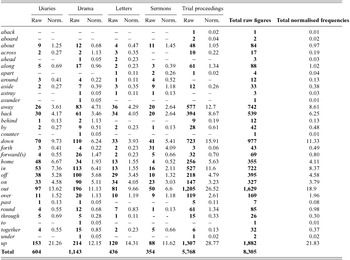
Regarding the particles used in the formation of phrasal verbs, the five genres under scrutiny provided different figures and types of particles. The genre with the widest variety of particles was drama, with examples of 29 different particles, followed by trial proceedings with 26, letters 24, diaries 23 and sermons 21. The raw figures and normalised frequencies of the particles found in the five genres are illustrated in alphabetical order in table 5.
Raw and normalised frequencies per 10,000 words of the distribution of phrasal verb particles across genres

As can be seen, the most common particles in all the genres analysed are up and out. This is not surprising, considering that up is not only the most common particle used in the formation of phrasal verbs in PDE (see Brinton Reference Brinton1988: 223n), but seems to have occupied the most prominent position in all periods of the language.Footnote 16 Out was not as frequent in OE and ME but, according to Ishizaki (Reference Ishizaki2012), it has experienced a dramatic growth from EModE to LModE (especially in less formal styles, such as diaries and personal letters).
One remarkable feature is that some particles are particularly frequent in certain genres, yet scarce in others. One outstanding case is forth, especially common in sermons. Hiltunen (Reference Hiltunen and Kastovsky1994: 134) notices a decrease of this particle during the EModE periodFootnote 17 and, according to Akimoto (Reference Akimoto, Dalton-Puffer, Kastovsky, Ritt and Schendl2006), forth tends to be replaced by out in many phrasal verbs, although sometimes it is possible to find ‘semi-archaic’ forms (e.g. come forth, go forth) alongside more modern ones (e.g. come out, go out). In fact, the frequency of the particle out in sermons is considerably lower than in the other text types (6.60 as opposed to 13.62 in diaries, 11.13 in drama, 9.66 in letters and 26.52 in trial proceedings), thus confirming Akimoto's observation that out acts as a modern and less formal replacement for forth. In my data, the particle forth tends to be used in sermons in quite old-fashioned and archaic expressions such as those in (11) and (12) below.
-
(11) Boast not thyself of to-morrow, for thou knowest not what a day may bring forth. (ARCHER: 16xxbuny.h2b)
-
(12) No human messenger putteth forth his miraculous hand to heal nature's unmedicable wounds. (ARCHER:18xxirvi.h5b)
Example (11) above is a direct quotation from the Bible containing proverbial advice. However, example (12) is part of a sermon in which the priest is explaining a biblical passage dealing with the announcement of ‘the coming forth of God’. The extensive use of the particle forth in archaic expressions indicates that, although sermons developed a plainer style from the seventeenth century onwards, they are still detached from ordinary, everyday language, as they often contain full biblical passages which are very formal in tone and include conservative linguistic features (see Görlach Reference Görlach2001: 204).
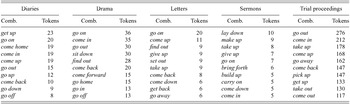
As far as the combinations are concerned, table 6 shows the ten most frequent phrasal verbs in the five genres analysed.
Ten most common verb–particle combinations in ARCHER and the OBC
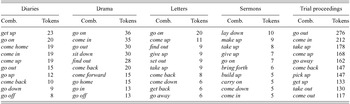
The most frequent phrasal verb in diaries is get up, explained largely by its repeated use in the Diary of Reverend Newcome, whereas the remaining 9 combinations are literal in meaning and contain either the verbal base come or go. The prevalence of these verbs can be explained by the fact that diaries are used mainly to narrate daily events, routines, the comings and goings of the narrators’ lives, and their personal reflections. Something similar occurs in the genre drama. Except sit down and find out, the remaining 8 combinations are formed with come or go, in large part due to the fact that phrasal verbs are common in asides. Pelli (Reference Pelli1976), who analyses the development of phrasal verbs in American English plays from 1765 to 1972, also finds that the percentages of combinations with go and come are considerably higher in stage directions than in dialogues for two main reasons: combinations like come in and go out are often the only text in an aside, and asides are more informal and consequently prone to containing phrasal verbs (1976: 122–5).
Letters, sermons and trial proceedings are somehow different from diaries and drama. Phrasal verbs with come and go are still quite common in letters, but we can also observe the presence of idiomatic or semi-idiomatic combinations among the most frequent ones (find out, give up, set out and take up). Similarly, in trial proceedings there are literal combinations, but also a number of idiomatic compounds (take up, pick up and take out). In sermons idiomatic or semi-idiomatic compounds are more frequent than in other genres (make up, take up, give up, bring forth, build up and carry on). In this sense, we can also observe differences between informal genres and the formality of sermons. These results confirm Thim's (Reference Thim, Johnston, von Mengden and Thim2006a) claim that the topics dealt with in the different texts can also affect the type and frequency of combinations. Although it is true that phrasal verbs are usually associated with colloquial styles, I agree with Thim (Reference Thim, Johnston, von Mengden and Thim2006a, Reference Thim2012) in that the occurrence or non-occurrence of these structures in certain text types can be motivated by the contents of the text, which may prompt the use of phrasal verbs to convey predominantly literal meanings. This seems to be the case with the majority of genres in ARCHER, whose frequency of phrasal combinations varies according to the topics dealt with in the narration (Rodríguez-Puente Reference Rodríguez-Puente2013). Nevertheless, this is not a characteristic exclusive of EModE texts, but also of writings from other periods of the language. However, the difference in the frequencies of phrasal verbs between the various genres is expectedly more evident in EModE, when the majority of combinations had literal or concrete meanings (see Thim Reference Thim, Johnston, von Mengden and Thim2006a), more suitable for the narration of events in, for example, diaries, than for a more literate and formulaic genre such as, for example, eighteenth-century letters.
Corpus data also provided quite a large number of phrasal verbs which occur only once or twice in the corpora. Diaries contain 179 hapax legomena (66.29% of all combinations), drama 312 (65.82%), letters 152 (65.51%), sermons 146 (69.85%) and trial proceedings 263 (42.62%). Although some of the single-occurrence items in the corpora still exist in PDE, others, such as break together, fret down, forward on and especially those containing polysyllabic Romance verbs, are nonce formations or ephemeral combinations. As rightly noted by Denison (Reference Denison1985: 45, Reference Denison and Romaine1998: 223), the history of phrasal verbs is not one of continuous growth, because many of the combinations which existed in the earlier periods are no longer used in PDE.
Among the single-occurrence items we find combinations such as add up (13), which only appears in trial proceedings, break together (14), only included in drama, mutter away (15) only in diaries, snuff out (16) in letters and weary out (17) exclusively in sermons.
-
(13) Yes, it was added up 6 s. more than I owed. (1864-OBC-POS-18640229)
-
(14) I believe we may get our Bones broke together to night. (ARCHER: 1730vanb.d3b)
-
(15) So we to stuff the body in the Sack, he muttering away beneath his breath. (ARCHER: 1752knyv.y4b)
-
(16) I heartily wish I could snuff out several of them, but my hand is forced. (ARCHER: 1913hard.x7b)
-
(17) Ah! too frequently, like the prophet in the wilderness, we are almost wearied out with the contest, are ready to succumb under the weight of our difficulties. (ARCHER: 17xxarch.h4b)
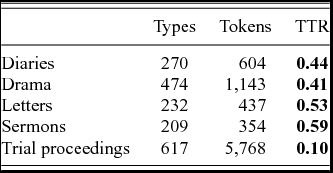
The large proportion of single-occurrence items can be considered as a sign of the productivity of constructions. As demonstrated by Baayen (Reference Baayen1989, Reference Baayen, Booij and van Marle1992) a measure of this kind is very appropriate with fairly large corpora. However, in small corpora ‘productive and non-productive processes alike produce so few occurrences that there will be an overestimation of hapaxes, inflating the productivity counts’ (Palmer Reference Palmer2014: 109). Therefore, the subcorpora for each subperiod and genre of ARCHER and the OBC are rather small for a measure of this kind to be reliable, which, on the other hand, is a common limitation of diachronic corpora. A better way of calculating the productivity of a construction is by analysing the type/token frequency, although again it must be acknowledged that word counts differ in each genre subcorpus (see section 3 above) and that type/token frequencies do not necessarily grow linearly with corpus size. To this end, table 7 sets out the type/token ratio of the combinations across the five genres.
Type/token ratio of phrasal verbs in the five genres analysed

The highest ratio is found with sermons; trial proceedings have the lowest score. This means that the combinations in trial proceedings are less varied and are repeated more often, which is also a feature of the spoken language, since we tend to repeat many of the words which our interlocutors use. Sermons, on the other hand, include a wider variety of phrasal verbs, thus exhibiting a lexical richness typical of pre-planned discourse. Therefore, regarding the type of combinations, we can again observe differences between the informal and formal genres.
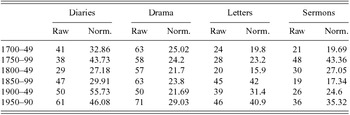
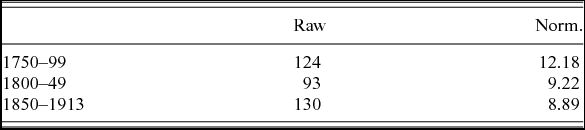
One of the problems stemming from the type/token count is that such an analysis does not take into account the new types that are introduced from one subperiod to the other. A more accurate approach to measuring the productivity of derivatives over time is that used by Palmer (Reference Palmer2014), who employs the aggregation of new types to observe diachronic changes in type frequencies. A similar analysis was carried out here for the phrasal verbs in the various genres analysed. Assuming that the data from the first corpus subperiod provide the ‘starter lexicon’, I counted all the new types used for the first time in subsequent periods. The assumption is that if high rates of new types are added over a period of time, phrasal verbs are likely to be productive over that period. New types in this analysis refers to neologisms in the corpus, though not necessarily neologisms in English. Tables 8a and 8b provide the raw figures and normalised frequencies of new types appearing in the various genres analysed in each of the subperiods.
Raw and normalised frequencies (per 10,000 words) of new types introduced over time in ARCHER: diaries, drama, letters and sermons

Raw and normalised frequencies (per 10,000 words) of new types introduced over time in the OBC: trial proceedings

The results of the aggregation analysis confirm some of the data obtained from the type/token ratio measures. The lowest rate of aggregation occurs in trial proceedings, which means that phrasal verbs are less productive in this genre than in others. Although trial proceedings show the highest frequency of phrasal verbs, the combinations in this genre are frequently repeated which, as mentioned above, is a feature of the spoken language. However, whereas the type/token ratio showed that sermons were the most productive genre as far as phrasal verbs are concerned, according to the aggregation analysis, the genre with the highest production of phrasal verbs in most of the periods is diaries. The only exception is the subperiod 1850–99, in which letters display the highest frequency of new types. This is probably so because diaries are used to narrate personal experiences and their content depends greatly on what the writer chooses to narrate; hence, they are not necessarily thematically linked and the type of combinations may vary greatly from one author to another.
6 Conclusions
The present study has shown that there are differences at various levels in the use of phrasal verbs across speech-related genres from the eighteenth century to the end of the twentieth. Although trial proceedings cannot be described as faithful representations of the spoken language of the past, they are linguistically closer to face-to-face interaction than, for example, prose fiction and drama. In this sense, the present study sheds some new light into the characteristics of trial proceedings by comparing the use of phrasal verbs in this and other speech-related genres, emphasising the value and need to study genres like these more closely.
Regarding frequency, phrasal verbs are more common in trial proceedings than in diaries, drama, letters or sermons, which seems to confirm beyond doubt that phrasal combinations were already a feature of the spoken language in LModE. These results show that, unlike in the period 1500–1700 when phrasal verbs have been described by Thim (Reference Thim, Johnston, von Mengden and Thim2006a) as being stylistically neutral, from 1700 onwards, verb–particle combinations can be considered as markers of colloquiality and spokenness.
The frequency of phrasal combinations tends to increase over time following the patterns described in the multivariate analyses by Biber and associates, except in the case of trial proceedings. Here, phrasal verbs seem to evolve in the opposite direction from other speech-related text types and behave in a way similar to some of the formal writing-based and writing-purposed text types, such as scientific and medical writing (see Rodríguez-Puente Reference Rodríguez-Puente, Pfenninger, Timofeeva, Gardner, Honkapohja, Hundt and Schreier2014). This increase may be accounted for, on the one hand, by changes in the formal features of trial proceedings from the LModE period to the present-day. These results do not imply that phrasal verbs are not common in present-day spoken English, but rather that they are infrequent in present-day legal-cross examinations.
We have also pointed out some differences at the formal level, especially regarding the type of verbs, particles and combinations typical of the different genres. Thus, sermons and trial proceedings show a certain tendency to include polysyllabic verbs of Latin and French origin, probably because of the historical relationship of law and religion with Romance languages. Regarding the particles, the old-fashioned forth is particularly common in sermons, arguably because sermons tend to maintain a more archaic and conservative language than less formal speech-related text types, such as diaries, drama, letters and trial proceedings. Moreover, sermons display a wider variety of combinations (higher type/token ratio) and a more varied use of idiomatic or semi-idiomatic phrasal verbs, rather than literal combinations formed with the verbal bases come and go, whereas trial proceedings present a very low type/token ratio, indicating that the combinations used are less varied and repeated more often, itself a feature of oral speech. These results are also confirmed by the aggregation analysis, which shows that the lowest rate of aggregation of new types occurs in trial proceedings.
Summing up, the present findings show that there were already differences across the speech-related genres in the use of phrasal verbs in the LModE period, and that these combinations were a feature of the spoken language as early as the eighteenth century, thus answering the question raised by Thim (Reference Thim2012: 214–46) as to when phrasal verbs came to mark colloquiality. The findings here also show that the development of phrasal verbs follows the trends of colloquialisation described in the multivariate analyses by Biber and associates, thus demonstrating that the association of phrasal verbs with the spoken language is more than a ‘colloquialization conspiracy’ (Thim Reference Thim2012: 233–46). Nevertheless, when working with historical corpora we must also bear in mind that data are preserved only randomly, and that their potential as faithful representation of the spoken language has its limits.