The age at which an individual acquires a word, the age of acquisition (AOA), influences lexical processing significantly. Previous studies of AOA have reported the effect in various processing tasks using normal subjects, including word naming, picture naming, lexical decision, object recognition, word-associate generation, and semantic categorization (for reviews, see Ghyselinck, Lewis, & Brysbaert, Reference Ghyselinck, Lewis and Brysbaert2004; Johnston & Barry, Reference Johnston and Barry2006; Juhasz, Reference Juhasz2005). Items that are learned early in life generally take less time to process in these tasks.
One main account for AOA effects that has received much attention is the arbitrary mapping (AM) hypothesis (Ellis & Lambon Ralph, Reference Ellis and Lambon Ralph2000; Zevin & Seidenberg, Reference Zevin and Seidenberg2002, Reference Zevin and Seidenberg2004). It proposes that the effect may depend on the degree of AM between different representations. Corroborating evidence for the hypothesis is found in larger AOA effects in picture-naming than reading-aloud tasks (e.g., Bonin, Barry, Meot, & Chalard, Reference Bonin, Barry, Meot and Chalard2004; Brysbaert & Ghyselinck, Reference Brysbaert and Ghyselinck2006; Lambon Ralph & Ehsan, Reference Lambon Ralph and Ehsan2006), in reading and spelling words with inconsistent grapheme–phoneme correspondence than ones with consistent mappings (e.g., Bonin et al., Reference Bonin, Barry, Meot and Chalard2004; Monoghan & Ellis, Reference Monaghan and Ellis2002b; Weekes, Castles, & Davies, Reference Weekes, Castles and Davies2006; Weekes, Davies, Parris, & Robinson, Reference Weekes, Davies, Parris and Robinson2003; Zevin & Seidenberg, Reference Zevin and Seidenberg2002), and smaller AOA effects in scripts that are more transparent than English such as Dutch (Brysbaert, Lange, & Van Wijnendaele, Reference Brysbaert, Lange and Van Wijnendaele2000; Ghyselinck et al., Reference Ghyselinck, Lewis and Brysbaert2004) as pointed out by Juhasz (Reference Juhasz2005).Footnote 1
Further support for the AM hypothesis can be drawn from writing systems that are more opaque than alphabetic scripts. Yamazaki, Ellis, Morrison, and Lambon Ralph (Reference Yamazaki, Ellis, Morrison and Lambon Ralph1997) and Yamada, Takashima, and Yamazaki (Reference Yamada, Takashima and Yamazaki1998) found that both written and spoken AOA significantly contribute to reading latencies of Japanese Kanji.Footnote 2 Of more interest, Havelka and Tomita (Reference Havelka and Tomita2006) reported stronger AOA effects on reading Kanji (102 ms) than the syllabic Kana with transparent grapheme to sound correspondence (27 ms). This comparison is analoguous to that between consistent and inconsistent English words and provides support for the claim that the size of AOA effects is modulated by the degree of AM.
The aforementioned studies of reading aloud have focused exclusively on the orthographic form to sound correspondence. Clearly, the notion of AM also applies to the correspondence of form to meaning, as in picture naming. In word naming, investigating the effect of AOA in the context of predictability of orthographic form and meaning mapping is only possible if the writing system contains components providing semantic cues. The Chinese script is one such system. In this paper, we report a case study of a Cantonese-speaking brain-injured individual with acquired dyslexia. His reading deficits were the results of disruption to both the semantic and nonsemantic reading routes, that is, deep dyslexia. His word-naming accuracy was affected by both AOA and semantic transparency. There was also evidence for an interaction between the two variables. The findings have thus provided further support for the AM hypothesis of AOA effects. In the rest of this section, we describe the characteristics of the Chinese orthographic system, followed by a review of recent studies of the AOA effect in Chinese language processing.
FEATURES OF THE CHINESE WRITING SYSTEM AND VARIABLES RELEVANT TO WORD NAMING
The Chinese script is often characterized as morphosyllabic because the majority of characters are monosyllabic and represent morphemes. More than 80% of all Chinese characters are phonetic compounds consisting of a semantic radical and a phonetic radical. The semantic radical provides a clue to the meaning of a character, whereas the phonetic radical provides a cue to the pronunciation of the character. For instance, the character 趾 zi2 (toe) has a semantic radical 足 on the left meaning “foot” and a phonetic radical  zi2 on the right.3 Unlike alphabetic scripts, there are no elements within a character that correspond to phonemes or tone.
Law (Reference Law1997) surveyed the entries in two phonetic compound dictionaries (Li, Reference Li1989; Ni, Reference Ni1982) and found that about 34% to 40% of phonetic compounds in Cantonese are “regular” characters containing a phonetic radical that is segmentally identical (regardless of tone) to the whole character (e.g., 指 zi2 and 旨 zi2), 30% are “partially regular” phonetic compounds sharing at least the same rime as their phonetic radical (e.g., 拍 paak3 and 白 baak6), and the rest of the entries are “irregular” with no phonological relationship with their phonetic radical (e.g., 路 lou6 and 各 gok3). Besides regularity, consistency refers to the extent to which a phonetic radical serves as a reliable cue to the pronunciations of the phonetic compounds in which it appears. A high consistency value means that phonetic compounds sharing the same phonetic radical as a group map onto a small number of phonological forms (e.g., the phonetic radical 責 zaak appears in five phonetic compounds that as a group map onto two different syllables, zaai for  and zik for 績, 幘, 漬, 積), and a low consistency value refers to a set of phonetic compounds having a common phonetic radical that is associated with many phonological representations (e.g., 由 jau appears in 10 phonetic compounds, together representing six different pronunciations, jau for
 , 柚, and 鈾; dek for 笛; dik for 迪; zau for
 , 袖, and 岫; cau for 抽; and zuk for 軸). In other words, “regularity” focuses on the phonological relationship between a phonetic radical and the phonetic compound character in which it appears, whereas “consistency” emphasizes the relationship between a phonetic radical and the family of phonetic compounds containing it. The effects of frequency, regularity, and consistency have been strongly demonstrated in the literature on Chinese single word reading involving normal speakers (e.g., Ding, Peng, & Taft, Reference Ding, Peng and Taft2004; Fang, Horng, & Tzeng, Reference Fang, Horng, Tzeng, Kao and Hoosain1986; Hue, Reference Hue, Chen and Tzeng1992; Hue & Erickson, Reference Hue and Erickson1988; Lee, Tsai, Su, Tzeng, & Hung, Reference Lee, Tsai, Su, Tzeng and Hung2005; Lian, Reference Lian1985; Seidenberg, Reference Seidenberg1985; Weekes, Chen, & Lin, Reference Weekes, Chen, Lin, Leong and Tamaoka1998; Wu, Chou, & Liu, Reference Wu, Chou, Liu, Chang, Huang, Hue and Tzeng1994; Zhou & Marslen-Wilson, Reference Zhou, Marslen-Wilson, Wang, Inhoff and Chen1999), as well as individuals with acquired dyslexia (Han, Bi, Shu, & Weekes, Reference Han, Bi, Shu and Weekes2005; Law, Weekes, Wong, & Chiu, Reference Law, Weekes, Wong and Chiu2009; Law & Wong, Reference Law and Wong2005; Weekes & Chen, Reference Weekes and Chen1999).
A distinguishing feature of the Chinese orthography is that many characters not only contain a phonetic cue provided by their phonetic radical, but they also carry a semantic cue signified by their semantic radical. Previous psycholinguistic studies have shown that semantic radicals are involved in lexical processing; more specifically, there is access from these radicals to meaning (Chen & Weekes, Reference Chen and Weekes2004; Feldman & Siok, Reference Feldman and Siok1999; Li & Chen, Reference Li and Chen1999; Zhou & Marslen-Wilson, Reference Zhou, Marslen-Wilson, Wang, Inhoff and Chen1999). Similar to the phonetic radical, the semantic radical also varies in consistency. For instance, the semantic radical  in 氧 (oxygen) is consistently linked to the meaning of gaseous substance such as 氮 (nitrogen), 氯 (chlorine), and 氦 (helium); characters containing the semantic radical 門, meaning “door,” are often not related to the object, for example, 開 (open), 閉 (close), 閘 (gate), 閱 (to read), 闆 (owner), 閃 (to flash), and 閒 (leisure). Besides semantic radical consistency, two other variables associated with the semantic radical have been found to affect lexical processing including semantic categorization and character decision (Chen & Weekes, Reference Chen and Weekes2004; Feldman & Siok, Reference Feldman and Siok1997): semantic transparency and semantic radical combinability. The former refers to the degree of relatedness between the meaning of a target character and the concept denoted by its semantic radical. For instance, the semantic radical 木 means “wood.” The character 檯 (desk) is therefore semantically transparent, whereas 權 (power) is semantically opaque. Semantic radical combinability is the number of phonetic compound characters in which a semantic radical appears.
RECENT STUDIES OF AOA EFFECTS ON CHINESE LANGUAGE PROCESSING
Interests in examining the effect of AOA on word production in Chinese have only begun in the last several years. Weekes, Shu, Hao, Liu, and Tan (Reference Weekes, Shu, Hao, Liu and Tan2007) have found unique and independent contributions of AOA, name agreement, and object familiarity to picture-naming latencies in normal Mandarin Chinese participants. Significant effects of AOA on object-naming accuracy were also observed in Cantonese anomic individuals with relatively preserved reading aloud performance (Law, Weekes, Yeung, & Chiu, Reference Law, Weekes, Yeung, Chiu, Law, Weekes and Wong2009).
Given the presence of phonological and semantic cues in phonetic compound characters and the variation in consistency (or predictability) between these radicals and phonological and semantic information, respectively, the AM hypothesis would predict that character processing should be affected by AOA, phonological consistency, semantic consistency, and their interaction. The predictions were confirmed in Chen, Zhou, Dunlap, and Perfetti (Reference Chen, Zhou, Dunlap and Perfetti2007), in which two experiments with a factorial design were carried out. In a character-naming task, Chen et al. (Reference Chen, Zhou, Dunlap and Perfetti2007) orthogonally manipulated the AOA and phonological predictability (in terms of regularity and phonetic consistency) of the stimuli, while controlling for character frequency, phonetic radical frequency, number of strokes per character, concreteness, and cumulative frequency across experimental conditions. Significant main effects of AOA and phonological predictability and their interaction were found. Moreover, a larger AOA effect was observed for items with low predictability (31 ms) than those with high predictability (9 ms). Subsequently in a semantic category judgment task, AOA and semantic predictability were independently manipulated. The latter was defined by the percentage of phonetic compounds sharing the same semantic radical having a meaning related to that of the semantic radical. The findings paralleled those in the reading-aloud task. Main effects and interaction effect of AOA and semantic predictability were statistically significant. In addition, the AOA effect was larger in the low predictability condition (65 ms) than the high predictability condition (25 ms).
Both factorial and regression approaches were employed to study AOA effects on reading aloud in Liu, Hao, Shu, Tan, and Weekes (Reference Liu, Hao, Shu, Tan and Weekes2008). A distinction was made between rated AOA based on adult estimates and written AOA based on the grade at which a character is first introduced into standard textbooks. Significant predictors of naming latencies in the multiple regression analysis included rated AOA, written AOA, character frequency, phonological regularity, phonological consistency, imageability, and number of strokes per character. The interactions between written AOA and regularity and between written AOA and consistency were also significant. The more interesting finding came from the 2 (early vs. late written AOA)×2 (phonologically predictable vs. unpredictable characters) design, where pairwise comparisons revealed significant AOA effects for both predictable (12 ms) and unpredictable items (34 ms), although the former was smaller than the latter, in addition to significant main and interaction effects of the independent variables. The unexpected finding of an AOA effect in predictable characters was attributed to limited orthography to phonology mapping in Chinese. More specifically, Liu et al. (Reference Liu, Hao, Shu, Tan and Weekes2008) claimed that any grapheme–phoneme correspondence in alphabetic scripts is realized in a larger number of words (e.g., 27 items in English), whereas the average size of a phonetic radical neighborhood is no more than 5. The study thus illustrates how the realization of AOA effects, although reported for an increasing number of languages and writing scripts, may vary as a function of the characteristics of the system in question.
Converging evidence for the AOA effect can also be found in language-impaired speakers. In a recent case study of a Chinese dyslexic individual FWL, Law, Wong, Yeung, and Weekes (Reference Law, Wong, Yeung and Weekes2008) stated that their subject's reading performance was influenced by AOA and phonological consistency. There was also tentative evidence for an interaction between the two: the effect of phonological consistency was more evident for late-acquired than early-learned characters. Although the absence of a semantic contribution to reading performance seems to be at odds with the prediction of the AM hypothesis, it is consistent with the hypothesized reading deficits of FWL that she relied on the nonsemantic reading route to name characters. It is also consistent with the results of many studies of word reading in alphabetic scripts that have failed to find semantic effects, that is, imageability, in normal participants who are assumed to rely on direct mapping from orthography to phonology to read words aloud (Brown & Watson, Reference Brown and Watson1987; Morrison & Ellis, Reference Morrison and Ellis2000; Morrison, Hirsh, & Duggan, Reference Morrison, Hirsh and Duggan2003; Yamazaki et al., Reference Yamazaki, Ellis, Morrison and Lambon Ralph1997).
Nevertheless, as Monaghan and Ellis (Reference Monaghan and Ellis2002b) have suggested, in brain-injured individuals whose word reading is mediated by the semantic reading pathway as in the case of deep dyslexia, the semantic contribution to reading performance may be more important, hence the possibility of significant effects of semantic-based variables. Hirsh and Ellis (Reference Hirsh and Ellis1994) described single-word production of their aphasic subject, NP. The results suggested an effect of imageability on NP's reading aloud. A more detailed examination of semantic effects on reading accuracy was conducted by Gerhand and Barry (Reference Gerhand and Barry2000) and Barry and Gerhand (Reference Barry and Gerhand2003), who found effects of concreteness, along with AOA, on the reading performance of their deep dyslexic subject, LW. Words that were correctly read had lower AOA and were more concrete. There was a tendency of semantic errors being made on less concrete words. Of more interest, they found an interaction between AOA and concreteness; there was a stronger effect of AOA on reading concrete but not abstract words.
PRESENT STUDY
In this investigation, we examined the reading performance of a Chinese brain-damaged individual with acquired dyslexia, TWT, as a function of AOA, phonological consistency, semantic radical consistency, semantic transparency, semantic radical combinability, character frequency, imageability, and visual complexity. In addition to these variables, we also included lexical combinability, a measure of the number of multicharacter words in which a target character may appear. The inclusion of this variable was motivated by the observation of a type of semantic error referred to as an “association” error that has been reported in previous studies of Chinese dyslexia (Law, Reference Law2004a, Reference Law2004b, Reference Law2004c). An example of this error type is reading joeng4 (goat) as laai5 (milk) where the target and the response form a word, jeong4lai5 (goat milk). It is not implausible that the combinability of a character with others to form words may affect the frequency of occurrence of such errors. As there was evidence suggesting that TWT's reading aloud relies on the semantic reading pathway, significant effects of AOA and semantic-based variables were expected. Furthermore, interactions between AOA and these variables would also be compatible with results of previous work (Barry & Gerhand, Reference Barry and Gerhand2003).
METHOD
Dyslexic participant
TWT is a male 49-year-old, right-handed, native speaker of Cantonese with a secondary school level 5 education. He was a businessman before suffering a left hemisphere cerebral vascular accident in April 1999. A CT scan showed a left putaminal hemorrhage without ventricular extension. He has right hemiparesis and mild dysarthria. His speech is fairly fluent despite word-finding difficulties. TWT lives with his elder sister, and his children visit him monthly. He normally spends his day watching television, but he also likes to take short trips to mainland China once or twice a month. During the period of this study, he did not receive any type of therapy.
Control participants
All control subjects were native speakers of Cantonese who were born and educated in Hong Kong.
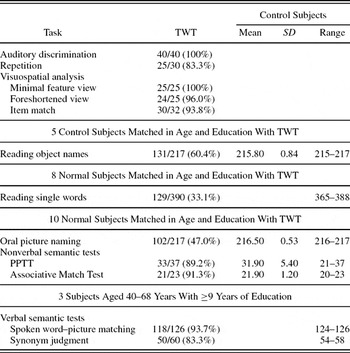
Groups of normal participants, matched in age and educational level with TWT, were employed to provide normal performance on various tasks in the background assessment. Different groups were recruited as the test battery was developed over the span of 2 years. As indicated in Table 1, groups of 5 (5 males with an average age of 44.6 years and secondary school education), 8 (4 males and 4 females with an average age of 48.6 years and secondary school level 5 education), 10 (5 males and 5 females with an average age of 50.5 years and secondary school level 3 education), and 3 subjects supplied normative data for reading aloud 217 object names, reading aloud 390 single words, orally naming 217 pictured objects, nonverbal semantic tests (Pyramid and Palm Trees Test [PPTT], Howard & Patterson, Reference Howard and Patterson1992; and Associative Match Test in the Birmingham Object Recognition Battery [BORB], Riddoch & Humphreys, Reference Riddoch and Humphreys1993), and verbal semantic tests (spoken-word picture matching and synonym judgment).
Subject's (TWT) performance on language and visual analysis tests

Note: Performance on auditory discrimination, repetition, and the visuospatial analysis tests by normal subjects with a secondary school education is expected to be near 100%. PPVT, Peabody Picture Vocabulary Test.
In addition, 20 undergraduate students (18 females, 2 males) with ages ranging between 20 and 22 years in the second and third years of study in the Division of Speech and Hearing Sciences of the University of Hong Kong were asked to estimate the age at which they acquired each of 260 single characters in the main reading-aloud test. They were also asked to rate the imageability and semantic transparency of these items. Details are described in the Stimuli for Reading Aloud Section.
Background assessment
A series of tests were carried out on TWT to understand the nature of his language impairment.
1. An auditory discrimination task was administered, consisting of 40 trials with half of them involving two identical syllables to assess whether the subject could process phonological input accurately. All stimuli were existing Cantonese syllables with a consonant–vowel–consonant (CVC) structure. For those trials where two different items were presented, they were equally likely to differ in the initial, nucleus, coda, or tone. On each trial, the experimenter orally presented two syllables with 0.5 s in between; the subject had to decide immediately whether the two syllables were identical. There were four practice trials before the test began. The stimuli of a trial were not repeated.
2. Repetition of 30 single words and phrases of up to four syllables in length was performed to evaluate speech production: 10 one-syllable, 14 two-syllable, 5 three-syllable, and 1 four-syllable items. The subject was presented a word or a short phrase on each trial and expected to repeat it verbatim immediately.
3. Three visuospatial analysis tests from the BORB (Riddoch & Humphreys, Reference Riddoch and Humphreys1993) were administered: minimal feature view, foreshortened view, and item match. On each trial of these tests, the participant was presented with three pictured objects with the stimulus at the top and the other items in the same row below and asked to select the picture that matched the stimulus. For the minimal feature view and foreshortened view tests, the stimulus and the target depicted the same object from different angles. Common perspectives were taken for the minimal feature view test, whereas unusual perspectives were used in the foreshortened view test. As for the item match test, the stimulus and the target may depict different objects of the same category or the same entity in slightly different states, for example, a pig with its mouth open in one picture and closed in another. Results of these tests would reveal whether the subject can process visual input properly.
4. Oral naming of selected pictures in Snodgrass and Vanderwart (Reference Snodgrass and Vanderwart1980)Footnote 4 in Cantonese was tested. The participant was given a pictured object to name one at a time. The task was not timed and the last (self-corrected) response was scored for accuracy.
5. TWT was asked to read aloud the names of the objects in the oral naming test and 390 single words from five word lists described in Law and Caramazza (Reference Law, Caramazza, de Gelder and Morais1995). They included the “frequency” list (45 high- and 45 low-frequency words with an equal number of nouns, verbs, and functors in each condition); the monosyllabic and bisyllabic “form class” lists with 20 nouns, 20 verbs, and 20 functors in each list; the “imageability” list (30 bisyllabic nouns with high imageability values and 30 items with low imageability values); and the “phonetic compound” list containing 120 phonetic compound characters varying in the position of occurrence of the phonetic radical (i.e., left, right, top, or bottom) and the phonological relationship between the sound of the phonetic radical and that of the whole character: identical (including segmentals and tone), similar (same rime but different onset and/or tone), and unrelated. The stimuli in each list are controlled for character complexity in terms of number of strokes and word/character frequency across conditions (with the exception of the frequency list). The items from these lists were randomized and divided in two blocks given over separate sessions. Like oral naming, the reading-aloud task was untimed and the last response was scored.
6. Semantic tests included two verbal and two nonverbal tasks. The first verbal test was spoken word–picture matching in which the subject had to match a word with one of three pictures taken from Snodgrass and Vanderwart (Reference Snodgrass and Vanderwart1980): the target, a semantic distractor, and an unrelated foil. The participant was aurally presented an object name that was immediately followed by three pictures. The participant had to point to the picture that matched the word. The stimulus word might be repeated once at most. The second verbal test was a synonym judgment task where the subject had to decide whether two aurally presented words were similar in meaning. The test consisted of 60 trials, half of which were synonymous spoken words. Fourteen trials, equally distributed across the two synonymy conditions, involved verbs; the rest were nouns. Words in 8 pairs in the synonymous condition and 10 pairs in the nonsynonymous condition were considered highly imageable. There were four practice trials to ensure that the participant understood the task. The stimuli on a trial were repeated as many times as the participant requested. Nonverbal semantic tests included selected itemsFootnote 5 from the PPTT (Howard & Patterson, Reference Howard and Patterson1992) and the Associative Match Test in the BORB (Riddoch & Humphreys, Reference Riddoch and Humphreys1993). Both tests employed the same format. The subject was given three pictured objects on each trial with the stimulus at the top and had to point to the object that is functionally related to the stimulus. There were four practice trials and the task was untimed. The performance results for TWT and normal subjects on these tasks is presented in Table 1.
Stimuli for reading aloud
The stimuli were the same as those used by Law et al. (Reference Law, Wong, Yeung and Weekes2008). The characters must be phonetic compounds containing a semantic radical with some associated meaning and a phonetic radical that appears in at least four phonetic compound characters, which are listed in Ho (Reference Ho1992). Based on a survey reported in Law, Yeung, Wong, and Chiu (Reference Law, Yeung, Wong and Chiu2005), 106 semantic radicals are considered to signify certain concepts relatively consistently. At the end, 260 characters were chosen. Information on the following variables was obtained.
1. Character frequency is based on a frequency count in Ho (Reference Ho1992).
2. Phonological consistency: The consistency reflects the extent to which the target pronunciation dominates in the family of phonetic compounds sharing the same phonetic radical as the stimulus character. To qualify for a member of the neighborhood, a phonetic compound containing the target phonetic radical must be listed in both Li (Reference Li2003) and Ni (Reference Ni1982), two dictionaries of phonetic compounds. The pronunciations of the characters are based on a Cantonese phonetic compound dictionary (Li, Reference Li1989). The phonological consistency of a stimulus is computed by dividing the sum of the frequencies of characters with the target pronunciation (regardless of tone) by the sum of the frequencies of all characters belonging to the phonetic radical family. For items that cannot be found in the frequency count of Ho (Reference Ho1992), a count of 1 is given.
3. Estimate of AOA: Twenty undergraduate students at the University of Hong Kong were asked to estimate for each stimulus character the age at which they believed it was encountered in books. An 8-point scale was used (1 = preschool years, 2 = Grade 1, 3 = Grade 2, 4 = Grade 3, 5 = Grade 4, 6 = Grade 5, 7 = Grade 6, 8 = secondary school or above). Adult ratings of AOA correlate highly with more objective measures of AOA; that is, the actual ages at which different words are acquired or children can name the words (e.g., Chalard, Bonin, Meot, Boyer, & Fayol, 2003; Jorm, Reference Jorm1991; Morrison et al., 1997). Hence, they are generally considered a valid and reliable measure of word learning age.
4. Imageability: The instruction was adopted from Chiarello, Shears, and Lund (Reference Chiarello, Shears and Lund1999). The concept of imageability was first introduced to the same group of undergraduate subjects. A character is of high imageability if its meaning can quickly and easily generate a mental image, that is, a mental picture, sound, or other sensory experience. In contrast, if it is difficult or it takes a long time to create such a mental image, the character is of low imageability. The subjects then provided an imageability rating for each character on a 7-point scale (1 = lowest imageability, 7 = highest imageability).
5. Semantic transparency: again, the same subjects were asked to make judgments about how related the meaning of a character is to that associated with its semantic radical on a 5-point scale (1 = unrelated, 2 = indirectly and loosely related, 3 = weakly related, 4 = highly related, 5 = directly and strongly related). The meaning of the semantic radical in each stimulus character was provided for easy reference.
6. Semantic radical consistency indicates how reliable a semantic radical is as a cue to the meaning of the characters containing it. The consistency is computed by dividing the number of characters carrying the target semantic radical with a listed meaning in the Li (Reference Li2003) dictionary that is compatible with that of the semantic radical by the total number of characters sharing the target semantic radical.
7. Semantic radical combinability equals the number of phonetic compound characters in the Li (Reference Li2003) dictionary containing the semantic radical in question. For instance, the semantic radical 足 (foot) may appear in over 180 phonetic compound characters, including 路 (road), 跳 (to jump), 跑 (to run),
 (trace), (to hesitate), and (ankle).
8. Lexical combinability is a measure of the number of multicharacter (syllabic) words formed by a target character combining with other characters. For example, 署 (to arrange, to write down) may combine with other characters to form eight compound words, including 署 名 (to sign one's name), 署 理 (to administer in an acting capacity), 署 簽 (to inscribe a title label on a book), 署 事 (to deal with public affairs), and 署 字 (to sign on a document). The count was derived from a database of printed materials in Hong Kong, Taiwan, and Mainland China consisting of 5 million characters (Cheung & Chan, Reference Cheung and Chan1997). Of the 260 stimuli, 204 characters were found in the corpus.
9. The visual complexity of a character is measured by the number of strokes the character comprises.


Analysis of reading aloud performance
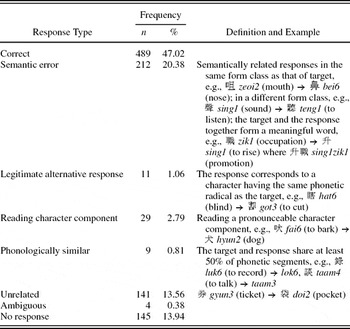
TWT was asked to read aloud the set of characters 4 times on separate occasions within 2 weeks. Incorrect responses were classified into semantic errors, legitimate alternative reading response, reading character component, phonologically similar errors, unrelated, “ambiguous” between two or more error types, and omission. Definitions and examples of various response types are given in Table 2. The data based on responses to the 204 characters on which lexical combinability information was available was analyzed using a multinomial logistic regression with three response categories, correct, semantic errors, and other errors.
Distribution of subject's (TWT) reading responses to single characters

RESULTS
TWT's performance on the language and visual analysis tests is shown in Table 1. He was able to process auditory input normally and at most mildly disrupted in processing visual information. As TWT had mild dysarthria, his repetition performance was compromised. More important for our understanding of his language deficits was his severely impaired performance on word naming and picture naming. For both tasks, he scored far below the range of normal performance. As there are no standard tests available for diagnosing acquired dyslexia in brain-injured subjects, we take TWT's poor performance on reading object names and single words, compared with normal participants, as an indicator that he was severely dyslexic. In other words, TWT was both anomic and dyslexic. He performed normally on nonverbal semantic tests, but his verbal semantic processing seemed impaired. These observations suggest that, as far as the loci of functional lesion are concerned, both his semantic and nonsemantic reading pathways were disrupted.
TWT was asked to read the set of 260 single character stimuli aloud four times. His performance across these occasions was highly stable, ranging between 46% and 49%. His responses were then combined for subsequent analyses. His overall accuracy rate was about 47% (see Table 2). The largest proportion of erroneous responses was semantically related to their target. There were also many unrelated responses and omissions. In about 4% of the time, TWT would read aloud a pronounceable component of the target character or produced a response that would be appropriate for a phonetic compound having the same phonetic radical as the target. The preponderance of semantic errors suggests that TWT's reading aloud was mainly mediated by the semantic reading route with much reduced input from the nonsemantic pathway.
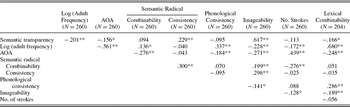
Intercorrelation coefficients among the predictor variables are given in Table 3. The matrix reveals relationships that have been observed elsewhere; that is, early acquired words tend to be of higher frequency and imageability (Gilhooly & Logie, Reference Gilhooly and Logie1980; Monaghan & Ellis, Reference Monaghan and Ellis2002b; Morrison et al., 1997). There are also interesting relationships unique to the Chinese orthography. Characters that are learned early have simpler structures and have fewer phonetic compounds having the same semantic radical. Frequently occurring phonetic compounds have pronunciations that are more predictable from their phonetic radical (phonological consistency). The more characters in which a semantic radical appears (semantic radical combinability), the more reliable it is as a cue to meaning (semantic radical consistency). The high correlation between semantic transparency and imageability indicates that semantically transparent characters tend to be more imageable. This is probably because the concepts linked to semantic radicals generally create mental images easily, such as objects and actions. Therefore, if the meaning of a character is consistent with its semantic radical, that is, semantically transparent, then it is also more imageable. Finally, the more multisyllabic words in which a target character occurs, the higher its frequency of occurrence is.
Intercorrelation matrix among predictor variables

Note: AOA, age of acquisition.
*p < 0.05. **p < 0.01.
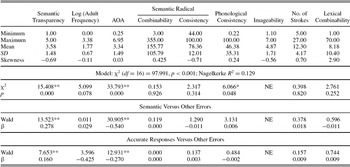
As semantic transparency and imageability are statistically and conceptually highly correlated, only one of these variables was entered in the multinomial logistic regression. Hence, the predictor variables included ratings of AOA and semantic transparency, phonological consistency, log frequency, semantic radical consistency, semantic radical combinability, lexical combinability, and visual complexity. The results are given in Table 4. The predictor variables together significantly predicted TWT's reading performance. AOA, semantic transparency, and phonological consistency were significant predictors. When the three response types were contrasted using “other errors” as the reference category, semantic transparency and AOA significantly discriminated semantic errors from other erroneous responses, as well as correct from incorrect responses that are semantically unrelated to their target. Compared with unrelated errors, both accurate responses and semantic errors tended to be made on early learned characters with meaning consistent with that of their semantic radical. As illustrated in Table 5, the characters that TWT correctly read aloud, in comparison with incorrect responses on the whole and semantically unrelated errors, were learned earlier and more semantically transparent. However, we also noted that TWT showed a tendency to produce semantic errors on items that were learned earlier and higher in semantic transparency than stimuli he correctly read aloud. Finally, when an AOA×Semantic Transparency was entered in the regression, it was not significant.
Descriptive statistics of predictor variables and results of multinomial logistic regression

Note: AOA, age of acquisition; NE, not entered.
*p < 0.05. **p < 0.01.
Characteristics of items with correct responses, incorrect responses, semantic errors, and other errors

Note: AOA, age of acquisition.
DISCUSSION
Law et al. (Reference Law, Yeung, Wong and Chiu2008) reported the reading performance of a Chinese anomic and dyslexic individual, FWL, whose error patterns indicate a reliance on the nonsemantic reading pathway. The results of a simultaneous logistic regression showed significant effects of AOA and phonological consistency. A post hoc analysis of selected items further suggested an interaction between the two variables. Law et al. (Reference Law, Wong, Yeung and Weekes2008) attributed the absence of effects of semantic-based variables to the nature of FWL's reading deficits and left open the possibility of semantic effects on reading aloud in dyslexic individuals relying on the semantic reading pathway (Monaghan & Ellis, Reference Monaghan and Ellis2002b).
This paper describes a brain-injured individual whose reading impairment is hypothesized to be mediated by the semantic route on the basis of his propensity to produce semantic errors. A multinomial logistic regression with three response categories found that AOA and semantic transparency (the consistency between the meaning of a character and that of its semantic radical) were significant predictors in distinguishing between semantic errors and other errors semantically unrelated to their target, and between correct and incorrect semantically unrelated responses. Compared with items that TWT read aloud incorrectly, he was more accurate on characters that are learned early and have meaning consistent with that of their semantic radical.
Our findings of the effects of AOA, phonological predictability, and semantic predictability partly replicated the observations of Chen et al. (Reference Chen, Zhou, Dunlap and Perfetti2007). All of these effects were found in a reading-aloud task in this study, whereas character naming and semantic category judgment were used to reveal phonological and semantic effects, respectively, in Chen et al. (Reference Chen, Zhou, Dunlap and Perfetti2007). The significant effects of a semantic-based variable and AOA on reading aloud in an individual who relies on the semantic reading route are compatible with previous studies involving alphabetic scripts and Japanese Kanji and with the case study of an English-speaking dyslexic individual by Hirsh and Ellis (Reference Hirsh and Ellis1994). The results also converge on reports of these effects among language-impaired speakers with deep dyslexia (Barry & Gerhand, Reference Barry and Gerhand2003; Gerhand & Barry, Reference Gerhand and Barry2000). However, we also found that the characters on which TWT made semantic errors were learned earlier and were semantically more transparent than those he correctly read aloud (Table 5). This is dissimilar to the observations of Gerhand and Barry (Reference Gerhand and Barry2000), where semantic errors, compared with correct responses, tended to be produced to stimuli that were acquired later and less concrete (their table 3, p. 34). We suggest that semantic errors were more likely to occur on semantically transparent characters because characters sharing the same semantic radical tend to be related in meaning, and the presence of orthographic information and relevant semantic information as provided by the semantic radical may bias the system toward selecting a semantically related lexical item. In other words, the propensity of semantically related responses to phonetic compound characters of higher semantic transparency may be the result of both semantic cue and orthographic cue in the target character, both carried by the semantic radical. We further suggest that the lower AOA values of stimuli that induced semantic errors, compared with correctly read items, may also have to do semantic transparency. Because the two variables are negatively correlated (Table 3), if a participant is prone to err on items with higher semantic transparency because of the influence of semantic and orthographic information, s/he is more likely to be inaccurate in reading characters that are learned earlier. If this is the case, the discrepant observations between this study and Gerhand and Barry illustrate how the AOA effect on reading aloud may manifest itself differently across writing systems given their individual features. This also echoes the point made by Liu et al. (Reference Liu, Hao, Shu, Tan and Weekes2008) about the effect of AOA in phonologically predictable Chinese characters.
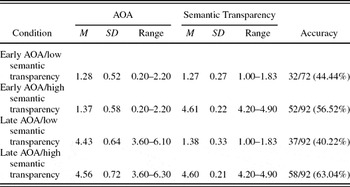
The multinomial logistic regression failed to find an interaction between AOA and semantic transparency; its absence may be due to the small number of items that are simultaneously low on these variables. To explore this possible interaction effect, we carried out a post hoc analysis in which subsets of items were selected in such a way that AOA was orthogonally varied with semantic transparency, while keeping the values of the other variables as comparable as possible across conditions. For the four subsets of stimuli, there were significant differences between characters of early versus late AOA and high versus low semantic transparency (p < .001); no reliable differences exist among these subsets (p > .1) for semantic radical combinability, semantic radical consistency, phonological consistency, and lexical combinability. Eighteen items were identified for the early AOA/low semantic transparency conditions, and 23 items for the other three conditions. The mean AOA and semantic transparency values of stimuli and TWT's reading accuracies in different experimental conditions are given in Table 6.
Reading accuracy as a function of age of acquisition (AOA) and semantic transparency using selected items

Table 6 shows a larger difference between high and low semantic transparency items of late AOA (22.82%) than those of early AOA (12.08%). The contrast between late AOA/low semantic transparency (40.22%) and late AOA/high semantic transparency (63.04%) was significant, χ2 (1) = 9.60, p = .0020, whereas that between early AOA/low semantic transparency (44.44%) and early AOA/high semantic transparency (56.52%) was not, χ2 (1) = 2.36, p = .1247. We then compared the two critical subsets in terms of other predictor variables to see whether the lower accuracy of low semantic transparency items might be attributable to other factors. Low semantic transparency/late AOA stimuli were significantly higher in character frequency than high semantic transparency/late AOA items. The effect of character frequency, if any, should have given the low semantic transparency items an advantage. That it was not the case indicates differential performance on these two sets of stimuli cannot be related to character frequency. In summary, the overall pattern of results is suggestive of an interaction between AOA and semantic transparency. That is, the effect of semantic transparency is only evident among late-acquired characters (see Note 5).
Our main findings that AOA and semantic transparency are involved in the production of semantic errors and there is an interaction between the two variables naturally raises the question about the locus of AOA effects. Various claims have been made about the source of semantic errors. They could be the result of underspecified semantic information addressing phonological output (Coltheart, Reference Coltheart, Coltheart, Patterson and Marshall1980), a disruption in the transmission of semantic information to phonology (Morton & Patterson, Reference Morton, Patterson, Coltheart, Patterson and Marshall1980), or impairment at the phonological output lexicon (Caramazza & Hillis, Reference Caramazza and Hillis1990). In models that recognize a lexicosemantic (lemma) level (e.g., Levelt, Reference Levelt1989), semantic errors may arise from damage to the conceptual level itself, access from that level to lemmas, the lemmas, or even to access from lemmas to lexemes if multiple lexemes are allowed to be activated in the system.
The results from previous works on AOA, however, have cast serious doubts on the locus of the effect being at the phonological output level, because of the great difficulties presented to the phonological completeness hypothesis (Brown & Watson, Reference Brown and Watson1987). It states that late-acquired words are assumed to have more segmented phonological representations than early-acquired words; hence, lexical items learned in early childhood are responded to more quickly than words learned later. However, the observations of AOA effects in tasks that do not involve verbal responses, such as category verification (e.g., Holmes & Ellis, Reference Holmes and Ellis2006), lexical decision (e.g., Gerhand & Barry, Reference Gerhand and Barry1999; Morrison & Ellis, Reference Morrison and Ellis1995, Reference Morrison and Ellis2000), and face recognition (Lewis, Reference Lewis1999), are problematic to the hypothesis. The most challenging evidence against it came from Monaghan and Ellis (Reference Monaghan and Ellis2002a), who showed a lack of relatonship between one's ability to segment a word and the AOA of the word. Moreover, it is not certain how the notion of phonological completeness applies to output representation of Chinese words. Unlike English words, most of which are polysyllabic and can be as short as one syllable or as long as eight syllables (internationalization), or even longer, Chinese words in general are shorter. About half of the commonly used Chinese words are bisyllabic, and very few words exceed three syllables. In addition, syllables in Chinese have simple structures, CVC, CV, or VC, and more important, homophones abound at the character level.
The involvement of AOA in semantic error production originating from disruption in other parts of the lexical system mentioned above effectively suggests that the effect is semantic in nature, that is, the semantic locus hypothesis (Brysbaert, Lange, et al., Reference Brysbaert, Lange and Van Wijnendaele2000; Brysbaert, Van Wijnendaele, & De Deyne, Reference Brysbaert, Van Wijnendaele and De Deyne2000). The growing semantic network hypothesis contends that concepts acquired later in life are often built on or defined in terms of those learned earlier (Gilhooly & Gilhooly, Reference Gilhooly and Gihooly1979). In addition, the lexical–semantic competition hypothesis suggests the AOA effects may also arise from competition at the lemma level to account for the frequency-independent AOA effect in picture-naming and word-associate generation (Belke, Brysbaert, Meyer, & Ghyselinck, Reference Belke, Brysbaert, Meyer and Ghyselinck2005; Brysbaert & Ghyselinck, Reference Brysbaert and Ghyselinck2006). The advantage of early- over late-acquired AOA words is explained in terms of richness of conceptual representations; that is, early-acquired concepts have more semantic connections, thus facilitating access to them and their associated lemmas (Steyvers & Tenenbaum, Reference Steyvers and Tenenbaum2005).
TWT's results seem compatible with any of the foregoing semantic-based hypotheses, but the findings of another recently reported Chinese dyslexic case, FWL (Law et al., Reference Law, Wong, Yeung and Weekes2008), compels us to consider the AOA effect as residing in parts of the lexical system beyond the semantic pathway. Recall that FWL's reading aloud was hypothesized to be mediated by the nonsemantic reading route, and her reading performance showed effects of AOA, phonological consistency, and their interaction. The AOA effect was larger among late-acquired characters varying in consistency of form to sound mappings. The cases of TWT and FWL together indicate that AOA effects may be present throughout the lexical production system, perhaps except for phonological output. The interaction effects between AOA and other variables, phonological consistency and semantic transparency, further suggest that the AOA effect is only evident if the mappings between two levels of representation are arbitrary. The greater the degree of inconsistency of mappings is, the larger the AOA effect will be (Monaghan & Ellis, Reference Monaghan and Ellis2002b). These two properties are features of a learning system that gradually loses its plasticity as training progresses, and are supportive of the AM hypothesis (Ellis & Lambon Ralph, Reference Ellis and Lambon Ralph2000; Zevin & Seidenberg, Reference Zevin and Seidenberg2002, Reference Zevin and Seidenberg2004). The AM hypothesis is broader in scope than the semantic locus hypothesis, but they are both founded on the same idea: neural plasticity.Footnote 6
ACKNOWLEDGMENTS
The work reported here was supported by a grant from the Seed Funding Programme for Basic Research at the University of Hong Kong. We are grateful to TWT for participating in this study.