Within the United States of America, ~40,000 infants are born yearly with CHD.Reference Upham and Medoff-Cooper 1 Although survival of infants with CHD has improved markedly over the past several decades owing to enhanced surgical and medical therapies, neurodevelopmental impairments are common.Reference Jerrell, Shuler, Tripathi, Black and Park 2 Children requiring open-heart surgery during the neonatal or infant period are considered at high risk for developmental disorders or disabilities.Reference Marino, Lipkin and Newburger 3 , Reference Gaynor, Stopp and Wypij 4 This risk is not based solely on disease severity.Reference Marino, Lipkin and Newburger 3 Additional risk factors include prematurity, genetic abnormalities, history of mechanical support, cardiopulmonary resuscitation at any point, perioperative procedures, and prolonged hospitalisation.Reference Marino, Lipkin and Newburger 3 Furthermore, the level of risk can change over time and deficits can present across many domains.Reference Marino, Lipkin and Newburger 3 , Reference Donofrio and Massaro 5 – Reference Massaro, El-Dib, Glass and Aly 9 In infants, gross and fine motor skills and communication may be most affected, whereas other deficits – that is adaptive, social/emotional, cognitive, and executive functioning – may not become apparent until later in childhood.Reference Marino, Lipkin and Newburger 3 , Reference Brosig, Mussatto and Hoffman 10 – Reference Snookes, Gunn and Eldridge 14
For these reasons, neurodevelopmental evaluation is recommended to improve neurodevelopmental outcomes from birth to adulthood in children with CHD.Reference Marino, Lipkin and Newburger 3 However, data are lacking regarding the proportion of children who actually receive this important evaluation. Failure to keep outpatient appointments is known to be common across other paediatric populations.Reference Andrews, Morgan, Addy and McNeish 15 – Reference Specht, Powell and Dormo 17 For example, in neonatal intensive care unit graduates, follow-up rates in high-risk clinics ranged from 28% to <50%.Reference Bruni, Bahamonde, Gupta, Findlay and Bean 18 , Reference Patra, Greene, Perez and Silvestri 19 Our understanding of barriers to follow-up is also limited. We know that socio-demographic factors have been identified in other paediatric populations.Reference Yoon, Davis, Van Cleave, Maheshwari and Cabana 20 , Reference Roberts, Howard, Spittle, Brown, Anderson and Doyle 21 In addition, for infants with CHD, specialised follow-up services may only be available at the surgical center and may not be easily accessible locally. The objective of this study was to determine the prevalence of neurodevelopmental evaluation at our institution and to identify risk factors for failure to attend neurodevelopmental follow-up clinic after infant cardiac surgery.
Materials and methods
Study population
A list of all patients who were discharged after having cardiac surgery within the first year of life at our institution between April 2011 and March 2014 was obtained through our institutional Society of Thoracic Surgeons Congenital Heart Surgery Database. These patients comprised the study population. Infants who did not survive to discharge or died between discharge and the scheduled neurodevelopmental appointment date were excluded.
Our standard practice is to refer all infants who have cardiac surgery between 0 and 12 months of age to our Congenital Heart Center Neurodevelopmental Follow-up Clinic, a programme started in April 2011 to provide neurodevelopmental evaluation including administration of the Bayley Scales of Infant and Toddler Development and review of parent-reported measures of development and psychosocial functioning by a paediatric psychologist. A social worker and dietician are available to meet with families as needed. In addition, since January 2014, initial visits may also include a physical exam focused on neuromotor assessment by a paediatric nurse practitioner. During the infant’s surgical hospitalisation, parents received information about the clinic and infants were referred at discharge. After discharge, parents were contacted by the neurodevelopmental clinic to schedule the infant’s evaluation. Since late 2013, patients are scheduled before discharge. Following the initial visit at 9–12 months of age, follow-up is scheduled at 18–24 months, and 3 years with referral to our school age programme for children over 4 years of age. On the basis of the evaluation, referrals are made to local early intervention or private programmes for physical, occupational, or speech therapies available throughout the region.
Study procedures and data collection
After Institutional Review Board approval with waiver of informed consent, medical records were retrospectively reviewed to retrieve demographic data including age at time of surgery, sex, race, maternal age at time of birth, residence location, insurance type, and cardiologist location and whether affiliated with the surgical center. Clinical data included CHD severity – mild, moderate, or severe as previously described by WernovskyReference Wernovsky 22 – and the Society of Thoracic Surgeons-European Association for Cardio-Thoracic Surgery risk category; comorbid conditions such as prematurity <37 weeks, genetic abnormality or syndrome, seizures, treatment with extracorporeal membrane oxygenation/ventricular assist device, or heart transplantation during initial surgical hospitalisation; and total length of hospital stay.
United States Census block data for place of residence as last designated in the medical record, including family income and parental educational levels, were collected. The University of Michigan Congenital Heart Neurodevelopmental Outcome database was reviewed to ascertain attendance in the Congenital Heart Center Neurodevelopmental Follow-Up clinic at any time during the study period. Individuals who initially cancelled and later attended a Neurodevelopmental clinic follow-up appointment were included as “attendees”.
Outcome measures
The primary outcome was attendance at the scheduled neurodevelopmental clinic appointment for evaluation.
Statistical analysis
The prevalence of neurodevelopmental follow-up was calculated by determining the percentage of survivors following CHD surgery during the study period who attended follow-up appointments at our centre for neurodevelopmental evaluation. Univariate comparisons of clinical and socio-demographic factors were made between attendees and non-attendees to identify factors associated with neurodevelopmental clinic appointment attendance using χ2 test or Fisher’s exact test for categorical variables and Wilcoxon rank sum test for continuous variables. Age at time of surgery was also evaluated as dichotomous (age <30 days [neonate] versus ⩾30 days). Other continuous variables including family income, parental educational levels, and hospital length of stay were also examined categorically using the lowest quartile. Distance to surgical center was examined categorically based on the distribution of the variable. Variables found to be significantly associated with non-attendance in univariate analysis (p<0.05) were further evaluated in multivariable logistic regression to assess independent associations with non-attendance. Multicollinearity for the variables included in the multivariable analysis was examined using variance inflation factor. When variance inflation factor is >10, the variables are considered collinear. The variance inflation factors for all variables included in the model were <1.8, demonstrating that multi-collinearity is not a problem for this model. A p-value of <0.05 was considered statistically significant. All analyses were performed using IBM SPSS Statistic 22.
Results
Study population
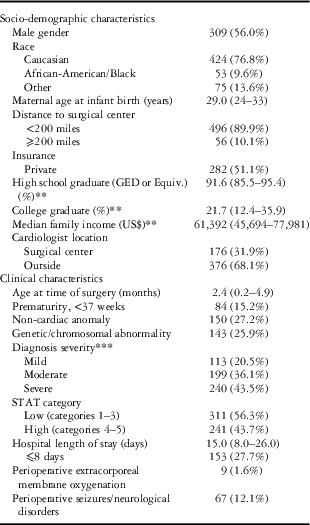
During the study period, 574 infants had cardiac surgery. A total of 22 patients were excluded owing to death before neurodevelopmental evaluation. The remaining 552 had cardiac surgery at a median age of 2.4 months (interquartile range 0.2–4.9); 80% of the patients had moderate or severe CHD. Approximately one-third (32%) received cardiac follow-up at the surgical center and 10% lived >200 miles from our centre. Approximately one-half (51%) had private insurance. Other socio-demographic and clinical characteristics are summarised in Table 1.
Patient/family demographics and clinical characteristics (n=552)Footnote *

STAT=Society of Thoracic Surgeons-European Association for Cardio-Thoracic Surgery
* Data presented as frequency (%) for categorical variables; median (interquartile range) for continuous variables
** United States Census block data as based off the 2009–2013 American Community Survey
*** Diagnosis severity as defined in the methodsReference Wernovsky 22
Prevalence of neurodevelopmental follow-up
Overall, 17% (94/552) of infants returned for neurodevelopmental evaluation during the follow-up period, with attendance remaining unchanged across the 3 years of the study, including the final 6 months following a modification of the scheduling process. Year 1 attendance was 21.3%, year 2 attendance was 14%, and year 3 attendance was 15.2%, slightly higher in year 1 with longer follow-up time. Median age at first neurodevelopmental evaluation was 12.4 months, ranging from 9.6 to 48.5 months.
Univariate analysis
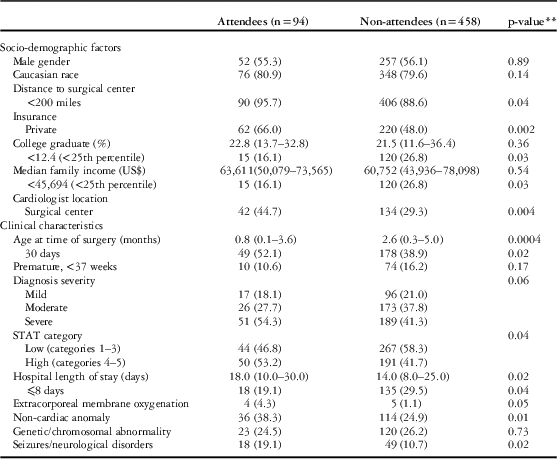
As shown in Table 2, in univariate analysis, non-attendees were older at surgery (p<0.001) and had a lower Society of Thoracic Surgeons-European Association for Cardio-Thoracic Surgery category (p=0.04). Non-attendees also had shorter hospital stays (p=0.02), and were less likely to have seizures/neurological disorders (p=0.02) or non-cardiac anomalies (p=0.01). There was no significant difference between attendees and non-attendees with respect to the presence of a genetic/chromosomal abnormality (p=0.73).
Univariate comparison of neurodevelopmental follow-up clinic attendees versus non-attendees.

STAT=Society of Thoracic Surgeons-European Association for Cardio-Thoracic Surgery
* Data presented as frequency (%) for categorical variables; median (interquartile range) for continuous variables
** p-value from χ2 test or Fisher’s exact test for categorical variables and Wilcoxon rank sum test for continuous variables
Non-attendees were less likely to have a cardiologist at the surgical center (p=0.004) and more likely to live more than 200 miles from the surgical center (p=0.04). With respect to family characteristics, families of non-attendees were more likely to have a median income below the 25th percentile (p=0.03), and were less likely to be college graduates (p=0.03) based on census block data. In addition, non-attendees were less likely to have private insurance (p=0.002). There was no association between insurance type and distance from the surgical centre (p=0.65).
Multivariate analysis
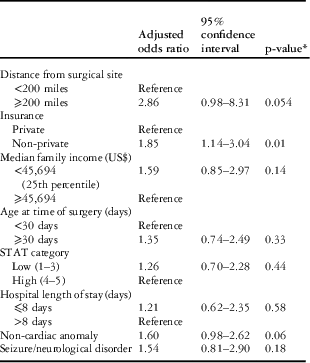
In multivariable analysis (Table 3), lack of private insurance was the only factor that remained independently associated with non-attendance (p=0.01). Non-attendance also tended to be associated with living ⩾200 miles from our surgical centre (p=0.054).
Risk factors for non-attendance in neurodevelopmental follow-up clinic in multivariable analysis.

STAT=Society of Thoracic Surgeons-European Association for Cardio-Thoracic Surgery
* p-value from multivariable logistic regression
Discussion
This single-centre, retrospective study identified a low rate of attendance in neurodevelopmental follow-up clinic for children with CHD who underwent cardiac surgery in the first year of life. Lack of private insurance was associated with almost a twofold risk of non-attendance in our study. In addition, living farther from the surgical center tended to be associated with non-attendance. Multiple factors may influence loss to follow-up in paediatric populations. To our knowledge, this study is the first to evaluate and characterise risk factors associated with non-attendance for the CHD population.
Prevalence of non-attendance
A scientific statement from the American Heart Association recommends that all children with CHD receive long-term neurodevelopmental surveillance.Reference Marino, Lipkin and Newburger 3 The majority of our patients (83%), however, did not return for neurodevelopmental follow-up. Our findings are consistent with other studies documenting low rates of attendance in paediatric subspecialty or follow-up clinics.Reference Bruni, Bahamonde, Gupta, Findlay and Bean 18 , Reference Patra, Greene, Perez and Silvestri 19 , Reference Hunter, Meinzen-Derr, Wiley, Horvath, Kothari and Wexelblatt 23 , Reference Kanji, Khoza-Shangase and Ballot 24 In a retrospective review of very low birth weight infants, follow-up rates for patients enrolled in neonatal high-risk follow-up clinics were documented at 28%.Reference Patra, Greene, Perez and Silvestri 19 Within this study, inadequate insurance coverage and distance from the clinic site were documented reasons for low follow-up rates.Reference Patra, Greene, Perez and Silvestri 19 Return rates of <50% were documented for former neonates referred for continued high-risk developmental follow-up and continued subspeciality care.Reference Bruni, Bahamonde, Gupta, Findlay and Bean 18 Additionally, follow-up rates as low as 31% have been reported among newborns referred for additional audiology screening, with distance from clinic site and transportation and insurance coverage being cited as common barriers.Reference Hunter, Meinzen-Derr, Wiley, Horvath, Kothari and Wexelblatt 23 – 25
Lack of private insurance as a risk factor for non-attendance
Lack of private insurance was the only independent factor associated with neurodevelopmental loss to follow-up in our study. Previous studies linked the lack of private insurance to low socio-economic status, increased barriers to accessing continued medical care, and loss to follow-up.Reference Boss, Benke, Tunkel, Ishman, Bridges and Kim 26 – Reference Skinner and Mayer 29 In a retrospective cohort study, Chang et al found that children with adequate public insurance coverage and Medicaid reimbursement were more likely to have poor follow-up compliance post cochlear implantation when compared with those with private insurance.Reference Chang, Ko, Murray, Arnold and Megerian 27 Furthermore, Skinner and colleagues also noted that children with public insurance had access to speciality care, but were less likely to access this care when compared with individuals with private insurance.Reference Skinner and Mayer 29 These findings suggest that perhaps access to speciality care may by limited owing to decreased availability of resources – transportation, child care, etc. – encountered by patients from lower socio-economic statuses lacking private insurance. This is consistent with our findings from univariate analyses that non-attendees were more likely to live within a census block group with a family income below the 25th percentile.
Distance from the site of neurodevelopmental evaluation as a risk factor for non-attendance
Living >200 miles from the surgical center where neurodevelopmental evaluations were performed tended to be associated with non-attendance. Schultz and colleagues observed that distance from the neurodevelopmental testing site was an important factor in failure to complete neurodevelopmental follow-up at 1 year of age in multiple-gestation births in which one child had CHD.Reference Schultz, Jarvik and Wernovsky 30 Mussatto et alReference Mussatto, Hoffmann and Hoffman 31 also noted that non-attendees lived farther away than attendees and had less complex operations. As a large referral centre, many patients travel a long distance within and outside of our state for surgical repair, but may perceive travel for neurodevelopmental follow-up, which may not be available locally, as less important.
Clinical characteristics as risk factors for non-attendance
In our study, univariate analysis suggests that non-attendance was also associated with older age at surgery, lower surgical Society of Thoracic Surgeons-European Association for Cardio-Thoracic Surgery risk categories, and shorter hospital length of stay. Previous studies have found that clinical and family factors such as severity of illness or parent’s perceptions of their child’s illness and perceived cost-benefit of appointments may influence paediatric follow-up rates.Reference Andrews, Morgan, Addy and McNeish 15 , Reference McPherson, Lairson, Smith, Brody and Jefferson 32 In the CHD population, clinicians have observed that parents often focus on their child’s heart disease and have lower developmental expectations.Reference Brosig, Mussatto and Hoffman 10 Consistent with this observation, attendance is reported to be more common in cardiology clinics than in other sub-speciality clinics.Reference Andrews, Morgan, Addy and McNeish 15 , Reference Cameron, Heath and Redwood 33 In our study, the absence of a non-cardiac anomaly tended to be associated with non-attendance. Perhaps the presence of additional non-cardiac anomalies motivated parents to seek further evaluation to identify potential neurodevelopmental deficits. Interestingly, the presence of a known genetic/chromosomal abnormality, a recognised risk factor for adverse neurodevelopmental outcomes, was not associated with attendance at neurodevelopmental follow-up. These findings suggest that parents of children referred to our neurodevelopmental follow-up clinic may underestimate the importance of this evaluation. As a result, parents may focus on their child’s heart disorder while overlooking other aspects of well-being and development.
Limitations
This study encompassed the largest analysis to date evaluating factors associated with non-attendance with neurodevelopmental follow-up in the CHD population. However, important limitations must be considered. Being a single-centre study, our results may not be generalisable across all centres. Families may have moved and failed to receive reminder notices before scheduled appointments as appointments were often made well in advance of planned follow-up at 9–12 months of age. Furthermore, some infants may have received developmental screening and/or services through local, state-supported early intervention programmes, which parents perceived as sufficient. In addition, as data collection was limited to chart review and census data, further detailed assessments of parental attitudes and beliefs towards the importance of neurodevelopmental behaviours, of individual family circumstances/resources (including insurance coverage of developmental or mental health services), and other family factors could not be captured. This will require further study and we are currently prospectively attempting to elicit reasons for neurodevelopmental clinic appointment cancellation. Finally, while our methodology using census block groups has been widely used in other similar studies, we were limited to inferring that a patient’s block group represents his/her socio-demographic status based on the last known address. This study, however, was a necessary first step in addressing this important issue of neurodevelopmental follow-up.
Conclusion
Neurodevelopmental follow-up is recommended for children with congenital heart surgery during infancy. Lack of private insurance, which may be a marker of other social risk factors, was a significant risk factor for non-attendance at neurodevelopmental follow-up evaluation. Furthermore, parents may not understand that risk of adverse neurodevelopmental outcomes is not based solely on CHD severity. Our findings suggest the need to minimise barriers to follow-up for families and to better educate parents regarding their child’s neurodevelopmental risk.
On the basis of the findings from this study, we have modified our practice in several ways in an attempt to augment the rate of follow-up. Practice changes include calling to remind families of the scheduled visit, providing further information regarding the importance of follow-up, and eliciting reasons for cancellation. We have also launched a developmental care initiative to promote and model practices to support infant development during hospitalisation and to emphasise the importance of ongoing neurodevelopmental evaluation. Further research is needed to understand the impact of these initiatives, and to better understand ways through which neurodevelopmental evaluation and follow-up can be delivered, integrated, and encouraged as part of standard care to individuals with CHD starting from infancy.
Acknowledgements
None.
Financial Support
This research received no specific grant from any funding agency, commercial, or not-for-profit sectors.
Conflicts of Interest
None.
Ethical Standards
None.