During the last decade, a considerable number of researchers have turned their attention to processing of grammar in a second language (L2) using on-line behavioral and neuroimaging methods. Some models suggest that grammatical rules of L2 are never automatized by L2 learners, but are learned declaratively and are consciously applied when necessary (Ullman, Reference Ullman2001a). According to this view, L2 learners cannot process the grammar of their L2 like native speakers (NSs). According to a second model, only some types of rules can be automatized, and their automatization is subject to L2 learners’ level of proficiency and exposure to the L2 (Clahsen & Felser, Reference Clahsen and Felser2006). Finally, according to a third view, L2 learners can achieve nativelike processing irrespective of the structure tested (Gillon-Dowens, Vergara, Barber, & Carreiras, Reference Gillon-Dowens, Vergara, Barber and Carreiras2010; Hopp, Reference Hopp2010). L2 processing is influenced by a number of factors that do not apply in native (first) language (L1) processing, such as age of onset of L2 acquisition, proficiency level, exposure in an L2 speaking environment, and everyday use of the L2 (for review, see Grosjean, Reference Grosjean1998). To date, several studies have investigated the impact of proficiency on L2 processing (Hahne, Reference Hahne2001; Kirkici, Reference Kirkici2005; Rossi, Gugler, Friederici, & Hahne, Reference Rossi, Gugler, Friederici and Hahne2006), but very few studies have investigated the role of exposure type on L2 processing (Dussias, Reference Dussias2003; Dussias & Sagarra, Reference Dussias and Sagarra2007; Frenck-Mestre, Reference Frenck-Mestre, Altarriba and Herridia2002; Morgan Short, Sanz, Steinhauer, & Ullman, Reference Morgan Short, Sanz, Steinhauer and Ullman2010). The present study addresses the controversy surrounding L2 processing by investigating real-time processing of inflection in L2 learners of English. To address whether the type of exposure affects L2 processing, we compare a group of L2 learners with naturalistic exposure (NE) to a group of L2 learners with only classroom exposure (CE) to English and a group of NSs of English.
PROCESSING OF INFLECTION IN L1
There are two types of past tense forms in English: regular past tense forms, where a suffix (-ed) is attached to the verb stem (e.g., play–played), and irregular past tense forms, where the past tense form is created in an unpredictable fashion (e.g., eat–ate). Previous research has revealed important differences between the two verb types; for example, irregular past tense forms are subject to form frequency effects (Pinker, Reference Pinker1999). This has resulted into a 20-year-old debate on how past tense inflection is processed (Pinker & Prince, Reference Pinker and Prince1988; Pinker & Ullman, Reference Pinker and Ullman2002). One viewpoint argues for a dual-system model of inflectional processing (Pinker, Reference Pinker1999; Ullman, Reference Ullman2004). According to this approach, past tense forms of regular verbs are constructed with the automatic application of a general rule, according to which the -ed suffix is attached to the verb stem. Conversely, irregular past tense forms are directly retrieved from memory, as they occupy separate lexical entries than their stems. A different viewpoint is the one suggested by Rumelhart and McClelland (Reference Rumelhart, McClelland, McClelland and Rumelhart1986) who constructed a model that used phonological associations to produce the past tense of both regular and irregular verbs. After considerable training, the model was able to produce both regular and irregular past tense forms when the present tense forms were presented. Rumelhart and McClelland (Reference Rumelhart, McClelland, McClelland and Rumelhart1986) concluded that no rule-based processing takes place for the production of the regular past tense. Conversely, they suggested that all past tense forms, irrespective of their regularity, occupy separate entries in the mental lexicon than their stems and are retrieved as a result of their phonological association to the corresponding present tense forms (see also McClelland & Patterson, Reference McClelland and Patterson2002).
A significant number of studies on NSs of English appear to support the dual-system model. One of the most influential studies has been the one by Marslen-Wilson and Tyler (Reference Marslen-Wilson and Tyler1997), who tested brain-damaged aphasic patients in an auditory priming task involving regular and irregular past tense forms. Marslen-Wilson and Tyler (Reference Marslen-Wilson and Tyler1997) found that two patients had problems in processing irregular forms, whereas a third one had problems with regular forms only, and this difference corresponded to differences in the loci of the brain damage. This double dissociation was interpreted as indicative of the dual nature of past tense inflection in English, which also has neurological correlates (see also Longworth, Marslen-Wilson, Randall, & Tyler, Reference Longworth, Marslen-Wilson, Randall and Tyler2005; Miozzo, Reference Miozzo2003; Tyler, Marslen-Wilson, & Stamatakis, Reference Tyler, Marslen-Wilson and Stamatakis2005; Tyler, Stamatakis, Post, Randall, & Marslen-Wilson, Reference Tyler, Stamatakis, Post, Randall and Marslen-Wilson2005; Ullman et al., Reference Ullman, Pancheva, Love, Yee, Swinney and Hickok2005).
Much of the supporting evidence for a dual system comes from studies utilizing frequency effects. Alegre and Gordon (Reference Alegre and Gordon1999) cite a number of studies that indicate that irregular verbs consistently show frequency effects, in that more frequent forms are comprehended/produced faster than less frequent ones; however, such a pattern is not common in regular verbs. This has been interpreted as evidence that irregularly inflected forms are stored as full-form entries, with frequency being a crucial factor in their recognition, whereas regular forms are computed online, so frequency is only relevant for regular verbs of the highest frequency (Prado & Ullman, Reference Prado and Ullman2009).Footnote 1 Additional supporting evidence for the decompositional abilities of NSs of English has recently been provided by Silva and Clahsen (Reference Silva and Clahsen2008). Silva and Clahsen (Reference Silva and Clahsen2008) conducted a masked-priming lexical decision study with regular verb stems that were paired with (a) their inflected form (prayed–pray), (b) an identical form pray–pray), and (c) with an unrelated form (baked–pray). They demonstrated that the target (pray) was recognized faster in (a) and (b), compared to (c). This effect was interpreted as evidence that the inflected form was decomposed and allowed the stem to prime the target form, in the same way as the identical prime did.
Significant supporting evidence for the dual-system approach has also been provided by neuroimaging studies that used event-related potentials (ERPs). In neuroimaging literature, distinct ERP effects have been shown to underlie different aspects of language processing. One of the most relevant ERP effects is the N400, that is, a negativity that peaks 400 ms. after the stimulus presentation. The N400 is considered to underlie lexical–semantic processing, and to be elicited upon processing of content words (Bornkessel-Schlesewsky & Schlesewsky, Reference Bornkessel-Schlesewsky and Schlesewsky2009). As such, it has been shown to be modulated by word frequency (Kutas & Federmeier, Reference Kutas and Federmeier2000, Reference Kutas and Federmeier2011), with less frequent words eliciting N400 effects with high amplitude; a similar effect is also observed upon encountering semantically unexpected words in a sentence environment (Kutas & Federmeier, Reference Kutas and Federmeier2000, Reference Kutas and Federmeier2011).
The N400 effect has also been frequently linked to morphological processing. A study by Münte, Say, Clahsen, Schlitz, and Kutas (Reference Münte, Say, Clahsen, Schiltz and Kutas1999) used a delayed repetition priming task to investigate the priming effect that the inflected forms can have on the corresponding uninflected ones. The regular and irregular prime-target pairs were compared to unrelated pairs with the same targets. Although no significant RT effects appeared in either of the conditions, the regular pairs elicited an N400 ERP component on the target. The N400 has also been suggested to underlie the reactivation of a previously presented word stimulus (Chwilla, Brown, & Hagoort, Reference Chwilla, Brown and Hagoort1995). Thus, Münte and colleagues (Reference Münte, Say, Clahsen, Schiltz and Kutas1999) concluded that the regular prime created a memory trace capable of reactivating the representation of the stem when the target was encountered, something that did not happen with irregular primes. Münte et al. (Reference Münte, Say, Clahsen, Schiltz and Kutas1999) explained this by claiming that there is only one lexical entry for regular verbs, which was activated by the prime and was reactivated by the target, but two separate entries for irregular verbs, which did not prime each other. Similar effects were found by Newman, Ullman, Pancheva, Waligura, and Neville (Reference Newman, Ullman, Pancheva, Waligura and Neville2007), who embedded present tense regulars and irregulars in sentences that called for past tense (e.g., beginning with yesterday). This syntactic violation elicited an N400 for regular verbs only, and they explained this effect by claiming that it is the absence of the regular affix that elicits this response. Further ERP evidence was presented by Allen, Badecker, and Osterhout (Reference Allen, Badecker and Osterhout2003). Allen et al. (Reference Allen, Badecker and Osterhout2003) included grammatical and ungrammatical regular and irregular verbs with varied frequency (low vs. high), which were embedded into sentences. Allen and colleagues (Reference Allen, Badecker and Osterhout2003) focused on the differences in the delay of elicitation of P600, a component elicited when content words with contextually anomalous inflections are encountered (Rodriguez-Fornells, Clahsen, Lleó, Zaake, & Münte, Reference Rodriguez-Fornells, Clahsen, Lleó, Zaake and Münte2001). The results from this study revealed faster elicitation of the P600 component for grammatical violations with irregular verbs than with regular verbs. Allen and colleagues (Reference Allen, Badecker and Osterhout2003) interpreted this effect by claiming that, whereas irregularly inflected verbs are accessed as whole-word forms that readily give clues about their syntactic role, regular verbs must first be morphologically parsed and decomposed for their role to be identified within the sentence. In sum, these effects suggest different processing for regular versus irregular forms: regularly inflected verbs are decomposed online (Allen et al., Reference Allen, Badecker and Osterhout2003; Münte et al., Reference Münte, Say, Clahsen, Schiltz and Kutas1999), and the past tense rule is automatically applied to regular forms (Newman et al., Reference Newman, Ullman, Pancheva, Waligura and Neville2007). The same effects are not observed for irregular verbs, which are thought to be processed as nondecomposable whole words.
Apart from studies in English, there is also abundant behavioral information on processing of inflection from studies in other languages. In German for instance, a number of studies suggest that processing of inflection takes place via a dual system: Marcus, Brinkmann, Clahsen, Wiese, and Pinker (Reference Marcus, Brinkmann, Clahsen, Wiese and Pinker1995) employed a judgement task in which the participants were presented visually with regularly and irregularly inflected participles embedded into sentences, and they had to rate those sentences for naturalness. Marcus et al. (Reference Marcus, Brinkmann, Clahsen, Wiese and Pinker1995) showed that, although in German regular verbs are less common than in English, still regularly inflected participles were preferred as the most natural and acceptable forms. Further behavioral findings were presented by Sonnenstuhl, Eisenbeiss, and Clahsen (Reference Sonnenstuhl, Eisenbeiss and Clahsen1999), who used the cross-modal priming paradigm in a lexical decision task on participles. Sonnenstuhl and colleagues showed that regular participles primed their present tense forms, and the priming effect was similar to the effect induced between identical words; in addition, this effect was not observed for irregular participles. In line with research in English, Sonnenstuhl et al. (Reference Sonnenstuhl, Eisenbeiss and Clahsen1999) suggested that the same lexical entry is activated for both inflected and uninflected forms of a regular verb, whereas separate entries underlie the various forms of an irregular verb that are not morphologically related (see also Clahsen, Eisenbeiss, Hadler, & Sonnenstuhl, Reference Clahsen, Eisenbeiss, Hadler and Sonnenstuhl2001). Similar conclusions have been reached with the use of ERP (Penke et al., Reference Penke, Weyerts, Gross, Zander, Münte and Clahsen1997) and functional magnetic resonance imaging techniques (Beretta et al., Reference Beretta, Campbell, Carr, Huang, Schmitt and Christianson2003) in German, but also behaviorally in Hebrew (Frost, Deutsch, & Forster, Reference Frost, Deutsch and Forster2000), Greek (Tsapkini, Jarema, & Kehayia, Reference Tsapkini, Jarema and Kehayia2002), Portuguese (Veríssimo & Clahsen, Reference Veríssimo and Clahsen2009), and Hungarian (Lukacs & Pléh, Reference Lukacs and Pléh1999). However, there are languages for which there is no evidence for dual-system processing: studies in Italian (Orsolini & Marslen-Wilson, Reference Orsolini and Marslen-Wilson1997), French (Meunier & Marslen-Wilson, Reference Meunier and Marslen-Wilson2000), and Polish (Reid & Marslen-Wilson, Reference Reid and Marslen-Wilson2002) suggest a single mechanism for the processing of inflection. A possible explanation of this discrepancy is the suggestion that dual-system processing is language specific (Sonnenstuhl et al., Reference Sonnenstuhl, Eisenbeiss and Clahsen1999); the above languages are morphologically richer than the Germanic languages (English, German), and features such as conjugation (French, Spanish, Italian, and Polish) and morphophonological alterations (Polish) introduce further morphological complexity to inflected forms. However, the aforementioned findings in other morphologically rich languages from various language families (Greek, Hebrew, Portuguese, Hungarian) seriously weaken the suggestion about language specificity due to morphological richness.
PROCESSING OF INFLECTION IN AN L2
An important question in L2 processing research is whether or not L2 learners are able to reach the automated processing that underlies rule application in a L1. A number of factors have been suggested to affect the acquisition of an L2 (Grosjean, Reference Grosjean1998; Johnson & Newport, Reference Johnson and Newport1989). For example, if the age of L2 acquisition is beyond a critical period of the individual's development, the automatization of L2 grammar has been argued to be less successful (Bialystok, Reference Bialystok1997; Butler & Hakuta, Reference Butler, Hakuta, Bathia and Ritchie2004). Based on this idea, Ullman (Reference Ullman2001a) presented an extension of his earlier declarative/procedural model (Ullman, Reference Ullman2001b) that concerned how L2 learners acquire grammatical rules, and how they compare to L1 learners. Ullman (Reference Ullman2001a) used neurocognitive data to claim that, if L2 is acquired later in life (and especially after childhood or puberty), rule usage should be gradually harder, and therefore restricted, for L2 learners. In terms of inflection, the model by Ullman predicts that the past tense rule will be absent in L2 learners. As a result, L2 learners should be incapable of decomposing regularly inflected forms into their constituents, but they should memorize them as separate lexical entries, similarly to irregular forms. However, Ullman later suggested that it is possible for L2 learners to have access to L2 language rules as an effect of increased L2 experience (Ullman, Reference Ullman2004).
Compared to L1 processing studies, L2 studies on on-line processing of regular inflection are rather scarce. One of the few studies investigating L2 processing of regular inflection is the study by Silva and Clahsen (Reference Silva and Clahsen2008). Silva and Clahsen (Reference Silva and Clahsen2008) investigated the processing of regularly inflected forms by L2 learners using the masked priming technique. This method is widely accepted as a good means for detection of morphological relationships between words (Frost, Deutsch, Gilboa, Tannenbaum, & Marslen-Wilson, Reference Frost, Deutsch and Forster2000), and of whether regularly inflected forms of verbs prime the corresponding uninflected forms. Silva and Clahsen (Reference Silva and Clahsen2008) recruited advanced L2 learners of English from various language backgrounds (Chinese, Japanese, German), which were first exposed to English in a classroom setting at an average age of 11 years and had lived in the United Kingdom for 11 to 15 months. Comparison of the L2 data to those of NSs revealed that NSs were strongly primed by morphological prime-target pairs (prayed–pray) when compared to unrelated pairs (baked–pray), but L2 learners did not show any priming effects for morphological pairs. In addition, both groups were facilitated by identical pairs (pray–pray). This finding suggests that, although the inflected primes were unconsciously processed by L2 learners, they did not prime the uninflected forms. This was interpreted to show that there was no morphological relationship between them. On the contrary, NSs were affected by this relationship and were, therefore, primed. Silva and Clahsen (Reference Silva and Clahsen2008) suggested that the inability of L2 learners to decompose inflected forms arises from the absence of specific inflection-related structured representations from their grammar, which would allow them to morphologically parse an inflected form.
The above presented results are in contrast to the findings of a recent study on the processing of L2 inflection by Kirkici (Reference Kirkici2005). Kirkici (Reference Kirkici2005) employed a simple lexical decision task on regularly and irregularly inflected past tense forms of low and high frequency, in which high- and low-proficiency Turkish–English L2 learners with classroom L2 exposure took part. Although the results from the low-proficiency group were inconclusive, the high-proficiency group was overall slower in recognizing regular past tense forms compared to irregular ones, suggesting that an additional process takes place for this type of verbs, namely, decomposition. Kirkici (Reference Kirkici2005) failed to find any significant frequency effects on either regular or irregular verbs. The dual-system model predicts frequency effects for stored forms, namely, that the highly frequent ones should be responded to more quickly. Kirkici (Reference Kirkici2005) explained the lack of a frequency effect based on L2 instruction, that is, the use of irregular verb lists. According to Kirkici, the administration of irregular verb lists in a classroom setting does not take into account the actual frequency of the forms because all of them are expected to be memorized in a similar way. As a consequence, learning of irregular verbs through lists outstrips them from any frequency features.
Useful evidence for the decomposing abilities of L2 learners comes also from studies on other domains of inflectional morphology. Gor and Cook (Reference Gor and Cook2010) conducted a study on the processing of regularly and irregularly inflected infinitives in L2 Russian by highly proficient English–Russian learners. Gor and Cook (Reference Gor and Cook2010) employed an auditory priming lexical task where they presented their participants with regular, irregular, and semiregular verbs (the latter being a highly productive nonregular class with complex allomorphy). Each trial consisted of a word pair, including the first person singular as the prime and either the infinitive form or an unmatched word as the target. Gor and Cook (Reference Gor and Cook2010) reported priming effects for all verb categories and for both L2 learners and NSs of Russian, with the irregular verbs yielding greater priming effects. They attributed these findings to the decomposition of the majority of the verbs they used (even some of the irregular ones), which is achieved by L2 learners too. Gor and Cook (Reference Gor and Cook2010) linked this high sensitivity to decomposition to the type of instruction that the L2 learners received, and suggested that written input leads to overreliance to decompositional processing and prevents the formation of whole-word auditory representations. L2 decomposition of irregular forms with distinct suffixes is not a novel finding; it has also been demonstrated for late learners of German (Neubauer & Clahsen, Reference Neubauer and Clahsen2009) and Spanish (de Diego Balaguer, Sebastian-Galles, Diaz, & Rodriguez-Fornells, Reference de Diego Balaguer, Sebastian-Galles, Diaz and Rodriguez-Fornells2005). In addition, L2 learners have been shown to be able to decompose regularly inflected nouns in Swedish (Lehtonen, Niska, Wande, Niemi, & Laine, Reference Lehtonen, Niska, Wande, Niemi and Laine2006; Portin, Lehtonen, & Laine, Reference Portin, Lehtonen and Laine2007), especially low-frequency forms, but also to decompose real and pseudoderivations (Diependaele, Duñabeitia, Morris, & Keuleers, Reference Diependaele, Duñabeitia, Morris and Keuleers2011).
To date, most studies investigating the processing of inflectional morphology in L2 learners have used tasks tapping processing at the single-word level. Paradis (Reference Paradis2004) pointed out that the use of single-word tasks may be problematic for the study of language processing. This is because in normal language use, words appear in sentential contexts, and therefore, factors such as their syntactic and thematic role, as well as the pragmatic context, can affect how they are processed and interpreted. Results from single-word tasks may not reflect the way we process language in real life, but other processes, like memory retrieval. Paradis reviewed a number of neuroimaging studies on L1 and L2 speakers and noticed that differences in brain activation between the two populations are observed in sentence-level studies but not in word-level ones. He explained this finding by suggesting that isolated words are processed by both populations as lexical items; in contrast, grammatical words provide morphosyntactic cues that are utilized only by L1 speakers for sentence comprehension, but L2 learners may still treat them as lexical items. Because the present study investigates application of a grammatical rule during online comprehension in L2, a more ecological sentence-level comprehension task was selected, which resembles more closely online language processing.
The only available study that has investigated L2 processing of inflection at the sentence level is by Hahne, Mueller, and Clahsen (Reference Hahne, Mueller and Clahsen2006), and focused on L2 learners of German. Hahne et al. (Reference Hahne, Mueller and Clahsen2006) conducted an ERP experiment investigating the processing of inflectional violations. Hahne et al. (Reference Hahne, Mueller and Clahsen2006) recruited proficient L2 speakers of German (L1: Russian) who had lived in a German-speaking environment for 4.5 years on average and were first exposed to the L2 during adolescence. Following the design in Penke et al. (Reference Penke, Weyerts, Gross, Zander, Münte and Clahsen1997), Hahne et al. (Reference Hahne, Mueller and Clahsen2006) used four lists of German participles: regularly inflected, irregularly inflected, overregularized (where the regular inflectional suffix was attached to the stems of otherwise irregular verbs) and irregularized (where an irregular suffix replaced the regular one). These were embedded in plausible sentences, which the participants had to read. The ERP effects showed a clear distinction between the two types of morphological violations described above: regularized participles of irregular verbs elicited a left anterior negativity and a smaller P600 response when compared to correct irregular participles. The left anterior negativity response has been suggested to reflect violations of rule-based morphological processing (Penke et al., Reference Penke, Weyerts, Gross, Zander, Münte and Clahsen1997), whereas the P600 response has been shown to relate to controlled processing and especially reanalysis (Friederici, Reference Friederici2002). The elicitation of these two responses suggests that participants made use of the rule, realized its misapplication to an irregular form, and conducted a reanalysis. In contrast, a N400 was elicited upon encountering irregularizations of regular verbs. This has also been reported in NSs for pronounceable nonwords that are created by irregularization, so it is likely to be related to lexical violations (Penke et al., Reference Penke, Weyerts, Gross, Zander, Münte and Clahsen1997). Taken together, these two findings suggest that during sentence processing, L2 learners process regular and irregular verbs via two distinguishable routes, similarly to NSs. This demonstrated that the dual-system model of processing applies to highly proficient L2 learners.
Based on these findings, Clahsen and Felser (Reference Clahsen and Felser2006) suggested that, although the complete rule system of a language is not available to L2 learners irrespective of their proficiency, there are a number of rules that are easier for them to automatize, including the regular inflection rule. In this sense, they extended the Ullman (Reference Ullman2004) model by dissociating different types of rules: they suggested that it is the more complicated syntactic rules that are inaccessible, whereas the automatization of the inflectional rules is possible, but it is subject to L2 learners’ proficiency, practice, and exposure to their L2.
L2 EXPOSURE EFFECTS
L2 practice is closely related to L2 exposure. Muñoz (Reference Muñoz2008) describes two types of L2 exposure: naturalistic, where learning takes place within the L2 environment, and classroom, where learning is through formal instruction in a structured way, without any other type of L2 input. The most notable difference between the two is that in NE, L2 input is unlimited and unstructured, whereas in CE the input is specific and sometimes restricted. Thus, practice seems to be qualitatively different in those two types, so it is possible that ultimate attainment would be different in each case. Flege (Reference Flege2009) reviewed several studies that examine the effects of NE, and suggested that extensive NE encompasses extensive L2 input, and this in turn may affect L2 acquisition. The effects of NE have been examined in several domains: in terms of phonological processing for example, Flege and Liu (Reference Flege and Liu2001) conducted a series of tests (identification of word-final English stops, grammatical sensitivity, and listening comprehension), and revealed that L2 participants with extensive NE (4–15 years) performed better than participants with limited NE (up to 4 years).
Fewer studies have focused on the effects of NE on online L2 processing, and the available evidence is not conclusive. Frenck-Mestre (Reference Frenck-Mestre, Altarriba and Herridia2002) investigated relative clause (RC) attachment preferences of advanced L2 learners on an eye-tracking study, and revealed significant effects of NE. Participants with NE of 5 years revealed nativelike RC attachment preferences, while participants with very little NE (9 months) tended to transfer their L1 preferences and apply them to the L2. Similar effects were presented by Dussias (Reference Dussias2003), who, in addition, revealed that L2 RC attachment preferences are not only successfully utilized by L2 learners but can also be applied to their L1. Dussias suggested that exposure to a naturalistic environment affects processing strategies in L2, but can also have an impact on processing in the L1 (see also Dussias & Sagarra, Reference Dussias and Sagarra2007).
In the domain of morphological processing, the effects of the type of exposure are relatively understudied. Gor and Long (Reference Gor and Long2009) have underlined the effects of CE in the acquisition and processing of inflection in the L2. According to Gor and Long (Reference Gor and Long2009), CE can be beneficial for the acquisition of forms of low frequency or for the establishment of regular inflectional patterns, as CE is independent of naturalistic frequencies that guide learning in a naturalistic environment. This suggestion is only partially in accordance with the suggestions by Ullman (Reference Ullman2004) and Clahsen and Felser (Reference Clahsen and Felser2006), who claimed that automatization of rule processing may be dependent on factors, such as type and amount of L2 exposure, which, however, they do not specify or quantify. Therefore, the question of what kind and amount of exposure is needed for the establishment of regular inflectional patterns remains open. To address the issue of exposure effects on L2 processing of past tense inflection, the present study focuses on processing of inflected forms embedded in well-formed sentences by L2 learners with different types of L2 exposure.
THIS STUDY
The purpose of this study was to investigate the way L2 learners process regular and irregular English past tense inflection at the sentence level. This was studied with the use of real forms (regular, irregular) and forms that include violations (regularized, irregularized). The L2 learners had Greek as their L1. Greek is a highly inflected language, in which regular and irregular past tense inflection is carried out with simple suffixing or with suffixing and prefixing of the verb stem. Irregular inflection is manifested as stem allomorphy, which nevertheless bears the same prefixes/suffixes with regular verbs. Therefore, both regular and irregular verbs have a similar high degree of orthographic overlap between the present and the past tense forms (Tsapkini, Jarema, & Kehayia, Reference Tsapkini, Jarema and Kehayia2002).
If the use of a dual system is available to L2 learners, it is possible that the differences reported by Hahne et al. (Reference Hahne, Mueller and Clahsen2006) will also be found in processing English as an L2 at the sentence level. More specifically, and based on the findings by Kirkici (Reference Kirkici2005), processing of regularly inflected forms will yield significantly longer RTs than processing of irregularly inflected forms, and this is because of the additional process of decomposition that applies to the former. A difference in RTs is also expected between regularized and irregularized forms; if decomposition is achievable for every word form that consists of valid morphemes (Diependaele et al., Reference Diependaele, Duñabeitia, Morris and Keuleers2011), then evidence for decomposition should be found for regularized forms, with RTs similar to those of the regular forms. In contrast, irregularized forms should be treated as nonwords, and as such, they are expected to yield longer RTs.
Furthermore, to investigate to what extent NE is crucial for the automatization of the regular inflection rule, the L2 learners were split into two groups of similar language abilities but with different type of L2 exposure: NE and CE groups. Following the findings by Hahne et al. (Reference Hahne, Mueller and Clahsen2006), if NE plays a crucial role for L2 processing, we predict that the NE group should have established a dual system for past tense processing, and therefore, would process irregular verbs faster than regular ones. For the nonwords, dual-system processing would result in the decomposable regularized forms being processed faster than the irregularized ones that are nonwords. If NE is necessary for the processing of rules in the L2, then the CE group should reveal no processing differences between regular and irregular verbs, but also between regularized and irregularized ones. This would indicate the lack of decomposition for the CE group. Conversely, if CE can also lead to nativelike processing of L2 rules, then the CE group should be similar to the NE group.
METHOD
Participants
Two groups of highly proficient Greek–English L2 learners participated in this study: 30 with NE to an English-speaking environment (mean age = 29, SD = 3.99, range = 20–38) and 30 with CE to English (mean age = 27, SD = 4.99, range = 16–35). In addition, a group of 30 English NSs (mean age = 20, SD = 3.86, range = 18–40) served as the control group. Both L2 groups reported English as the nonnative language they spoke the best. The NS and NE groups were tested in the United Kingdon, whereas the CE group was tested in Greece. The L2 participants were assessed for their competency in English with the Quick Placement Test (QPT; UCLES, 2001). The QPT provides 20-min computer-based language tests that assess comprehension skills in English. The participants' results were presented by the software on a scale from 1 to 5, and only participants who scored in ranks 4 (effective proficiency) and 5 (mastery) were invited to participate in the experimental task. The NE group scored 83.97% (range = 68%–100%, SD = 8.05), whereas the CE group scored 76.8% (range = 65%–91%, SD = 7.75). A one-way analysis of variance (ANOVA) revealed that this difference was significant, F (1, 58) = 12.338, p < .001.
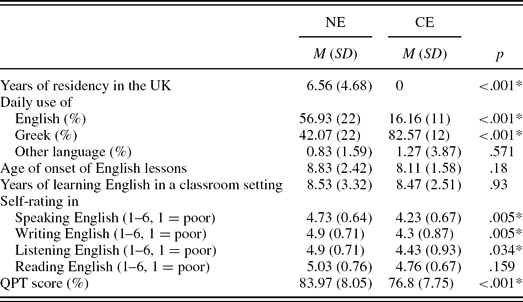
Participants' language background was assessed through a questionnaire, administered at the beginning of the session. The NE group candidates were initially required to confirm that they had lived and worked in an English-speaking country for at least one year immediately prior to this study. Similarly, the CE group candidates were excluded if they had lived in an English-speaking country for over a month. The questionnaire also included questions related to the participants' language environment and experiences, including the amount of each language they speak daily. This enabled us to build the sample's language profile and investigate whether any particular aspects of it can influence the participants' performance. It has been suggested that self-ratings provide a good indicator of the learner's language abilities in an L2 (MacIntyre, Noels, & Clément, Reference MacIntyre, Noels and Clément1997). Therefore, in the same questionnaire, the participants were asked to rate their speaking, writing, listening, and reading skills in English on a 1–6 scale (1 = poor, 6 = native). The results of the questionnaire and the participants' language-related biographical data are illustrated in Table 1.
Second language learners’ linguistic background and self-rating

Note: NE, naturalistic exposure; CE, classroom exposure; QPT, Quick Placement Test.
Table 1 shows that the NE group uses English in everyday life significantly more often than the CE group does and the opposite occurs for the use of Greek. Moreover, the groups did not differ in the age of L2 onset or the years they had been studying English as an L2. The participants of the NE group rated themselves higher than the CE group for their production skills as well as for writing and listening, but not for reading. The absence of a significant between-groups difference in self-rating for reading suggests that the two groups have equal reading abilities.
Materials
One hundred twenty English verbs were used in the self-paced reading (SPR) task: 60 regulars and 60 irregulars. The irregular verbs were selected so as to represent the majority of the irregular families described by Pinker (Reference Pinker1999) and no modal or auxiliary verbs were used. The two verb lists were subsequently divided into two sublists each, in order to create the four conditions of the experiment, based on the task employed by Hahne et al. (Reference Hahne, Mueller and Clahsen2006). A total of 30 regular verbs and 30 irregular verbs were inflected in the past tense. The remaining 30 regular verbs, which were selected based on their form similarity to irregular verbs (e.g., show–throw, reach–teach), were irregularized in the past tense, that is, irregular-like past tense forms were created in order to resemble real irregular forms. For the irregularization, the irregular templates described by Pinker (Reference Pinker1999) were applied, and the irregularized forms were created as closely as possible according to the phonology and morphology of real irregular forms (e.g., reach–raught, according to teach–taught). Any irregularized form that resembled an existing and meaningful word was excluded. Similarly, the 30 remaining irregular verbs were affixed with the regular -ed morpheme to create regularized forms. The -ed was directly affixed to the regular verb stem and no morphological or phonological alteration of the standard irregular form was preserved (e.g., eat–eated).
Three important factors were controlled for during the compilation of the verb lists for this study: frequency of occurrence, the number of orthographic neighbors the verbs had (neighborhood density), and length. Care was taken so that only verbs that feature high frequency of occurrence were selected, because a verb of low frequency may be unknown to the L2 learner; in addition, the frequency of a verb can influence how easily it is learned (Bybee & Slobin, Reference Bybee and Slobin1982), and it has been proven crucial for the processing of past tense inflection (Alegre & Gordon, Reference Alegre and Gordon1999). The verbs’ frequency of occurrence was assessed using the CELEX database (Baayen, Piepenbrock, & Gulikers, Reference Baayen, Piepenbrock and Gulikers1995), where for each word form the frequency of occurrence per million of written words in the COBUILD corpus was extracted, expressed as a logarithmic value. Orthographic neighborhood density has been defined as “the number of other words of the same length that share all but one letter in the same position” (Grainger, Muneaux, Farioli, & Ziegler, Reference Grainger, Muneaux, Farioli and Ziegler2005). Orthographic neighborhood density has been shown to affect visual word recognition (Frost et al., Reference Frost, Deutsch and Forster2000), so it is important that it is controlled for studies such as the present. The orthographic neighborhood density data were extracted using the English Lexicon Project Database (Balota et al., Reference Balota, Yap, Cortese, Hutchison, Kessler and Loftis2007). Finally, the length of the items in each of the four lists was controlled, because this could affect the RT of the words. To ensure that those four base form lists were of comparable properties, one-way ANOVAs for length, frequency, and neighborhood density were conducted, with verb type as the independent factor (regular, irregular, regularized, irregularized). The ANOVAs revealed no main effects of verb type for length, F (3, 116) = 0.492, p = .69, η2 = 0.013, frequency, F (3, 116) = 1.376, p = .25, η2 = 0.034, or neighborhood density, F (3, 116) = 1.322, p = .27, η2 = 0.033, of the base forms.Footnote 2
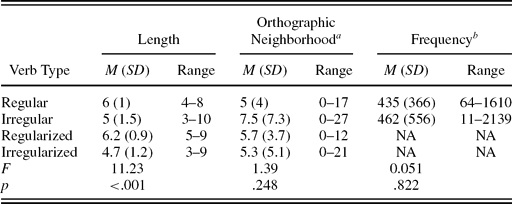
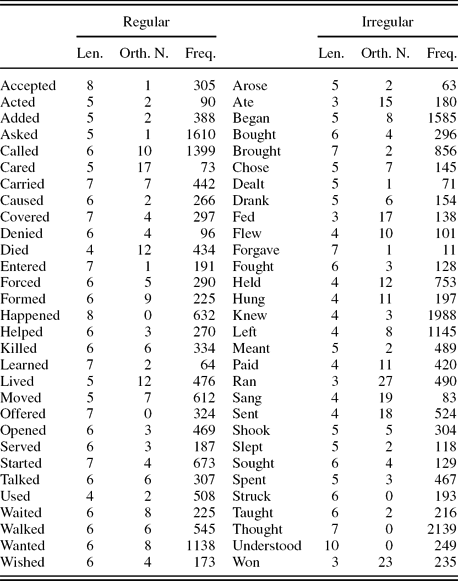
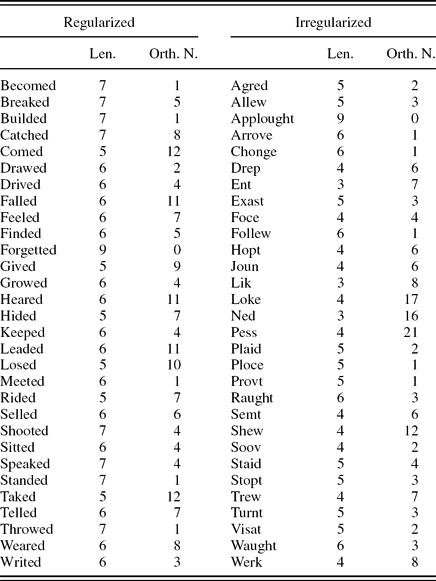
The same ANOVAs were conducted for the four lists of the inflected forms, which were the critical segments of this experiment. These analyses can be found in Table 2, whereas all the critical items, along with their length, frequency, and neighborhood density data, can be found in Appendix A.
Mean (standard deviation) length, orthographic neighborhood density, and frequency per condition
a Number of orthographic neighbors, measured as the number of other words of the same length that share all but one letter in the same position.
b Frequency of occurrence per million written words in the COBUILD corpus, expressed as a logarithmic value.
The regularly and irregularly inflected forms did not differ in terms of frequency, F (1, 58) = 0.051, p = .822, η2 = 0.001. Being nonwords, the regularized and irregularized forms were only compared to the real words in terms of length and neighborhood density. The analysis showed no significant differences in terms of neighborhood density, F (3, 116) = 1.395, p = .248, η2 = 0.035, whereas the analysis of length revealed a main effect of verb type, F (3, 116) = 11,229, p < .001, η2 = 0.225. A post hoc analysis revealed that regular forms were significantly longer than irregular (p = .007) and irregularized forms (p < .001), and also that regularized forms were longer than both irregular (p = .001) and irregularized forms (p < .01). This difference can be readily attributed to the presence of the -ed affix on the regular and regularized forms, and this assumption is reinforced by the absence of a significant difference in length between regular and regularized forms.Footnote 3
The above described inflected and pseudoinflected forms were subsequently embedded in one sentence each. One hundred twenty plausible and syntactically simple experimental sentences were constructed, along with 80 filler sentences and 10 practice items, making the number of sentences 210. The sentences of the SPR task were divided into six segments, as shown in the examples below.
Regular: The head teacher/gave a prize/to the student because she/helped/a poor guy/last month.
Irregular: The enemies/were scared by/our soldiers who/fought/very bravely/and won the battle.
Regularized: Aunt Tina/felt really sad/when her husband/taked/his stuff/and left home.
Irregularized: The babysitter/was so scared/by the noise that she/drep/the plate/with the baby food.
In the experimental sentences, the verb was always in Segment 4 (critical segment). Apart from the critical segment, which was controlled for length and word frequency, the rest of the sentence was constructed and segmented without following a particular pattern to ensure that participants would not be able to make predictions based on structure similarity between the sentences. A total of 45% of the experimental sentences and all of the fillers were followed by a comprehension question. This ensured that participants read the sentences for comprehension and provided us with information as to how good the participants comprehended the sentences and also acted as a distracting task.
Procedure
The participants were scheduled for an hourly slot each. In the case of L2 learners, the language background questionnaire was completed first, and then the QPT was administered. Participants who ranked 4 or 5 in the QPT, proceeded immediately with the SPR task. The SPR task was designed and presented on the E-prime experimental software (Schneider, Eschman, & Zuccolotto, Reference Schneider, Eschman and Zuccolotto2002a, Reference Schneider, Eschman and Zuccolotto2002b), which was also tuned to collect accuracy data from the questions and response times from each segment according to the noncumulative moving-window procedure (Just, Carpenter, & Woolley, Reference Just, Carpenter and Woolley1982; Marinis, Reference Marinis2003). The sentences were presented in a segment-by-segment fashion in white letters (18 point Courier New) on black background in the center of a 14-in. CRT monitor (800 × 600 resolution, 16-bit color depth, 60-Hz refresh rate). Participants used an E-prime compatible five-button serial response box with three active buttons: one pacing button, and two response buttons.
Prior to the experiment, the participants were presented with oral and written instructions and were given the opportunity to ask questions about the experiment. A practice session was subsequently initiated, followed by the actual experiment. They were instructed to read each segment as quickly as possible for comprehension and then to press the pacing button to move to the next segment. Comprehension questions appeared immediately after the last segment of the sentence on the same screen with two potential answers: one at bottom right and one at bottom left. One response button was assigned to the left answers and one to the right answers, and the participants were instructed to press the button corresponding to the correct answer. For half of the questions, the correct answer was on the right, and for the other half it was on the left. The total duration of this experiment was approximately 35 min.
RESULTS
Accuracy
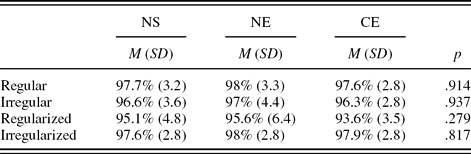
All three groups were highly accurate in answering the comprehension questions that followed the experimental sentences, as shown in Table 3.
Mean (standard deviation) accuracy scores in percentage per group
Note: NS, native speaker; NE, naturalistic exposure; CE, classroom exposure.
One-way ANOVAs revealed no significant between-group differences in accuracy for the sentences with regular, F (2, 87) = 0.090, p = .914, irregular, F (2, 87) = 0.065, p = .937, regularized, F (2, 87) = 1.295, p = .279, and irregularized verbs, F (2, 87) = 0.203, p = .817.Footnote 4 The trials with incorrect answers were excluded from further analyses.
RTs
RTs were collected from all segments and questions. The RTs from all groups were screened for extreme values, defined as any RT that exceeded 4000 ms.Footnote 5 This affected 0.99% of the NS group data, 0.90% of the NE group data, and 1.03% of the CE group data. In addition, the data were screened for outliers defined as RTs beyond 2 SD from the mean RT for each condition per subject and per item. This affected 4.88% of the NS group data, 5.73% of the NE group data, and 5.95% of the CE group data. Extreme values and outliers were replaced by the subject or item mean RT per condition.
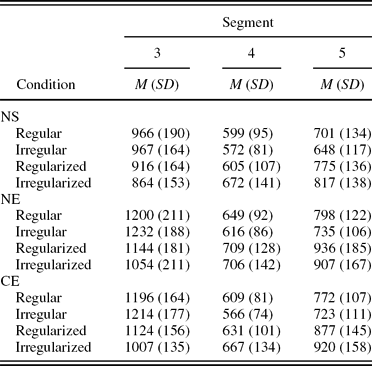
For the aims of this experiment, RTs from three segments were analyzed: Segment 4, the critical segment, and Segments 3 and 5, in order to investigate for any potential spill-over effects to and from Segment 4, respectively. Table 4 shows the mean RTs for each group per segment per condition.
Mean (standard deviation) reaction times (ms) per segment and condition
Note: NS, native speaker; NE, naturalistic exposure; CE, classroom exposure.
A mixed two-way repeated-measures ANOVA was conducted for each segment, with Group (NS, NE, and CE) as a between-groups factor and Verb Type (regular, irregular, regularized, irregularized) as a within-groups factor. Interactions were followed up with one-way ANOVAs for each condition to address between-group differences and repeated-measures ANOVAs for each group separately to address differences between the conditions for each group separately.
Segment 3
Segment 3 is the segment immediately before the verb which is the critical segment, and was analyzed to rule out that effects at Segment 4 were caused by effects at Segment 3.
The mixed ANOVA revealed a main effect of group, F (2, 87) = 18.279, p < .001, η2 = 0.296, a main effect of verb type, F (3, 261) = 111.539, p < .001, η2 = 0.562, and a Group × Verb Type interaction, F (6, 261) = 3.858, p < .001, η2 = 0.081. In all conditions, there were significant differences between the groups: regulars, F (2, 87) = 15.101, p < .001, η2 = 0.258, irregulars, F (2, 87) = 21.132, p < .001, η2 = 0.327, regularized, F (2, 87) = 17.071, p < .001, η2 = 0.282, and irregularized, F (2, 87) = 12.684, p < .001, η2 = 0.226. This was because both groups of L2 learners showed longer RTs than the NSs in all conditions (all comparisons: p < .001). The within group analyses showed a similar pattern in the three groups. In all groups, the condition with the regular verbs showed longer RTs than the condition with regularized (NS: p = .005; NE: p = .026; CE: p = .005) and irregularized verbs (all groups: p < .001). The condition with irregulars showed longer RTs than the conditions with regularized (NS: p = .006; NE: p < .001; CE: p < .001) and irregularized verbs (all groups: p < .001), and they also showed longer RTs in the condition with regularized than in irregularized verbs (NS: p = .002; NE: p < .001; CE: p < .001). There were no significant differences between the conditions with regulars and irregulars in any of the three groups (NS: p = 1.0; NE: p = .5, CE: p = 1.0). The observed Verb Type × Group interaction is likely to have resulted from differences at the significance levels of the within-groups comparisons between the groups.
Segment 4
Segment 4 is the critical segment and consists of the regular, irregular, regularized, or irregularized verb. The mixed ANOVA revealed a near-significant effect of group, F (2, 87) = 3.071, p = .051, η2 = 0.066, an effect of verb type, F (2.272, 197.638) = 66.755, p < .001, η2 = 0.434, and a Group × Verb Type interaction, F (4.543, 197.638) = 3.341, p = .008, η2 = 0.071. The one-way ANOVAs revealed significant between-group differences for irregulars, F (2, 87) = 3.446, p = .036, η2 = 0.073, and regularized verbs, F (2, 87) = 6.940, p = 0.002, η2 = 0.138. Post hoc analyses showed that for irregulars, the NE group showed longer RTs than the CE group (p = .047), and that for regularized verbs the NE group showed longer RTs than both the NS group (p = .002), and the CE group (p = .024). No other significant differences were observed.
The within group analyses showed a main effect of verb type in all groups, NS: F (2.035, 59.012) = 29.304, p < .001, η2 = 0.503; NE: F (2.344, 67.989) = 19.710, p < .001, η2 = 0.405; CE: F (2.031, 58.885) = 27.630, p < .001, η2 = 0.488, but the subsequent pairwise comparisons with Bonferroni correction showed some differences between the groups causing the Group × Verb Type interaction. All groups showed longer RTs in regulars than irregulars (all groups: p ≤ .001) and shorter RTs for regulars than for irregularized verbs (all groups: p < .01). All groups also showed shorter RTs in irregulars than in regularized (all groups: p ≤ .010) and irregularized verbs (all groups: p < .001). The NE group showed shorter RTs for regulars than irregularized verbs (p = .005), which was not significant in the other groups; the NS and CE groups showed shorter RTs in regularized than in irregularized verbs (NS: p < .001; CE: p = .029), but there was no significant difference between those verb types in the NE group. Finally, the different pattern of performance between Segments 3 and 4 in all comparisons and for all groups indicates that there were no spillover effects from Segment 3 to Segment 4.
To investigate whether the significant difference in RTs between the four verb types reflected differences in length between the verb types, we ran a simple linear regression analysis on the mean RTs per item across all groups, in which length was added as the predicting variable. The results of the regression indicated that length did not explain a proportion of variance in the mean RT of the verbs, R 2 = .024, F (1, 118) = 2.859, p = .093, and that it did not significantly predict the mean RTs, β = 9.857, t (118) = 1.691, p = .093. Finally, if length was crucial, we would also expect to find longer RTs for regularized versus irregularized forms because regularized forms were longer than irregularized ones, but this was not evident in any of the groups.
Segment 5
The mixed ANOVA revealed a main effect of group, F (2, 87) = 6.076, p = .003, η2 = 0.123, a main effect of verb type, F (2.473, 215.143) = 200.1, p < .001, η2 = 0.697, and a significant Group × Verb Type interaction, F (4.946, 215.143) = 3.709, p = .003, η2 = 0.079. The one-way ANOVA revealed significant between-groups differences for regulars, F (2, 87) = 5.165, p = .008, η2 = 0.106, irregulars, F (2, 87) = 5.332, p = .007, η2 = 0.109, regularized, F (2, 87) = 8.096, p = .001, η2 = 0.157, and irregularized verbs, F (2, 87) = 3.957, p = .023, η2 = 0.083. Post hoc analyses revealed that the NS group showed shorter RTs than the NE group for regulars (p = .007), irregulars (p = .009), and regularized verbs (p < .001). The NS group showed shorter RTs than the CE group in irregulars (p = .035), regularized (p = .036), and irregularized verbs (p = .031).
The within group analyses showed a main effect of verb type in all groups, NS: F (3, 87) = 77.416, p < .001, η2 = 0.727; NE: F (2.032, 58.914) = 62.946, p < .001, η2 = 0.685; CE: F (3, 87) = 71.446, p < .001, η2 = 0.711, and the subsequent pair-wise comparisons with Bonferroni correction showed similar results for most comparisons. All three groups showed longer RTs for regulars than irregulars (all groups: p ≤ .001) and shorter RTs in regulars than in regularized (all groups: p < .001) and irregularized verbs (all groups: p < .001). All groups also showed shorter RTs in irregulars than in regularized (all groups: p < .001) and irregularized verbs (all groups: p < .001). However, only the group of NS and CE showed shorter RTs in regularized than in irregularized verbs (NS: p = .007; CE: p = .05), which has caused the Group × Verb Types interaction. The similarity of the effects to those of Segment 4 suggests a spill-over effect from Segment 4 to Segment 5 for all groups.
Relation among proficiency level, accuracy, and RTs
To investigate a possible relationship between proficiency level and the participants' performance in our task, we conducted Pearson correlations between the participants' proficiency level and their accuracy and RTs. These showed that the proficiency of the NE group was not correlated to the mean accuracy (p = .956), the mean RT at the critical segment (p = .404), or the mean RT of a whole sentence (p = .543). Similarly, the proficiency of the CE group was not correlated to mean accuracy (p = .187), mean RT at the critical segment (p = .703), or mean RT of the whole sentence (p = .658).
DISCUSSION
The present study investigated the processing of English regular and irregular verb morphology at the sentence level in highly proficient Greek L2 learners of English and whether this is influenced by the type of exposure in the L2. The main results can be summarized as follows: first, regularly inflected verbs were processed more slowly than irregular verbs during online processing of grammatical sentences by NSs. Second, this effect was also observed in late learners of English with high proficiency. Third, this difference was not dependent on the type of language exposure of the L2 learners. Fourth, small differences in proficiency level among highly proficient L2 learners did not affect their accuracy and RTs.
L1 processing of past tense inflection
Our results revealed a clear distinction between processing regular versus irregular past tense forms of English verbs also reported in several other studies (Allen et al., Reference Allen, Badecker and Osterhout2003; Newman et al., Reference Newman, Ullman, Pancheva, Waligura and Neville2007). Having controlled for possible confounding factors of the two verb lists (such as frequency, neighborhood density, and length), we can attribute this distinction to the morphological difference between the two verb types. The delay for regular verb processing can be explained by the activation of the regular rule, which automatically leads to the decomposition of the inflected form (Kirkici, Reference Kirkici2005). Conversely, irregular past tense forms already exist in the mental lexicon as separate entries, so no computational processes are required, which can explain the apparent facilitation in their RTs. Consequently, our findings support the dual-system theory (Pinker, Reference Pinker1999) and challenge the parallel distributed model (Rumelhart & McClelland, Reference Rumelhart, McClelland, McClelland and Rumelhart1986), according to which there should not be any differences in comprehension speed between the two lists, as regularity plays no important role. These findings appear to suggest that past tense processing takes place according to the declarative/procedural model (Ullman Reference Ullman2004), with the irregular verbs relying on direct retrieval from declarative memory and the regular verbs relying on decomposition according to the -ed rule, which is suggested to be carried out by the procedural memory system.
Additional evidence in favor of decomposition is provided by processing of regularized and irregularized verbs. Our results reveal a greater processing cost for irregularized forms (e.g., raught) than regularized ones (e.g., feeled), but also no difference between regular and regularized forms. This difference could be due to the presence of the regular suffix on the regularized forms; although these forms are incorrect, the individuals are able to process them in a decompositional manner. Those results indicate that the decomposing mechanism could be activated in the presence of a valid recognisable morpheme, such as -ed, and a valid stem (Diependaele et al., Reference Diependaele, Duñabeitia, Morris and Keuleers2011; Rastle & Davis, Reference Rastle, Davis, Kinoshita and Lupker2003; Rastle, Davis, & New, Reference Rastle, Davis, Kinoshita and Lupker2004). In contrast, by being nonwords, the irregularized forms are processed more slowly than the other verb types (also in Münte et al., Reference Münte, Say, Clahsen, Schiltz and Kutas1999).
L2 processing of past tense inflection
The second important finding of this study is that highly proficient L2 learners of English show the same effects with NSs. Indeed, the longer RTs observed for regularly inflected forms, compared to irregularly inflected ones, suggest activation of a rule-like system. This finding is not in accordance with the results reported by Silva and Clahsen (Reference Silva and Clahsen2008), who found that regular verb stems were not primed by inflected past tense forms. Silva and Clahsen interpreted their findings to show that inflected forms are processed as full forms rather than composed ones. Although Silva and Clahsen (Reference Silva and Clahsen2008) compared morphological primes to identical ones (i.e., prayed–pray vs. pray–pray), they did not compare regular versus irregular verbs. Moreover, the fact that that study used masked priming with single words does not make this study directly comparable. Paradis (Reference Paradis2004) suggested that single word studies are not the most appropriate to capture real language processing, because in real life words do not usually appear in isolation. According to that view, studies like Hahne et al. (Reference Hahne, Mueller and Clahsen2006) and the present are more capable of revealing the nature of past tense processing by L2 learners.
Our findings support the suggestion by Clahsen and Felser (Reference Clahsen and Felser2006) that, although nativelike rule processing is difficult and potentially unachievable by L2 learners, there are a number of rules than can be automatized and actively utilized in L2 processing, one of them being the regular past tense rule. Indeed, our findings suggest that not only L2 learners have an internal representation of the past tense rule, but also that their processing is comparable to that of NSs of English. Moreover, the present results confirm Ullman's suggestion that proceduralized processing of inflection in L2 can be achieved as a function of L2 experience (Ullman, Reference Ullman2004), and this experience does not have to be in a naturalistic environment, but can be limited to a highly structured classroom environment (Gor & Long, Reference Gor and Long2009). It seems that regular past tense inflection is among those rules that are available for automatization, at least by highly proficient L2 learners (Kirkici, Reference Kirkici2005).
Nonword processing data by the two L2 groups are less conclusive. The CE group showed a similar pattern of effects to the NS group: irregularized forms had the longest RTs, and regularized forms had longer RTs than irregular ones. One important difference between the CE and the NS groups, however, was that the CE group revealed longer RTs for the regularized forms, compared to the regular ones, whereas NSs did not show a significant difference between these two verb types. The increased RTs for the regularized forms may be due to the participants' being non-NSs, and therefore slower in reading a nonword that appears in a potentially correct grammatical form (valid stem, valid affix). This is also illustrated more dramatically in the results from the NE group, in which the regularized verbs had longer RTs than both regulars and irregulars, but with no difference to the irregularized ones. Therefore, the L2 learners’ performance in the nonwords does not provide clear evidence for or against the decomposing abilities of L2 learners, although results from the CE group indicate a discrepancy in processing the two types of nonwords.
Effects of L2 exposure, proficiency, and age of onset
Our L2 groups differed in terms of type of L2 exposure, one of them having only CE and the other one having an average of 6.5 years NE. This distinction was initially made in order to investigate the possible influence of naturalistic L2 exposure on language skills, given that according to Ullman (Reference Ullman2004) substantial experience in L2 can lead to more automated use of a number of L2 rules. The results suggest that the type of L2 exposure is not an important factor that facilitates the automatization of the past tense rule. Both L2 groups showed similar effects when real verbs were considered, with small variations regarding the processing of regularized verbs.
It could be argued that consolidation of the past tense rule requires a certain amount of L2 exposure, which is not confined to NE only. Indeed, both L2 groups in this study had studied English in a classroom environment for a mean of 8.5 years and started at a mean age of 8–9 years. It is possible that several years of language education can assist in the automatization of some language rules in L2, such as the past tense rule. Furthermore, although people in Greece do not usually speak or write in English in their everyday life, there is a considerable amount of exposure to English, mainly through popular culture. Apart from the extensive use of English websites and the popularity of English music, English-speaking movies are never dubbed but they are subtitled. Therefore, a substantial exposure to the language is present, and that may influence the way Greek–English L2 learners process English.
Although there was no difference between the two groups of learners in the processing of real verbs, we found a between-groups difference on the processing of nonwords. This difference may be related to the type of exposure. According to Gor and Long (Reference Gor and Long2009), the structured nature of CE means that classroom learners are not affected by naturalistic frequencies, whereas naturalistic learners are primarily exposed to high-frequency forms and inflections. This suggests that, although both groups can freely and successfully process decomposable forms, classroom learners readily decompose forms with zero frequency, such as regularized forms, based on instruction-based probabilities of inflectional patterns. In contrast, NE learners are affected by the zero frequency of the regularized forms, so the linguistic rule is not applied and these forms are processed similarly to irregularized forms, that is, as nondecomposable nonwords (cf. Gor & Long, Reference Gor and Long2009, for similar experimental findings in L2 Russian). Thus, the observed between-group difference may have been caused by the NE learners’ sensitivity to the frequency of the pseudoinflected forms.Footnote 6
Because we did not find a between-group difference in the processing of past tense of real words that is directly attributable to the type of language exposure, all highly proficient L2 learners are likely to be able to employ the past tense rule automatically. Despite the fact that the NE group scored higher in the language test, both groups were of high proficiency, and the proficiency level was not found to affect their performance. Although a direct comparison to participants with low proficiency was not carried out in this study, Kirkici (Reference Kirkici2005) showed that it is difficult to describe morphological processing of low proficiency L2 learners, as their performance can be constrained simply by their restricted L2 competence. Therefore, it could be argued that a certain level of proficiency can accommodate some aspects of nativelike rule-based L2 processing, at least some “shallow” morphological rules as described by Clahsen and Felser (Reference Clahsen and Felser2006), among which is the past tense rule (see also Hopp, Reference Hopp2010).Footnote 7
If increased level of proficiency accounts for the automatic processing of the past tense rule, then an explanation is needed for the discrepancy between the results of the present study and the study by Silva and Clahsen (Reference Silva and Clahsen2008). A critical point that could explain this discrepancy relates to the proficiency of the groups tested in the Silva and Clahsen (Reference Silva and Clahsen2008) study versus the proficiency level of the participants in our study. In Silva and Clahsen, L2 participants in Experiment 1 scored highly in the proficiency test, but participants in Experiment 2, which was conducted in order to control for methodological issues arisen from Experiment 1, were of medium to high proficiency; in addition, the participants' proficiency was drawn from their scores in the IELTS certificate, which did not necessarily reflect their language competence at the time of testing. Because participants in the present study were of advanced proficiency, it could be argued that advanced proficiency is beneficial for the acquisition and automatization of the -ed rule in L2 learners. An additional important difference between the two studies concerns the age of onset: in the present study both groups started studying English at a mean age of 8–9 years, but in the Silva and Clahsen (Reference Silva and Clahsen2008) study all groups reported age of onset of a minimum of 12 years. Therefore, the present findings suggest that learning an L2 before the age of 12 can be beneficial for the automatization of some language rules. It may also be that the combination of an early age of onset and an increased amount of L2 exposure leads to the automatization of those rules (Muñoz, Reference Muñoz2008); the Silva and Clahsen (Reference Silva and Clahsen2008) groups have a mean age of 25 years and a mean age of onset of 13 years, which gives a mean overall exposure to English of 12 years. The corresponding figure for both groups in the present study was almost 20 years. However, this assumption does not necessarily account for the results presented by Hahne et al. (Reference Hahne, Mueller and Clahsen2006), as their participants had an age of onset of 17 years.
To conclude, the present findings suggest that establishment of L2 rule-based usage is depended on the interaction of a number of factors. Although a high level of proficiency is essential for the successful consolidation of the past tense rule, the amount of overall exposure and the age of onset are also important. Consequently, it is the combination of all those factors that allowed our participants to treat regularly inflected forms similarly to NSs of English. The observed distinction between processing regular and irregular past tense forms suggests that dual-system processing is accessible to both NSs and L2 learners of English, and that the consolidation of the past tense rule is not related to the type but to the overall amount of L2 exposure.
Our study is the first to test effects of type of exposure in L2 processing of inflection. To address the effect of type of exposure, we controlled for the level of proficiency, the age of onset, and the L1 of the learners. To disentangle these factors, future studies need to also manipulate the level of proficiency, the length of exposure, the age of onset, and the L1–L2 combination. This can address the way these factors interact with each other and the relative contribution of each factor for the L2 processing of past tense inflection.
List of critical items with balancing data
List of real verbs used at the critical segment
List of nonwords used at the critical segment
ACKNOWLEDGMENTS
This work was supported by the Economic and Social Research Council (Grant PTA-030-2006-00359). We thank Stavroula-Thaleia Kousta and Gabriella Vigliocco for providing us space to test some of the participants at UCL, and the Scholars Language School (Kallithea, Greece), Eleni Vlahou, and Athanassios Protopapas (University of Athens) for providing us with space to test the participants in Greece.