Widely publicized since 1876 as far-sighted acts of social benevolence and guarantees of labour peace,Footnote 1 the large-scale housing initiatives of the Krupp steel company drew a steady stream of visitors to the highly industrialized city of Essen. The list included: Kaiser Wilhelm II and Secretary of State Admiral von Tirpitz, the Heimat (homeland) preservationists Richard Klapheck and Paul Schultze-Naumburg, a 500 member delegation from the International Congress of Workmen's Accidents and Assurance, representatives from a Canadian Royal Commission, correspondents from the British Medical Journal and Harper's Magazine, the ill-fated Bavarian revolutionary leader Kurt Eisner and Walter Gropius’ successor as director of the Bauhaus, Hannes Meyer. The contemporary opinions of Krupp's housing initiatives ranged from heralding Alfred Krupp as the true ‘originator of the garden city idea’ to denouncing its showcase Altenhof estate as a ‘cemetery for the living’.Footnote 2 The Krupp developments thus represented high-profile targets on which both supporters and critics could set their sights. Their respective observations revealed at least as much about their diverse visions of the shape of German housing as they did about the Krupp projects themselves.
Notorious for its reputation as ‘Cannon Kings’, Krupp's controversial history has received enough attention to ‘fill entire libraries’.Footnote 3 Although nowhere near as extensive, the scholarly literature on the firm's housing legacy has increased significantly, beginning in the mid-1980s when the company archives in the Villa Hügel estate began to be opened up to researchers. With the exception of Nicholas Bullock and James Read, however, the existing literature has barely touched upon the considerable contemporary interest and public discourses that the Krupp housing developments in Essen generated.Footnote 4 This article will examine the first-hand accounts by national and international historical actors who visited the Krupp projects in Essen and expressed their views through various media. Beginning in 1876, the firm was unique in utilizing very extensive marketing techniques to highlight its housing projects. During the Wilhelmine era the entrenched Krupp tradition of displaying its industrial achievements through company publications and physical displays at international trade exhibitions began to be employed to showcase select housing projects. Krupp also utilized another proven technique, the official company tour, or Besucherpolitik, to publicize its housing achievements. As Klaus Tenfelde has recently shown in his impressive book on the firm's centennial celebrations, it was the visit of Kaiser Wilhelm II in 1912 that represented the absolute pinnacle of this Krupp marketing tradition.Footnote 5 While the numerous so-called Kaisertage (Emperor days) are certainly worthy of note, the reactions of uninvited visitors like Eisner, Schultze-Naumburg and Meyer are no less important since these observers passionately attempted to deconstruct the firm's housing legend.
Given this extensive exposure of Krupp housing, it was inevitable that its national importance would ultimately be debated in the Reichstag. In a 1911 parliamentary session, none other than German Secretary of State Alfred von Tirpitz, himself a recent participant in an official company housing tour, was able to vouch that the Krupp projects were indeed truly exemplary. In a period when the housing question entered the realm of politics, conservative members of the Reichstag rallied around Tirpitz and heralded Krupp's projects in Essen as the very antithesis of Berlin's infamous Mietskasernen (rental barracks). Krupp's housing Besucherpolitik had apparently paid political dividends.
Quantity and quality
Founded in the Ruhr city of Essen in 1811, the Friedrich Krupp steel company had developed into Germany's largest industrial establishment by 1918. With over 10,000 total units constructed prior to the outbreak of World War I, Krupp's housing initiatives also represented the largest German employer's attemptFootnote 6 to alleviate what General Hindenburg in 1917 identified as an issue with ‘the greatest social implications’.Footnote 7 When the Weimar coalition government took the admirable step of promising ‘every German family a healthy dwelling’Footnote 8 in Article 155 of the 1919 constitution, the Essen steel firm had been building company dwellings for nearly 70 years.
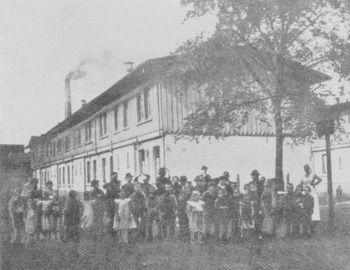
At the time of the 1911 Reichstag debates, a total of 6,551 units of Krupp housing were dispersed across eight main developments in Essen, one of the most industrialized cities in Wilhelmine GermanyFootnote 9 (see Figure 1). There was no such thing as a definitive Krupp housing project or style. Housing types, site layouts and proximity to the main factory varied greatly from the barracks and shoddy tenements of the Alt-Westend, built in 1863 (see Figures 2 and 3), Nordhof (1871) and Schederhof (1873) to the imposing 1,509 units in Cronenberg (1873), which housed over 8,000 people.Footnote 10 Although they contained what would become hallmarks of Krupp housing: a company store, schools, modest green spaces and even a beer hall, the aforementioned projects were situated either on, or directly adjacent to, the bustling factory. Only the low-density Altenhof (1890–1893), Alfredshof (1894) and Margarethenhöhe (1911) developments began to be located away from the noise and soot of the sprawling main plant (see Figure 4).
Smokestack skyline – central Essen 1893

Alt-Westend 1905

Alt-Westend site plan

Main factory (shaded) and housing locations (outlined) 1912

The company owned all but 256 units with the remainder generating a rental return of between 2 and 3 per cent.Footnote 11 Approximately 18 per cent of its total workforce of 36,369Footnote 12 in Essen thus lived in company houses, with rents estimated at 10 to 15 per cent below market value. Only 986, less than 3 per cent of Krupp workers, resided in the most desirable ‘cottage’ developments like the Alfredshof, Altenhof and Margarethenhöhe. Employees needed to have 22 years of seniority to even be considered for occupancy in these low-density projects. Since Essen was a city where the vacancy rate between 1890 and 1918 was never above 2 per cent, it is not surprising that the waiting list for Krupp housing was estimated at 10 years.Footnote 13 These figures themselves indicate that the numbers, although impressive, were never enough actually to meet the demands of the growing workforce after 1890.Footnote 14
While Krupp housing in Essen was therefore unique in its overall scale, it is clear that, when compared to projects of its main competitors like Stahlhausen in Bochum or Eisenheim in Oberhausen,Footnote 15 its pre-1890 buildings were neither innovative nor a qualitative improvement over existing Ruhr company housing. Krupp housing director Ernst Haux even acknowledged as much at the Ninth Annual General Assembly of the Rhenish Society for Promoting Workers’ Housing in 1907, stating that all pre-1890 construction was now substandard.Footnote 16 What was truly unique about the projects was how they were marketed.
Marketing Krupp housing
From its origins in the 1870s, the marketing of Krupp housing was intricately linked to the legend of its most famous sole-proprietor, Alfred Krupp (1812–87), Essen's ‘Cannon King’. Due to his penchant for bombastic displays at international exhibitions, Evelyn Kroker has fittingly described Alfred Krupp as the ‘undisputed champion of marketing strategies’.Footnote 17 Predominantly overlooked in the literature on Krupp's self-representation was the marketing of its workers’ welfare provisions. In this regard, housing was always depicted as the most important company provision for fostering harmonious relations between capital and labour in Essen. Following the first truly large-scale foray into constructing mass housing, Alfred Krupp seemed driven to publicize his firm as a world leader in the field.
Beginning with the 1876 Brussels International Exhibition for Health and First Aid, every Krupp display at major domestic and international exhibitions included a section on its workers’ housing. In Brussels, the company began to provide informative brochures which clarified the main characteristics of housing for visitors and the press free of charge. The Belgian newspaper Echo du Parlement was surprised to see the German firm participate in the Brussels Exhibition, stating: ‘Even Mr. Krupp, inventor of the crucible steel cannon from Essen, wanted to take part in our peaceful exhibition and here he has taken up the same honourable rank that is usually reserved for his cannon.’Footnote 18 Significantly, the 1876 Brussels’ explanatory booklet was almost apologetic about the tenement buildings provided for workers, rather than the far more expensive ‘ideal workers cottages’.Footnote 19
At the Brussels Exhibition, the international press was exposed to the legend of Alfred Krupp's Stammhaus (Ancestral home). In 1873, this house had been painstakingly reconstructed and placed in the middle of the factory's busiest thoroughfare. After receiving a printed postcard (see Figure 5)Footnote 20 in the same year, to commemorate 25 years of Alfred's sole-proprietorship, every Krupp employee was informed of its symbolic significance. Pseudo-personalized by replicating Alfred's own handwriting, the card outlined a Horatio Alger-like tale:
Let this example give strength to the distraught; let it serve as a lesson to respect modest homes and the great people that may reside in them. The purpose of work is the common well-being, only then is work blessed, only then is work holy. Let everyone in our establishment from the highest to the lowest in rank pursue his domestic bliss modestly and thankfully, then my greatest wish has come true.Footnote 21
Stammhaus postcard 1873

When Harper's Magazine was granted access to the factory and viewed the Stammhaus in 1887, its correspondent cited the passage in its entirety. He believed it did much to explain why the Krupp worker ‘accepts his orders passively; he does not know what it is to strike’.Footnote 22 Significantly, the main plant in Essen would indeed not experience its first full strike until April 1919.Footnote 23 This was a remarkable statistic and one the company was quick to highlight during its official housing tours.Footnote 24 Already in 1887, one of the first participants in Besucherpolitik left thoroughly convinced there was a direct correlation between its housing legend and labour peace.
Housing Besucherpolitik
By the 1890s, official visits to the Krupp facilities in Essen by domestic and foreign dignitaries had become an integral part of the firm's marketing strategies dating back to the first royal visit of Wilhelm I in 1856. Hartmut Pogge von Strandmann has captured how Krupp's carefully choreographed official tours targeted potential customers, ranging from the German military establishment to the Shah of Persia.Footnote 25 What the author has not addressed is that under the leadership of Friedrich Alfred Krupp from 1887 to 1902, Besucherpolitik began to showcase select Krupp housing estates. Most widely publicized amongst these were the visits of the young Kaiser Wilhelm II beginning in June 1890.
In a period that continued to be marked by steady electoral gains of the Social Democratic Party and the dismissal of Chancellor Bismarck, Wilhelm II was eager to show the German public that his 1890 ‘February Decrees’ had truly transformed him into the ‘social and workers’ Kaiser’.Footnote 26 Similarly concerned about recent local electoral advances of labour candidates and the 1889 Ruhr workers unrest, Friedrich Alfred Krupp also began to entertain the notion of running for public office and would actually serve as a Reichstag delegate from 1893 to 1898. In a letter sent to Wilhelm one month prior to the royal visit, Krupp wrote: ‘Your Majesty is undoubtedly aware that during the [1889] strike wave last year, my workers have behaved in an exemplary manner’ and went on to conclude ‘I am utterly convinced that my workers in Essen will serve others as fine example.’Footnote 27
When the Kaiser travelled to Essen in 1890 he was therefore assured he was entering an environment where the workers were loyal. Wilhelm II chose the extensive Cronenberg housing project to proclaim: ‘The Krupp factory has given the German worker and German industry a reputation unlike any other firm.’Footnote 28 The conservative industrial periodical Stahl und Eisen (Steel and Iron) was on hand to explain further that his Imperial Highness was:
understandably full of praise for all these provisions. In fact, the Kaiser – and we believe this to be extraordinarily important – witnessed that Rhenish-Westphalian industry has created mass facilities for the welfare of the workers long before the state took on these socio-political duties. He [Wilhelm II] saw that the expansion of these facilities continues even after the state has now taken up a part of these provisions for the working people.Footnote 29
At the time of the Kaiser's visit these state ‘provisions for the working people’ did not include housing. In fact, a national housing law was still nearly 30 years in the making.Footnote 30 While the housing question became increasingly politicized in the 1890s, Krupp began with the construction of two low-density cottage and garden projects: the Altenhof (see Figure 6) and Alfredshof. These would become the new focal points of Besucherpolitik and the growing Krupp housing legend.
Altenhof site plan

‘Garden city precursors’
All hagiographic portrayals of the ‘Cannon King’ aside, the archival documents do support the contention that Alfred Krupp genuinely pursued the construction of cottage and garden estates, alluded to in the 1876 Brussels Exhibition brochure. Literally lying on his deathbed in 1887, Krupp dictated his final wish: ‘[the next housing project] should not be situated near a main street but in an open field, because the worker who spends his entire day amongst 12,000 men should be able to enjoy the company of his family at home, he does not wish to be disturbed by noisy neighbours’.Footnote 31 The far more economical rowed barrack or tenement design of earlier Krupp housing was now to be replaced with a substantial 25–30 metre buffer zone between each of the projected 100 dwellings. Scribbles explaining that the Stammhaus should serve as a model for the next low-density housing project were forwarded to his son Friedrich Alfred. The last words Alfred Krupp committed to paper were ‘I would appreciate it if I could give the go ahead for such dwellings while I am still alive.’Footnote 32 For his successor not to act on Alfred's dying wish was unthinkable.
Düsseldorf art history professor and leading Heimat preservationist Richard Klapheck identified Alfred's final housing directives as a matter of immense historical importance. In his work Siedlungswerk Krupp, which remains the most widely cited treatment of the topic, Klapheck made the startling assertion that Alfred Krupp ‘was the first person in Germany to think of the garden city idea’.Footnote 33 According to Klapheck's account, Alfred Krupp had preceded Theodor Fritsch's book Die Stadt der Zukunft – Gartenstadt (1894)Footnote 34 by seven years, and Ebenezer Howard had supposedly developed the garden city a decade after Krupp.
When all of Alfred's statements are examined and compared to Howard's Tomorrow – A Peaceful Path to Real Reform, it is clear that Alfred's paternalistic aims for the provision of housing and urban development were diametrically opposed to the socially transforming objectives of Howard. Even so, it is important to keep in mind what Axel Schollmeier concluded about Krupp's most famous housing development, the Margarethenhöhe: ‘Together with Dresden-Hellerau, it represents the best-known example of what especially in later times was perceived to be a garden city.’Footnote 35 In Siedlungswerk, Klapheck was instrumental in constructing this myth by tracing the evolution of Krupp housing back to the supposed garden city vision of Alfred Krupp. The first company biography of Alfred Krupp by Wilhelm Berdrow would perpetuate this inaccuracy.Footnote 36
With the Altenhof and Alfredshof projects, Alfred Krupp's ideal of building a low-density cottage development was finally realized, yet its picturesque cottages would bear little resemblance to the austere Stammhaus. From its earliest planning stages in 1892 the Altenhof was to be a truly unique undertaking. It was designated as a cottage and garden community for ‘old, invalid [Krupp] workers and their widows where they could live out their final days free of rent’.Footnote 37 It was situated 10 kilometres south of the noise and smoke of the main factory entrance near a substantial green belt. The company tradition of building self-contained urban communities was continued by including a grocery store, two churches, bathing facilities and a library. Schools and beer halls were replaced by a nursery garden and a basket-weaving workshop for those who ‘still wished to keep busy with light manual work’.Footnote 38
Target Altenhof: Kurt Eisner and Paul Schultze-Naumburg
In 1897 and 1900, Kaiser Wilhelm II made widely publicized visits to the Altenhof. The images that have remained depict the royal couple being chauffeured through the Altenhof streets (see Figure 7) and cheerfully shaking hands with the elderly Krupp labourers. The Altenhof's picturesque cottage and garden aesthetic, combined with the firm's Besucherpolitik, fostered an environment where both Krupp and the Kaiser seemed to be directly in touch with the needs of the proletariat. The setting created the illusion that the German working class, at least in Essen, stood firmly behind the young Emperor and that in turn, his sympathy for their concerns was genuine. When the Kaiser himself concluded that what he witnessed was ‘truly an exemplary facility’,Footnote 39 it gave the Altenhof a royal seal of approval. In the pre-war decade that actually saw the Social Democrats (SPD) emerge as the largest party in the Reichstag by 1912, it is not difficult to see why delegates from the political left sarcastically began to label Essen ‘Krupp's Kingdom’.Footnote 40
‘Kingdom Krupp’ – Altenhof Kaiser visit 1900

One of the most outspoken members of the surging socialist movement was Kurt Eisner. As the former chief editor of the SPD publication Vorwärts, he eventually broke with the socialists completely, helped formed the Independent Social Democratic Party in 1917 and led the ill-fated Bavarian Revolution in November 1918.Footnote 41 In his 1912 article ‘A cemetery for the living’, he provided an intriguing first-hand account of the Altenhof. Eisner deliberately bypassed the official company tour and took an ‘accidental tourist’ approach to explain the Altenhof's unique characteristics: ‘Even of the Essen air, which is always saturated with thick oil, this oasis contains no remnants; [here] fragrant, natural air finally allows the lungs to breathe freely again.’Footnote 42 The article completed this image of tranquillity by describing the many picturesque dwellings, a housing style which the author had apparently not encountered in the Ruhr region before:
And these homes also no longer have remnants of the horrific era of the workers’ houses, these blackened brick graves that are devoid of colour and form, ones which Krupp welfare has built en masse and which remain as witnesses to the barbaric capitalism of earlier times. Here [in the Altenhof] art and labour are united through the wise and heartfelt social deed of their benefactor.Footnote 43
Given the sarcastic tone of the last sentence, it is clear that Eisner believed that the Altenhof was nothing more than a company propaganda ploy.
What ultimately left the greatest impression on Eisner during his Altenhof visit was the dreary appearance of the senior residents he encountered. All were apparently preoccupied with carrying out depressingly repetitive daily tasks that, the observer believed, were literally draining them of their last ounce of life. Whether the residents realized it or not, Eisner cynically remarked, they were living out their final days in a setting that was more like a ‘colourful coffin’ than a vibrant community. When he eventually came across a couple whom he described as still having ‘a glimmer of life in their eyes’,Footnote 44 Eisner struck up a conversation and was granted the rare opportunity to see the inside of their home.
Once inside, he encountered an interior of very modest dimensions, decorated in a rustic manner and filled with very plain furnishings, all details the author related in the following, rather condescending tone: ‘inside nothing remained of the artful exterior façade since, what the passers-by could not see, did not concern the landlord’.Footnote 45 Most surprising, however, was how this labour activist then chastised the simple interior decor of the accommodating elderly couple, mocking their poor taste in wallpaper and cheap furnishings. Eisner's greatest criticism of the old couple was for their habit of displaying numerous images of their employer: ‘Dozens of times the old and young master [Krupp] is displayed, very tasteless and very cheap looking. But the house occupants point these out with considerable devotion, like the Russian farmer who worships his holy icons. The old man does not know any better. His entire soul is filled with the images of his master.’Footnote 46 With an odd mix of admiration for the physical structures erected by Krupp and an aloof attitude towards the supposedly naïve individuals who occupied them, Eisner sent very conflicting messages to his readership. On the one hand, the residents of the Altenhof were fortunate enough to reside in a community that was, by Eisner's own admission, a vast improvement over previous workers’ dwellings, yet on the other hand, they had also been indoctrinated into worshipping the likenesses of the Krupp patriarchs.
That Eisner himself was very selective in his choice of Krupp targets is exemplified by the fact that he chose to visit the Altenhof instead of the Alfredshof. The latter replicated the Altenhof's cottage and garden style, yet was open to all employees, not just the elderly. In retrospect, Eisner's Altenhof critique mirrored the SPD's stance on low-density housing which utilized Friedrich Engels’ On the Housing Question as its official policy guide.Footnote 47 Here Engels stated: ‘The rural domestic industry of earlier times combined with kitchen-gardening and agriculture was, at least in some countries in which it was developing, the basis of a tolerable and here and there even a comfortable material situation for the working class, but at the same time the basis of its intellectual and political nullity.’Footnote 48 In 1912 the real housing question remained why similar developments were not being made available to the entire working population. If the air was cleaner, the buildings more appealing and life more tranquil than in the remainder of the soot-covered city of Essen, then the provision of this housing type should have been pursued by all political parties interested in improving workers’ living conditions. In the final analysis, Eisner's views proved to be long on criticism and alarmingly devoid of offering tangible alternatives to Krupp's physical reality. It was a disturbing trait which Eisner shared with one of his most prominent critics from the far right.
Paul Schultze-Naumburg's 1906 work Kulturarbeiten – Dörfer und Kolonien intended to re-establish a purely German housing style. A painter, architect, outspoken leader of the Heimatbund (homeland federation) and future National Socialist Reichstag member,Footnote 49 Schulze-Naumburg attempted to chart German workers’ housing along a critical graph. To do so, he had embarked on a personal fact-finding mission to view housing throughout Germany. In relation to projects like Nordhof and Alt-Westend, the author remarked: ‘[Only] In recent years has the realization that the worker should no longer be housed in prison-like boxes become obvious to some people.’Footnote 50 Displaying an image from the Altenhof, the author announced that Krupp had led the way to the ‘first period of awakening’. However, the architect's critique of the Altenhof was anything but subtle, referring to the miniature villa-like exteriors of these Krupp homes as prime examples of angeklebte Romantik (glued-on romanticism).Footnote 51 This was only the beginning of Schultze-Naumburg's attack:
[in the Altenhof] they fell into the trap of using an over-abundance of gables and alcoves, miniature towers and little roofs, that makes the colony look like a pure catalogue of pseudo-building elements that are cultivated today. In addition, it takes its tradition from an inorganic precedent, since the houses are built to resemble castle gate-keepers’ houses from the Middle Ages rather than modest [vernacular] farm houses.Footnote 52
In contrast to what he labelled the ‘ornate foreign element’ of the Altenhof, Schultze-Naumburg believed that the shape of urban housing in general now needed to adhere to local vernacular styles. What Krupp had created with the Altenhof was ahistorical and did not represent a desirable ‘purely German’ housing form.
Ironically, for the anonymous foreign correspondent from the British Medical Journal, it was exactly this type of housing development that was worthy of emulation. He was part of a 500-member delegation attending the International Congress of Workmen's Accidents and Assurance, held just 30 kilometres south of Essen in Düsseldorf in June of 1902. During the logistical height of Besucherpolik, Krupp went to the trouble of chartering an entire train for all in attendance to travel from Düsseldorf to Essen to view the Altenhof. Like all official visitors, the delegation was provided with tour guides and company brochures for its walkabout. The observer ultimately concluded that Krupp's foresight in building workers’ housing had created a harmonious co-existence of capital and labour: ‘If any proof were required of the friendliness that exists between Herr Krupp and his workmen, it is found in the fact that since the works were established one hundred years ago [sic] there has never been a strike. The houses with their little gardens are the best of buildings the writer has ever seen.’Footnote 53 Similar to the findings in Harper's Magazine, the British visitor was duly impressed by the German workers he encountered, concluding: ‘Here in Essen the acerbity that exists so often between capital and labour has never shown itself. An air of contentedness without signs of servility is at once apparent.’Footnote 54
In a move that was eerily reminiscent of his father's utilization of the Stammhaus, Friedrich Krupp had one of the Altenhof–Alfredshof cottages that had so impressed the above-mentioned foreign visitor placed on display at the Düsseldorf Industrial Fair in 1902. After the exhibition, it was permanently resituated beside the main entrance of the Essen factory (see Figure 8). Here it officially served as an administrative office and unofficially as a reminder of where workers might one day reside. Unlike Eisner and Schultze-Naumburg, therefore, Krupp believed that the possibility of one day living in a picturesque detached home was a powerful motivational force for his steel workers.Footnote 55 With its next showcase project, the Margarethenhöhe, the company would attempt to re-create the ‘air of contentedness’ in development that was not solely limited to housing Krupp employees.
Cottage at the factory gates 1902

Margarethenhöhe myths and Hannes Meyer
In 1909 the Margarethenhöhe became the new showcase of Krupp housing endeavours. To ensure that the creation of this project did not go unnoticed, Margarethe, the widow of Friedrich Alfred Krupp, announced in 1906: ‘I will create a foundation that is above all intended to assist with housing provisions for the lower-income classes. The foundation will be called the Margarethe Krupp Housing Foundation.’Footnote 56 A remarkable one million mark private donation was set aside for the construction of this project, which was to immortalize the Krupp matriarch's name. The Margarethenhöhe was therefore intended to mark the significant transition from company to social housing. To this day, it continues to be praised as a tremendous act of social compassion and heralded as one of Germany's first ‘garden cities’.Footnote 57
Once the thoughts of its main architect, Georg Metzendorf, are carefully analysed, it is evident that the Margarethenhöhe was never intended to be a garden city. Metzendorf was part of a 1909 German delegation that visited the English precedents of Bournville, Port Sunlight and Letchworth, yet it seems as though this trip only helped clarify what his next project was not going to be.Footnote 58 In reference to the Margarethenhöhe, he wrote: ‘It cannot be a mere urban settlement like the garden cities, but a part of greater Essen that is architecturally and artistically distinct from the main city itself.’Footnote 59 This meant that, much to the chagrin of Heimat lobbyists like Schultze-Naumburg, adhering to any prevalent architectural vernacular was strictly out of the question.
Both in its form and planning layout, the Margarethenhöhe was intended to be ‘artistically unique’. Metzendorf drew his inspiration from South German Kleinstadtidyllen (small town idylls), which incorporated architectural and planning elements from eighteenth-century German towns. The periphery of Metzendorf's project was not, however, a fortified wall, but rather an external ring of multi-level tenements that shielded the inner core. As in traditional walled cities, the low-density homes, the central market square, shops and churches were thus isolated from the outside, creating what the architect had intended: ‘a small world in itself’.Footnote 60
Remarkably, when the first phase was completed in 1911, company and non-company publications completely disregarded Metzendorf's explanation and simply began to describe the Margarethenhöhe as a ‘garden city’.Footnote 61 Riding the pre-war wave of garden city popularity thus became more important than respecting the architect's own insistence that it was never intended as such. For those singing its praises, the fact that Metzendorf had provided each home with a modest garden was enough to justify the garden city label. Beyond this, it had neither the blend of industry and shops nor the elements of communal land tenure that Howard had specified in Tomorrow. The residents still paid their rents to the company and shopped in the Krupp-owned stores. Although a handful of its residents may have found employment in Margarethenhöhe itself, nearly all needed to travel to Essen for work. When the electric tram line was completed in 1914, the Margarethenhöhe was exposed for what it truly was: an architecturally unique suburb of Essen.Footnote 62
For those involved in the construction of the project and familiar with the actual occupational profile of the initial residents, it was glaringly apparent that even the social levelling component of the development was a mere façade. One of the most high-profile Krupp employees, who quickly realized these shortcomings of the Margarethenhöhe, was the Basel architect Hannes Meyer (1889–1954). Ultimately rising to fame as the successor of Walter Gropius and as the director of the famous Bauhaus art school in 1928, Meyer was one of the most outspoken proponents of a revolutionary new building style.Footnote 63 Krupp's housing initiatives, and the Margarethenhöhe project in particular, represented everything the cosmopolitan, socialist Meyer hoped the Bauhaus would one day replace. He considered his work on the Margarethenhöhe (1916–18) to be a project solely intended for white-collar employees: ‘For the Krupp Beamten [officials], I had to draft plans for a settlement in romantic Hessian village style, in which the slanted roof, the curved street and the wide alcoves, deceive the member of the Krupp Beamten casino that he is chained to the House of Krupp von Bohlen and Halbach in a much more romanticized fashion.’Footnote 64 Under Metzendorf's supervision, Meyer saw himself as a mere cog in the capitalist machinery: ‘So I designed a settlement [first phase of the Margarethenhöhe] for 1600 dwellings for Beamten, with myself as building Beamte Meyer number 16824 and every Wednesday I would receive a war-time Beamten ration of 2 m[eters] of horse sausage.’Footnote 65 During his tenure at Krupp, Meyer's hatred towards the capitalist order and Metzendorf's ‘romantic Hessian village style’ crystallized.
Meyer's concerns about the social composition of the Margarethenhöhe were confirmed in political scientist Erich Enke's 1912 doctoral dissertation. Enke's detailed breakdown by occupation revealed that it was a company fallacy to portray this housing project as benefiting ‘low-income classes’ at all. The initial residents of the first phase were predominantly well-paid Krupp and public and private sector Beamten. Enke provided the following numeric breakdown by occupation: ‘48% Krupp workers and Beamte, 16% civic workers and officials, 11.7% postal and telegraph managerial staff, 4.7% railway managerial staff, 7.5% court officials, 2.5% [coal] consortium officials, 9.6% private sector officials and workers.’Footnote 66 The figures indicate that this social composition could hardly be characterized as ‘low-income’. Instead, the high demographic concentration of state, provincial, public employees and private sector officials was much more in line with Jürgen Kocka's definition of the so-called neue Mittelstand (new middle class) that was to feel increasingly politically isolated during the Weimar Republic.Footnote 67 The great importance of the Margarethenhöhe, Enke argued, was that the Krupp firm and Metzendorf had created a low-density urban settlement that brought together individuals from different white-collar professions. It was in the diversity of its social composition that the political scientist believed lay its greatest legacy. Ironically, it was a model of social equalization that, by design, had excluded the lower social strata altogether.
‘An unscheduled visit to the welfare firm’
On 18 July 1911, members of the ‘Canadian Royal Commission on Industrial Training and Technical Education’ made their way to Essen. One of the delegates, James Simpson, took the unusual step of approaching the editor of the Arbeiter-Zeitung (Workers’ Newspaper), to request a guided tour to gain an impression of workers’ living conditions. Whether by intent or chance, the members of the Royal Commission embarked upon a tour of the darker side of the Krupp housing legend. In other words, unlike any previous foreign delegations visiting Essen to view Krupp projects, the unique choice of guide allowed the Canadians the rare opportunity to side-step the official company tour. A record of what took place survived in an article entitled ‘A non-scheduled visit at the Welfare Firm’ that was promptly published in the Arbeiter-Zeitung the very next day.
The tone of the article was reflective of someone who by 1911 had been eagerly awaiting his chance to counter-balance the firm's Besucherpolitik with his own. The editor set his sights on exposing the living conditions of those workers who were not fortunate enough to obtain a dwelling in one of Krupp's showcase housing developments. Just four months earlier he had witnessed the visit of Tirpitz, the key figure in devising Germany's fateful naval programme, to recently completed homes in the Margarethenhöhe. This he described in the following terms: ‘Here they [Krupp] even managed to let the gramophone play the entire day and place sentries in front of the homes that were to be viewed, so that the chauffeur would not stop at the homes that would destroy the reputation of the welfare firm. During this process, the cave dwellings in the Borbecker Street were avoided altogether.’Footnote 68 Now, when the opportunity presented itself to conduct his own tour, he made the shoddy barracks of Krupp's Nordhof his very focal point. With a noticeable degree of personal satisfaction, the editor noted: ‘What the gentlemen witnessed in the cave dwellings of the Nordhof and Borbecker Street sufficed to destroy the often praised reputation of the welfare firm.’Footnote 69 As a final gesture of hospitality, he even presented the Canadian guests with ‘successfully taken photographs of human misery’, which the delegation could add to its research material.Footnote 70 However, all that was included in the Canadians’ three-volume summary was a short sub-section entitled ‘Conditions of living’ which examined ‘the physical development of the men and women, boys and girls in their appearance of dress and houses’ to conclude that Germans were ‘thorough, robust, courteous and self-respecting people’.Footnote 71 The editor of Essen's Arbeiter-Zeitung had certainly not hoped for this type of foreign exposure.
Heights of Besucherpolitik
While the Arbeiter-Zeitung's attempt at Besucherpolitik had failed, Krupp's was moving towards achieving new heights. Less than a year after the first visit which had been so vehemently criticized by the Arbeiter-Zeitung, Admiral von Tirpitz again found himself in Essen's Margarethenhöhe. On 9 August 1912 he was part of Kaiser Wilhelm's ever-expanding entourage that travelled to Essen to celebrate the firm's centenary. This time the new German chancellor, Theobald von Bethmann-Hollweg, along with a virtual Who's Who of the German political and military establishment, accompanied Wilhelm II on a tour of Krupp housing. Significantly, an examination of the 1912 Kaiser motorcade mapFootnote 72 reveals a very selective tour. While the ‘cave dwellings’ of the Borbeckerstrasse, Alt-Westend and Schederhof were avoided, the main projects chosen for royal walkabout were the Altenhof, Alfredshof and Margarethenhöhe.
The German press was again out in force and captured this symbolic moment in a number of memorable photographs. One particular image shows the Kaiser, his entourage, Gustav Krupp von Bohlen und HalbachFootnote 73 and Georg Metzendorf strolling through streets of the Margarethenhöhe (see Figure 9). Metzendorf and the Krupp officials were dressed in their bourgeois finery, while the Kaiser wore full military uniform. All were pictured ascending Metzendorf's curving Steile Strasse (Steep Street) situated inside the castle-like arched entrance way to the sparkling new Margarethenhöhe. The power-brokers of the German government, the military establishment and industry joined to admire the latest work of one the nation's most promising young architects. Three worlds were uniting to admire Krupp's latest housing creation.
Kaiser, Krupp and entourage – Margarethenhöhe 1912

In a move that was strangely similar to Eisner's Altenhof visit, the Kaiser also gained access to a resident's home. Here the Essener Volkszeitung reported: ‘the Kaiser [and members of his entourage] spent ten minutes in the home of Mr Wulfmeier and closely examined its interior decor. He re-emerged visibly pleased with what he saw.’Footnote 74 While the opportunity existed to pass judgment on the interior and Wulfmeier himself, Wilhelm II chose to play the part of a respectful guest. The contrast to Eisner's conduct in his Altenhof article, published two days earlier, could not have been more pronounced.
As the Kaiser left Steile Strasse 25 en route to the Margarethenhöhe's central square, he was cheered by a large crowd. The streets were lined with clapping men, women and children all dressed in their Sunday best. Even without Erich Enke's aforementioned statistical evidence, the residents’ well-to-do appearance in itself shattered the myth that this housing project was in any way intended for Essen's ‘low-income classes’. For many critics of the firm and/or the eccentric German monarch, these images only served to further deconstruct company and government propaganda: in 1912 Wilhelm II was as much a ‘social emperor’ as the Margarethenhöhe was a genuine experiment in social housing.
A matter of honour: Reichstag debates
Given the scope and exposure the Krupp housing initiatives had received since the mid-1870s, it was inevitable that their national relevance would ultimately be debated in the Reichstag. A very intense pre-war political debate on the housing question unfolded beginning on 15 February 1911 and pitted Essen's SPD delegate Otto Hue against the conservative Deutsche Reichspartei (DRP) member Karl von Gamp-Massaunen. These two politicians were the central figures in a heated exchange over the potential spread of the infamous Berlin Mietskasernen to other industrializing regions of Germany. Drawing on a 1910 Essen civic census, Otto Hue argued that even in what he sarcastically referred to as ‘Krupp's Kingdom’, the workers’ housing shortage was beginning to spiral out of control. Targeting Krupp and its carefully constructed image as a leader in workers’ housing allowed the SPD to strike at the heart of the German capitalist order. If housing conditions had deteriorated to this extent in a city repeatedly praised for its exemplary Krupp housing projects, then the situation in other developing urban centres (Hue cited the Ruhr towns of Wattenscheid, Gelsenkirchen, Bochum, Herne, Witten, Steele and Duisburg) must be infinitely worse.Footnote 75 The attack on Krupp's housing legacy quickly drew an emotional response from conservatives in the national assembly.
Gamp-Massaunen, a member of the Prussian aristocracy, used the same census cited by Hue to argue that in comparison to conditions in Berlin, Krupp had actually done a remarkable job of keeping the housing shortage in check. He was quick to point out, for example, that the inspection found that 72 per cent of workers living in Krupp dwellings were fortunate enough to have at least a three-room flat, a luxury of which labourers residing in the German capital could only dream. Like Hue, the DRP delegate also asserted that the Krupp precedent had been followed in other German cities. However, in contrast to the SPD representative's interpretation of this development as an outright calamity, this wealthy landowner viewed such emulation in a much more positive light. In fact, he challenged all SPD delegates to take the time to visit other Ruhr towns first-hand: ‘Go and visit Leverkusen. There [as in Essen] you will also enjoy the nice workers’ dwellings and the manner in which they have been decorated. You will also be pleased with the flowers in their windows. I believe that amongst such contented workers, the Social Democrats will never find [politically] fertile ground.’Footnote 76 No one in the Reichstag noticed that Gamp-Massaunen actually grossly manipulated the census figures when he eventually concluded his assessment: ‘I believe there is not one worker in all of Berlin, who is in a situation as favourable as that of 72 per cent of Krupp workers.’Footnote 77 Not prefacing this statement with the clarification that it was the 72 per cent of the workers residing in Krupp dwellings, and not the total workforce of over 36,369, gave the impression that 26,185 lived in three room or more dwellings, when the actual figure was approximately 5,000.Footnote 78 Although Gamp-Massaunen's numerical sleight of hand was stunning, how the debate had escalated was nothing short of remarkable.
Presumably, Hue was just beginning to regroup when none other than Admiral Tirpitz himself also felt moved enough to rush to Krupp's defence. ‘The member has specifically showed up the Krupp firm. In the name of justice, this forces me to reply that as far as I have personally gained insight into this topic, there is hardly a firm like Krupp that has done so much for the living conditions and well-being of their workers.’Footnote 79 For the German secretary of state to pledge himself to defend the living conditions of the Krupp workers was indicative that the mere possibility of an attack on Krupp's housing reputation could inspire conservatives to close ranks. Gamp-Massaunen would save his most damaging argumentative salvo for last, lashing out at the SPD delegate: ‘It really requires a certain courage to attack a firm such as Krupp in public. I deplore this courage on the part of my colleague Hue; I cannot say that this attack has done much to contribute to your honour.’Footnote 80 Since the 1860s, Berlin's Mietskasernen had been the negative model that housing reformers hoped to avoid at all costs. The key difference in the 1911 debate was that for Gamp-Massaunen and Tirpitz, the extensive Krupp precedents in Essen now offered a clear alternative to the nation's worst living conditions.
Conclusions
While the Reichstag debates on the housing question generated more heat than light prior to August 1914,Footnote 81 Krupp had constructed over 10,000 units. Qualitatively diverse and never accommodating more than 20 per cent of its total workforce in Essen, the steel firm had been extensively marketing its housing initiatives since 1876. Although the barrack and tenement colonies constructed under the leadership of Alfred Krupp were far from innovative, company publications argued that it was this individual's visionary foresight in the timely provision of quality housing that had kept his workers content and the main Essen factory strike-free. Even the origins of the garden city idea, hagiographic portrayals erroneously argued, could be traced back to the supposed genius of the ‘Cannon King’.
In reality, it was only under the leadership of Friedrich Alfred Krupp in the 1890s that the construction of cottage and garden estates were begun. Although having nothing in common with the socially transforming ‘garden cities’ proposed in Howard's Tomorrow, projects like the Altenhof and Alfredshof did represent a distinct improvement on the Ruhr workers’ housing of the period. Even Eisner admitted as much in his muddled critique of the Altenhof. The real problem was that this picturesque, low-density housing would never be made available to more than 3 per cent of Krupp's ever-expanding workforce. The ten year employee waiting list for occupancy indicates that the company never constructed enough of these dwellings to satisfy the demand. The willingness to endure such lengthy waiting periods also undermines Eisner's Altenhof critique; it seems that many workers actually desired to live in ‘colourful coffins’.
By the admission of its own director of housing, Ernst Haux, the steel company's entire pre-1890 construction was substandard and was already in dire need of replacement by 1907. That the so-called ‘cave dwellings’ of Alt-Westend and Nordhof were still in a state of advanced decay four years later was glaringly exposed by the Arbeiter-Zeitung's unofficial tour for members of a Canadian Royal Commission. The Canadians ultimately chose completely to disregard the complimentary ‘photographs of human misery that would destroy the reputation of the welfare firm’ in their final report. The Arbeiter-Zeitung's admirable efforts to counter-balance the company's Besucherpolitik had failed.
Much to the dismay of the Canadians’ accommodating tour guide, it was clear from the positive accounts published in Harper's Magazine and the British Medical Journal that Krupp's Besucherpolitik had paid dividends. Many visitors left Essen not only convinced of the Alfred Krupp housing legend, but, more importantly, identified a direct correlation between its legacy and the harmonious co-existence of capital and labour. Most important amongst those who propagated this view was Kaiser Wilhelm himself. Not only did his visits to the Altenhof, Alfredshof and Margarethenhöhe represent the pinnacle of Besucherpolitik, they also gave Krupp housing a degree of royal sanction. Subsequently, for conservative members of the Reichstag, merely calling Krupp's housing achievements into question became a matter of honour. After grossly distorting the statistical data, these individuals proclaimed that there was ‘not one worker in Berlin who enjoyed the same quality living conditions as nearly three quarters of Krupp employees in Essen’. For certain members of the political right, Krupp's housing legacy in Essen now represented the very antithesis of Berlin's notorious Mietskasernen.
In the Wilhelmine era the marketing of Krupp housing, especially its Besucherpolitik, unleashed a passionate range of contemporary discourses on Essen's ‘Garden City Precursors’ and ‘Cemeteries for the Living’. The abdication of Wilhelm II in November 1918 ensured that this unique period in the history of the company's Besucherpolitik had drawn to a close. Further debates about its housing legacy would take place in the changed political climate of the new republic. When the Weimar coalition pledged to make the provision of housing for every German family a national priority with Article 155 of the new constitution, the controversy about what physical forms the state-sponsored initiatives would take remained unresolved. For better or for worse, as the Weimar solutions began to be implemented in the early 1920s, the housing initiatives of the nation's most infamous capitalist establishment still served as living monuments of what lay within the realm of the possible.