Introduction
Delirium is a neuropsychiatric disorder characterized by disturbances of consciousness, attention, cognition, and perception with an abrupt onset and fluctuating course. Delirium usually has an underlying physiological etiology (American Psychiatric Association, 2000).
Delirium is a common event in the course of hospitalization depending on the age of the patient and the severity of the illness. In a general hospital setting, the occurrence of delirium may approach 30% in medically ill patients, 40% in the hospitalized elderly (Lipowski, Reference Lipowski1989; Bucht et al., Reference Bucht, Gustafson and Sandberg1999), and 85% in cancer patients and for those with terminal illness (Massie et al., Reference Massie, Holland and Glass1983; Breitbart and Strout, Reference Breitbart and Strout2000; Bond et al., Reference Bond, Neelon and Belyea2006). Upon admission to a hospital, 14–24% of elderly patients present with delirium and an additional 6–56% will develop delirium during the course of hospitalization (Lipowski, Reference Lipowski1989; Bucht et al., Reference Bucht, Gustafson and Sandberg1999). Delirium and dementia are highly interrelated, yet the interrelationship has still to be determined (Inouye, Reference Inouye2006). Dementia is the leading risk factor for delirium and two thirds of cases of delirium occur in dementia (Cole, Reference Cole2004), and dementia may increase the risk of becoming delirious by 40% (McNicoll et al., Reference McNicoll, Pisani, Zhang, Ely, Siegel and Inouye2003). Furthermore, delirium increases the risk for being diagnosed with dementia in patients with no known premorbid dementia (Rahkonen et al., Reference Rahkonen, Makela, Paanila, Halonen, Sivenius and Sulkava2000). Delirium is associated with poor functional outcome, increased morbidity and mortality and prolonged hospitalization (Inouye, Reference Inouye1998).
Both delirium and dementia involve global cognitive impairment and may be a diagnostic challenge in differentiation. Generally, delirium should be diagnosed when there is an abrupt onset, fluctuating course and a disturbance in consciousness. Dementia, by contrast, usually presents with a gradual onset, stable symptomatology and clear consciousness. End-stage dementia though may resemble a chronic delirious state (Trzepacz et al., Reference Trzepacz, Breitbart, Franklin, Levenson, Martini and Wang1999; Moraga and Rodriguez-Pascual, Reference Moraga and Rodriguez-Pascual2007).
Levkoff and colleagues (Reference Levkoff1992) identified advanced age and cognitive impairment as an increased incident risk in the community and were able to show continuing delirium at three and six months after hospital discharge. They concluded that delirium is a common disorder in the course of hospitalization and much less transient than accepted (Levkoff et al., Reference Levkoff1992). Kiely et al. (Reference Kiely, Jones, Bergmann, Murphy, Orav and Marcantonio2006) also reported delirium symptoms lasting longer than six months and they were able to find an association between length of persistence of delirium symptoms and functional recovery. The persistence of delirium symptoms for less than two weeks was associated with excellent functional recovery (Kiely et al., Reference Kiely, Jones, Bergmann, Murphy, Orav and Marcantonio2006).
The course of delirium in patients with dementia who undergo management of delirium with antipsychotics has not been studied. In order to determine the treatment characteristics of delirium superimposed on dementia we analyzed our delirium database comparing subjects with delirium superimposed on dementia to subjects with delirium in the absence of dementia. Clinical observation suggests that delirium superimposed on dementia may have a prolonged and refractory course.
Methods
Subjects
Subjects in this trial included patients referred for delirium management to the Memorial Sloan Kettering Cancer Center (MSKCC) Psychiatry Service from July 2004 to June 2006. Clinical data, including serial Memorial Delirium Assessment Scale (MDAS) ratings, etiologies of delirium, medications and dosages utilized, adverse events and comorbid medications and medical conditions were recorded in a MSKCC Psychiatry Service clinical database approved by an Institutional Review Board (IRB).
Inclusion criteria were (i) meeting the DSM-IV-TR (American Psychiatric Association, 2000) criteria for delirium, and (ii) the ability to participate in delirium rating. Patients on previous antipsychotic medication with limited response or side effects requiring discontinuation were equally likely to be assigned to an antipsychotic medication as patients without any previous treatment. Exclusion criteria were (i) objections by the patient or family to the use of any antipsychotic, (ii) inability to comply with delirium rating, (iii) severe agitation, (iv) a critical medical condition, and (v) imminent death.
All patients and families gave verbal consent to be evaluated for the purpose of this trial. In patients with limited capacity to provide consent due to delirium, the patient's primary caregiver provided verbal consent with the patient's assent to treatment. All data were obtained in an open-label, naturally assigned, prospective way and entered in our delirium database for further analysis.
Measurements
Sociodemographic and medical variables were collected at the baseline assessment. This included age, sex, cancer diagnosis, stage of cancer (localized, metastatic, or terminal), current psychiatric diagnosis, past psychiatric diagnosis, history of dementia, presence of brain metastases, and delirium etiologies.
Delirium severity was measured with the MDAS, a ten-item, four-point clinician-rated scale (Breitbart et al., Reference Breitbart, Rosenfeld, Roth, Smith, Cohen and Passik1997). The MDAS items reflect the diagnostic criteria for delirium in the DSM-IV-TR and assess disturbance in arousal and level of consciousness, cognitive functioning (memory, attention, orientation, and disturbances in thinking) and psychomotor activity. Symptoms are rated as absent (0), mild (1), moderate (2) and severe (3) on the MDAS. MDAS scores >10 identified the presence of delirium (Lawlor et al., Reference Lawlor, Nekolaichuk, Gagnon, Mancini, Pereira and Bruera2000; Kazmierski et al., Reference Kazmierski2008). Subtyping of delirium was based on the motoric subtype (Meagher et al., Reference Meagher, O'Hanlon, O'Mahony, Casey and Trzepacz2000; Reference Meagher2008a; Reference Meagher2008b). Further scales used were the Karnofsky Scale of Performance Status (KPS) (Karnofsky, Reference Karnofsky, Burchenal and Macleod1949), indicating physical performance ability, and an abbreviated version of the UKU (Udvalg for Kliniske Undersogelser) Side Effect Rating Scale (Lingjaerde et al., Reference Lingjaerde, Ahlfors, Bech, Dencker and Elgen1987).
Procedures
Data on cancer diagnosis, cancer stage, presence of brain metastases, delirium etiology, history of dementia, and sociodemographic data were collected at baseline (T1). MDAS and KPS, as well as side-effect rating, were performed at baseline (T1) and repeated at 2–3 days (T2) and 4–7 days (T3). After seven days the observation period ended and patients were continued on their assigned medication as necessary.
All subjects in the delirium database were treated with haloperidol, risperidone, olanzapine and aripiprazole. Doses were adjusted as determined necessary by clinical response and subsequently titrated. The standard approach was to manage delirium with antipsychotics, continue necessary medical treatments, including risk factors for delirium such as opiates or corticosteroids, and treat reversible underlying causes such as infection.
No other standing antipsychotic medication was administered; in severe cases of delirium with agitation, haloperidol as needed (prn) was administered to maintain the safety of the patient. Other concomitant psychotropic medication, which was not deemed necessary to be discontinued, only included medication taken prior to the onset of delirium.
Statistical analysis
Analyses for the trial were performed with the SPSS 16 statistical software package for Windows. The delirium sample was divided into delirium superimposed on dementia (DD) and those with delirium but no dementia (the non-demented with delirium; NDD). For data on an interval scale, parametric tests such as the t-test were used. The sample was not normally distributed regarding MDAS and KPS scores and nonparametric tests were used. For multiple related measures, the Friedman test (for pairwise comparison of independent samples) the Mann-Whitney U test, and the Pearson χ2 (for independent categorical variables) were used. Exact tests were used when available.
Results
Patient characteristics
We were able to retrieve 22 cases with a diagnosis of delirium and dementia (DD) and 89 cases with delirium without dementia (NDD). The mean age between both groups was significantly higher in DD with 77.1 years (62–89, SD 7.9) compared to 62.7 years (23–83, SD 13.3) in NDD (t-test: t = −4.88, F 3.30, d(f) = 109, p < 0.001). Both groups included more men in DD and NDD, and the ethnicity was predominantly Caucasian. There were no significant differences with respect to type of cancer diagnoses between DD and NDD. The etiologies of delirium differed in the frequency of corticosteroid administration with 22.7% and 52.8% (DD/NDD: χ2 = 6.41, df(1), p < 0.05), infection: 45.5% and 19.1% (DD/NDD: χ2 = 6.66, df(1) p < 0.05) and other medications: 59.1% and 91% (DD/NDD: χ2 = 13.96, df(1), p < 0.01). The sum of etiologies was not significantly different between groups. MDAS scores were significantly higher in DD with 21.1 compared to 17.6 in NDD (Mann-Whitney U: 573.0, Z = −3.01, p < 0.05), and KPS scores were not significantly different at baseline.
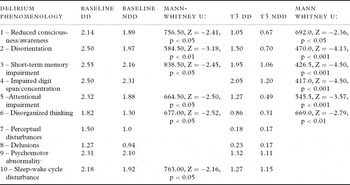
At baseline, DD was characterized by higher MDAS scores in the disturbance of consciousness (2.14 and 1.89, Mann-Whitney U: 756.50, Z = −2.41, p < 0.05), disorientation (2.50 and 1.97, Mann-Whitney U: 584.50, Z = −3.18, p < 0.01), impaired short-term memory (2.55 and 2.16, Mann-Whitney U: 838.50, Z = −2.45, p < 0.05), attentional impairment (2.32 and 1.88, Mann-Whitney U: 664.50, Z = −2.50, p < 0.05), disorganized thinking (1.82 and 1.30, Mann-Whitney U: 677.00, Z = −2.52, p < 0.05) and sleep-wake cycle disturbance (2.18 and 1.92, Mann-Whitney U: 763.00, Z = −2.16, p < 0.05) compared to NDD (see Table 1).
Delirium phenomenology of DD and NDD at baseline (T1) and T3

DD = dementia with delirium; NDD = non-demented with delirium.
Treatment characteristics
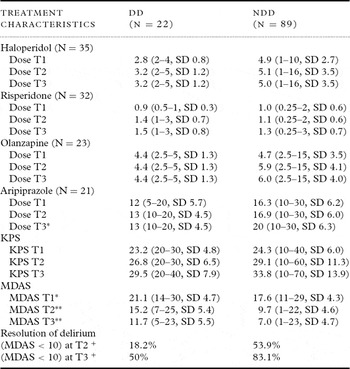
As shown in Table 2, all 22 patients in the DD group and 89 patients in the NDD group were treated with haloperidol, risperidone, olanzapine and aripiprazole. Dosing was not significantly different between DD and NDD with the exception of subjects receiving aripiprazole, where a significant difference at T3 was found (DD 13mg and NDD 20mg, Mann-Whitney U: 15.5, Z = −2.22, p < 0.05). Within both DD and NDD the MDAS scores improved over the treatment course (Friedman: χ2 = 169.61, df(2), p < 0.001), but differences between groups existed at all observation points. The MDAS scores were significantly higher in DD compared to NDD at T2 and T3. At T2 the MDAS score was 15.2 in DD compared to 9.7 in NDD (Mann-Whitney U: 414.50, Z = −4.20, p < 0.001), and at T3 the MDAS scores were 11.7 and 7.0 (DD/NDD, Mann-Whitney U: 447.5, Z = −3.95, p < 0.001). The delirium resolution rates were also significantly lower in DD compared to NDD. At T2 the DD cohort reached a delirium resolution rate of 18.2% compared to 53.9% in the NDD cohort (χ2 = 10.81, df(1), p < 0.01), and at T3 delirium resolution differed with 50% and 83.1% respectively (DD/NDD: χ2 = 9.05, df(1), p < 0.01). At T3 there were significant differences in disturbance of consciousness (1.05 and 0.67, Mann-Whitney U: 692.0, Z = −2.36, p < 0.05), disorientation (1.50 and 0.70, Mann-Whitney U: 470.0, Z = −4.13, p < 0.001), short-term memory impairment (1.95 and 1.06, Mann-Whitney U: 426.5, Z = −4.50, p < 0.001), impaired concentration (2.05 and 1.20, Mann-Whitney U: 417.0, Z = −4.50, p < 0.001), attentional impairment (1.27 and 0.49, Mann-Whitney U: 545.5, Z = −3.57, p < 0.001) and disorganized thinking (0.86 and 0.31, Mann-Whitney U: 669.0, Z = −2.79, p < 0.01).
Treatment characteristics

*Mann-Whitney U: p<0.05; ** Mann-Whitney U: p < 0.01; + Fisher's exact: p < 0.01.
DD = dementia with delirium; NDD = non-demented with delirium; KPS = Karnofsky Scale of Performance Status; MDAS = Memorial Delirium Assessment Scale; T1 = baseline; T2 = 2–3 days; T3 = 4–7 days.
KPS scores improved in both DD and NDD over the course of treatment (Friedman: χ2 = 17.54, df(2), p < 0.001 and χ2 = 76.56, df(2), p < 0.001) and there were no significant differences in KPS scores between groups at any observation point.
Discussion
We were able to demonstrate a difference in treatment characteristics in terms of lower delirium resolution rates in DD patients compared to NDD patients. Levkoff and colleagues identified advanced age and cognitive impairment as an increased incident risk in the community and were able to show continuing delirium at three and six months after hospital discharge. They concluded that delirium may be a common disorder in the course of hospitalization and much less transient than expected (Levkoff et al., Reference Levkoff1992). Kiely et al. (Reference Kiely, Jones, Bergmann, Murphy, Orav and Marcantonio2006) also reported delirium symptoms lasting longer than six months and were able to find an association between length of persistence of delirium symptoms and functional recovery. The persistence of delirium symptoms for less than two weeks was associated with excellent functional recovery (Kiely et al., Reference Kiely, Jones, Bergmann, Murphy, Orav and Marcantonio2006).
We found different treatment characteristics in DD in contrast to NDD. The delirium resolution rates were more than 30% lower at 72 hours and at one week for DD patients. Such patients had delirium resolution rates of 18.2% and 50% at T2 and T3 compared to 53.9% and 83% in NDD patients. After one week of management of delirium, the delirium response rates were lower than at 48–72 hours in patients without dementia. Moreover, we were able to show that at one week patients with delirium and dementia showed an increased level of disturbance in consciousness, disorientation and impairment in the cognitive domain. In particular, the increased disturbance of consciousness and attentional impairment indicate an ongoing delirium in this population, while the disorientation and cognitive impairment could be caused in part by the premorbid cognitive deficits. It has been well established that delirium in the elderly, including the elderly with cognitive deficits, may be prolonged, with residual symptoms lasting as long as 12 months (Levkoff et al., Reference Levkoff1992; Reference Levkoff1994; Rockwood, Reference Rockwood1993; McCusker et al., Reference McCusker, Cole, Dendukuri, Han and Belzile2003). Thus, the finding that delirium may resolve at a slower rate in patients with prior cognitive deficits may not be surprising in itself. The fact that delirium is associated with poor functional outcome, increased morbidity and mortality (Inouye, Reference Inouye1998) and that the persistence of delirium symptoms for less than two weeks may be associated with excellent functional recovery (Kiely et al., Reference Kiely, Jones, Bergmann, Murphy, Orav and Marcantonio2006) may hint towards the importance of detection and management of delirium superimposed on dementia. The finding that delirium resolution may be prolonged and refractory in DD patients emphasizes the necessity of ongoing management with identification and elimination of etiologies contributing to delirium and psychopharmacological interventions in DD patients and avoiding discouragement of management by slow progress in the delirium resolution.
Several limitations to our data analysis have to be noted. The number of DD subjects was rather small and we did not differentiate between etiologies of dementia owing to the small numbers of patients involved. We were not able to get a baseline assessment of the level of cognitive dysfunction due to the naturalistic design of the data collection and long-lasting persistence of delirium symptoms in this population. We were thus unable to eliminate prior baseline cognitive deficits in our MDAS rating at T3. The observation period was limited to one week. With the emergence of a decreased treatment response over time, a longer observation period would have been preferred. All subjects had cancer diagnoses and the generalizability of results to the non-cancer population remains to be studied. The use of antipsychotics in the management of delirium is not approved by the regulatory agencies, and the use of antipsychotics in the elderly patients with dementia carries a black box warning of increased risk of death (Schneider et al., Reference Schneider, Dagerman and Insel2005; Jeste et al., Reference Jeste2008).
In summary, delirium superimposed on dementia may show lower response rates over the course of one week, and the course of delirium may be prolonged and refractory in patients with delirium superimposed on dementia compared to delirium in the absence of dementia. Improvement at a slower rate in delirium superimposed on dementia should not discourage from continuing with treatment, particularly ongoing reversal of underlying etiologies and the management of delirium with antipsychotic medication.
Conflict of interest
None.
Description of authors' roles
William Breitbart conceptualized the delirium database and supervised the data collection. Steven Passik supervised the data collection and statistical analysis. Soenke Boettger conducted the statistical analysis and wrote the paper.
Acknowledgment
This paper was presented in part at the Annual Meeting of the Academy of Psychosomatic Medicine, Miami, FL, 14–18 November 2008.