


Do de jure policies affect potential migrants’ decisions about whether and where to flee? Intense political debates over immigration policies explicitly assume that migrant behavior is a function of destination policy environments. Moreover, neoclassical economic models posit that migrants gravitate to destinations with favorable policies (Czaika Reference Czaika2009). Correspondingly, recent evidence suggests migrants are attracted to countries that afford rights to employment (Holland, Peters, and Sánchez Reference Holland, Peters and Sánchez2019), free movement (Betts et al. Reference Betts, Bloom, Kaplan and Omata2017), and citizenship (Alarian and Goodman Reference Alarian and Goodman2018; Fitzgerald, Leblang, and Teets Reference Fitzgerald, Leblang and Teets2014), and avoid restrictive policy environments (Hatton Reference Hatton2016; Helbling and Leblang Reference Helbling and Leblang2019). However, existing research explores these dynamics in the context of developed countries with mature immigration policy regimes and effective enforcement mechanisms. To what extent are migration flows in the Global South also a function of destination country policies?
Although developing countries bear the overwhelming burden of hosting the world’s forcibly displaced people (FDP), little is known about the determinants and consequences of their migration policies (Adamson and Tsourapas Reference Adamson and Tsourapas2020).Footnote 1 Prevailing neglect in the literature owes to a strong presumption that de jure policies are inconsequential in the Global South. This belief is premised on two assumptions. First, it is assumed that developing countries suffer enforcement gaps stemming from resource and accountability deficits, resulting in de facto environments inferior to de jure policies. Second, it is assumed that prospective developing world FDP are unaware of policies in destination countries (Havinga and Böcker Reference Havinga and Böcker1999). If policy knowledge is low, de jure provisions cannot affect migrant decision making.
The first assumption, we argue, ignores genuine incentives developing countries may have to promote migration via integrative policies, especially if they believe that FDP will contribute to the local economy (Betts et al. Reference Betts, Bloom, Kaplan and Omata2017). The second assumption breaks down in the face of growing connections between origin and host countries (Bacishoga, Hooper, and Johnston Reference Bacishoga, Hooper and Johnston2017), which facilitate the diffusion of knowledge about migration policies in potential destinations (Holland and Peters Reference Holland and Peters2020).
Using an original dataset, the Developing World Refugee and Asylum Policy database (henceforth DWRAP) (Blair, Grossman, and Weinstein Reference Blair, Grossman and WeinsteinForthcoming), we analyze FDP flows between 92 African, Middle Eastern, and South Asian countries from 2000 to 2017. Estimates from gravity, synthetic control, and interrupted time-series models reveal that de jure asylum policies influence FDP flows in the Global South. Interviews with 100 FDP and 26 humanitarian and government officials corroborate our quantitative findings. Gravitation toward more liberal policy environments is conditional on factors like transnational ethnic kin (TEK), which facilitate the diffusion of information on potential host countries’ asylum and refugee policies. Policies supporting free movement, service provision, and employment are especially attractive.
This research note makes three contributions to the broader literature. First, we offer, to the best of our knowledge, the first macro-level evidence that de jure migration policies affect FDP flows in the developing world. Shifting attention to migration policy making in the Global South is of critical importance because developing countries host a disproportionate share of FDP and their displacement policies are trending toward liberalization (Blair, Grossman, and Weinstein Reference Blair, Grossman and WeinsteinForthcoming). By demonstrating the relevance of policy frameworks to migrant decision making in the Global South, this article extends findings from developed contexts and suggests that de jure policies are not pro forma, as is often assumed. Second, by disaggregating policies, we show that access to free movement, services, and employment rights are most attractive, while unlike in developed countries (Alarian and Goodman Reference Alarian and Goodman2018; Fitzgerlad, Leblang, and Teets Reference Fitzgerald, Leblang and Teets2014), access to citizenship has only a modest effect on flows. Third, our study helps clarify a puzzle for existing analyses of the effects of policies on flows: how migrants accumulate policy knowledge about destinations.Footnote 2 We highlight communications technologies and coethnics as sources of information about de jure policies. Ethnic networks are known to affect migration choice by easing integration (Munshi Reference Munshi2003). We show that part of the effect of such networks on destination choice is indirect, operating by increasing knowledge about host policies.
Forced Displacement Policies and Migrant Decision Making
Canonical models view migrant decision making in terms of a rationalist, utility-maximizing framework (Hanson and McIntosh Reference Hanson and McIntosh2016). According to this view, individuals weigh the costs of leaving versus the prospective benefits of migrating to various destination countries before deciding whether and where to go, subject to uncertainty and budget constraints. Factors driving individuals to leave their home countries, such as civil conflict, are “push” factors, while factors inducing gravitation toward certain destinations, like contiguity and wage differentials, are “pull” factors. We draw on this framework but broaden the scope of many existing models by focusing on de jure policies as a pull factor. Theoretically, we follow Czaika’s (Reference Czaika2009) seminal model, which formalizes the intuition that asylum-seekers are attracted to more liberal policies.Footnote 3
In the context of forced displacement, FDP face severe constraints. The nature of FDP flight—from war and repression—means distance considerations (i.e., costs of travel) weigh paramount in their decisions (Moore and Shellman Reference Moore and Shellman2007). Precisely because most flee acute emergencies, more than three-quarters of all FDP are displaced to contiguous neighboring countries (United Nations High Commissioner for Refugees 2019). Still, among the limited set of proximate host countries FDP might flee to during crises, policies affording more expansive rights should be more attractive. This is because liberal de jure policies enhance migrant assimilation, security, and prosperity. This argument builds on evidence that prospective migrants seek information on destination policy environments (Holland and Peters Reference Holland and Peters2020) and prefer countries where they can access more and better services (Balcilar and Nugent Reference Balcilar and Nugent2019; Hatton Reference Hatton2016).
However, gravitation toward liberal policy environments is conditional, particularly in the Global South, where households have less knowledge about policy environments in other countries (Havinga and Böcker Reference Havinga and Böcker1999). We anticipate that two key factors—access to information communications technologies (ICT) and ethnic networks—facilitate the spread of information about policy environments. Opportunities to learn about host policies are greater in information-dense origins, where ICT penetration enables FDP to research potential host environments (Holland and Peters Reference Holland and Peters2020). Internet and mobile technologies have proven to be particularly important tools (Bacishoga, Hooper, and Johnston Reference Bacishoga, Hooper and Johnston2017). Similarly, ethnic kin play two roles.Footnote 4 First, coethnics in a destination ease integration by helping arriving migrant kin realize de jure rights (Rüegger and Bohnet Reference Rüegger and Bohnet2018). For instance, ethnic networks are vital for finding jobs where employment is allowed (Munshi Reference Munshi2003). Second, coethnics in host countries are a source of policy knowledge. Individuals in destinations can transmit information about de jure laws and de facto conditions to kin in origin countries (Helbling and Leblang Reference Helbling and Leblang2019). This networked policy communication is partly responsible for spurring migrant waves (Holland and Peters Reference Holland and Peters2020).
Data and Empirical Strategy
We test the effect of de jure migration policies on FDP flows using data from DWRAP, an original dataset of all national laws on forced displacement in a sample of 92 African, Middle Eastern, and South Asian countries (Blair, Grossman, and Weinstein Reference Blair, Grossman and WeinsteinForthcoming).Footnote 5 The dataset includes 229 national-level migration laws and represents the most expansive mapping of domestic laws and policies on forced displacement in the developing world. For each law in the data, we code 54 policy provisions, which we aggregate to five policy fields: (1) access—status and entry procedures; (2) services—access to education, aid, and health care; (3) livelihoods—property and employment rights; (4) movement—encampment requirements and identity documents; and (5) participation—citizenship and political rights. We use summary indices to aggregate from policy provisions to a policy score.
In our primary specifications, we estimate Poisson pseudo-maximum likelihood (PPML) gravity models (Silva and Tenreyro Reference Silva and Tenreyro2006). The dependent variable is the directed dyadic arrival rate, calculated as
 $ \frac{\left(\mathrm{Asylum}\ \mathrm{Applications}+\mathrm{Prima}\ \mathrm{Facie}\ \mathrm{Arrivals}\right)}{\mathrm{Country}\ \mathrm{of}\ \mathrm{Origin}\ \mathrm{Population}\ \mathrm{in}\;\mathrm{100,000}\mathrm{s}} $
.Footnote
6 By taking the arrival rate, we capture the magnitude and intensity of forced displacement between countries. Comparable rates are used in prominent gravity models of voluntary migration (Hanson and McIntosh Reference Hanson and McIntosh2016). Our main independent variable is the five-year lagged moving average of a destination country’s policy score.Footnote
7
To capture the conditional effects of liberal asylum policies, we interact our policy measure with three distinct variables. We evaluate the effect of host policy liberality conditional on origin ICT access by interacting our policy score with Dreher’s (Reference Dreher2006) index of information openness, which aggregates data on press freedom, Internet bandwidth, and television and Internet subscriptions.Footnote 8 To capture the influence of ethnic networks, we interact our policy index with measures of the presence and number of transnational ethnic kin (TEK) linkages between origin-destination dyads. Data on TEK are drawn from the Ethnic Power Relations dataset (Vogt et al. Reference Vogt, Bormann, Rüegger, Cederman, Hunziker and Girardin2015) and reflect politically relevant ethnic groups split between countries. These measures proxy for the social connections between migrants at origin and destination populations. We cannot directly observe dyadic ethnic networks between FDP and hosts, but TEK linkages increase the probability of shared ties ceteris paribus (Rüegger and Bohnet Reference Rüegger and Bohnet2018).
Our gravity model of forced displacement takes the following form:
 $$ \begin{array}{c}{Y}_{o,a,t}=\mathit{\exp}({\alpha}_o+{\beta}_a+{\gamma}_t+\delta \left(\mathrm{Polic}{\mathrm{y}}_{a,t-1,5}\times \mathrm{Facilitator}{\mathrm{s}}_{o,a,t-1}\right)\\ {}\hskip-26pt + \unicode{x03BB} \left({G}_{s,t}\right)+\phi \left({X}_{o,t-1}\right)+\mu \left({Z}_{a,t-1}\right)+{\varepsilon}_{s,t}),\end{array} $$
where
 $ {Y}_{o,a,t} $
is the arrival rate of FDP from country of origin o to country of asylum a in year t and
 $ \delta $
captures the interactive effect of policies and facilitators, such as information openness and transnational kin, which are key to realizing the benefits of liberal policy provisions.
 $ {G}_{s,t} $
is a vector of controls (e.g., distance) for origin-destination dyad s,
 $ {X}_{o,t-1} $
is a vector of lagged covariates specific to origin o,
 $ {Z}_{a,t-1} $
is a vector of lagged covariates specific to country of asylum a,
 $ {\alpha}_o $
are origin fixed effects,
 $ {\beta}_a $
are destination fixed effects,
 $ {\gamma}_t $
are year fixed effects, and
 $ {\varepsilon}_{s,t} $
is the error term.Footnote
9 We cluster standard errors by dyad. Our quantitative results are bolstered by qualitative evidence from 126 interviews with FDP and other stakeholders on forced displacement in Uganda in summer 2017.Footnote
10
Results
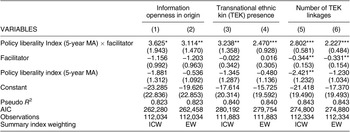
Table 1 reports results from our core gravity models.Footnote 11 Across all models, we observe a large, significant positive effect of displacement policy liberality on FDP flows, conditional on the key facilitating factors. Results suggest that liberal de jure displacement policies attract FDP when information about policies in prospective destination countries is more readily accessible (due to information openness at origin) and when coethnic networks are available, which, we argue, facilitate both information diffusion and integration.
Displacement Policy Liberality, Policy Facilitators, and FDP Flows

Note: Robust, dyad-clustered standard errors are in parentheses. In each column, the header denotes the respective facilitator variable. The models include origin and destination fixed effects, year fixed effects, and controls for region, intercapital distance, contiguity, shared language, bilateral stock of nonforced migrants, GDP/capita ratio and its squared term, population, unemployment, civil war occurrence, and repression at origin and destination. The policy summary indices are constructed using inverse covariance weighting (ICW) or equal weighting (EW). ***p
 $ < $
0.01, **p
 $ < $
0.05, *p
 $ < $
0.10.
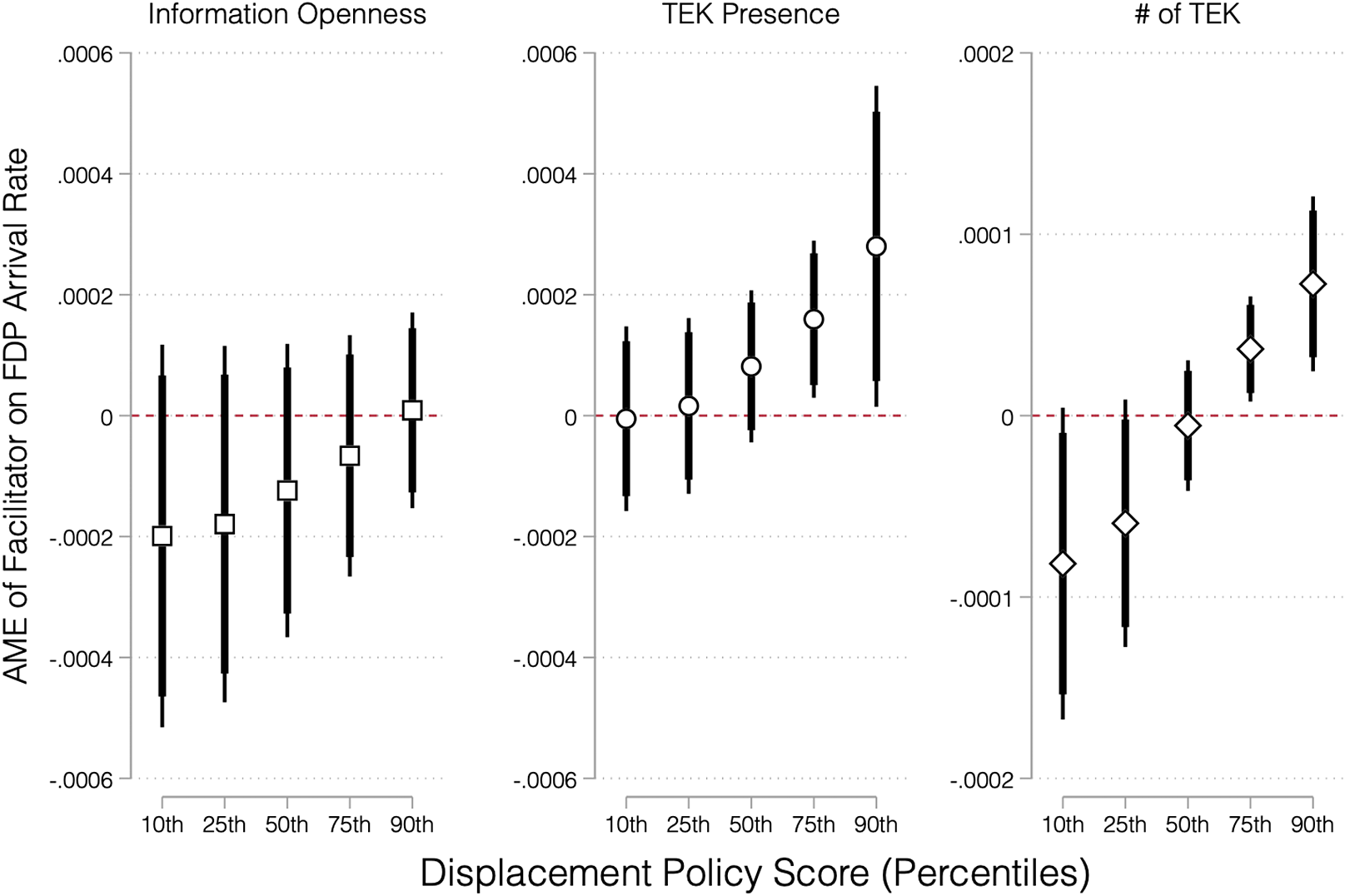
Figure 1 highlights the substantive magnitude of these effects. We find striking evidence that TEK linkages influence how migration flows respond to the policy environment. In the most illiberal asylum policy environments, the presence of TEK has no effect on FDP inflows, and increasing the number of TEK linkages significantly reduces flows. In contrast, TEK attract more FDP as displacement policies become more liberal. In dyads linked by TEK, increasing destination policy liberality from its 10th to 90th percentile increases the arrival rate by 61% on average. The magnitude of this effect is twice as large as the effect of civil war at origin and is comparable to reducing dyadic intercapital distance by about 1.1 standard deviations. The heterogeneous effect of TEK on flows across policy environments is consistent with the idea that information about policies diffuses via kin networks. The effects depicted in Figure 1 strongly suggest that TEK warn about policy restrictiveness and alert FDP to favorable conditions and liberal environments in potential destinations.
The Conditional Effect of Displacement Policy Liberality on FDP Flows
Note: The plots shows the average marginal effect (AME) of the respective facilitator at different levels of displacement policy liberality. The left panel shows the effects of information openness at origin, the middle panel shows the effect of the presence of TEK in a dyad, and the right panel shows the effects of an additional TEK group in a dyad. Estimates correspond to columns 1, 3, and 5 of Table 1. Thick and thin bars are 90% and 95% confidence intervals. The dashed line marks 0. Moving from the 10th percentile to the 90th percentile of the policy index is equivalent to a 2.44-SD increase in policy liberality.

We do not find strong substantive evidence that information openness at origin facilitates gravitation toward more liberal policy environments. Although the effect is in the expected direction, it is small and imprecisely estimated. While these results do not accord with recent evidence highlighting the essential role of communications technology in bolstering migrant awareness of host policies (Bacishoga, Hooper, and Johnston Reference Bacishoga, Hooper and Johnston2017), we are limited by the annual, cross-national nature of our data. For instance, though Holland and Peters (Reference Holland and Peters2020) show Syrian refugees use the Internet to search for information on European asylum policies, search spikes occur in narrow intervals around policy announcements. We are unable to identify short-lived, localized shocks using our data.
Disaggregating Policy Domains
Does the conditional positive effect of displacement policy liberality on FDP flows vary across policy provisions? Existing research points to employment rights (Holland, Peters, and Sánchez Reference Holland, Peters and Sánchez2019), welfare access (Hatton Reference Hatton2016), and citizenship (Alarian and Goodman Reference Alarian and Goodman2018; Fitzgerald, Leblang, and Teets Reference Fitzgerald, Leblang and Teets2014) as particularly attractive. To explore variation across policy domains, we repeat our core specifications from Table 1, substituting the full policy index for constituent subindices capturing access, services, livelihoods, movement, and participation. All effects are positively signed, but the largest and most robust associations emerge between the movement, access, services, and livelihoods indices and FDP flows.Footnote 12 Liberal asylum policies related to free movement and identity documents (movement); welfare, education, and health care access (services); and employment and property rights (livelihoods) are critical for migrants’ integration prospects and economic opportunities in host countries (Betts et al. Reference Betts, Bloom, Kaplan and Omata2017; Hatton Reference Hatton2016). Thus, the disproportionate pull of liberal policies on movement, services, and livelihoods aligns with the neoclassical view of migrants’ decision making calculus as utility maximizing (Hanson and McIntosh Reference Hanson and McIntosh2016). More specifically, gravitation toward liberal welfare and employment provisions comports with recent evidence that migrants are drawn to destinations with right-to-work policies and social safety nets (Holland, Peters, and Sánchez Reference Holland, Peters and Sánchez2019). As in the Global North (Hatton Reference Hatton2016), we also find that FDP gravitate toward host countries where it is easier to gain recognition and reunify with migrant family members (access).
In developed countries, permanent residency and citizenship provisions draw migrants (Alarian and Goodman Reference Alarian and Goodman2018; Fitzgerald, Leblang, and Teets Reference Fitzgerald, Leblang and Teets2014). We find weak evidence of this dynamic in the Global South. That citizenship and political rights like voting (participation) only weakly influence refugees’ decisions about where to flee in the developing world has an intuitive explanation. South-South FDP typically want to return to their home countries or resettle in Western countries, not reside permanently in asylum countries in the region (Ghosn et al. Reference Ghosn, Chu, Simon, Braithwaite, Frith and Jandali2021; United Nations High Commissioner for Refugees 2019). As a result, considerations about permanent political membership in a host country are less salient.
Robustness
We conduct a host of additional tests to probe the robustness of these results. Our core finding—conditional gravitation toward liberal policies—holds with (a) alternative three- and five-year lags on the policy index (Tables A.10 and A.11), (b) a lower-limit Tobit estimator (Table A.12), and (c) and an alternative dependent variable that extends the analysis period back to 1992 (Table A.13). Evidence from alternative research designs and qualitative interviews supports a causal interpretation of the results.
Generalized Synthetic Control Method
Our primary analyses use gravity models to study FDP flows between country dyads. Gravity models are a well-known approach for estimating migrant flows (Hanson and McIntosh Reference Hanson and McIntosh2016), but they require strong identification assumptions. In particular, our PPML estimations (1) assume no unobserved, time-varying confounders and (2) estimate a single effect of policy liberality rather than an effect allowed to vary across countries. As an alternative, we estimate generalized synthetic control models (Xu Reference Xu2017).Footnote 13
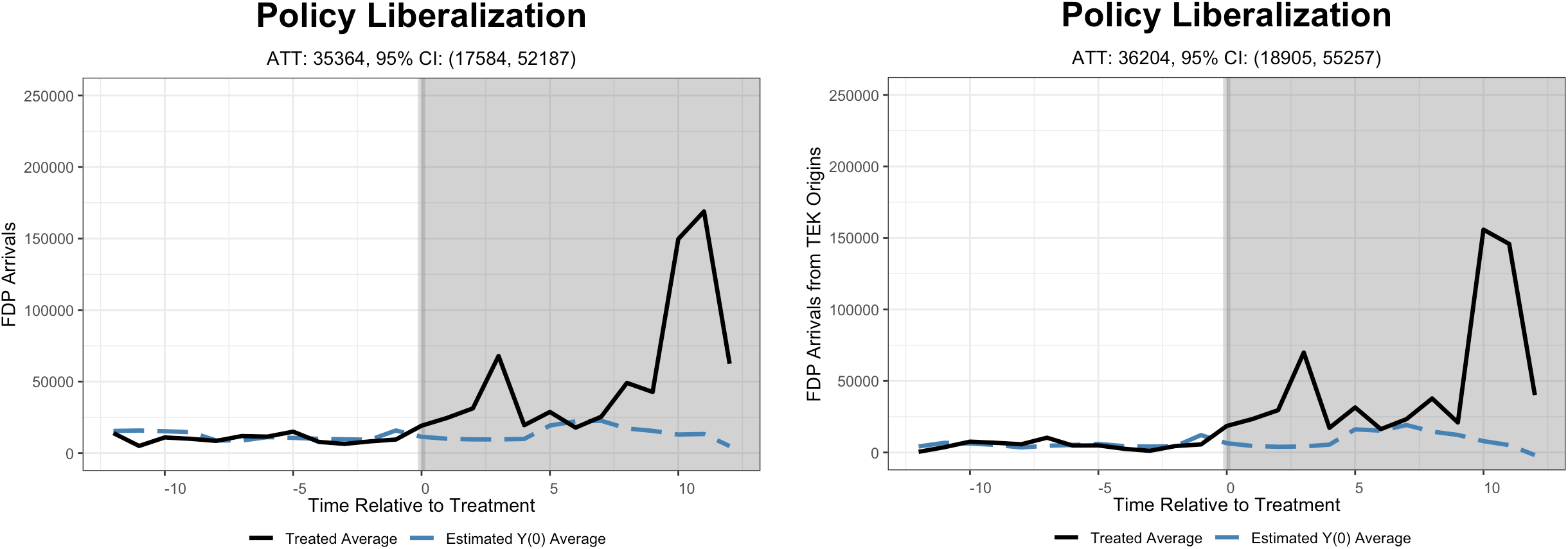
In this framework, we fit a predictive model of flows to a destination country and compare the observed effect of displacement policy liberalization on flows to counterfactual flows absent liberalization. We define treatment as policy liberalization such that a country’s score is in the top quartile of all policy scores. As reflected in Figure 2, policy liberalization is associated with a large, statistically significant increase in total FDP arrivals (ATT: 35,364, 95% CI: 17,584-52,187) and FDP arrivals from TEK-linked origins (ATT: 36,204, 95% CI: 18,905-55,257). The increase in flows peaks between 9 and 14 years after liberalization. Preliberalization trends between treated and control units are parallel, assuaging concerns that liberalization is endogenous to prior flows. Results from a related approach, the panel event study, are substantively similar.
Synthetic Control Estimates of the Effect of Displacement Policy Liberalization
Note: The plots depict observed FDP arrivals (solid line) versus imputed FDP arrivals in the absence of policy liberalization (dashed line). The left plot displays the results for all FDP arrivals, and the right plot displays the results for FDP arrivals from origins linked by TEK. The shaded region indicates the posttreatment period.

Interrupted Time-Series Analysis
The preceding results reveal that liberal policies on forced displacement attract FDP on average. But which specific reforms drive this effect? To probe heterogeneity in the effect of policy changes, we estimate a series of interrupted time-series regressions. Following Blair, Grossman, and Weinstein (Reference Blair, Grossman and WeinsteinForthcoming), we define treatment as reform such that a country’s score changes by at least one standard deviation.Footnote 14 These shifts represent large, substantive reforms to national policy frameworks rather than minor procedural modifications to existing laws. We observe 71 such reforms since 1951 (62 liberalizing, 9 restrictive), with 23 since 2000 (17 liberalizing, 5 restrictive).
Taking the time-series of FDP flows, we compare changes in the level and slope around policy reforms. For each reform we compare the treated country with similar untreated countries, which serve as a counterfactual. The effect of an intervention is the difference between pre- and posttreatment means and slopes in treated versus control countries. Results are depicted in Figure A.18 and A.19. Large liberalizing reforms in Ethiopia in 2004 (p = 0.001), Kenya in 2006 (p < 0.001), Uganda in 2006 (p < 0.001), and Sudan in 2014 (p < 0.001) increased FDP arrivals. Similarly, restrictive reforms in Kazakhstan in 2004 (p = 0.092) and Kenya in 2007 (p = 0.005) reduced flows.
Qualitative Evidence from Uganda
Uganda hosts a large FDP population—the fourth-largest in the world in terms of total stock and the seventh-largest on a per capita basis—and undertook substantial policy liberalization in 2006. Interrupted time-series estimates reveal that Uganda’s policy reform increased annual FDP arrivals by approximately 40,200 (95% CI: 36,200–44,200). To understand this crucial case, we conducted interviews and focus group discussions with FDP and policy makers in Kampala, Mbarara, and Nakivale, Uganda, in summer 2017. Qualitative insights from conversations with 100 FDP and 26 officials corroborate our quantitative results.
In particular, our interviewees confirmed both that liberal policies are attractive and that coethnics serve as a vector for diffusion of policy information. Interviews are described in greater detail in section A.20, but we offer select quotes here to illustrate the main findings. First, many interviewees reported that Uganda was regionally well known for its liberal policy environment and that policy provisions, especially for employment and free movement, were attractive. One refugee explained that FDP flee to Uganda
… because of the ongoing policy. When you look at the countries hosting South Sudanese, Uganda is the best. Why? Because Uganda has freedom, and according to the Act, whereby you have the freedom to do anything … start an organization, work. In the work department, it is free of charge to work as long as you have a refugee card. And they look and see that there are many South Sudanese in Uganda. You move also freely, and you can have your business. In Kenya, they cannot allow this.Footnote 15
Other interviewees confirmed Uganda’s relative liberality and indicated that many FDP know de jure conditions are more favorable in Uganda than other nearby countries.Footnote 16 As one humanitarian working on refugee reception explained, “[the policy] has gone quite broad now I would say. Many [forcibly displaced] people know about the policy now.”Footnote 17
FDP we spoke with also cited ethnic networks as a source of information about Uganda’s policy environment. One noted how shared tribal linkages between South Sudan and Uganda helped spread knowledge and eased integration:
The [coethnic] people communicate back home … and the people cultivating go to Uganda. The host communities have the same language. The community members speak the same language, and you feel okay to speak with them.Footnote 18
Somali refugees also described how the Somali diaspora informed prospective migrants about more favorable conditions in Uganda than Kenya.Footnote 19 Likewise, Congolese refugees explained how FDP heard about policy opportunities from Kampala-based leaders of the Congolese community in Uganda.Footnote 20
In total, our conversations with migrants and officials in Uganda corroborate our core quantitative findings. Aspects of Uganda’s policy, such as employment rights and free movement, attracted FDP, who often heard about these provisions from coethnics.
Conclusion
In this letter, we explore the influence of de jure policies on forced displacement in the Global South. We demonstrate the important, direct role that asylum and refugee policies play in potential migrants’ decision making. Moreover, our findings indicate that access to services, free movement, and employment opportunities are particularly important pull factors. Finally, our results suggest that information about de jure policies likely diffuses through two key channels—communications technologies and transnational ethnic kin. These findings underscore the importance of taking policies seriously, including in the Global South, where issues of enforcement are notable. Migrant households weighing decisions about whether to move and where to go weigh a variety of factors, including the legal provisions that govern their rights and privileges in potential host countries.
SUPPLEMENTARY MATERIALS
To view supplementary material for this article, please visit http://doi.org/10.1017/S0003055421000848.
DATA AVAILABILITY STATEMENT
Research documentation and data that support the findings of this study are openly available at the APSR Dataverse: https://doi.org/10.7910/DVN/AYBXMJ.
ACKNOWLEDGMENTS
We thank Sarah Bermeo, Maggie Peters, Jim Fearon, David Leblang, Beth Whitaker, Stephanie Schwartz, Rana Khoury, Beth Wellman, Alex Braithwaite, Mike Kenwick, and participants at the Penn Identity and Conflict Lab, the UNHCR-World Bank Group Joint Data Center on Forced Displacement, and the 2020 Annual Conference of the Southern Political Science Association for helpful comments and advice. Excellent research assistance was provided by Martin Leet, Leila Braganza, Phoebe Quinton, and Sean Lee.
FUNDING STATEMENT
Generous support for this research was provided by the Fels Policy Research Initiative at the University of Pennsylvania and the King Center on Global Development at Stanford University.
CONFLICT OF INTEREST
The authors declare no ethical issues or conflicts of interest in this research.
ETHICAL STANDARDS
The authors declare that the human subjects research in this article was reviewed and approved by the Institutional Review Board at the University of Pennsylvania Protocol (#827614). The authors affirm that this article adheres to the APSA’s Principles and Guidance on Human Subject Research.




Comments
No Comments have been published for this article.