Leuconostoc genus consists of lactic acid bacteria (LAB) present in many environments originating from green vegetation and roots, their natural ecological niches (Mundt, Reference Mundt1970). Their presence in milk and dairy products, due to contamination during milking or manufacturing, is enhanced by their peculiarity of long time survival on material surfaces such as on wood and moulds or in the pasteuriser (Martley & Crow, Reference Martley and Crow1993). The presence of Leuconostoc species in different European raw milk cheeses has been reported, and for this reason these strains could be considered as characterising LAB (Callon et al. Reference Callon, Millet and Montel2004; Abriouel et al. Reference Abriouel, Martín-Platero, Maqueda, Valdivia and Martínez-Bueno2008; Morandi et al. Reference Morandi, Brasca and Lodi2011).
Leuconostoc grows poorly in milk, but it produces compounds such as acetaldehyde, diacetyl and acetoin from lactate and citrate, which contribute to the organoleptic properties of dairy products (Mc Sweeney & Sousa, Reference McSweeney and Sousa2000). Leuconostoc shows other valuable technological properties, such as the synthesis of dextrans from sucrose and the presence of proteolytic, lipolytic and aminopeptidase activities (Vedamuthu, Reference Vedamuthu1994).
Some species of this genus (Leuconostoc mesenteroides and Ln. lactis) with acid-producing lactococci compose the mesophilic starter cultures used in the production of butter, cream, soft and semi-hard cheeses (Edam and Gouda) and blue-veined cheeses, such as Roquefort. In this last, the CO2 produced by Leuconostoc creates an opening that allows the colonisation of the cheese by Penicillium roqueforti (Vedamuthu, Reference Vedamuthu1994; Hemme & Foucaud-Scheunemann, Reference Hemme and Foucaud-Scheunemann2004). Strains belonging to this genus are also components of kefir grains, contributing to the production of ethanol and acetate which are characteristic of this product (Robinson et al. Reference Robinson, Tamime, Wszolek and Robinson2002). Apart from its technological characteristics Leuconostoc also has the ability to produce bacteriocins active against pathogenic and spoilage bacteria. These bacteriocins (leucocins and mesenterocins) belong to class II and show anti-Listeria and anti-LAB activity. Multiple bacteriocins production has been observed in Ln. mesenteroides TA33a (Papathanasopoulos et al. Reference Papathanasopoulos, Dykes, Revol-Junelles, Delfour, von Holy and Hastings1998; Jasniewski et al. Reference Jasniewski, Cailliez-Grimal, Younsi, Milliere and Revol-Junelles2008), and recently Sawa et al. (Reference Sawa, Okamura, Zendo, Himeno, Nakayama and Sonomoto2010) reported the production of four novel bacteriocins (leucocin A, A-QU15, N and Q) from Ln. paramesenteroides QU15 isolated from rice bran bed.
At present, there is increasing attention being paid to the possibility that LAB could serve as reservoirs for antibiotic resistance determinants, the risk being that there could be gene transfer to many food-borne commensal bacteria and other pathogenic bacteria. It is well-known that Leuconostoc strains have an intrinsic resistance to glycopeptides (vancomycin) but there are few reports concerning other antibiotics (Hemme & Foucaud-Scheunemann, Reference Hemme and Foucaud-Scheunemann2004; Hummel et al. Reference Hummel, Hertel, Holzapfel and Franz2007; Cardamone et al. Reference Cardamone, Quiberoni, Mercanti, Fornasari, Reinheimer and Guglielmotti2011). Moreover, in recent years Leuconostoc has been classified as an opportunistic pathogen, in fact some strains may produce biogenic amines, and can cause bacteraemia, pulmonary infections, peritonitis, endocarditis, abscess and septicaemia (Bover-Cid & Holzapfel, Reference Bover-Cid and Holzapfel1999; Ogier et al. Reference Ogier, Casalta, Farrokh and Saïhi2008).
In the present study 34 Leuconostoc strains collected from different Italian traditional raw milk cheeses, were characterised in order to study their genotypic biodiversity, technological properties, safety aspects and antibiotic susceptibility, as well as the distribution of tetracycline, erytromycin, vancomycin resistance genes, and the ability to produce antibacterial substances.
Materials and methods
Bacterial strains and culture conditions
The study was carried out on a total of 35 strains belonging to different species of Leuconostoc. They comprised 1 type strain (Ln. mesenteroides subsp. mesenteroides DSM#20343T from the Deutsche Sammlung von Mikroorganismen und Zelkulturen, Braunschweig (Germany)); the other 34 were wild strains from the bacterial collection of ISPA-CNR (Milan, Italy). The wild strains were isolated from eleven traditional Lombardy raw milk cheese between 2000 and 2010. Leuconostoc strains consist of 4 Ln. citreum (3 from Formaggella Valle di Scalve and 1 from Formaggella del Luinese), 7 Ln. lactis (3 from Bitto, 1 from Semigrasso d'Alpe, 1 from Silter, 2 from Valtellina Caserca), 18 Ln. mesenteroides (4 from Fatulì, 1 from Formaggella del Luinese, 1 Formai de Mut, 2 from Semuda, 5 from Formaggella Valle di Scalve, 1 from Fomagèla Valseriana and 4 from Valtellina Casera) and 5 Ln. pseudomesenteroides (1 from Bitto, 1 from Formaggella Valle di Scalve and 3 from Fomagèla Valseriana).
Before each experiment the cultures were incubated overnight at 30 °C, in MRS broth (Scharlau Microbiology, Barcelona, Spain). Strains had been previously identified as described by Morandi et al. (Reference Morandi, Brasca and Lodi2011).
DNA extraction
The isolates were grown overnight at 30 °C in 10 ml MRS broth, and DNA was extracted using the Microlysis kit (Labogen, Rho, Italy) following the manufacturer's instructions.
Randomly amplified polymorphic DNA (RAPD) analysis
RAPD-PCR was used to explore the genetic diversity of the Leuconostoc strains. RAPD-PCR reactions were performed with primers M13 (5′-GAGGGTGGCGGTTCT-3′), D11344 (5′-AGTGAATTCGCGGTCAGATGCCA-3′) (Andrighetto et al. Reference Andrighetto, Borney, Barmaz, Stefanon and Lombardi2002) and D8635 (5′-GAGCGGCCAAAGGGAGCAGAC-3′) (Morandi et al. Reference Morandi, Brasca, Andrighetto, Lombardi and Lodi2006). Grouping of the RAPD-PCR profiles was obtained with the BioNumeric 5.1 software package (Applied Maths, Kortrjik, Belgium) using the UPGMA (unweighted pair group method using arithmetic averages) cluster analysis. The reproducibility value of the RAPD-PCR assay, calculated from two repetitions of independent amplification of LAB type strains, was higher than 90%.
Technological characterisation
Growth-temperature, salt tolerance and activity in litmus milk
The strains were tested for their ability to grow at 15, 30, 37 and 45 °C in MRS broth, salt tolerance (growth with 0, 2, 4 and 6·5% of NaCl in MRS broth), and their activity in litmus milk (Harrigan & McCance, Reference Harrigan and McCance1993) were evaluated at 30 °C.
Acidifying and redox activities
A multi-channel pH-Eh-meter (Acidification Monitoring System and Analyser AMSA, Star Ecotronics, Milan, Italy) was used to follow the pH and redox values (Eh) in the milk during 24 h of incubation at 30 °C. Strains were inoculated at a level of 1% in reconstituted sterile non-fat dry milk (10% w/v). The acidification rate and the Eh values were calculated according to Morandi et al. (Reference Morandi, Brasca and Lodi2011) and Brasca et al. (Reference Brasca, Morandi, Lodi and Tamburini2007).
Enzymatic activities
Caseinolytic activity was evaluated according to International Dairy Federation (1997) and lipolytic activity on Tributyrin agar (Oxoid LTD, Basingstoke, Hampshire, UK) according to Morandi et al. (Reference Morandi, Brasca, Andrighetto, Lombardi and Lodi2006).
All tests were performed twice.
Antibiotic resistance
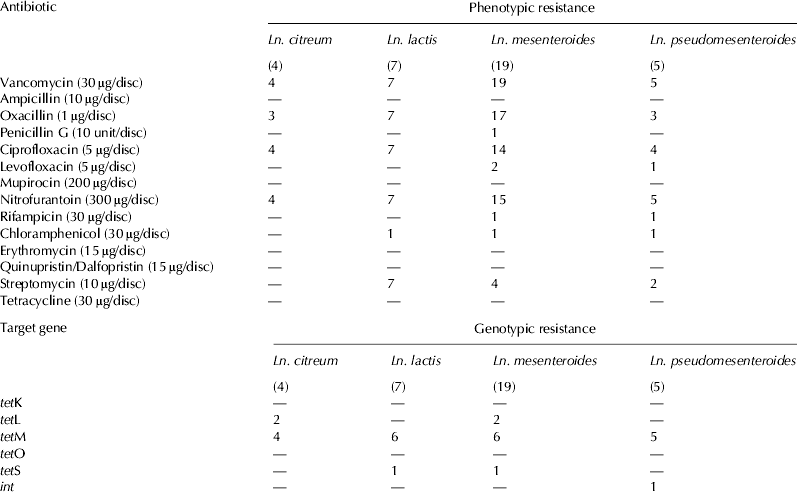
Antimicrobial susceptibility was determined by the standardised agar diffusion test on MRS agar (Scharlau Microbiology) (Morandi et al. Reference Morandi, Silvetti and Brasca2013). All isolates were screened for their susceptibility to 14 antibiotics (Table 3). After incubation each strain was classified as sensitive, intermediate or resistant according to the inhibition zone diameters, in accordance with the breakpoints recommended by the Clinical and Laboratory Standards Institute (2007).
Antibiotic resistance genes
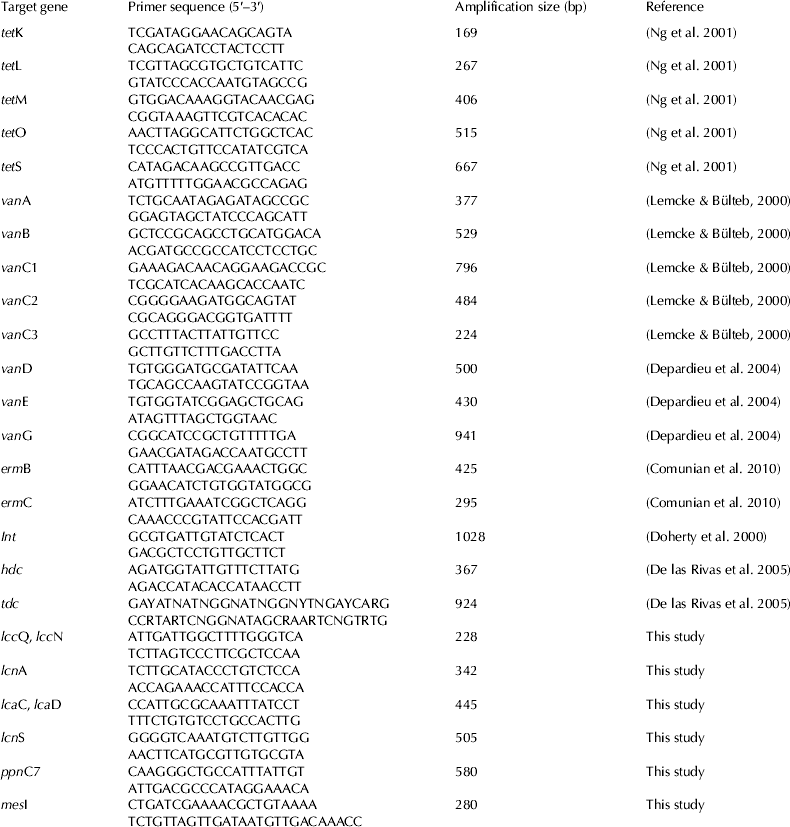
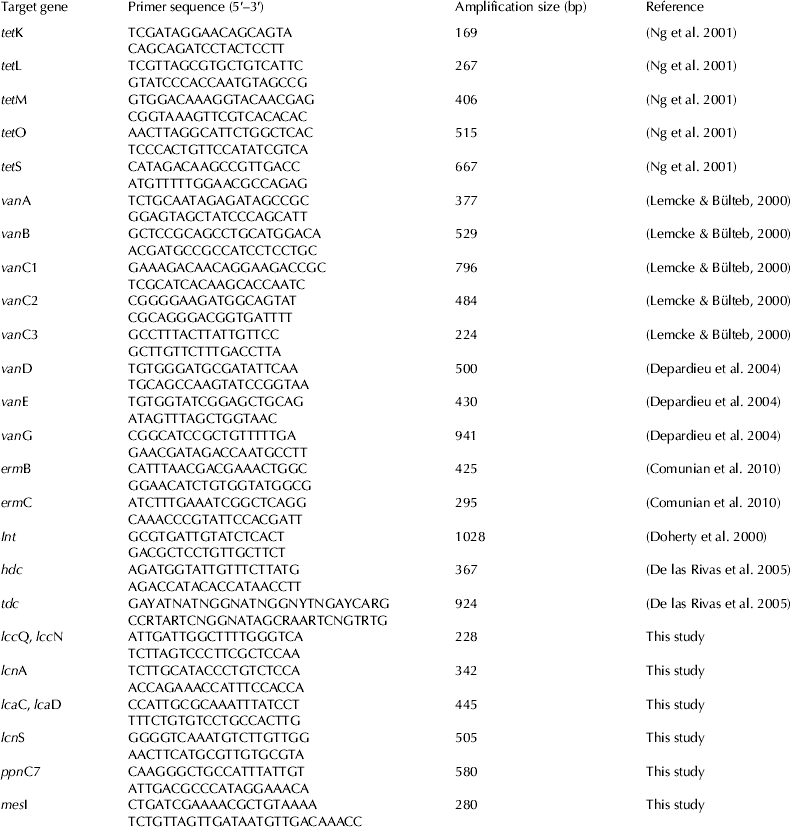
The possible presence of genes responsible for resistance to tetracycline, vancomycin and erythromycin was investigated for all strains by specific PCR assays. PCR reactions were performed with primers and conditions previously described by Ng et al. (Reference Ng, Martin, Alfa and Mulvey2001), Lemcke & Bülteb (Reference Lemcke and Bülteb2000), Depardieu et al. (Reference Depardieu, Perichon and Courvalin2004) and Comunian et al. (Reference Comunian, Daga, Dupré, Paba, Devirgiliis, Piccioni, Perozzi, Zonenschain, Rebecchi, Morelli, De Lorentiis and Giraffa2010) (Table 1). Strains were also tested for the presence of the transposon integrase gene (int gene), of the Tn916/Tn1545 family, according to Doherty et al. (Reference Doherty, Trzcinski, Pickerill, Zawadzki and Dowson2000). The positive controls used were Streptococcus thermophilus VC59 (tetL and tetS), St. thermophilus VC56 (tetM) and Enterococcus faecalis VC49 (int) obtained from the CNR ISPA bacterial collection (Morandi & Brasca, Reference Morandi and Brasca2012). The identity of PCR products was confirmed by sequencing. Sequencing was performed by Primm s.r.l. (Milan, Italy) and the Blastn program (http://www.ncbi.nlm.nih.gov) was used for nucleotide sequence analysis.
PCR primers used for the detection of genes implicated in antibiotic resistance, virulence and antimicrobial activity and bacteriocins in Leuconostoc strains
Antimicrobial activity
Antibacterial activity was evaluated in parallel by standardised agar disc diffusion with extracellular extract of bacterial cells (Campos et al. Reference Campos, Rodríguez, Calo-Mata, Prado and Barros-Velásquez2006) and with overnight cultures. Twenty microlitre of an overnight culture or 20 μl of each extracellular extract of Leuconostoc strains were spotted onto agar.
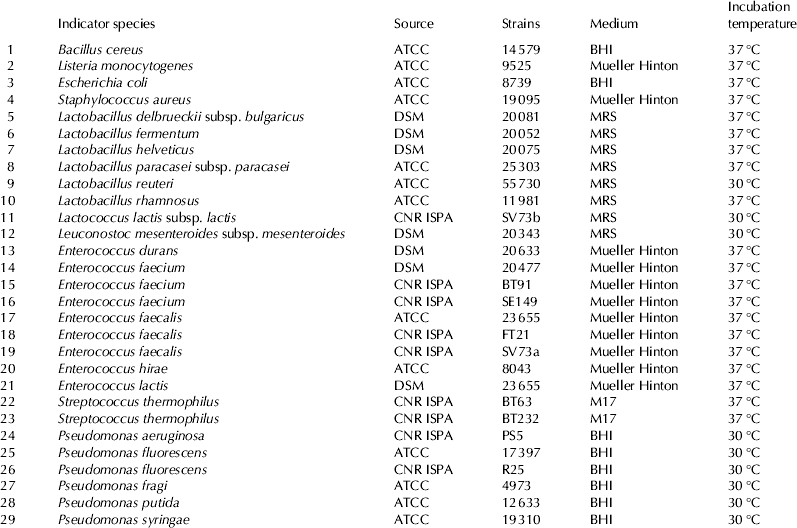
The 29 bacterial strains used as indicator organisms and their culture conditions are listed in Table 2. Before use, the strains were propagated twice in the appropriate broth overnight. Agar plates were seeded with indicator strains at a concentration of 105 CFU/ml, the plates were incubated at the optimal temperature of indicator strains for 24 h, and then the diameter (mm) of the growth inhibition zone was measured.
Indicator organisms used in the antimicrobial activity assay

ATCC: American Type Culture Collection; DSM: Deutche Sammlung von Mikroorganismen und Zell Kulturen; CNR ISPA: Italian National Research Council, Institute of Sciences of Food Production collection
Detection of bacteriocin genes
To check the presence of bacteriocin genes in Leuconostoc strains, specific primers were designed using the Primer3 program (http://frodo.wi.mit.edu/primer3/). The target genes were chosen from the leucocin sequences presently available on the NCBI (http://www.ncbi.nlm.nih.gov/sites/entrez): lccQ, lccN (AB499611) was used for leucocin Q and N; lcnA (AB499610), lcaC, lcaD (L40491), lcnS (AF036713) for leucocin A; ppnC7 (AF420260) for leucocin K; mesI (AY286003) for mesentericin Y105. PCR reactions were carried out in a GeneAmp PCR System 2700 thermal cycler (Applied Biosystems, Foster City, CA, USA) with the following conditions: initial denaturation at 94 °C for 5 min followed by 30 cycles of 94 °C for 1 min, 56 °C for 1 min and 72 °C for 1 min. Final extension was carried out at 72 °C for 5 min. Each DNA amplification was performed in 200 μl microtubes using a 25 μl reaction mixture containing 50–100 ng DNA template, PCR Master Mix 2X (Fermentas, Inc., Burlington, Ontario, Canada), 10 μm of the primer pair and double-distilled water to achieve the final volume. Amplification products were separated on a 1·5% agarose gel (GellyPhor) stained with SYBR Safe (Invitrogen) and photographed. Molecular size markers (100-bp DNA ladder, Euroclone) were included in each agarose gel.
Genotypic assay of amino-acid decarboxylase genes
Genomic DNA was used in the PCR reaction to detect the incidence of genes encoding different amino-acid decarboxylase (histidine decarboxylase (hdc) and tyrosine decarboxylase (tdc)). PCR reactions were performed with primers and conditions previously described by De las Rivas et al. (Reference De las Rivas, Marcobal and Muñoz2005) (Table 1).
Results and discussion
RAPD-PCR analysis
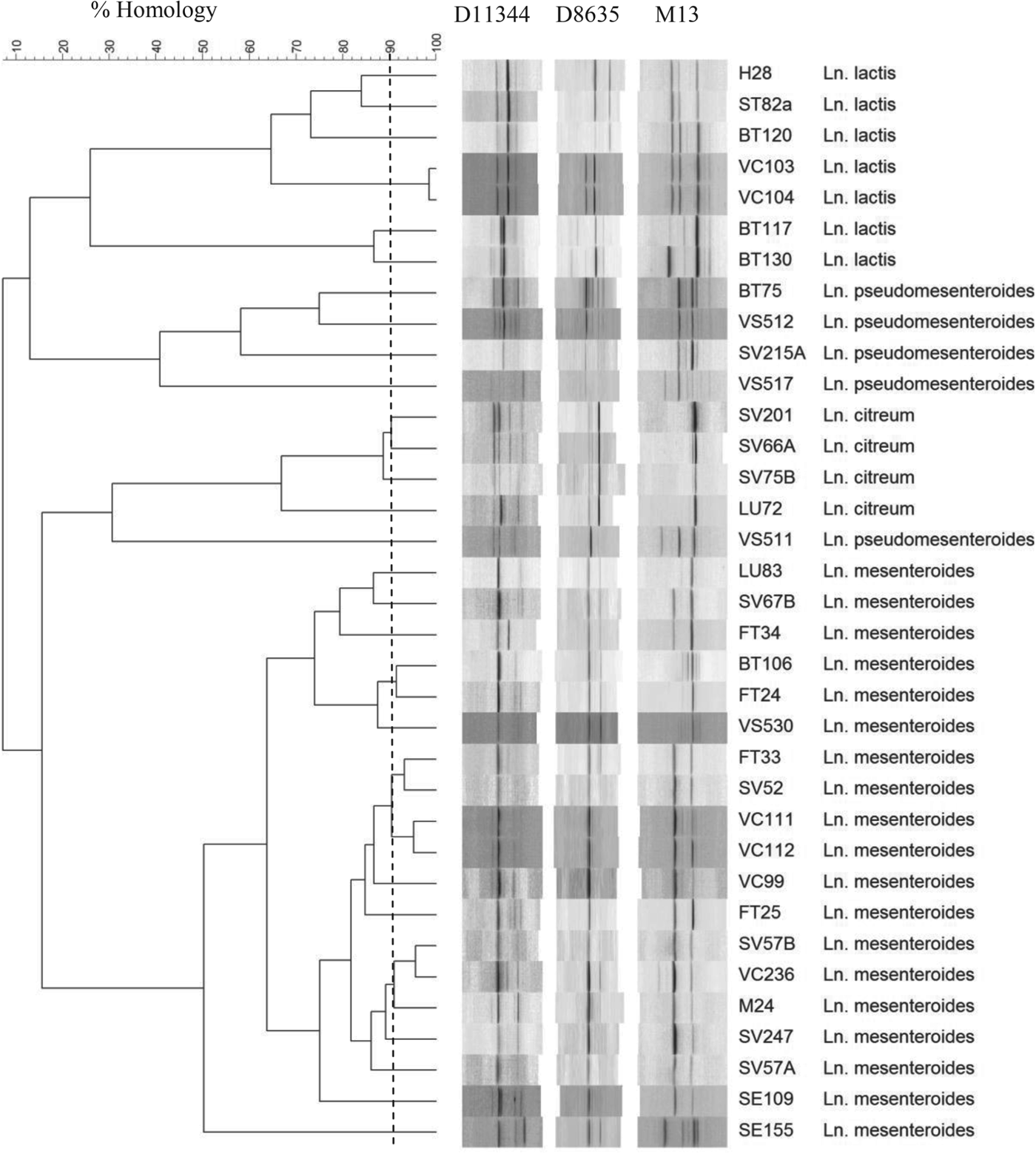
All the isolates considered in this study were characterised by RAPD-PCR analysing amplification profiles obtained with three primers (Fig. 1). Strains with a similarity coefficient equal to or higher than 90% can be considered as being extremely close genotypically, and perhaps even identical. All the strains were grouped according to species except for one Ln. pseudomesenteroides, which did not fall in any cluster. A notable genotypic heterogeneity among Leuconostoc strains was evident, in fact, the coefficients of similarity for each species ranged from 25·9 to 66·8% (Ln. lactis 25·9%, Ln. pseudomesenteroides 40·9%, Ln. mesenteroides 49·5% and Ln. citreum 66·8%). With exception of VC103 – VC104 and VC111 – VC112, strains isolated from the same cheese do not represent multiple copies of the same strains, moreover strains having similar typing profiles come from different cheeses (SV578 – VC236 and FT33 – SV52). In the Ln. mesenteriodes cluster the genetic polymorphism detected allowed the identification of 13 different RAPD genotypes among 19 analysed strains, highlighting a high degree of variability, as previously indicated by Cibik et al. (Reference Cibik, Lepage and Tailliez2000).
Composite data set and unweighted pair group method using arithmetic averages (UPGMA)-based dendrogram derived from the combined RAPD-PCR profiles generated with primers D11344, D8635 and M13 of the 35 Leuconostoc strains collected from different cheeses: BT Bitto cheese, FT Fatulì cheese, LU Formaggella del Luinese cheese, M Formai de Mut cheese, H Semigrasso d'Alpe cheese, SE Semuda cheese, ST Silter cheese, SV Formaggella della Valle di Scalve cheese, VC Valtellina Casera cheese and VS Formagèla Valseriana cheese. Strains named 274 correspond to the DSM 20343T strain.
Technological characterisation
A technological characterisation of the isolates was performed to evaluate the suitability of Leuconostoc for the cheese-making process and its tolerance of the ripening conditions. The level of Leuconostoc present in the 11 raw milk cheeses, evaluated by isolation on MSE agar, was generally between 104 and 109 CFU/g, thus indicating that they should play a role in certain cheese technologies (data not shown).
Growth-temperature, salt tolerance and activity in litmus milk
During cheese manufacture, LAB are exposed to different temperatures and a high salt environment. In accordance with previous studies (Hemme & Foucaud-Scheunemann, Reference Hemme and Foucaud-Scheunemann2004), all Leuconostoc strains grew well from 15 to 30 °C, 33 out of 35 at 37 °C while none multiplied at 45 °C. All the strains were able to grow in the presence of 2 and 4% NaCl and 14 (4 Ln. citreum, 6 Ln. mesenteroides and 4 Ln. pseudomesenteroides) were salt-tolerant, growing with 6·5% NaCl. None of the studied isolates curded litmus milk within 16 h, nor did they change the colour of the indicator from purple to white.
Acidifying and redox activities
With regard to the intensity of acidification, in 6 h, none of the Leuconostoc isolates reduced the milk pH by more than 1·5, and these strains were defined, in accordance with Beresford et al. (Reference Beresford, Fitzsimons, Brennan and Cogan2001), as low acid producers. Considering the final pH obtained after 24 h, the majority of the isolates (86%) resulted to be low acidifying strains causing a pH decrease lower than 1·5 pH units, and only 5 strains (3 Ln. lactis and 2 Ln. mesenteroides) showed medium acidifying activity (1·5<pH<2·0). Our results differ from the data reported by Nieto-Arribas et al. (Reference Nieto-Arribas, Seseña, Poveda, Palop and Cabezas2010), who, from Manchego cheese, isolated Ln. lactis with good acidifying activity and Bendimerad et al. (Reference Bendimerad, Kihal and Berthier2012) who isolated from mare's fermented milk a strain of Ln. mesenteroides possessing high acidifying potential in milk.
The low acidifying activity of Leuconostoc can be explained by the heterofermentative metabolism of this genus that produces lactic acid and CO2 and ethanol or acetate, as reviewed by Cogan & Jordan (Reference Cogan and Jordan1994). For this reason, Server-Busson et al. (Reference Server-Busson, Foucaud and Leveau1999) suggested that Leuconostoc isolates should be combined with acid-producing lactococci when used as starters or starter adjuncts.
The evolution of the redox potential is a characteristic parameter of LAB species. This parameter is important because the redox potential of cheese influences the development of microorganisms, excluding the growth of obligate aerobes such as Pseudomonas, Brevibacterium, Bacillus and Micrococcus spp. in the cheese interior (Brasca et al. Reference Brasca, Morandi, Lodi and Tamburini2007). After 24 h fermentation sixty-nine per cent (24 out of 35) of the isolates were low reducing isolates (Eh>−2 mV), while 31% of strains (1 Ln. citreum, 1 Ln. lactis strains, 8 Ln. mesenteroides and 1 Ln. pseudomesenteroides) showed medium reducing activity (−102 mV<Eh<−2 mV) and none highly reducing isolate (Eh<−102 mV) was detected. The reduction activity of strains increased constantly up to 17 h incubation, when all the isolates reached the Eh minimum value, the exception being 3 strains (1 Ln. lactis and 2 Ln. mesenteroides) that reached the Eh minimum after 7–13 h (data not shown). At the present time no data are available on the reduction activity of Leuconostoc strains, and this study represents a first description of this parameter for this group of bacteria.
Enzymatic activities
Proteolytic activity seems to be essential for LAB growth in milk and, in addition, it is involved in the development of some organoleptic characteristics in different fermented milk products. Low casein breakdown ability (<0·13 mg tyrosine·5 ml−1 milk) was detected in the 35 Leuconostoc isolates. The proteolytic activity values were similar to those reported by other authors for Leuconostoc isolates (Garabal et al. Reference Garabal, Rodriguez-Alonso and Centeno2008; Nieto-Arribas et al. Reference Nieto-Arribas, Seseña, Poveda, Palop and Cabezas2010). None of the Leuconostoc showed lipolytic activity on Tributyrin agar, in agreement with other authors (Nieto-Arribas et al. Reference Nieto-Arribas, Seseña, Poveda, Palop and Cabezas2010). Low lipolytic activity is considered to be an important advantage as just the slight breaking of the milk fat is enough to induce aroma production without giving the cheese a rancid flavour (Herrero et al. Reference Herrero, Mayo, González and Suárez1996).
Antibiotic resistance
While food-associated fermentative bacteria, whether antimicrobial-resistant or not (with the possible exception of enterococci), do not present a clinical problem, they might act as a reservoir for transmissible antimicrobial resistance determinants (EFSA, 2008). Leuconostoc strains were tested for antibiotic resistance using the standardised agar diffusion method.
The analysed antibiotics include (1) inhibitors of cell-wall synthesis such as glycopeptides: (vancomycin) and β-lactams (ampicillin, oxacillin and penicillin G); (2) inhibitors of bacterial synthesis on the 30S ribosomal subunit such as tetracyclines (tetracycline) and aminoglycosides (streptomycin); (3) inhibitors of the bacterial synthesis on the 50 ribosomal subunit were chloramphenicol, macrolides (erythromycin) and streptogramins (quinupristin/dalfopristin); (4) inhibitors of the bacterial nucleic acid synthesis such as quinolones (ciprofloxacin and levofloxacin), rifamicines (rifampicin), nitrofurans (nitrofurantonin) and mupirocin.
Different studies have shown that LAB isolated from food appear to be quite sensitive to penicillin and cephalosporins (Herrero et al. Reference Herrero, Mayo, González and Suárez1996; Flórez et al. Reference Flórez, Delgado and Mayo2005) and more resistant to oxacillin (Ammor et al. Reference Ammor, Flórez and Mayo2007). These observations were confirmed in the present study as all the Leuconostoc tested were susceptible to β-lactams (ampicillin and penicillin G), but a high resistance to oxacillin was observed in 31 out of 35 strains (89%) (Table 3). Resistance to β-lactam antimicrobials may occur by a number of mechanisms, including production of β-lactamase (penicillinase), which hydrolyses the antibiotic agent; however, cell-wall impermeability appears to be the main mechanism of resistance in LAB species (Ammor et al. Reference Ammor, Flórez and Mayo2007). With regard to glycopeptides, all the strains were resistant to all vancomycin. The resistance of Leuconostoc to vancomycin is a general intrinsic feature and is linked to the presence of a pentadepsipeptide with a C terminal d-lactate instead of a d-alanine in the peptidoglycan (Hemme & Foucaud-Scheunemann, Reference Hemme and Foucaud-Scheunemann2004). Considering streptomycin-resistance, different behaviour was observed: all Ln. citreum were susceptible while all Ln. lactis strains were streptomycin resistant; 100% of the isolates were susceptible to tetracycline. Leuconostoc may have a natural resistance to the aminoglycosides, but low rates of resistance were observed in this study. Similar results were obtained by Rodríguez-Alonso et al. (Reference Rodríguez-Alonso, Fernández-Otero, Centeno and Garabal2009) for Leuconostoc isolated from Galician raw milk cheeses and by Cardamone et al. (Reference Cardamone, Quiberoni, Mercanti, Fornasari, Reinheimer and Guglielmotti2011). None of the studied isolates (except for 3 strains) were classified as resistant to chloramphenicol, erythromycin, tetracycline, quinupristin/dalfopristin.
Antibiotic resistance in Leuconostoc strains and presence of tetracycline resistance genes
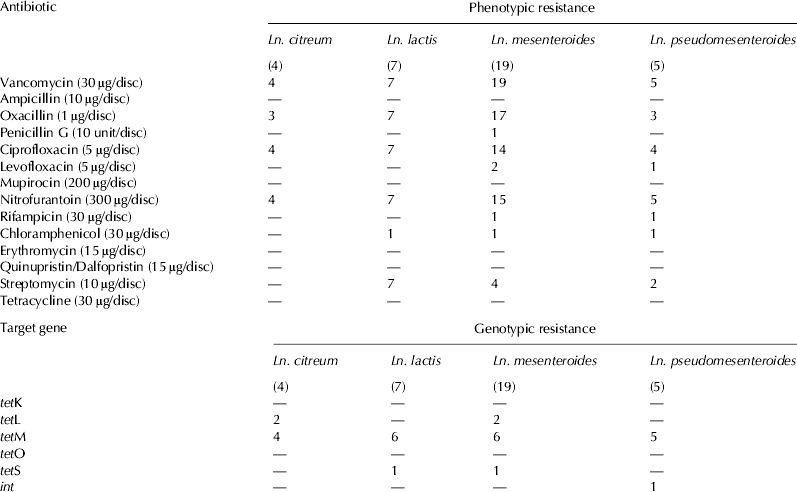
Considering the inhibitors of bacterial nucleic acid synthesis, different levels of resistance were detected; high resistance was observed for ciprofloxacin (83%) and nitrofurantonis (89%), while the Leuconostoc tested were highly susceptible to levofloxicin, mupirocin and rimfapicin.
All isolates displayed resistance to at least two antibiotics. Thirteen strains (36%) were resistant to vancomycin, oxacillin, ciprofloxacin and nitrofurantoin, whereas 30·5% were resistant towards 5–6 antibiotics. Two isolates (Ln. pseudomesenteroides VS517 and Ln. mesenteroides displayed resistance to more than 6 of the antibiotics tested. The strain VS517, isolated from Formagèla Valseriana, was resistant to 7 antibiotics (ciprofloxacin, oxacillin streptomycin, vancomycin, chloramphenicol, nitrofurantoin and rifampicin) while Ln. mesenteroides VC236, isolated from Valtellina Casera, showed resistance to 8 antibiotics (ciprofloxacin, levofloxacin, oxacillin, penicillin G, streptomycin, vancomycin, nitrofurantoin and rifampicin).
Antibiotic resistance genes
Determination of the genetic background to phenotypic resistance was achieved using PCR for the presence of different genes most commonly involved in resistance to erythromycin, vancomycin and tetracycline.
Intrinsic vanC and vanD resistance is present in enterococcal species Ent. gallinarum, Ent. casseliflavus and Ent. flavescens, and the vanC operon is chromosomally located and is not transferable, moreover both vanA and vanB genes are present on the chromosome but can also be carried on a plasmid (Pootoolal et al. Reference Pootoolal, Neu and Wright2002; Fisher & Phillips, Reference Fisher and Phillips2009). All the Leuconostoc strains were vancomycin resistant, but vanA resistance genes are absent, the cell wall structure providing intrinsic resistance to glycopeptides (Klein, Reference Klein2011) as vanB, vanC1, vanC2, vanC3, vanD, vanE and vanG genes. This finding bolsters the idea that the glycopeptides resistance of the Leuconostoc strains is mediated by a mechanism that is different from that associated with the enterococci. Moreover the exclusion of transferable vanA genes allows the safe usage of strains in food production.
No PCR signals were detected for ermB and ermC genes. Even though no tetracycline resistant strains were observed, there are several cases in which tetracycline resistance genes have been detected. Moreover it is interesting to note that the presence of tet determinants was observed in 25 tetracycline-susceptible isolates (71%) (Table 3). The most frequent gene was tetM (22 strains) followed by tetL and tetS (n. 2). In 2 Ln. citreum tetL and tetM were found in combination. No PCR signals for tetK and tetO were detected. At the present time no data are available on the spread of tet genes in Leuconostoc strains isolated from dairy products. A substantial presence of silent antibiotic resistance genes was observed also by Hummel et al. (Reference Hummel, Hertel, Holzapfel and Franz2007) who detected the presence of the chloramphenicol acetyltransferase gene (cat genes) in 15 of 46 LAB strains that phenotypically were not resistant to chloramphenicol. The tetracycline determinants detected in tetracycline sensitive Leuconostc seemed to be unusual. To the best of our knowledge, tetracycline resistance, and the associated tetS determinant in Leuconostoc spp., has only been identified in three other studies in which the tetS element was found in Leuconostoc spp. tetracycline-resistant isolates from raw milk, from raw pork meat and from an Irish beef abattoir (Gevers et al. Reference Gevers, Masco, Baert, Huys, Debevere and Swings2003; Wang et al. Reference Wang, Manuzon, Lehman, Wan, Luo and Wittum2006; Toomey et al. Reference Toomey, Bolton and Fanning2010). The VS512 strain belonging to the Ln. pseudomesenteroides species was positive for the presence of the transposon integrase gene (int gene) of the Tn916/Tn1545 family (NCBI accession number; FR671416.1). To date this is the first time the conjugative transposon Tn916 has been detected inside the Leuconostoc species. The VS512 strain isolated from Formagèla Valseriana cheese carried both the int and the tetM genes. TetM has been frequently associated with Tn916, a highly infective transposon that has contributed to the spread of tetracycline resistance among Gram-positive and Gram-negative bacteria (Rice, Reference Rice1998). The presence of tetM associated with the Tn916 gene has already been documented in some LAB isolated from dairy products, such as Ln. lactis (Flórez et al. Reference Flórez, Ammor and Mayo2008) and Ent. faecalis (Huys et al. Reference Huys, D'Haene, Collard and Swings2004).
Considering that in recent years Leuconostoc has been classified as an opportunistic pathogen (Hemme & Foucaud-Scheunemann, Reference Hemme and Foucaud-Scheunemann2004), the evaluation of the presence of the transposon integrase gene in wild food-transforming bacteria represents an important feature.
Antimicrobial activity
The inhibitory spectrum of Leuconostoc strains against a wide range of microorganisms was evaluated by agar disc diffusion method. Considering the results obtained with the co-culture of the Leuconostoc with the indicator strains we observed that all isolates showed a high antimicrobial activity (inhibition halos ranging within 13–27 mm) against enterococci species (Ent. durans, Ent. faecium, Ent. faecalis Ent. hirae and Ent. lactis) and 4 isolates (2 Ln. lactis, 2 Ln. mesenteroides) gave a zone of growth inhibition when Staph. aureus was used as an indicator organism. Moreover few Leuconostoc were found to display antimicrobial activity against LAB such as Lactobacillus. fementum (1 Ln. lactis, 1 Ln. pseudomesenteroides), Lb. helveticus (2 Ln. mesenteroides and 1 Ln. pseudomesenteroides), Lb. paracasei subsp. paracasei (1 Ln. pseudomesenteroides), Lb. reuteri (1 Ln. pseudomesenteroides) and Str. thermophilus (3 Ln. lactis, 1 Ln. pseudomesenteroides). Considering the growth inhibition of Gram (−), some strains showed a moderate antibacterial effect (halo<13 mm) towards Ps. aeruginosa (4 Ln lactis, 2 Ln. mesenteroides and 1 Ln. pseudomesenteroides), Ps. fluorescens (5 Ln lactis, 9 Ln. mesenteroides and 1 Ln. pseudomesenteroides) and Ps. fragi (2 Ln lactis and 2 Ln. mesenteroides); on the other hand, all isolates exhibited antimicrobial activity against Ps. syringae. No inhibitory spectrum was detected against List. monocytogenes, B. cereus, Escherchia coli, Ps. putida and the other LAB studied.
Different results were obtained with the cell-free supernatant; all the Leuconstoc strains exerted inhibitory effect on Ent. faecalis and Ent. faecium supporting the hypothesis that the mechanism of inhibition has to be attributed to bacteriocins. No inhibition was observed against the other indicator strains.
At the present time there are few reports of an antimicrobial action of Leuconostoc. The mechanism of inhibition has been attributed to the degradation products of carbohydrate and citrate metabolism. Lactic and acetic acids produced during fermentation by LAB affect the integrity of cell membranes, compromising cell viability and leading in many cases to their lysis. Matamoros et al. (Reference Matamoros, Pilet, Gigout, Prevost and Leroi2009) attributed the Leuconostoc inhibitory activity against enterococci to bacteriocin-like substances.
Detection of bacteriocin genes
All the strains were tested for the presence of anti-listerial bacteriocin genes. In accordance with phenotypic data, the strains appeared to be free of their respective bacteriocin determinants: no PCR signals were detected for leucocin A, K, N, Q and mesentericin Y105 genes.
Differently three Ln. mesenteroides strains, isolated from Fatulì cheese, showed a lack of correlation between the presence of bacteriocin genes and their anti-Listeria activity; in particular, the strain FT34 was positive for lcnS and lcnA genes, FT33 showed the presence of mesI and lcnA genes, and FT24 harboured the gene mesI. This finding may be explained by the presence of silent bacteriocin genes in Ln. mesenteroides isolates. Similar observations were reported by Poeta et al. (Reference Poeta, Costa, Rojo-Bezares, Zarazaga, Klibi, Rodrigues and Torres2007) for enterococci isolated from faecal samples of wild animals.
Amino-acid decarboxylase genes
No amplification occurred for histidine decarboxylase (hdc) and tyrosine decarboxylase (tdc) in agreement with Bover-Cid & Holzapfel (Reference Bover-Cid and Holzapfel1999) and Nieto-Arribas et al. (Reference Nieto-Arribas, Seseña, Poveda, Palop and Cabezas2010), who reported that Leuconostoc spp. showed no decarboxylase activity.
Conclusion
Traditional raw milk cheeses are colonised by a complex microbiota where different biotype properties are present. Adventitious Leuconostoc strains were susceptible to clinically important antibiotics such as ampicillin and penicillin, showing interesting antibacterial properties but not harbouring some of the virulence genes assayed. The present study provides new evidence concerning the resistance of Leuconostoc to antimicrobial agents, and reports one strain, Ln. pseudomesenteroides, that harbours the tetM gene and Tn916 transposon.
Initially studied mainly in the clinical setting for their involvement in antibiotic resistance, the role of transposons in the environment is now an increasing focus of attention, since their uncontrolled dissemination in the environment could represent a risk for human health.
Results from this study allow us to conclude that Leuconostoc strains isolated from traditional Italian cheeses could be selected to be included as adjunct starter cultures since they fulfil customary cheesemaking requirements such as salt-tolerance and medium acidifying and reducing activity. Although their role in cheese is not clearly defined, other functions could be assumed in shelf-life extension through the inhibition of undesirable bacteria. The results obtained open the way to the in-vivo evaluation of the strains in cheese production.
This study was partly performed within the research project ‘Accordo Quadro CNR-Regione Lombardia’ supported by the Regione Lombardia.