Most Organization for Economic Co-operation and Development (OECD) countries have changed their reimbursement systems during the past 30 years away from per diem toward diagnosis-related group (DRG)–based payment. Surgical site infections (SSIs) are well known to increase the hospital length of stay. Reference Badia, Casey, Petrosillo, Hudson, Mitchell and Crosby1–Reference Kirkland, Briggs, Trivette, Wilkinson and Sexton3 Although higher costs due to complications and prolonged length of stay used to be reimbursed proportionally with per diem payments, DRGs reimburse average cost based on a combination of procedure and diagnosis codes irrespective of the individual cost of a given case. With this change, in theory, hospitals were incentivized to reduce costs by preventing complications and decreasing length of stay. Reference Rosenthal4
However, in most DRG systems (eg, Swiss DRG or US Medicare) postadmission diagnoses and additional procedures, such as long-term ventilation or revision surgery, increase case weight and therefore reimbursement. Reference Eappen, Lane and Rosenberg5 These adverse incentives led (first in the United States) to the idea of “pay for performance,” Reference Rosenthal4,Reference Barie6,Reference Figueroa, Wang and Jha7 in which certain preventable complications, such as pressure ulcers or never-events like wrong-side surgery, were no longer reimbursed. To date, this does not include SSI, which is a frequent surgical complication Reference Lewis, Moehring, Chen, Sexton and Anderson8,Reference Mangram, Horan, Pearson, Silver and Jarvis9 that increases morbidity, mortality, Reference Coello, Charlett, Wilson, Ward, Pearson and Borriello2,Reference Kirkland, Briggs, Trivette, Wilkinson and Sexton3 hospital stay, and costs. Reference Badia, Casey, Petrosillo, Hudson, Mitchell and Crosby1,Reference Vegas, Jodra and Garcia10–Reference Broex, van Asselt, Bruggeman and van Tiel13 Nevertheless, SSI does not necessarily translate into financial losses for hospitals if reimbursement compensates for this. Hospitals may be confronted with trade-offs when considering the implementation of potentially costly quality improvement programs to reduce the SSI rate. Reference Dimick, Pronovost, Cowan and Lipsett14
In this prospective observational study, we aimed to assess the impact of SSI on contribution margin in 2 large tertiary-care referral centers in Switzerland under the conditions of a DRG-based reimbursement system. To increase overall generalizability, the findings were validated by a simulation in which the costs and income of the Swiss study patients were simulated as if they were treated in the National Health Service (NHS) England reimbursement system. The primary research question was whether the occurrence of SSI changed the contribution margins compared to patients without SSI.
Methods
Setting
This observational study was a secondary analysis of a multicenter randomized controlled trial (RCT) designed to evaluate the optimal timing of surgical antimicrobial prophylaxis (SAP) in a general, orthopedic trauma, and the vascular surgery population. Reference Weber, Mujagic and Zwahlen15 The current study question was defined a priori, and prespecified data were prospectively collected between February 22, 2013, and July 31, 2015, at the University Hospital of Basel and the Cantonal Hospital of Aarau, 2 tertiary-care referral centers in Switzerland.
The study was approved by the local ethics committees, and informed consent was obtained from all patients. The study was registered on clinicaltrials.gov under the identifier NCT01790529.
Patients
The study protocol of the underlying RCT has been published. Reference Mujagic, Zwimpfer and Marti16 Briefly, all inpatients aged 18 years or older undergoing general, orthopedic trauma, and vascular procedures with an indication for surgical antimicrobial prophylaxis according to clinical standards were included. These standards were based on Centers for Disease Control and Prevention (CDC) definitions for surgical wound classification and guidelines for SSI prevention. Reference Mangram, Horan, Pearson, Silver and Jarvis9 Exclusion criteria were outpatient surgery, contraindication for cefuroxime and/or metronidazole, preexisting antibiotic therapy within 14 days prior to surgery, cognitive impairment, combined operations including other than the surgical subspecialties specified above, emergency procedures with planned incision within 2 hours after indicating the procedure, as well as the unavailability of hospital cost and income data for the case.
SSI detection
Occurrences of superficial, deep or organ-space SSIs within 30 days of the index procedure, as defined by the CDC, are reported here. SSI detection was performed by ward residents, ward physicians and operating surgeons, and members of the study team during daily ward rounds. Postdischarge follow-up at 30 days after surgery was performed by trained nurses at each study site via telephone. When the telephone interview suggested possible SSI, we contacted the treating general practitioners for further information. A board-certified infectious diseases specialist validated all diagnoses of SSI. In cases of detection of multidrug-resistant bacteria in the performed wound swabs, patients were treated according to the hospital protocol. Multidrug-resistant bacteria included methicillin-resistant Staphyloccocus aureus (MRSA), extended spectrum β-lactamase–producing bacteria (ESBL), and others.
Cost and income
Data were derived from the hospital accounting agencies of the 2 contributing institutions. Costs were based on a full cost accounting, including direct costs as assigned in the accounting system for nursing and physician’s treatment, drugs, implants, etc, as well as indirect costs for the usage of infrastructure (eg, operating rooms, intensive care units [ICUs], etc), depreciation of these and other overhead costs. Income was based on the entire reimbursement that was paid by insurers (∼42%), taxpayers, like cantons and municipalities (∼56%), and patients (2%). For example, in Switzerland patients have to pay a percentage of their healthcare bills themselves (so-called franchise or deductible). Contribution margin was calculated and defined as the difference of all variable and fixed cost and all income before the discount of tax and interest. A positive contribution margin represents a financial gain for the hospital, and a negative contribution margin represents a financial loss. Results are reported in Swiss francs (CHF). The average exchange rate to euro and $ during the study period were 1.068114 CHF per euro and 0.962560 CHF per US dollar, respectively. 17
The simulation of cost and income (respective tariffs) in the English system was based on individual case data from the patients of the Swiss study cohort, which were used to derive cost and income for a virtual identical patient in the NHS England reimbursement system: English cost assignment used healthcare resource group (HRG) codes from inpatient International Classification of Disease, Tenth Revision (ICD-10) diagnoses, Office of Population Censuses and Surveys Classification of Surgical Operations and Procedures, Fourth Revision (OPCS4) procedure codes (translated by the study team from Swiss procedure codes), length of stay, level of care, and comorbidities. The group software of the UK Department of Health was used to derive HRG codes. Unit costs were assigned to HRG-coded activity using the NHS reference costs (2016/2017 version) for costs, and the payment by results tariff (2016/2017 version) for income.
The simulated contribution margins are reported in US dollars based on average exchange rates (pounds Sterling per dollar, £/$) during the study period and are adjusted for buying power since prices and wages in Switzerland compared to England were, on average, 1.42 times higher. 18
Predictors
The following variables were considered potential confounders: age, body mass index, mode of admission, American Society of Anesthesiologists (ASA) score, wound class, department in which the surgery took place, surgery duration (hours), occurrence of ICU admission, and insurance class. Compulsory insurance was defined as the obligatory Swiss health insurance cover without free choice of doctor, semiprivate insurance included additional cover for free choice of doctor, and private insurance included free choice of doctor and additional single-room accommodation.
Statistical analysis
We used R version 3.5.1 software (R Core Team Reference Team19 ) for the analysis of the Swiss study cohort and JMP Pro version 13.1.0 software (SAS Institute, Cary, NC) for the analysis of the NHS England simulation data. Descriptive statistics were used for baseline variables and distribution of cost, income, and contribution margin. Quantile regression was used to investigate the impact of SSI on the 10th, 50th (median), and 90th percentiles of the contribution margin distribution. Reference Koenker20
A multivariable model was fitted. Because variables occurring only in SSI patients (multidrug-resistant strains and revision surgery, defined as any surgical reintervention in the OR in SSI cases, can lead to singularities in model fitting, we did not include these variables in the main model. However, we examined their effect in a sensitivity analysis. We report variable estimates and 95% confidence intervals, calculated using the inverted rank. Standard errors were estimated via bootstrapping to obtain P values. The tables show expected contribution margin for patients without SSI; the estimate for SSI indicates the change in the expected contribution margin in the event of SSI.
Results
In total, 5,175 patients were analyzed in the underlying RCT; cost and income data were available for all but 44 patients. Of the remaining patients, 575 patients were lost to follow-up after several attempts to contact them after hospital discharge, and their SSI status was unknown. These patients represented 11% of the initial study population, with an equal distribution in both arms of the underlying RCT and without any patterns according to SSI or non-SSI status. More detailed information on patient distribution is available in the publication of the underlying RCT. Reference Weber, Mujagic and Zwahlen15 Thus, 4556 patients were available for the primary analysis. The baseline characteristics of the analyzed complete cohort (n = 4,556) are available in Supplementary Table 1 online.
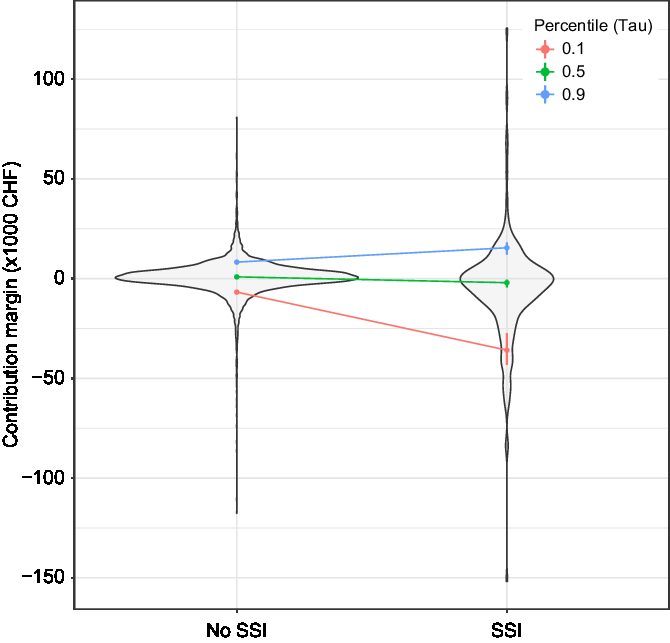
Separate examination of costs and income showed both higher costs and higher incomes in cases of SSI. The differences between SSI and non-SSI cases exhibited an overall negative median contribution margin for SSI cases (CHF, −2,045; IQR, −12,800 to 4,848) versus non-SSI cases (CHF, 895; IQR, −2,190 to 4,158). As shown in Figure 1, the distribution of the contribution margin was much wider in SSI cases, with more extreme values, including the cases with the highest contribution margin as well as the greatest deficits.
Probability distribution of contribution margin in patients with or without SSI. Dots and lines represent the relevant estimated percentile and its estimated 95% confidence interval. The distribution of contribution margin is wider with more extreme values in SSI cases.
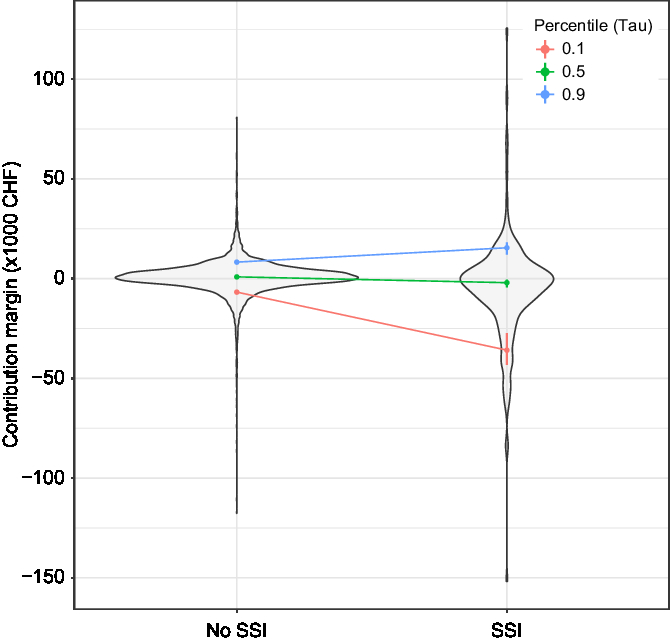
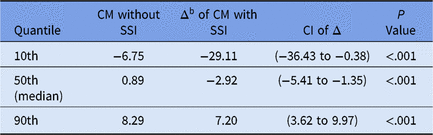
The association of contribution margin with SSI was analyzed with quantile regression analysis (Table 1 and Figure 2). The 10th, 50th (median), and 90th percentiles showed more extreme values in SSI cases. In the 10th percentile, negative contribution margin was significantly greater for patients with SSI, whereas in the 90th percentile (the strong benefit cases), negative contribution margin again higher in SSI cases.
Quantile Regression of the Predicted Contribution Margin (CM) on Surgical Site Infection (SSI) Status for the 10th, 50th (Median), and 90th Quantilesa

Note. CI, confidence interval; CHF, Swiss francs.
a Estimates in 1,000 CHF.
b Δ is the predicted difference of the CM in SSI cases reported at 3 quantiles of the distribution of the CM.
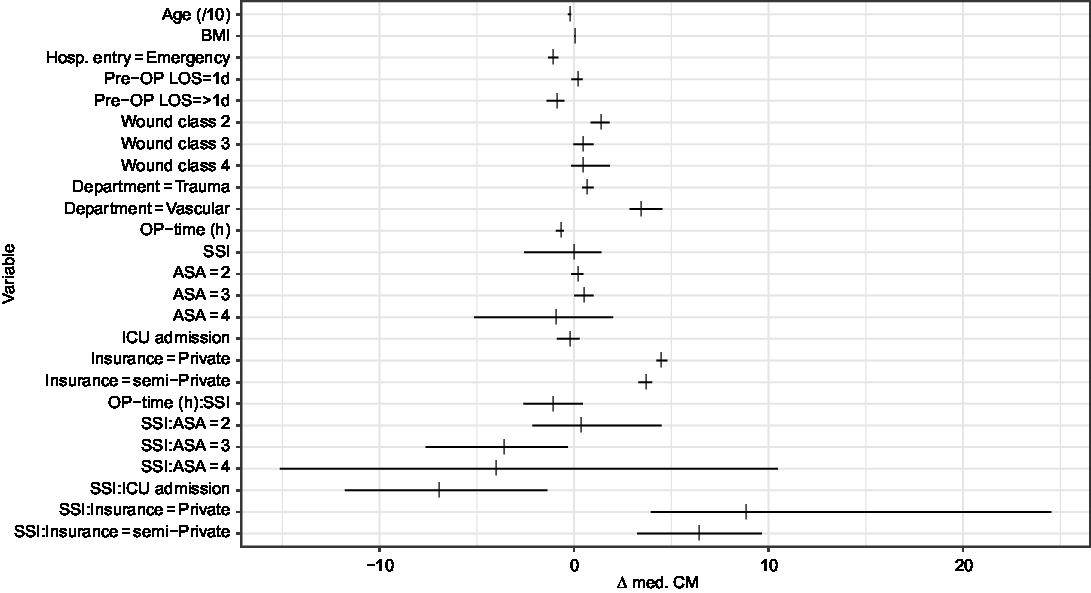
Multiple regressions for the effects of confounders and SSI status on the median contribution margin (median CM) (×1,000 CHF). Bars represent 95% confidence intervals. Note. SSI, surgical site infection; CHF, Swiss francs; BMI, body mass index; LOS, length of stay; ASA, American Society of Anesthesiologists score; OP, operation; ICU, intensive care unit.
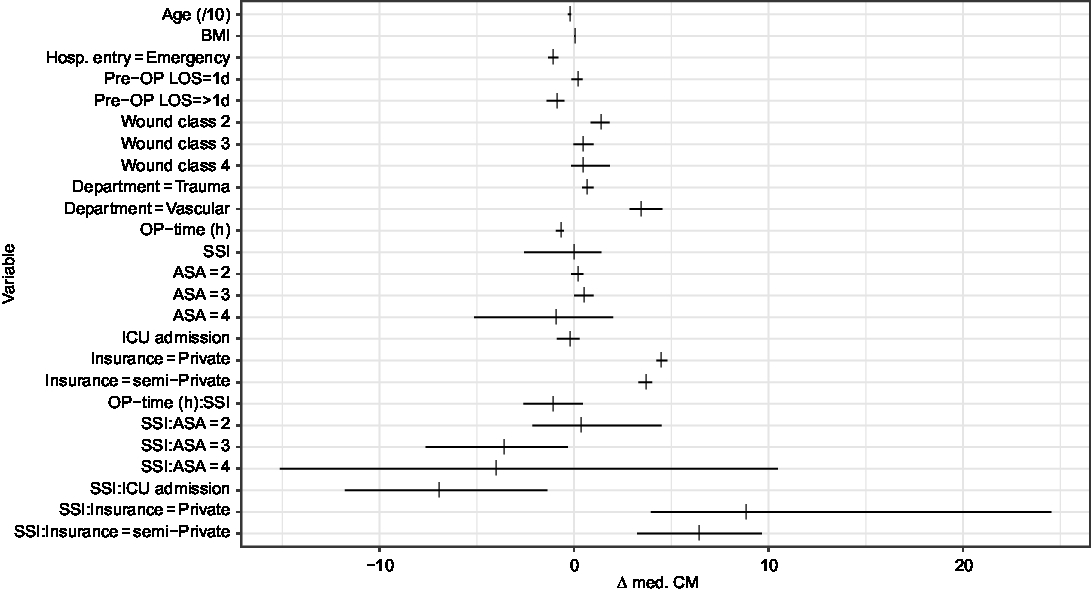
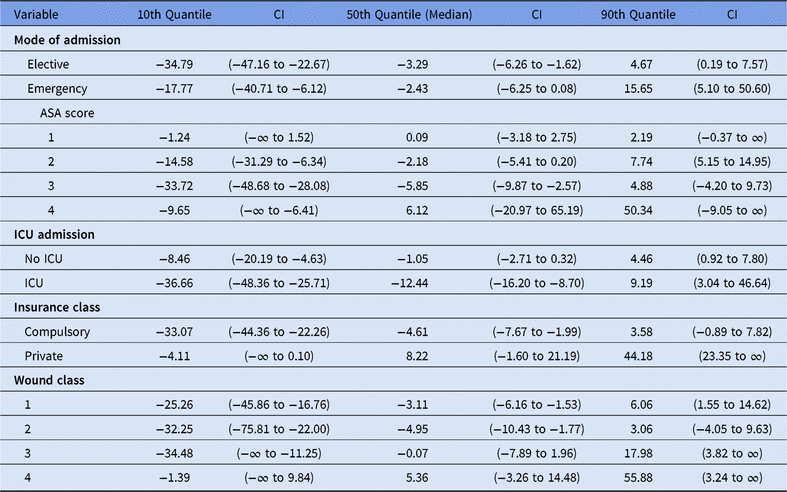
The effect of confounding factors changed in relation to the examined quantiles, respectively (Table 2). Emergency admission was associated with higher contribution margin in the 90th percentile in SSI cases, and SSI turned the median contribution margin in cases of emergency admission into a deficit case. Private insurance showed significantly higher contribution margins in SSI cases at the 50th and 90th percentiles, whereas compulsory insurance was associated with the greatest losses at the 10th percentile.
Summary of the Influence of a Selection of Potential Categorical Confounders on the Difference in Contribution Margin (×1,000 CHF) with SSI for the 10th, 50th (Median), and 90th Quantiles of the Distribution of the Contribution Margin

Note. CHF, Swiss francs; CI, confidence interval; ASA, American Society of Anesthesiologists; SSI, surgical site infection; ICU, intensive care unit.
Considering duration of surgery as a continuous variable, longer operations were associated with lower contribution margin at the 10th and 50th percentiles in SSI cases, whereas longer operations led to even higher contribution margins in the 90th percentile (Supplementary Table 2 online). Revision surgery and multidrug-resistant bacteria were analyzed separately because they can only occur in the context of SSI. These confounders (in small numbers) had the most extreme effects on the contribution margin. Although multidrug-resistant bacteria led to deficits in all percentiles, revision surgery did so for the 10th and 50th percentiles, and it increased benefits in the 90th percentile (Supplementary Table 3 online).
Multivariable analysis
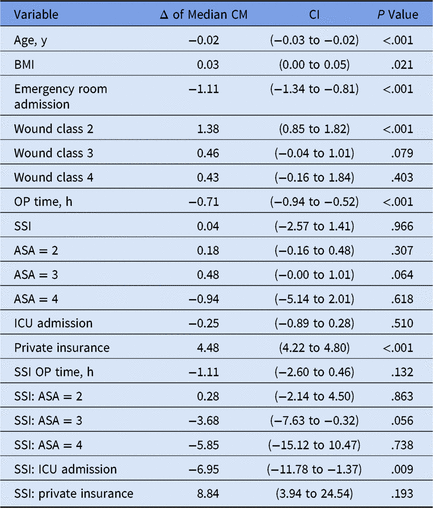
The multivariable analysis of hospital contribution margin was performed for the 10th, 50th, and 90th percentiles. Table 3 shows the influence of different confounders on median hospital contribution margin. The effect of SSI itself was small, but SSI in combination with other confounders had a strong effect. Higher ASA score, ICU admission, and longer operations led to strong median deficits, whereas private insurance increased contribution margins in SSI cases. The SSI-specific confounders (ie, multidrug-resistant bacteria and revision surgery) were excluded, but an analysis including these factors is displayed in Supplementary Table 4 online.
Summary of the Multiple Regressions for the Effects of Various Confounders and SSI Status on the Median Contribution Margin (CM) (×1,000 CHF), Excluding Variables Only Relevant for Patients With SSI

Note. SSI, surgical site infection; BMI, body mass index; ASA, American Society of Anesthesiologists; OP, operation; ICU, intensive care unit.
At the 10th and 90th percentiles, the aforementioned effects were more extreme (Supplementary Table 5A and B online). Length of stay was not included as a possible confounder due to its strong collinearity with cost and income (Supplementary Figure 2 online).
Simulating costs and income in an English setting
Concerning the simulation of cost and income within the NHS England reimbursement system, 3,893 patients had complete data sets that included SSI status and simulated cost and income data for both healthcare systems. Of the initial 4,556 patients, 663 had to be excluded due to incompatible coding or unavailable comparable codes within the NHS England system in relation to the Swiss codes.
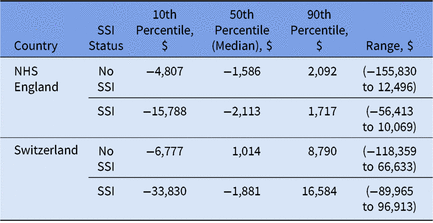
The simulated cohort showed a high correlation of cost with tariff, which confirmed internal validity of the simulation (Supplementary Figure 3 online). The effect of SSI on the 10th, 50th, and 90th percentiles of the simulated contribution margin in the available cases is shown in Table 4. A negative but less pronounced effect on contribution margin in relation to SSI was observed within the simulated cohort. SSI showed smaller losses in the 10th percentile, whereas gains were reduced in the 90th percentile compared with the Swiss data. In a multivariable model, ICU admission, occurrence of SSI, and higher ASA score significantly increased losses in the simulated NHS dataset (Supplementary Figure 4 online).
The 10th, 50th (Median), and 90th Percentiles of the Distribution of the Contribution Margin in US Dollars Within the NHS England Simulation and the Swiss Cohort (n = 3,893)

Note. NHS, National Health Service; SSI, surgical site infection. The values are calculated in $ based on the average exchange rate of pounds Sterling to dollars during the study period and are adjusted for buying power since prices and wages in Switzerland compared to England are on average 1.42 times higher (https://ec.europa.eu/eurostat/web/purchasing-power-parities/data/main-tables).
The comparison between Swiss contribution margin and the simulated NHS contribution margin was restricted to 2,933 patients with only compulsory insurance. This comparison revealed an estimated median higher contribution margin (US$1,808; IQR, US$−2,131 to 5,892) in SSI cases, whereas a marked more negative deficit (US$−1,432; IQR US$−11,783 to 8,383) resulted in SSI cases in the Swiss cohort. In a multivariable model controlling for the aforementioned confounders in this subgroup of patients, SSI cases led to higher deficits ICU admission, and higher ASA score led to higher contribution margins in the Swiss data compared to the NHS simulation (Supplementary Figure 5 online). Age, gender, and body mass index had only a minor or no influence on differences between both reimbursement systems.
Discussion
The occurrence of SSI led to decreased overall median hospital contribution margin in this prospective observational study. Our results stress that efforts to reduce SSI would increase hospital contribution margin in the DRG-based Swiss and English reimbursement systems. Nevertheless, contribution margin varied widely by payer type and other factors, including ICU admission and ASA score. In certain circumstances, financial disincentives to SSI control and prevention persist, especially in private-payer systems as in Switzerland.
Over the last 20 years, a large body of evidence on the economic impact of SSI has evolved. Most studies have focused on costs alone and have shown significantly increased costs in SSI cases. Reference Weber, Zwahlen and Reck12,Reference Broex, van Asselt, Bruggeman and van Tiel13,Reference Haider, Gupta and Zogg21–Reference Wick, Hirose and Shore23 In a recent review by Badia et al Reference Badia, Casey, Petrosillo, Hudson, Mitchell and Crosby1 of 26 European studies from Italy, Spain, Germany, and the United Kingdom, all confirmed higher costs with SSI mostly attributed to increased LOS, additional surgical procedures and higher level of care, including ICU care. A wide range of additional costs was reported. Reference Badia, Casey, Petrosillo, Hudson, Mitchell and Crosby1,Reference Coello, Charlett, Wilson, Ward, Pearson and Borriello2,Reference Alfonso, Pereperez, Canoves, Martinez, Martinez and Martin-Moreno24 Nevertheless, all available studies indicated 20%–200% higher costs for SSI cases compared with non-SSI cases. Reference Badia, Casey, Petrosillo, Hudson, Mitchell and Crosby1
DRG-based reimbursement should give financial incentives for hospitals to reduce SSIs. This hypothesis was tested most recently by Eappen et al Reference Eappen, Lane and Rosenberg5,Reference Eappen, Rosenberg and Gawande25 in 2013 in an analysis of contribution margin in a large US hospital network. They found a higher contribution margin with complications while total margin was lower. At least 2 of the 4 investigated payer types showed adverse short-term incentives for surgical complications. For an NHS Trust in 2014, Jenks et al Reference Jenks, Laurent, McQuarry and Watkins26 calculated opportunity costs and margin if detected SSIs would have been prevented. They found adverse incentives in 7 of the 18 investigated procedures with reduced margins with SSI prevention. Reference Jenks, Laurent, McQuarry and Watkins26 Unfortunately, the evidence shows that adverse financial incentives do have an impact on clinical practice. Reference Figueroa, Wang and Jha7,Reference Scally, Thumma, Birkmeyer and Dimick27,Reference Papanicolas and McGuire28
In contrast to this evidence from the United States and the United Kingdom, the present Swiss and English data do not show adverse financial incentives in SSI cases. However, the impact is small in relation to overall hospital charges (median −9% in SSI cases vs +11% in non-SSI cases). Nevertheless, an easy way of reducing adverse effects of SSI on contribution margin is case selection.
Hospitals might, in the light of the described negative economic effects of SSI, be tempted to refuse the treatment of patients with a poor risk profile and to focus on those with a reduced risk of SSI. This will leave public tertiary-care referral centers with high-risk patients and potentially financially devastating cases leading to chronic deficits in these institutions.
The opposite effect might occur with patients with private insurance, where SSIs lead to even higher contribution margins, and this might increase the indication for surgery in these patients, which was observed in a recent analysis of surgical treatment of uncomplicated diverticulitis in Switzerland. Reference von Strauss Und Torney, Thommen and Dell-Kuster29
The current analysis has several limitations. SSIs are never completely preventable; therefore, a certain SSI rate will accompany any kind of surgical intervention. Because cost assignment and composition standards differ widely among healthcare systems, comparisons of healthcare providers and hospitals are difficult. In our analysis, we did not consider potential lost business from patients with complications occupying beds, though this problem is rare in the Swiss healthcare system, which mainly struggles with excess capacity. The study setting within the RCT regarding timing of antibiotic prophylaxis led to the exclusion of patients requiring immediate surgery. These cases tend to develop SSI more frequently and have a high individual impact on cost and income. Reference Mehra, Koljonen and Seifert30 We excluded LOS as a confounder in multivariable analysis based on the facts that cost is a factor of LOS and that SSIs lead to increased LOS. This collinearity would have influenced results, with possibly wrong conclusions. SSI is not the sequel but the reason for prolonged LOS. Reference Vegas, Jodra and Garcia10,Reference Boyce, Potter-Bynoe and Dziobek31 Consequently, and because strictly separating the effect of SSI and LOS is not possible, we did not include it in the analysis. Last but not least, any direct comparisons of the Swiss and simulated NHS England cohorts are of limited validity because, for a relevant percentage of cases (n = 663, 14.6%), no cost or income data could be retrieved based on incompatibility of the NHS England system with the code composition of the Swiss cohort.
In conclusion, the current common Western reimbursement system with DRGs offers limited financial incentives to prevent SSI for patients with compulsory insurance while private insurance does not. Further research is needed to help determine whether incentives lead to optimized patient risk reduction by quality improvement or rather to case selection and onward referral of high-risk patients with poor health insurance.
Acknowledgements
Financial support
This work was funded supported by the Swiss National Foundation, the Research Foundation Kantonsspital Aarau, the Gottfried und Julia Bangerter-Rhyner-Stiftung, the University of Basel, the Freiwillige Akademische Gesellschaft Basel, the Nora van Meeuwen-Haefliger-Stiftung, and the Research Fund of the Department of Surgery of the University Hospital Basel.
Conflicts of interest
All authors report no conflicts of interest relevant to this article.
Supplementary material
To view supplementary material for this article, please visit https://doi.org/10.1017/ice.2019.273