In alphabetic writing systems, the spelling of a word often reflects the sounds that it contains, and thus learning the mappings between sounds and letters is central to spelling development (e.g., Ball & Blachman, Reference Ball and Blachman1988; Bourassa & Treiman, Reference Bourassa and Treiman2001). However, many words, particularly in the English writing system, have more than one plausible spelling; it is for this reason that English is well known as an “opaque” orthography. Thankfully, there are sources of regularities to help determine the correct choice among plausible alternative spellings of a word. One of these lies in morphological regularities. The spelling of a root morpheme often remains the same across related forms, an aspect of the English writing system that has been referred to as the morphophonemic principle (Chomsky & Halle, Reference Chomsky and Halle1968) or the principle of morphological root constancy (e.g., Bourassa & Treiman, Reference Bourassa and Treiman2008; Deacon & Dhooge, Reference Deacon and Dhooge2010). Knowledge of the root constancy principle allows children to deal with a variety of morphologically complex forms; for example, the roots walk, heal, and magic retain their spellings in the morphologically complex forms walked, health, and magician.
In this study, we examine the extent to which children with dyslexia are sensitive to the principle of root constancy in inflected and derived forms. Inflected forms include changes in number and tense (e.g., cars from car, tricked from trick). Derived forms include changes in syntactic class and/or meaning (e.g., tricky from trick). We use a spelling-level matched design, in which the performance of older children with dyslexia is compared to that of younger, typically developing children of the same spelling-grade level, as established by a standardized spelling measure (e.g., Bourassa & Treiman, Reference Bourassa and Treiman2008).
The spelling-level matched comparison enables us to better understand the nature of dyslexics’ spelling difficulties. If children with dyslexia are less sensitive to morphology, then they should show a different pattern of performance relative to spelling-level matched controls. In this case, dyslexia may be viewed as reflecting atypical development. That is, the older children with dyslexia have achieved the same overall level of spelling skill as the typically developing younger children, but the combination of knowledge and skills that they have used to achieve this level of performance is atypical. However, if children with dyslexia learn to spell in a similar manner to typically developing individuals, but more slowly, they should be comparable to a spelling-level control group in terms of sensitivity to morphological constancy (as well as other aspects of spelling). In this case, dyslexia might be viewed from a developmental delay perspective. To contextualize this work, we begin with a brief review of research that outlines typically developing children’s sensitivity to root constancy in inflected and derived forms.
Research has shown that young, typically developing children do use morphological root constancy, to some extent, to aid their spellings of problematic portions of root words in both inflected and derived forms. One example involves alveolar flaps. When pronounced in North American English, the word motor does not contain a clear medial /t/. Rather, the tongue taps rapidly against the top of the mouth to produce a flap. Flaps are voiced (the vocal cords vibrate during their production), and as such are more similar to /d/ (voiced) than /t/ (unvoiced). Young children may therefore erroneously spell them as d (Treiman, Reference Treiman1993). Treiman, Cassar, and Zukowski (Reference Treiman, Cassar and Zukowski1994) asked whether young children can make use of the root constancy principle to overcome such errors. These investigators examined first, second, and fourth graders’ spellings of flaps in inflected (e.g., shouting), derived (e.g., cheater), and one-morpheme control (e.g., motor) items. They found that first and second graders produced more correct spellings of flaps when there was a root word that could help them, as with shouting and cheater, than when there was no such root word, as with motor (there was evidence of a ceiling effect among fourth graders). For each group, performance for inflected and derived forms was equivalent. There was evidence of a developmental increase in sensitivity to root constancy; the morphemic effect (i.e., advantage for inflected and derived forms over control items) was larger in Grade 2 than in Grade 1. However, Treiman et al. found that no group adhered to root constancy to maximal extent; specifically, at each grade level correct spellings for the critical letter in the inflected and derived forms (e.g., the t in shouting and cheater) were less common than those for the actual base forms (e.g., the t in shout and cheat).
Morphemic effects have also been demonstrated in young children’s ability to deal with word-final consonant clusters in inflected forms. Children tend to omit interior consonants of final consonant clusters for one-morpheme words (e.g., spelling sink as “sik”; Treiman, Zukowski, & Richmond-Welty, Reference Treiman, Zukowski and Richmond-Welty1995). Treiman and Cassar (Reference Treiman and Cassar1996) examined whether 7- and 8-year-old children use root constancy to overcome this phonological segmentation problem by comparing performance for inflected two-morpheme words such as tuned against one-morpheme control words such as brand. They found that the children were more likely to include the n in tuned as compared to brand, indicating that the children were sensitive to the relationship between inflected words and their base forms. However, consistent with the finding of Treiman et al. (Reference Treiman, Cassar and Zukowski1994), the children did not demonstrate maximal sensitivity to this relationship; they were less likely to include the n in tuned in comparison to a base form condition (e.g., tune).
Although spellings of single sounds can provide a sensitive measure of children’s root constancy use, it does not necessarily indicate fully developed knowledge of roots. More recent work by Deacon and colleagues has provided analyses of children’s use of the root constancy principle with a metric assessing the accurate spelling of whole roots. Deacon and Dhooge (Reference Deacon and Dhooge2010) asked second, third, and fourth graders to spell base, inflected, derived, and one-morpheme control words that contained the same critical letter-sound sequences (e.g., sing, singing, singer, and single). The authors examined children’s accuracy in spelling the initial segment. They also examined consistency, specifically whether each spelling used in the inflected, derived, and control conditions is the same as that used in the base condition, irrespective of accuracy (e.g., seng and senging or sing and singing would be classified as consistent, whereas sing and senging or seng and singing would not; see also Bourassa & Treiman, Reference Bourassa and Treiman2008; Bourassa, Treiman, & Kessler, Reference Bourassa, Treiman and Kessler2006; Egan & Tainturier, Reference Egan and Tainturier2011). Morphemic effects on the consistency measure are established by higher consistency scores for inflected and derived forms than for one-morpheme control forms. On both accuracy and consistency measures, Deacon and Dhooge found equivalent morphemic effects for inflected and derived items at each grade level (and these morphemic effects were stable across grades), echoing Treiman et al.’s (Reference Treiman, Cassar and Zukowski1994) evidence for early and equivalent sensitivity to root constancy for these morpheme types. Their findings contrasted quite sharply with those of prior studies without such tight controls (Deacon, Reference Deacon.2008; Deacon & Bryant, Reference Deacon and Bryant2006). On the accuracy measure, the groups did differ with respect to the question of maximal sensitivity to the principle of morphological constancy; while the second and third graders were less accurate in spelling the critical sequences in the inflected and derived conditions than the base condition (indicating nonmaximal sensitivity), the fourth graders spelled the sequences with similar accuracy across these conditions (indicating maximal sensitivity; cf. Treiman et al., Reference Treiman, Cassar and Zukowski1994).
In summary, the research outlined above indicates that young, typically developing children are equally sensitive to root constancy in inflected and derived forms that are matched with respect to spelling difficulty. Sensitivity to root constancy is apparent in superior accuracy for morphologically complex forms compared to one-morpheme control items. This morphemic effect is found in cases where the spelling of either a single phoneme (e.g., Treiman et al., Reference Treiman, Cassar and Zukowski1994) or entire root forms (e.g., Deacon & Dhooge, Reference Deacon and Dhooge2010) is examined. Up to and including third grade, it appears that children are not able to make maximal use of root constancy, as accuracy performance for morphologically complex forms lags behind that for base forms. Finally, children’s stable adherence to root constancy is seen in their consistent spellings (whether correct or incorrect) of root forms across base, inflected, and derived forms across Grades 2 to 4 (Deacon & Dhooge, Reference Deacon and Dhooge2010).
RESEARCH WITH DYSLEXIC CHILDREN
Do children with dyslexia have a deficit in sensitivity to root constancy in inflected and derived forms, or do they show sensitivity that is commensurate with their general spelling ability? As will be seen below, the relatively few studies that have employed the spelling-level matched design to investigate the question of atypical versus typical development have led to both mixed results and a number of unaddressed questions.
Evidence in favor of the atypical development view was reported by Carlisle (Reference Carlisle1987). Carlisle compared spelling and reading disabled 14-year-olds to typically developing 9-year-old spelling-matched controls on their spelling of base and derived words. The dyslexic children were more likely to spell a base form incorrectly and the derived form correctly (e.g., “equl” for equal and “equality” for equality). Carlisle concluded that dyslexic children are more likely than typically developing children “to learn derived forms as whole words, without regard for the relationship to the base form or the morphemic transformation” (p. 105). More recently, Egan and Tainturier (Reference Egan and Tainturier2011; see also Hauerwas & Walker, Reference Hauerwas and Walker2003) found similar results for inflectional morphology; their investigation of 9-year-old dyslexic children and 7-year-old spelling-matched controls revealed that the dyslexic children produced fewer consistent renderings of roots across inflected and base forms, whether correct (e.g., covered-covered) or not (e.g., kuver-kuvered).
However, other studies featuring consistency measures have found that dyslexic children exhibit sensitivity to root constancy that is comparable to that of typically developing younger children. For example, Bourassa et al. (Reference Bourassa, Treiman and Kessler2006) examined the ability of 11-year-old dyslexic children and 7-year-old spelling-matched controls to use root constancy in inflected forms to resolve the problems involving flaps (Treiman et al., Reference Treiman, Cassar and Zukowski1994) and interior consonants of final consonant clusters (Treiman & Cassar, Reference Treiman and Cassar1996) that were outlined earlier. Contrary to the results of Egan and Tainturier (Reference Egan and Tainturier2011), Bourassa et al. found that dyslexic children and controls did not differ in the consistency with which they spelled (correctly or incorrectly) entire root morphemes in base word–complex word pairs. For example, the groups were equally likely to spell wait as “wat” and waiting as “wating,” and equally likely to spell lace as “lase” and laced as “lased.” Similar results were found by Bourassa and Treiman (Reference Bourassa and Treiman2008) when they examined dyslexic (mean age of 15 years) and spelling-matched control (mean age of 10 years) children’s spellings of derived words (e.g., magician) and base forms (e.g., magic). Contrary to the findings of Carlisle (Reference Carlisle1987), the dyslexic children were as consistent as the younger control children when spelling, whether correctly or incorrectly, the entire root morphemes in base word-derived word pairs.
How do dyslexic children and spelling-matched controls compare with respect to accurate spelling? Here, the existing evidence appears to favor the delayed development view. In their study of flaps and consonant clusters, Bourassa et al. (Reference Bourassa, Treiman and Kessler2006) found similar morphemic effects among the dyslexic and control groups; that is, both groups produced significantly more correct spellings of flaps when they occurred in words like shouting than in one-morpheme control words like motor, and both groups were less likely to omit the first consonant of a final cluster in words like tuned than in control words like brand. The groups were also comparable in their failure to make maximal use of morphological constancy (i.e., performance was worse in the morphologically complex condition than a base form condition). Bourassa and Treiman (Reference Bourassa and Treiman2008) reported a similar result in their analysis of children’s spelling of problematic sounds in derived words. For example, dyslexic children and controls were equally likely to provide the correct spelling of the c in musician, while also demonstrating comparable levels of superior performance for the c in music.
More recent evidence suggests that similar performance in terms of accuracy for dyslexic children and spelling-matched controls may extend beyond the single phonemes examined by Bourassa et al., at least in a case where children can make use of a visible root cue to aid in the spelling of morphologically complex forms. Breadmore and Carroll (Reference Breadmore and Carroll2016) asked dyslexic children (9 years of age) and spelling-matched controls (7 years of age) to complete a fill-in-the blank spelling task for experimental nonword items that were placed in written sentences that suggested that they were either inflected (e.g., experimental item: dacks; context: “The two girls dack in the park, one has to go home so the other girl ______ alone.”) or derived words (e.g., experimental item: deaverous; context: Sally sensed deaver, she was in a ______ situation.”). Breadmore and Carroll determined root constancy by identifying cases where a child’s spelling of the experimental item began with the same letter sequence as the root word shown earlier in the sentence (e.g., “deaverous” or “deaveras” indicate use of root constancy). Breadmore and Carroll found that overall use of root constancy was greater in the inflected than the derived condition (cf., Deacon & Bryant, Reference Deacon and Bryant2006; Deacon & Dhooge, Reference Deacon and Dhooge2010; Treiman et al., Reference Treiman, Cassar and Zukowski1994). More importantly, the dyslexic and control groups demonstrated similar, but not maximal, sensitivity to root constancy within each of the morphology type conditions.
In summary, the results of the few studies that have employed the spelling-matched design appear to support the developmental delay view in terms of spelling accuracy, but are equivocal with respect to consistency. More importantly, there remain considerable gaps in our knowledge regarding dyslexic children’s sensitivity to root constancy on both measures, due in large part to the fact that studies of dyslexia have not featured many of the types of detailed analyses (outlined earlier) that have been used in studies of typically developing children. We outline these gaps below.
One lies in the analysis of full root accuracy. The studies by Bourassa et al. (Reference Bourassa, Treiman and Kessler2006) and Bourassa and Treiman (Reference Bourassa and Treiman2008) have established that dyslexic children are comparable to spelling-matched controls in their ability to use root constancy to accurately reflect specific phonemes in both inflected and derived forms. An open question remains in whether dyslexic children also exhibit fully developed knowledge of whole roots in these morphologically complex forms. The findings of Breadmore and Carroll (Reference Breadmore and Carroll2016) tentatively provide an affirmative answer to this question; however, it is unclear as to whether children with dyslexia, like typically developing children (Deacon, Reference Deacon.2008; Deacon & Bryant, Reference Deacon and Bryant2006; Deacon & Dhooge, Reference Deacon and Dhooge2010), demonstrate appropriate levels of full root accuracy in the absence of visual cues. Breadmore and Carroll’s use of cues may have allowed the dyslexic children to compensate for any potential difficulties they have in producing fully accurate spellings of roots in morphologically complex forms.
Another lies in the use of one-morpheme control items to ensure a focus on morphemic effects. While a number of studies of typically developing children (Deacon, Reference Deacon.2008; Deacon & Bryant, Reference Deacon and Bryant2006; Deacon & Dhooge, Reference Deacon and Dhooge2010; Treiman & Cassar, Reference Treiman and Cassar1996; Treiman et al., Reference Treiman, Cassar and Zukowski1994) have employed one-morpheme control items as a means by which to isolate morphemic effects from orthographic effects, only Bourassa et al. (Reference Bourassa, Treiman and Kessler2006) included such items in their comparison of dyslexic children and spelling-matched controls. The need to include such items cannot be overstated, as they provide a “nonmorphemic” baseline level of performance for the spelling of critical sequences. Although Bourassa et al. found that their dyslexic and control groups exhibited comparable morphemic effects in accuracy performance when dealing with specific features (flaps and consonant clusters) in inflected forms, it is not known whether dyslexic children also exhibit spelling-level appropriate morphemic effects when dealing with a variety of whole word spellings, in both inflected and derived forms, for both accuracy and consistency measures.
Further, there is no direct contrast of sensitivity to matched inflected and derived forms for dyslexics. Thus far, the only study, that of Breadmore and Carroll (Reference Breadmore and Carroll2016), to directly examine dyslexic children’s processing of both inflected and derived forms did not feature items (e.g., inflected: dack; derived: deaver) that were matched for difficulty. Moreover, Breadmore and Carroll’s use of a visual cue paradigm leaves open the question of how dyslexic children perform on inflected and derived forms in a more naturalistic spelling task.
THE PRESENT STUDY
The gaps in the research outlined above point to the need for more extensive analyses of dyslexic children’s sensitivity to root constancy. More specifically, no single study including dyslexic and spelling-level matched groups to date has examined full root accuracy and consistency performance for well-matched inflected, derived, one-morpheme control, and base items. Accordingly, we report a comparison of carefully selected dyslexic children (9-year-olds) and spelling-level matched controls (7-year-olds) in Deacon and Dhooge’s (Reference Deacon and Dhooge2010) experimental design. Evidence of developmental delay would come from a demonstration that these two groups perform similarly. To confirm developmental delay, one would need to show poorer performance for dyslexics than chronological age matched controls; to evaluate this, we include analyses with the data for the Grade 4 children originally reported in Deacon and Dhooge.
Deacon and Dhooge’s (Reference Deacon and Dhooge2010) experimental design enables us to address several questions. With respect to accuracy performance, the inclusion of a one-morpheme control condition (e.g., single; cf. Bourassa & Treiman, Reference Bourassa and Treiman2008; Breadmore & Carroll, Reference Breadmore and Carroll2016; Carlisle, Reference Carlisle1987; Egan & Tainturier, Reference Egan and Tainturier2011) provides a means by which to determine whether dyslexic children exhibit spelling-level appropriate sensitivity to the principle of root constancy; following the logic used by Bourassa et al. (Reference Bourassa, Treiman and Kessler2006), sensitivity is indexed by morphemic effects, that is, more accurate spellings of the critical letter sequence (e.g., sing) in related forms (e.g., singing and singer) than in one-morpheme control items (e.g., single). The inclusion of a base item condition (e.g., sing) provides a means by which to determine whether dyslexic children are maximally sensitive to the principle of morphological constancy, with maximal sensitivity indexed by equally accurate spellings of the critical letter sequence in related forms (inflected and derived) and base item conditions. With respect to consistency performance, this design allows for an additional test of the presence and relative strength of dyslexic children’s use of root constancy; use of this principle is indicated by higher consistency scores for related forms (inflected and derived) than for the one-morpheme control forms.
METHOD
Participants
Dyslexic children
Twenty-three children (12 males) from Grade 4 classrooms in a suburban school district in Winnipeg, Manitoba, formed the final sample (mean age: 9 years 8 months [9;8]; range: 9;1 to 10;4). To select these 23 children, 117 children (all native speakers of English) were screened in five schools made available to the researchers by the school district. To be included in the final sample, a child had to meet two criteria: a standard score of at least 85 (mean standard score: 96; standard deviation: 6.7) on the Peabody Picture Vocabulary Test—4 (Dunn & Dunn, Reference Dunn and Dunn2007) and performance below the 25th percentile (see Bourassa & Treiman, Reference Bourassa and Treiman2008; Bourassa et al., Reference Bourassa, Treiman and Kessler2006; Breadmore & Carroll, Reference Breadmore and Carroll2016) for the child’s age group on both the spelling and reading subtests of the Wide Range Achievement Test—Fourth Edition (Wilkinson, Reference Wilkinson2006). Following recent work (e.g., Breadmore & Carroll, Reference Breadmore and Carroll2016; Donovan & Marshall, Reference Donovan and Marshall2016), we did not limit our dyslexic sample by IQ.
Spelling-level matched controls
To select a control group consisting of 23 children, 32 second graders (all native speakers of English) were screened in the same five schools made available to the researchers. The final sample of 23 children (9 males; mean age: 7;6; range: 7;1 to 8;1) chosen to continue with the remainder of the study scored at or above the 25th percentile for their age group on both spelling and reading subtests of the Wide Range Achievement Test.
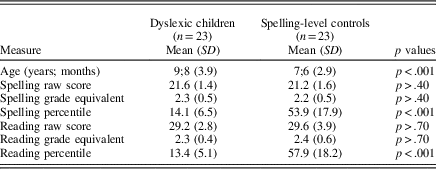
Table 1 shows the mean age and spelling and reading scores for the dyslexic and control groups. The dyslexic children were very similar to the control children in spelling and reading raw score and grade level performances, with no significant group differences on these measures (ps > .40 according to t tests). Thus, an effective group-wise match of dyslexics and controls was achieved.
Means (and standard deviations) on the spelling and reading subtests of Wide Range Achievement Test for dyslexic and spelling-level matched control children

Chronological age matched controls
We report on data from the 57 Grade 4 children from Deacon and Dhooge (Reference Deacon and Dhooge2010). Mean age for these children was 9;9 (SD = 4 months). Their mean age was comparable to that of the dyslexic children (9;8) and higher than that of the spelling-level matched children (7;6). Spelling and reading levels were not collected for these children, and so we cannot report on them here.
Stimuli
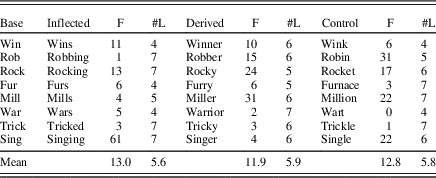
We used the eight quadruplet sets of words from Deacon and Dhooge (Reference Deacon and Dhooge2010). Each quadruplet consisted of a root, inflected, derived, and one-morpheme control word. Items within each quadruplet set began with the same initial letter-sound pattern (e.g., sing, singing, singer, single; see Appendix A). Words in the inflected, derived, and control conditions were balanced for surface frequency (i.e., frequency of occurrence in children’s reading materials) at the Grade 2 level (Zeno, Ivens, Millard, & Duvvuri, Reference Zeno, Ivenz, Millard and Duvvuri1995; p >.95) and number of letters in the inflected, derived, and control conditions (p >.90).
Two semirandomized orders of the words were presented. Response forms were composed of four response sheets with eight numbered lines on each page. Each page included one item to be spelled from each quadruplet set (e.g., only sing from the quadruplet set sing, singing, singer, and single).
Procedure
The participants were given a response booklet and completed the task individually in one session in quiet rooms outside their classrooms. They were told they were going to be doing a spelling activity. Two practice examples were given at the beginning of the task to ensure all students understood and followed the instructions. For the spelling task, the experimenter said each target word, used it in a sentence, and then said the word again (e.g., “Win. When I play games I like to win. Win.”). The child then wrote the word on the response form (no specific time limit was enforced). The experimenter provided general encouragement but did not indicate whether specific spellings were correct. If the experimenter could not determine the identity of a letter the child had written, he or she inquired about the intended letter after the child had finished spelling the word.
RESULTS
Spellings were coded in terms of both accuracy and consistency (see Deacon & Dhooge, Reference Deacon and Dhooge2010, for details) of children’s spelling of the initial letter-sound sequence common across the base, inflected, derived, and one-morpheme control condition (e.g., sing in sing, singing, singer, and single). The consistency measure involved comparing each child’s spelling of the critical sequence in the base condition to his/her spelling of the sequence in the inflected, derived, and control conditions, resulting in a separate consistency score for the inflected, derived, and control conditions. For example, if a child produced seng in the base word condition, a spelling of senger in the derived condition would be coded as consistent, whereas a spelling of sangle or single in the control condition would be coded as inconsistent.
Main analyses
Our main analyses focus on the contrast between dyslexic and spelling-level matched control groups; these were the two groups recruited specifically for this study. In addition, while we present both by-subject and by-item analyses, we focus on the results and interpretation of the by-subject analyses. Raaijmakers, Schrijnemakers, and Gremmen (Reference Raaijmakers, Schrijnemakers and Gremmen1999) argued that when, as here, experiments involve sets of matched items (i.e., the assumption of random sampling for the items analysis of variance is violated), item analyses become insensitive and prone to Type 2 error, and that subject analyses are sufficient for rejection of the null hypothesis.
Accuracy (subject analyses)
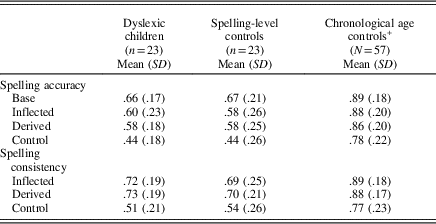
The upper portion of Table 2 presents the mean proportion of correct spellings of initial letter-sound sequences. Analysis of variance, with the within-subjects factor of word type (base, inflected, derived, and control words) and the between-subjects factor of group (dyslexic and spelling-level matched control), revealed no main effect of group and no group by word type interaction (ps >.90). There was a main effect of word type, F (3, 132) = 29.67, p <.001, ηp2 = .40. Means (and SD) across the two groups for base, inflected, derived and control conditions were .67 (.19), .59 (.24), .58 (.21), and .44 (.23), respectively. Follow-up analyses with Bonferonni corrections revealed that spellings for base items were more accurate than those for inflected, derived, and control items, t (45) = 3.29, p <.02, d = 0.48, t (45) = 3.46, p <.01, d = 0.51, and t (45) = 10.15, p <.001, d = 1.50, respectively. Spellings for inflected and derived items were more accurate than those for control items, t (45) = 5.37, p <.001, d = 0.79, and t (45) = 6.22, p <.001, d = 0.92, respectively. There was no difference in performance for the inflected and derived items, p >.85.
Mean proportion (and standard deviations) of accurate spellings (spelling accuracy) of critical segment of base, inflected, derived, and control items and of consistent spellings (spelling consistency) of critical segment for inflected, derived, and control items

Note: +These data were originally reported in Deacon and Dhooge (Reference Deacon and Dhooge2010).
Accuracy (item analyses)
Analyses revealed no main effect of group, no main effect of word type, and no group by word type interaction (ps >.20).
Consistency (subject analyses)
The lower portion of Table 2 presents the mean proportion of consistent spellings of the base form in the inflected, derived, and control words. Analysis of variance, with the within-subjects factor of word type (inflected, derived, and control words) and the between-subjects factor of group (dyslexic and spelling-level matched control), revealed no main effect of group and no group by word type interaction (ps >.50). There was a main effect of word type, F (2, 88) = 30.03, p <.001, ηp2 = .41. Means (and SD) across the two groups for inflected, derived, and control items were .71 (.22), .71 (.20), and .52 (.24), respectively. Follow-up analyses with Bonferonni corrections revealed that scores were higher for the inflected and derived conditions than for the control condition, t (45) = 6.39, p <.001, d = 0.94, and t (45) = 6.22, p <.001, d = 0.92, respectively. Scores for the inflected and derived conditions did not differ, p >.80.
Consistency (item analyses)
Analyses revealed no main effect of group and no group by word type interaction (ps >.55). There was a main effect of word type, F (2, 21) = 3.77, p <.05, ηp2 = .26. Follow-up analyses with Bonferonni corrections revealed that the advantages for the inflected and derived conditions over the control condition approached significance, t (14) = 2.38, p <.09, d = 1.20, and t (14) = 2.28, p <.08, d = 1.14, respectively. Scores for the inflected and derived conditions did not differ, p >.90.
Additional analyses
The results reported on to this point suggest a developmental delay, in that dyslexics are performing similarly to the spelling-level matched control group. We conducted an additional set of analyses to confirm this pattern. We incorporated data for the Grade 4 children from Deacon and Dhooge (Reference Deacon and Dhooge2010); this group is of the same chronological age as our dyslexics. We report this as additional analyses as reading and spelling levels are not available for these children, as these measures were not included in Deacon and Dhooge’s study. Means for accuracy and consistency scores of the chronological age control group are in the right-most column in Table 2.
Accuracy (subject analyses)
Analysis of variance, with the within-subjects factor of word type (base, inflected, derived, and control) and the between-subjects factor of group (dyslexic, spelling-level control, and chronological age control), revealed a main effect of group, F (2, 100) = 27.33, p <.001, ηp2 = .35. Follow-up analyses with Bonferonni corrections revealed that the chronological age control children outperformed the dyslexic and spelling level control groups, t (78) = 6.22, p <.001, d = 1.59, and t (78) = 5.76, p <.001, d = 1.37, respectively. There was also a main effect of word type, F (3, 300) = 59.75, p <.001, ηp2 = .37, which was qualified by a group by word type interaction, F (6, 300) = 3.15, p <.01, ηp2 = .06. All three groups exhibited use of morphological constancy, reflected in better performance in the inflected and derived conditions than in the one-morpheme control condition. Only the chronological age control group demonstrated maximal use of this principle; for this group, mean performance in the base condition was not significantly different from those in the inflected and derived conditions, ps >.20 (for detailed analyses, see Deacon & Dhooge, Reference Deacon and Dhooge2010).
Accuracy (item analyses)
Analyses revealed no main effect of word type and no group by word type interaction (ps >.20). There was a main effect of group, F (2, 56) = 60.27, p <.001, ηp2 = .68. Follow-up analyses with Bonferonni corrections revealed that the chronological age control group outperformed the dyslexic and spelling level control groups, t (31) = 8.90, p <.001, d = 1.57, and t (31) = 8.95, p <.001, d = 1.58, respectively.
Consistency (subject analyses)
Analysis of variance, with the within-subjects factor of word type (inflected, derived, and control) and the between-subjects factor of group (dyslexic, spelling-level control, and chronological age control), revealed a main effect of group F (2, 100) = 14.82, p <.001, ηp2 = .23. Follow-up analyses with Bonferonni corrections revealed that the chronological age control group outperformed the dyslexic and spelling-level control groups, t (78) = 4.55, p <.001, d = 1.16, and t (78) = 4.30, p <.001, d = 1.02, respectively. There was also a main effect of word type, F (2, 99) = 47.86, p <.001, ηp2 = .49, that did not interact with group, p >.15. Follow-up analyses on the main effect with Bonferonni corrections revealed advantages for the inflected and derived conditions over the control condition, t (102) = 9.15, p <.001, d = 0.90, and t (102) = 8.51, p <.001, d = 0.84, respectively. Scores for the inflected and derived conditions did not differ, p >.80.
Consistency (item analyses)
Analyses revealed main effects of group and word type, F (2, 42) = 27.03, p <.001, ηp2 = .56, and F (2, 21) = 4.70, p <.05, ηp2 = .31, respectively. There was no group by word type interaction (p >.70). Follow-up analyses of the main effect of group, using Bonferonni corrections, revealed that the chronological age control group outperformed the dyslexic and spelling level control groups, t (23) = 5.33, p <.001, d = 1.09, and t (23) = 6.65, p <.001, d = 1.36, respectively. Follow-up analyses of the main effect of word type, using Bonferonni corrections, revealed advantages for the inflected and derived conditions over the control condition, t (14) = 2.67, p <.05, d = 1.36, and t (14) = 2.44, p <.05, d = 1.22, respectively. Scores for the inflected and derived conditions did not differ, p >.95.
DISCUSSION
Previous research has attempted to determine whether dyslexic children and spelling-level matched controls differ with respect to their sensitivity to the root constancy principle. Much of this work has produced mixed results, and has not provided well-controlled and detailed analyses of dyslexic children’s use of root constancy when dealing with both inflected and derived words. In the present study, the use of Deacon and Dhooge’s (Reference Deacon and Dhooge2010) experimental design allowed for these types of analyses. Specifically, we used base, inflected, derived, and one-morpheme control words that are matched with respect to the difficulty of their initial letter sequences, and we assessed both root accuracy and consistency performance measures. We recruited dyslexics and children matched for spelling level. We also addressed the question of a developmental delay by conducting additional analyses with data from Deacon and Dhooge’s Grade 4 children as a chronological age match. Together, this allowed for a more comprehensive and conclusive picture of dyslexic children’s sensitivity to root constancy.
Our results indicate that children with dyslexia are as likely to use morphological root constancy to aid their spelling as typically developing younger children of the same general spelling ability. In terms of accuracy performance, both groups exhibited similar morphemic effects, that is, more accurate spelling of the initial sequences (e.g., sing) in inflected (e.g., singing) and derived (e.g., singer) items than in one-morpheme control items (e.g., single). This result concurs with that of Bourassa et al. (Reference Bourassa, Treiman and Kessler2006), and shows that this pattern extends beyond the specific features (flaps and final consonant clusters) examined by those investigators to a case where correct spelling of a variety of whole root morphemes is required. Neither the dyslexic nor spelling-level matched groups made maximal use of root constancy (i.e., performance for the inflected and derived word conditions fell below performance for the base word condition); this pattern emerged only for the chronological age matched group. These findings extend previous work examining accuracy only for specific segments (e.g., Bourassa & Treiman; Reference Bourassa and Treiman2008; Bourassa et al., Reference Bourassa, Treiman and Kessler2006) or accuracy for full root forms on the basis of visual cues (Breadmore & Carroll, Reference Breadmore and Carroll2016). Together, it seems that dyslexic children use root constancy to support their spelling accuracy to the same extent as children of the same spelling level, and less so than children of the same chronological age, who are likely to be better spellers.
The results from our consistency measure provide important insights beyond the traditional accuracy measure as to whether or not dyslexic children and younger controls demonstrate comparable sensitivity to root constancy; prior research had been conflicting on this point, with findings on both sides (e.g., Bourassa & Treiman, Reference Bourassa and Treiman2008; Bourassa et al., Reference Bourassa, Treiman and Kessler2006; Carlisle, Reference Carlisle1987; Egan & Tainturier, Reference Egan and Tainturier2011). In line with Bourassa and Treiman (Reference Bourassa and Treiman2008) and Bourassa et al. (Reference Bourassa, Treiman and Kessler2006), we found that dyslexic children and spelling-level matched controls were equally likely to retain their base form spellings (whether correct or incorrect) in their spellings of the initial segments of the inflected and derived forms. This same pattern emerged, and to the same extent, for children of the same chronological age as the dyslexic children. In addition, it is important to note that these consistency scores were higher, and equally so for all three groups, than those for the control items. To our knowledge, this is the first demonstration of equivalent morphemic effects for dyslexic children as for typically developing children on a spelling consistency measure. This finding provides evidence for the notion (see Bourassa & Treiman, Reference Bourassa and Treiman2008) that, like younger typically developing children and like same-aged matched peers, children with dyslexia exhibit a rather stable adherence to root constancy, whether representations of root forms are accurate or not.
A final noteworthy aspect of our results concerns performance on inflected versus derived items. As outlined earlier, we directly compared spelling of relatively simple inflected and derived items that are matched with respect to the difficulty of their initial letter sequences (cf. Breadmore & Carroll, Reference Breadmore and Carroll2016). Our finding that dyslexic children performed comparably on these items, on both accuracy and consistency measures, extends the findings of prior research with typically developing children (e.g., Deacon & Dhooge, Reference Deacon and Dhooge2010; Treiman et al., Reference Treiman, Cassar and Zukowski1994; see also Kemp, Reference Kemp2006). Yet, the finding of comparable performance for inflected and derived forms may be limited to the types of stimuli used here. The matching of inflected, derived, and control items on initial letter sequences precludes the use of many of the complex derivational relations that exist in the English language (Deacon & Dhooge, Reference Deacon and Dhooge2010). For present purposes, the critical point is that, irrespective of the presence (as found by Breadmore & Carroll, Reference Breadmore and Carroll2016) or absence (as found here) of a morpheme type effect, dyslexic children exhibit levels of sensitivity to root constancy that are commensurate with their general spelling ability.
Taken together, the results outlined above clearly favor the notion that dyslexic children’s sensitivity to root constancy is characterized by delayed rather than atypical development. That is, the absence of a deficit in sensitivity to root constancy indicates that this particular type of linguistic knowledge does not serve as a marker for dyslexia; our findings instead suggest that what is known about early spelling development in typical children may often apply to dyslexic children. Dyslexic children learn about the writing system at a relatively slow rate, but they face typical stumbling blocks and make typical errors. Such a view has received support outside the domain of morphology; several studies have found dyslexic children and spelling-matched controls to be indistinguishable in their ability (or lack thereof) to deal with a variety of basic phonological and graphotactic features (e.g., Bourassa & Treiman, Reference Bourassa and Treiman2003; Cassar, Treiman, Moats, Pollo, & Kessler, Reference Cassar, Treiman, Moats, Pollo and Kessler2005; Moats, Reference Moats1983; Nelson, Reference Nelson1980). Pedagogical consequences for such findings are clear; instruction needs to target the same linguistic features for all children, but it may need to be more intensive and/or more explicit for children with dyslexia. In the present context, dyslexic children would certainly benefit from instructional efforts that capitalize on their relatively intact sensitivity to root constancy; see Deacon, Cleave, Baylis, Fraser, Ingram, and Perlmutter (Reference Deacon, Cleave, Baylis, Fraser, Ingram and Perlmutter2013) for a similar argument with respect to children with specific language impairment.
Limitations and next steps for research
Interpreting our results must be done with consideration of the context in which our study was conducted. Our dyslexic sample was identified on the basis of screening procedures (see also Breadmore & Carroll, Reference Breadmore and Carroll2016; Donovan & Marshall, Reference Donovan and Marshall2016) within a public school system. Consistent with recent studies of dyslexia (e.g., Breadmore & Carroll, Reference Breadmore and Carroll2016; Donovan & Marshall, Reference Donovan and Marshall2016), as well as current clinical recommendations (American Psychiatric Association, 2013) and empirical evidence (see Taylor, Miciak, Fletcher, & Francis, Reference Taylor, Miciak, Fletcher and Francis2017, for a review), we decided to not limit our dyslexic sample by IQ. We did confirm normal levels of vocabulary, reducing concerns that our dyslexic sample may simply be characterized as having general language delay. Our broader recruitment means that we do not have extensive language and full-scale IQ measures for our dyslexic sample as have been available in some other previous studies. (e.g., Bourassa & Treiman, Reference Bourassa and Treiman2008; Bourassa et al., Reference Bourassa, Treiman and Kessler2006; Carlisle, Reference Carlisle1987; Egan & Tainturier, Reference Egan and Tainturier2011). Further, we have very limited information on our chronological age control group; data for these children were originally reported in Deacon and Dhooge, and spelling and reading levels are not available for these children. However, our prior studies with this approach to recruitment have resulted in typically developing samples (see, e.g., Deacon, Kieffer, & Laroche, Reference Deacon, Kieffer and Laroche2014), and we expect that this is the case with the children on whom we report here. Of course, in the absence of standardized measures of word spelling and reading, we cannot say this with 100% confidence. Another potential limitation involves our somewhat limited dyslexic sample size of 23. However, this is comparable to that in past research (ns = 17 to 28; Bourassa et al., Reference Bourassa, Treiman and Kessler2006; Carlisle, Reference Carlisle1987; Donovan & Marshall, Reference Donovan and Marshall2016; Egan & Tainturier, Reference Egan and Tainturier2011). Our design had reasonable statistical power (.67 for the accuracy data, .77 for the consistency data) to detect group differences in sensitivity to morphological constancy, had they existed. Together, these features of our sample need to be borne in mind in interpreting our results.
Another issue relates to the absence of detailed background information regarding morphology and spelling instruction for our dyslexics; this is a problem common to all of the studies of dyslexia reviewed here. As noted by Friend and Olson (Reference Friend and Olson2008), dyslexics who have received substantial training in these areas may be less likely to differ from younger typically developing children on spelling performance measures. We cannot rule out any such targeted training effects as a potential explanation for the absence of group differences. However, it seems unlikely that our dyslexics had received much, if any, specific instruction on morphology; research (e.g., Joshi et al., Reference Joshi, Binks, Hougen, Dahlgren, Ocker-Dean and Smith2009; Moats, Reference Moats1994) indicates that teachers have little linguistic knowledge relating to morphemes, and their importance in literacy instruction. Nonetheless, it will be important to provide detailed information regarding pedagogical background in future studies of dyslexics.
Our work focused on root constancy; another line for future research lies in exploring sensitivity to spelling constancy for inflections and derivations. Evidence to date on this front is mixed. In terms of inflections, Egan and colleagues (Egan & Pring, Reference Egan and Pring2004; Egan & Tainturier, Reference Egan and Tainturier2011; see also Hauerwas & Walker, Reference Hauerwas and Walker2003) reported that dyslexic children make more spelling errors on regular past tense verb endings than younger control children. In contrast, Breadmore and Carroll (Reference Breadmore and Carroll2016) found that dyslexic children and spelling-level matched controls demonstrated reliable and comparable sensitivity to inflectional suffixes on spelling of a range of inflectional suffixes in a nonword spelling task. In terms of derivations, Breadmore and Carroll (Reference Breadmore and Carroll2016) found that their spelling-level controls demonstrated overall sensitivity to derivational suffixation (e.g., ous, ment, ness) on the nonword spelling task, but their dyslexic group did not. To account for this finding, these authors point to the fact that derivation tends to be more difficult than inflection (see also Deacon & Bryant, Reference Deacon and Bryant2005); they suggest that this is because derivational transformations are less frequent and more variable on many dimensions. It will be important to provide direct comparisons between dyslexic children and spelling-level controls on sensitivity to the variety of inflectional and derivational suffixes that exist in the English language.
Finally, dyslexic children’s sensitivity to graphotactic knowledge also requires further investigation. In a large-scale study, Cassar et al. (Reference Cassar, Treiman, Moats, Pollo and Kessler2005) found that dyslexic children and spelling-matched controls performed comparably on nonword choice tasks that assessed basic knowledge of doublet position (nuss vs. nnus), doublet identity (heek vs. haak; gatt vs. gaww), allowable initial consonant clusters (dret vs. gvet), and allowable final consonant clusters (pilt vs. pibk). However, it is not known whether dyslexic children also perform comparably to younger, typically developing children on tests that examine more complex aspects of graphotactic knowledge. Exploring features such as the distinction between extended and nonextended spellings as a function of preceding vowel context (e.g., peck vs. peek; Hayes, Treiman, & Kessler, Reference Hayes, Treiman and Kessler2006) and the awareness of consonant context on vowel spellings (e.g., wand vs. pond; Treiman & Kessler, Reference Treiman and Kessler2006) will be useful next steps.
Conclusion
To summarize and conclude, the present investigation demonstrates that children with dyslexia and younger, typically developing children use the principle of root constancy to the same extent for both inflected and derived forms of words. Neither of these groups, spelling at the Grade 2 level, do so to a maximum extent; this is reserved for Grade 4 children in the present design. These findings are consistent with the idea that, with respect to sensitivity to root constancy, dyslexia is characterized by delayed rather than atypical development. However, future research will need to examine how dyslexic children and typically developing children deal with more complex features of the English language. Such work will lead to a more comprehensive view of spelling development and disability.
ACKNOWLEDGMENTS
This research was supported by a grant from the Natural Sciences and Engineering Research Council of Canada to Derrick Bourassa and also one to Hélène Deacon for the data for the chronological age control children. We thank the children, parents, teachers, and administrators of the River East Transcona School Division (Winnipeg, Canada) for their cooperation.
APPENDIX A
Base, Inflected, Derived, And Control Items (From Deacon & Dhooge, Reference Deacon and Dhooge2010) And Their Frequencies At Grade 2 (Zeno et al., Reference Zeno, Ivenz, Millard and Duvvuri1995)