Studies from established neonatal intensive care units (NICUs) demonstrate diverse microbiota in the built environment that surrounds neonates. Reference Brooks, Olm and Firek1 Exchange of organisms between the microbiota of the built environment and resident neonates has been described, Reference Brooks, Olm and Firek2 and neonates in different locations within the same hospital are colonized with location-specific microbiota profiles. Reference Hourigan, Subramanian and Hasan3 The NICU microbial environment thus plays a role in the development of hospitalized infants’ microbiota Reference Hartz, Bradshaw and Brandon4 and could moderate acquisition of pathogenic organisms. However, the initial microbiota of the built environment of the NICU before patient introduction and its evolution over time after patient introduction have not been well described. Reference Patel, Mutlu and Sun5
Insights as to how patient introduction may shape the built environment of hospital units have previously come from the hospital setting caring for adults. Reference ElRakaiby, Gamal-Eldin, Amin and Aziz6,Reference Christoff, Sereia, Hernandes and de Oliveira7 For example, in a large tertiary-care adult hospital, the introduction of patients was associated with an increase in skin-associated genera (eg, Corynebacterium, Staphylococcus, and Streptococcus, with concurrent decreases in the abundance of Acinetobacter and Pseudomonas), which had dominated samples prior to opening. Reference Lax, Sangwan and Smith8 Describing the built environment of a NICU prior to introducing patients, and its evolution over time would help better delineate the NICU built environment–neonate interaction and could potentially help assess the effectiveness of routine infection prevention and control (IPC) practices in controlling colonization in the built environment over time.
In this study, we used the opening of a new neonatal cardiac intensive care unit, (NCICU) to describe the microbiota of the built environment prior to admitting patients and periodically after patient introduction. We compared microbial community changes over time within the new NCICU and between the new NCICU and the microbiota of the built environment of the previous NICU within the same hospital, which housed the same patients prior to transfer. We hypothesized that (1) the built-environment microbiota of the new NCICU would gradually become similar to that of the built environment of the previous NICU location and (2) that specific clinical variables such as antibiotic use and patient turnover would have a measurable impact on the microbiota of the built environment in the new NCICU.
Methods
Study design
This was an 11-month prospective longitudinal study carried out at NewYork-Presbyterian Morgan Stanley Children’s Hospital, a 200-bed academically affiliated tertiary-care hospital. Two geographically separate locations in the same hospital were included in built-environment surveillance: the original 50-bed NICU, and a newly constructed 17-bed NCICU. On September 27, 2017, the existing NICU transferred some patients to the new NCICU. The Columbia University Irving Medical Center Institutional Review Board approved this study with a waiver of informed consent.
Environmental sampling strategy
Samples from the built environment were collected from 7 patient rooms in the original NICU housing cardiac patients the day before infants were transferred to the new NCICU. On the same day, samples were collected from 5 empty patient rooms and 1 common staff area in the new NCICU; simulations had been performed in the new NCICU during the weeks prior to patient transfer. Samples from these same locations were then collected from the new NCICU over an 11-month period, approximately doubling the time interval between each sample collection: new NCICU days 1, 5, 9, 16, 33, 61, 89, and 304. This sampling frequency was adopted to be more sensitive to early shifts in the built-environment microbiota while reducing the burden of sample collection and analysis.
Built environment sampling procedure
Specific surfaces were targeted for sampling in each patient room in both the original and the new units. These surfaces were determined a priori in collaboration with IPC personnel based on past outbreak investigations and surveillance efforts because they were the most commonly contaminated, as determined by bacterial cultures. Surfaces within a room were swabbed using a single, large, sponge-type swab (3M Product ID no. 70200750951). This technique, which combined multiple surfaces, was done to increase total microbial content gathered from each room and to improve the signal-to-noise ratio within each sample. Reference Brooks, Olm and Firek2 In each room, each surface was swabbed for 2–3 minutes each in the following order: bedrails and surfaces of isolettes, monitors, and infusion pump high-touch surfaces, inside door handles, and diaper scales. This order was selected so that the surfaces closest to the baby were swabbed first, successively moving to surfaces that were likely to have greater bacterial density. We also collected swabs from the common provider workplace area where the surfaces included countertops, computer mouse and keyboard, and chair armrests.
Sample processing and cultures
After collection, swabs were squeezed and drained for 1 minute to yield 2.5 mL of fluid. Aerobic cultures were also performed for (1) vancomycin-resistant Enterococcus (VRE), (2) methicillin-resistant Staphylococcus aureus (MRSA) (Remel), and (3) multidrug-resistant gram-negative rods using Chromagar. These samples were then stored frozen at −80°C for batched DNA extraction and subsequent 16S rRNA sequencing of microbial DNA.
Infection prevention and antibiotic practices in the new NCICU
According to prior established IPC policy, routine cleaning and disinfection of the NCICU was performed twice daily using disposable wipes and a bleach-based product throughout the study period. Environmental surfaces and points of patient or healthcare worker contact were targeted during daily cleaning. Upon patient discharge or transfer between locations, an additional terminal cleaning was performed, which included removal of curtains, remaining supplies, ventilators, and any residual patient care equipment. The neonatal isolettes are exchanged every 14 days and are cleaned at a dedicated equipment center. Empiric antibiotic use protocols and hand hygiene compliance in both the NICU and NCICU were reviewed for differences and were noted if present.
Sequencing and microbiota analysis
DNA was extracted using the Qiagen AllPrep PowerViral DNA/RNA Kit. The V3/V4 region of the 16S rRNA gene was amplified using established primers Reference Klindworth, Pruesse and Schweer9 with Illumina Nextera adaptors. Libraries were multiplexed using Illumina Nextera XT Index kits and were normalized and pooled with 10% PhiX. Sequencing was performed on an Illumina MiSeq platform (MiSeq Reagent kit v3, 600 cycles). 16S rRNA sequences were processed using QIIME for quality-filtering, trimming, dereplication, and chimeric sequence filtering of FASTQ sequences through the National Institute of Allergy and Infectious Diseases Nephele platform. Reference Weber, Liou and Dommer10 In total, 61 samples were sequenced, and 60 of these samples passed the minimum read cutoff of 7,500 reads for inclusion in further analysis. Low-abundance operational taxonomic units (OTUs) with relative abundance <0.005% were filtered out using the R package phyloseq v1.28.0. Reference Ani, Ekandem and Singh11 Clustering of filtered reads into OTUs at 97% similarity was performed. The Greengenes 97% database was used as a reference database for taxonomic classification of these OTUs. Reference DeSantis, Hugenholtz and Larsen12
Relative abundances of specific taxa were calculated and compared between the original and new units, as well as across time in the new unit. The pipeline used in this study, DESeq2, uses a generalized linear model to analyze log 2 fold changes in differential abundance. The Wald test was used for significance testing with adjustment for multiple testing using the Benjamini and Hochberg test. Reference Love, Huber and Anders13 Principal coordinate analysis of weighted UniFrac β diversity was used to assess overall similarity between samples collected based on (1) the date of collection and (2) the geographical location of the samples within the NCICU.
The Chao index was used to quantify α diversity, which was compared between the original and the new NICUs. We determined the correlation of changes in room-specific α diversity between sampling time points and 2 room-level clinical exposures of interest: (1) interval broad-spectrum antibiotic use, and (2) interval patient turnover using samples obtained during the last 4 sampling points (ie, days 33, 61, 89, and 304). Interval antibiotic use was defined as the number of days of broad-spectrum antibiotics administered to patients in that specific location between the sampling time points divided by the number of interval days. Broad-spectrum antibiotic use was defined as treatment with any systemic third- or fourth-generation cephalosporin, vancomycin, piperacillin/tazobactam, linezolid and/or aminoglycoside. Interval patient turnover was defined as the total number of occupant changes that occurred between sampling time points divided by the number of interval days.
Results
Taxa changes in new NCICU with patient introduction
Prior to patient introduction into the new NCICU, multiple taxa were detected in the built environment including taxa of potential clinical importance: Staphylococcus spp, Klebsiella spp, Pseudomonas spp, and Streptococcus spp. Only 1 taxon (Gemmata) was present in the built environment prior to patient introduction but was not detected after patient introduction. There was an immediate change in the overall differential abundance of taxa on the first day of patient introduction, with increases in gut-related anaerobes, (Bacteroides, Bifidobacterium, Ruminococcus, and Faecalibacterium) being most striking (Fig. 1). Over time, there was an increase in differential abundance of Staphylococcus, Enterobacteriaceae, Pseudomonas, and Enterococcus (Fig. 2).
Volcano plot demonstrating changes in relative taxon abundance between baseline and immediately after patient introduction.

Volcano plot demonstrating changes in relative taxon abundance between baseline and at end of study period.

Microbiota dissimilarity across time and geographic location
The built-environment microbial communities from locations in the original NICU remained distinct from locations in the new NCICU at all study time points (Fig. 3). The microbiota of the previous NICU location just prior to patient transfer was characterized by an abundance of Pseudomonas OTUs. The common staff areas in the new NCICU were initially closer to the microbiota profiles of patient rooms, but over time these microbiota profiles diverged toward a distant distinct cluster that aligned closer with that of the original NICU; both were dominated by Pseudomonas (Fig. 3).
The β diversity plots demonstrating clustering of samples across time and location. In the later period, samples collected from the common area cluster together with samples from the original NICU. The circle is an ellipse assuming multivariate t distribution drawn around the samples from the common area over 1 month after patient introduction.

Changes in alpha diversity in the new NCICU
Mean α diversity (Chao index) was lowest in the former NICU (mean ±SD, 402±166). The mean α diversity of the new location immediately after patient introduction was significantly higher (1,003.02+127.96; P = .045) and stayed higher compared to the original NICU over the 11 months of the study (969.63; P < .01).
Correlation of cumulative antibiotic use and patient turnover with alpha diversity of the built environment of patient rooms in the new NICU
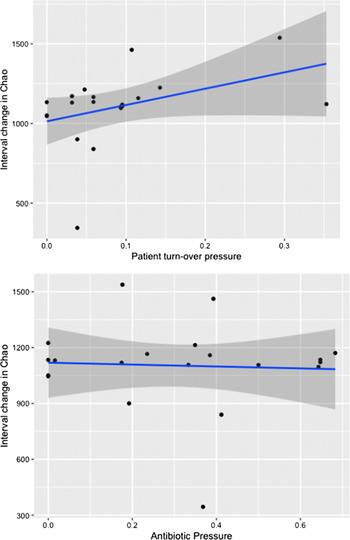
Interval increases in patient turnover increased microbial diversity (correlation coefficient of 0.39), and the impact of room-level antibiotic use on α diversity was limited (correlation coefficient of −0.05) (Fig. 4).
Changes in α diversity (Chao index) against interval number of occupants and interval antibiotic use. Both variables were normalized for interval days.

Routine bacterial cultures
In total, 61 cultures were processed. All were negative for the targeted drug-resistant bacteria, except cultures from the common provider area were positive for Acinetobacter baumanii and Acinetobacter iwofii on Day 89.
Discussion
In this pilot study of microbiota of the built environment of a new NCICU, we demonstrated time-dependent changes with implications for assessing IPC practice. The data from these methods could help hospital epidemiologists (1) understand global changes in the patient environment secondary to a disruptive change, (2) define and contrast microbiologic niches within a specific unit to monitor compliance with IPC practice, and (3) identify routes of transmission of organisms within the hospital environment.
First, even prior to the introduction of patients, diverse microbiota including taxa of clinical importance were detected in the built environment. The initial microbiota profile was disrupted almost immediately with patient introduction. The most noticeable change with patient introduction was an increase in anaerobic organisms which have been associated with the neonatal gut. Reference Gritz and Bhandari14 While not unexpected, the immediacy of the change was striking and implies that patients’ impact on the environment could outpace routine IPC interventions. Over time, after patient introduction, clinically relevant organisms, such as Enterobacteriaceae, Pseudomonas, and Staphylococcus, occupied a larger fraction of the microbiota of the built environment of patient rooms. This gradual increase occurred despite IPC activities designed to mitigate patient-to-environment transfer: daily cleaning, terminal cleaning, and barrier precautions for patients with MDROs. The scope of these changes were not identified using routine surveillance and indicate the potential benefit of molecular methods in identifying rapid changes in a local environment prior to being reflected in clinical or environmental cultures.
The dominance of the ICU built environment with these hospital-specific organisms has been demonstrated previously. Reference Oberauner, Zachow, Lackner, Hogenauer, Smolle and Berg15 Possible explanations for this preferential organism burden include the cumulative pressure of local antibiotic use, organism propensity to create biofilms resistant to regular cleaning practices, Reference Vickery, Deva, Jacombs, Allan, Valente and Gosbell16 or a continued reservoir of organisms contributed by healthcare providers. Across all time points, however, the built environment of the NCICU remained distinct from the original location. The original NICU was characterized by a low-diversity state seen in established ICU-type settings. Reference Poza, Gayoso and Gomez17 Our findings thus illustrate the difference that altering the physical location makes to the microbiota of the patient environment within the same hospital, at least in the short term, which is consistent with previous work. Reference Hourigan, Subramanian and Hasan3
The microbiota of the common area of the NCICU, frequented by providers, initially resembled patient areas. However, the common area eventually formed a separate cluster. This dissimilarity between patient and provider areas is a desirable outcome from an infection control perspective, indicating limited transfer of organisms from patient rooms to shared areas. Distinct microbiota niches within the hospital environment have been described in adult settings Reference ElRakaiby, Gamal-Eldin, Amin and Aziz6,Reference Lax, Sangwan and Smith8 Correlating these separate profiles with relevant IPC practice could help monitor compliance.
Interestingly, microbiota profiles of common staff areas of the new NCICU quickly became similar to those of the original NICU with a high dominance of Pseudomonas. Some providers staff both units, which could contribute to this finding. Whether provider work stations act as reservoirs for typical hospital associated pathogens across hospital units either because of traffic, suboptimal cleaning, or proximity to Pseudomonas reservoirs (eg, sinks) should be further studied. This finding also illustrates the application of these techniques to identify routes of transmission between areas based on similarity between microbiota profiles.
The microbiota in the rooms in the new NICU remained mostly similar over time. The impact of modifiable factors, such as antibiotic use on the microbiota, was limited. The limited impact of antibiotic use observed could be because of the relatively short study duration, long hospital stays, and relatively low rates of broad-spectrum antibiotic use compared to adult units. Reference Zou, Liu and Li18 in contrast, a positive association with increased diversity was observed with patient turnover, suggesting that influx of new patients and interval terminal cleanings may help reset microbial diversity.
This study has several limitations. The sample size was small, and our patient population was restricted to neonates with complex cardiac issues, which limits the generalizability of our findings. Species-level identification was not available for all taxa, so the attribution of potential clinical significance may not be fully accurate. Routine cultures were mostly negative, so viability of organisms could not be ascertained. Multidrug-resistant organisms were not isolated in the environment, which may limit generalizability. The lack of identification of antibiotic resistance using molecular methods limits inference around the impact of antibiotic use. This study was limited by a lack of a quantitative measure of bioburden. Due to our swabbing technique, we were unable to distinguish between surfaces sampled within each room. Also, we did not sample patients or healthcare workers which limits inference about transmission.
In summary, the introduction of patients into the hospital environment, leads to time-dependent and clinical care–dependent changes in the resident microbiota. Patient turnover may influence the overall structure of the microbiota in the built environment. Non–culture-based methods to track environmental microbiota may reveal patterns of transmission and colonization missed by regular cultures and may be a useful adjunct to current IPC practice.
Acknowledgments
None.
Financial support
This study was supported in part by the National Institutes of Health/National Institute of Allergy and Infectious Diseases (NIH/NIAID grant no. AI116939-01 to A.C.U.). D.E.F. was funded in part by the National Institutes of Health (NIH grant no. K23 DK111847) and by a Department of Defense Clinical trial award (no. PR181960).
Conflicts of interest
All authors report no conflicts of interest relevant to this article.