There are many problems with the arguments that Fincher & Thornhill (F&T) make, given the data and analyses they present in the target article (and elsewhere). We will limit our criticisms to three main points:
-
1. The units of analysis are not independent.
-
2. Correlations may result from association with other variables.
-
3. There is no evidence of the proposed cognitive mechanism from these analyses.
Because of their historical relationships, countries (F&T's unit of analysis) cannot be considered as independent for the purposes of statistical analysis. Although F&T do acknowledge this, their handling of the issue is flawed. While there is not necessarily a single correct grouping variable, as multiple historical processes may lead to non-independence, the grouping used in their cross-national analyses is problematic. Murdock's (Reference Murdock1949) classification of world regions was designed with the analysis of traditional societies in mind. For example, Australia and New Zealand, whose populations are now predominantly of European descent (culturally and biologically), are included in an “Insular Pacific” region along with Indonesia and the Philippines.
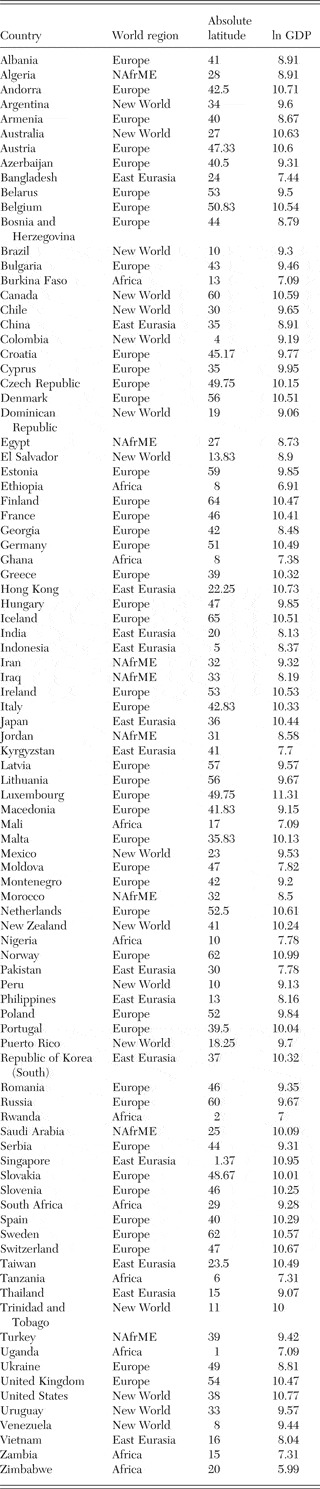
We examined the data provided by F&T and reclassified countries into “Europe,” “North Africa and Middle East,” “Sub-Saharan Africa,” “East Eurasia,” and “New World” (the Americas, Australia, and New Zealand), reflecting more recent regional historical relationships (see Table 1). A more in-depth analysis would undoubtedly involve some kind of hierarchical linear model (Raudenbush & Bryk Reference Raudenbush and Bryk2002), or a phylogenetic comparative method within regions (Currie et al. Reference Currie, Greenhill and Mace2010). However, F&T's argument is for a universal human response to pathogen stress, so if the relationship between the variables is strong, correlations should hold within these groups. As the target article focuses on religiosity, here we examine the variable “Religious participation and value” (although our arguments apply to other aspects of sociality discussed by F&T).
Table 1.
World region classification, absolute latitude, and lnGDP for countries for which Religosity data were available (NAfrME=North Africa and the Middle East)
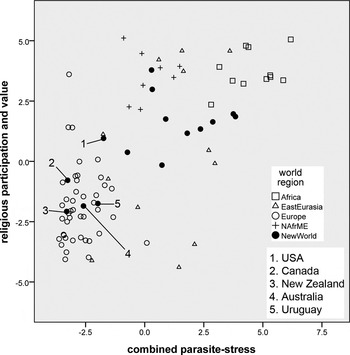
Plotting out the relationship between combined parasite stress and religious participation reveals a number of interesting patterns (see our Fig. 1). Europe, for example, exhibits relatively little variation in parasite stress but relatively substantial variation in religious participation. Furthermore, while taking all regions together a positive relationship between the two variables can be seen, the correlation within these regions is not consistent (Pearson correlation coefficients, sub-script represents n: Africa, r
11=0.39, p=0.24; East Eurasia, r
12=0.34, p=0.28, Europe, r
43=−0.02, p=0.92, North Africa, r
8=0.05, p=0.90, New World, r
15=0.69, p=0.005). Although these are admittedly small sample sizes within all regions except Europe (where there is practically no relationship in any case), the only region in which there is a substantial relationship between parasite stress and religious participation is the “New World.” However, even within this region further inspection reveals that this correlation is being driven by the four English-speaking countries that were settled predominantly by northern Europeans (Canada, USA, Australia, New Zealand). The relationship in the “New World” is no longer statistically significant if these four countries are removed (r
11=0.43, p=0.18). Additionally, the remaining positive relationship appears entirely due to the presence of Uruguay (the correlation coefficient in the remaining ten countries is 0.05, p=0.90). The apparent overall strong relationship between religious participation (and other sociality variables) and parasite stress therefore appears at least partly a result of not adequately identifying and controlling for sources of non-independence in the data.
Figure 1.
Relationship between the variables religious participation and value and combined parasite-stress with countries grouped according to world region. Although overall there is a negative relationship between the two variables, a strong negative relationship exists only within the “New World” region (see text for details).
Even if a relationship does remain between the dependent variables and parasite stress after properly controlling for the problem of non-independence, this does not necessarily indicate a causal relationship. As we have pointed out before (Currie & Mace Reference Currie and Mace2009; in press; Mace & Jordan Reference Mace and Jordan2011), many ecological variables (including parasite stress) co-vary with latitude. Furthermore, religious participation and parasite stress also co-vary with economic indicators of development such as gross domestic product (GDP). Therefore, the positive association between religious participation and parasite stress may be due to their common co-variation with other factors. Although F&T claim to have controlled for a number of potential confounds, this does not appear to have been conducted in a systematic manner. Indeed, if we enter lnGDP, absolute latitude, and combined parasite stress into a multiple regression model with religious participation as the dependent variable then both lnGDP (β = −0.26, p=0.02) and absolute latitude (β = −0.53, p<0.001) are statistically significant predictors, while combined parasite stress is not (β = 0.06, p=0.73). Teasing apart causal relationships from spurious associations is not easy; however, future work should at least assess alternative models more thoroughly to see whether they do at least as well, if not better, than F&T's favoured hypothesis. We feel it is likely that some other ecological factor or factors that co-vary with latitude (and therefore parasite stress) and affect such things as subsistence strategies and population densities, may ultimately underlie the relationships reported by F&T here and elsewhere.
Finally, even if a robust relationship were to be shown between parasites and the various measures of sociality, using cross-national data, it does not demonstrate that the causal mechanism is the same as that proposed by F&T. They argue for a cognitive mechanism that is sensitive to parasite stress and causes people to exhibit more in-group favouritism accordingly. Yet, there is no direct evidence for such a cognitive mechanism from these analyses. An alternative explanation could be that it is purely cultural evolution, with groups that have a social organization or cultural practices that expose them to greater parasite stress, leaving behind fewer representatives in subsequent generations. These issues will not be addressed by yet more cross-national studies attempting to show that parasite stress is correlated with everything imaginable.
In short, while parasites and diseases have undoubtedly played an important role in shaping human history (Diamond Reference Diamond1997), the analyses presented here do not demonstrate that parasite stress is the strong, universal shaper of human psychology and social behaviour in the manner proposed by F&T.





There are many problems with the arguments that Fincher & Thornhill (F&T) make, given the data and analyses they present in the target article (and elsewhere). We will limit our criticisms to three main points:
1. The units of analysis are not independent.
2. Correlations may result from association with other variables.
3. There is no evidence of the proposed cognitive mechanism from these analyses.
Because of their historical relationships, countries (F&T's unit of analysis) cannot be considered as independent for the purposes of statistical analysis. Although F&T do acknowledge this, their handling of the issue is flawed. While there is not necessarily a single correct grouping variable, as multiple historical processes may lead to non-independence, the grouping used in their cross-national analyses is problematic. Murdock's (Reference Murdock1949) classification of world regions was designed with the analysis of traditional societies in mind. For example, Australia and New Zealand, whose populations are now predominantly of European descent (culturally and biologically), are included in an “Insular Pacific” region along with Indonesia and the Philippines.
We examined the data provided by F&T and reclassified countries into “Europe,” “North Africa and Middle East,” “Sub-Saharan Africa,” “East Eurasia,” and “New World” (the Americas, Australia, and New Zealand), reflecting more recent regional historical relationships (see Table 1). A more in-depth analysis would undoubtedly involve some kind of hierarchical linear model (Raudenbush & Bryk Reference Raudenbush and Bryk2002), or a phylogenetic comparative method within regions (Currie et al. Reference Currie, Greenhill and Mace2010). However, F&T's argument is for a universal human response to pathogen stress, so if the relationship between the variables is strong, correlations should hold within these groups. As the target article focuses on religiosity, here we examine the variable “Religious participation and value” (although our arguments apply to other aspects of sociality discussed by F&T).
World region classification, absolute latitude, and lnGDP for countries for which Religosity data were available (NAfrME=North Africa and the Middle East)
Plotting out the relationship between combined parasite stress and religious participation reveals a number of interesting patterns (see our Fig. 1). Europe, for example, exhibits relatively little variation in parasite stress but relatively substantial variation in religious participation. Furthermore, while taking all regions together a positive relationship between the two variables can be seen, the correlation within these regions is not consistent (Pearson correlation coefficients, sub-script represents n: Africa, r 11=0.39, p=0.24; East Eurasia, r 12=0.34, p=0.28, Europe, r 43=−0.02, p=0.92, North Africa, r 8=0.05, p=0.90, New World, r 15=0.69, p=0.005). Although these are admittedly small sample sizes within all regions except Europe (where there is practically no relationship in any case), the only region in which there is a substantial relationship between parasite stress and religious participation is the “New World.” However, even within this region further inspection reveals that this correlation is being driven by the four English-speaking countries that were settled predominantly by northern Europeans (Canada, USA, Australia, New Zealand). The relationship in the “New World” is no longer statistically significant if these four countries are removed (r 11=0.43, p=0.18). Additionally, the remaining positive relationship appears entirely due to the presence of Uruguay (the correlation coefficient in the remaining ten countries is 0.05, p=0.90). The apparent overall strong relationship between religious participation (and other sociality variables) and parasite stress therefore appears at least partly a result of not adequately identifying and controlling for sources of non-independence in the data.
Relationship between the variables religious participation and value and combined parasite-stress with countries grouped according to world region. Although overall there is a negative relationship between the two variables, a strong negative relationship exists only within the “New World” region (see text for details).
Even if a relationship does remain between the dependent variables and parasite stress after properly controlling for the problem of non-independence, this does not necessarily indicate a causal relationship. As we have pointed out before (Currie & Mace Reference Currie and Mace2009; in press; Mace & Jordan Reference Mace and Jordan2011), many ecological variables (including parasite stress) co-vary with latitude. Furthermore, religious participation and parasite stress also co-vary with economic indicators of development such as gross domestic product (GDP). Therefore, the positive association between religious participation and parasite stress may be due to their common co-variation with other factors. Although F&T claim to have controlled for a number of potential confounds, this does not appear to have been conducted in a systematic manner. Indeed, if we enter lnGDP, absolute latitude, and combined parasite stress into a multiple regression model with religious participation as the dependent variable then both lnGDP (β = −0.26, p=0.02) and absolute latitude (β = −0.53, p<0.001) are statistically significant predictors, while combined parasite stress is not (β = 0.06, p=0.73). Teasing apart causal relationships from spurious associations is not easy; however, future work should at least assess alternative models more thoroughly to see whether they do at least as well, if not better, than F&T's favoured hypothesis. We feel it is likely that some other ecological factor or factors that co-vary with latitude (and therefore parasite stress) and affect such things as subsistence strategies and population densities, may ultimately underlie the relationships reported by F&T here and elsewhere.
Finally, even if a robust relationship were to be shown between parasites and the various measures of sociality, using cross-national data, it does not demonstrate that the causal mechanism is the same as that proposed by F&T. They argue for a cognitive mechanism that is sensitive to parasite stress and causes people to exhibit more in-group favouritism accordingly. Yet, there is no direct evidence for such a cognitive mechanism from these analyses. An alternative explanation could be that it is purely cultural evolution, with groups that have a social organization or cultural practices that expose them to greater parasite stress, leaving behind fewer representatives in subsequent generations. These issues will not be addressed by yet more cross-national studies attempting to show that parasite stress is correlated with everything imaginable.
In short, while parasites and diseases have undoubtedly played an important role in shaping human history (Diamond Reference Diamond1997), the analyses presented here do not demonstrate that parasite stress is the strong, universal shaper of human psychology and social behaviour in the manner proposed by F&T.
ACKNOWLEDGMENT
T.E.C. and R.M. are supported by a European Research Council Grant.