We live in a global age that celebrates freedom, liberty, consent, and choice . . . and have created a metropolis of global institutions that are dedicated to interfering in the lives of others in order to advance this best of possible worlds. This contrapuntal rhythm runs throughout contemporary global governance, and it often exists within the same institution. Consider the United Nations (UN). It recognizes sovereignty as a fundamental institution of the society of states and noninterference as an essential principle of international order and justice. Yet over the years, sovereignty seems to have become more conditional, and exceptions to the principle are increasing. The UN Charter proclaims that states are sovereign and enjoy supreme political authority, but they are also expected to run their internal affairs in ways that protect their societies from harm and that respect fundamental human rights. At the time of creation, such statements were truly empty gestures, yet the possibility that the “international community” might act on its pledge has now moved from the impossible to the imaginable. Discourses of interference such as “responsibility,” “duty,” and “obligation” easily attach themselves to the same institutions that also compel respect for difference, self-determination, and sovereign equality.
This impulse to intervene in order to protect and promote humanity is readily apparent in the rapidly expanding area of humanitarian governance, defined as “the administration of human collectivities in the name of a higher moral principle that sees the preservation of life and the alleviation of suffering as the highest value of action.” Footnote 1 Much of humanitarian governance aspires to inculcate negative liberty. There is no formal right to relief, but there is a strong expectation that the international community will serve as the protector of last resort when human-made and natural disasters strike. There now exist an overlapping number of protection regimes to represent the world’s most vulnerable populations, including refugees, civilians during war, and women. International human rights have experienced nothing short of a revolution. Humanitarian governance also includes a heavy dose of positive liberty and the desire to prevent harm from occurring in the first place, to eliminate the root causes of suffering, and to foster human flourishing. A spiraling number of regional and international organizations, aid agencies, epistemic communities, and transnational activists are pursuing this sacred mission by working in areas of emergency assistance, public health, human rights, development, and post-conflict reconstruction. This procession is fueled by both an imperative to act and the confidence that such action will make a difference.
While the “humanitarian” in humanitarian governance brings attention to an ethics of care, the second half of the term shifts our attention to the imperative of control. Governance, including humanitarian governance, often cannot function without its fair share of power. Consider the following examples. Global health campaigns often do not, and arguably cannot, operate with Western-based notions of patient consent. Footnote 2 If the World Health Organization, for instance, decides to eradicate a certain strain of tuberculosis, then it is mandatory that all, or nearly all, potential carriers be treated — to allow a population to opt out might put those who decline, as well as others, at risk. In refugee camps, medical personnel frequently run immunization campaigns, often failing to ask for consent, or even knowing that the patient cannot provide informed consent because the patient is not fully aware of the purpose or side effects of the treatment. Footnote 3 There are global prohibition campaigns that are premised on the belief that no one under any circumstances could ever consent to certain categories of action. The widespread movements to ban female genital cutting/mutilation and the migration of individuals from one country to another to engage in sex work are based on the assumption that no one could ever freely consent to such injurious and degrading practices. Footnote 4 In peacebuilding operations, outsiders frequently decide a priori what local populations need, and impose relevant conditions on aid. Footnote 5 Global and humanitarian governance, in short, frequently engages (and justifies) the imposition of power on the grounds that it is necessary for the well-being of others.
There is a concept that captures this mixture of care and control: paternalism. Theorists, philosophers, and ethicists have expended considerable effort attempting to identify what is and is not paternalism and when it is and is not justified. This is neither the time nor the place to provide a systematic review of the rather expansive menu of choice with the hope of offering a definition for the ages. Drawing from several existing definitions, I define paternalism as a situation when one actor substitutes his judgment for another on the grounds that it is in her interest, welfare, or happiness. What does this definition accomplish? It includes situations when one actor, motivated by the concern for another: considers and then ignores another actor’s expressed interests; and fails to explicitly solicit the interests and concerns of another actor in his or her proper sphere of autonomy. Definitions of paternalism, similar to definitions of many concepts, migrate between the analytical and the ethical. My defense for distinguishing between the two, and prioritizing the analytics over the ethics, is based on the observation that normative theorists of global affairs spend more time arguing over what should, rather than what does, exist, and that, as an empirically minded political scientist, I should stick to my relative advantages. Footnote 6
My analysis of paternalism in humanitarian governance will frequently reference liberalism for two reasons. First, liberal political theory — perhaps more than any branch of political theory — has developed a body of thought that wrestles with the question of when external authorities can and should infringe on the autonomy of others. I do not mean to suggest that liberal political theorists have a settled position on these issues; I am well aware that there are important differences between scholars who otherwise associate themselves with the liberal tradition in one way or another. Consequently, I will leave it to others to map out the battle lines and will instead draw selectively and opportunistically from liberal political theory, writ large, to help explore the relationship between care and control in humanitarian governance.
Second, we live in an international liberal order. Footnote 7 Although there are important variants of international liberalism, they share some core values that comfortably circulate in, and help to orient, world affairs, such as equality, independence, sovereignty, self-determination, consent, and rights. Yet in addition to this liberalism of restraint, there also is a liberalism of intervention. Many of the great campaigns of human emancipation over the last century have been orchestrated to the sounds of liberalism. This liberal world order defined by impulses of restraint and interference has constituted a modern structure of global and humanitarian governance that is driven by the contradictory impulses to “live and let live” and to nurture moral progress.
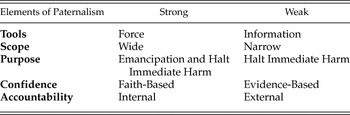
This essay is organized in the following way. It begins with a discussion of paternalism and situates paternalism in the gray zone between solidarity and consent-based institutionalism, on the one hand, and hegemony, on the other. Our unease with paternalism seems to grow as we scale up from the interpersonal to the international, which I argue owes to the evaporation of community and equality. I consider how different elements of paternalism combine to generate different configurations. Specifically, I point to five dimensions that are most relevant for examining the paternalism found in contemporary global and humanitarian governance: the tools used to restrict another actor’s liberty (force versus information); the scope of the interference (wide versus narrow); the purpose of the intervention (prevention of harm versus emancipation); the source of the paternalizer’s confidence (faith versus evidence); and the mechanisms of accountability (internal versus external). These different elements often correlate historically, suggestive of two ideal types of global paternalism: strong and weak. Contemporary global and humanitarian governance is largely the weak variety: force is severely proscribed, interference is relatively restricted, the paternalizer’s confidence has epistemic roots, and accountability to local populations remains a noble but rarely practiced goal. I further speculate that a major reason for this difference is the effects of liberalism and rationalization. I use this taxonomy to suggest how two different global efforts to improve the lives of people living in what were perceived to be unstable and illiberal territories — the civilizing missions of the nineteenth century and the peacebuilding operations of the post-Cold War period — exhibited different kinds of paternalism. I conclude by reflecting on the ethics of international paternalism.
I. Paternalism
How do we know paternalism when we see it? The Merriam Webster dictionary defines it as “the attitude or actions of a person, organization, etc., that protects people and gives them what they need but does not give them any responsibility or freedom of choice.” Footnote 8 According to the Oxford Dictionary, paternalism is “The policy or practice on the part of people in positions of authority of restricting the freedom and responsibilities of those subordinate to them in the subordinates’ supposed best interest.” Footnote 9 Other definitions highlight not the attempt by one person to improve the circumstances of another, but instead the intent to “prevent him from harming himself, either when he would harm himself voluntarily or when he would do so involuntarily.” Footnote 10 According to another, frequently cited definition by Gerald Dworkin, it is “the interference with a person’s liberty of action justified by reasons referring exclusively to the welfare, good, happiness, needs, interests or values of the person being coerced.” Footnote 11 In a recent review of the contending definitions, Dworkin marches through seven candidates, including Seana Shiffrin’s influential version, which emphasizes not the interference with another actor’s interests but rather the interference in another actor’s proper sphere of autonomy and judgment. Footnote 12 Scholars of paternalism have given us a healthy range of choices from which to select, and they vary according to which first-order principles have been assaulted, and how much. Footnote 13
Paternalism is the substitution of one actor’s judgment for another’s on the grounds that it is in her interests, happiness, and well-being. This definition is intended to capture several critical elements. First, a necessary condition is that the subject be motivated, in whole or in part, by compassion, care, and benevolence. What merges an ethics of care with elements of control and power, though, is the “how” of care, which is addressed by the other, related, elements. Second, there is the underlying assumption that the object of paternalism is unable to make an informed decision. The reasons might owe to incompetence, incapacity, irrationality, or some other oppressive circumstance or deficit in judgment, but the bottom line conclusion is that the person of concern is about to make a decision that will lead to harmful consequences. Third, the subject concludes that his judgment is superior to that of the person of concerned. He is smarter, more knowledgeable, better educated, more rational, or wiser. Fourth, paternalism exists with the act of substitution, and substitution can exist through either positive or negative action; that is, it includes situations when one actor either knowingly overrides another’s preference on paternalistic grounds or makes a decision in another’s area of proper autonomy without consultation. It is important, in short, that we include power in its fullest expressions.
Fourth, the paternalist often, but not always, feels as if he is fulfilling an existing duty or responsibility. Many who are paternalists are so because their roles instruct them to be. Parents are supposed to be paternalistic toward their children; if they are not, then they have failed to fulfill their parental duties. To be an authority of any kind often comes with a job description that includes some form of intervention for the good of others. Fifth, paternalism, as a hierarchical relationship, allocates roles of superiority and inferiority, and these positions distribute differential social capacities based on relative competences and incompetence. Those occupying a position of superiority look down upon those who are seen as occupying a position of inferiority — at least that is the view from below. The typical synonyms for paternalism include high-mindedness, condescension, arrogance, conceit, and haughtiness. The consequence is that the paternalized often feel infantilized and disrespected, leading to a loss of dignity. It is irrelevant whether or not the target would have made the same choice if asked. The point is that he was not asked and should have been. It is equally irrelevant whether or not the decision improved the welfare of the target. It has nothing to do with the results. If it turns out for the best, it might make the offender feel vindicated and the offended a little less willing to hold a grudge, but results can only mitigate, not erase, the wrongdoing. It is the act itself — the usurpation of someone else’s right to decide for himself — that is the offense.
My hunch is that much of what is called paternalism in global affairs takes this form. When international development agencies and peacebuilders are accused of being paternalistic toward local populations, they are being charged with presuming that their expertise gives them the right to make decisions that others should at least have some say in or be allowed to make for themselves. Footnote 14 Over the last decade the humanitarian sector has introduced the idea of “needs assessment,” which was supposed to allow local populations to decide and communicate their needs, but has often been given the limited interpretation of mandating that aid workers assess what those needs are rather than assume they know. Footnote 15 The human rights community does not wait for individuals to “discover” their rights and then ask for outside assistance — instead it often operates on the assumption that it must spread and enforce “natural rights.” These rights exist, in other words, whether or not the target party has meaningful choice and the local populations recognize them and ask for help from outsiders. Footnote 16 And then activists often draw from their favorite tool — to name and shame.
My definition excludes three elements that feature prominently in many other definitions. First, it does not depend on one actor successfully imposing his views on another. It is enough that one actor attempts to substitute his judgment for another. Second, and related, it does not depend on coercion. For many, the problem with paternalism is that it is, quite literally, heavy handed. For instance, in Dworkin’s classic definition, paternalism is not just interference but interference that includes some degree of coercion. In this respect, the grievance is the application of power in its most traditional sense — one actor compelling another to do something that he would not do otherwise. In this view, we might not enjoy being told by another what to do, but the fundamental transgression is not someone speaking for another but rather using force to do so. My definition, then, accepts that while force is bad, the original sin is the imposition of reasoning. Coercion only adds injury to insult. Footnote 17
This definition also does not explicitly reference consent. As political theorists know, the concept of consent is easier to stipulate than empirically assess. While no choice is made outside of constraints, constraints can quickly become so severe that consent can be seen as coerced in some form. What does consent mean under conditions of gross power asymmetries? Also, consent assumes that one is allowed to follow one’s preferences. However, what about the claim that sometimes individuals might not know what their “objective” interests are because they are products of inegalitarian societies that have caused them to form preferences that violate their true interests? Can individuals make informed decisions if they are, for instance, locked down by a culture that has taught them to blindly accept an outward and inward orientation that stifles their human development? Further, we often describe as paternalistic those kinds of social relations in which the individual is not judged, and perhaps does not judge herself, to be a fully sovereign and autonomous agent. Consider, for example, the typical characterization of patriarchy. Despite my reluctance to insert consent into the definition, as I will discuss later, consent has become a contingent property of contemporary global relations, affecting the practices of global paternalism.
II. Solidarity, Persuasion, Institutions, and Hegemony
Paternalism is the substitution of one person’s judgment for another’s on the grounds that it is in the latter’s best interest. However, if we tweak the motives from concern for others to self-interest, then we quickly move from paternalism to domination; if we accept that those who are in a position of inferiority might have voluntarily chosen their position, then we quickly move from paternalism to persuasion and voluntarily formed institutions designed to further individual and collective interests; and if we allow for the possibility that the person providing assistance is simply following the wishes of the recipient, then we can migrate from paternalism into forms of solidarity. In other words, whether or not a social relationship qualifies as paternalism depends on the assessment of the (e)quality of the relationship. Again, our moral intuitions help us draw the boundaries.
Those involved in humanitarian governance often characterize themselves as acting in solidarity with those in need and the victims of the world. Solidarity is premised on a feeling of unity between people who have the same interests, goals, and objectives. If a labor union in France helps workers in Bangladesh, it represents an act of solidarity, not paternalism. When believers in one country help co-religionists in another country by providing aid for rituals, they are not engaging in proselytization but rather in fellowship and religious solidarity. When Amnesty International and other human rights agencies engage in letter-writing campaigns on behalf of political prisoners, they are typically acting in solidarity with the imprisoned. When aid workers scramble to help the victims of a natural or man-made disaster, they are acting in solidarity with those in need and in accordance with their belief in the unity of humanity. Solidarity, rather than paternalism, is the more accurate description of these acts because the benefactor is responding to the wishes and interests of the beneficiary.
Yet it is common for those who profess to be acting in solidarity with others to be accused of sliding into paternalism, because they have failed to properly listen to the views of those they want to help and have unilaterally substituted their own judgment for the others’ judgment. Those in solidarity might assume that they know the interests of those they want to help without ever asking. Those in the West spend a lot of time attempting to save those in the Third World, but it is not always clear that those in the Third World feel as if they need to be saved, at least not in the way perceived by Westerners. Those living under oppressive conditions are quite likely to want to better their human rights but might have a very different idea about what those rights are and which rights should be prioritized. Additionally, outsiders might be attempting to further the interests of those in need in ways that the latter defines them, but be interfering in a manner that the recipient finds inefficient or even harmful. Western-based NGOs that attempt to defend the interests of underage workers being subjected to slave-like factory conditions have pursued policies that have left the children jobless, homeless, and forced into an even more dangerous situation on the streets. Sometimes those suffering under oppression welcome economic sanctions as a way to pressure their governments to enact serious political reforms, but at other times they have asserted that such sanctions do more harm than good and that other kinds of interventions are preferable. In these situations, acts of “solidarity” can feel demeaning and disrespectful.
Paternalism is also not synonymous with persuasion. Paternalism is the substitution of one person’s judgment for another’s. Persuasion suggests that there has not been the forced substitution but rather the attempt to offer reasons, evidence, and arguments to convince another person to decide for herself, based on the merits of the case, to alter her direction. Footnote 18 Persuasion typically includes most, if not all, of the following elements: a belief that another is thinking or acting in a wrong-headed manner; the attempt to steer another in a different direction because of a concern for the other’s welfare; an approach that communicates respect for the other’s autonomy and capacity for making an informed decision; the avoidance of coercion; and the right of refusal by the person being persuaded. Once again, our emotions provide a guide to the distinction between persuasion and paternalism. When someone attempts to sincerely convince me to change my mind for my own good, the person has recognized my dignity, autonomy, and ability to judge for myself what is in my best interest.
A critical way in which solidarity and persuasion differ from paternalism is that the former two are presumably reflective of relations of (relative) equality and not relations of hierarchy. However, there are relations of hierarchy that generate superordinate and subordinate positions that nevertheless might not qualify as paternalism. Specifically, there are instances when an actor has voluntarily delegated the authority to another to act in ways that the authority believes is in the best interest of the actor in the subordinate position. Why would anyone do such a thing? Presumably because she believes that it is in her best interest to enter into an arrangement where another actor has the authority to restrict or guide her choices in the future. We might do so when experiencing collective action problems, a self-awareness that we are sacrificing long-term gains for immediate gratification, or to improve our welfare by seeking out another’s assistance. For instance, William Talbott distinguishes between legal paternalism, which “overrules the target population’s judgment about what is good for them,” and a legal solution to a collective action problem, which “gives effect to the target population’s judgments about what is good for them by bringing about an overall outcome they generally regard as better for them than the outcome that would eventuate if there was no law.” Footnote 19 To perform this welfare-enhancing role, the agent must be relatively autonomous from the (most powerful) members. Critical to this arrangement working out the way the principals imagined, of course, is that the decision to yield some authority is truly a result of consent and not coercion, the agent or institution is truly interested in acting in the best interests of the principals, and the transfer of authority is temporary or can be retrieved if the principal decides that the agent or institution is pursuing an alternative agenda that is not in her best interests. Institutionalist and principal-agent approaches capture this logic and have been used to understand why states might voluntarily surrender some part of their sovereignty to a third party. David Lake’s influential writings on international governance also adopt a rationalist, voluntary framework to argue that many relations of hierarchy are, in fact, the result of a consensual agreement between the inferior and superior party. Footnote 20
An emerging, and controversial, argument both labels these sorts of institutional arrangements as paternalistic and applauds their presence. The argument runs as follows. It begins with a simple question: what if individuals do not have stable preferences or there are factors that interfere with a rational decision-making process? Psychology, experimental economics, and behavioral economics offer considerable empirical evidence that individuals do not make choices as economic textbooks portray. There are various factors that might lead to impaired choice: preferences over options can be shaped by framing, preferences can be affected by individuals’ psychological state at the moment preferences are expressed, preferences might be affected by irrelevant information, and preferences might be different if experts had a chance to present the information. Footnote 21
If so, then the question is not whether there are factors that interfere in an actor’s choice but whether those factors can and should be influenced by a third-party to produce an outcome that is prospectively closer to the interests of the actor and Pareto-improving. This role can be played by institutions. Footnote 22 In this spirit, Robert Thaler and Cass Sunstein advocate for “libertarian paternalism.” Footnote 23 Institutions are supposed to help “nudge” people to make choices that are good for themselves and good for society. As they forthrightly state:
The paternalistic aspect consists in the claim that it is legitimate for private and public institutions to attempt to influence people’s choices and preferences, even when third-party effects are absent. In other words, we argue for self-conscious efforts, by private and public institutions, to steer people’s choices in directions that will improve their own welfare. In our understanding, a policy therefore counts as “paternalistic” if it attempts to influence the choices of affected parties in a way that will make choosers better off. Footnote 24
They call their approach “libertarian paternalism” because it “preserves the freedom of choice but . . . encourages both private and public institutions to steer people in directions that will promote their own welfare.” Footnote 25 A critical part of their defense of preserving freedom of choice is the assumption that these arrangements are being made in a liberal, democratic context, in which the political institutions have significant legitimacy and the “planners” that are called to guide decisions are accountable to its citizens. As we will see, though, these conditions do not exist in international governance, thereby unsettling the claim of consent.
What solidarity, persuasion, and voluntary self-binding all share is an interest in the needs of the target object and the use of noncoercive tools to change its behavior. However, the moment we suspect that one’s motives are not as benign or altruistic as they are presented to be, then we have moved away from paternalism and into domination. Many scholars object to the very possibility of paternalism on the grounds that actors care about no one but themselves. This is a powerful critique. Actors are constantly presenting their private interests as beneficial to others and in the public interest. Footnote 26 And, even if actors sincerely believe that they are intervening for the benefit of others, they might be ignorant of either their true motives or how their actions serve the interests of the powerful. The powerful typically delude themselves into believing that they know what is best for everyone. We should be worried whenever actors become convinced of their benevolence. In this view, the liberal empires of the nineteenth century were not paternalists; instead, they were pure imperialists. To call them paternalists is to give them too much credit.
III. Scaling Up
One of the interesting features of the scholarship on paternalism is that while it generates a healthy debate in domestic politics, as we cross an international border, anti-paternalists dominate the debate. My speculation is that this shift owes to two related background features. The first is inequality. As an empirical matter, in global affairs, distance and inequality expand alongside each other. Specifically, most of the paternalism that worries scholars and practitioners exists in contexts of gross levels of inequality between the subject and object of paternalism. Indeed, almost all reported cases of paternalism involve Western states, Western NGOs, Western-based international organizations, and Western experts crossing into non-Western lands. (Few seem to be too offended when Third World leaders tell Western leaders how to get their economic house in order). This gross inequality triggers paternalism in several ways. There is the lack of cultural proximity — outsiders do not know the cultural context and therefore should mind their own business. The perception that outsiders believe that they are superior in some way can translate into arrogance, either dormant or realized. And, the inequality of power, resources, and knowledge is so severe that it is impossible to imagine a relationship of care that is not entangled with some form of coercion.
The second is the sense of community. Footnote 27 As paternalism scales up from the intimate and continuous interaction to the itinerant and the imaginary, the sense of community declines. In order to highlight the degrees of difference, many international relations scholars have turned to Ferdinand Tönnies’s classic distinction between gemeinschaft and gesellschaft. Footnote 28 Gemeinschaft is largely translated as a sense of genuine community, in which members feel a thick sense of belonging to each other, to the point that their identity derives from the collective, and they feel a deep sense of obligation for each other’s welfare and fate. Gesellschaft, on the other hand, is understood as society, in which individuals are bound together not by identity but rather by interests, and group association is instrumental rather than intrinsic to the self. International relations scholars have been dubious of the claim that a genuine international community exists. For many, the “international community” must always be surrounded by scare quotes, not only because it is a fantasy but also because its discourse permits all kinds of unwelcome and illegitimate interventions. Consequently, international relations scholars use the language of community advisedly and cautiously and almost always restrict it to those transnational spaces that are constituted by ongoing and layered networks of interactions. Footnote 29
The variation in a sense of community is generally related to the perceived legitimacy of the community’s institutions. Specifically, the more the sense of community is imprinted on and guides the institutions of governance, the more they are imbued with legitimacy. Briefly, legitimacy has two dimensions. Footnote 30 There is procedural legitimacy, in which decisions made by the state are seen as having followed the correct path. There is also substantive legitimacy, in which the state’s decisions are seen as being consistent with society’s values. To the extent that the state gets high marks for both procedural and substantive legitimacy, the public is more likely to see the state’s decisions as reflecting their interests and more likely to comply with its decisions; to the extent that the state gets low marks, the public is more likely to feel removed from, threatened by, and resistant to the state’s decisions. There is a clear analytical link between paternalism and procedural and substantive legitimacy. Paternalism is most easily justified and defended when there is a strong sense of community that shapes the decision-making process and outcomes. For instance, there are two typical responses to the claim that motorcycle helmet laws are paternalistic: they are paternalistic, and justifiable, because those who do not wear helmets increase the welfare costs to society; they are not paternalistic because the laws were passed through a democratic process.
The conditions that make paternalism potentially defensible in domestic governance are absent in international governance. There is a relatively thin sense of community. There is the absence of genuinely representative institutions. The organization of the international system around the principle of sovereignty severely restricts the development of a sense of international community, the creation of genuinely representative institutions, and the manufacture of legitimacy. Global institutions are thus engaged in a constant struggle to convince others of their legitimacy. The state is the unit of authority, unit of protection, and unit of identity. There is no legal authority superior to the state in international affairs, which, of course, underwrites the principle of noninterference. One of the state’s chief roles is to provide security for its citizens from both internal and external threats. And the state is not just a legal and functional entity; it is also supposed to be reflective of the “nation” that is contained within its territorial borders, which provides an additional brace for the principle of noninterference. Accompanying the principle of noninterference is the notion of consent; comparable to the citizen in modern liberal polities, the state in international society has the exclusive right to give and deny consent to interventions by outsiders.
The analogy between the citizen in modern liberal polities and the state in modern international society provides another opening for global paternalism. What if the state (citizen) is deemed incapable of acting in its own interests or in the interests of the community it represents? What if it lacks legitimacy and is separate from, or even at war with, its society? Footnote 31 What if the state or the people are incapable of reason and rationality? Turning the assumption of state sovereignty into an empirical question has two major effects directly related to the conditions for global paternalism. It opens up the question of who is best able to protect the survival and welfare of the local population. The prevailing legal and political assumption in international relations is that the state is best able, which is why outsiders require permission from state authorities to intervene. Yet state sovereignty is not a given but rather a social construction, and not all states are seen as equally legitimate or even authorized to give consent. Footnote 32 If the state is not the unit of protection or the gatekeeper, then this issues invitations to others outside the state. For instance, John Stuart Mill and John Rawls argued, in different ways, that the principle of noninterference does not extend to barbarians or states that are not well ordered, respectively. Footnote 33
To state the obvious, then, the underlying claim is that the international community can possibly be a better representative of the people than the state. Footnote 34 During the colonial period well-meaning and not so well-meaning imperialists, missionaries, and liberal humanitarians frequently operated with the belief that they were an upgrade over the backward despots who exploited their own people. Although this might be seen as nothing more than swapping one absolutist rule for another, at least they were committed to the welfare of the population. Footnote 35 “Such power-backed paternalism, while admittedly despotic, was at the same time progressive and thus was superior to the indigenous forms of self-rule found in less developed societies, which, while no less despotic, were evidently less progressive.” Footnote 36 The globalization of sovereignty has not necessarily translated into a presumption that all states deserve the same degree of deference and respect. Sovereignty remains dependent on social recognition — it is not a natural right — and there is continuing debate over when such recognition is warranted or should be rescinded. Specifically, although some scholars and practitioners insist that having control over a territory is sufficient, others argue that sovereignty and legitimate authority depend not only on external legitimacy but also on domestic legitimacy. Footnote 37 In recent decades, this has led to the following syllogism: A state’s sovereignty is dependent on popular sovereignty; and, popular sovereignty, in today’s world, is best guaranteed through democratic institutions and the rule of law. Consequently, illiberal states cannot convincingly claim to represent the people and are therefore in no position to refuse or give consent to external interference. Footnote 38
What is the legal, epistemic, and moral basis for one actor substituting his judgment for another, perhaps even enacting the substitution by means of force? There are formal authorizations by the UN Security Council. There are global experts who draw from their specialized knowledge. And also there are discourses of natural law, universalism, and cosmopolitanism. In contrast to positive law that presumes that law exists when there is an agreement between two or more states that have the legal authority to enter into binding agreements, natural law presumes that we have certain kinds of rights, protections, privileges, and responsibilities that owe from the simple fact of our humanity. Universalism and the idea that there are ethics (however thin) that envelope all individuals makes territorial borders less fortified and encourages us to see each other as bound by a common morality. And cosmopolitanism demands that we judge our duties and obligations to others not on the basis of their passports, race, gender, or some other discriminating feature, but rather, once again, on our shared humanity.
Those who refer to these transcendental beliefs are often referring to both a fact and a promise. They insist that these humanity-generated discourses truly do exist, yet they also advocate global projects that are intended to bring these beliefs into existence. Humanitarianism, for instance, is both a set of practices that are premised on the existence of our shared humanity and a project that is intended to help create a sense of genuine community. Many transboundary actions that have the flavor of paternalism are defended in the name of a community that can often be imagined but not seen or touched, which is precisely the reason why paternalistic-type practices are a tougher sell in global governance than in domestic governance.
IV. Variations in International Paternalism
Paternalism comes in different kinds. In an effort to capture variations in the practices of paternalism, scholars have nominated various dimensions on which they might pivot. Footnote 39 These analytical exercises are essential for considering paternalism historically. The paternalism that characterized the relations between the state and the urban poor in nineteenth century Victorian England differs from the “new paternalism” in the contemporary American welfare state. Footnote 40 The paternalism associated with the humanitarian governance in the nineteenth century differs from the prevailing forms of paternalism in contemporary humanitarian governance. Footnote 41 Not all paternalisms are alike. To better discriminate between different kinds, I briefly outline five critical dimensions: their tools of influence; scope; purpose; source of confidence; and source of accountability.
As in all forms of power, the means of imposition can vary from outright physical violence which leaves the object little or no choice, to the existence of formal and informal institutions that limit (and might even preserve the illusion of) choice. There can be the threat and use of force. There also can be the manipulation of information. United Nations High Commissioner for Refugees has joined with states to forcibly repatriate refugees on the grounds that it was in their best interests. It has also framed information in ways that encouraged refugees to decide they were best off returning home rather than staying in camps.
Imposition can vary in terms of scope from surgical interventions to wide-ranging supervision. What are the range of areas and activities that are subject to oversight? The liberal, democratic state does not exhibit regulatory and paternalistic power over all aspects of public and private life; it is selective. The World Health Organization and medical relief agencies such as Doctors without Borders routinely engage in immunization programs in rural areas and refugee camps without the formal or full consent of the patients. Other trustees claim broad supervisory functions. Parents, for instance, claim jurisdiction over nearly all aspects of their children’s lives, more so when they are younger than when they are older (in part because children are supposed to become increasingly competent, and in part because learning by doing is one way that children become competent). In international affairs, trusteeships, transitional administrations, and peacebuilding operations involve themselves in all areas of life, though with each increase in the capacity for self-governance they are supposed to cede authority — until sovereignty is fully restored.
Paternalism also can vary in terms of its purpose, from the goal of protecting individuals from harming others and from self-harm, to aspiring to create actors that are capable of reason and rationality and, thus, deserving of autonomy and respect. The British imperial power frequently attempted to introduce regulations in their colonies that were intended to limit cultural practices that were deemed injurious to self and others. In China, they tried to outlaw foot binding, in the Sudan they attempted to stamp out female genital cutting/mutilation, and in India they attempted to outlaw Sati, where recently widowed women are burned on a funeral pyre.
Yet paternalists also accept a responsibility to help individuals develop reason and rationality and to alter the underlying institutional, culture, political, and economic conditions so that individuals can enjoy liberty and determine their own futures. The disjuncture between what is possible and what currently exists produces a tension between a “moral legal standpoint” or moral universalism, and an “anthropological-historical standpoint” or belief that human development happens unevenly. Footnote 42 “As a result, historical events and tendencies that are unacceptable from a ‘moral legal perspective’ can be defended from a ‘developmental perspective’ as a means to the perfection of our rational nature.” Footnote 43 The liberal John Stuart Mill defended British imperialism in India on the grounds that it would help the Indians develop the mental capacities and social institutions to become free-thinking, reasoning peoples who were capable of self-governance (which would benefit the British). Footnote 44 His sentiments were hardly radical, for many colonizing peoples genuinely believed that colonialism could and should benefit the colonized population. Indeed, accusations that colonial administrators and commercial elites were exploiting the colonial peoples could unleash a torrent of outrage by the British public on the grounds that Britain was failing its role of trustee. Footnote 45 The League of Nations’ mandatory system was premised on the idea that the international community has a responsibility to help the backward populations develop the skills for self-governance, and that different countries could be graded depended on how close they were to sitting at the adult table.
A fourth dimension is the paternalist’s confidence. There are many sources of confidence, but I highlight two types: faith-based and evidence-based. Faith-based paternalism exists when confidence derives from preternatural commitments that leave little room for doubt, most obvious when claims to know better cannot be challenged by empirical evidence. These nearly foundational claims help orient the self in relationship to humankind and the cosmos. Religious theology has this characteristic. “Theological propositions are unverifiable because the existence they posit — God, immortal souls, and so forth — do not, even if they exist, intrude on human experience in such a way as to provide compelling evidence for their verification.” Footnote 46 Some secular thought has these very qualities as well. For instance, many statements on human rights are founded on natural law and nonverifiable commitments; they cannot be proven or disproven but rather are a matter of faith. In terms of its effects, then, belief in God is not that different from a belief in humanity. Footnote 47
Alternatively, confidence can be founded on claims to superior knowledge. Evidence-based paternalism exists when confidence derives from potentially verifiable claims that can be supported or challenged by empirical evidence. In other words, it rests on science in its broadest possible meaning: the systematic effort to organize, develop, and accumulate knowledge in the form of verifiable and testable explanations and predictions. Importantly, scientific inquiry and rationalization processes have produced a new kind of actor that is central to contemporary evidence-based paternalism: the expert.
The sociological category of expert is a modern creation, emerging in the late nineteenth century with the expansion of capitalism, the growth of a more specialized division of labor, the heightened importance of services in the modern economy, and, ultimately, the emphasis of modernity on knowledge gained by formal training and education. Several features of the modern expert are particularly relevant to this discussion. Experts are perceived to have specialized knowledge and skill largely because of advanced training, education, and credentials. Although not all recognized knowledge is general — sometimes referred to as “local” — or obtained through education — sometimes referred to as “experiential” or “practical” — the presumption is that in modern society credentialed knowledge trumps local and practical knowledge. Footnote 48 One of the striking features of contemporary global and humanitarian governance is its rapidly expanding professionalization. Moreover, experts that operate in the public sphere or with public authority are assumed to be trustworthy (or at least more trustworthy than hired guns), committed to scientific inquiry, and mindful of the public interest. Footnote 49 The staffs at the World Bank, the United Nations Development Program, and the International Committee of the Red Cross present themselves as, and are more or less believed to be, operating to advance the goals of the international community.
Furthermore, expertise generates hierarchies of superiority and inferiority. Experts claim to know more and expect to be treated with deference. Global governance institutions are increasingly staffed by experts who, by virtue of their superior knowledge, feel as if they know best and that others should listen and do as they say. Such mentalities, according to many in the humanitarian sector, are particularly prevalent when those with advanced knowledge are asked to help “victims,” who, almost by definition, are victims because they were and, and continue to be, unable to act in their own best interests. Footnote 50 Lastly, the belief that some people just know more and better, and are willing to use their insights to help others, creates the space to interfere without consent. Those in global and humanitarian governance often believe that they have a license to interfere — indeed, they would not be doing their jobs if they were not constantly intervening to improve the lives of others. Footnote 51
And last, but hardly least, is accountability. This is not the place to review the debate on the multiple meanings of accountability; for my purposes, what matters most is whether the affected populations have the ability to hold accountable those who claim to be their trustees. Footnote 52 Outsiders frequently bristle at being fully accountable to those they want to help; after all, if they are going to be helpful to those who are unable to act in their own best interests, then they probably must be deaf to their voices. That said, interveners tend to be subject to one of two kinds of accountability mechanisms. Internal accountability mechanisms are typically sown by self-doubt and a crisis of confidence; in other words, they are dependent on the conscience of the paternalizer. External mechanisms, on the other hand, allow affected populations to register their opinions, to punish the abuse of power, and to sanction officials that are guilty of too much slack or slippage.
In modern governance there is a strong correlation between the ideal types of confidence and accountability. Specifically, a characterization of modern governance, particularly in a liberal setting, is the simultaneous rule of the experts and the rule of the people. In democracy, the rule of the people, there is deference to respect the “general will,” the “majority,” and the “will of the people” on various grounds, including autonomy, liberty, and the belief that the people know best. In technocracy, the rule of experts, there is deference to those who have the knowledge. Experts, then, are not expected to always respect the preferences of the people but instead are supposed to use their presumably objective knowledge and judgment. As Larson aptly states, “ . . . because such crucial decisions are both assisted by expert advice and esoteric technologies, and increasingly involved with matters of great scientific and technological complexity, the average person is…disenfranchised by his lack of expert knowledge.” Footnote 53 Although it might be worrisome if others had such unchecked authority, it is because they are seen as using scientific knowledge for the public good that the rule by experts is often preferred to rule by the elites, markets, or even the people. Footnote 54 Although it is often underappreciated, modern global governance is increasingly constituted by a rule of experts, and these experts are even further removed from the populations they affect in comparison to domestic technocrats.
Students of paternalism have examined how different elements of paternalism might co-vary to produce different kinds of paternalism. Toward that end, they have nominated a variety of possibilities, including old versus new, hard versus soft, moral versus duty, pure versus impure, and on and on. Footnote 55 My hypothesis is that the aforementioned elements have migrated together historically from strong to weak. This historical clustering, in turn, is produced by liberalizing and rationalizing processes. Footnote 56
V. Strong and Weak Paternalism
The Elements of Strong and Weak Paternalism

There are two ideal-types of paternalism, strong and weak. A strong paternalism exists when: force can be entertained, interference is wide-ranging, the purpose is to protect from immediate harm and guide toward emancipation; the paternalizer’s confidence is metaphysical rather than epistemic, and the paternalizer’s actions are immune to redirection by the paternalized. A weak paternalism exists when: force is severely proscribed, interference is relatively restricted, the purpose is to provide temporary protection from harm to self or others, the paternalizer’s confidence has epistemic roots, and the paternalized possess mechanisms that potentially allow them to make their views known and hold the paternalizer accountable.
I want to employ these different kinds of paternalism to briefly compare nineteenth century civilizing missions with post-cold war peacebuilding operations. It has been repeated to the point of truism among scholars that the two bear considerable resemblance; specifically, liberal peacebuilding is arguably the modern day heir to nineteenth century civilizing missions.Footnote 57 Yet there is also considerable acceptance that the analogy is imperfect and perhaps a little unfair. There are various ways in which the two cross paths and diverge, and the different practices of paternalism provide the suggestion of how.
My conjecture is that an important structural feature of this change from strong to weak paternalism has been the institutionalization of liberalism, as manifested in the globalization of sovereignty, the rise of the principle of equality, and the assumption of consent, and rationalization. Prior to World War One the prevailing assumption among the colonial powers was that non-Western peoples were not competent to govern themselves; because they were deemed incapable of agency and denied personhood, there was no reason to ask for consent from people incapable of reason. If they did object initially, hopefully they would come to see the wisdom of colonial rule. In this spirit, the great abolitionist leader William Wilberforce proclaimed at a dinner in 1816 that freed slaves would come to appreciate their protected position: “Taught by Christianity, they will sustain with patience the suffering of their actual lot . . . [and] will soon be regarded as a grateful peasantry.” Footnote 58 In general, civilizing missions did not even think to ask for consent, and were not deterred if it was refused. Footnote 59
In contrast, the globalization of sovereignty and the principles of equality and consent have made it necessary for contemporary peacebuilding operations to cite law, negotiations, and agreements with the domestic authorities in order to legitimate their presence and areas of involvement; such negotiations and references can have a restraining effect on what external interveners believe that they can do without running into trouble. Whether it is possible for war-torn countries and vulnerable peoples under such crippling stress to give genuine consent is debatable, but local authorities now have the legal, political, and administrative capacities to deny entry to foreigners and deport undesirables. And international aid agencies could not operate locally without a degree of security, which is premised on acceptance, i.e. consent. Footnote 60
Although the ability to use force has declined considerably, the purposes of these interventions remain, in some ways, as sweeping as ever. The civilizing missions of the nineteenth century ranged far and wide in their ambitions to maintain control and bring enlightenment to the backward populations. In similar ways, contemporary peacebuilding’s purpose is defined by liberalism — so much so that scholars agree that it constitutes “liberal peacebuilding.” Footnote 61 Peacebuilding is designed to create the conditions for a stable, peaceful, and prosperous society — and the presumption is that such qualities are dependent on states organized around the holy trinity of markets, democracy, and the rule of law. In order to accomplish such an ambitious task, liberal peacebuilding imagines intervening in nearly all features of political, economic, social, and cultural life in order to advance liberal values and give individuals and societies the capabilities they require to improve their lives. Footnote 62
There has also been a change in the basis of confidence. Although the colonial administrators, liberal humanitarians, and missionaries were often educated and saw themselves, by virtue of being from the West, as more knowledgeable, they were not experts in the modern sense of the term. Indeed, often their knowledge was not generalizable and scientific, but rather was ideographic and based on their detailed understanding of the “native population”; such knowledge, moreover, was often acquired through years of existence in one place as expatriates. In contrast, a striking feature of contemporary humanitarian governance and peacebuilding operations is the degree to which it is increasingly run by an expert class. Fields of intervention have become more specialized and professionalized, that is, human resources, management, water engineering, sanitation, shelter, medicine, gender issues, and on and on. A cause and consequence of this shifting basis of expert authority is the emergence of “drive-by” peacebuilders; one month in East Timor, the next in Congo. The knowledge that is most prized is generalizable and transferrable, not limited to the specific. Indeed, career advancement is often dependent on such mobility. Footnote 63 The aid world has undergone considerable professionalization over the last several years, and the planned growth of professionalization, accreditation, and the creation of a more “scientific” standing for humanitarianism makes it all the more likely that these trends will continue to intensify in the years to come. One dangerous implication, according to many critics of this professionalization, is that the aid world will become increasingly populated by self-referential experts with little ability to incorporate local or non-credentialed knowledge. Footnote 64
Contemporary global and humanitarian governance has a well-deserved reputation for being accountability-challenged, though, historically speaking, there has been progress. The civilizing missions did not include any way for the local population to register its views, consent, dissent, or suggestions. Following trends in global governance, contemporary peacebuilding and humanitarian operations have now established various kinds of local accountability mechanisms. Footnote 65 Yet there is widespread acceptance that accountability is preached more than it is practiced. This gap between ideology and reality is particularly evident in the rise of “participation.” Similar to accountability, participation has an elusive set of meanings, though most operations suggest that local populations are meaningfully involved in the entire life cycle of a program, from design to implementation to evaluation. Footnote 66 This remains more aspiration than accomplishment, and it is not particularly clear how motivated external interveners are to involve local populations.
In addition to the simple fact that those in power are almost always reluctant to give it up, external interveners frequently imply that their lack of accountability advances the broader ambitions of peacebuilding. Part of the professionalization of peacebuilding includes the growing reliance on expert and specialized knowledge. Experts, though, are encouraged to rely on “best practices” and accumulated knowledge that has presumably been vetted through proper methodological filters, and not the express preferences of the “people” or even politicians because of their built-in biases and self-interest. Footnote 67 Local participation might conflict with the liberal peacebuilding’s stated goals of decentralizing political power and instilling the rule of law. Frequently the loudest and most strident voices are those defending their own economic and political power. If peacebuilders defer to them, they are likely to reproduce existing inequalities and fail to promote political and economic liberalization. The alternative, of course, is for peacebuilders to promote marginalized groups. Footnote 68 Consequently, they feel justified promoting once silenced voices, though they also feel at liberty to decide who among them gets to participate. In general, the paternalism of external interventions for the local good has changed considerably over the years, shifting from a strong to a weak variant, but it remains paternalism by another modifier.
VI. Paternalism, Present . . . and Justified?
Relations of care and control are entangled in all aspects of global and humanitarian governance. There are various ways in which we might begin to tease apart their relationship, but the premise of this essay is that the concept of paternalism provides a fairly good starting point. Toward that end, I have offered an abbreviated conceptual, empirical, and historical journey. I have: defined paternalism as premised on the substitution of one actor’s judgment for another in his proper area of autonomy on the grounds that this substitution will advance the interests and welfare of the target; considered one way of thinking about variation in global paternalism; and suggested that there has been a global historical change from strong to weak paternalism. In proceeding in this manner, I put aside what, for many, is the fundamental ethical issue: Can paternalism be justified? After all, paternalism is not just a concept of analysis; it also is a concept of evaluation. Anti-paternalism is still quite strong and is probably the normative baseline, especially in global affairs. Unwelcome interference is almost, by definition, classified as paternalism and evidence of colonial-style thinking. Both critical and conservative voices warn against do-gooders getting involved. Footnote 69 There are good reasons why our moral intuitions often line up against paternalism.
Yet my own engagement with the practice of humanitarian governance has left me wondering whether, in fact, paternalism has a time and place. Simply put, under what conditions are there grounds for one actor to substitute his judgment for another’s in the hopes that it improves the latter’s security and welfare? Although one reviewer of the essay wondered if I was raising this question as satire, I do not fancy myself a Jonathan Swift proposing that society eat children of the poor to reduce poverty. Instead, in a world in which global practices of care are becoming more widely and deeply institutionalized in bureaucratic structures, and in which many of us teach in undergraduate and graduate programs that are designed to give students the tools (and confidence) to make the world a better place, it seems important to think more systematically about when, if ever, it makes sense to infringe on others’ judgment for their own good. Following the legal theorist Joel Feinberg, the challenge is to reconcile the “general repugnance for paternalism with the seeming reasonableness of some apparently paternalistic regulations.” Footnote 70 A conclusion is no place to offer an answer to such a complicated issue, but my conceptual and empirical analysis suggests four cautionary questions.
First, are the paternalized better off? Interference is typically justified with a combination of consequentialism and counterfactual analysis. Footnote 71 Wanting to be good and wanting to do good are not enough — it also is mandatory that there be an improvement in the target’s welfare in explicit comparison to the “no intervention” scenario. Part of the utility calculation must include not just material benefits but also the emotional damage caused by this intrusion. In other words, the case against paternalism is not simply that we know what is best for us, but also that violations of our autonomy are direct assaults on our dignity and self-respect. For paternalizers, the explicit claim is that autonomy, at times, can be overrated. Is autonomy all that worthwhile? At what cost? Footnote 72
Second, is the interference in an area that is central to their well-being? Intervention should not be in a trivial or tertiary domain of life, but should only happen in domains arguably fundamental to being able to live a full life. But, often the most trivial areas of life can be tied to human flourishing, opening the door to intrusive and potentially wide-ranging interventions. This leads to a third cautionary question: Are the areas of interference tied directly to the ability of individuals and societies to achieve their ends as they define them? Scholars who advocate a capabilities approach tiptoe this line. Specifically, they have attempted to argue that there are certain capabilities, such as education, that are a ticket to rights and the good life as one defines it. The distinction between means and ends, process and outcomes, furthermore, recommends that the debilitating conditions should not be blamed on the presumed lack of individual rationality but rather on an institutional environment that limits the possibility of meaningful choice to large populations. As Dennis Thompson argues, “To justify paternalism, we must identify some impairment that can be described independently of the end or good an individual chooses . . . We should look for impairments that arise from social structures or affect large numbers of people in similar ways.” Footnote 73 In a similar spirit, Sigal Ben-Porath, argues that institutions will foster meaningful choice if they help individuals develop an awareness of their options and the capacity to exercise them, enable rights, and foster what T. H. Marshall called social rights. Footnote 74 Carried over from domestic to global governance, the suggestion is that international institutions should spend much less time worrying about whether a society chooses what the West chooses and more time working to expand meaningful choice to excluded populations. Footnote 75 That said, there are recent arguments, informed by advances in behavioral economics and judgment,that argue that too much choice can be a miserable thing. Footnote 76
The fourth, and perhaps most difficult, question is: How will the global paternalist be held accountable? Part of the defense of paternalism in liberal societies is the claim that those who are given the authority to impose their views can be held accountable to those who are affected by their decisions. As already discussed, a central problem for humanitarian and global governance is the nearly complete lack of accountability mechanisms. Ideally, the state would help perform this function. But in the absence of effective state institutions, which is almost always the normal state of affairs where humanitarian governance operates, there must be other kinds of mechanisms in place. Until today, and perhaps for the foreseeable future, those who are quite prepared to engage in a global ethics of care are also quite resistant to being held responsible for their actions and to the objects of their concern. Accountability without responsibility. And accountability is probably what separates responsible from irresponsible paternalizers.