INTRODUCTION
Hydrodynamic features, such as tidal currents or wind-induced waves, induce erosive actions on bottom substrates causing sediment resuspension in shallow coastal ecosystems (De Jonge & Van Beusekom, Reference De Jonge and Van Beusekom1995). The latter occur frequently, both cyclically (tidal actions) or episodically (storm effect). Even if it could induce light limitation for phytoplankton production (due to high turbidities), it often contributes to a strong benthic-pelagic coupling in macrotidal systems (Ubertini et al., Reference Ubertini, Lefebvre, Gangnery, Grangeré, Le Gendre and Orvain2012). Significant changes could actually occur in the structure of pelagic biological compartments (Blanchard et al., Reference Blanchard, Guarini, Orvain and Sauriau2001; Guarini et al., Reference Guarini, Gros, Blanchard, Richard and Fillon2004). On one hand, benthic microorganisms from different trophic levels (viruses, bacteria, nanoflagellates, diatoms …) may flow into pelagic assemblages (Dupuy et al., Reference Dupuy, Mallet, Guizien, Montanie, Bréret, Mornet, Fontaine, Nérot and Orvain2014; Guizien et al., Reference Guizien, Dupuy, Ory, Montanié, Hartmann, Chatelain and Karpytchev2014) and thus participate in the overall pelagic production (Underwood & Kromkamp, Reference Underwood, Kromkamp and Nedwell1999). On the other hand, both inorganic (nutrients) and organic (dissolved organic matter – DOM) benthic inputs may fuel the pelagic microbial food web and/or enhance the microalgae production (Garstecki et al., Reference Garstecki, Wickham and Arndt2002; Montanié et al., Reference Montanié, Ory, Orvain, Delmas, Dupuy and Hartmann2014). The ability of algae and protozoa to be resuspended and their benefit from benthic inputs could vary from one species to another according to their specific ecological niches (Garstecki et al., Reference Garstecki, Wickham and Arndt2002). Moreover, modifications in mesozooplankton assemblages had also been reported and explained by cascading effects induced by resuspension (Porter et al., Reference Porter, Mason and Sanford2010). By all these aspects, sediment resuspension is now recognized to have a deep impact on the functioning and the stability of the pelagic food web in shallow ecosystems (Saint-Béat et al., Reference Saint-Béat, Dupuy, Agogué, Carpentier, Chalumeau, Como, David, de Crignis, Duchêne, Fontaine, Feunteun, Guizien, Hartmann, Lavaud, Lefebvre, Lefrancois, Mallet, Montanié, Mouget, Orvain, Ory, Pascal, Radenac, Richard, Vezina and Niquil2014).
Bare intertidal mudflats are often characterized by the development of a microbial biofilm at the surface of the sediment, mainly composed of epipelic diatoms (microphytobenthos, MPB) and prokaryotes at low tide (Cariou-Le Gall & Blanchard, Reference Cariou-Le Gall and Blanchard1995; Haubois et al., Reference Haubois, Sylvestre, Guarini, Richard and Blanchard2005). Previous works conducted on the Brouage mudflat (Marennes-Oléron Bay, France) showed that biofilm resuspension due to erosive effects on bottom surfaces maintains a high amount of carbon flow within the microbial loop when nutrients are depleted (summer) while it facilitates the carbon export toward heterotrophic nanoflagellates when nutrients are abundant (late winter) (Montanié et al., Reference Montanié, Ory, Orvain, Delmas, Dupuy and Hartmann2014). During the later season, sediment resuspension should thus benefit higher trophic levels, i.e. mesozooplankton, due to their abilities to consume both nanozooplankton and MPB.
The objective of this study was thus to test the sensitivity of mesozooplankton to biofilm resuspension during late winter on the Brouage mudflat. The questions arising were: Is the mesozooplankton production really favoured by biofilm resuspension? Which pelagic carbon ways are impacted by biofilm resuspension? Which criteria drive the sensitivity of mesozooplankton taxa to biofilm resuspension?
MATERIALS AND METHODS
Study site
The Marennes-Oleron Bay is a macrotidal bay located on the French Atlantic coast with a tidal range of 6 m during spring tides (see map in Montanié et al., Reference Montanié, Ory, Orvain, Delmas, Dupuy and Hartmann2014). It is affected by the continental inputs from the Charente river and episodically from the Gironde estuary. The current speeds in the bay range from 0.2 to 0.6 m s−1 (Bassoullet et al., Reference Bassoullet, Le Hir, Gouleau and Robert2000). The bare intertidal mudflats represent about 35% of its total surface area (170 km2) where sediment is mainly composed of silt and clay particles (Dupuy et al., Reference Dupuy, Mallet, Guizien, Montanie, Bréret, Mornet, Fontaine, Nérot and Orvain2014). The Brouage mudflat, located in the eastern part of the bay represents 68 km2 at low tide. The sampling zone is located in the middle of the Brouage mudflat and is characterized by a typical ridge and runnel structure (Saint-Béat et al., Reference Saint-Béat, Dupuy, Agogué, Carpentier, Chalumeau, Como, David, de Crignis, Duchêne, Fontaine, Feunteun, Guizien, Hartmann, Lavaud, Lefebvre, Lefrancois, Mallet, Montanié, Mouget, Orvain, Ory, Pascal, Radenac, Richard, Vezina and Niquil2014). Despite the ability of epipelic diatoms to migrate into the sediment at the end of the emersion period (Herlory et al., Reference Herlory, Guarini and Blanchard2004), they are known to contribute highly to pelagic phytoplankton communities during winter in the Marennes-Oleron Bay because of the frequent biofilm resuspension that occurs in this season (Guarini et al., Reference Guarini, Gros, Blanchard, Richard and Fillon2004). The sediment and MPB resuspension is controlled by a complex interaction between physical and biological forces (De Jonge & Van Beuselom, Reference De Jonge and Van Beusekom1992; Orvain et al., Reference Orvain, Sauriau, Sygut, Joassard and Le Hir2004). Sediment sampling was realized on the Brouage mudflat (45°55N 1°53W, see Saint Béat et al., Reference Saint-Béat, Dupuy, Agogué, Carpentier, Chalumeau, Como, David, de Crignis, Duchêne, Fontaine, Feunteun, Guizien, Hartmann, Lavaud, Lefebvre, Lefrancois, Mallet, Montanié, Mouget, Orvain, Ory, Pascal, Radenac, Richard, Vezina and Niquil2014) at low tide while both mesozooplankton and marine water (MW) were sampled at station E (45°59′N 1°10′W; see Montanié et al., Reference Montanié, Ory, Orvain, Delmas, Dupuy and Hartmann2014) at sub-surface (1 m depth) at high tide.
Sampling
Mesozooplankton was slowly collected with a standard 200 µm net by vertical hauls on 3 March 2008, a few hours before the experiments. They were brought to the laboratory in an ice box supplied with oxygen.
One subsample of mesozooplankton was fixed in 5% (final concentration) seawater/buffered formalin, sorted and identified to the lowest taxonomic level possible under a dissecting stereomicroscope (×63). The determination was performed on 200 individuals (Frontier, Reference Frontier1972).
Marine water (MW) was carefully filtered (reverse filtration) on 200 µm mesh to remove mesozooplankton without damaging the natural prey assemblage used for the experiments (nanoflagellates, diatoms, ciliates).
Experimental design
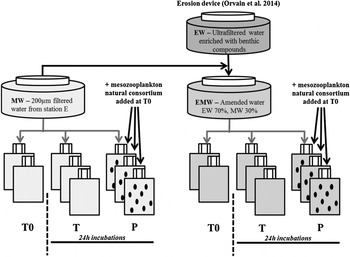
The mesozooplankton sensitivity to biofilm resuspension was studied by comparing the evolution of a ‘natural’ prey assemblage (diversity and abundances) in the presence and absence of predators (‘natural’ mesozooplankton consortium) during 24 h experiments (Figure 1).
Experimental setup showing the MW and EMW conditions. Treatments were performed in triplicate except for control (T0). They contained nanoflagellates – PNF and HNF) and dinoflagellates, diatoms and ciliates. Natural consortium of mesozooplankters were added in P treatments at the beginning of the experiments.

The experiments were performed both on a natural pelagic prey assemblage (‘Marine Water’, MW) and on the same pelagic assemblage enriched with benthic compounds (‘Enriched Marine Water’, EMW) according to the method described by Orvain et al. (Reference Orvain, Guizien, Lefebvre, Bréret and Dupuy2014). This erosion device was deployed on 50 l of <30 kDa ultra-filtered seawater collected at high tide at station E, a few days before the experiment (28 February 2008). It allowed enrichment of the ultra-filtered seawater with sedimentary particles, nutrients and biofilm (EW; see Montanié et al., Reference Montanié, Ory, Orvain, Delmas, Dupuy and Hartmann2014 for details). At the end of the process, EW was mixed with MW to constitute the marine water amended with eroded biofilm condition (EMW = EW 70%, MW 30%; Figure 1).
Sixteen incubators (polycarbonate bottles, 2.4 l) were filled with 200 µm filtered water, half with MW (‘pelagic’ condition) and half with EMW (‘biofilm enriched’ condition; Figure 1). For each condition, two incubators were fixed at the start of the experiment (control T0 – duplicates). A natural consortium of 30 mesozooplankters (12,500 ind m−3, maximal densities observed in situ) were added in three of them (treatment with predators P – triplicates) and their addition marked the beginning of the 24 h experiment. The last three incubators represented the treatment without predators (T, triplicates). All incubators were enriched in nutrients (final concentrations of 2.22 µMol l−1 in nitrate and 3.55 l−1 in phosphate) to compensate the excretion of mesozooplankton that could occur in P incubators. Predators were allowed to feed during 24 h. Incubators were kept in a 1 m deep mesocosm outside and gently homogenized every hour: they were thus submitted to natural temperature, light intensity and night-day rhythm conditions.
At the end of the experiment, mesozooplankters were collected by a 200 µm filtration in P incubators. Microphytoplankton and ciliates were preserved in alkaline lugol (2% final concentration) and counted by microscopy using Utermöhl settling chambers. Nanoflagellates were fixed with paraformaldehyde (1% final concentration), stored at 4°C, filtered on black polycarbonate 0.8 µm membranes, stained with DAPI and frozen at −20°C until counting under ultraviolet excitation to differentiate pigmented and heterotrophic nanoflagellates – PNF and HNF, respectively (Sherr et al., Reference Sherr, Caron, Sherr, Kemp, Sherr, Sherr and Cole1994). Prey were measured using a calibrated ocular micrometer and biovolumes were estimated by applying standard geometric formulae to each taxon (Hillebrand et al., Reference Hillebrand, Dürselen, Kirschtel, Pollingher and Zohary1999). The biovolumes were then converted in individual biomasses as 106 µm3 = 1 µg of wet weight (Lohmann, Reference Lohmann1908). For each condition and each incubators (2 × T0, 3 × T and 3 × P per condition), the abundances (ind l−1), the mean individual biomass (IB) and thus the mean population biomass (PB) were thus estimated for several prey: taxa (diatoms, ciliates) and functional groups (PNF, HNF, dinoflagellates).
The same experimental design was used to compare mesozooplankton production rate between EMW and MW conditions. Two size fractions were considered: 200–500 µm mesh and >500 µm mesh size. Incubations in 2.4 l flasks contained either one or the other fraction. The variation of size over the 24 h of the experiments was considered as a proxy of somatic production. For each condition, all individuals of each species from T0 and P incubators were measured: the prosome for calanoid copepods, the maximal length for cirriped larvae and cephalothorax + urosome for decapod zoea. For each species, the size fraction for which the maximum number of individuals was obtained was considered: 200–500 µm for Temora stylifera and barnacle larva, >500 µm for Acartia clausi, Paracalanus parvus and decapod zoea. For each state (T0 and P), a natural consortium of 200 mesozooplankters was added in P incubators at the beginning of the experiment in order to obtain at least 20 individual measurements per replicate and per species.
Environmental parameters
For each condition (MW and EMW), the initial concentrations of chlorophyll a (Chl a), pheopigments (Pheo), particulate organic matter (POM), nitrates, nitrites and phosphates were analysed for the T0 incubators according to conventional oceanographic techniques (Aminot & Kérouel, Reference Aminot and Kérouel2004). Active Chlorophyll (active Chl a) defined as (Chl a/(Chl a + 1.51 × Pheo)) was used as an index of the quality of the vegetal POM (Irigoien & Castel, Reference Irigoien and Castel1997).
Data analysis
Wilcoxon–Mann–Whitney tests were conducted to compare the initial concentrations for environmental parameters and planktonic compartments (T0) between MW and EMW conditions.
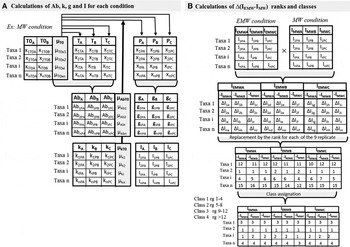
The growth rate k (d−1) and the mean abundance Ab of each prey (cell l−1), the mesozooplankton predation rate g (d−1) and the consumption rate I (N ind−1 l−1) on each prey were calculated according to Frost (Reference Frost1972). For each prey and each condition (MW and EMW), three values of k and Ab were calculated based on the mean prey abundance between the T0 bottles and the prey abundances measured in each of the T incubators (three values thanks to the ‘T’ triplicates; Figure 2A). For each prey /condition, three values of g and I were calculated based on the average k and Ab obtained with the T bottles and the prey abundances measured in each of the P incubators (three values thanks to the P triplicates; Figure 2A).
Description of the calculations of Ab, k, g and I for each condition (A) and the Δ(I EMW − I MW) ranks and classes used for the cross-calculation method. x designated the abundances obtained for each taxa and replicates (T0A and T0B for T0; TA, TB and TC for T; PA, PB and PC for P)

Wilcoxon–Mann–Whitney tests allowed determining which taxa were significantly brought from the eroded biofilm (abundances at T0 significantly higher in EMW than in MW conditions) and which taxa presented significant higher growth rates (g) in EMW vs MW conditions.
Wilcoxon signed rank tests were applied to determine the n potential prey's taxa or functional groups for which consumption rates were significantly positive for at least one condition. If the consumption rate was not significantly positive for one prey/condition, it was considered as null.
In order to compare the mesozooplankton consumption rates between biofilm-enriched (EMW) and pelagic conditions (MW), the difference Δ (I EMW − I MW) was calculated considering all combinations between replicates (Figure 2B) according to the cross-calculation method adapted from Azémar et al. (Reference Azémar, Boulêtreau, Lionard, Muylaert, Vyverman, Meire and Tackx2007): for each prey, nine values of Δ(I EMW − I MW) were thus calculated (3MW × 3EMW).
For each of these nine combinations, Δ(I EMW − I MW) were ranked (from rank 1 for the taxa corresponding to the highest Δ(I EMW − I MW) to rank n for the one with the lowest Δ(I EMW − I MW)). The ranked Δ(I EMW − I MW) were then related to certain ranked prey characteristics: (i) ΔEMW−MW of their mean abundances (Ab), (ii) ΔEMW−MW of their growth rate (k), (iii) ΔEMW−MW of their population biomass (PB) and (iv) their mean individual biomass (IB). For each prey characteristic, ranks were classified in four classes (Figure 2B). A dynamic cross table reported the cross number of observations for each Δ(I EMW − I MW) class and each ΔEMW−MW class of k, Ab, PB or IB (see Azémar et al., Reference Azémar, Boulêtreau, Lionard, Muylaert, Vyverman, Meire and Tackx2007 for details). For each prey characteristic, a Spearman rank test was then used to test the distribution for each Δ(I EMW − I MW) class and the different cumulated ΔEMW−MW class of k, Ab, PB or IB. This cross-calculation method adapted from Azémar et al. (Reference Azémar, Boulêtreau, Lionard, Muylaert, Vyverman, Meire and Tackx2007) allowed (1) to compare the predator consumption rates combining different communities of potential preys and enrichment conditions, (2) to use a non-parametric approach (based on a ranking method) since the low number of replicates did not permit the use of parametric tests.
Kruskal–Wallis ANOVA and Steel–Dwass post hoc test were used to detect significant fluctuations in size between T0, P-EMW and P-MW for each mesozooplankton species.
RESULTS
Initial conditions
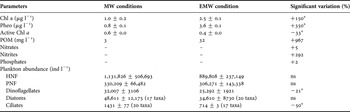
Significant higher concentrations of chl a and pheo were recorded for the EMW condition at the beginning of the experiment (Wilcoxon–Mann–Whitney test, P < 0.05; Table 1). In contrast, active chl a was significantly lower for the EMW condition (Wilcoxon–Mann–Whitney test, P < 0.05; Table 1).
Comparison of initial conditions between Marine (MW) and water amended with eroded biofilm (EMW).

Mean and standard error are reported per condition.
Variation were calculated as (EMW − MW)/MW × 100.
* Indicates a significant difference between the two conditions.
POM and nutrient concentrations were higher for the EMW condition with a high variation for POM (+967%) and nitrites concentrations (+292%). Nitrates and phosphates differences were negligible (Table 1).
Only dinoflagellates and ciliates presented significantly lower total densities for the EMW condition vs the MW condition (Wilcoxon–Mann–Whitney test, P < 0.05; Table 1) while no significant differences were detected for HNF, PNF and diatoms (Table 1). However, a higher number of taxonomic units were recorded for diatoms and a lower number for ciliates for the EMW condition (Table 1).
The natural consortium of mesozooplankton present in March 2008 at station E (MW) was co-dominated in abundances by holoplankton: three calanoid copepods – Acartia clausii (Giesbrecht, 1889) (38%), Temora stylifera (Dana, 1849) (10%) and Paracalanus parvus (Claus, 1863) (6%) – and two groups of meroplankton larva – cirriped nauplii (40%) and decapod zoea (6%). Species' details for copepods are given in Walter & Boxshall (Reference Walter and Boxshall2015).
Mesozooplankton grazing
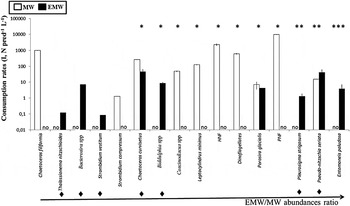
Significant positive consumption rates were recorded for 16 taxa/functional groups of prey for at least one condition – biofilm-enriched (EMW) or pelagic (MW) condition (Wilcoxon signed rank test, P < 0.05): HNF, PNF and dinoflagellates functional group, 10 taxonomic units of diatoms and two ciliates (Figure 3). Only these consumed taxa/functional groups are considered below.
Consumption rates per taxa (mean ± ES) for MW condition (‘Marine Water’; white bars) and EMW conditions (‘water amended with biofilm’, black bars). Only taxa for which rates were significantly positive for at least one condition were reported. Species were ranked along the horizontal axes according to an increasing EMW/MW abundance ratio. ***Species only present in EMW condition, ** and *Species present in MW and EW with respectively higher (**) and lower abundances (*) in EMW conditions. Diamonds indicate a significant growth rates in EMW vs MW conditions (no = no significant consumption rates).

DIFFERENCES IN PREY ASSEMBLAGES BETWEEN EMW AND MW
Among consumed taxa, 11 were significantly brought from the eroded biofilm (Wilcoxon–Mann–Whitney test, P < 0.05; Figure 3) considering the dilution effect of the mix EW:MW (70:30) for the constitution of the EMW condition. Only one diatom, Entomoneis paludosa (Reimer, 1975), was totally absent from marine waters and thus entirely brought from the resuspended biofilm. In contrast, three diatoms were not present at all in amended water (EW): Chaetoceros filiformis (Meunier, 1910), Thalassionema nitzschioides (Mereschkowsky, 1902) and Bacterosira spp. (Gran, 1900). Moreover, two species were proportionally more present in amended vs pelagic water: Pseudo-nitzschia seriata (Peragallo, 1899) and Pleurosigma strigosum (Smith, 1852). Species details for algae are given in Guiry & Guiry (Reference Guiry and Guiry2015).
None of the ciliates consumed by the mesozooplankton – Strombidium vestitum (Leegaard, 1915) and S. compressum (Leegaard, 1915), was present in amended water (EW). Species details for ciliophora are given in Warren (Reference Warren2015). Only three of the 29 ciliates recorded were actually significantly brought from the eroded biofilm during the experiment but none of those three was significantly consumed.
In contrast, the flagellate's functional groups were more abundant in amended water (EW) than in marine waters.
DIFFERENCES IN PREY'S GROWTHS BETWEEN EMW AND MW
Seven consumed taxonomic units presented significant highest growth rates in EMW vs MW conditions (Wilcoxon–Mann–Whitney test, P < 0.05; diamond symbols in Figure 3): one ciliate (Strombidium vestitum) and six diatoms (Thalassionema nitzschioides, Bacterosira spp., Chaetoceros curvisetus (Cleve, 1889), Biddulphia spp. (Gray, 1821), Pleurosigma strigosum, Pseudo-nitzschia seriata). Moreover, flagellates (HNF, PNF and dinoflagellates) displayed high negative growth rates in the EMW compared with the MW condition.
DIFFERENCES IN PREY'S CONSUMPTIONS BETWEEN EMW AND MW
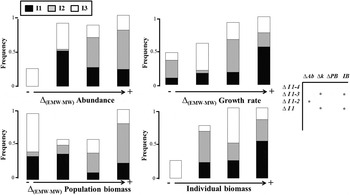
The Δ(I EMW − I MW) ranks were significantly and positively correlated with the Δk ranks, the IB ranks and slightly with ΔAb ranks while no correlation was observed with the ΔPB-ranks (Spearman correlations, Figure 4). The highest grazing rates observed in EMW were thus more related to the prey presenting higher growth rates and greater sizes (individual biomass) than to their abundances and their population biomasses.
Cumulated frequencies of the difference of consumption rates ranks between the EMW and MW conditions Δ(I EMW − I MW) of mesozooplankton in relation to the differences of abundances (Δ(Ab EMW − Ab MW)), growth rates (Δ(k EMW − k MW)), population biomass Δ(PB EMW − PB MW) and individual biomass IB rank of their prey. Significant correlations between ΔI (I1 for rank 1–4, I2 for rank 5–8 and I3 for rank 9–12) and differences in the preys characteristics are noted with a star on the right (Spearman correlation).

Mesozooplankton somatic production
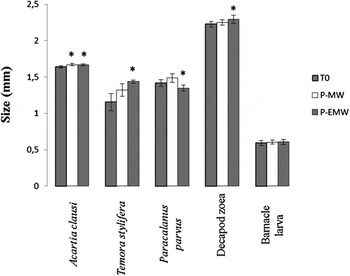
Cirriped larva did not show any significant fluctuation in size for both EMW and MW conditions compared with the beginning of the experiment (Kruskal–Wallis ANOVA and associated post hoc test, Figure 5).
Size (mean ± ES) of different mesozooplankton taxa for control incubators (T0), incubators with mesozooplankton for MW conditions (P-MW) and EMW conditions (P-EMW).

In contrast, Acartia clausii exhibited a significant size growth during the experiment in both conditions (Kruskal–Wallis ANOVA and associated post hoc test, P < 0.05; Figure 6). However, no significant difference was observed between the two conditions.
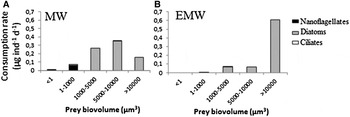
Consumption rate per class of prey biovolume (black for nanoflagellates, grey for diatoms and white for ciliates) in MW conditions (A) and EMW conditions (B).

No significant size-gain was observed in MW condition for Temora stylifera, decapod zoea and Paracalanus parvus (Kruskal–Wallis ANOVA and associated post hoc test, P > 0.05; Figure 5). Temora stylifera and decapod zoea exhibited a significant size-gain whereas Paracalanus parvus presented a significantly lower size in the biofilm enhanced condition (Kruskal–Wallis ANOVA and associated post hoc test, P > 0.05; Figure 5).
DISCUSSION
Several works had been conducted simultaneously during March 2008 at the same station. The trophic pathway that dominated the plankton assemblage at this time was described as a ‘multivorous food web’ (Ory et al., Reference Ory, Hartmann, Jude, Dupuy, Del Amo, Catala, Mornet, Huet, Jan, Vincent, Sautour and Montanié2010), in which herbivorous and microbial grazing modes have significant roles (Sakka Hlaili et al., Reference Sakka Hlaili, Niquil and Legendre2014). Previous works have shown that HNF and regenerated matter enhanced bacterial growth (Montanié et al., Reference Montanié, Ory, Orvain, Delmas, Dupuy and Hartmann2014). Inverse modelling showed that an excess of microphytobenthic production and a high carbon recycling by bacteria at the surface of the sediment generated carbon and nutrients potentially exportable to the water column at high tide (Saint-Béat, Reference Saint-Béat2012). The high bacterial growth was actually transferred to the pelagic compartment through HNF that may be grazed by zooplankton in the water column and thus channelled out through higher trophic levels (Montanié et al., Reference Montanié, Ory, Orvain, Delmas, Dupuy and Hartmann2014).
Is the mesozooplankton production favoured by the biofilm resuspension?
In the Marennes-Oleron Bay, mesozooplankton assemblages are characterized by a mixing of three ecological communities – oceanic, estuarine and intermediate – which relative importance varies seasonally, driven by hydrodynamic processes, i.e. balance between important oceanic inputs and significant continental inflows (Sautour & Castel, Reference Sautour and Castel1993). The natural mesozooplankton assemblage observed during March 2008 at the sampling station was typical of one previously described during early spring at this location: mesozooplankton was poorly diversified and the copepod community was dominated by Acartia clausii. The high relative abundance of cirriped larva was also previously described for the same area (Sautour & Castel, Reference Sautour and Castel1993).
Even if the two main taxa constituting the zooplankton assemblage were not sensitive to biofilm resuspension (A. clausii and cirriped larva), some taxa were favoured in water amended with eroded biofilm (T. stylifera, Decapod zoea) while P. parvus was disfavoured in term of somatic production. The response to biofilm resuspension is thus complex and taxa-dependent. The apparent tolerance of A. clausii and cirriped larvae to biofilm resuspension may explain their dominance in an estuarine station. The proximity to mudflat areas implies a great range in the contribution of the amended biofilm to the water column due to hydrodynamic processes on a short time scale, i.e. tidal cycle (De Jonge & Van Beusekom, Reference De Jonge and Van Beusekom1995).
Which pelagic carbon flows are impacted by the biofilm resuspension?
DIRECT INPUTS OF BENTHIC MICROORGANISMS FLOWING INTO PELAGIC ASSEMBLAGES
Biofilm resuspension has caused the input in the water column of large benthic or tychopelagic diatoms, usually recorded in local intertidal mudflats (Haubois et al., Reference Haubois, Sylvestre, Guarini, Richard and Blanchard2005), that were consumed by mesozooplankton grazers: Entomoneis paludosa, Chaetoceros curvesitus, Biddulphia spp., Pseudo-nitzschia seriata, Thalassionema nitzschioides and Pleurosigma strigosum. Such benthic diatoms are known to contribute highly to pelagic phytoplankton communities during winter in the Marennes-Oleron Bay (Guarini et al., Reference Guarini, Gros, Blanchard, Richard and Fillon2004). The presence of benthic diatoms may explain the higher species diversity observed in EMW vs MW conditions for diatoms. In contrast, neither of the two consumed ciliates (Strombidium vestitum and S. compressum) was brought by the biofilm resuspension during the experiment.
Even if flagellates were not determined at the species level during the experiment, changes were observed in the abundances of dinoflagellates between EMW and MW conditions: dinoflagellates abundances were significantly lower in water amended with biofilm while HNF and PNF abundances were not significantly different between the two conditions. However, none of the flagellates were significantly consumed in EMW conditions in contrast with MW conditions and flagellate biovolumes were lower at T0 in EMW conditions compared with MW conditions (0.76 ± 0.27 µm3 vs 1.27 ± 0.53 µm3 for MW conditions). Such results suggest the flagellates structure may have changed too. Biofilm resuspension had thus significantly changed the prey assemblages available in the water column for zooplankton grazers.
CHANGES IN PELAGIC PRODUCTION DUE TO BIOFILM RESUSPENSION
Several pelagic diatoms (Biddulphia spp., Chaetoceros curvisetus, Strombidium vestitum, Bacterosira spp., Thalassionema nitzschioides) as well as benthic ones (Pleurosigma strigosum, Pseudo-nitzschia seriata) exhibited enhanced growth rates with biofilm resuspension. These highest growth rates could allow a competitive advantage for these species in water amended with eroded biofilm caused either by a decreasing light availability or benthic nutrient inputs (Garstecki et al., Reference Garstecki, Wickham and Arndt2002). During the experiment, the water amended with eroded biofilm was enriched with inorganic nitrogen forms (mainly nitrites) whereas phosphorus inputs were negligible. However, the assumption of nutrient input enhancing algae production is unlikely in our experimental setup since all incubators (T and P) were nutrient enriched (both nitrogen and phosphorus forms) to compensate for the excretion of mesozooplankton that could occur in P incubators. A light limitation in EMW conditions is in contrast more likely since suspended particulate matter concentrations were higher in EMW than in MW treatments and that could explain a light limitation. Moreover, among the more competitive diatoms favoured in biofilm-enriched conditions, some are known to be R-strategists (‘ruderal’ species; Pseudo-nitzschia seriata, Chaetoceros curvisetus, Thalassionema nitzschioides) whereas among the non-competitive species some are S-strategist (‘Stress-tolerant’ species; Coscinodiscus spp. (Alves-de-Souza et al., Reference Alves-de-Souza, Gonzalez and Iriarte2008). In high nutrient environments, R-strategists are more competitive than S-strategists when light is limited (Reynolds, Reference Reynolds2006).
Among the 29 taxa of ciliates recorded during the experiment, 11 had significantly higher growth rates in water amended with biofilm whereas only six were significantly favoured in MW conditions. Only one of the favoured ciliates was consumed by mesozooplankton grazers (Strombidium vestitum). Ciliates are known to be a major component of the pelagic marine food webs, playing a crucial part of the multivorous food web since they consume prey of a wide size spectrum: bacteria, nanoflagellates, large diatoms as well as other ciliates (Pierce & Turner, Reference Pierce and Turner1992). The resuspended biofilm seems thus to stimulate ciliate growth even if some potential prey abundances (HNF, PNF) were not significantly different between the two conditions at the beginning of the experiment. The nanoflagellates that were brought by the biofilm might have changed the structure of the pelagic nanoflagellates assemblage, making them more sensitive to ciliate predation: the lower mean biovolume of nanoflagellates at T0 in EMW conditions may favour their grazing by ciliates. Nanoflagellates displayed high negative growth rates inducing a high mortality rate in the EMW controls (without mesozooplankton), which were lower in the presence of mesozooplankton. Some of this mortality rate in the controls might be explained by a predation exerted by ciliates on this functional group in the EMW treatments. This high grazing pressure exerted by ciliates on nanoflagellates confirms that the eroded biofilm facilitates the export rate toward the multivorous food web in late winter (Montanié et al., Reference Montanié, Ory, Orvain, Delmas, Dupuy and Hartmann2014).
CHANGES IN MESOZOOPLANKTON GRAZING DUE TO BIOFILM RESUSPENSION
The mesozooplankton grazing rates increased with prey growth rates and prey sizes (individual biomass) rather than prey population biomasses in biofilm-amended waters (Figure 4). This confirms the results observed in Figure 2: the most grazed species in EMW vs MW conditions are those benefiting in growth with biofilm resuspension. Mesozooplankton grazing rates may thus depend on the ability of their prey to regenerate their stock, with a preference for prey with larger individual biomass. Such results had been previously reported by Azémar et al. (Reference Azémar, Boulêtreau, Lionard, Muylaert, Vyverman, Meire and Tackx2007) for estuarine mesozooplankton. Moreover, the grazing rates on nanoflagellates in water amended with biofilm were significantly lower than in marine water conditions. The lower mean biovolume of nanoflagellates at T0 in EMW conditions compared with MW conditions may explain the absence of their grazing by mesozooplankton while it seems to favour their grazing by ciliates (Figure 6).
PELAGIC CARBON FLOWS IMPLIED BY THE BIOFILM RESUSPENSION
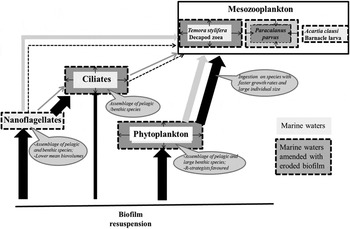
Biofilm resuspension caused (1) a direct input of benthic microorganisms that had changed prey structure in term of diversity and/or size and (2) a differential growth ability between prey taxa (Figure 7). Both changes have had consequences in terms of grazing rates for ciliates as well mesozooplankters suggesting a bottom-up control by benthic compounds on both micro- and mesozooplankton predation. Microzooplankton seemed favoured by the carbon export toward heterotrophic nanoflagellates suggested by Montanié et al. (Reference Montanié, Ory, Orvain, Delmas, Dupuy and Hartmann2014) while mesozooplankton switched their diet to largest autotrophic prey with faster growth rates (i.e. benthic diatoms as well as pelagic R-strategist diatoms). Nevertheless, ciliates constituted a very small part of the diet of mesozooplankters suggesting a decoupling between the carbon flow channelled out by nanoflagellates and the carbon flow due to MPB resuspension in the planktonic trophic pathways.
Schematic representation of the role of the biofilm resuspension on mesozooplankton in March 2008 over the Brouage mudflat. Grey and black arrows represent the fluxes through the pelagic trophic pathway in marine water and in water amended with eroded biofilm, respectively.

Which criteria drive the sensitivity of mesozooplankton taxa to biofilm resuspension?
Several taxa seemed to react differently to biofilm resuspension. Even if the dominant taxa were not sensitive (the copepod Acartia clausii and cirriped larva), Temora stylifera and decapod zoea were favoured in water amended with eroded biofilm contrary to Paracalanus parvus (Figure 7). All taxa constituting the mesozooplanktonic natural consortium fed preferentially on phytoplankton, mainly diatoms (Kerambrun et al., Reference Kerambrun, Thessalou-Legaki and Verriopoulos1993; Kumlu, Reference Kumlu1999; Ceballos & Ianora, Reference Ceballos and Ianora2003; Gaonkar & Chandrashekar Anil, Reference Gaonkar and Chandrashekar Anil2010), except the nano-particles grazer Paracalanus parvus (Pagano et al., Reference Pagano, Sagarra, Champalbert, Bouvy, Dupuy, Thomas and Charpy2012). The change in the size structure of nanoflagellates assemblage might have favoured ciliates at the cost of Paracalanus spp. since the nanoflagellates were not significantly grazed in EMW conditions. Even if the method employed here to evaluate the somatic production had been recognized as effective for copepod species (Kimmerer & McKinnon, Reference Kimmerer and McKinnon1987), it may also be biased for certain taxa. As an example, the somatic growth of cirriped nauplii could have been underestimated because of the consideration of the unique length as a proxy of production: the width may also be important due to its triangular form. However, the results suggest that the prey composition and its fluctuation over time on a short timescale could affect the physiology of mesozooplankton species, some prey being more appropriate to a predator physiology than others according to its trophic niche (Mazzocchi et al., Reference Mazzocchi, Buffoni, Carotenuto, Pasquali and Ribera d'Alcalà2006). The criteria that make a species more efficient to the production of its predator must be not only morphological (i.e. size, such as for P. parvus) but also biogeochemical (i.e. fatty acids composition, Pommier et al., Reference Pommier, Frenette and Glémet2010).
CONCLUSIONS
Benthic compounds implied a bottom-up control on both micro- and mesozooplankton predation in late winter in the Marennes-Oleron Bay characterized by a bare intertidal mudflat. While ciliates were favoured by the carbon export toward heterotrophic nanoflagellates, mesozooplankton switched their diet to the largest autotrophic prey with faster growth rates (resuspended benthic species and pelagic R-strategist species). Ciliates constituted a very small part of the mesozooplankton diet suggesting a decoupling between (i) an ‘herbivorous’ pathway from large phytoplankton through mesozooplankton and (ii) a ‘microbial’ pathway from bacteria to microzooplankton even if both pelagic carbon ways were controlled by benthic inputs.
Moreover, the sensitivity of mesozooplankton to resuspension appeared taxa-dependent suggesting a role of erosive actions on bottom substrates causing sediment resuspension on the spatio-temporal structuring of zooplankton assemblages and thus on the pelagic trophic pathways in macrotidal coastal ecosystems.
ACKNOWLEDGEMENTS
The authors thank Camille Treilhes, Samir Chekaoui, Laetitia Birée, Camille Fontaine, Margot de Crignis, Françoise Mornet, P. Catala and the personnel at both RV Tidalou and Estran for their technical support.
FINANCIAL SUPPORT
The French ANR (National Research Agency) provided the financial support for this study through the VASIREMI project ‘Trophic significance of microbial biofilms in tidal flats’ (contract ANR-420 06-BLAN-0393-01).