In Usage-Based (UB) theory, frequency and consistency of morphosyntactic structures in the input are key factors predicting acquisition sequences and rates (Lieven & Tomasello, Reference Lieven, Tomasello, Robinson and Ellis2008; Tomasello, Reference Tomasello2003). Young children in the process of learning two languages are likely to have less exposure, on average, to each language than monolinguals. Therefore, UB approaches might also predict there would be differences between bilingual and monolingual children's acquisition rates for some morphosyntactic structures because the frequency with which bilinguals hear and use these structures would be lower (Gathercole & Hoff, Reference Gathercole, Hoff, Hoff and Shatz2007). Thus, both distributional properties of morphosyntactic structures and bilingual learning could influence children's acquisition rates. Many studies comparing morphosyntactic acquisition in young bilinguals and monolinguals lend support to these predictions (Gathercole, Reference Gathercole2007; Gathercole & Thomas, Reference Gathercole, Thomas, Cohen, McAlister, Rolstad and MacSwan2005; Nicoladis, Palmer & Marentette, Reference Nicoladis, Palmer and Marentette2007; Pérez-Leroux, Pirvulescu & Roberge, Reference Pérez-Leroux, Pirvulescu and Roberge2009; Thordardottir, Rothenberg, Rivard & Naves, Reference Thordardottir, Rothenberg, Rivard and Naves2006). However, other studies have found more limited or non-existent bilingual–monolingual differences, in particular when bilinguals' dominant language of exposure was being examined (e.g. Gutiérrez-Clellen, Simon-Cereijido & Wagner, Reference Gutiérrez-Clellen, Simon-Cereijido and Wagner2008; Paradis, Reference Paradis2010; Paradis & Genesee, Reference Paradis and Genesee1996; Paradis, Crago & Genesee, 2005/Reference Paradis, Crago and Genesee2006). Therefore, further research on young bilinguals, taking differential exposure to each language and distributional properties of morphosyntactic structures into account, is needed to understand more about how input generally, and the bilingual experience more specifically, affects language acquisition. Accordingly, this study compared French–English bilingual four- to five-year-olds with monolingual peers in their acquisition of the past tense in both languages. The aim was to determine whether language exposure differences within bilinguals, and type/token frequency differences between regular and irregular past tense forms, would influence bilingual children's acquisition rates and how they compared to their monolingual peers.
Usage-Based theory and bilingual acquisition
UB theory belongs to a family of emergentist approaches to acquisition that assume children make use of a variety of domain-general perceptual, social and cognitive mechanisms to learn language without the guidance of innate knowledge and mechanisms specific only to language (O'Grady, Reference O'Grady2008). According to UB theory, these domain-general mechanisms of learning are highly sensitive to input properties such as type and token frequency, and semantic and phonological consistency; therefore, input properties drive the morphosyntactic acquisition process forward to a large extent (Lieven & Tomasello, Reference Lieven, Tomasello, Robinson and Ellis2008; Tomasello, Reference Tomasello2003). Focusing on inflectional morphology in particular, UB approaches consider the early acquisition of verbs and their morphology to be concrete and item-based, meaning that multimorphemic verb forms are initially stored holistically from the input. Consequently, early correct use of morphology is argued not to be productive, and morphological rules, or schemas, emerge gradually and in a piecemeal fashion, morpheme by morpheme (Gathercole, Sebastián & Soto, Reference Gathercole, Sebastián and Soto1999; Pizzuto & Caselli, Reference Pizzuto and Caselli1994; Tomasello, Reference Tomasello2003). The frequency and consistency properties of stem+morpheme constructions are thought to influence the emergence of productive schemas (Lieven & Tomasello, Reference Lieven, Tomasello, Robinson and Ellis2008; Theakston, Lieven & Tomasello, Reference Theakston, Lieven and Tomasello2003). This is because morphological schemas are acquired through a process of generalization across numerous stored items in an individual's lexicon, as discussed in the following section, ‘Usage-Based theory and the past tense’. Finally, UB theory assumes that both abstract schemas and language-specific morphophonological forms are interconnected in individual lexicons, and thus there is no mechanism for symbolic rules, inflectional morphemes and content lexical items to be stored separately (Lieven & Tomasello, Reference Lieven, Tomasello, Robinson and Ellis2008; Bybee, Reference Bybee, Robinson and Ellis2008; cf. Pinker & Ullman, Reference Pinker and Ullman2002).
If UB theory is on the right track, it is reasonable to assume that reduction in overall exposure to a language, most likely the case of bilinguals vis à vis monolingual age-mates, would impact children's rate of acquisition (Gathercole & Hoff, Reference Gathercole, Hoff, Hoff and Shatz2007). Gathercole (Reference Gathercole2007) reports the results of several studies with Spanish–English bilingual children, approximately between the ages of 7;0 and 10;0, that found these children to lag behind their monolingual peers in morphosyntactic abilities in each language, as measured by grammaticality judgments. Similarly, some studies of young French–English bilinguals have also found children's accurate production and grammaticality judgments of morphosyntactic structures to be lower than those of monolingual age-mates (Nicoladis et al., Reference Nicoladis, Palmer and Marentette2007; Paradis, Reference Paradis2010; Pérez-Leroux et al., Reference Pérez-Leroux, Pirvulescu and Roberge2009; Thordardottir et al., Reference Thordardottir, Rothenberg, Rivard and Naves2006). In contrast, other studies of both Spanish–English and French–English bilinguals have found no bilingual–monolingual differences for the structures examined (Gutiérrez-Clellen et al., Reference Gutiérrez-Clellen, Simon-Cereijido and Wagner2008; Paradis & Genesee, Reference Paradis and Genesee1996; Paradis et al., 2005/Reference Paradis, Crago and Genesee2006).
Variation in exposure to each language could influence bilingual children's rates of acquisition which, in turn, could be a determining factor in the presence of bilingual–monolingual differences. Gathercole's research with both Spanish–English and Welsh–English bilingual children revealed children's morphosyntactic abilities to be directly related to their exposure time at home and at school to each language (Gathercole, Reference Gathercole2007). Marchman, Martínez-Sussman & Dale (Reference Marchman, Martínez-Sussman and Dale2004) found that Spanish–English bilingual toddlers' percent input in each language was significantly and positively correlated to their morphosyntactic achievements in that language, according to parent report data. Thordardottir et al. (Reference Thordardottir, Rothenberg, Rivard and Naves2006) found that the French–English bilingual toddlers they examined performed on a par with monolinguals in French, but not in English. These researchers explained this asymmetry as possibly being the result of greater exposure to French at home. The bilingual–monolingual group differences in accuracy with English verb morphology found in Paradis (Reference Paradis2010) became non-existent when data from only balanced and English-dominant bilinguals were examined. Finally, both Paradis et al. (2005/Reference Paradis, Crago and Genesee2006) and Pérez-Leroux et al. (Reference Pérez-Leroux, Pirvulescu and Roberge2009) studied bilingual three-year-olds' production of direct object clitics in French and Paradis et al. (2005/Reference Paradis, Crago and Genesee2006) found no significant bilingual–monolingual differences, but Pérez-Leroux et al. (Reference Pérez-Leroux, Pirvulescu and Roberge2009) did find differences. One reason why these findings conflict could be related to exposure to French: children in the Paradis et al. study resided in a French majority city, while those in the Pérez-Leroux et al. study resided in an English majority city.
In addition to input variation within the bilingual experience, studies have demonstrated that bilingual acquisition rates are sensitive to the nature of the morphosyntactic structures examined, as monolingual acquisition rates would be. For example, Gathercole & Thomas (Reference Gathercole, Thomas, Cohen, McAlister, Rolstad and MacSwan2005) found an interaction between the semantic and phonological consistency of Welsh inflectional morphemes, as well as languages spoken at home, on bilingual children's acquisition rates for Welsh morphology (see also Paradis, Reference Paradis2010). Similarly, Nicoladis et al. (Reference Nicoladis, Palmer and Marentette2007) examined the use of the past tense in a story-retelling task in French and English by bilingual and monolingual children aged 4;0–6;0. While they found that the bilinguals lagged behind the monolinguals in general, this pattern interacted with the distributional frequency properties of the regular and irregular past tense forms in each language. (These properties are discussed in detail in the next section.)
In sum, on the one hand, research indicates that bilingual children's acquisition rates can be slower than those of monolinguals, thus revealing the sensitivity of the language acquisition process to variations in the amount of input. On the other hand, research indicates that differential exposure to each language and the input properties of the morphosyntactic structure also influence bilingual children's acquisition rates. Consequently, bilingual–monolingual differences can greatly diminish or even disappear in bilinguals' dominant language of exposure and/or for more consistent and frequent morphosyntactic structures.
Usage-Based theory and the past tense
This section is focused on the input frequency properties of inflectional morphology, and their impact on acquisition rates by both monolinguals and bilinguals. Bybee's UB model of the lexicon has been adopted for this study, as it is consistent with the overall UB approach discussed above (Bybee, Reference Bybee1995; Reference Bybee2001; Reference Bybee2002; Reference Bybee, Robinson and Ellis2008).Footnote 1 In Bybee's model, the lexicon is comprised of a complex network of words, phrases and even larger constructions. Multimorphemic words are stored items and are inter-connected through shared phonological and semantic features. Thus, verb stems and their inflected constructions, e.g. walk, walk-ed, walk-ing, walk-s, are all stored in the lexicon, and inter-connected through the shared phonological segments and semantics. They are also connected through some shared phonological segments of the stem, and phonological and semantic features of inflectional morphemes, with other verbs, e.g. talk, talk-ed, talk-ing, talk-s. Thus, walked and talked would be connected at the level of [-ed] via phonological form and semantic features, and would also be connected at this level with other verb+ed words in the lexicon, i.e. worked, picked, etc. Verbs with irregular past tense forms, like sleep, slept, sleep-s, sleep-ing, would also be connected with each other via semantic features and whichever sounds they share, but slept would only be connected to other past tense forms of the regular pattern verb+ed via semantic features. Bybee (Reference Bybee, Robinson and Ellis2008) argues that semantics trumps phonology in influencing lexical storage and use, and thus even completely phonologically unrelated forms like go and went are connected in the lexicon.
Individual phonological/semantic forms have varying degrees of lexical strength. Token frequency in the input and in the language user's output increases the lexical strength of a word directly, and indirectly, to the other words, mono- and multimorphemic, it is connected to phonologically and semantically. The greater the lexical strength of a word, the more likely it will be accessed appropriately and produced accurately in the speech of language learners. A crucial aspect of this model is the role of type frequency in acquisition. The type frequency of a verb form, or ‘schema’, is the number of unique stem+morpheme constructions in the speaker's lexicon, or in the input, of that type. Type frequency determines, in part, the lexical strength of a stem+morpheme schema. In other words, lexical strength can be built through the network of shared phonological and semantic features of the inflectional morphological schema and not just through the token frequency of individual stem+morpheme constructions. The productivity of a schema like [verb [ed]]past tense is determined by the learner having a critical mass of verb forms with this suffix stored in the lexicon. Learners' accuracy and consistency in applying this schema to verbs with past temporal reference in language production is increased gradually as the lexical strength of the schema is increased. Lexical strength is increased via use of individual verb forms (token frequency) and other forms of the same schema (type frequency) (see especially Bybee, Reference Bybee1995). Therefore, both token and type frequency are important determinants of learners' increasing accuracy with verb morphology in this UB model of the lexicon, but type frequency is possibly more relevant to the issue of achieving a critical mass of input, i.e. sufficient input, for a schema to emerge and become productive (Bybee, Reference Bybee, Robinson and Ellis2008).
With respect to English irregular verb forms, such as run–ran, or take–took, there are no schemas that operate across forms, with a few exceptional but small lexical gangs or families, like ring–rang, sing–sang. Most English irregular verbs are unique and considered to be inflectional islands (Bybee, Reference Bybee2002) and, as such, are entirely dependent on token frequency to build lexical strength and become accurately used in learners' production. Irregular forms are also subject to over-regularization (*runned instead of ran), defined in this model as the overapplication of the [verb [ed]]past tense schema due to its superior lexical strength. Overapplication would occur until enough token instances of the irregular form have been heard and used by the learner to enable that particular irregular form to become instantiated as an inflectional island. Because regular past tense forms can be acquired on the basis of type and token frequency, but irregular forms rely heavily or exclusively on token frequency, schema productivity and accuracy with regular verbs should emerge in learners earlier than accuracy with irregular verbs, as a group, and regardless of whether children are bilingual or monolingual. (Very high frequency irregular verbs like fall–fell, could be produced accurately early on because they are relatively easily instantiated; cf. Marchman & Bates (Reference Marchman and Bates1994) ; Marcus, Pinker, Ullman, Hollander, Rosen & Xu (Reference Marcus, Pinker, Ullman, Hollander, Rosen and Xu1992).)
Thus far, the simple past in English has been used to exemplify regular versus irregular forms, i.e. the verb+ed and strong verbs, respectively. A similar, although not identical, distinction can be made in French. Like other Romance languages, French has verb classes commonly referred to as conjugations. The past temporal reference verb form that is the closest semantically to the English simple past is the passé composé, a periphrastic construction of an auxiliary verb and a past participle (Bassano, Laaha, Maillochon & Dressler, Reference Bassano, Laaha, Maillochon and Dressler2004). The participle form varies according to the conjugation. The vast majority of French verbs are 1st conjugation (Bybee, Reference Bybee1995; Clark, Reference Clark and Slobin1985), and the present indicative and passé composé are formed as follows: il marche ‘he walks’/il a marché ‘he walked’. The 2nd and 3rd conjugations can be construed as consisting of families of irregulars because the type frequencies of the participle forms are much lower than the [aux+verb [é]]past part schema for the 1st conjugation; however, family membership is relatively higher than for English irregular verbs (Nicoladis et al., Reference Nicoladis, Palmer and Marentette2007). Because some families of irregular participle forms in French have many more members than the ring–rang/sing–sang families in English, this may be the reason that over-regularization can take more than one form in French (Nicoladis et al., Reference Nicoladis, Palmer and Marentette2007; Nicoladis & Paradis, Reference Nicoladis and Paradisin press). In other words, there are more competing productive schemas than just the dominant regular schema from the 1st conjugation. For example, for the verb prendre ‘to take’, the correct passé composé form is elle a pris ‘she took’, but an over-regularized form could be either *elle a pren(d)é ‘she taked’, after the 1st conjugation, or *elle a pren(d)u ‘she taked’ after the sizable family of 3rd conjugation verbs that have the participle ending in [-(d)u]. In sum, the regular–irregular distinction can be made in French when regular is defined on the basis of type frequency as in Bybee's model. Nevertheless, this distinction is more gradient than it is in English, and this could influence acquisition patterns and rates. For example, while the regular past tense schemas ought to be acquired in advance of the less type-frequent irregular ones in both languages, this distinction might be less prominent in French.
A related distinction to be made between French and English is in the distribution of regular and irregular verb forms in the use of each language. Corpus-based analyses of Nicoladis and colleagues showed that, in English, regular verbs tend to have lower token frequency than many irregular verbs; whereas, in French, many regular (1st conjugation) verbs are high in token frequency, and many irregular verbs are low in token frequency (Nicoladis et al., Reference Nicoladis, Palmer and Marentette2007). These cross-linguistic differences in token frequency in language use could yield some differences in acquisition rates between languages. For example, the schema for regular verbs in French might be acquired more easily than the schema for regular verbs in English because in French it is high in both type and token frequency. For the irregular verbs in both languages, those in English tend to be more frequent in the language being used; however, those in French have more productive schemas with more family members in each – higher type frequency. Following Bybee (Reference Bybee, Robinson and Ellis2008), if type frequency is a stronger determinant of acquisition, one could expect the irregular verbs in French to be acquired more easily than those in English, except for very high frequency irregulars in English.
To summarize, following Bybee's UB model of the lexicon, regular past tense forms in both French and English should be acquired in advance of irregular past tense forms in both languages because they have higher type frequencies. At the same time, some differences in acquisition rates between regular and irregular past tense forms might be apparent within and across the languages.
Acquisition of the past tense in French and English
The majority of research on the acquisition and psycholinguistic processing of the past tense in children and adults has been devoted to the theoretical debate between dual- versus single-route models (see Pinker & Ullman, Reference Pinker and Ullman2002, and McClelland & Patterson, Reference McClelland and Patterson2002, for reviews). Research on the acquisition of the past tense in English- and French-speaking children is summarized here without engaging in this debate. Whether French–English bilingual acquisition of the past tense best supports a single- or dual-route model is the subject of another study (Nicoladis & Paradis, Reference Nicoladis and Paradisin press).
English-speaking children produce both regular and irregular verbs with past tense inflection by the age of 2;0–2;6, as shown by parental checklists and spontaneous speech data (Marchman & Bates, Reference Marchman and Bates1994; Marcus et al., Reference Marcus, Pinker, Ullman, Hollander, Rosen and Xu1992; Thordardottir, Reference Thordardottir2005). These studies show that while some high-frequency irregular past tense verb forms initially appear well-formed in children's speech, when the regular past begins to become productive, the irregular past tense verbs appear mainly in over-regularized forms. Children gradually become more accurate with irregular verbs, although the relationship between morphological accuracy and lexicon size and composition is disputed (Marchman & Bates, Reference Marchman and Bates1994; Marcus et al., Reference Marcus, Pinker, Ullman, Hollander, Rosen and Xu1992). According to norming sample information for the standardized Test of Early Grammatical Impairment (TEGI: Rice & Wexler, Reference Rice and Wexler2001), English-speaking children do not reach stable and ceiling performance (90 percent correct or greater) on the past tense elicitation probe for regular verbs until the ages of 4;6–5;0; ceiling performance with irregular verbs is not reached even by age 7;0 (see also Oetting & Horohov, Reference Oetting and Horohov1997; Nicoladis et al., Reference Nicoladis, Palmer and Marentette2007). For regular verbs, incorrect responses on the TEGI tend to be bare verb stems, and for irregular verbs, they tend to be either bare verb stems or over-regularized forms (Rice & Wexler, Reference Rice and Wexler2001).
French-speaking children also begin to use verbs in contexts for past temporal reference in their spontaneous speech around age 2;0–2;6 (Bassano et al., Reference Bassano, Laaha, Maillochon and Dressler2004; Paradis & Genesee, Reference Paradis and Genesee1996; Reference Paradis and Genesee1997; Thordardottir, Reference Thordardottir2005). Errors with the passé composé in young French children's language tend to be either the bare verb stem or the bare past participle/infinitive without the auxiliary (Bassano et al., Reference Bassano, Laaha, Maillochon and Dressler2004; Paradis & Genesee, Reference Paradis and Genesee1996; Reference Paradis and Genesee1997).Footnote 2 Studies with French-speaking three-year-olds using spontaneous speech (Paradis & Crago, Reference Paradis and Crago2001) and elicitation (Jakubowicz & Nash, Reference Jakubowicz and Nash2001; Royle & Thordardottir, Reference Royle and Thordardottir2008) found that children this age make omission and commission errors with the passé composé, and thus are still in the process of acquiring this construction. Parallel to English-speaking children, Royle & Thordardottir (Reference Royle and Thordardottir2008) found French-speaking children to be more accurate with regular than irregular past tense verbs in French. French-speaking children seem to reach 90 percent or greater accuracy with the passé composé by the age of 6;0 to 7;0 for both regular and irregular verbs (Jakubowicz & Nash, Reference Jakubowicz and Nash2001; Nicoladis et al., Reference Nicoladis, Palmer and Marentette2007; Paradis & Crago, Reference Paradis and Crago2001). Large sample data like those in Rice & Wexler (Reference Rice and Wexler2001) do not exist for this construction in French, but these smaller sample studies suggest that that the passé composé might be mastered a little later than the simple past tense in English.
Research questions for this study
The goal of this study was to test the predictions of UB theory for the bilingual acquisition of morphosyntax. This study was designed to further our understanding of the role of input factors on acquisition rates: variation in exposure time (between monolinguals and bilinguals, and within bilinguals), and type and token frequency of morphological schemas (regular and irregular past tense). The specific research questions guiding our methods and analyses were as follows:
(i) Are bilingual children less accurate than monolinguals in the production of the past tense in English and in French?
(ii) Does the language of greater exposure at home influence bilinguals' accuracy with the past tense in each language?
(iii) Are children more accurate with regular than irregular verb forms in both languages and how does this interact with differential exposure to that language?
The present study builds on Nicoladis et al. (Reference Nicoladis, Palmer and Marentette2007) in the following ways: (i) using an elicitation task, which gives more control of which verbs children use than naturalistic speech; (ii) systematically including home language use as a variable in the analyses; and (iii) recruiting a larger number of children, the majority of whom were preschoolers.
METHOD
Participants
Forty-four children participated in this study: twenty-three French–English bilingual children (mean age=4;10, SD=0;5, range=4;1–5;7) and twenty-one French monolingual children (mean age=4;9, SD=0;5, range=3;7–5;4). An independent samples t-test confirmed no significant difference in the ages between the bilingual and French monolingual groups. An English monolingual participant group was not necessary because the bilinguals' performance could be compared to the means of the norming sample group from the English past tense probe, since it was part of a standardized test, the TEGI (Rice & Wexler, Reference Rice and Wexler2001). The bilingual children resided in Edmonton, Canada, and the monolingual children resided in Montréal, Canada. All bilingual and French monolingual children were attending a French language daycare, preschool or kindergarten, which was the location where the testing took place. The French spoken in Edmonton and Montréal both belong to the Laurentian Canadian French variety, and no systematic differences in the use of the passé composé would be expected, nor has been documented, between these two regions (Rochet, Reference Rochet and Poirier1994; Walker, Reference Walker, Valdman, Auger and Piston-Halten2005). Furthermore, many of the bilingual children who participated in this study had one or both parents who came from the province of Québec, where Montréal is situated.
Procedures
Parental questionnaire
The bilingual children's parents were given a short questionnaire on their child's language learning history and the family's current language use in the home as part of the information and consent form. For example, parents where asked whether English, French or both was/were their child's first language(s), and if there was a sequence in acquisition, at what age was their child first exposed to the second language. Parents were also asked on a rating scale of 1 to 5 to rate their child's fluency in French and in English, where 1=‘just functional in that language’ and 5=‘very fluent in that language’. Finally, parents were asked to indicate which language they used more often with their child. Answers were on the following rating scale: 1=‘only English’, 2=‘mainly English’, 3=‘French and English equally’, 4=‘mainly French’ and 5=‘only French’, and there were separate scales for each parent. Results from the question regarding first language indicated that thirteen of the twenty-three were simultaneous bilinguals from birth, and the remaining ten children were very early sequential bilinguals, with exposure to the other language beginning, on average, at age 1;6. The questions about what language each parent spoke to the child were used to determine the language of greater exposure at home. Scores from the scale for each parent were added together, to make a maximum of 10. If a child were in a household where only French was spoken by the parents, their score would be 10. If a child were in a household where only English was spoken, their score would be 2. If both languages were used equally by both parents, then the child's score would be 6. These scores were used in the analyses as a continuous variable measuring language exposure, as well as a categorical variable to create groups.
In the case of the categorical variable, children with scores of 7–10 were categorized as having more French input at home, and children with scores from 5–2 were categorized as having more English input at home. There were two children with scores of 6, thus not enough to form a group. In these two cases, we examined what the parents indicated was the child's stronger language, in order to break the tie, on the grounds that (i) input is seldom perfectly balanced, when one considers the matter beyond a 5-point rating scale, and (ii) the stronger language is most likely to coincide with the language of greater input in the home for preschool children. For one child, the stronger language by parental report was English, and the other French, and so they were placed in the ‘more English input’ and ‘more French input’ group for the analyses using language exposure as a categorical variable. Descriptive statistics for the dependent variables are given in the Appendix for the entire bilingual group (N=23), and for the bilingual group with the two children with input scores of 6 removed (N=21). This comparison shows there are no differences in the overall patterns, and only minor differences in absolute scores. Thus, statistical analyses were conducted with the whole sample. The mean score on the combined scales of language exposure was 5·86 (SD=2·2, range=2–10). The mean ages between the more-English (ME) and more-French (MF) input groups was roughly equivalent (ME=57·33 (SD=4·85) and MF=57·75 (SD=5·8)); A t-test confirmed no significant difference between them.
For all the children, there were no contradictions between parental rating of a child's fluency and parental report of language use with their children. For example, parents did not indicate that they used mainly English with their child, but that their child was fluent in French and just functional in English. In the sample as whole, there were eight children with more French input at home, and fifteen with more English input. Furthermore, concerning the ten early sequential bilinguals, these children ended up being placed in the ‘more English input’ group if their first language was English, or in the ‘more French input group’, if their first language was French, as a consequence of the placement according to language use in the home. It would be expected that early sequential bilinguals would have experienced less exposure to their second language than to their first language. Thus, this difference in exposure time between the first and second language has been captured by the parental report of language exposure at home. Finally, all the bilingual children in the study, whether simultaneous or very early sequential, were spontaneous and proficient enough in both languages to do the past tense/passé composé tasks. In the course of data collection, five children were excluded from the bilingual group in this study because they were not proficient enough in both languages to complete the tasks.
Past tense elicitation tasks
The children were given a past tense elicitation task in both languages, or just in French in the case of the monolinguals. Because this research was conducted as part of a larger study, three other tasks, two in French and one in English, were also given to the bilingual children. It took two testing sessions of approximately 20 to 30 minutes each to complete all the tasks. The English tasks were given together by a native speaker of English, and the French tasks were given together by a native speaker or a near-native speaker of French. The order of the French versus English groups of tasks, and the order of tasks within each language, was alternated between children as testing took place.
The English task for this study consisted of the past tense probe from the TEGI (Rice & Wexler, Reference Rice and Wexler2001). The motivation for using the TEGI was that bilingual children's performance could be compared to a larger sample of their monolingual age peers than could be obtained through our own testing. For this probe, children were shown a picture of a child engaged in an activity followed by a picture of the child having completed the activity, and were given the following prompt, with the verb varying according to the picture: Here, the boy is painting. Now he is done. Tell me what he did. A French passé composé probe was designed to mirror the TEGI past tense probe. The French probe also consisted of paired images of activities in progress and then completed. Children were given the following prompt, with the verb varying according to the picture: Regarde, il boit son lait. Maintenant il a fini. Dis-moi ce qu'il a fait ‘Look, he is drinking his milk. Now he's finished. Tell me what he did’. Both the English and French probes included training picture sets.
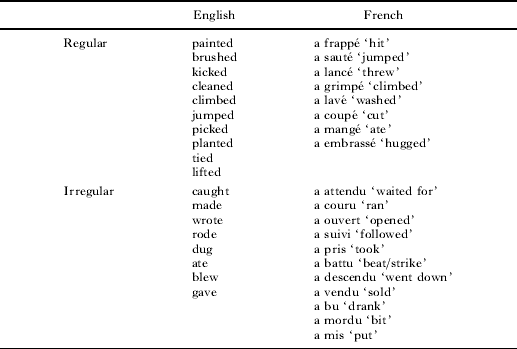
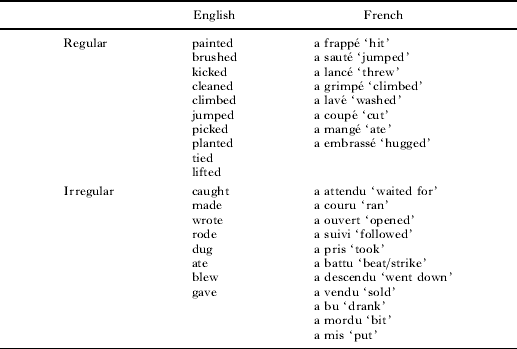
As shown in Table 1, the target verbs on the English probe consisted of ten regular and eight irregular verbs. On the French probe, there were eight regular and eleven irregular verbs. There are slightly more irregulars in French in order to ensure common families of irregular forms were well represented. Verbs used in the TEGI are likely to be familiar to children this age (Rice & Wexler, Reference Rice and Wexler2001), and they appear in parental input to preschool children according to the CHILDES database (Nicoladis & Paradis, Reference Nicoladis and Paradisin press; MacWhinney, Reference MacWhinney2000; www.childes.cmu.edu). Choosing the verbs for the French probe could not be done through direct translation of the English verbs because of semantic differences between the languages and differences in whether a verb shows a regular or irregular pattern in the past tense. Three translation equivalent verbs, eat/manger, jump/sauter and climb/grimper, appear on both probes. Verbs for the French probe were chosen on the basis of imageability, likelihood of familiarity for children this age and irregular family pattern. Imageability refers to whether the activities denoted by the verb could be clearly depicted as ongoing and then completed. Regarding familiarity, these French verbs appear in parental input according to the (limited) CHILDES database for French (Nicoladis & Paradis, Reference Nicoladis and Paradisin press; MacWhinney, Reference MacWhinney2000; www.childes.cmu.edu), and most of them also appear in Nicoladis et al. (Reference Nicoladis, Palmer and Marentette2007) and Royle & Thordardottir (Reference Royle and Thordardottir2008). Seven of the eleven French irregular verbs were chosen from the most common 3rd conjugation family, those with the past participle [stem-u]: attendre–attendu ‘wait for’, battre–battu ‘beat/strike’, descendre–descendu ‘go down X’, vendre–vendu ‘sell’, mordre–mordu ‘bite’, boire–bu ‘drink’, courir–couru ‘run’ (Bescherelle, Reference Bescherelle1996). Three of the remaining four verbs had past participles ending in [-i(s)], another sizable family of the third conjugation: mettre–mis ‘put’, prendre–pris ‘take’, suivre–suivi ‘follow’. The eleventh irregular verb is from a smaller 3rd conjugation family: ouvrir–ouvert ‘open X’. Although most of the irregular verbs in the French probe had two past participle suffixes, several of them show phonological changes between the verb stem and the past participle, and thus are not completely transparent.Footnote 3
Verbs from the French and English (TEGI) past tense probes
The children's responses to the elicitation tasks were written by the experimenter during testing as well as recorded on digital audiotape for later transcription and verification with the written response. There was agreement 91 percent of the time between the audiotape and the written form. In the case of any discrepancies, the child's response according to the audio-recording was used. The verification between the audio-recordings and the written form was undertaken by a different research assistant than the experimenter approximately 50 percent of the time.
Scoring for the TEGI probe was conducted according to the instruction manual, in order to enable comparison of the children in this study with the TEGI norming sample children. Scoring for the French probe was designed to be parallel to the system for the TEGI. Children's responses were coded first as scorable or unscorable on both probes. Unscorable responses included sentence fragments, off-topic responses and responses using tense–aspect constructions such as the present or past progressive in English or the imparfait in French. Scorable responses included correctly and incorrectly formulated attempts at the past tense, with bare verb stems/infinitives and incorrectly formulated past tense forms counted as incorrect. If the child used a non-target verb, but used it in the past tense, this was counted as a scorable response, unless it was did in English or a fait ‘did’ or a fini ‘finished’ in French, since these forms were given in the prompts (cf. Rice & Wexler, Reference Rice and Wexler2001: 155). Scorable responses were calculated as proportion correct scores for regular and irregular verbs. The categorization of a verb as regular or irregular was based on the actual verb the child used and not the target verb given, if these differed (Rice & Wexler, Reference Rice and Wexler2001: 18–19). A second calculation was made for the regular and irregular verbs combined, which is called ‘past-finite’. In this calculation, responses that were considered to be ‘correct’ included correct forms of the regular verbs, and correct forms or over-regularized forms of the irregular verbs. The logic of the past-finite score is that it measures how well a child marks the past tense generally across all the verbs in the probe, regardless of form correctness for irregulars. Over-regularized irregular verbs in English are responses such as digged instead of dug, and in French they are responses such as a ouvri or a ouvrir for a ouvert ‘opened’.Footnote 4 To summarize, proportion correct scores for past-finite, past-regular and past-irregular are the dependent variables in this study. Detailed analyses of these children's error types are the subject of a different study aimed at the dual- versus single-route debate (Nicoladis & Paradis, in press). Therefore, a detailed analysis of error types is not included in the present study.
RESULTS
English past tense
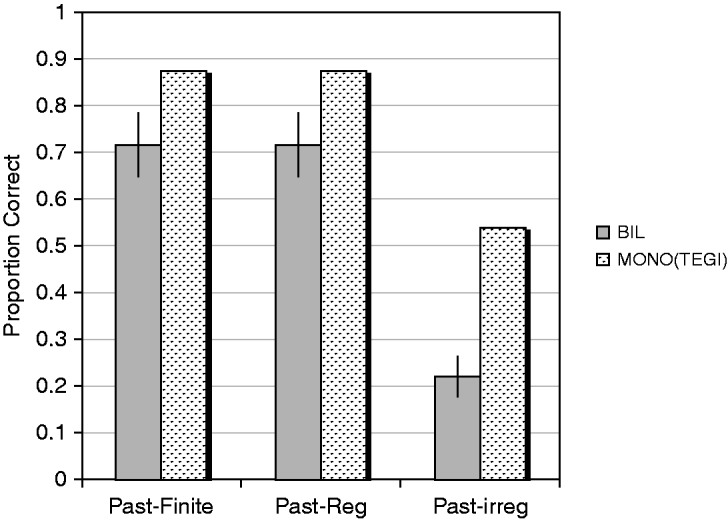
The mean proportion correct scores for past-finite, past-regular and past-irregular in English are presented in Figure 1 for the bilingual children and for the TEGI norming sample children in the same age range.Footnote 5 One-sample t-tests conducted between the bilingual and monolingual groups showed the monolinguals to have higher scores for past-finite (t(22)=–2·311, p=0·031, d=0·99), past-regular (t(22)=–2·353, p=0·028, d=1·0) and past-irregular (t(22)=–7·334, p<0·001, d=3·13). Interpretations based on Cohen's d indicate that past-finite and past-regular group differences had a medium effect size, but the past-irregular group differences had a large effect size (Cohen, Reference Cohen1988).
Mean proportion correct scores for the English past tense probe from bilinguals and monolinguals (TEGI).
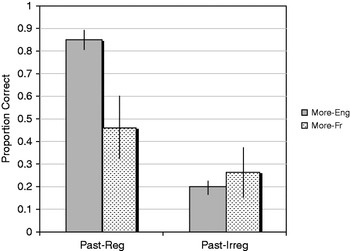
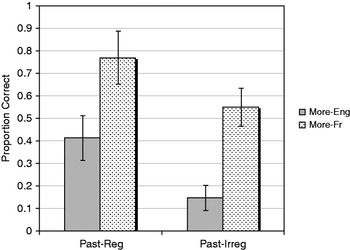
Significant correlations were found between bilingual children's scores on the home input measure and their scores on past-finite (r=−0·654, p<0·01) and past-regular (r=−0·609, p<0·01), but a correlation was not significant between input and past-irregular scores. These correlational analyses were followed up with between-group analyses. The mean proportion correct scores for the ME input and MF input bilingual groups for past-regular and past-irregular are given in Figure 2. A 2-way ANOVA with one repeated (past-regular and past-irregular) and one between-groups (ME, MF) factor was conducted. Results showed a significant main effect for past tense type (Wilk's Lambda=0·0807, F(1, 21)=8·771, p=0·001, partial eta-squared=0·807, observed power=1·0), a significant interaction between input group and past tense type (Wilk's Lambda=0·455, F(1, 21)=2·51, p=0·001, partial eta-squared=0·545, observed power=0·998), but no significant main effect for input group. Thus, this analysis indicated that bilingual children as a group were more accurate with regular than irregular past tense forms, and the ME group were more accurate for regular forms than the MF group. The groups had similar and very low scores for the irregular past tense forms.
Mean proportion correct scores for regular and irregular verbs in English from bilinguals in home language input groups.

Additional comparisons were carried out between the monolingual TEGI norming sample and the bilinguals divided into input groups. A series of one-sample t-tests between the ME group and the monolinguals revealed no significant differences for past-finite or past-regular, but a significant difference was found for past-irregular, with a large effect size (t(14)=−10·934, p<0·001, d=5·84). By contrast, t-test comparisons between the MF group and monolinguals revealed significant differences for all three measures, and with large effect sizes (past-finite: t(7)=−3·034, p=0·019, d=2·29; past-regular: t(7)=−2·964, p=0·021, d=2·24; past-irregular: t(7)=–2·420, p=0·05, d=1·83). Thus, while bilinguals as a group had lower scores than monolinguals, bilingual children with relatively more English input had scores similar to their monolingual peers for past-finite and past-regular.
French past tense
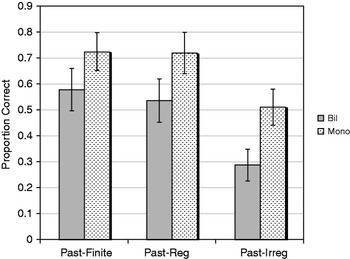
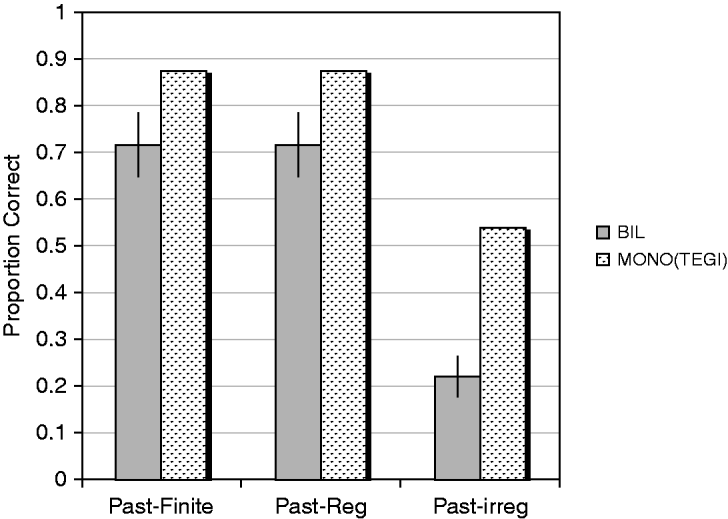
The mean proportion correct scores for past-finite, past-regular and past-irregular in French are presented in Figure 3 for the bilingual and French monolingual children. Independent sample t-tests conducted between the bilingual and monolingual groups showed that monolinguals had higher scores for past-irregular (small effect size) (t(42)=−2·410, p=0·02, d=0·74), but there were no significant differences between bilinguals and monolinguals for past-finite and past-regular.
Mean proportion correct scores for the French past tense probe from bilinguals and monolinguals.

Significant correlations were found between bilingual children's scores on the home input measure and their scores on past-finite (r=0·423, p<0·05), past-regular (r=0·433, p<0·05) and past-irregular (r=0·630, p<0·01) in French. As with the English data, these correlational analyses were followed up with between-group analyses. The mean proportion correct scores for the ME and MF input bilingual groups for past-regular and past-irregular in French are given in Figure 4. A 2-way ANOVA with one repeated (past-regular and past-irregular) and one between-groups (ME, MF) factor was conducted. Results showed a significant main effect for past tense type (Wilk's Lambda=0·520, F(1, 21)=19·38, p<0·001, partial eta-squared=0·480, observed power=0·99), and a significant main effect for input group (F(1, 21)=9·841, p=0·001, partial eta-squared=0·319, observed power=0·849), but no significant interaction between input group and past tense type. Thus, this analysis indicated that, as a group, bilingual children were more accurate with regular than irregular past tense forms in French, and the MF group was more accurate than the ME group for both past tense types.
Mean proportion correct scores for regular and irregular verbs in French from bilinguals in home language input groups.

As with the English data analyses, additional comparisons were carried out between the monolinguals and the bilinguals divided into input groups. A series of independent sample t-tests between the MF group and the monolinguals revealed no significant differences for past-finite, past-regular or past-irregular. By contrast, t-test comparisons between the ME and monolingual groups revealed significant differences for all three past tense types, and with effect sizes ranging from small to medium (past-finite: t(34)=−2·262, p=0·03, d=0·78; past-regular: t(34)=−2·407, p=0·02, d=0·85; past-irregular: t(34)=−3·797, p=0·001, d=1·3). Thus, while bilinguals as a group had lower scores than monolinguals only for past-irregular, the bilingual children with relatively more English input had lower scores in French than their monolingual peers for all past tense types.
DISCUSSION
The aim of this study was to test predictions of UB theory regarding sensitivity of bilingual children's acquisition rates to input factors. Bilingual and monolingual children's accuracy in the production of the past tense in both languages was examined. In addition, bilingual children's accuracy was examined as a function of differential exposure to each language, and regular versus irregular verb forms. The specific research questions asked in this study were: (i) Are bilingual children less accurate than monolinguals in the production of the past tense in English and in French? (ii) Does the language of greater exposure at home influence bilinguals' accuracy with the past tense in each language? (iii) Are children more accurate with regular than irregular verb forms in both languages and how does this interact with differential exposure to that language?
Both bilingual and monolingual children were more accurate with regular than irregular verbs. Like their monolingual peers, bilingual children tended to mark irregular verbs for the past tense, even erroneously, rather than leaving them as bare verb stems, as shown by past finite scores. Thus, for both groups of children and in both languages, past tense marking was a productive morphological process. The bilingual children, as a group, were less accurate than their monolingual peers with regular and irregular verbs in English, and with irregular verbs in French. Differential exposure to each language at home, as measured by parental report, had an impact on how accurate children were with the past tense in each language, and on how their accuracy compared with that of monolinguals. Overall, the results of this study indicate that acquisition rates for bilinguals are sensitive to input variation, both in terms of quantity of input in each language and in terms of type/token frequency properties of morphological structures. Therefore, these findings support the fundamental assumptions of UB theory that input factors influence acquisition, and are consistent with much prior research (Gathercole, Reference Gathercole2007; Gathercole & Thomas, Reference Gathercole, Thomas, Cohen, McAlister, Rolstad and MacSwan2005; Nicoladis et al., Reference Nicoladis, Palmer and Marentette2007; Paradis, Reference Paradis2010).
Some results of this study, however, do not fit straightforwardly with UB theory, for example, the absence of bilingual–monolingual differences for regular verbs in French, and the disappearance of bilingual–monolingual differences in the bilinguals' language of greater exposure. The absence of bilingual–monolingual differences for French regular verbs cannot be attributed to a skew in home language in the sample since there was a larger number of children who were exposed to more English at home in this sample. One explanation for this finding in French could lie in the monolinguals' accuracy levels not being stable and at ceiling, and in the larger standard deviations in the French data generally, as shown by comparing across Figures 1 and 3. The increased variation in the children's performance on the French task could have resulted in the difference in bilinguals' and monolinguals' mean scores not reaching significance. Alternatively, it is possible that bilinguals were able to achieve similar accuracy levels to monolinguals with regular verbs in French because, unlike English, many regular past tense forms in French have both high type and token frequency (Nicoladis et al., Reference Nicoladis, Palmer and Marentette2007), giving French regular verbs an advantage over regular verbs in English for the learner. Although, even if regular verbs require less critical mass of input to acquire in French than in English, the absence of bilingual–monolingual differences in children this young is a challenge for UB theory since bilingual–monolingual differences should emerge at some point in development, even for relatively easy-to-acquire structures, due to the reduced input exposure that is likely the case for bilinguals. Similarly, UB theory should predict that bilingual children would lag behind monolinguals at some point in their development even in their language of greater exposure. This is because even English-input-dominant bilinguals would have experienced less English input than their monolingual age peers, on average. Put differently, whatever the critical mass of input necessary for any given morphosyntactic structure to be acquired, in the early preschool years, bilinguals are likely to have less of that required input than monolinguals. Perhaps by ages 4;0 to 5;0, bilingual children would have received sufficient input to have caught up to their monolingual peers in their language of greater exposure and for lower-critical-mass structures, but at the age of, say, 3;0, bilingual–monolingual differences in rates of morphosyntactic development might be more pervasive. Future research is needed to know if this is the case for French–English bilinguals' acquisition of the past tense, but we would like to point out that, if differences were to be found at age 3;0, they must be short-lived since bilingual children seem to be able to catch up to monolinguals in their dominant input language for inflectional morphology like the past tense shortly after.
This study joins other research finding that young bilinguals do not appear to be consistently behind monolinguals in their morphosyntactic acquisition when differential exposure to each language is taken into account (e.g. Gutiérrez-Clellen et al., Reference Gutiérrez-Clellen, Simon-Cereijido and Wagner2008; Paradis & Genesee, Reference Paradis and Genesee1996; Paradis, Reference Paradis2010, Paradis et al., 2005/Reference Paradis, Crago and Genesee2006; Thordardottir et al., Reference Thordardottir, Rothenberg, Rivard and Naves2006). As such, this study raises the question of whether additional mechanisms might be operative in bilingual acquisition that could compensate for reduced input and, in so doing, enable children to catch up for some morphosyntactic structures relatively rapidly. Since young bilingual children are developing two linguistic systems in tandem, it is possible that these two systems interact with each other such that not every aspect of language needs to be acquired twice (cf. Paradis & Genesee, Reference Paradis and Genesee1996). Gathercole (Reference Gathercole2007) suggests that carry-over or sharing between a bilingual's two languages could occur; however, she argues that it is more likely at the cognitive–linguistic interface level than at the level of language-specific morphophonological forms, such as verbal inflections. On the one hand, past tense inflections are specific in morphophonological form to French and English, but on the other hand, at the cognitive–linguistic interface level, the simple past tense and the passé composé share semantic features. Therefore, it is possible that the semantic features associated with marking verbs for past temporal reference could be shared between two developing languages, whereas children need to rely on exposure to each language to acquire all the morphophonological details. If the potential for the sharing of semantic features for morphology exists, and if it enables bilinguals to acquire these construction schemas faster, this could be one reason why children could catch up to monolinguals for past tense marking in their dominant-input language in the preschool years. The assumption of shared semantic features could also lead to the prediction that for morphology where there is no parallel semantic feature operative in the other language, bigger differences between bilinguals and monolinguals might emerge and persist for a longer period in development.
A residual issue in these results is the cross-linguistic differences found in children's use of regular and irregular verbs. While the children were less accurate with irregular than regular verbs in French and English, there was no interaction with input group in French as there was in English. Moreover, differential accuracy rates between regulars and irregulars were smaller in French than in English. For example, partial eta-squared for the main effect of past tense type in English was 0·807, but in French it was 0·480, and even English-dominant bilinguals were less accurate with irregulars in English than their monolingual peers, but this was not the case for French. These asymmetries in the results could be caused by cross-linguistic differences in the type and token frequencies of regular and irregular verbs between the languages. Recall that in French, regular verb forms have both high type and token frequency and irregulars can have relatively high type frequency depending on the family, but lower token frequencies than regular verbs, as a group. In English, regular past tense forms have low token frequency but high type frequency, and irregular verb forms show the opposite pattern of high token frequency but low type frequency. Overall, in French, the distinction between regular and irregular verb forms is more gradient because so-called irregular forms are comprised of reasonably sized families of verb schemas, so that type frequencies for most irregulars are not very low or non-existent as they are in English. This distinction in type/token frequency could underlie the cross-linguistic differences for irregular verbs in these data, favoring their acquisition in French, especially considering that type frequency is possibly more influential than token frequency (Bybee, Reference Bybee, Robinson and Ellis2008). For example, it could be hypothesized that bilingual acquisition is more resilient in the face of reduced input for the irregular past tense in a language like French because irregular forms have high type frequency, and so even though absolute number of exposures to forms could be less for bilingual children than for monolinguals, they could be potentially sufficient to build schemas. Put differently, morphological forms that rely solely on token frequency for acquisition, like irregular verbs in English, may be more susceptible to delay in the bilingual acquisition context.
A final issue concerns why cross-linguistic differences for regular and irregular verbs found in this study were the opposite of those found in Nicoladis et al. (Reference Nicoladis, Palmer and Marentette2007). In Nicoladis et al., bilingual children were comparatively less accurate for irregular verbs in French than in English. We believe this difference is mainly due to the use of spontaneous versus elicited speech. Correct use in Nicoladis and colleagues' study was calculated based on tokens in speech, and thus the same verb used correctly many times could inflate scores. While this calculation method could inflate scores in both languages, recall that irregular verbs in English are high in token frequency, and thus highly frequent irregular verbs are more likely to emerge as correct in form early on in children's spontaneous speech (cf. Marcus et al., Reference Marcus, Pinker, Ullman, Hollander, Rosen and Xu1992). This difference between the studies could also be due to sample size; twice as many children were included in the present study.
CONCLUSION
This study showed bilingual morphosyntactic acquisition to be sensitive to input factors, some related to the dual language experience, and some related to input properties of the languages themselves. While the former is particular to bilingual acquisition, the latter affects acquisition in all children. Overall the results are consistent with UB theory, but with some qualifications. For example, young bilinguals can display acquisition rates similar to monolinguals for easier-to-acquire morphology (e.g. regular past tense verbs) in their dominant input language. It might be expected for bilingual–monolingual differences to be more systematic when children are young on the grounds that even for morphosytnactic structures requiring less input to acquire, bilinguals are likely to have had much less of the required exposure time to do so. However, it is possible that bilingual acquisition comes along with some compensatory mechanisms that off set their variations in input exposure to some degree. We have speculated on what these might be for the past tense in particular. Future research focused on more fine-grained examinations of the actual input bilingual children receive at home and at preschool, and how this predicts their individual acquisition trajectories, would elucidate more about the complexities of the relationship between input factors and acquisition rates in bilingual children.
APPENDIX
Descriptive statistics for the entire bilingual sample (N=23), and for the bilingual sample with the children with balanced input according to parental report removed (N=21).
Bilingual sample (N=23)