Introduction
Peritonsillar abscess is a common disease of the head and neck area, occurring as a complication of acute tonsillitis, especially in young adults.Reference Klug, Rusan, Clemmensen, Fuursted and Ovesen1 The spreading of an abscess into the parapharyngeal space and major blood vessels, or the descending of inflammation along the fascias of the neck down to the mediastinum, can lead to life-threatening situations.
In the current literature on peritonsillar abscess, the diagnostic and epidemiological data are of interest; for example, the microbiology or the choice of antibiotics.Reference Sowerby, Hussain and Husein2 Different studies have investigated a possible association between smoking behaviours and peritonsillar abscess.Reference Klug, Rusan, Clemmensen, Fuursted and Ovesen1, Reference Risberg, Engfeldt and Hugosson3–Reference Klug7 Smoking seems to lead to increased oral infections through damage to the mucosa, thereby increasing the likelihood of developing abscesses.Reference Hidaka, Kuriyama, Yano, Tsuji and Kobayashi8
These previous studies all lacked an accurate survey of patients’ smoking behaviour, mostly because of the retrospective character of the studies. When interviewing patients regarding their medical history, the usual questioning strategy restricts the validity of the data, particularly in the case of tobacco use analysis, as the person collecting the information was not aware of the (later) meaning of the data.
A prospective study was conducted to determine the precise smoking behaviour of patients with peritonsillar abscess and to compare it with a matched control cohort.
Materials and methods
This prospective, matched case–control study was performed at a tertiary care centre over a period of 2.5 years (November 2013 to April 2016).
The primary diagnosis of peritonsillar abscess was based on the clinical impression, and thereafter confirmed by the proof of pus after incision or drainage.
A questionnaire on smoking behaviour was given to patients who fulfilled the inclusion criteria (a definitive diagnosis of peritonsillar abscess and aged over 16 years). This questionnaire was designed and approved by the Robert Koch Institute (Berlin, Germany) to analyse the smoking behaviour in epidemiological studies. It contains questions about the beginning of smoking, the time interval of smoking, the number of cigarettes smoked per day and the kind of cigarettes smoked. As this study involved a routine survey of detailed smoking behaviour during anamnesis, approval by our ethics committee was (in accordance to the local requirements) not necessary.
Based on these questions, a distinction between smokers, former smokers and non-smokers could be made. By the end of the study period, there were 54 patients with a diagnosis of peritonsillar abscess for inclusion in the study.
Matching age and gender, a control group of 54 people were consecutively surveyed. These controls were recruited from out-patient department patients who presented with diseases not associated to smoking (e.g. otosclerosis, sialolithiasis). There were no other selection criteria and always the next possible patient who fulfilled the inclusion criteria for the control group (aged over 16 years, no peritonsillar abscess and no smoking-related disease) was included. Because of a history of tonsillectomy, two control group patients were subsequently excluded. The final control cohort consisted of 52 patients. The patients were classified into 10 age categories.
The analysed data were statistically evaluated with SPSS statistical software, version 24.0.0 (SPSS IBM, New York, USA). Continuous variables were tested for normality using the Kolmogorov–Smirnov test. Additionally, for each variable and group, a normal distribution was evaluated by a histogram, quantile–quantile plot, and in terms of distribution skewness and kurtosis. In cases of non-normal distribution, a Mann–Whitney U test was used. Nominal variables were compared via cross tables and/or chi-square tests. Effect sizes were calculated for the Mann–Whitney U test using the formula:  $r = {{\sqrt z} \over n}$, with 0.1 displaying a small effect, 0.3 displaying a medium effect and 0.8 displaying a strong effect. For contingency tables, Cramer's V was chosen as a measure of effect size.Reference Field9 A p-value of less than 0.05 was considered statistically significant.
Results
Both groups were perfectly matched regarding age and gender (χ2 (1 degree of freedom) = 0.002, p = 0.96). Patients with peritonsillar abscess were, on average, 31.31 years old (median = 28 years) and those without a peritonsillar abscess were 31.98 years (median = 29 years). The peritonsillar abscess group consisted of 33 males and 21 females. The non-peritonsillar abscess group comprised 32 males and 20 females.
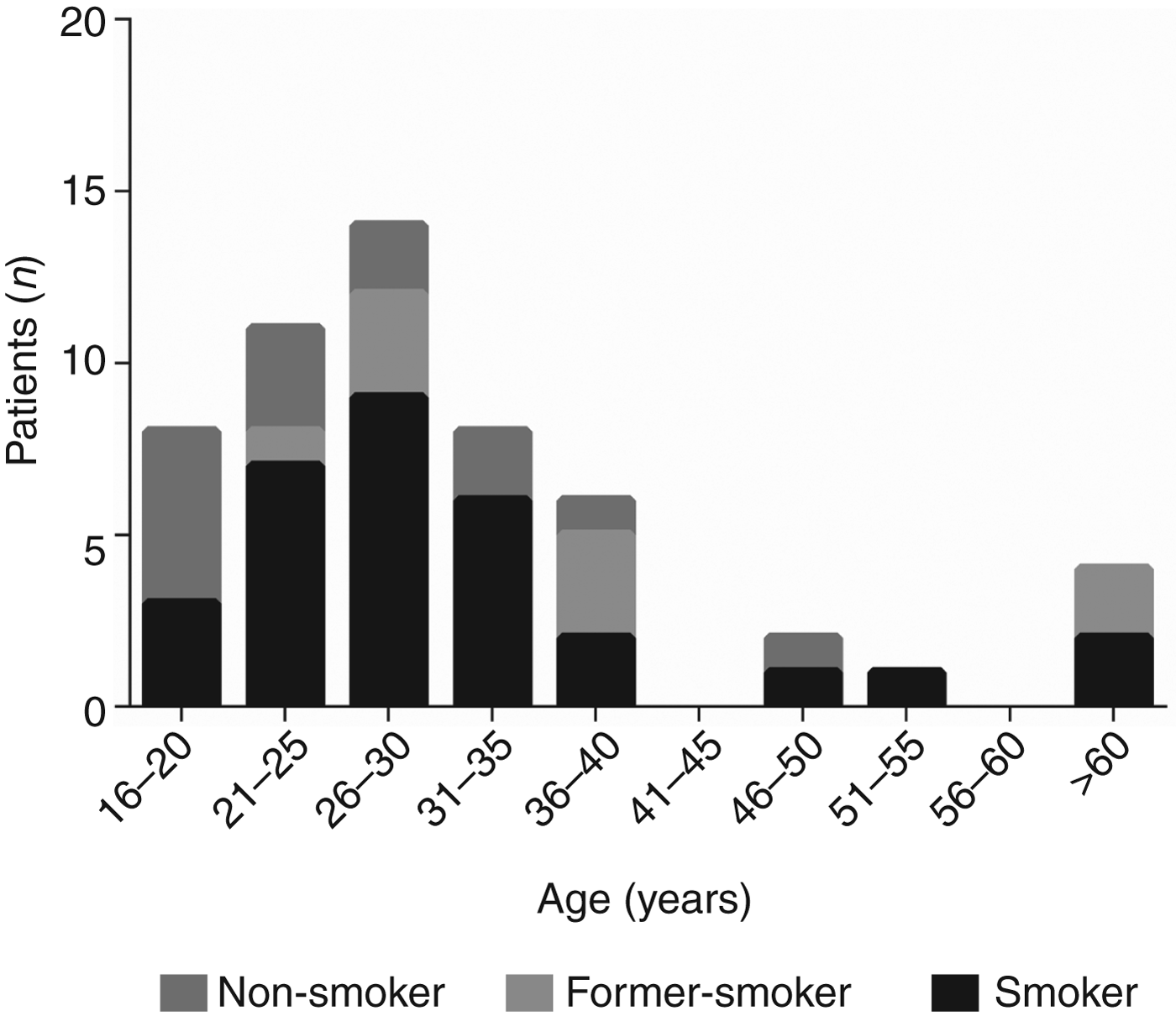
Figure 1 displays the distribution of patients in the peritonsillar abscess cohort, categorised in terms of smoker, former smoker and non-smoker, in respect to age. The majority of patients were aged 26–30 years, and over 75 per cent were between 20 and 40 years.
Distribution of smokers, former smokers and non-smokers, divided by age, in the peritonsillar abscess group.

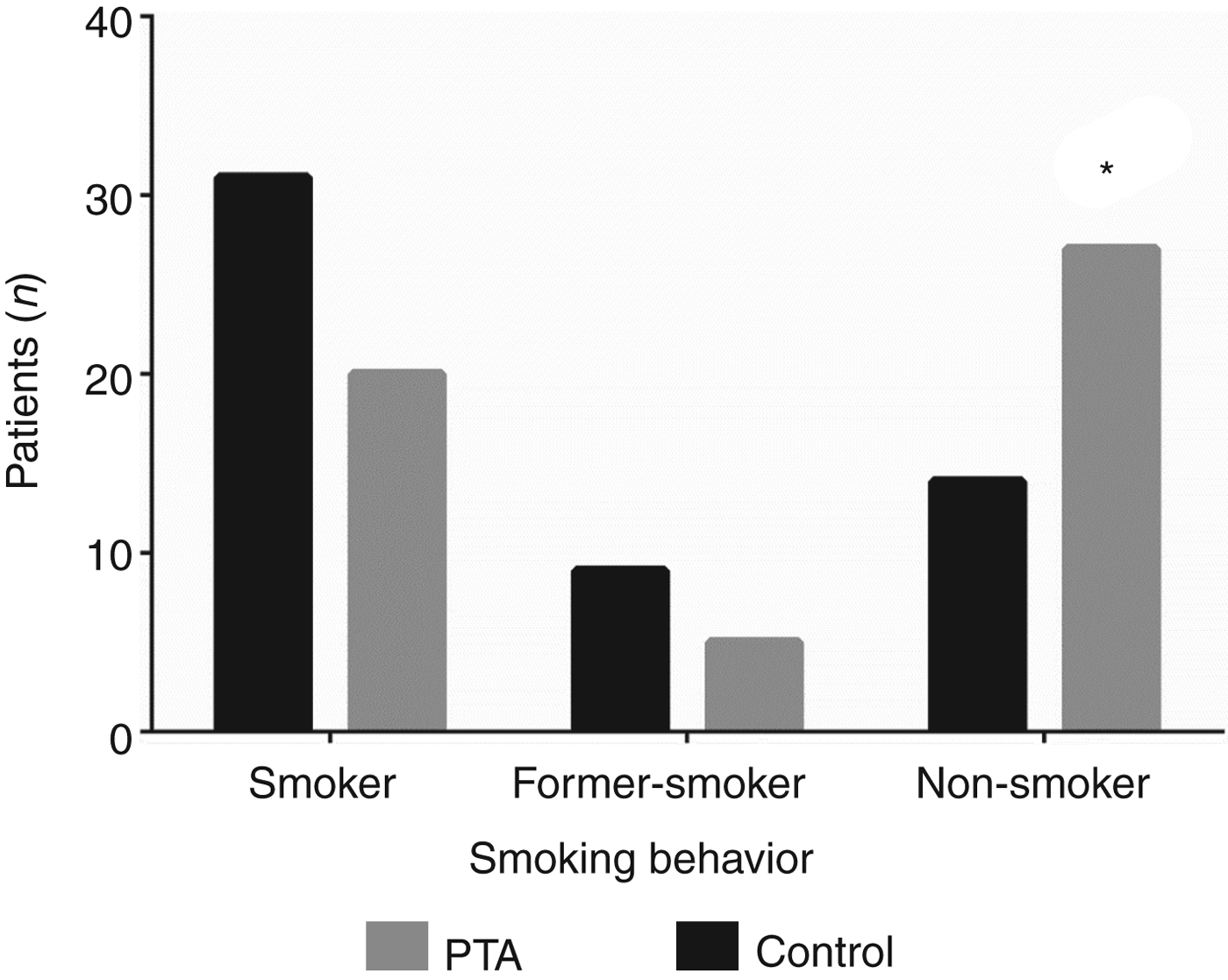
A 2 × 3 contingency table calculated for group-specific differences regarding smoking status (smoker, former smoker and non-smoker) revealed a significant correlation of small to moderate strength between peritonsillar abscess status and smoking experience (χ2 (2 degrees of freedom) = 7.6, p = 0.025). Follow-up analyses revealed no differences between current smokers (peritonsillar abscess (n = 31) vs non-peritonsillar abscess (n = 20): χ2 (1 degree of freedom) = 2.37, p = 0.12) and former smokers (peritonsillar abscess (n = 9) vs non-peritonsillar abscess (n = 5): χ2 (1 degree of freedom) = 1.14, p = 0.29). However, there was a strong effect for patients who had never smoked. Specifically, there were significantly more patients with no smoking history in the non-peritonsillar abscess group (n = 27) compared to the peritonsillar abscess group (n = 14) (χ2 (1 degree of freedom) = 4.12, p = 0.04) (Figure 2).
Comparison of smoking behaviour between peritonsillar abscess (PTA) and control groups. *p < 0.05, compared to peritonsillar abscess group

The analyses of pack-years confirmed our hypothesis that smoking is a risk factor for peritonsillar abscess development. The peritonsillar abscess group had significantly higher pack-years than the non-peritonsillar abscess group (p = 0.037).
Discussion
The results of our study confirm a link between smoking behaviour and peritonsillar abscess development. There was a significant relationship between peritonsillar abscess status and smoking experience, and a higher number of pack-years in the peritonsillar abscess group. Moreover, the number of non-smokers was significantly lower in the peritonsillar abscess group compared to the non-peritonsillar abscess group. This is the first study to distinguish between active smokers, former smokers and non-smokers with detailed nicotine anamneses (pack-years) in a prospective study. The results are in line with the current literature, which consists entirely of retrospective studies.Reference Klug, Rusan, Clemmensen, Fuursted and Ovesen1, Reference Risberg, Engfeldt and Hugosson3, Reference Kilty and Gaboury6, Reference Lehnerdt, Senska, Fischer and Jahnke10
Klug et al. performed a retrospective study with a high number of patients included, and demonstrated an increased risk of peritonsillar abscess formation in tobacco smokers.Reference Klug, Rusan, Clemmensen, Fuursted and Ovesen1 Given the retrospective nature of that study there is a lack of detailed information regarding smoking behaviour, and the study is affected by some bias.
The association between number of cigarettes smoked and prevalence of peritonsillar abscess had previously been shown by Hidaka et al., who reported a significantly higher rate of peritonsillar abscess in patients who smoked more than 20 cigarettes per day.Reference Hidaka, Kuriyama, Yano, Tsuji and Kobayashi8 That study did not include information on former smokers. This might introduce a bias for further analysis, which is why we included information on pack-years (1 pack-year = 20 cigarettes per day per year) in our study. In our opinion, this parameter increases the accuracy of analysing smoking behaviour, because it includes former smokers and indicates the amount of cigarettes smoked. The statistical significance in our study confirms the importance of pack-years analysis in further studies on smoking behaviour.
Two studies in the literature investigated the association between smoking and peritonsillar abscess prospectively. Dilkes et al. reported that patients with a peritonsillar abscess were 70 per cent more likely to smoke than the general population.Reference Dilkes, Dilkes and Ghufoor5 Sowerby et al. reported that only 15 per cent of their peritonsillar abscess patients admitted to smoking, which was even lower than the smoking incidence reported for the study region; hence, the study showed no association between peritonsillar abscess and smoking.Reference Sowerby, Hussain and Husein2 However, both studies distinguished only between smokers and non-smokers; there was no discrimination between (active) smokers, former smokers and non-smokers, or a detailed anamnesis of the pack-years. Therefore, the results of our study could be regarded as most valid and precise.
• There is a significant correlation between smoking behaviour and peritonsillar abscess development
• This is the first study to determine this relationship using a questionnaire on a prospective basis
• Former smokers have an increased risk of peritonsillar abscess formation
The association between peritonsillar abscess and gender remains controversial.Reference Klug, Rusan, Clemmensen, Fuursted and Ovesen1, Reference Risberg, Engfeldt and Hugosson3 However, in our study the prevalence of peritonsillar abscess seems to be higher in men. This has been reported in other studies too, and might be associated with the higher tobacco consumption in the male population.Reference Tachibana, Orita, Abe-Fujisawa, Ogawara, Matsuyama and Shimizu4, Reference Matsuda, Tanaka, Kanaya, Kamata and Hasegawa11 The age distribution is comparable to other studies, with a peak in the 20–40 years of age category.Reference Sowerby, Hussain and Husein2, Reference Risberg, Engfeldt and Hugosson3, Reference Uhler, Schrom and Knipping12 The relatively small sample size of this study has to be taken into account as a limitation when interpreting the results.
In conclusion, our matched case–control study presents, for the first time, prospective data of smoking behaviour in peritonsillar abscess patients. The results confirm an association between smoking and peritonsillar abscess, and show the importance of analysing the pack-years to include former smokers into the risk profile for peritonsillar abscess formation.
Competing interests
None declared