Introduction
Interest in tactical medicine – the provision of medical support to law enforcement and military tactical teams – has continued to grow in recent years as the benefit of physician support during these operations has become evident.Reference Young, Sena and Galante1 The majority of tactical physicians are Emergency Medicine (EM)-trained with expertise in Emergency Medical Services (EMS) and additional training and experience in Tactical Emergency Medical Support (TEMS) operations. Given the vast differences in provision of care during tactical operations as compared to the hospital setting, additional specialized training is required to adequately prepare physicians for direct support of these missions. As such, residents and fellows with an interest in TEMS would benefit from exposure to tactical medicine training during their post-graduate education. Ideally, post-graduate trainees would be given the opportunity to actively support tactical teams, facilitating their transition into this sub-specialty upon graduation.
In 2005, an email survey of the 104 United States (US) EM residency programs was used to assess the degree of post-graduate exposure to tactical medicine. That survey showed that 19 (18%) of the responding residencies offered their resident physicians exposure to, or involvement in, tactical medicine at that time.Reference Bozeman, Blankenship and Winslow2
It is unknown if the growth of tactical medicine as a sub-specialty over the last 12 years has led to a similar increase in post-graduate exposure to tactical medicine during training. The objective in this study was to assess interval changes in tactical medicine exposure during post-graduate training. The primary aim of the survey instrument was to determine the number and proportion of US EM residencies and EMS fellowships that offered trainees exposure to tactical medicine as a part of their programs; secondary goals were to clarify the nature of post-graduate roles when participating in tactical training, and to inquire about logistical issues related to that training (eg, types of tactical units supported, required preparatory training, and whether trainees were armed).
Methods
A 22-question survey consisting of yes/no, multiple choice, and open-ended questions was used to assess interval change in tactical medicine exposure during training. Respondents were also provided free-text boxes to provide additional details or to highlight unique features of their individual programs. The survey questions were based on the previously used survey and were designed with attention to best practices for survey studies.Reference Stratton3 The study was reviewed and approved by the Wake Forest School of Medicine (Winston Salem, North Carolina USA) Institutional Review Board.
The secure, online survey was sent to all 212 US EM residency programs as listed by the Accreditation Council for Graduate Medical Education (ACGME; Chicago, Illinois USA) and all 44 US EMS fellowship programs as listed by the Society for Academic Emergency Medicine (SAEM; Des Plaines, Illinois USA) via email. Three email invitations were sent to residency and fellowship directors and their administrative coordinators over a six-week period requesting participation in the online survey.
Study data were collected and managed using REDCap electronic data capture tools hosted at Wake Forest University (Winston Salem, North Carolina USA) and exported to a spreadsheet for descriptive analysis.Reference Harris, Taylor, Thielke, Payne, Gonzalez and Conde4 Differences in observed proportions of the primary outcome (exposure to tactical medicine as part of an EM residency or EMS fellowship training program) between the index study and the current study were compared via two-tailed Fisher’s exact test analysis using commercially available statistical analysis software (GraphPad InStat version 3.6 for Windows; GraphPad Software; La Jolla, California USA).
Results
Responses were received from 99 (46%) of the 212 EM residency programs and 40 (91%) of the 44 EMS fellowship programs. Of the responding residency programs, 52 (53%) offered physician trainees formal exposure to, or involvement in, tactical medicine as part of their training, which was almost three-fold the number of programs that offered such training in 2005 (P < 0.0001 compared to 18% in the prior study). In addition, 32 (72%) of the 40 responding EMS fellowships offered similar opportunities (this information was not solicited during the initial survey due to lack of formal EMS fellowships at the time). Twenty-eight of the programs reported tactical medicine opportunities for both residents and fellows at their institutions, which was not surprising given the fact that EMS fellowships are generally hosted at institutions that also have EM residencies.
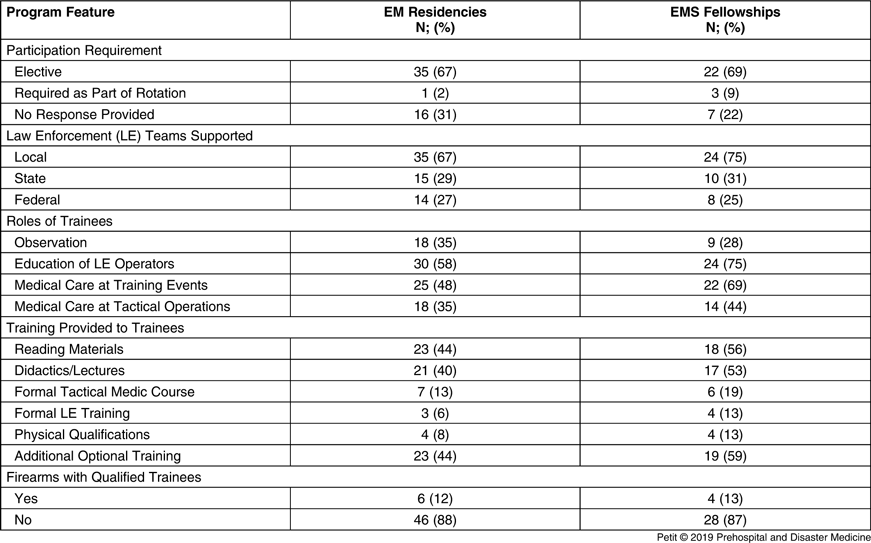
The scope of participation by post-graduates ranged from observation-only to active participation during tactical operations (Table 1). The most commonly reported experiences were provision of training for tactical medics and operators (64%) and provision of medical care at tactical training events (56%). Required reading (48%) and didactic sessions (45%) were the most commonly reported training requirements, though these varied by program. Training opportunities existed with both military units and civilian law enforcement agencies at the local, state, and federal level. A small number of programs (six residencies and four fellowships) allowed a subset of qualified trainees to be armed during tactical operations.
Program Features of 52 EM Residencies and 32 EMS Fellowships Offering Tactical Medicine Opportunities to Trainees

Abbreviations: EMS, Emergency Medical Services; EM, Emergency Medicine; LE, law enforcement.
Discussion
As the specialty of EM continues to grow and evolve, so too will the number and scope of its sub-specialties. Opportunities exist for residents to become familiar with a variety of these during graduate training, but the ACGME only requires that programs provide exposure to critical care medicine, ultrasound training, and EMS.5 The objective of this study was to determine if the increasing recognition of the benefits provided by tactical medics, and the resulting growth of tactical medicine as a sub-specialty within EMS, would result in a commensurate increase in opportunities for resident and fellow exposure.
These results show a significant increase in the proportion of responding EM residency programs offering tactical exposure to their trainees since the initial survey distributed 12 years prior. Eight programs that do not currently offer exposure to tactical medicine responded that they have plans to include it in the future. In addition, the majority of EMS fellowship programs offer similar tactical training opportunities. Some programs provide interested trainees with the opportunity to register for Tactical Emergency Casualty Care (TECC), Tactical Combat Casualty Care (TCCC), Counter Narcotics and Terrorism Medical Support (CONTOMS), or commercially available tactical medicine courses. A small number of programs allow residents and fellows to undergo formal law enforcement training, including enrollment in Special Weapons and Tactics (SWAT) schools.
The value of integrating specially trained physicians and prehospital providers with military and law enforcement tactical teams has been apparent for decades. In 1993, Hieskell and Carmona published an article detailing the origins of tactical medicine, the role of tactical medics, training considerations, and the benefits of an on-scene physician during tactical operations.Reference Heiskell and Carmona6 More recently, Ramirez and Slovis acknowledged the multitude of opportunities available for physicians to help shape the growing field of tactical medicine. They also stressed the value of “extracurricular training” for interested residents.Reference Ramirez and Slovis7 The data suggest that EM residencies and EMS fellowships are tailoring their training programs to reflect the growth of tactical medicine as a sub-specialty and providing their trainees with a variety of opportunities to gain experience in the field.
Limitations
One limitation of this study was the low response rate (46%) among EM residency programs. It can be reasonably assumed that programs choosing not to respond are ones unlikely to provide tactical medicine exposure to their residents. Additional surveys can continue to track changes in exposure rates for post-graduates and further qualify the types of exposures available. This information would be useful to medical students and residents with an interest in tactical medicine by helping them identify the types of training opportunities they can reasonably expect from programs that opt to provide exposure to tactical medicine during post-graduate training.
Conclusions
Overall, training opportunities in tactical medicine have grown significantly from 18% to 53% of responding EM residencies, and 72% of responding EMS fellowships over the last 12 years. These encompass a wide-range of potential opportunities for trainees interested in tactical medicine, which vary on an institutional basis.
Author Contributions
All authors participated in the study design, acquisition of data, analysis and interpretation of data, drafting of the manuscript, and critical revision of the manuscript.