INTRODUCTION
The American species of the snapping shrimp family Alpheidae have received a great deal of attention during the last decade. Most publications involving these interesting caridean shrimps are taxonomic descriptions and species revisions (i.e. Anker & Iliffe, Reference Anker and Iliffe2000; Anker & Felder, Reference Anker and Felder2005; Anker, Reference Anker2007; Ríos & Duffy, Reference Ríos and Duffy2007; Anker et al., Reference Anker, Hurt and Knowlton2007, Reference Anker, Hurt and Knowlton2008), new records and range extensions (i.e. Hermoso-Salazar & Hendrickx, Reference Hermoso-Salazar and Hendrickx2005; Anker, Reference Anker2007), behavioural studies, i.e. on mate choice (Rahman et al., Reference Rahman, Dunham and Goving2004) and studies on eusociality (Duffy et al., Reference Duffy, Morrison and Macdonald2002; Duffy, Reference Duffy and Kikuchi2003), as well as results from still ongoing research on molecular and morphological evolution (Williams et al., Reference Williams, Knowlton, Weigt and Jara2001; Morrison et al., Reference Morrison, Ríos and Duffy2004; Mathews, Reference Mathews2006; Hurt et al., Reference Hurt, Anker and Knowlton2009; Mathews & Anker, Reference Mathews and Anker2009).
Our knowledge of the reproductive ecology of tropical American alpheids is rather poor. Corey & Reid (Reference Corey and Reid1991) examined reproductive aspects of 16 alpheid species from Florida; their results revealed that many of these species tend to produce small eggs. There is, however, evidence that alpheid shrimps can also produce large eggs, indicating a tendency for an abbreviated larval development (Felder, Reference Felder1982; Dardeau, Reference Dardeau1984; Wehrtmann & Albornoz, Reference Wehrtmann and Albornoz2002). To our best knowledge, data on reproductive patterns of Central American alpheids are still deficient except for the description of first postembryonic stages in the transisthmian sister species Alpheus saxidomus and A. simus (Wehrtmann & Albornoz, Reference Wehrtmann and Albornoz2002).
Fecundity has been widely recognized as one of the ecologically most important features in the life history of many invertebrates, including decapod crustaceans (i.e. Hines, Reference Hines1991; Somers, Reference Somers and Schram1991). This aspect usually refers to the total number of eggs (here we use the term ‘eggs’ also for developing embryos) carried by the females. As in many decapods, a positive relationship has been observed between fecundity and female size in alpheid shrimps. The correlation coefficient (r) reported for some of these species (Corey & Reid, Reference Corey and Reid1991; Lardies & Wehrtmann, Reference Lardies and Wehrtmann1997) is highly variable (0.54–0.99), suggesting that endo-exogenous factors may provoke loss of eggs during the embryogenesis (for review see Kuris, Reference Kuris and Schram1991).
Egg size offers valuable information on a species' reproductive strategy. It serves as a useful indicator for the duration of embryogenesis and larval size at hatching (Steele & Steele, Reference Steele and Steele1975; Wehrtmann & López, Reference Wehrtmann and López2003). Many species of Synalpheus show a clear correlation between egg size and type of larval development, ranging from normal (= extended) via abbreviated to quasi-direct (see Coutière, Reference Coutière1898; Dardeau, Reference Dardeau1984; Duffy, Reference Duffy1996). However, more detailed information on this issue is presently restricted to just a few alpheid species.
Synalpheus, being one of the most species-rich genera of the Alpheidae, with well over 60 species in the Caribbean region alone (Ríos & Duffy, Reference Ríos and Duffy2007; Anker & Tóth, Reference Anker and Tóth2008), received more attention compared to the other genera of this family, mainly due to the fact that some species form eusocial colonies in sponges (Duffy et al., Reference Duffy, Morrison and Ríos2000, Reference Duffy, Morrison and Macdonald2002). The eusocial Synalpheus inhabit the internal canals of larger demosponges, forming colonies of up to several hundred individuals, but containing only one reproductive female equivalent of a ‘queen’ in insect societies. Despite this extraordinary behaviour and a great scientific potential of these shrimps, their reproductive biology is poorly known (Duffy et al., Reference Duffy, Morrison and Macdonald2002). However, the vast majority of sponge-dwelling Synalpheus are pair-living species.
Synalpheus yano (originally described as Zuzalpheus yano Ríos & Duffy, Reference Ríos and Duffy2007; see Anker & De Grave, Reference Anker and De Grave2008 for synonymy of Zuzalpheus) is apparently a pair-living species. It is one of the most common sponge-dwelling species of Synalpheus of Bocas del Toro, a small archipelago on the Caribbean coast of Panama. In Bocas del Toro, this species most frequently associates with the bright red-orange sponge Lissodendoryx colombiensis Zea & van Soest, 1986. The same sponge is used by S. yano as main host at the type locality in Belize, although three other sponge species have been reported as facultative hosts there (Ríos & Duffy, Reference Ríos and Duffy2007).
The presence of parasitic bopyrid isopods (Epicaridea: Bopyridae; mainly Bopyrinae and Hemiarthrinae), has been documented in a number of decapod crustaceans, including species of Alpheus and Synalpheus (Markham, Reference Markham, Gore and Heck1986). These parasites may cause castration by: (1) inhibiting the maturation of the female gonad; and (2) feminizing parasitized males (Reinhard, Reference Reinhard1956; van Wyk, Reference van Wyk1982; O'Brien & van Wyk, Reference O'Brien, van Wyk and Wenner1985; González & Acuña, Reference González and Acuña2004; Calado et al., Reference Calado, Bartilotti and Narciso2005). Most studies focus on the intensity and prevalence of infestation, population structure and energetics of the bopyrid isopod parasite and its decapod host (Beck, Reference Beck1980; González & Acuña, Reference González and Acuña2004; Smith et al., Reference Smith, Chapman and Dumbauld2008). However, detailed data on the impact of parasitic infestation on egg production in carideans are rather limited. The presence of adult abdominal bopyrids in egg-bearing females of Synalpheus highlights the complexity of parasite–host interactions and the lack of knowledge on this topic (see Calado et al., Reference Calado, Bartilotti and Narciso2005).
The aim of the present study is to provide information on the fecundity, egg volume and energy allocation for reproduction in S. yano. Also shown are the effects of parasitism by bopyrids on egg production in this species. We compare our results with those available for other tropical–subtropical alpheid species.
MATERIALS AND METHODS
Study area
Ovigerous females of S. yano were collected in August 2008 during a shrimp taxonomy course in Bocas del Toro, Caribbean coast of Panama (Figure 1). The Bocas del Toro archipelago comprises several larger and many smaller islands and patchy reefs and sponge gardens supporting a very diverse fauna. Initially, a small number of ovigerous females of S. yano were extracted from internal canals of a red-orange sponge, Lissodendoryx colombiensis that is fairly common in these sponge gardens and also grows on jetty pilings or large pieces of coral rubble, at shallow depths (1–5 m). Consequently, a fairly large number (>20) of these sponges was collected and revised to obtain a sufficient number of ovigerous females. In the laboratory, specimens were extracted from sponge canals and preserved in ethanol (75%).
Sampling locations in Bocas del Toro, Caribbean coast of Panama.

We also collected ovigerous females of other alpheid species (Alpheus spp., other Synalpheus spp. and Automate sp.), e.g. in coral rubble and other sponges. The total number of collected individuals per species was relatively low, mostly due to time constraints. However, because of insufficient knowledge of reproductive traits in Central American Alpheidae, we decided to include these data in the present study.
Analyses of material
All specimens of Synalpheus were identified using an identification key based on Ríos & Duffy (Reference Ríos and Duffy2007). We measured the carapace length (CL, in mm) of each female from the tip of the rostrum to the posterior margin of the carapace; this measurement was recorded with the aid of a stereomicroscope provided with an ocular micrometer (nearest 0.1 mm). The size at first maturity was established as 50% of the overall size–frequency distribution for ovigerous females, as determined after fitting a sigmoid curve to the relationship between the percentage of ovigerous females and size, using 0.1 mm size-classes (Wenner et al., Reference Wenner, Fusaro and Oaten1974).
After removing the complete egg mass from each female, the total number of eggs (EN) was determined by counting them under a Leitz stereomicroscope. All collected ovigerous females of S. yano were examined for the presence of parasitic isopods (Epicaridea, Bopyridae and Hemiarthrinae) (see Dardeau, Reference Dardeau1984; Markham, Reference Markham1985). Developing eggs of each species were classified into three stages (Stages I–III) based on the shape and development of both abdomen and eyes, as described by Wehrtmann (Reference Wehrtmann1990). We separated arbitrarily 20 embryos from the egg mass and measured the width and length of each egg under a microscope equipped with a calibrated ocular micrometer. These data were used to calculate egg volume (EV) according to the formula proposed by Turner & Lawrence (Reference Turner, Lawrence and Stancyk1979) for oblate spheroids: EV = 1/6 (a * b2 * π), where a represents length, and b width. The volume increment during the incubation period was calculated using the equation proposed by Kobayashi & Matsuura (Reference Kobayashi and Matsuura1995).
The energy allocation for egg production was estimated by determining the reproductive output (RO) of the females, considering only recently extruded eggs (Stage I). Females and their corresponding egg masses were dried at 60ºC for 24 hours, and the resulting data were used in the formula proposed by Clarke et al. (Reference Clarke, Hopkins and Nilssen1991): RO = dry weight of the entire egg mass/dry weight of the female without eggs.
Data analysis
The relation between fecundity and female size was described by an allometric model (Y = a · Xb), which has been used widely for this purpose in similar studies with other decapods (i.e. Corey & Reid, Reference Corey and Reid1991; Hines, Reference Hines1991; Hernáez & Palma, Reference Hernáez and Palma2003). According to Somers (Reference Somers and Schram1991), an isometric relation is indicated by values for b that are near 3. Thus, b values of <2.90 and >3.10 were taken as indication of a negative and positive allometric relation, respectively (Somerton, Reference Somerton1980). An analysis of covariance (ANCOVA; Zar, Reference Zar1999) was applied to analyse the relation between egg number and female CL for each embryonic stage to estimate possible egg loss during the incubation period. In the case of a significant difference between egg numbers per stage (P < 0.05), a Tukey a posteriori test was applied to establish the similarity between each pair of developmental stages (Zar, Reference Zar1999).
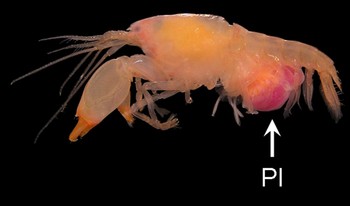
The area of egg attachment was frequently infested with parasitic isopods, Hemiarthrinae (Dardeau, Reference Dardeau1984; P. Hernáez, personal observation; Figure 2). In order to evaluate the possible impact of parasitic infestation on egg production, we analysed the fecundity of infested and non-infested females, and compared the slopes of each scenario applying the analysis of covariance (ANCOVA; Zar, Reference Zar1999).
Specimen of Synalpheus yano with a parasitic isopod (PI), collected in Bocas del Toro, Caribbean coast of Panama.

RESULTS
Egg production of un-infested females S. yano
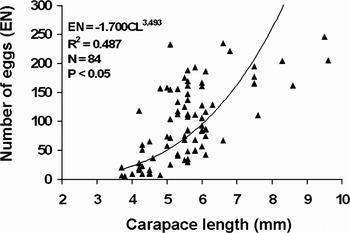
A total of 249 individuals of S. yano were analysed; 112 of them were ovigerous females (45%). Regarding the un-infested females (N = 84), 23 were at Stage I, 37 at Stage II, and 24 females carried eggs close to hatching (Stage III). These females measured from 3.7 to 9.6 CL mm (average 5.6±1.16 mm), and 73% of them were in the range between 4.1 and 6.0 mm CL. The total number of eggs in un-infested S. yano varied between 6 and 246 (average: 98±64.6). The fecundity increased significantly with female size (simple regression; r = 0.70; P < 0.05); however, the correlation was relatively low explaining approximately 50% of the observed variability (Figure 3). During the incubation period, un-infested females of S. yano lost approximately 16% of their initially produced eggs (ANCOVA, f = 23.5; P < 0.05). However, no statistically significant differences were detected between numbers of eggs at different developmental stages (Tukey test, P > 0.05).
Relation between carapace length (CL) and number of eggs (EN) in un-infested ovigerous females of Synalpheus yano in Bocas del Toro, Caribbean coast of Panama.

During the incubation period, the egg volume in un-infested females increased from 0.100 to 0.218 mm3, representing an overall increase of 118% (Figure 4). The average RO of S. yano was 25.7±11.48% of their dry weight, and varied between 10.5 and 44.9%. RO did not increase with the female size (Spearman test, P > 0.05). The egg mass comprised on average 35% of the dry body weight of females.
Egg volume (mean±SD) of developing embryos (Stages I–III) of un-infested and infested females of Synalpheus yano in Bocas del Toro, Caribbean coast of Panama. The numbers for un-infested and infested females indicate the increase of egg volume during embryonic development.

Comparison of egg production between infested and un-infested females of S. yano
Out of 112 analysed egg-bearing females, 18 (16%) were infested by bopyrids; seven females carried eggs in Stage I, four in Stage II and seven in Stage III. Infested females measured from 4.6 to 9.4 mm CL (average 6.7±1.30 mm) and produced between 22 and 166 eggs (average: 81±44.4). During the incubation period, infested females lost approximately 39% of their initially produced eggs (ANCOVA, f = 23.5; P < 0.05), and no statistically significant differences were detected between the numbers of eggs at different developmental stages (Tukey test, P < 0.05).
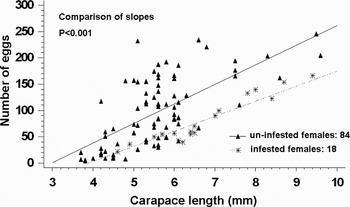
Since we did not detect any statistically significant difference of egg number between the three embryonic stages, we pooled the data of un-infested ovigerous females independent of their developmental stage to assess the impact of parasites on egg production: ANCOVAs revealed statistically significant differences between the two slopes (Figure 5); females infested by bopyrids carried 41% fewer eggs than similar-sized females without parasites.
Egg production in Synalpheus yano from Bocas del Toro, Caribbean coast of Panama, with a comparison of slopes between un-infested and infested females.

Egg length and egg volume in Stages I and III of infested females varied between 0.74 and 0.97 mm (average: 0.86±0.179 mm) and from 0.118 to 0.246 mm3 (average: 0.17±0.116 mm3), respectively. The volume increase during development was slightly higher in the un-infested than in infested females (117% versus 108%, respectively). We detected, however, no statistically significant differences between the egg length and egg volume carried by both infected and un-infected females (Student's t-test, P > 0.05).
The morphological sexual maturity of un-infested females was reached at a size of 5.7 mm CL (Figure 6). The relatively low number of ovigerous females with parasites did not allow a similar analysis for this group. The same figure shows the number of parasitized females per size-class. The smallest individuals (3.1–4.0 mm CL) were not infested, and parasites were detected exclusively in ovigerous females ranging in size between 4.6 and 9.4 mm CL. Highest occurrence was recorded in egg-bearing females between 5.1 and 8.0 mm CL, representing 72% of all infested specimens.
Number of individuals of un-infested and infested females per size-range (carapace length (CL)), and morphological maturity curve in un-infested ovigerous females of Synalpheus yano in Bocas del Toro, Caribbean coast of Panama. The number indicates the size at first maturity established as the 50% of the overall.

Other alpheid species
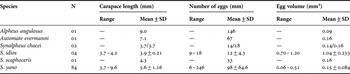
Table 1 presents some preliminary data on egg production in two other sponge-associated Synalpheus species (S. chacei and S. idios), and two free-living alpheids, Alpheus angulosus and Automate evermanni (all from Bocas del Toro). The largest of them, A. angulosus, carried the highest number of eggs; S. idios, one of the smallest species studied herein, produced the lowest number of eggs, which, however, were by far the largest (1.04 mm3). Egg volume among these four species varied between 0.09 mm3 and 0.16 mm3 (Table 1).
Range and average of carapace length (CL), number of produced eggs (EN) and egg volume (EV) in six species of the family Alpheidae from Bocas del Toro, Caribbean coast of Panama. N, number of individuals; SD, standard deviation.

DISCUSSION
Social organization of S. yano
So far, eusociality has been documented or is strongly suspected in nine western Atlantic species of Synalpheus, including S. regalis, S. chacei, S. filidigitus, S. duffyi and S. riosi (Duffy, Reference Duffy1996, Reference Duffy1998; Duffy & Macdonald, Reference Duffy and Macdonald1999; Anker & Tóth, Reference Anker and Tóth2008). This life style implies a complex social organization where reproduction is restricted to a single female, the ‘queen’ (Duffy, Reference Duffy1996, Reference Duffy, Duffy and Thiel2007). Although at first glance, S. yano may appear as a ‘colonial species’, based on large numbers of individuals obtained from the same host sponge, it actually is a pair-living species, with each male–female pair being restricted to a small portion of the host sponge (A. Anker, personal observation). Sponge portioning among different individuals of S. yano, or between S. yano and other species of Synalpheus such as S. dardeaui, remains to be investigated in detail.
Egg production in S. yano
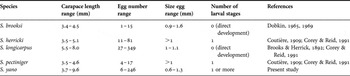
In comparison to other caridean shrimps (see Corey & Reid, Reference Corey and Reid1991) S. yano produces relatively large eggs (0.7–1.3 mm in diameter). However, when compared to the available data for other representatives of Synalpheus, the egg size of S. yano is within the range reported for other species of this genus (Table 2). Although the range of egg size in all sponge-dwelling species of Synalpheus listed in Table 2 fluctuates around 1 mm, reproductive strategies are different among species: S. brooksi and S. longicarpus are known to have a quasi-direct development, whereas all other species seem to have at least one zoeal stage. In the case of S. yano, a recently-hatched larva is a typical Zoea I (see Albornoz & Wehrtmann, Reference Albornoz and Wehrtmann1997), with sessile eyes, a telson bearing 7+7 distal spines, and without developing uropods. Thus, egg size alone, even in species of the same genus, inhabiting the same type of habitats, and having roughly the same adult size (e.g. S. longicarpus), is not a reliable indicator for the type of postembryonic development. Future studies need to clarify the underlying evolutionary and ecological factors responsible for shaping the reproductive strategy in these sponge-dwelling species.
Range of carapace length, number of produced eggs, egg size and number of larval stages in some sponge-dwelling Synalpheus from the western Atlantic. Carapace length and egg number were obtained from Corey & Reid (Reference Corey and Reid1991), size of eggs and number of larval stages are from Brooks & Herrick, (Reference Brooks and Herrick1892), Coutière, (Reference Coutière1909) and Dobkin, (Reference Dobkin1965, Reference Dobkin1969).

In un-infested S. yano, the egg volume increased approximately 118% during embryogenesis, whilst egg loss during embryonic development was low (~15%) and statistically not significant. Egg loss in S. yano is within the range reported for some other alpheid shrimps, e.g. Betaeus emarginatus: 11.6%; B. truncatus: 19.1% (Lardies & Wehrtmann, Reference Lardies and Wehrtmann2001); Alpheus armillatus: 12.2% (Pavanelli et al., Reference Pavanelli, Mossolin and Mantelatto2008). Egg swelling during egg development is well documented in decapods, and may fluctuate in alpheid shrimps between 19% and 274% (Corey & Reid, Reference Corey and Reid1991; Lardies & Wehrtmann, Reference Lardies and Wehrtmann2001). The fact that despite a substantial egg swelling during embryogenesis the observed egg loss was insignificant suggests that the space available for the egg attachment in S. yano is sufficient to accommodate and to maintain the total number of eggs until hatching occurs. This scenario contradicts the general assumption that substantial egg volume increase is associated with a considerable egg loss during embryonic development (Kuris, Reference Kuris and Schram1991). The low egg mortality observed in S. yano might be related to: (1) an efficient parental care during embryogenesis promoted by the pair living in a small portion of the host; and (2) to the fact that this species lives in sponges, which provide a relatively protected microhabitat, reducing the possible abrasion of developing egg during rapid movements and probably containing fewer pathogenes compared to the exterior.
The efficiency of a size-specific fecundity regression model in decapods generally is evaluated by the coefficient of determination (Somers, Reference Somers and Schram1991). In S. yano, the determination coefficient (lineal regression: r2 = 0.43) was within the range reported for other alpheid shrimps from temperate and tropical–subtropical waters (0.23 to 0.97; Corey & Reid, Reference Corey and Reid1991; Lardies & Wehrtmann, Reference Lardies and Wehrtmann1997, Reference Lardies and Wehrtmann2001; Pavanelli et al., Reference Pavanelli, Mossolin and Mantelatto2008). Present evidence suggests that sponge-dwelling Synalpheus have a low relationship between egg number and female body size (S. brooksi = 0.54, S. longicarpus = 0.65 and S. pectiniger = 0.23; Corey & Reid, Reference Corey and Reid1991), and thus S. yano is not an exception. All these species are known to be occasionally infested by abdominal bopyrid parasites (Dardeau, Reference Dardeau1984), which in brooding females interact with their egg masses. Therefore, we assume that the low determination coefficient may be linked to the bopyrid parasitism. However, this aspect needs further attention in future studies.
Reproductive output of S. yano
Brood weight of marine decapods is highly variable and generally constrained to approximately 4 to 30% of the female body weight, for instance in Alpheoidea: 7–12% (Pavanelli et al., Reference Pavanelli, Mossolin and Mantelatto2008, in press); in Anomura: 3–33% (Hernáez & Palma, Reference Hernáez and Palma2003); in Brachyura: 10% (Hines, Reference Hines1982), and in Thalassinidea: 15% (Hernáez et al., Reference Hernáez, Palma and Wehrtmann2008). Ovigerous females of S. yano inverted 35% of their weight in egg production, and this value is substantially higher than those observed in some temperate-cold water alpheids, such as Betaeus emarginatus: 8.5%, and B. truncatus: 9.7–14% (Lardies & Wehrtmann, Reference Lardies and Wehrtmann2001), and other subtropical species such as A. armillatus: 12.1% (Pavanelli et al., Reference Pavanelli, Mossolin and Mantelatto2008) and A. nuttingi: 7.3% (Pavanelli et al., in press). The large reproductive output in S. yano may be an adaptation to a sponge-dwelling life style. This conclusion is supported by the fact that pinnotherid crabs living in different host species show even higher reproductive outputs, e.g. Pinnotheres ostreum (Pinnotheridae): 66%, and Fabia subquadrata (Pinnotheridae): 97% (Hines, Reference Hines1992).
Effects of parasitism on egg production in S. yano compared to data available for other decapods
To our best knowledge, the present report is the first to highlight the impact of the infestation by abdominal bopyrids on egg production in an alpheid shrimp. Our results demonstrate that the fecundity of S. yano diminishes considerably in females infested by bopyrids (Figure 5). It is speculated that the presence of the enormous bopyrid isopod in the abdomen (Figure 2) limits the available space for egg attachment, which results in considerably lower egg numbers in infested versus similar-sized un-infested females (Figure 5). There is ample evidence of parasitic castration in different decapods (Caridea: Beck, Reference Beck1980; Calado et al., Reference Calado, Bartilotti and Narciso2005; Anomura: González & Acuña, Reference González and Acuña2004; Brachyura: Shields & Wood, Reference Shields and Wood1993; Brockerhoff, Reference Brockerhoff2004). Concerning caridean shrimps, Calado et al. (Reference Calado, Bartilotti and Narciso2005) studied the effects of parasitic isopods on the reproduction of the protandric simultaneous hermaphrodite caridean shrimp Lysmata seticaudata (Hippolytidae), and Beck (Reference Beck1980) examined the effects of a bopyrid ectoparasite on sexual characteristics of Palaemonetes paludosus (Palaemonidae). In marked contrast to parasitized females of S. yano, parasitized females of L. seticaudata and P. paludosus were not able to produce embryos. The simultaneous presence of the bopyrids and developing eggs was observed also in Upogebia pugettensis (Upogebiidae), but this phenomenon was extremely rare (Smith et al., Reference Smith, Chapman and Dumbauld2008): the only two ovigerous females with parasites carried substantially fewer eggs than un-infested females. Dardeau (Reference Dardeau1984) mentioned the presence of hemiarthrine bopyrids in several Synalpheus (S. brooksi, S. longicarpus and S. pandionis), however, without indicating effects of these parasites on egg number in infested ovigerous females. Both Dardeau's and our findings clearly show that infestation by bopyrid parasites does not necessarily result in the ‘castration’ (or in case of females: sexual inability) of the Synalpheus host.
According to our results, the infestation rate is higher in medium-sized individuals of S. yano than in smaller ones (Figure 6). This size preference of the parasites might be related to the moult cycle of the host: since the time interval between successive moulting increases gradually with age (Bliss, Reference Bliss1982), it might be advantageous for the parasite to select larger individuals of S. yano which moult less frequently than the smaller (younger) shrimp.
We recommend that in all future studies on fecundity in decapod crustaceans, females infested by abdominal bopyrids or other parasites, such as rhizocephalans, should be treated separately from un-infested females to allow a direct assessment of parasitism on egg production.
ACKNOWLEDGEMENTS
We are grateful to the Smithsonian Tropical Research Institute (STRI) and the STRI station in Bocas del Toro, Panama, for providing facilities for this study, and to Sammy De Grave (Oxford University Museum of Natural History, Oxford, UK) and Rachel Collin for co-instructing and organizing, respectively, the shrimp taxonomy course in Bocas del Toro in August 2008. We thank Catalina Benavides (UNIP, Universidad de Costa Rica), who helped us with the preparation of Figure 1, and two anonymous referees for their constructive comments.