During the course of language development, children learning one or two first languages (L1s) and children and adults learning a second language (L2) after completion of the first go through stages during which their linguistic intuitions and preferences exhibit optionality (i.e., the coexistence of two or more variants of a linguistic structure that are mutually exclusive in the grammars of mature monolinguals; Sorace, Reference Sorace, Doughty and Long2003). Whereas optionality is a transitory phenomenon in monolingual acquisition, in bilingual acquisition, optionality may persist at advanced levels of competence. Optionality is believed to primarily affect linguistic phenomena at the interfaces between syntax and other (external) cognitive domains (Sorace, Reference Sorace, Cornips and Corrigan2005; Sorace & Serratrice, Reference Sorace and Serratrice2009; Tsimpli & Sorace, Reference Tsimpli, Sorace, Bamman, Magnitskaia and Zaller2006). A growing body of research has shown that grammatical properties situated at the syntax-discourse interface are particularly vulnerable to persistent and potentially permanent optionality in bilingual grammars (see Sorace & Serratrice for a review).
One well-documented example is the realization of pronominal subjects in null-subject languages. In null-subject languages (e.g., Italian, Greek, Spanish), pronominal subjects (null and overt) are syntactically licensed, but their distribution is governed by discourse-pragmatic felicity conditions. Bilinguals acquiring a null-subject language and a non-null-subject language (e.g., English) are prone to violate the discourse constraints on pronominal subject distribution in their null-subject language, typically by overextending the interpretive scope of the overt pronoun. This tendency is evinced in a variety of bilingual populations, including child bilinguals (Argyri & Sorace, Reference Argyri and Sorace2007; Hacohen & Schaeffer, Reference Hacohen and Schaeffer2007; Haznedar, Reference Haznedar2010; Paradis & Navarro, Reference Paradis and Navarro2003; Sorace, Serratrice, Filiaci, & Baldo, Reference Sorace, Serratrice, Filiaci and Baldo2009), adult L2 learners (Belletti, Bennati, & Sorace, Reference Belletti, Bennati and Sorace2007; Liceras, Reference Liceras, Pankhurst, Sharwood Smith and Van Buren1988; Montrul & Rodríguez Louro, Reference Montrul, Rodríguez Louro, Torrens and Escobar2006; Rothman, Reference Rothman2008, Reference Rothman2009; Sorace & Filiaci, Reference Sorace and Filiaci2006), L1 speakers under attrition (Tsimpli, Sorace, Heycock, & Filiaci, Reference Tsimpli, Sorace, Heycock and Filiaci2004), and heritage speakers (Montrul, Reference Montrul2004b, Reference Montrul, Slabakova, Montrul and Prévost2006; Silva-Corvalán, Reference Silva-Corvalán1994).
One potential source of optionality germane to the distribution of pronominal subjects that has yet to garner significant attention is exposure to input in the null-subject language (Rothman, Reference Rothman2009; Sorace & Serratrice, Reference Sorace and Serratrice2009). As Rothman (Reference Rothman2009) noted, acquiring grammatical properties shaped by knowledge of discourse-pragmatics requires exposure to input that unambiguously illustrates the relevant constraints—something a bilingual’s linguistic experience may not confer. A bilingual’s exposure to input can differ from a monolingual’s—and from another bilingual’s—in crucial ways, including age of first exposure (early or later in life), setting (naturalistic or instructed), mode (aural or written), quantity (abundant and frequent or not), and quality (linguistically varied and contextually appropriate or not), among others (Montrul, Reference Montrul2008). As this list of nonmutually exclusive factors shows, exposure to input is a macro variable that subsumes other related variables.
The most widely spoken null-subject language in the United States is Spanish. The United States is home to two populations of bilingual Spanish speakers whose experiential profiles differ from those of Spanish monolinguals and from each other: Spanish heritage speakers (HSs) and L2 learners of Spanish. For HSs, exposure to Spanish begins early in life (at or shortly after birth) in a naturalistic setting (the home) and consists of primarily aural input. Childhood exposure to English reduces the quantity of Spanish input that HSs receive relative to monolingual peers, and input to HSs may differ qualitatively if a parent or caregiver is a L2 learner of Spanish or speaks an attrited or contact variety of Spanish. A HS’s exposure to Spanish input also differs from an adult L2 learner’s in several key ways, including age of first exposure (birth vs. postpuberty), setting (naturalistic vs. largely instructed), mode (aural vs. aural and written), quantity (years of home use vs. hours of classroom use and brief immersion stays), and quality (native input vs. nonnative input from peers and some instructors). If exposure to input in a null-subject language is critical to convergence in the domain of pronominal subject realization, then comparing the linguistic behavior of bilingual populations with distinct experiential profiles may shed light on the nature of optionality at the syntax-discourse interface.
This study contributes to the growing body of research devoted to pronominal subjects in bilingual acquisition by examining the effect of exposure to Spanish input on the resolution of intrasentential anaphora in Spanish. Research on anaphora resolution in mature monolinguals finds that speakers of null-subject and non-null-subject languages employ distinct strategies for linking overt subject pronouns to antecedents when more than one antecedent is available (Carminati, Reference Carminati2002; Serratrice, Reference Serratrice2007). The current study examines whether bilingual speakers who are dominant in a non-null-subject language (English) demonstrate nativelike antecedent biases in their null-subject language (Spanish). The antecedent biases of Spanish speakers raised monolingually are compared to those of Spanish HSs and adult L2 learners of Spanish. The results indicate that the HSs and the L2 learners differ from each other and from monolingually raised Spanish speakers and that early input and language use do not confer advantages to HSs relative to L2 learners in this particular domain.
SUBJECTS IN SPANISH AND ENGLISH
Whereas overt subjects (lexical or pronominal) are obligatory in all but a few restricted contexts in English, lexical and pronominal subjects may be omitted in Spanish. Sentences (1) and (2) are grammatical in Spanish, but only (1) is possible in English.
(1) Juan/Él camina en la playa.
“Juan/He is walking on the beach.”
(2) Ø Camina en la playa.
“He is walking on the beach.”
In Spanish and other pro-drop languages, null and overt subjects do not exist in free variation; rather, their distribution is governed by discourse-pragmatic constraints. Null subjects indicate topic continuity and are the felicitous choice when there is no change of referent. As shown in (3), overt subjects without a change of referent are pragmatically odd.
(3) Juan camina en la playa. *Juan/?Él/Ø Está contento.
“Juan is walking on the beach. He is happy.”
The overt pronoun signals a shift in discourse topic. When a new referent is introduced, null subjects are pragmatically odd, as in (4).
(4) Juan camina en la playa. María/Ella/*Ø nada en el mar.
“Juan is walking on the beach. María/She is swimming in the ocean.”
In addition to their switch-reference function, overt subjects are required to establish contrast, as in (5), and focus, as in (6), where i indicates coindexation.
(5) ¿Camina Juan/él/*Ø o camina María/ella/*Ø?
is walking Juan/he/Ø or is walking María/she/Ø
“Is Juan/he walking or is María/she walking?”
(6) Juani dice que ÉLi camina en la playa.
“Juan says that HE walks on the beach.”
Differences in the inventories and functions of pronominal subjects between null- and non-null-subject languages impact how monolinguals assign pronouns to antecedents when confronted with pronominal ambiguities, as will be discussed here.
ANAPHORA RESOLUTION IN MONOLINGUALS
Pronouns enable interlocutors to maintain an established discourse referent without the need to restate it explicitly. Pronouns are also a common source of ambiguity in languages, as the English sentence in (7) illustrates.
(7) John saw Charles when he was walking on the beach.
In this sentence, the subject pronoun he can refer equally to John, the subject antecedent, or to Charles, the object antecedent, such that it is not certain who was walking on the beach. The ambiguous sentence in (7) can be rendered in one of two ways in null-subject languages, as indicated in the Spanish examples in (8) and (9).
(8) Juan vio a Carlos cuando pro caminaba en la playa.
(9) Juan vio a Carlos cuando él caminaba en la playa.
In (8), the subject of the subordinate clause is a null pronoun, or pro, and in (9), it is an overt pronoun, él “he.”
Crosslinguistic research on anaphora resolution suggests that native speakers of different language backgrounds display distinct antecedent biases for the overt pronoun in cases of ambiguity. The case of anaphora resolution in null-subject languages will be considered first. Carminati (Reference Carminati2002) proposed the position of antecedent strategy (PAS) for anaphora resolution in Italian. Her proposal postulated a division of labor between null and overt pronouns according to which the null pronoun prefers an antecedent in the specifier of the inflection phrase [Spec, IP] and the overt pronoun prefers an antecedent lower in the phrase structure. In (8) and (9) and in Carminati’s (Reference Carminati2002) experiments, [Spec, IP] corresponds to the subject position of a clause and the lower (i.e., non-[Spec, IP]) position corresponds in most cases to the object position. In the context of these examples, the PAS predicts that Spanish speakers will resolve the null pronoun in (8) in favor of Juan, the subject antecedent, and the overt pronoun in (9) in favor of Carlos, the object antecedent.
In a series of online and offline experiments with native speakers of Italian, Carminati (Reference Carminati2002) found strong support for the PAS. This discussion of her work is limited to Experiment 2 because it tested the PAS in sentences that contained canonical subjects (i.e., those assumed to occupy [Spec, IP] and receive nominative case) and that were globally ambiguous (i.e., free of pragmatic, grammatical, or contextual biases in favor of a particular antecedent). As Carminati (Reference Carminati2002) stated, “these wholly ambiguous contexts are the ones in which we should see the antecedent biases of the pronouns work at their best” (p. 79). In her written questionnaire study, monolingual Italian speakers residing in Italy read complex sentences such as (10) and were asked to determine which of two paraphrases of the subordinate clause best expressed what they understood the sentence to mean (a) “when Marta was in the United States” or (b) “when Piera was in the United States.”
(10) Marta scriveva frequentemente a Piera quando pro/lei era negli Stati Uniti.
“Marta wrote frequently to Piera when she was in the United States.”
When pro was the subject of the subordinate clause, participants overwhelmingly chose the noun in [Spec, IP] of the main clause as the antecedent (80.72%). In contrast, when the subject of the subordinate clause was a pronoun, participants chose the noun in the non-[Spec, IP] position as the antecedent (83.33%). In sum, Carminati’s (Reference Carminati2002) data support a complementary distribution between null and overt pronouns in the resolution of intrasentential anaphora.Footnote 1
The discussion now turns to anaphora resolution in English. A vast literature on the interpretation of pronouns in English has found that adults and children tend to utilize a subject assignment strategy, whereby overt pronouns are resolved in favor of subject antecedents, regardless of their syntactic position in an utterance (Arnold, Eisenband, Brown-Schmidt, & Trueswell, Reference Arnold, Eisenband, Brown-Schmidt and Trueswell2000; Crawley, Stevenson, & Kleinman, Reference Crawley, Stevenson and Kleinman1990; Frederiksen, Reference Frederiksen1981; Grober, Beardsley, & Caramazza, Reference Grober, Beardsley and Caramazza1978; Hudson-D’Zmura & Tanenhaus, Reference Hudson-D’Zmura, Tanenhaus, Walker, Joshi and Prince1998; Song & Fisher, Reference Song and Fisher2005, Reference Song and Fisher2007).Footnote 2 For illustrative purposes, this review of the findings is limited to two studies involving the interpretation of subject pronouns in adults. In one early study of intrasentential anaphora, Grober et al. (Reference Grober, Beardsley and Caramazza1978) asked university students to complete sentence fragments that comprised a main clause that introduced two referents of the same gender followed by a subordinating conjunction and a subject pronoun that could refer to either of these main clause antecedents (e.g., John may scold Bill because he…). Participants resolved the subject pronoun in favor of the subject antecedent more than 70% of the time.
Hudson-D’Zmura and Tanenhaus (Reference Hudson-D’Zmura, Tanenhaus, Walker, Joshi and Prince1998) investigated intersentential anaphora. In one experiment, college students read two-sentence discourses composed of a context sentence that introduced two referents of the same gender (e.g., Jack apologized profusely to Josh) followed by a target sentence that began with a subject pronoun whose antecedent was either the subject of the context sentence (He had been rude to Josh yesterday) or the object (He had been offended by Jack’s comment). (They also tested other sentences not discussed here.) Participants read the target sentences faster (2158 ms vs. 2644 ms) and judged them to be more coherent (97% vs. 78%) when the pronoun elicited the subject antecedent in lieu of the object antecedent.
The evidence reviewed hitherto indicates that monolinguals prefer to link a maximally reduced pronominal form—the null pronoun in Italian or Spanish and the unstressed pronoun in English—to the most discourse-prominent antecedent, the sentential subject (Ariel, Reference Ariel1994). The evidence also indicates that languages differ with regard to the resolution of overt subject pronouns. The so-called subject rule—a purportedly universal strategy—dictates coreference of the overt pronoun with the subject antecedent, whereas the PAS stipulates resolution of the overt pronoun in favor of the object antecedent. These competing strategies pose a potential conflict to bilinguals who speak a null-subject language alongside a non-null-subject language. Evidence showing that instability in the domain of pronominal subjects is manifest in the resolution of intrasentential anaphora will now be reviewed.
ANAPHORA RESOLUTION IN BILINGUALS
Sorace and colleagues were the first to investigate whether bilingual speakers of a null-subject language (Italian) and a non-null-subject language (English) interpret intrasentential anaphora in their null-subject language in accordance with the PAS (Belletti et al., Reference Belletti, Bennati and Sorace2007; Serratrice, Reference Serratrice2007; Sorace & Filiaci, Reference Sorace and Filiaci2006; Tsimpli et al., Reference Tsimpli, Sorace, Heycock and Filiaci2004). Their experiments elicited antecedent preferences via a picture verification task in which participants read or heard complex sentences such as (11) and then selected which of three pictures best rendered its meaning. The third picture was included to determine whether participants interpreted a pronoun as coreferential with an extrasentential referent. (They also examined other sentence types not discussed here.)
(11) La mamma dà un bacio alla figlia mentre lei/pro si mette il cappotto.
“The mother gives a kiss to the daughter while she puts on her coat.”
The studies tested near-native L2 learners of Italian (Belletti et al.; Sorace & Filiaci), Italian monolingual and English-Italian bilingual children (Serratrice), and Italian native speakers under attrition from L2 English (Tsimpli et al.). In intrasentential (forward) anaphora, all bilingual groups were more likely to resolve the overt pronoun in favor of the subject antecedent than were monolingual adults, who, like Carminati’s (Reference Carminati2002) participants, chose the expected object antecedent more than 80% of the time. There were no differences among the groups on the resolution of null pronouns.Footnote 3
The observation that bilinguals of different ages and backgrounds are more likely than monolinguals to link overt subject pronouns to subject antecedents is consistent with other research that reports pragmatically inappropriate overextensions of overt pronouns to same-reference contexts in production and comprehension tasks (Montrul, Reference Montrul2004b, Reference Montrul, Slabakova, Montrul and Prévost2006; Montrul & Rodríguez Louro, Reference Montrul, Rodríguez Louro, Torrens and Escobar2006; Rothman, Reference Rothman2008, Reference Rothman2009; Silva-Corvalán, Reference Silva-Corvalán1994). A crucial difference between bilinguals and monolinguals that may contribute to optionality in this domain of the grammar is exposure to input in the null-subject language. Learning pragmatically appropriate uses of null and overt pronouns requires exposure to discourse patterns that unambiguously illustrate the relevant constraints (Rothman, Reference Rothman2009). Recent research on the distribution of subject pronouns in monolinguals has found that even when appropriate discourse-level input is available in sufficient quantities, a significant amount of time on task is required to acquire the switch-reference properties of overt pronouns. Shin and Cairns (Reference Shin, Cairns, Collentine, García, Lafford and Marín2009) examined preferences for null and overt subject pronouns in switch-reference and same-reference contexts in monolingual Mexican children and teenagers of various ages (7-, 9-, 11-, 13-, and 14- to 15-year-olds). In switch-reference contexts, the control group of college-aged adults preferred an overt pronoun 83% of the time, compared to 27% in same-reference contexts. Children’s preference for overt pronouns in switch- versus same-reference contexts was not statistically significant until age 9, which suggests that sensitivity to switch-reference contexts emerges sometime between 7 and 9 years of age. It is interesting to note that preferences for the overt pronoun in switch-reference contexts did not reach adult levels until age 14–15. The results reported in Sorace et al. (Reference Sorace, Serratrice, Filiaci and Baldo2009) dovetail with those of Shin and Cairns (Reference Shin, Cairns, Collentine, García, Lafford and Marín2009) in that their Italian monolinguals between 6 and 7 years of age made significantly more inappropriate overextensions of overt pronouns in same-reference contexts than monolingual adults and older monolingual children between 8 and 10 years of age.
Developmental delays notwithstanding, a monolingual is certain to receive the requisite evidence regarding constraints on pronominal subject distribution and have sufficient time on task to acquire them; a bilingual is not. Some of the distinguishing characteristics of input received by bilinguals and monolinguals that may come to bear on the resolution of intrasentential anaphora will now be discussed, with a focus on the experiential profiles of two groups of Spanish-speaking bilinguals tested in the current study: Spanish HSs and L2 learners of Spanish in the United States.
EXPERIENTIAL PROFILES OF SPANISH HSs AND L2 LEARNERS
Input is crucial to language acquisition because it is the primary source of positive evidence. As stated at the outset of this study, exposure to input in bilingual acquisition varies along several dimensions, including age of first exposure (birth vs. later in life), setting (naturalistic vs. instructed), mode (aural vs. written), quantity (abundant vs. varying), and quality (structurally varied and contextually appropriate vs. limited structural and contextual variety; Montrul, Reference Montrul2008). Similar to Spanish monolinguals, HSs in the United States are exposed to Spanish from birth (or shortly thereafter) and learn Spanish naturalistically in the home via exposure to primarily aural (conversational) input. Second-generation speakers of immigrant parents typically receive abundant amounts of linguistically rich and contextually varied input in childhood and usually continue to use Spanish with family members throughout adulthood. However, unlike their monolingually raised peers, HSs receive quantitatively less Spanish input due to childhood exposure to English that begins before age 5 and increases substantially when schooling begins. In terms of quality, some HSs may hear an attrited variety of Spanish in the home if a caregiver has had prolonged exposure to English or may hear a nonnative variety of Spanish if a caregiver is a L2 learner of Spanish. Unlike Spanish monolinguals, HSs are usually schooled in English-only schools from kindergarten onward and do not develop formal literacy skills in Spanish. In adulthood, they tend to be English-dominant and are sometimes considered to be incomplete learners or attrited speakers of Spanish.
Whether HSs are incomplete or attrited acquirers of properties at the syntax-discourse interface impacts predictions about how they might perform relative to L2 learners. Here it is relevant to distinguish between L1 attrition and incomplete acquisition (see also Montrul & Bowles, Reference Montrul and Bowles2009). L1 attrition refers to loss of grammatical elements of the L1 that occurs as a result of prolonged contact with a L2 after elements of the L1 are completely acquired and have stabilized (around adolescence). In the literature on heritage language acquisition, incomplete acquisition denotes an outcome of early childhood bilingualism whereby a child does not receive sufficient input in a language in order to (a) acquire a particular grammatical property or (b) maintain a property that was acquired but had yet to stabilize before the onset of bilingualism or a shift in language dominance (this shift constitutes a form of L1 attrition in childhood). As Montrul (Reference Montrul2008) noted, in light of the paucity of longitudinal data that exist on language loss during childhood bilingualism, it is difficult to ascertain whether the nonnative representations of HSs tested in adulthood are the result of incomplete L1 acquisition, L1 attrition (loss) in childhood, or both, although the probable origin of such knowledge can be deduced indirectly by determining when a grammatical phenomenon is usually acquired by monolingual children. If a HS’s exposure to the majority language begins before monolingually raised children typically acquire a phenomenon in the minority language, then incomplete L1 acquisition (and not L1 attrition in childhood) is likely to be the source of nonnative knowledge.
In the context of pronominal subject distribution, Spanish-speaking children raised monolingually set the null-subject parameter early on and produce null and overt lexical subjects (e.g., Juan, el niño “the boy”) in pragmatically appropriate contexts by age 3 (for a review of the findings, see Montrul, Reference Montrul2004a). However, the research of Shin and Cairns (Reference Shin, Cairns, Collentine, García, Lafford and Marín2009) and Sorace et al. (Reference Sorace, Serratrice, Filiaci and Baldo2009) showed that pragmatically appropriate uses of subject pronouns do not emerge in monolinguals until between 7 and 9 years of age and may not reach adultlike levels until the teenage years. Given that most HSs in the United States begin day-long English language schooling by age 5 and usually have exposure to English beforehand, it is highly probable that they do not receive the amount of Spanish input needed to acquire such complex knowledge, thus making incomplete L1 acquisition the likely source of any nonmonolinguallike behavior that HSs might display in the domain of pronominal subject distribution.
In contrast, L2 learners’ first exposure to Spanish occurs in adulthood (i.e., postpuberty) in an instructed setting that includes written and aural input. The input obtained in classrooms lacks in both quantity and quality relative to naturalistic input. Regarding quantity, exposure to conversational input is limited to a few class hours per week. It is also not uncommon for Spanish instructors to use English in the classroom, further reducing the quantity of available input. In terms of quality, classroom learners receive nonnative input from peers and may also receive it from instructors who are adult L2 learners (Rothman, Reference Rothman2009). Classroom input offers less structural variety and is often restricted to instructional contexts. Spanish majors (and those pursuing graduate study) may receive sizable quantities of written input. Many L2 learners also receive naturalistic input via immersion abroad, but oftentimes not lasting longer than one or two semesters. On the whole, the outcome of SLA is deemed more varied and less successful relative to L1 acquisition.
Although all of the aforementioned characteristics likely conspire to make pronominal subject distribution difficult to acquire, insufficient access to large quantities of Spanish input is particularly relevant when English is a bilingual’s community language. Contrary to Spanish, English uses overt pronouns with or without a shift in topic. Furthermore, in contrast to Spanish monolinguals, English monolinguals prefer to interpret overt anaphors as coreferential with a discourse topic (i.e., the subject rule). The routine processing of overt pronouns in English is believed to raise their accessibility, making them an equally, if not more viable, choice than null pronouns (Sorace & Serratrice, Reference Sorace and Serratrice2009). Sorace et al. (Reference Sorace, Serratrice, Filiaci and Baldo2009) found support for the effect of the community language on anaphora resolution. In their study, English-Italian child bilinguals living in the United Kingdom were significantly more likely than English-Italian child bilinguals residing in Italy to choose pragmatically inappropriate overt pronouns.
THE PRESENT STUDY
This study examines the effect of exposure to input on the resolution of intrasentential anaphora in a null-subject language: Spanish. The antecedent biases of monolingually raised Spanish speakers are compared to those of two groups of English-dominant Spanish bilinguals that differ in their exposure to Spanish input: Spanish HSs and L2 learners of Spanish. The current study seeks to answer two questions. The first question is the following:
1. Do Spanish HSs and L2 learners of Spanish display distinct biases in antecedent assignment for null and overt pronouns, as predicted by the PAS?
In light of each group’s exposure to Spanish input and the attested propensity for speakers of both groups to violate the pragmatic constraints on subject expression in Spanish (for Spanish HSs, see Lipski, Reference Lipski, Roca and Jensen1996; Montrul, Reference Montrul2004b, Reference Montrul, Slabakova, Montrul and Prévost2006; Silva-Corvalán, Reference Silva-Corvalán1994; for L2 learners, see Montrul & Rodríguez Louro, Reference Montrul, Rodríguez Louro, Torrens and Escobar2006; Rothman, Reference Rothman2008, Reference Rothman2009), it is predicted that HSs and L2 learners will not display distinct antecedent biases for null and overt pronouns. With regard to the processing of null pronouns, the subject rule and the PAS make the same prediction—namely, that HSs and L2 learners will display a bias for resolving pro in favor of the noun in [Spec, IP] (i.e., the subject antecedent). Regarding the processing of overt pronouns, the subject rule competes with the PAS. Due to their extensive contact with and dominance in English, it is expected that HSs and L2 learners will comply with the subject rule by displaying a bias toward interpreting the overt pronoun as coreferential with the subject antecedent.
The second question is the following:
2. Are HSs less likely than L2 learners to display pragmatically inappropriate biases in antecedent assignment in Spanish?
In light of the fact that pronominal subject distribution is acquired late in monolingual acquisition and requires a significant amount of sustained Spanish input (Shin & Cairns, Reference Shin, Cairns, Collentine, García, Lafford and Marín2009; Sorace et al., Reference Sorace, Serratrice, Filiaci and Baldo2009), no advantages in antecedent biases are anticipated for HSs over L2 learners (i.e., HSs will not choose fewer subject antecedents for overt subject pronouns and fewer object antecedents for null-subject pronouns compared to L2 learners).
Participants
Nineteen monolingually raised Spanish speakers, 25 Spanish HSs, and 19 adult L2 learners of Spanish participated in the current study.Footnote 4 All participants were living in the United States at the time of the study and received payment for their participation. The monolingually raised Spanish speakers were professionals and degree-seeking students in fields other than linguistics or psycholinguistics at San Diego State University and Texas Tech University. They arrived in the United States during adulthood between the ages of 18 and 29 (mean age of arrival: 22.58 years) and represented a variety of countries (Mexico, Spain, Peru, Nicaragua, Ecuador, and Chile). It is important to note that speakers of Caribbean dialects, who are known to use more overt subject pronouns relative to speakers of other Spanish dialects (Toribio, Reference Toribio2000), were excluded. The mean age for this group was 24.84 years (range: 20–33 years). Because immersion in the L2 (English) environment can influence parsing strategies in the L1 (Dussias, Reference Dussias2003, Reference Dussias2004; Dussias & Sagarra, Reference Dussias and Sagarra2007), participation was restricted to recent arrivals. The mean length of residence was 2.26 years (range: 6 months to 5.5 years). Additionally, the Spanish speakers’ functional proficiency in English relative to Spanish was assessed via an empirically validated language history questionnaire to ensure that they were Spanish-dominant.
The Spanish HSs were also professionals and degree-seeking students at San Diego State University who were pursuing disciplines unrelated to linguistics or psycholinguistics. All HSs were of Mexican descent and were exposed to English at or before entering kindergarten (age: 5–6). Of the 25 HSs, 20 were born in the United States (19 Southern California natives and 1 native of South Texas relocated to California) and 5 were born in Mexico. Four of the five Mexican-born participants moved to the United States at or before age 2 and the fifth at age 4. All participants had attended English-only schools in the United States from kindergarten onward. The mean age for this group was 24.96 years (range: 18–56 years).
The advanced L2 learners of Spanish were native speakers of American English recruited from the teaching and research communities at Texas Tech University and San Diego State University and from the local community in Lubbock, Texas. Participants were categorized as advanced on the basis of formal study and self-reported proficiencies. Of the 19 participants, 16 held bachelor’s degrees or held or were pursuing advanced degrees in Spanish or a related field. Three participants were completing final coursework for a bachelor’s degree in Spanish. All L2 learners reported first exposure to Spanish after age 12 (M = 15.32 years; range: 12–24 years) and all but one reported immersion in a Spanish-speaking country lasting at least 3 months (M = 1.64 years; range 3 months to 5.5 years). The L2 learner without immersion experience performed similarly to L2 learners with exposure abroad. Nine participants reported study of other languages after learning Spanish. The mean age of the group at the time of testing was 33 years (range: 21–61 years).
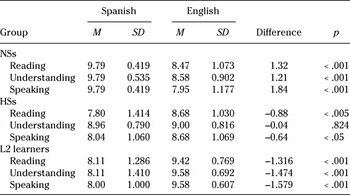
Self-reported Proficiencies. To assess participants’ functional proficiencies in and exposure to Spanish and English, all participants completed the Language Experience and Proficiency Questionnaire (LEAP-Q) developed by Marian, Blumenfeld, and Kaushanskaya (Reference Marian, Blumenfeld and Kaushanskaya2007). The LEAP-Q elicits self-rated proficiencies for three language areas (reading, understanding, and speaking) on a scale of 1 to 10, where 1 indicates minimal ability and 10 indicates high proficiency. The questionnaire also elicits information about current language experience such as the portion of time spent reading, conversing, listening to the radio, and watching television in each language. This information was used to further delineate differences in experience between the Spanish HSs and the L2 learners.Footnote 5
The data in Table 1 show that monolingually raised Spanish speakers’ self-rated proficiencies in each language area (reading, understanding, and speaking) were near ceiling in Spanish. As would be expected of individuals pursuing careers or academic study in the United States, their self-rated proficiencies in English were also high but markedly lower than in Spanish. Paired-samples t tests revealed that proficiency ratings were significantly higher in Spanish compared to English for each of the three language areas. Additionally, the questionnaire revealed that their preference for reading was greater in Spanish than English (57% vs. 37%) and their preference for speaking Spanish was greater than their preference for speaking English (67% vs. 27%).Footnote 6
Participants’ mean self-rated proficiencies in Spanish and English as measured by the LEAP-Q (10 = highly proficient, 1 = minimal ability)

Note
Difference = mean self-rating in Spanish minus mean self-rating in English; NSs = native speakers.
All of the HSs reported Spanish as their L1 and English as their L2, introduced shortly after birth or before age 5. Of the 25 participants, 19 claimed English dominance and 6 reported Spanish dominance. All HSs reported using Spanish and English in their daily lives. The data in Table 1 indicate that the HSs’ proficiency ratings were high in both languages but were significantly higher in English compared to Spanish for two of the three language areas (reading and speaking). Their preference for reading was much greater in English than Spanish (71% vs. 28%), but their preference for speaking English was slightly lower than their preference for speaking Spanish (45% vs. 50%).
All advanced L2 learners reported English as their L1 and Spanish as their L2, and all claimed dominance in English. Participants’ self-rated proficiencies were near ceiling in English and very high in Spanish. Pairwise comparisons found that self ratings were significantly higher in English compared to Spanish in each of the three language areas. Furthermore, their preference for reading was much greater in English compared to Spanish (76% vs. 20%), as was their preference for speaking (57% vs. 37%).
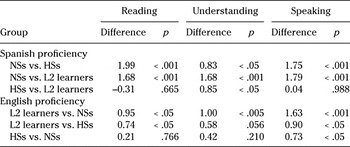
To test for differences among the groups in each language and subskill, six one-way ANOVAs were conducted, one for each language skill (reading, understanding, speaking) in each of the two languages (Spanish, English). The main effect of group was significant in all of the ANOVAs (all ps < .01). Table 2 presents the results of Tukey post hoc tests conducted to interpret the main effects of group. With regard to proficiency in Spanish, the monolingually raised speakers’ self-rated Spanish abilities in the three language areas were significantly higher than those of the HSs and the L2 learners. The HSs reported stronger Spanish abilities relative to L2 learners in one language area: understanding. Regarding English abilities, the L2 learners’ self-rated abilities in the three language areas were significantly higher than those of the monolingually raised Spanish speakers. Their self-rated abilities were higher than those of the HSs in reading and speaking and marginally higher in understanding. The HSs’ self-rated speaking proficiency in English was significantly higher than that of the Spanish speakers raised without English contact, but the groups did not differ in their self-reported abilities in reading and understanding English.
Between-groups comparison of self-rated proficiencies in Spanish and English as measured by the LEAP-Q (10 = highly proficient, 1 = minimal ability)

Note
Difference = mean self-rating for group on the left minus mean self-rating for group on the right; NSs = native speakers.
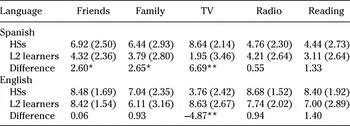
Bilinguals’ Exposure to Spanish. To ensure that the HSs and L2 learners differed not only in their past experience with Spanish but also in their current exposure to and use of the language, the LEAP-Q was used to assess their frequency of exposure to Spanish (and English) in conversation with friends and family and in nonconversational input obtained via television, radio, and reading. The results appear in Table 3. Regarding exposure to Spanish, the HSs used Spanish much more frequently in their interactions with friends and family than the L2 learners. They also watched significantly more Spanish-language television than their L2 counterparts. The two groups were quite similar in their current use of and exposure to English, barring one exception: The L2 learners watched significantly more English-language television.
Heritage and L2 speakers’ mean rates of exposure to Spanish and English as measured by the LEAP-Q (0 = never, 10 = always)

Note
Standard deviations in parentheses; difference = HS rating minus L2 learner rating.
* p < .01.
** p < .001.
Materials
The materials for the offline task consisted of 40 critical items and 40 distractor sentences. The critical items were globally ambiguous complex sentences that consisted of a main clause followed by a subordinate clause. The description globally ambiguous means that critical items lacked pragmatic, grammatical, or contextual biases in favor of a particular antecedent.Footnote 7 The main clause introduced two potential referents for the pronoun in the subordinate clause. Subordinate clauses were headed by temporal conjunctions such as when, after, (ever) since, and while.Footnote 8 The subject of the subordinate clause was a null pronoun in half of the items and an overt pronoun (él “he” or ella “she”) in the other half. Two examples, one with a null pronoun and one with an overt pronoun, are provided in (12) and (13).
(12) Daniel ya no ve a Miguel desde que pro se casó.
“Daniel no longer sees Miguel ever since he got married.”
(13) Alicia se encontró con Elena mientras ella corría en el parque esta mañana.
“Alicia ran into Elena while she was running in the park this morning.”
Following each item was a comprehension question that elicited participants’ preference for the antecedent of the pronoun in the subordinate clause. For example, the item in (12) was followed by the question given in (14).
(14) ¿Quién se casó?
“Who got married?”
A. Daniel B. Miguel
To avoid potential biases in response choice, the order of the main clause referents in the answer choices was counterbalanced across the items in each condition (i.e., half of the A choices in null and overt sentences featured the subject antecedent and half featured the object antecedent). A few representative stimuli appear in the Appendix; the complete stimuli are available upon request.
Of the 40 distractor items, 20 consisted of two-sentence discourses modeled on items in Alonso-Ovalle, Fernández-Solera, Frazier, and Clifton (Reference Alonso-Ovalle, Fernández-Solera, Frazier and Clifton2002). The first sentence in each set introduced two referents and the second sentence contained either a null or an overt pronoun, as in the examples in (15) and (16). These items also involved anaphora resolution but differed from the critical items with respect to discourse context (intersentential vs. intrasentential anaphora).
(15) Rosa escuchó a Marta. Pro Está preocupada.
“Rosa listened to Marta. She is worried.”
(16) Enrique se encontró con Mario. Él está ansioso.
“Enrique ran into Mario. He is anxious.”
The remaining 20 distractors consisted of relative clauses, 10 of which were globally ambiguous and 10 of which required a forced reading by way of gender agreement on an adjective. These items were included for use in another study (Jegerski, VanPatten, & Keating, Reference Jegerski, VanPatten and Keating2010). As with the critical items, the 40 distractor items were followed by a comprehension question and two choices for answers.
Procedure
Participants completed the LEAP-Q followed by the offline sentence comprehension task. Stimulus presentation and recording of response choices for the offline task were conducted with SuperLab 4.0. All sentences appeared individually on a single line using normal uppercase and lowercase letters in 16-point Tahoma font. Comprehension questions and their answer choices appeared on a separate screen. Participants responded to comprehension questions by pressing either A or B (buttons 1 and 7, respectively) on a Cedrus RB-730 response pad. Erroneous button presses (i.e., pressing the advance button instead of an answer key) were scored as missing values. Such responses comprised less than 1% of the data. The experimental items were preceded by instructions (in Spanish) and 10 practice items. The order of sentences was randomized for each participant. As in previous offline studies, there was no time limit to read a stimulus sentence or answer a follow-up question. However, participants were instructed to read at their normal rate and to answer according to their first intuition, without dwelling excessively on the stimulus sentences or the follow-up questions. Participants completed the LEAP-Q and the offline task in approximately 60 min.
RESULTS
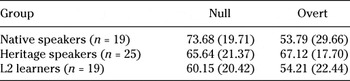
Table 4 shows each group’s percentage of subject (i.e., [Spec, IP]) antecedent choices for null and overt subject pronouns. The data were submitted to a Pronoun (null vs. overt) × Group (monolingually raised vs. heritage vs. L2 learner) ANOVA with Subjects (F 1 and t 1) and Items (F 2 and t 2) as random effects. In the analysis by subjects, Group was a between-subjects factor and Pronoun was a within-subjects factor. Given that items were not matched across the two pronoun conditions, in the analysis by items, both Pronoun and Group were between-items factors. Alpha was set at .05 for all analyses. The analysis on antecedent selection yielded a main effect of Pronoun, F 1(1, 60) = 6.865, p < .05; F 2(1, 114) = 9.760, p < .005, which reflects the stronger preference to link the null (as opposed to the overt) pronoun to the subject antecedent. The effect of Group was significant in the analysis by items but not by subjects, F 1(2, 60) = 1.408, p = .253; F 2(2, 114) = 4.343, p < .05. The effect of Pronoun was qualified by a significant two-way interaction with Group, F 1(2, 60) = 4.179, p < .05; F 2(2, 114) = 5.791, p < .005. The interaction reflected the fact that the difference in antecedent preference between null and overt pronouns was greater for the monolingually raised speakers than for the HSs and the L2 learners.
Percentage selection of [Spec, IP] as antecedent of null and overt pronouns

Note
Standard deviations in parentheses.
To further interpret the interaction, two one-way ANOVAs were conducted—one on the data in the null pronoun condition and one on the data in the overt pronoun condition—and three paired-samples t tests—one for each of the three experimental groups. In the null pronoun condition, the one-way ANOVA revealed a main effect of Group that was significant only in the analysis by items, F 1(2, 60) = 2.078, p = .134; F 2(2, 57) = 4.661, p < .05. The main effect in the analysis by items was due to the fact that the native speakers were more likely than the L2 learners to link a null subject to a subject antecedent (p < .05). In the overt pronoun condition, the one-way ANOVA revealed a main effect of Group that was significant in the analysis by items and that approached significance in the analysis by subjects, F 1(2, 60) = 2.412, p = .098; F 2(2, 57) = 5.445, p < .01. Tukey post hoc comparisons of the by-items analysis found that the HSs were more likely to interpret an overt pronoun as coreferential with a subject antecedent than the monolingually raised Spanish speakers (p < .05) and the L2 learners (p < .05).
Results of the paired-samples t tests indicated that the difference between null and overt pronouns with regard to the selection of [Spec, IP] as the antecedent was significant for the monolingually raised speakers, t 1(18) = 2.420, p < .05; t 2(38) = 4.548, p < .001, but not for the HSs, t 1(24) = –0.498, p = .623; t 2(38) = –0.335, p = .740, or the L2 learners, t 1(18) = 1.280, p = .217; t 2(38) = 1.223, p = .229.
To ensure that language dominance did not influence the antecedent biases of the early bilinguals, the HSs were divided into English- (n = 19) and Spanish-dominant (n = 6) groups based on their self-reported claims of language dominance. In terms of percentage selection, the Spanish-dominant HSs were more likely than the English-dominant HSs to resolve pro in favor of a subject antecedent (71.67% vs. 63.75%), a result that might be expected if language dominance matters. However, they were also more likely to resolve the overt pronoun in favor of a subject antecedent (71.10% vs. 65.87%), an unanticipated result if language dominance influences antecedent biases. A Group (Spanish- vs. English-dominant) × Pronoun ANOVA revealed no main effect of Group, F 1(1, 23) = 0.585, p = .452; F 2(1, 76) = 2.821, p = .097. Likewise, there was no main effect of Pronoun and no interaction between Group and Pronoun (all Fs < 1). Although these results must be interpreted with caution in light of the small and unequal sample sizes, they suggest that (self-reported) language dominance did not impact the performance of the HSs.
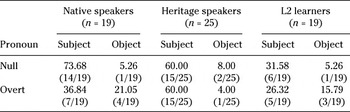
As in Serratrice (Reference Serratrice2007), individual response patterns to null and overt subject pronouns were examined by tallying the proportion of participants in each group who chose the subject and object antecedents on at least 70% of the trials (14/20) in each condition (null vs. overt).Footnote 9 The results appear in Table 5. In the null pronoun condition, 74% of monolingually raised Spanish speakers and 60% of HSs resolved pro in favor of the subject antecedent, compared to just 32% of L2 learners. Only one monolingually raised speaker, two HSs, and one L2 learner showed a bias to resolve pro in favor of an object antecedent. In the overt pronoun condition, 21% of Spanish speakers raised without English contact selected the expected object antecedent against 4% of HSs and 16% of L2 learners. The majority of HSs (60%) displayed a tendency to resolve the overt pronoun in favor of the subject antecedent versus 37% of monolingually raised Spanish speakers and 16% of L2 learners.
Proportion of participants in each group providing a subject and an object response on at least 70% of trials

Not shown in Table 5 is the number of participants in each group who did not display a bias toward either the subject or the object in each pronoun condition. In the null condition, this comprised 63% (12/19) of L2 learners against 32% (8/25) of HSs and 21% (4/19) of monolingually raised Spanish speakers. In the overt condition, this included 58% (11/19) of L2 learners against 36% (9/25) of HSs and 42% (8/19) of Spanish speakers raised monolingually.
DISCUSSION
The present study had two aims: (a) to determine whether Spanish HSs and L2 learners of Spanish who are dominant in a non-null-subject language (English) demonstrate nativelike antecedent biases for null and overt subject pronouns in their null-subject language (Spanish) and (b) to establish whether Spanish HSs are less likely than L2 learners to display pragmatically inappropriate antecedent biases for subject pronouns. Using an offline questionnaire that probed participants’ antecedent preferences for null and overt pronouns in globally ambiguous sentences, two main findings were revealed. First, unlike the control group of Spanish speakers raised monolingually, Spanish HSs and L2 learners of Spanish did not exhibit pragmatically constrained biases in antecedent assignment for null and overt subject pronouns. Additionally, Spanish HSs chose more pragmatically inappropriate subject antecedents for overt subject pronouns than did L2 learners and monolingually raised Spanish speakers; however, fewer L2 learners than Spanish HSs and monolingually raised Spanish speakers displayed the expected bias to resolve pro in favor of a subject antecedent. Before addressing these results further, the performance of the monolingually raised Spanish speakers will be discussed in light of previous research on anaphora resolution in monolinguals.
Anaphora Resolution in Monolingually Raised Spanish Speakers
This study replicates the primary finding of Carminati’s (Reference Carminati2002) study in Italian in that the Spanish natives raised monolingually displayed distinct antecedent biases for the resolution of null and overt subject pronouns in intrasentential anaphora. Consonant with the predictions of the PAS, more participants in this group selected [Spec, IP] as the antecedent of the null pronoun (74%) compared to the overt pronoun (37%). The bias for linking pro to the subject antecedent in this study is in line with that of Carminati’s (Reference Carminati2002) study (81%) and is clearly stronger than that reported in research conducted by Sorace and colleagues (Belletti et al., Reference Belletti, Bennati and Sorace2007; Serratrice, Reference Serratrice2007; Sorace & Filiaci, Reference Sorace and Filiaci2006; Tsimpli et al., Reference Tsimpli, Sorace, Heycock and Filiaci2004), whose adult Italian monolinguals chose the subject antecedent only about half of the time.
Although the results of the current study demonstrate a statistically significant bias in antecedent assignment, they did not reveal a neat division of labor between null and overt pronouns overall. On the one hand, there was a clear and strong tendency for Spanish speakers to link null subject pronouns to the noun in [Spec, IP] position of the previous clause. On the other hand, the results on the overt pronouns are a bit different. In the aggregate, the monolingually raised Spanish speakers interpreted the overt pronoun as coreferential with the object antecedent less than half of the time (46.21%), and in individual analyses, only 21% of participants selected the object antecedent on the majority of trials. The lack of a strong division of labor is not completely unexpected given that monolinguals reported in previous research show some tendency to accept subject antecedents for the overt pronoun; however, the Italian monolinguals reported in Carminati (Reference Carminati2002, Experiment 2) and in the studies conducted by Sorace and colleagues (Belletti et al., Reference Belletti, Bennati and Sorace2007; Serratrice, Reference Serratrice2007; Sorace & Filiaci, Reference Sorace and Filiaci2006; Tsimpli et al., Reference Tsimpli, Sorace, Heycock and Filiaci2004) did so less than 20% of time, against almost 54% in the current study. A possible explanation for this result is that the Spanish speakers of the current study were influenced by their contact with English; that is, their exposure to a language with a strong subject antecedent bias for overt pronouns (i.e., the subject rule) may have affected the way they interpreted overt pronouns in Spanish. This seems unlikely given that the results converge with those of other functionally monolingual Spanish speakers tested in their home countries. In a study investigating intersentential anaphora in two-sentence discourses, Alonso-Ovalle et al. (Reference Alonso-Ovalle, Fernández-Solera, Frazier and Clifton2002) found that Spanish monolinguals residing in Spain selected the object antecedent for the overt pronoun only 50% of the time. In a pilot study on intrasentential anaphora (VanPatten & Keating, Reference VanPatten and Keating2007), Spanish monolinguals residing in Spain and Mexico selected the object antecedent for the overt pronoun only 29% of the time.
The results are compatible with two other possibilities. First, some evidence suggests that speakers’ antecedent bias for the overt pronoun is intrinsically weaker or less stable than that of the null pronoun (Carminati, Reference Carminati2002). Carminati (Reference Carminati2002, Experiment 8; see also Carminati, Reference Carminati2005) tested whether Italian monolinguals would incur processing and comprehension accuracy penalties when gender cues obligated the resumption of null and overt subject pronouns against their antecedent biases. Online reading time data and offline comprehension data showed that resolving pro as coreferential with the object antecedent incurred penalties in processing and accuracy, whereas interpreting the overt pronoun as coreferential with the subject antecedent did not. In sum, native speakers may not have as strong a bias for overt pronoun antecedence compared to that of pro.
Another possibility is that there may be microvariation in the pro-drop parameter that allows for differences across null-subject languages. Spanish and Italian are often assumed to pattern similarly with respect to the distribution of null and overt pronouns, but some recent experimental evidence suggests this may not be the case. Filiaci (Reference Filiaci2009) conducted a self-paced reading study in which Spanish and Italian monolinguals read the same sentences translated into their native language. In the sentences, null and overt subject pronouns were semantically disambiguated against their antecedent biases. The results showed that null subjects were processed similarly in the two languages, whereas the processing penalty for an overt subject pronoun retrieving a subject versus an object antecedent went in different directions in the two languages. Even if Spanish and Italian differ in their processing biases for the resolution of overt subject pronouns, the question of whether English-dominant Spanish bilinguals pattern similarly to Spanish speakers raised monolingually remains of interest.
Anaphora Resolution in HSs and L2 Learners
The anaphoric behavior of the Spanish HSs and the L2 learners deviated from that of Spanish speakers raised monolingually, albeit in different ways. The HSs were nativelike in their antecedent biases for the null pronoun in that they preferred the noun in [Spec, IP] the majority of the time. In line with the predictions—but in contrast to the tendency displayed by Spanish speakers raised monolingually—the HSs also displayed a reliable bias to resolve the overt pronoun in favor of a subject antecedent (i.e., they complied with the subject rule). In fact, only 1 of 25 HSs tested displayed an object antecedent bias for the overt pronoun. In this respect, the results of the HSs are consistent with the results of studies on anaphora resolution in child bilinguals and adult L2 learners (for a review, see Sorace & Filiaci, Reference Sorace and Filiaci2006; Sorace & Serratrice, Reference Sorace and Serratrice2009), who also overextended the interpretative scope of the overt pronoun in ways that monolinguals did not. In terms of continuity of reference, this means that for the majority of HSs, the overt pronoun does not receive a switch-reference interpretation—at least not in isolated sentences like the ones tested here. Why might this be?
It could be that HSs do not receive the quantities of discourse-level Spanish input needed to acquire the switch-reference properties associated with overt pronouns. In an experimental study on the effects of continuity on pronoun selection in Mexican monolinguals, Shin and Cairns (Reference Shin, Cairns, Collentine, García, Lafford and Marín2009) found that sensitivity to switch-reference contexts emerges between the ages of 7 and 9 years. This is approximately 3 years after most HSs in the United States begin English-language schooling. From kindergarten onward, the majority of a HS’s daily language input is in English. Thus, from age 5 onward—and perhaps from an earlier age if English input is available in the home—a HS receives competing evidence regarding the discourse functions of overt subject pronouns (+ topic shift in Spanish, ± topic shift in English). As Shin and Cairns (Reference Shin, Cairns, Collentine, García, Lafford and Marín2009) noted, subject pronouns in Spanish also have functions in communication. In third-person singular contexts such as those tested in the current study, an infelicitous null pronoun in switch-reference contexts results in ambiguity, whereas an infelicitous overt pronoun in same-reference contexts results in redundancy. In light of these facts, the subject assignment strategy that HSs use to resolve intrasentential anaphora appears to reflect a preference to avoid ambiguity (i.e., if there is a subject pronoun, assign it a subject antecedent, even if it results in redundancy). HSs may have adopted this strategy at an early age to ease the burden imposed by sorting through two systems of pronominal subjects. In the absence of sufficient quantities of Spanish input needed to acquire a more monolinguallike strategy (i.e., the PAS), the subject rule then persists into adulthood.
What is not clear is why more than twice as many HSs as L2 learners (60% vs. 26%) chose a pragmatically inappropriate subject antecedent for an overt pronoun. The L2 learners were expected to also obey the subject rule by displaying a subject-antecedent bias for both null and overt pronouns. This prediction did not bear out in the individual response patterns. In fact, the majority of L2 learners did not show any bias in their interpretation of null (63%) or overt (58%) subject pronouns. This suggests that for the majority of L2 learners, null and overt pronouns are in some state of free variation when it comes to establishing continuity. Only 32% (6/19) of the L2 participants displayed the pragmatically appropriate bias of resolving pro in favor of the noun in [Spec, IP], compared to more than twice as many Spanish speakers raised monolingually (74%) who showed this bias. The instability of the null pronoun observed in this study is consistent with similar findings reported in other studies of L2 learners (Montrul & Rodríguez Louro, Reference Montrul, Rodríguez Louro, Torrens and Escobar2006; Rothman, Reference Rothman2009). The lack of clear antecedent biases for either pronoun suggests that the L2 learners are still sorting out the pragmatic constraints on pronominal subject distribution.
It appears that early exposure to and use of Spanish does not confer an advantage to HSs relative to L2 learners with respect to the resolution of overt subject pronouns. The findings support Montrul’s (Reference Montrul2008) claim that HSs may not have advantages over L2 learners with respect to grammatical properties that are acquired later in life or that require significant amounts of sustained input. The evidence presented by Shin and Cairns (Reference Shin, Cairns, Collentine, García, Lafford and Marín2009) suggests that sensitivity to continuity requires just those things. That said, the L2 learners are much more unstable than the HSs in their biases for null pronouns, which suggests that early exposure to and use of Spanish may have conferred some advantage to HSs.
In sum, the results of the current study of anaphora resolution in Spanish HSs and L2 learners of Spanish are interpreted in terms of the putative effects of exposure to Spanish input. However, input alone cannot account for instability at the syntax-pragmatics interface. The fact that monolingual speakers of null-subject languages require a substantial amount of time to acquire pronominal subject distribution in spite of exposure to the optimal type and quantity of input is testament that factors independent of the linguistic environment are also at play. In the case of bilinguals, Sorace and Serratrice (Reference Sorace and Serratrice2009) posited processing limitations as a probable source of vulnerability at the interfaces, where processing limitations include “inefficient (incremental) access to knowledge, inefficient coordination of information, and/or inefficient allocation of resources” (p. 198). In a nutshell, this account holds that knowledge integration between the syntax and other (external) domains taxes computational resources more so than the computation of narrow syntactic phenomena or those situated at internal interfaces. In the case of pronominal subject distribution, the claim is that bilinguals ease the processing burden by adopting the overt pronoun as a default, which results in its overextension to same-reference contexts.
One limitation of the current study, and most of those reported herein, is that only offline data were examined. Untimed offline judgments are subject to introspection and may be indicative of delayed decision making, not initial interpretational biases. If it is the case that Spanish HSs prefer to resolve overt pronouns in favor of subject antecedents, this should show up in online reading data. Specifically, a self-paced reading or eye-tracking study should reveal significantly longer reading times when the overt pronoun is resolved in favor of the object antecedent, a condition that violates the subject rule. This matter will be explored in future research, which should also establish that bilinguals have acquired the syntax of null subjects and make use of this knowledge during online sentence comprehension. Clahsen and colleagues have claimed that the syntactic representations adult L2 learners compute during online sentence comprehension are shallower (i.e., less detailed) than those of native speakers (Clahsen & Felser, Reference Clahsen and Felser2006; Felser & Roberts, Reference Felser and Roberts2007; Marinis, Roberts, Felser, & Clahsen, Reference Marinis, Roberts, Felser and Clahsen2005, among others). To rule out structural (as opposed to pragmatic) biases as the source of bilingual speakers’ difficulty with anaphora resolution, research might also examine their online sensitivity to violations of the overt pronoun constraint (Montalbetti, Reference Montalbetti1984), a purely syntactic principle that prohibits coreference between an embedded overt (as opposed to the null) subject pronoun and a quantified antecedent. Online sensitivity to violations of the overt pronoun constraint would constitute proof that bilinguals make use of their knowledge of the pro-drop parameter during language comprehension (see also Rothman, Reference Rothman2009).
CONCLUSION
The present study provides additional evidence in support of the claim that grammatical properties situated at the syntax-discourse interface—in this case, the resolution of intrasentential anaphora in null-subject languages such as Spanish—are loci of instability in bilingual acquisition. The results do not support the general notion that HSs have advantages over L2 learners, at least not in the resolution of pronominal ambiguities. For HSs, early exposure to and use of Spanish did not result in less nonmonolinguallike behavior with respect to the resolution of overt pronouns—the primary source of difficulty for bilingual speakers dominant in a non-null-subject language such as English (Belletti et al., Reference Belletti, Bennati and Sorace2007; Serratrice, Reference Serratrice2007; Sorace & Filiaci, Reference Sorace and Filiaci2006; Tsimpli et al., Reference Tsimpli, Sorace, Heycock and Filiaci2004). Considering recent evidence that continuity of reference is subject to considerable delays in monolingual acquisition (Shin & Cairns, Reference Shin, Cairns, Collentine, García, Lafford and Marín2009), it seems that Spanish HSs do not have more access than adult L2 learners to input that unambiguously illustrates the relevant switch-reference properties of overt Spanish pronouns. Clearly, detailed comparisons of the input that HSs and L2 learners receive during the course of acquisition is warranted.
To be sure, this research is not a comparison of HSs and L2 learners who are at the end state of acquisition, particularly those who appear to be nativelike; that is, the objective is not to test the interface hypothesis (Sorace, Reference Sorace2000, Reference Sorace, Doughty and Long2003, Reference Sorace, Cornips and Corrigan2005; Sorace & Filiaci, Reference Sorace and Filiaci2006). Instead, the focus is on advanced L2 learners who are highly proficient in Spanish in a variety of domains. They may still be in a learning phase when it comes to the distribution of pronoun antecedent bias. Whether L2 learners of Spanish deemed to be nativelike perform or do not perform like the advanced L2 learners of the current study on tests of pronoun antecedence is an empirical question.
APPENDIX
REPRESENTATIVE STIMULI
Null Condition
(1) Marta le escribía frecuentemente a Lorena cuando estaba en los Estados Unidos.
“Marta wrote frequently to Lorena when she lived in the United States.”
(2) Maribela se hizo amiga de Sandra después de que se divorció.
“Maribela became friends with Sandra after she got divorced.”
(3) Daniel ya no ve a Miguel desde que se casó.
“Daniel no longer sees Miguel ever since he got married.”
(4) Pedro no habla con Víctor desde cuando dio su resignación.
“Pedro doesn’t speak to Victor since he turned in his resignation.”
Overt Condition
(5) Cristina veía a Lina todos los días cuando ella vivía en Cancún.
“Cristina saw Lina every day when she lived in Cancun.”
(6) Roberto insultó a Hugo cuando él estaba borracho.
“Roberto insulted Hugo when he was drunk.”
(7) Diego le escribió a Eduardo después de que él se mudó a San Francisco.
“Diego wrote to Eduardo after he moved to San Francisco.”
(8) Susana llamó a Paola cuando ella estaba en la oficina.
“Susana called Paola when she was in the office.”