





The developing brain is especially sensitive to environmental insults during the prenatal period, and atypical neurodevelopment can lead to behavioural problems or psychopathology in children, including attention-deficit/hyperactivity disorder (ADHD), internalising problems, disruptive behaviour disorders and peer-relationship problems(Reference Melillo and Leisman1). Behavioural and emotional problems represent some of the most common mental disorders of childhood, and co-morbidity among them is common(Reference Vasileva, Graf and Reinelt2,Reference Polanczyk, Salum and Sugaya3) . Symptoms can persist into adulthood and can affect child and adolescent educational and professional attainment, emotional wellbeing, social function, and drug addiction vulnerability, as well as cause significant burdens on the family(Reference Harpin4–Reference Woodward and Fergusson7).
The quality of the maternal diet during pregnancy may influence child cognitive development(Reference Borge, Aase and Brantsæter8). However, the associations between maternal diet quality and offspring behavioural and emotional problems are less in agreement due to a significant degree of heterogeneity in meta-analyses and a clear indication of publication bias(Reference Borge, Aase and Brantsæter8). The maternal diet is believed to influence child neurodevelopment, at least in part, through inflammation, which has been demonstrated to adversely affect fetal brain development(Reference Bilal, Ashraf and Zhao9,Reference Lubrano, Parisi and Cetin10) . Inflammation during pregnancy is associated with alterations in placental pathology and exposes the fetal brain to oxidative stress and inflammation. This exposure may prime neurodevelopmental disorders via changes in fetal brain gene expression, disrupting neurogenesis and neuronal migration and impairing normal neuronal signalling(Reference Shivappa, Steck and Hurley11). The diet has an inflammatory potential, as dietary components such as fats, vitamins, and polyphenols may have pro- or anti-inflammatory effects(Reference Lubrano, Parisi and Cetin10,Reference Shivappa, Steck and Hurley11) . However, the combined effects of these pro- and anti-inflammatory dietary components on offspring behaviour have not been well characterised. The dietary inflammatory index (DII) offers a unique tool to assess this association by capturing the overall inflammatory potential of the diet(Reference Shivappa, Steck and Hurley11).
Three previous studies have used the DII or the energy-adjusted DII (E-DII), which more accurately predicts the inflammatory potential of the diet(Reference DiNatale, Azarmanesh and Hébert12)), to determine the relationship between diet-induced inflammation and offspring behavioural or emotional problems, but findings are inconsistent(Reference Polanska, Kaluzny and Aubert13–Reference Lertxundi, Molinuevo and Valvi15). A meta-analysis of four European cohorts of children of 7–10 years old found evidence of increased behavioural and emotional problems in offspring with higher maternal E-DII scores(Reference Polanska, Kaluzny and Aubert13). However, another study in 4-year-olds observed an inverse association between the E-DII and hyperactivity-inattention symptoms in boys only(Reference Lertxundi, Molinuevo and Valvi15), while Faleschini et al. observed a positive association between the DII and internalising (but not externalising) problems among children 7–13 years old that differed according to the evaluator(Reference Faleschini, Rifas-Shiman and Monthé-Drèze14).
The previous studies have some shortcomings, as only Faleschini et al. were able to evaluate the relationship at multiple time points in the same children(Reference Faleschini, Rifas-Shiman and Monthé-Drèze14). Evaluating the association at multiple time points could help determine whether the influence of the postnatal environment becomes more important over time and attenuates the influence of the intra-uterine environment, or whether the effects of in utero programming are strong enough to persist throughout childhood. In addition, some domains of behavioural and emotional problems have been poorly evaluated, as domains are often grouped together into internalising and externalising problems, though each domain may be influenced by the maternal diet differentially. Finally, none of the previous studies have specifically examined the effect of an inflammatory maternal diet on the development of peer-relationship problems, though they represent ‘an absolute necessity for healthy cognitive and social development and socialisation’(Reference Johnson and McMillan16). Peer relationships are a domain that warrants attention, as early relationships can affect adult social adjustment, and correlations have been observed between early relationships and externalising symptoms of aggressive, suicidal, and illegal behaviour, as well as internalising symptoms of anxiety and depression in adolescence(Reference Woodward and Fergusson6,Reference Davis and Allen17–Reference Biggs, Nelson and Sampilo19) .
Due to scarcity in the literature and the heterogeneous findings, the objective of this study was to examine the association between the E-DII during pregnancy and symptoms of offspring: hyperactivity-inattention, conduct problems, peer-relationship problems, and anxiety and depressive symptoms in a large French cohort at 5·5 and 10 years. We hypothesised that higher E-DII scores, indicative of a more pro-inflammatory maternal diet, would be associated with increased symptomology of behavioural and emotional problems in offspring.
Methods and materials
Study population
The Etude Longitudinale Française depuis l’Enfance/French Longitudinal Study since Childhood (ELFE) cohort was initiated in 2011 to study the determinants of child health, development, and socialisation from birth to 20 years(Reference Charles, Thierry and Lanoe20). Children were recruited at birth throughout metropolitan France from 320 randomly selected maternities. The recruitment period took place over 25 d in the four seasons throughout the year. Eligibility criteria included births at ≥ 33 weeks of gestation, mothers aged ≥ 18 years, and no plan to leave metropolitan France in the following 3 years. Written informed consent was received from both parents or the mother alone at enrolment.
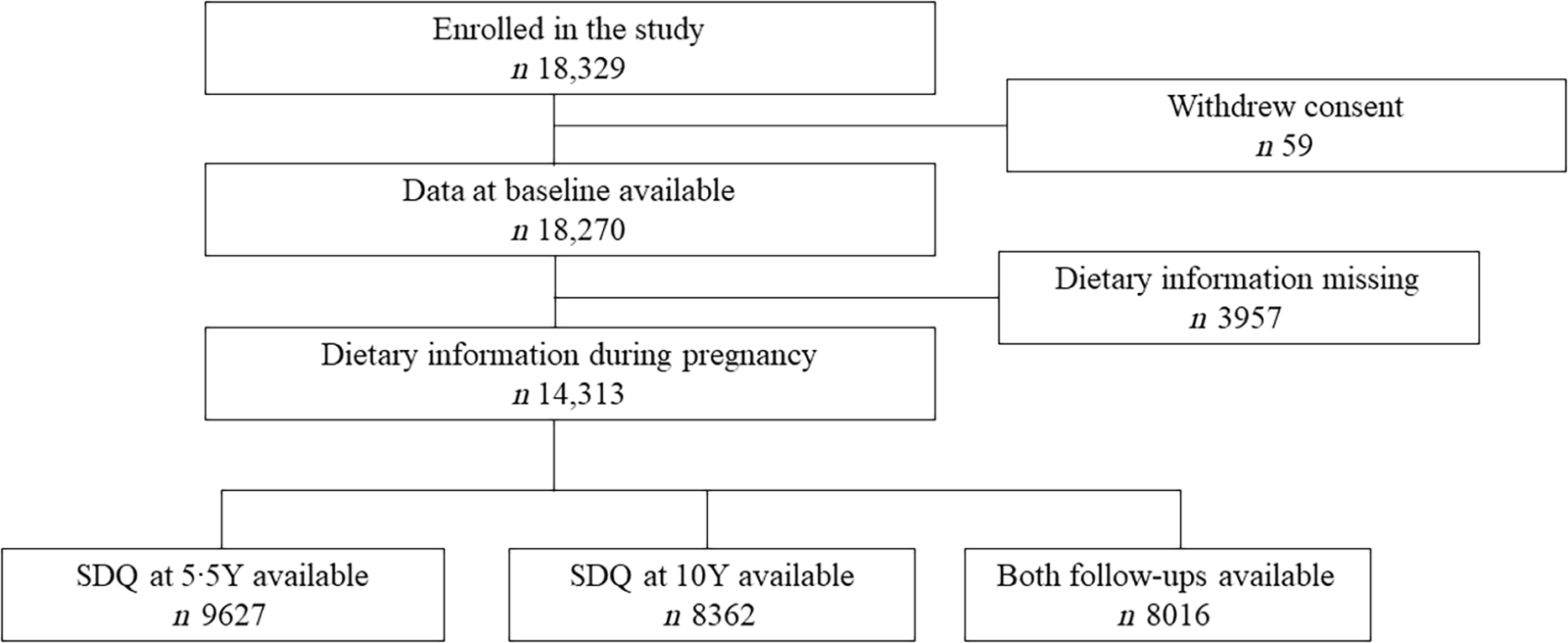
A total of 18 040 mothers agreed to participate in the ELFE study and gave birth to 18 329 infants (Figure 1). Baseline data for fifty-nine women were withdrawn at the mother’s request, resulting in an initial study population of 18 270 children. Data collection was via paper questionnaires, telephone interviews or the internet by one or both parents.
Flow chart of study participation in the ELFE study. SDQ, Strengths and Difficulties Questionnaire.

The ELFE study received approval from the Advisory Committee for the Processing of Information for Health Research (Comité Consultatif sur le Traitement des Informations pour la Recherche en Santé: CCTIRS), the committee for protection of persons engaged in research (CPP: Comité de Protection des Personnes), the National Data Protection Authority (Commission National Informatique et Libertés: CNIL), and the National Council for Statistical Information (CNIS).
Exposure assessment
Dietary intake during pregnancy was assessed using a self-administered, validated FFQ during the mother’s stay at the maternity(Reference Kadawathagedara, Ahluwalia and Dufourg21). Briefly, the FFQ estimated the intake of 125 food and drink items over the last 3 months of pregnancy. A seven-item scale ranging from ‘never’ to ‘more than once per day’ was used to assess frequency. Habitual portion sizes were indicated using photographic aids, or the mid-portion was automatically assigned(Reference Hercberg, Deheeger and Preziosi22). Daily intake was calculated combining frequency with portion size, which allowed items to be categorised into forty-eight food groups and the estimation of energy intake(Reference Hercberg23). Women were excluded if they had more than ten missing answers to the FFQ; otherwise, missing values were imputed with the sample median. Participants who were likely misreporting dietary intake (< 3rd or > 97th percentile of estimated total energy intake, corresponding to < 933 kcal/d and > 5072 kcal/d) were also excluded.
Maternal dietary inflammatory potential was determined using the E-DII. The E-DII has been described in detail previously(Reference Shivappa, Steck and Hurley11,Reference Delvert, Dow and Charles24) . Briefly, literature-based inflammatory weights calculated by Shivappa et al. were assigned to twenty-eight of the original forty-five dietary components for which data were available (online Supplementary Table S1). Weights were calculated based on each component’s pro- or anti-inflammatory potential on six biomarkers of inflammation: the canonical pro-inflammatory cytokines (IL-1β, IL-6, and TNF-α), the acute phase C-reactive protein (CRP), and two anti-inflammatory cytokines (IL-4 and IL-10)(Reference Shivappa, Steck and Hurley11). To calculate each mother’s E-DII, first, the energy-adjusted daily intake of each dietary component was calculated using the residual method(Reference Willett, Howe and Kushi25). Next, the energy-adjusted daily intake was subtracted from the population mean and divided by the population standard deviation to obtain a z-score for each participant. Z-scores were then converted into percentile scores to reduce right skewness and then multiplied by 2. Next they had 1 subtracted to obtain a range from –1 to 1. Finally, each percentile score was multiplied by the literature-based inflammatory weight and summed to obtain the overall E-DII for each participant, with a theoretical range from –7·97 to +7·97. Higher scores indicate a more pro-inflammatory dietary potential.
Outcome assessment
Symptoms of behavioural and emotional problems were assessed using the Strengths and Difficulties Questionnaire (SDQ) at 5·5 and 10 years of age via phone interviews with one of the parents. The SDQ is a validated tool to detect problem behaviours and emotions in children(Reference Goodman26). It is a twenty-five-item questionnaire comprised of five domains which each assess different symptoms: (i) hyperactivity-inattention – ADHD symptoms; (ii) emotional problems – depressive and anxiety symptoms; (iii) conduct problems – aggressive and oppositional behaviour symptoms; (iv) peer problems – relationship problems and (v) prosocial behaviour – which was not assessed in this cohort. Each of the assessed domains contains five items with responses ranging from ‘Not true (0 points)’ to ‘A little true (1 point)’ to ‘Very true (2 points)’. The domain-specific scores can range from 0 to 10, and the overall SDQ score, in this case, from 0 to 40, with higher scores indicating more symptoms of behavioural or emotional problems.
Data from the SDQ were collected for 11 248 children at 5·5 years and 9744 children at 10 years. Each domain-specific SDQ score was classified into three categories: ‘Normal’, ‘Borderline’, and ‘Abnormal’ (online Supplementary Table S2). These thresholds agree with both the traditional cut-off used to identify children with borderline or clinically significant symptoms and the French-specific cut-offs for ‘Abnormal’(Reference Goodman26,Reference Shojaei, Wazana and Pitrou27) . The exception is the case of peer problems, where the French-specific threshold for normal (0–3) is slightly different from the traditional threshold for normal (0–2)(Reference Goodman26,Reference Shojaei, Wazana and Pitrou27) . For the case of peer problems, the traditional thresholds were used in the main analyses.
Other variables
Other variables were collected from self-administered questionnaires, health records, or midwives during clinical examinations(Reference Charles, Thierry and Lanoe20). At baseline, sociodemographic variables included maternal age, country of birth, level of education, employment status, region of residence, household income, index of social deprivation(Reference Pergeline, Rivière and Rey28), population density of habitation area (based on census data), and cohabitation status. Factors collected or calculated related to the pregnancy were maternity unit, parity, gestational weight gain, type 1 or 2 diabetes history, gestational diabetes, hypertension during pregnancy, pre-eclampsia, any psychological problems before pregnancy, any psychological problems during pregnancy, mode of delivery, gestational age, and birth weight. Variables concerning maternal lifestyle reported at baseline were diet quality score during pregnancy(Reference de Lauzon-Guillain, Marques and Kadawathagedara29), energy intake during pregnancy (kcal/d), smoking during pregnancy, any alcohol consumption during pregnancy (even if women were not yet aware of the pregnancy), maternal pre-pregnancy body mass index (BMI), and energy expenditure scores (global, leisure-time, and sedentary) during pregnancy (score = metabolic equivalents (MET)activity × time (hours) × 7 (days)(Reference de Lauzon-Guillain, Marques and Kadawathagedara29)). Lastly, variables related to the child included sex, duration of any breast-feeding(Reference Wagner, Kersuzan and Gojard30), childcare at 2 years, sleep duration from 1 to 10 years(Reference Messayke, Franco and Forhan31), difficulties falling asleep from 2 to 10 years (wake up at night more than twice/week), and duration of daily screen time from 2 to 10 years(Reference Yang, Saïd and Peyre32).
Statistical analyses
The final study population consisted of 9627 participants at 5·5 years and 8362 participants at 10 years, with both dietary information and SDQ data. Descriptive analyses were conducted to describe the overall population characteristics, the SDQ variable distributions, and the E-DII distributions. ANOVA and χ 2 tests were used to compare characteristics between the excluded and included participants for continuous and categorical variables, respectively.
Missing data for covariates were imputed using multiple imputation with chained equations (Annex 1), and then multinomial logistic regression was performed to determine the association between the maternal E-DII during pregnancy and the odds of offspring behavioural problems. The linearity of the association was tested with each domain, and significant deviations from linearity were observed for conduct problems and peer problems. For this reason, the E-DII was divided into tertiles in the conduct and peer problems models. A directed acyclic graph was used to identify covariates to include in the multivariable models (online Supplementary Figure S1). Models were adjusted for the following covariates: maternal age at delivery, maternal education, monthly household income, maternal country of birth, parity, pre-pregnancy BMI, child sex, and age at assessment. Models were also adjusted for the maternity size and recruitment wave to account for the sampling design and for maternal energy intake, according to the residual method(Reference Thiébaut, Kesse-Guyot and Com-Nougué33). Interactions with offspring sex were tested, as a previous study found sex-specific differences between the DII and childhood behavioural and emotional problems(Reference Lertxundi, Molinuevo and Valvi15). Analyses were stratified by sex in the case of P < 0·05 for interaction.
In sensitivity analyses, we performed complete-case analyses using only participants with no data missing for covariates. Second, we ran analyses using only participants with data at both follow-ups (n 8016). Third, we ran analyses additionally adjusting for the maternal lifestyle during pregnancy (diet quality, smoking, any alcohol intake, leisure-time physical activity score, and sedentary score) and psychological problems during pregnancy. Finally, analyses for peer problems were rerun using the French-specific threshold for peer problem categories(Reference Shojaei, Wazana and Pitrou27).
All statistical analyses were performed using SAS 9.4 software (SAS Institute Inc.).
Results
Descriptive analyses
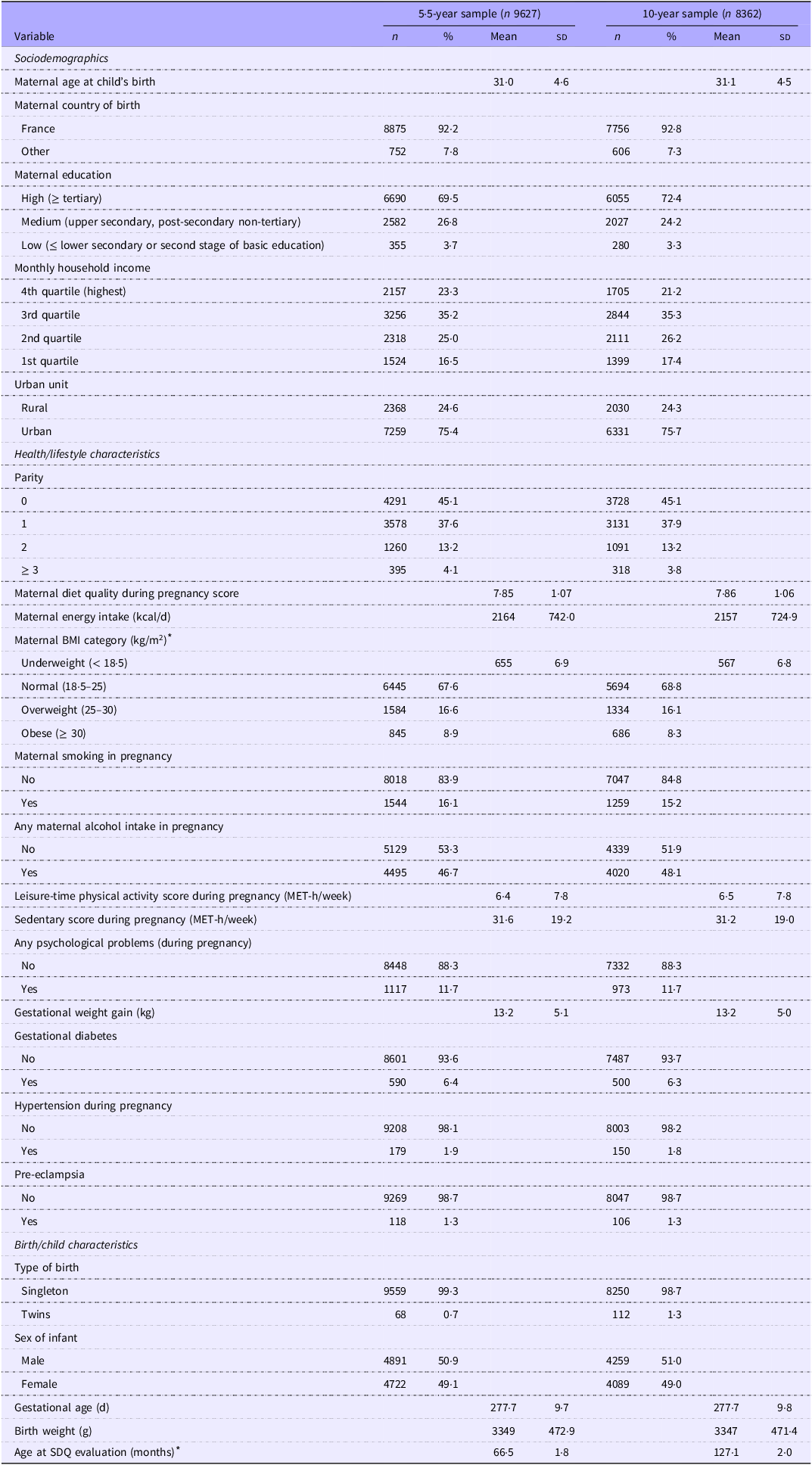
Women in both study populations gave birth at about 31 years of age, were of higher socio-economic status, and mostly lived in urban areas (Table 1). Most women were nulliparous, had normal BMI, and did not smoke during pregnancy. Almost half of women consumed alcohol at least once during their pregnancy, and few had complications during pregnancy. Most births were singleton and at term.
Descriptive characteristics of the study populations

Table 1. Long description
A table comparing characteristics of study populations over 5.5 and 10 years. The table has 38 rows and 12 columns. Column headers are: Variable, 5.5-year sample (n 9627) with subheaders n, percent, Mean, and so, and 10-year sample (n 8362) with subheaders n, percent, Mean, and so. Row labels include Sociodemographics, Maternal education, Monthly household income, Urban unit, Health/lifestyle characteristics, Maternal diet quality during pregnancy score, Maternal energy intake (kcal/d), Maternal BMI category (kg/m^2), Underweight (< 18.5), Normal (18.5-25), Overweight (25-30), Obese (≥ 30), Maternal smoking in pregnancy, Any maternal alcohol intake in pregnancy, Leisure-time physical activity score during pregnancy (MET-h/week), Sedentary score during pregnancy (MET-h/week), Any psychological problems (during pregnancy), Gestational weight gain (kg), Gestational diabetes, Hypertension during pregnancy, Pre-eclampsia, Birth/child characteristics, Type of birth, Sex of infant, Male, Female, Gestational age (d), Birth weight (g), Age at DQ evaluation (months). Row 1: Maternal age at child’s birth, 31.0, 4.6, 31.1, 4.5. Row 2: Maternal country of birth, France, 8875, 92.2, 7756, 92.8. Row 3: Other, 752, 7.8, 606, 7.3. Row 4: Maternal education, High (≥ tertiary), 6890, 69.5, 6095, 72.4. Row 5: Medium (upper secondary, post-secondary non-tertiary), 2582, 26.8, 2027, 24.2. Row 6: Low (≤ lower secondary or second stage of basic education), 355, 3.7, 280, 3.3. Row 7: Monthly household income, 4th quartile (highest), 2157, 23.3, 1705, 21.2. Row 8: 3rd quartile, 3256, 35.2, 2844, 35.3. Row 9: 2nd quartile, 2318, 25.0, 2111, 26.2. Row 10: 1st quartile, 1524, 16.5, 1399, 17.4. Row 11: Urban unit, Rural, 2368, 24.6, 2030, 24.3. Row 12: Urban, 7259, 75.4, 6331, 75.7. Row 13: Health/lifestyle characteristics, Parity, 0, 4291, 45.1, 3738, 45.1. Row 14: 1, 3578, 37.6, 3131, 37.9. Row 15: 2, 1260, 13.2, 1091, 13.2. Row 16: ≥ 3, 395, 4.1, 318, 3.8. Row 17: Maternal diet quality during pregnancy score, 7.85, 1.07, 7.86, 1.06. Row 18: Maternal energy intake (kcal/d), 2164, 742.0, 2157, 724.9. Row 19: Maternal BMI category (kg/m^2), Underweight (< 18.5), 655, 6.9, 567, 6.8. Row 20: Normal (18.5-25), 6445, 67.6, 5694, 68.2. Row 21: Overweight (25-30), 1584, 16.6, 1334, 16.1. Row 22: Obese (≥ 30), 845, 8.9, 686, 8.3. Row 23: Maternal smoking in pregnancy, No, 8018, 83.9, 7047, 84.8. Row 24: Yes, 1544, 16.1, 1259, 15.2. Row 25: Any maternal alcohol intake in pregnancy, No, 5129, 53.3, 4339, 51.9. Row 26: Yes, 4495, 46.7, 4020, 48.1. Row 27: Leisure-time physical activity score during pregnancy (MET-h/week), 6.4, 7.8, 6.5, 7.8. Row 28: Sedentary score during pregnancy (MET-h/week), 31.6, 19.2, 31.2, 19.0. Row 29: Any psychological problems (during pregnancy), No, 8448, 88.3, 7332, 88.3. Row 30: Yes, 1117, 11.7, 973, 11.7. Row 31: Gestational weight gain (kg), 13.2, 5.1, 13.2, 5.0. Row 32: Gestational diabetes, No, 8601, 93.6, 7487, 93.7. Row 33: Yes, 590, 6.4, 500, 6.3. Row 34: Hypertension during pregnancy, No, 9208, 98.1, 8033, 98.2. Row 35: Yes, 179, 1.9, 150, 1.8. Row 36: Pre-eclampsia, No, 9269, 98.7, 8047, 98.7. Row 37: Yes, 118, 1.3, 106, 1.3. Row 38: Birth/child characteristics, Type of birth, Singleton, 9559, 99.3, 8250, 98.7. Row 39: Twins, 68, 0.7, 112, 1.3. Row 40: Sex of infant, Male, 4891, 50.9, 4259, 51.0. Row 41: Female, 4722, 49.1, 4089, 49.0. Row 42: Gestational age (d), 277.7, 9.7, 277.7, 9.8. Row 43: Birth weight (g), 3349, 472.9, 3347, 471.4. Row 44: Age at DQ evaluation (months), 66.5, 1.8, 127.1, 2.0.
* SDQ, Strengths and Difficulties Questionnaire; MET, metabolic equivalents.
The average E-DII scores during pregnancy were very similar in both subsamples (0·25 (1·53) for women with children followed at 5·5 years and 0·25 (1·52) for women with children followed at 10 years). The E-DII score ranged from −5·21 to 4·97 in the 5·5-year subsample and from −5·21 to 4·62 in the 10-year subsample.
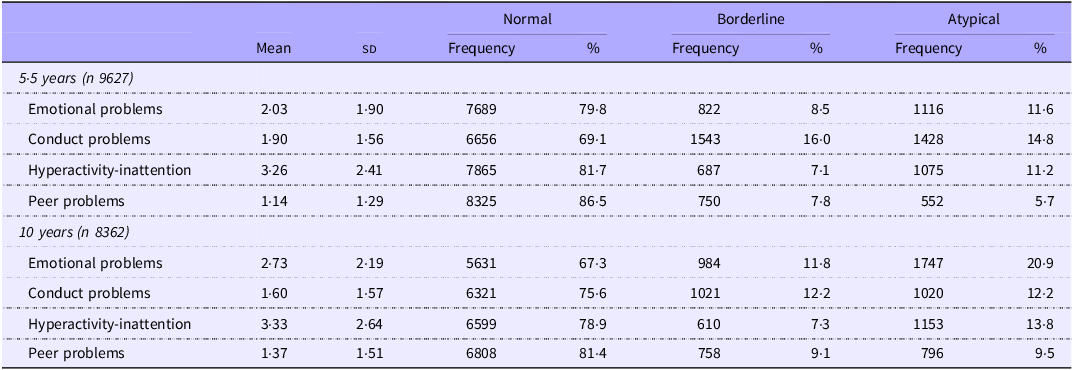
At the 5·5-year follow-up, 11·6 %, 14·8 %, 11·2 %, and 5·7 % of children were classified as ‘Atypical’ for the emotional, conduct, hyperactivity-inattention and peer-relationship domains of the SDQ, respectively (Table 2). At the 10-year follow-up, about one-fifth of children were classified as ‘Atypical’ for the emotional domain, about 12 % and 13·5 % for the conduct and hyperactivity-inattention domains, respectively, and 9·5 % for the peer problems domain.
Summary statistics of the Strengths and Difficulties Questionnaire at 5·5 and 10 years in the ELFE study using traditional thresholds(Reference Goodman26)

Table 2. Long description
The table presents summary statistics of the Strengths and Difficulties Questionnaire at 5.5 and 10 years in the ELFE study. It has 10 rows and 10 columns. The columns are labeled Mean, SD, Normal Frequency, Normal %, Borderline Frequency, Borderline %, Atypical Frequency, and Atypical %. The rows are labeled with different problem categories: Emotional problems, Conduct problems, Hyperactivity-inattention, and Peer problems, for two age groups: 5.5 years and 10 years. Row 1: 5-5 years (n 9627). Row 2: Emotional problems. Row 3: Mean, 2.03; SD, 1.90; Normal Frequency, 7689; Normal %, 79.8; Borderline Frequency, 822; Borderline %, 8.5; Atypical Frequency, 1116; Atypical %, 11.6. Row 4: Conduct problems. Row 5: Mean, 1.90; SD, 1.56; Normal Frequency, 6656; Normal %, 69.1; Borderline Frequency, 1543; Borderline %, 16.0; Atypical Frequency, 1428; Atypical %, 14.8. Row 6: Hyperactivity-inattention. Row 7: Mean, 3.26; SD, 2.41; Normal Frequency, 7865; Normal %, 81.7; Borderline Frequency, 687; Borderline %, 7.1; Atypical Frequency, 1075; Atypical %, 11.2. Row 8: Peer problems. Row 9: Mean, 1.14; SD, 1.29; Normal Frequency, 8325; Normal %, 86.5; Borderline Frequency, 750; Borderline %, 7.8; Atypical Frequency, 552; Atypical %, 5.7. Row 10: 10 years (n 8362). Row 11: Emotional problems. Row 12: Mean, 2.73; SD, 2.19; Normal Frequency, 5631; Normal %, 67.3; Borderline Frequency, 984; Borderline %, 11.8; Atypical Frequency, 1747; Atypical %, 20.9. Row 13: Conduct problems. Row 14: Mean, 1.60; SD, 1.57; Normal Frequency, 6321; Normal %, 75.6; Borderline Frequency, 1021; Borderline %, 12.2; Atypical Frequency, 1020; Atypical %, 12.2. Row 15: Hyperactivity-inattention. Row 16: Mean, 3.33; SD, 2.64; Normal Frequency, 6599; Normal %, 78.9; Borderline Frequency, 610; Borderline %, 7.3; Atypical Frequency, 1153; Atypical %, 13.8. Row 17: Peer problems. Row 18: Mean, 1.37; SD, 1.51; Normal Frequency, 6808; Normal %, 81.4; Borderline Frequency, 758; Borderline %, 9.1; Atypical Frequency, 796; Atypical %, 9.5.
In general, mothers excluded from the study were more likely younger, not born in France, had lower socio-economic status indicators, and lived in urban areas. (online Supplementary Table S3). Excluded women were also more likely to have poorer health and more unhealthy lifestyles during pregnancy. Excluded participants more likely gave birth to twins and gave birth at younger gestational ages with lower birth weights.
Energy-adjusted dietary inflammatory index and symptoms of behavioural problems
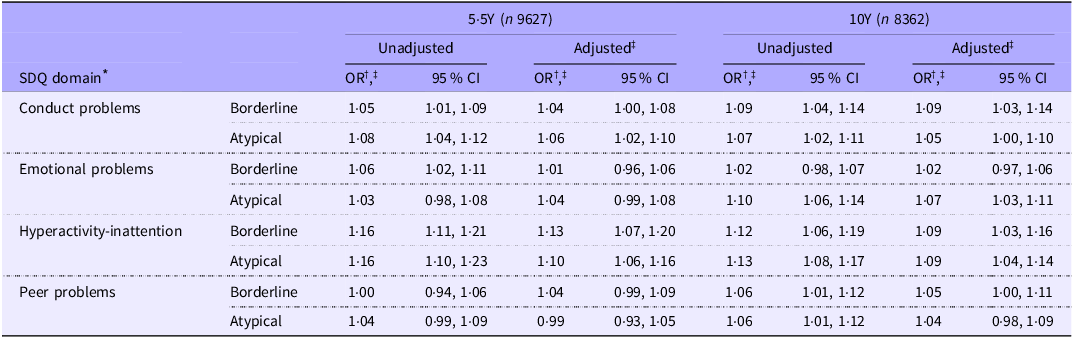
A greater E-DII score was associated with about 10 % higher odds of both ‘Borderline’ and ‘Atypical’ scores for hyperactivity-inattention at both follow-ups (5·5Y Atypical: OR 1·10 (95 % CI 1·06, 1·16); 10Y Atypical: 1·09 (1·04, 1·14)) (Table 3). Symptoms of emotional problems at 5·5 years were not associated with the E-DII, but higher odds of atypical emotional problems were observed at the 10-year follow-up (1·07 (1·03, 1·11)). An interaction with sex was observed at the 10-year follow-up for emotional problems (P = 0·0003), such that higher E-DII scores were associated with higher odds of ‘Borderline’ emotional problems in boys (1·08 (1·01, 1·16)) but not girls (0·96 (0·90, 1·02)), and higher odds of ‘Atypical’ scores were observed in girls (1·13 (1·07, 1·19)), but not boys (1·01 (0·96, 1·07)).
Relationship between the energy-adjusted dietary inflammatory index (E-DII) during pregnancy and offspring behavioural and emotional problems at 5·5 and 10 years of age under the hypotheses of linear associations

Table 3. Long description
The table presents the relationship between energy-adjusted dietary inflammatory index (E-DII) during pregnancy and offspring behavioral and emotional problems at 5.5 and 10 years of age. It includes unadjusted and adjusted odds ratios (OR) with 95% confidence intervals (CI) for conduct problems, emotional problems, hyperactivity-inattention, and peer problems. The table is divided into two main age groups: 5.5 years (n 9627) and 10 years (n 8362). Each age group is further divided into unadjusted and adjusted columns. The SDQ domains include conduct problems, emotional problems, hyperactivity-inattention, and peer problems, with borderline and atypical categories for each domain. Row 1: Conduct problems, Borderline, Unadjusted, 5.5Y, OR 1.05, 95 percent CI 1.01, 1.09. Row 1: Conduct problems, Borderline, Adjusted, 5.5Y, OR 1.04, 95 percent CI 1.00, 1.08. Row 1: Conduct problems, Borderline, Unadjusted, 10Y, OR 1.09, 95 percent CI 1.04, 1.14. Row 1: Conduct problems, Borderline, Adjusted, 10Y, OR 1.09, 95 percent CI 1.03, 1.14. Row 2: Conduct problems, Atypical, Unadjusted, 5.5Y, OR 1.08, 95 percent CI 1.04, 1.12. Row 2: Conduct problems, Atypical, Adjusted, 5.5Y, OR 1.06, 95 percent CI 1.02, 1.10. Row 2: Conduct problems, Atypical, Unadjusted, 10Y, OR 1.07, 95 percent CI 1.02, 1.11. Row 2: Conduct problems, Atypical, Adjusted, 10Y, OR 1.05, 95 percent CI 1.00, 1.10. Row 3: Emotional problems, Borderline, Unadjusted, 5.5Y, OR 1.06, 95 percent CI 1.02, 1.11. Row 3: Emotional problems, Borderline, Adjusted, 5.5Y, OR 1.01, 95 percent CI 0.96, 1.06. Row 3: Emotional problems, Borderline, Unadjusted, 10Y, OR 1.02, 95 percent CI 0.98, 1.07. Row 3: Emotional problems, Borderline, Adjusted, 10Y, OR 1.02, 95 percent CI 0.97, 1.06. Row 4: Emotional problems, Atypical, Unadjusted, 5.5Y, OR 1.03, 95 percent CI 0.98, 1.08. Row 4: Emotional problems, Atypical, Adjusted, 5.5Y, OR 1.04, 95 percent CI 0.99, 1.08. Row 4: Emotional problems, Atypical, Unadjusted, 10Y, OR 1.10, 95 percent CI 1.06, 1.14. Row 4: Emotional problems, Atypical, Adjusted, 10Y, OR 1.07, 95 percent CI 1.03, 1.11. Row 5: Hyperactivity-inattention, Borderline, Unadjusted, 5.5Y, OR 1.16, 95 percent CI 1.11, 1.21. Row 5: Hyperactivity-inattention, Borderline, Adjusted, 5.5Y, OR 1.13, 95 percent CI 1.07, 1.20. Row 5: Hyperactivity-inattention, Borderline, Unadjusted, 10Y, OR 1.12, 95 percent CI 1.06, 1.19. Row 5: Hyperactivity-inattention, Borderline, Adjusted, 10Y, OR 1.09, 95 percent CI 1.03, 1.16. Row 6: Hyperactivity-inattention, Atypical, Unadjusted, 5.5Y, OR 1.16, 95 percent CI 1.10, 1.23. Row 6: Hyperactivity-inattention, Atypical, Adjusted, 5.5Y, OR 1.10, 95 percent CI 1.06, 1.16. Row 6: Hyperactivity-inattention, Atypical, Unadjusted, 10Y, OR 1.13, 95 percent CI 1.08, 1.17. Row 6: Hyperactivity-inattention, Atypical, Adjusted, 10Y, OR 1.09, 95 percent CI 1.04, 1.14. Row 7: Peer problems, Borderline, Unadjusted, 5.5Y, OR 1.00, 95 percent CI 0.94, 1.06. Row 7: Peer problems, Borderline, Adjusted, 5.5Y, OR 1.04, 95 percent CI 0.99, 1.09. Row 7: Peer problems, Borderline, Unadjusted, 10Y, OR 1.06, 95 percent CI 1.01, 1.12. Row 7: Peer problems, Borderline, Adjusted, 10Y, OR 1.05, 95 percent CI 1.00, 1.11. Row 8: Peer problems, Atypical, Unadjusted, 5.5Y, OR 1.04, 95 percent CI 0.99, 1.09. Row 8: Peer problems, Atypical, Adjusted, 5.5Y, OR 0.99, 95 percent CI 0.93, 1.05. Row 8: Peer problems, Atypical, Unadjusted, 10Y, OR 1.06, 95 percent CI 1.01, 1.12. Row 8: Peer problems, Atypical, Adjusted, 10Y, OR 1.04, 95 percent CI 0.98, 1.09.
* SDQ, Strengths and Difficulties Questionnaire.
† OR issued from multinomial logistic regression and represent the odds of a 1-unit increase in the E-DII (using the ‘Normal’ SDQ category as the reference).
‡ Models adjusted for maternity size, wave, maternal age, education, country of birth, household income, parity, pre-pregnancy BMI, energy intake, child sex, and child age at SDQ evaluation.
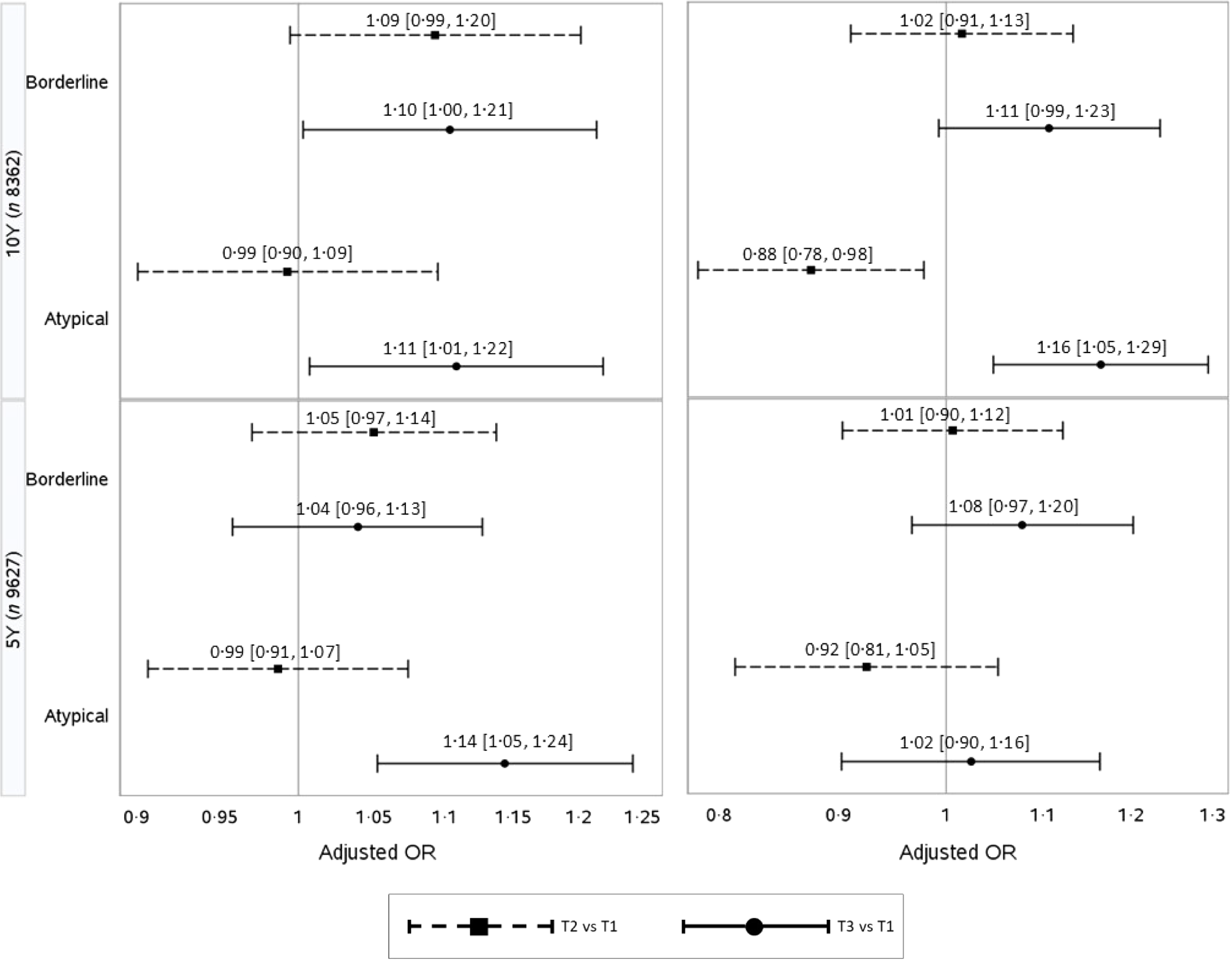
As there was some evidence that the E-DII score was not linearly associated with conduct problems and peer problems, it was classified into tertile groups. An E-DII score in the third tertile was associated with greater odds of obtaining ‘Atypical’ scores for conduct problems at the 5·5-year follow-up (tertile 3 (T3) v. T1:1·14 (1·05, 1·24)) and of both ‘Borderline’ and ‘Atypical’ scores at the 10-year follow-up (Atypical: 1·11 (1·01, 1·22)) (Figure 2). E-DII scores were not associated with peer problems at the 5·5-year follow-up, but E-DII scores in the third tertile were associated with 16 % higher odds of ‘Atypical’ scores at the 10-year follow-up (1·16 (1·05, 1·29)). To the contrary, E-DII scores in the second tertile were associated with lower odds of ‘Atypical’ peer problem scores (0·88 (0·78, 0·98)).
Adjusted logarithmic scale OR and 95 % CI of conduct problems (left panel) and peer problems (right panel) by tertile group of energy-adjusted dietary inflammatory index score. Models adjusted for maternity size, wave, maternal age, education, country of birth, household income, parity, pre-pregnancy BMI, energy intake, child sex, and child age at SDQ evaluation. SDQ, Strengths and Difficulties Questionnaire.

Findings from complete-case analyses were similar to those in the full analyses with regards to hyperactivity-inattention and emotional problems (online Supplementary Table S4). However, the association between T2 of the E-DII and ‘Borderline’ conduct problems became statistically significant. With regards to peer problems, the positive association for tertile 3 of the E-DII with ‘Borderline’ symptoms became statistically significant.
In analyses using only participants with data at both follow-ups, findings were similar to the full analyses (online Supplementary Table S5). In analyses adjusted for maternal lifestyle and psychological problems during pregnancy, findings were also similar to those of the main analyses except that the associations between the E-DII and conduct problems at 10 years became non-statistically significant (online Supplementary Table S6).
When French-specific cut-offs were used for the peer problems domain, 339 (3·5 %) and 396 (4·7 %) of children were classified as ‘Borderline’ at 5·5 and 10 years, respectively, while 213 (2·2 %) and 400 (4·8 %) of children were classified as ‘Atypical’ at 5·5 and 10 years, respectively. Using the French-specific threshold for peer problems shifted the associations we observed at 10 years; ‘Atypical’ became non-statistically significant at 10 years, while ‘Borderline’ became statistically significant (online Supplementary Table S7).
Discussion
In this large, nationwide cohort study, a more pro-inflammatory diet during pregnancy was associated with higher odds of offspring conduct and hyperactivity-inattention problems at both 5·5 and 10 years. The similar effect sizes at both time points suggest that this association remains relatively stable throughout early childhood. A more pro-inflammatory diet during pregnancy was also associated with higher odds of peer and emotional problems at 10 years, with sex-specific differences observed for emotional problems. Internalising problems may be more difficult to detect during early childhood or may take longer to manifest than externalising problems. Additionally, the non-linear relationships observed for conduct and peer problems suggest possible threshold-level effects.
A 1-point increase in the E-DII during pregnancy was associated with approximately 10 % higher odds of offspring being classified as either ‘Borderline’ or ‘Atypical’ for hyperactivity-inattention problems on the SDQ. This association persisted despite adjustment for multiple confounding factors, the maternal lifestyle during pregnancy, and was observed at both the 5·5- and 10-year follow-ups. We also found higher odds of conduct problems at both follow-ups in offspring of mothers with more pro-inflammatory diets during pregnancy. In a meta-analysis of four European cohorts, Polanska et al. observed that a higher E-DII during pregnancy was associated with 7 % higher odds of both borderline/clinical hyperactivity-inattention symptoms and aggressive behaviour symptoms in offspring from 7 to 10 years old(Reference Polanska, Kaluzny and Aubert13). However, in the USA, Faleschini et al. observed no association between the DII during pregnancy and either mother- or teacher-reported symptoms of externalising behavioural problems in offspring from 6 to 10 years(Reference Faleschini, Rifas-Shiman and Monthé-Drèze14). Grouping hyperactivity-inattention together with conduct problems may have masked any domain-specific associations, as the positive associations we observed with conduct problems were not always significant for borderline scores. In addition, Faleschini et al. used the DII to assess the inflammatory potential of the diet, though the E-DII has been demonstrated to more accurately predict the inflammatory potential of the diet(Reference DiNatale, Azarmanesh and Hébert12). However, a study of 4-year-old children in Spain and Greece observed an inverse relationship between the E-DII during pregnancy and parent- or teacher-reported symptoms of ADHD, but only in boys(Reference Lertxundi, Molinuevo and Valvi15). No significant associations were observed in girls. But, this overall negative association was driven by a single Spanish subcohort, and the associations in the other subcohorts were not significant, despite a significantly higher E-DII in the Greek cohort. The latter study may have lacked power due to the small sample size, or the lack of association may be due to the use of teacher-reported ADHD symptoms. Teachers may report less difficulties compared with parents for fear of parents’ reactions or labelling the child(Reference Fält, Wallby and Sarkadi34,Reference Fält, Sarkadi and Fabian35) . Nevertheless, studies have found overall that better diet quality during pregnancy was associated with fewer symptoms of hyperactivity-inattention in offspring(Reference Polanska, Kaluzny and Aubert13,Reference Galera, Heude and Forhan36,Reference Borge, Biele and Papadopoulou37) . With regard to conduct problems, only one study has separately examined conduct problems from externalising behavioural problems and found no association with maternal diet quality(Reference Galera, Heude and Forhan36). However, our results suggest the relationship between the maternal diet and offspring externalising behaviour may be partially attributed to the inflammatory potential of the diet, as these relationships persisted despite adjustment for the overall maternal diet quality.
We observed a sex-specific association of the E-DII with symptoms of emotional problems in offspring, such that at the 10-year follow-up, females had higher odds of ‘Atypical’ scores with increasing maternal E-DII scores, while males had higher odds for ‘Borderline’ symptom scores. The associations detected may be artefacts of postnatal influences, sex differences in internalising problems may take longer to manifest than externalising problems(Reference Chaplin and Aldao38) or the associations observed may be spurious, as we did not detect any associations for emotional problems at 5·5 years. Polanska et al. observed higher odds of depressive and anxiety symptoms with an increasing E-DII during pregnancy, but they found no interaction with sex (P > 0·1)(Reference Polanska, Kaluzny and Aubert13). Faleschini et al. did not find an association between the DII during pregnancy and internalising problems when assessed by teachers at 7 years or self-reported by adolescents at 10 years, and they did not test for an interaction with sex(Reference Faleschini, Rifas-Shiman and Monthé-Drèze14). However, the DII was positively associated with internalising problems at 7 years when assessed by mothers(Reference Faleschini, Rifas-Shiman and Monthé-Drèze14). In France, low adherence to a healthy dietary pattern was associated with moderately high depression and anxiety symptom trajectories in 3- to 8-year-old children, but adherence to a Western dietary pattern was not(Reference Collet, Heude and Forhan39). To our knowledge, no other studies have reported a sex-specific effect of the maternal diet on the development of emotional problems in offspring. However, evidence suggests that girls have greater difficulty regulating negative emotions than boys and experience more anxiety and depression, and that emotional dysregulation is more predictive of anxiety in girls than boys(Reference Bender, Reinholdt-Dunne and Esbjørn40), though oestrogens have been found to exert anti-inflammatory and neuroprotective effects(Reference Vegeto, Benedusi and Maggi41).
Finally, at 10 years, E-DII scores in the third tertile were positively associated with ‘Atypical’ symptoms of peer problems, while scores in the second tertile were negatively associated. The positive association with tertile 3 was consistent throughout sensitivity analyses, though shifted when the slightly higher French-specific thresholds were used. However, the negative association was less robust in complete-case analyses and may be attributed to selection bias by missing data. To our knowledge, this is the first study to examine the effect of an inflammatory diet on the development of peer-relationship problems in offspring separately from emotional difficulties, and none have examined maternal diet quality during pregnancy. However, greater pre-pregnancy diet quality has been associated with fewer peer problems in Australian children(Reference Gete, Waller and Mishra42). Despite the necessity of healthy social development to overall development and wellbeing, social development is an important aspect of child development that is often overlooked and must be addressed.
The diet is important not just with regard to overall quality but also with regard to its inflammatory potential. Dietary-induced inflammation during pregnancy may influence offspring behavioural and emotional difficulties by exposing the developing fetal brain to oxidative stress and inflammation, thereby altering fetal brain gene expression and neuronal circuit formation and, consequently, neurodevelopmental processes(Reference Edlow43). Elevated levels of maternal pro-inflammatory cytokines have been associated with increased risk of child ADHD(Reference Gustafsson, Sullivan and Battison44), and cytokine levels in cord blood have been associated with behavioural problems in children(Reference Barbosa, Khalfallah and Forhan45,Reference Howe and Lynch46) . The DII and the E-DII were developed to categorise diets on a continuum based on their potential to induce changes in the levels of six blood inflammatory biomarkers (IL-1β, IL-4, IL-6, IL-10, TNF-α, and CRP)(Reference Shivappa, Steck and Hurley11). Several studies in adults have found that the DII and E-DII are positively associated with the concentrations of some of these biomarkers (IL-6, TNF-α and CRP)(Reference Lécuyer, Laouali and Viallon47–Reference Hua, Liang and Yang50). However, studies in pregnancy often find no association, but pregnancy is a unique state of materno-fetal immune tolerance with temporal variations that may mask associations between the dietary inflammatory potential and biomarkers of inflammation observed in normal states(Reference Pieczyńska, Płaczkowska and Pawlik-Sobecka51–Reference McCullough, Miller and Calderwood54). Further research is needed to determine whether a pro-inflammatory diet directly triggers maternal inflammation and increases in circulating pro-inflammatory cytokines and whether these cytokines mediate the effects of the maternal diet on fetal inflammation and offspring neurodevelopment. Additionally, large-scale human studies are required to determine the specific mechanisms through which maternal inflammation could influence fetal cytokine profiles – whether through direct cytokine transfer across the placenta, altered placental function, endogenous fetal cytokine production or a combination of these pathways(Reference Woods, Lorusso and Fletcher55). Notably, beyond their role in inflammation, key pro-inflammatory cytokines (IL-1β, IL-6, and TNF-α) also have acknowledged roles in neurodevelopmental processes(Reference Knuesel, Chicha and Britschgi56,Reference Gumusoglu and Stevens57) .
This study evaluated the association between the inflammatory potential of the maternal diet on the development of offspring behavioural and emotional problems using a validated psychometric instrument(Reference Goodman26,Reference Goodman58) in a large sample size with data from two follow-up points. To our knowledge, this was the first study to separately analyse the role of an inflammatory maternal diet on the development of peer-relationship problems in children. We were able to control for a large number of confounding factors, though we cannot exclude the possibility of residual confounding.
However, several considerations should be taken into account when interpreting these findings. Given the relatively high socio-economic status of our cohort, our results may not be generalisable to the general population. In addition, this study was designed to estimate the total effect of a maternal pro-inflammatory diet on offspring behavioural and emotional problems; accordingly, postnatal factors were not included in the analytical models. Future studies incorporating repeated measures of child lifestyle factors would help disentangle these pathways.
The E-DII was derived from an FFQ assessing dietary intake in the previous 3 months of pregnancy, and that may be subject to recall or reporting bias. However, any reporting bias would most likely be driven by social desirability bias and would tend to attenuate, rather than inflate, our estimates. Additionally, the last 3 months of pregnancy may not fully capture overall fetal vulnerability to inflammation, as certain developmental windows may be more or less sensitive to diet-induced inflammation. Furthermore, dietary patterns can change throughout pregnancy, meaning that the inflammatory potential of the diet in the final trimester may not reflect the average exposure across gestation. However, evidence from a US cohort suggests that intakes of some food groups remain relatively stable during pregnancy – for example, fruit and vegetable consumption changed by only +1·5 % between the first and second trimester, while whole grains and fish had less than a 1 % change(Reference Rifas-Shiman, Rich-Edwards and Willett59). In contrast, intake of alcoholic beverages (–87·7 %), caffeinated beverages (–29·8 %), and multi- or prenatal vitamins differed greatly (35·1 %)(Reference Rifas-Shiman, Rich-Edwards and Willett59). In French-Canadian women, macronutrient and micronutrient intakes did not differ significantly across trimesters(Reference Savard, Lemieux and Weisnagel60). Finally, the FFQ estimates food intake but does not account for nutrient intake from supplementation. In addition, our E-DII score included only 28 of 45 possible dietary components, omitting several with strong inflammatory effects (e.g. polyphenols, spices, and condiments), which may have influenced our findings.
In conclusion, our results suggest that a more pro-inflammatory diet during pregnancy is associated with a greater risk of hyperactivity-inattention symptoms and conduct problems in children and may be differentially associated with a higher risk of symptoms of emotional problems at 10 years by sex. The relationship between the maternal diet-induced inflammation and offspring peer problems warrants further investigation. Future research should aim to replicate our findings and explore whether the DII/E-DII are correlated with inflammatory biomarkers in pregnant women and their offspring and whether this pathway may mediate any effects on child neurodevelopment.
Supplementary material
For supplementary material/s referred to in this article, please visit https://doi.org/10.1017/S0007114526107879
Acknowledgements
The authors would like to thank the participants and the families of the ELFE cohort for their continued contribution to this study.
The authors thank the scientific coordinators (B Geay, H Léridon, C Bois, JL Lanoé, X Thierry and C Zaros), IT and data managers, statisticians (M Cheminat, C Ricourt, A Candea and S de Visme), administrative and family communication staff and study technicians (C Guevel, M Zoubiri, L G L Gravier, I, Milan and R Popa) from the ELFE coordination team as well as the families that gave their time for the study. The authors would also like to thank researchers at the French Institute for Demographic Studies (INED) for the sociodemographic variables created as part of the ANR-funded Veniromond project.
The Elfe survey is a joint project between the French Institute for Demographic Studies (INED) and the National Institute of Health and Medical Research (INSERM), in partnership with the French blood transfusion service (Etablissement français du sang, EFS), Santé publique France, the National Institute for Statistics and Economic Studies (INSEE), the Direction générale de la santé (DGS, part of the Ministry of Health and Social Affairs), the Direction générale de la prévention des risques (DGPR, Ministry for the Environment), the Direction de la recherche, des études, de l’évaluation et des statistiques (DREES, Ministry of Health and Social Affairs), the Département des études, de la prospective et des statistiques (DEPS, Ministry of Culture) and the Caisse nationale des allocations familiales (CNAF), with the support of the Ministry of Higher Education and Research and the Institut national de la jeunesse et de l’éducation populaire (INJEP). Via the RECONAI platform, it receives a government grant managed by the National Research Agency under the ‘Investissements d’avenir’ programme (ANR-11-EQPX-0038, ANR-19-COHO-0001 and ANR-23-CE36-003-01).
C. D.: Conceptualisation-Equal, Data curation-Equal, Formal analysis-Lead, Investigation-Lead, Methodology-Equal, Software-Lead, Validation-Equal, Visualisation-Lead, Writing – original draft-Lead and Writing – review and editing-Lead; R. D.: Data curation-Equal and Writing – review and editing-Equal; B. d. L-G.: Data curation-Equal and Writing – review and editing-Equal; J. v. d. W.: Conceptualisation-Supporting, Methodology-Supporting and Writing – review and editing-Equal; L. D.: Conceptualisation-Supporting, Methodology-Supporting and Writing – review and editing-Equal; M-A. C.: Funding acquisition-Lead, Resources-Equal and Writing – review and editing-Equal; C. G.: Conceptualisation-Equal, Funding acquisition-Lead, Methodology-Equal, Project administration-Lead, Resources-Equal and Writing – review and editing-Equal; B. H.: Conceptualisation-Equal, Funding acquisition-Supporting, Investigation-Equal, Methodology-Equal, Project administration-Supporting, Validation-Equal and Writing – review and editing-Equal.
All authors report no financial interests or potential conflicts of interest to disclose.
The data underlying the findings cannot be made freely available for ethical and legal restrictions. This study includes a substantial number of variables that, together, could be used to re-identify the participants based on a few key characteristics and then be used to have access to other personal data. Therefore, the French ethics authority strictly forbids making these data freely available. However, some data can be obtained upon request from the ELFE principal investigator. Readers may contact marie-aline.charles@inserm.fr to request the data.


 Open access

