INTRODUCTION
As part of a comprehensive study of the reproduction, development, and growth of Palio dubia (Sars, 1829) from Newfoundland, Canada, Hamel et al. (Reference Hamel, Sargent and Mercier2008) reported that veliger larvae of P. dubia cultured in the laboratory at 5.5–7.5°C settled 1 to 3 days after hatching and that metamorphosis into juveniles commenced shortly thereafter. This larval period would not be unusual for a species with lecithotrophic development (Thompson, Reference Thompson1976; Hadfield & Switzer-Dunlap, Reference Hadfield, Switzer-Dunlap, Tompa, Verdonk and van den Biggelar1984; Hadfield & Miller, Reference Hadfield and Miller1987; Goddard, Reference Goddard2004). However, Hamel et al. (Reference Hamel, Sargent and Mercier2008) classified the hatching larvae of P. dubia as planktotrophic, consistent with Clark (Reference Clark1975) as well as with the egg and shell sizes (≅70 µm and 120 µm, respectively) apparent in their figures 2 & 4. Hamel et al. (Reference Hamel, Sargent and Mercier2008) did not explicitly describe the hatching veligers, nor mention if or when the larvae acquired eyespots and a propodium, the two most reliable indicators of metamorphic competence in opisthobranchs (Bonar, Reference Bonar, Chia and Rice1978; Hadfield & Switzer-Dunlap, Reference Hadfield, Switzer-Dunlap, Tompa, Verdonk and van den Biggelar1984). The minimum larval period known for other planktotrophic nudibranchs is 8–9 days (at 22–25°C) (Harris, Reference Harris1975; Perron & Turner, Reference Perron and Turner1977; Hadfield & Switzer-Dunlap, Reference Hadfield, Switzer-Dunlap, Tompa, Verdonk and van den Biggelar1984; Hadfield & Miller, Reference Hadfield and Miller1987), significantly longer than the period reported by Hamel et al. (Reference Hamel, Sargent and Mercier2008) for P. dubia, especially given the temperature dependence of developmental rates in opisthobranchs in particular and marine invertebrates in general (Dehnel & Kong, Reference Dehnel and Kong1979; Todd & Doyle, Reference Todd and Doyle1981; Hadfield & Switzer-Dunlap, Reference Hadfield, Switzer-Dunlap, Tompa, Verdonk and van den Biggelar1984; Chia & Koss, Reference Chia and Koss1988; Hoegh-Guldberg & Pearse, Reference Hoegh-Guldberg and Pearse1995). Here I describe the hatching planktotrophic larvae of P. dubia at 20°C, evaluate five alternative explanations for the short larval period reported by Hamel et al. (Reference Hamel, Sargent and Mercier2008), and conclude that the larval period of P. dubia is likely an order of magnitude longer than they reported.
MATERIALS AND METHODS
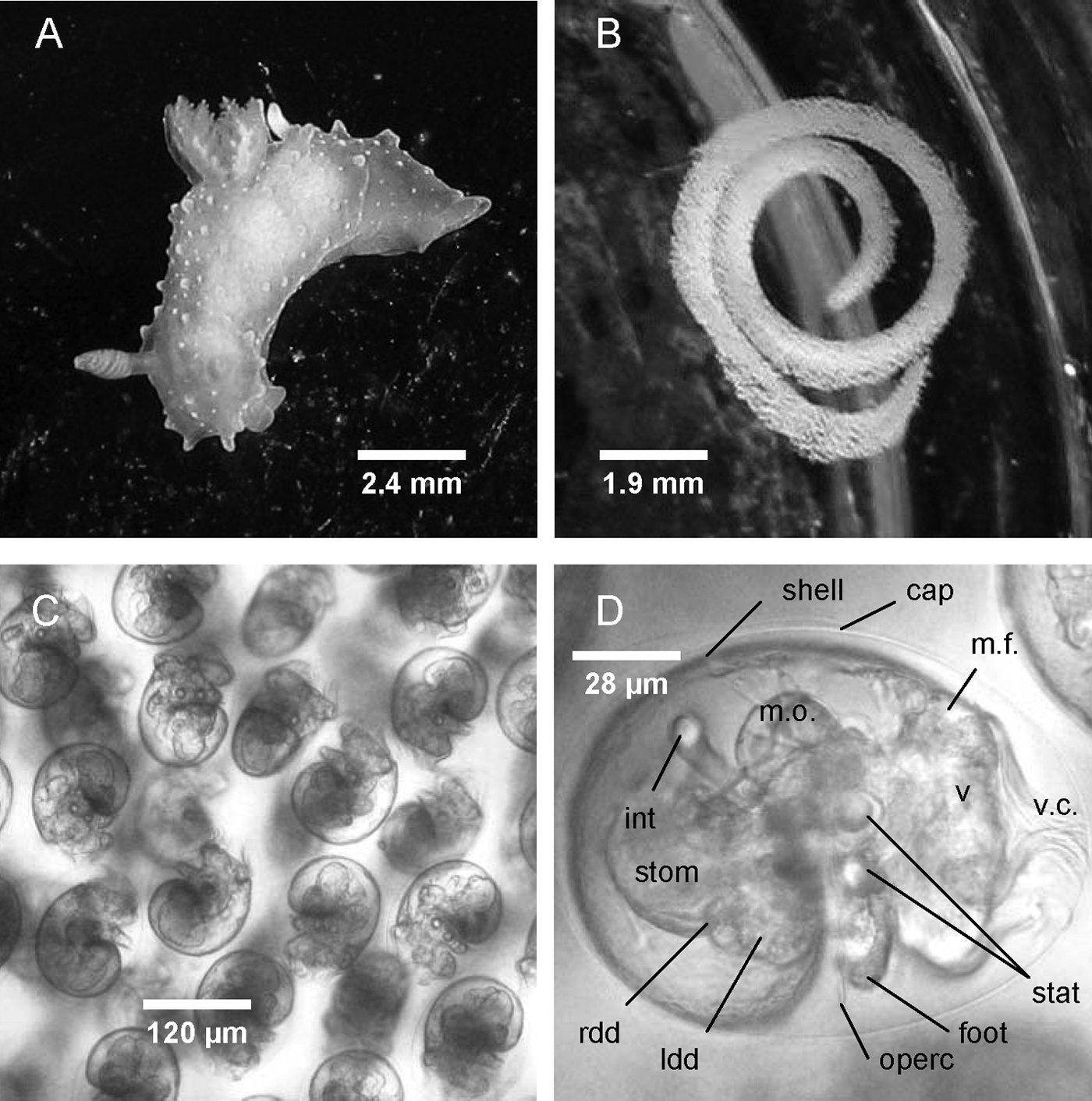
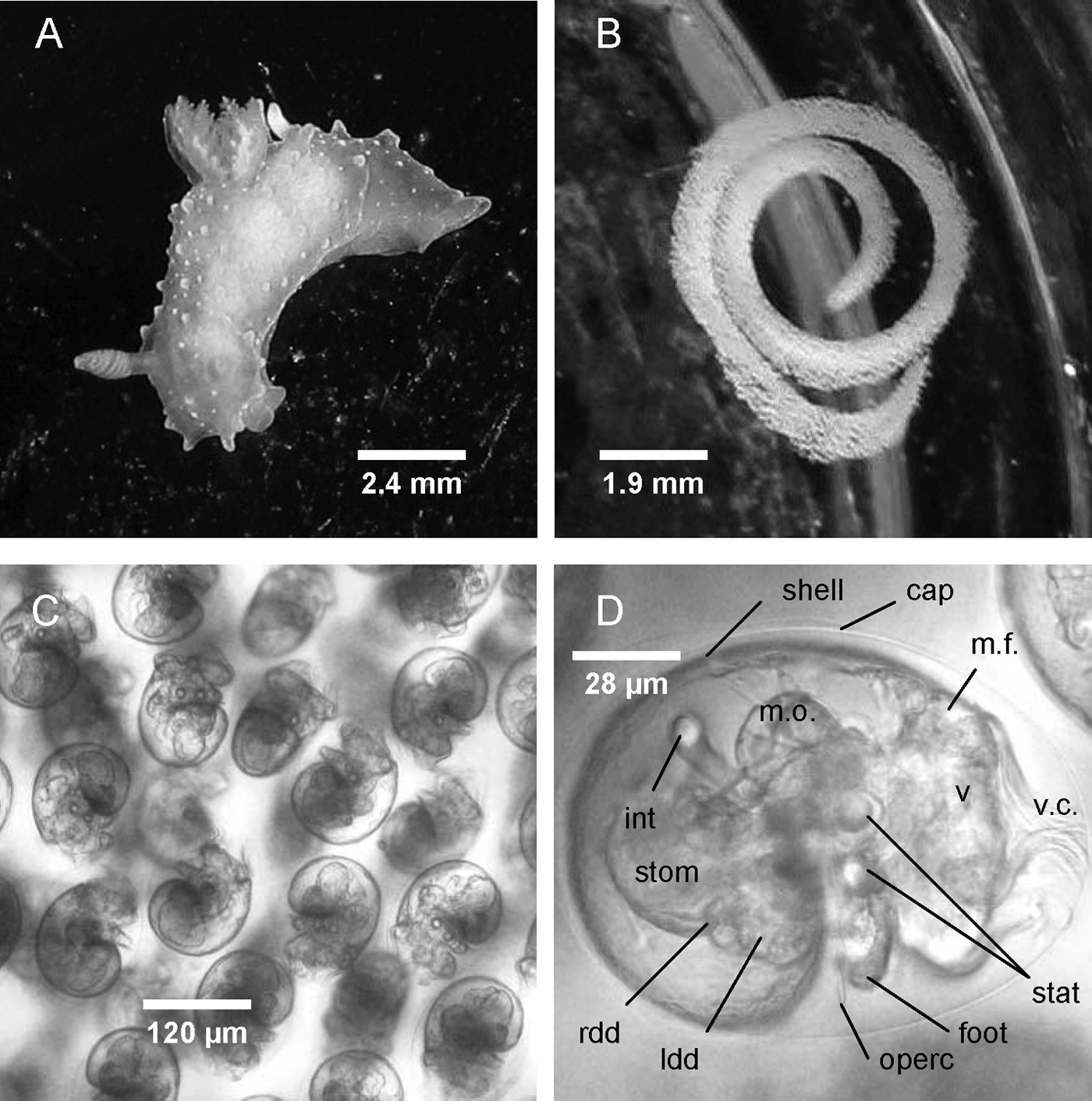
On 9 August 2009 I collected three adult Palio dubia (Figure 1A) from under cobbles in low intertidal pools on a rocky shore at Kettle Cove, Cape Elizabeth, Maine, USA (43°33′23″N 70°13′02″W), where local sea surface temperatures were 19°C. Two of the adults were next to a single egg mass, which I also collected. I held the adults in 250 ml of unfiltered seawater (collected from the same site) at 20 ± 2°C until they deposited egg masses. I examined newly laid egg masses (Figure 1B) using a Nikon compound microscope equipped with an ocular micrometer and measured the diameters of a random sample of 10 zygotes from each of two egg masses. I then isolated 1 cm long sections from each egg mass into separate, labelled vials and changed and gently swirled the seawater in these once or twice daily. I examined the egg masses daily until hatching and then determined mode of development according to the larval morphological criteria described by Thompson (Reference Thompson1976), Bonar (Reference Bonar, Chia and Rice1978), Hadfield & Switzer-Dunlap (Reference Hadfield, Switzer-Dunlap, Tompa, Verdonk and van den Biggelar1984) and Goddard (Reference Goddard2004).
Palio dubia. (A) Adult, 12 mm long extended; (B) egg mass laid in captivity; (C) encapsulated veligers in egg mass on day of hatching; (D) close-up of encapsulated veliger on day of hatching (day 7). Right lateral and slightly ventral view. Abbreviations: cap, egg capsule; int, intestine; ldd, left digestive diverticulum; m.f., mantle fold; m.o., mantle organ; operc, operculum; rdd, right digestive diverticulum; stat, statolith; stom, stomach; v, velum; v.c., velar cilia.
RESULTS
The diameter (±1 SD) of zygotes in two egg masses laid in captivity was 68.2 ± 1.3 µm (N = 10) and 69.2 ± 0.8 µm (N = 10). These were deposited one per egg capsule, with the capsules measuring up to 105 µm long and 84 µm wide. The capsular fluid was clear and did not contain any refractile or granular material that might indicate extra-zygotic food reserves for the developing embryos. At 20 ± 2°C the chronology of embryonic development (based on observations of three egg masses) was as follows: day 0, egg mass deposition; day 1, blastulas; day 2, gastrulas; day 3, first cilia and movement of the embryos, day 4, early shell and lobes of the foot and velum; day 5, statoliths present and viscera differentiating; day 6, well-developed veligers; and day 7, hatching. The hatching larvae lacked eyespots and had clear spiral shells and an operculum, a small foot lacking a propodium, and a mantle edge folded over the edge of the shell (Figure 1C & D). The somatic tissues were relatively transparent, indicating a lack of significant lipid reserves, and did not fill more than about one-half of the volume of the shell. At hatching the larval shells from two egg masses measured 120.8 ± 1.1 µm (N = 5) and 119.2 ± 4.6 µm (N = 10) in longest dimension.
DISCUSSION
Combined, the larval traits observed in the specimens from Maine clearly indicate planktotrophic development in a nudibranch (Thompson, Reference Thompson1976; Bonar, Reference Bonar, Chia and Rice1978; Hadfield & Switzer-Dunlap, Reference Hadfield, Switzer-Dunlap, Tompa, Verdonk and van den Biggelar1984; Goddard, Reference Goddard2004). Hamel et al. (Reference Hamel, Sargent and Mercier2008) did not state directly the sizes of either the zygotes or hatching larvae of Palio dubia. However, based on the scale bars and size-measurements shown in their figures 2 & 4, these sizes (71 µm and 118 µm, respectively) are similar to those observed in this study, and the egg diameter is well under the 100 µm minimum known for a nudibranch with lecithotrophic development (Hadfield & Miller, Reference Hadfield and Miller1987; Goddard, Reference Goddard2004). Although Hamel et al. (Reference Hamel, Sargent and Mercier2008) did not describe the morphology of hatching P. dubia, no eyespots or propodia are apparent in their figure 2F & G, but the larval somatic tissues may have filled more of the shell than observed in the present study. Hamel et al. (Reference Hamel, Sargent and Mercier2008) did note the similarity in development through hatching with that described by Martínez-Pita et al. (Reference Martínez-Pita, Sánchez-España and García2006) for the closely related north-east Atlantic species Polycera aurantiomarginata and Polycera quadrilineata, both of which clearly hatch as planktotrophic larvae similar in size and morphology to those of Palio dubia as observed in the present study. However, Martínez-Pita et al. (Reference Martínez-Pita, Sánchez-España and García2006), using a culture temperature of 19°C and a larval diet of Isochrysis galbana, were unable to obtain metamorphically competent larvae, even after 15 days of larval culture, a significant difference in results not mentioned by Hamel et al. (Reference Hamel, Sargent and Mercier2008).
Excluding a simple error of record keeping, five explanations might account for the short larval period reported by Hamel et al. (Reference Hamel, Sargent and Mercier2008) for Palio dubia: (1) at low temperatures P. dubia actually has lecithotrophic development. So far the morphological evidence does not support this, and we need to know when in the developmental chronology described by Hamel et al. (Reference Hamel, Sargent and Mercier2008) the larvae acquired eyespots and propodium. If P. dubia at low temperatures actually were to have lecithotrophic development, it would not only represent a new minimum egg size capable of supporting this mode of development in a nudibranch, but also appear to constitute a new example of variable developmental mode, or poecilogony, especially given the current results at 20°C. However, in the few cases of poecilogony fully documented in nudibranchs, egg sizes differ significantly by mode of development (e.g. Krug, Reference Krug1998), which is not the case for P. dubia based on Hamel et al. (Reference Hamel, Sargent and Mercier2008) and the present study; (2) Palio dubia comprises sibling species, each with a different mode of development, as reported by Sisson (Reference Sisson2002, Reference Sisson2005) for Dendronotus frondosus from the Gulf of Maine. Here too, the different forms of D. frondosus produce correspondingly different sizes of eggs and hatching veligers (Sisson, Reference Sisson2002); (3) Palio dubia exhibits a form of temperature compensation allowing it to develop metamorphic competence faster than known for other planktotrophic opisthobranchs, including tropical species. To my knowledge no examples of such developmental temperature compensation are known within any species of marine invertebrate, but to fully evaluate this possibility in the present case we would need to confirm larval feeding by P. dubia and measure larval period at varying temperatures, controlling for larval food density; (4) the competent larvae observed and used by Hamel et al. (Reference Hamel, Sargent and Mercier2008) either originated from egg masses missed by the those authors and laid earlier than recorded in their laboratory setup; or (5) were inadvertently drawn from the nearby ocean into their laboratory setup with their flow-through seawater system. Of these two possibilities, the latter seems likely given the mesh size of 500 µm explicitly described by Hamel et al. (Reference Hamel, Sargent and Mercier2008, p. 366) to ‘retain the larvae that would eventually hatch from egg masses.’ This mesh size would not retain actively swimming, newly hatched P. dubia (with shells only 120 µm long), especially if they exhibit the initial upward swimming phase characteristic of other planktotrophic nudibranch larvae (Hadfield & Switzer-Dunlap, Reference Hadfield, Switzer-Dunlap, Tompa, Verdonk and van den Biggelar1984). It also would not exclude wild competent larvae of P. dubia (approximately 140 µm long according to figure 4 of Hamel et al. Reference Hamel, Sargent and Mercier2008) from entering their laboratory setup. However, this raises questions about how Hamel et al. (Reference Hamel, Sargent and Mercier2008) would then have been able to obtain the batches of 1500 and 1050 competent larvae used in the two larval settlement preference experiments whose results are presented in their tables 4 & 5. Therefore, until we have more evidence, the larval duration of 1–3 days reported by Hamel et al. (Reference Hamel, Sargent and Mercier2008) for P. dubia appears to be in error, and the larvae of this species appear to be strictly planktotrophic. Based on the minimum larval periods known for other planktotrophic nudibranchs (Hadfield & Switzer-Dunlap, Reference Hadfield, Switzer-Dunlap, Tompa, Verdonk and van den Biggelar1984; Hadfield & Miller, Reference Hadfield and Miller1987; Strathmann, Reference Strathmann1987; Schlesinger et al., Reference Schlesinger, Goldshmid, Hadfield, Kramarsky-Winter and Loya2009), that of P. dubia is probably an order of magnitude longer than 1 to 3 days.
ACKNOWLEDGEMENTS
I thank Christine Brown, Leah Bymers, and the Biology Department at the University of New England for loan of the microscope used in this study, and four referees for their constructive comments. This research received no specific grant from any funding agency, commercial or not-for-profit sectors.