INTRODUCTION
Intercropping with two or more crop plants grown in mixture is a common practice in developing countries of the tropics (Seran and Brintha, Reference Seran and Brintha2010; Willey, Reference Willey1990). One important reason for the widespread use is the increase in productivity per unit of land that may be achieved (Seran and Brintha, Reference Seran and Brintha2010). Several studies have shown that farmer's adoption of intercropping schemes may be ascribed to improved use of resources providing yield stability, soil protection, better economic returns and a more secure food supply (Mucheru-Muna et al., Reference Mucheru-Muna, Pypers, Mugendi, Kung'u, Mugwe, Merckx and Vanlauwe2010; Seran and Brintha, Reference Seran and Brintha2010; Willey, Reference Willey1990). This resource use efficiency is related to both an inherent efficiency of the component crops and complementary effects between crops in the system. In addition, intercrop effects depend on cultivation practices like planting time and density, water and nutrient supply, etc. (Seran and Brintha, Reference Seran and Brintha2010; Zegada-Lizarazu et al., Reference Zegada-Lizarazu, Niitembu and Iijima2005).
Farmers in the tropics grow crops in many different intercropping combinations, but most published studies have focused on cereal/legume mixtures aimed at exploiting also the legume nitrogen fixation (Ghosh et al., Reference Ghosh, Tripathi, Bandyopadhyay and Manna2009; Mucheru-Muna et al., Reference Mucheru-Muna, Pypers, Mugendi, Kung'u, Mugwe, Merckx and Vanlauwe2010; Vesterager et al., Reference Vesterager, Nielsen and Høgh-Jensen2008). Increased resource use efficiency in such intercrop systems generally manifests itself through higher productivity per land area of intercrops compared with the same species grown separately. Sole cropping of maize (Zea mays) and cowpea (Vigna unguiculata) has in this way been shown to require 35% more land to produce the same nitrogen uptake as when the two species are intercropped (Vesterager et al., Reference Vesterager, Nielsen and Høgh-Jensen2008). Dahmardeh et al. (Reference Dahmardeh, Ghanbari, Syahsar and Ramrodi2010) reported that maize/cowpea intercropping resulted in increased amount of nitrogen, phosphorus and potassium in the soil compared to sole maize, indicating that part of the intercropping advantage may be due to increased soil nutrient availability. Another advantage of intercropping may be the result of increased canopy coverage of the soil. Maize/cowpea intercrops have been reported to absorb more photosynthetically active radiation and reduce soil temperature and water loss compared with sole crops (Ghanbari et al., Reference Ghanbari, Dahmardeh, Siahsar and Ramroudi2010). Increased canopy coverage of the soil also reduced weed density and weed dry matter in maize/legume intercropping (Bilalis et al., Reference Bilalis, Papastylianou, Konstantas, Patsiali, Karkanis and Efthimiadou2010).
Smallholder farmers use intercropping as a strategy to diversify food production and as an insurance against complete crop failure. In particular, severity of pests and diseases can be reduced as each crop may act as barrier against the spread or establishment of pests and diseases in the other crop (Seran and Brintha, Reference Seran and Brintha2010; Trenbath, Reference Trenbath1993).
Intercropping is of particular interest to overcome the risk of crop failure in semi-arid or arid areas with limited and unpredictable precipitation (Ghosh et al., Reference Ghosh, Tripathi, Bandyopadhyay and Manna2009; Yadav and Yadav, Reference Yadav and Yadav2001; Zegada-Lizarazu et al., Reference Zegada-Lizarazu, Niitembu and Iijima2005). There are relatively few studies involving cucurbits as an intercrop component in Africa, and these have been carried out in relatively high rainfall areas (Hulugalle et al., Reference Hulugalle, Ezumah and Leyman1994; Ikeorgu, Reference Ikeorgu1991; Ikeorgu et al., Reference Ikeorgu, Ezumah and Wahua1989; Silwana and Lucas, Reference Silwana and Lucas2002). Species in the genus Citrullus have been reported to be drought tolerant (Yokota et al., Reference Yokota, Kawasaki, Iwano, Nakamura, Miyake and Akashi2002), which makes them good candidates for intercropping in semi-arid areas. Watermelon (Citrullus lanatus) is an important crop typically intercropped with cereal or root crops in several African countries (Ikeorgu, Reference Ikeorgu1991). Previously, no intercropping studies including watermelon and cereals have been carried out in farmers' fields under drought prone conditions. Here, we report results from on-farm assessments of a landrace watermelon intercropped with landraces of maize (Zea mays) and sorghum (Sorghum bicolor) in a semi-arid area of Mozambique to evaluate the potential of watermelon as an intercropping component to obtain higher food security.
MATERIAL AND METHODS
Site description
The study was carried out in southern Mozambique in the Province of Gaza in two adjacent villages of the Mabalane District, namely Mathize and Yimba Yimue B, located at 23°82´S and 32°00´E at an altitude of 81–100 m above sea level. Soils are sandy and maize is the main crop in the area, and it is generally intercropped with cowpea, groundnut or cucurbits, including watermelon.
The district has an average annual mean temperature above 24 °C (Direcção Nacional da Administração Local, 2005) and an annual precipitation from 361 mm to 470 mm (Brito et al., Reference Brito, Famba, Munguambe, Ibraimo and Julaia2009). The experiment was carried out from December 2009 to May 2010, with an estimated average precipitation of 250 mm in the district from late January to May (Brito et al., Reference Brito, Famba, Munguambe, Ibraimo and Julaia2009). Crops in the area are prone to suffer from water deficit during the growing season due to low and irregular rainfall and high evaporation (Brito et al., Reference Brito, Famba, Munguambe, Ibraimo and Julaia2009; Direcção Nacional da Administração Local, 2005).
Planting material and cultivation practices
Seed of a local landrace of watermelon, maize and sorghum (Sorghum bicolor), respectively, were chosen by the participating farmers for the field experiments. All farmers in the study used a common seed lot of each landrace sourced from one volunteering farmer among the participants. The watermelon landrace was a red spongy dessert type known locally as ‘Kheva Yofsuka’. The maize was a local dent type landrace known as ‘Xifaque Xakale’, described by farmers as drought tolerant with a medium to long growing cycle (110–130 days). The sorghum landrace was named ‘Xicombe’ and it was white seeded and tall with a long growing cycle (>130 days). Cultivation methods followed local farmer's practices in rain-fed fields and neither chemical nor organic fertiliser were applied.
Experimental design
The experiments were designed as randomised block designs with each farmer's field as a block containing plots with sole crops and intercrop plots to be compared. Farmers in the villages, which are situated in the Limpopo Basin, plant their crop in different fields in an attempt to mitigate effects of both drought and eventual flooding from the river (Brito et al., Reference Brito, Famba, Munguambe, Ibraimo and Julaia2009). Some areas may provide protection from drought, while exposed to flooding (first scenario). Another area may be prone to drought but protected from flooding (second scenario). The first experiment (first scenario – exposed to flooding) used selected plots in 17 farmers' fields each comparing three treatments: sole maize, sole watermelon and maize/watermelon in combination, since farmers did not sow sorghum in these fields. The plots were selected for the experiment after sowing of the crops, and varied from 25 m2 to 289 m2. Maize was sown when the rain began late January 2010. Watermelon was sown approximately one week later, following emergence of the maize seedlings. The second experiment (second scenario – exposed to drought) was established in 14 farmers' fields each comparing five cropping systems: sole sorghum, sole maize, sole watermelon, sorghum/watermelon intercrop and maize/watermelon intercrop. Sowing took place mid-December 2009 and seeds germinated when the rain started late January 2010. Plot size for the second experiment was 15 × 10 m with plant/row spacing of 0.5–0.75 m for maize and sorghum and 1.5–2.0 m for watermelon, based on farmers' practice.
Data collection and analysis
The maize and watermelon plant density was recorded for each plot based on the number of plants at 50% flowering relative to total plot area. Total fruit and grain yield data were collected from each plot for each crop at maturity. Fresh fruit weight of watermelon was determined immediately after field harvest and weight of dry grain was recorded for maize and expressed as yield per hectare. The monetary value of each plot was calculated based on market price of maize and watermelon in the local market of the Mabalane District at harvest. Calculations are based on a maize price of MZM 12.63 kg−1 and a watermelon price of MZM 2.18 kg−1.
Yield data were subjected to analyses of variance using the proc GLM of SAS (version 9.2, SAS Institute Inc., Cary, NC, USA). The model removed main effects of farmers as blocks and main effects of cropping systems as treatments. Linear regressions for the study of farmer effects also used SAS Proc GLM. Yield or monetary value for each experimental plot was regressed on average yield or monetary value of each farmer modelling average slope and heterogeneity of slopes for each cropping system. Land equivalent ratio (LER) for each farmer was calculated based on yield data and monetary value according to the following formula:

Where:
YSm = Yield or monetary value of maize in sole cropping
YSw = Yield or monetary value of watermelon in sole cropping
YIm = Yield or monetary value of maize in intercrop with watermelon
YIw = Yield or monetary value of watermelon in intercrop with maize
RESULTS
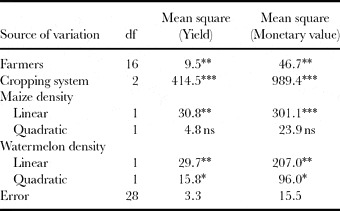
Analysis of variance of the first experiment detected highly significant differences among the 17 participating farmers for both yield and monetary value of total produce (p < 0.01; Table 1). Average farmer yield over all treatments in the experiment varied from 3.2 t ha−1 to 9.7 t ha−1 between farmers with an overall mean of 5.3 t ha−1. Average value of produce between farmers varied from 10 900 MZM ha−1 to 24 800 MZM ha−1 with overall mean of 15 050 MZM ha−1. Such differences in yield and monetary value between farmers may in part be due to different plant densities and the estimated plant density for each plot was therefore used as covariate to reduce the experimental error. For maize only the linear regression on plant density was significant, while both linear and quadratic regressions on plant density were significant for watermelon (Table 1).
Analysis of variance for crop yield and monetary value.

*p < 0.05; **p < 0.01; ***p < 0.001.
ns: not significant.
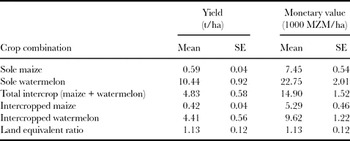
Also, the cropping system (intercropping versus the two sole cropping systems) revealed highly significant effects on both yield and monetary value (p < 0.001; Table 1). The highest fresh weight yield was produced by the sole crop of watermelon (average 10.44 t ha−1; Table 2). The intercrop with the two species was considerably less productive (average 4.83 t ha−1), while maize as the sole crop only produced an average of 0.59 t ha−1 (Table 2). When intercropped, the watermelon yield was reduced to 4.41 t ha−1, which is only 42.2% of the sole crop yield. In contrast, the maize suffered less yield loss when intercropped and produced 0.42 t ha−1, which is 71.2% of the sole crop yield. Watermelon alone also generated the highest monetary value (average 22 750 MZM ha−1) when the sole crops and the intercropping system were compared. Maize as a sole crop generated the lowest sales value (average 7450 MZM ha−1) and the intercrop with the two species generated an intermediate monetary value (average 14 900 MZM ha−1; Table 2).
Mean crop production yield, monetary value and land equivalent ratio.

SE: standard error.
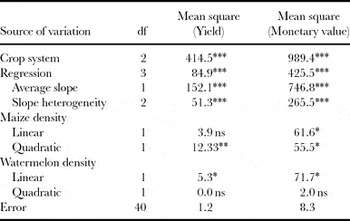
The effects of different farmers on the yield and monetary value of the cropping system were further studied through regression analysis of yield/value for each plot on average yield/monetary value for each farmer. Results showed significantly different slopes for the two crops and the crop combination (p < 0.001; Table 3). Heterogeneity of slope was also found for the same type of regression for monetary value (p < 0.001). Again significant reduction of the experimental errors was obtained using the plant density as covariates.
Analysis of regression on farmer mean yield and monetary value.

*p < 0.05; **p < 0.01; ***p < 0.001.
ns: not significant.
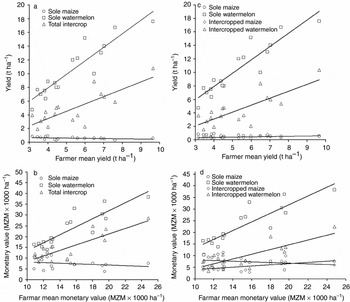
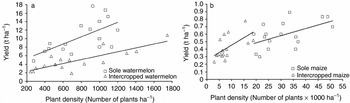
Effects of the farmer environments, including different growing methods among farmers and the effects of the cropping systems are illustrated in Figure 1 for crop yield and monetary value. Watermelon cultivated as sole crop responded positively to improved farmer environment, while the maize crop showed almost stable yield and value irrespective of the farmers' environment (Figures 1a and 1b). Estimated slopes for regression of sole cropped maize were 0.008 ± 0.04 and 0.022 ± 0.05 for yield and monetary value, respectively, which were not significantly different from zero. A separate analysis excluding the maize crop also showed highly significant differences (p < 0.001) in slope between watermelon grown as sole crop and watermelon intercropped with maize. The estimate of slope for watermelon in sole crop was 1.84 ± 0.04, while the slope of watermelon in intercrop was 0.54 ± 0.06. Figures 1c and 1d illustrate the yield and monetary value of products for maize and watermelon as sole crops compared with their yield and monetary value from the intercrop regressed on farmer mean yields and monetary value. In particular, watermelon is suppressed in relation to crop yield and monetary value when intercropped. However, also during intercropping watermelon responded positively to improved cultivation conditions in contrast to maize. Part of the differences in yield among farmers may be explained by differences in plant density, since there was a clear tendency that farmers with high yields also had more dense plantings for maize and watermelon both when cultivated alone and as intercrop (Figure 2).
Yield (a and c) and monetary value (b and d) of watermelon, maize and their intercrop regressed on farmers' means.

Relationship between plant density and the yield of watermelon (a) and maize (b) under sole cropping and intercropping.

Differences in land use efficiency measured as the land equivalent (LER) was observed among farmers. LER recorded values from 0.54 to 2.10 with a mean value of 1.13 and standard error of 0.12 (Table 2). LER showed positive correlation with total intercrop yield for each farmer (r = 0.60, p = 0.006). Also, plant densities of intercropped maize (r = 0.38, p = 0.07) and watermelon (r = 0.42, p = 0.05) indicated positive correlation with LER.
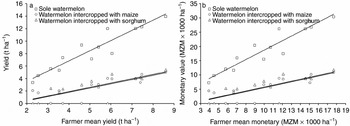
In the second experiment, intercropping watermelon with either maize or sorghum, the growing area was prone to drought, and the two cereal crops died before flowering and hence did not develop harvestable seeds. In contrast, watermelon still produced a crop. However, also during this intercropping, watermelon experienced a significant reduction in both yield and monetary value when intercropped both with maize and sorghum compared with its performance as a sole crop (Figures 3a and 3b). Sole crops of watermelon in this experiment on average produced 8.78 ± 0.92 t ha−1 fresh weight, while the production of watermelon intercropped with maize and sorghum was only 2.62 ± 0.46 t ha−1 and 2.73 ± 0.48 t ha−1, respectively. Thus, the yield reduction of watermelon was about 70% when intercropped with maize and about 69% when intercropped with sorghum. Slopes of regression on farmers' average yield for watermelon cultivated as the sole crop or intercropped were highly significantly different (p < 0.001; analysis not shown). The yield or monetary value of watermelon with different farmers was very much the same whether intercropped with maize or sorghum in this experiment, where the maize or sorghum intercrop did not produce seeds (Figures 3a and 3b).
Yield (a) and monetary value (b) of watermelon intercropped with maize or sorghum regressed on farmers' means when cereals failed to produce grain due to drought.

DISCUSSION
The farmers' fields in southern Mozambique used for this study represent an acreage of estimated 30 000 ha arable land grown, mainly by smallholder farmers along the Limpopo Basin (Direcção Nacional da Administração Local, 2005). Most farmers in the district grow at least three small-sized fields (0.3 ha per field) distributed at different sites around the villages (Brito et al., Reference Brito, Famba, Munguambe, Ibraimo and Julaia2009; Direcção Nacional da Administração Local, 2005). This is a strategy to avoid complete crop failure, and crop farming is combined with animal husbandry. Late and unreliable rains are not uncommon for the area and frequently result in crop failure in many farmers' fields. This was also the case in the present study, where the maize crop failed under the conditions exposed to drought. This highlights that the farmers' strategy to rely on more fields with different growing conditions to produce a yield is wise and enhances food security or at least reduces the risk for complete crop failure.
Single component yield depression in intercropping
Intercropping in this study resulted in yield reduction of both intercrop components. The yield of maize was reduced 28.8% and watermelon 57.8% in the intercrop in comparison to the yield of sole crops. This is in agreement with findings from other intercropping studies involving cereals intercropped with pumpkin or legumes (Agegnehu et al., Reference Agegnehu, Ghizaw and Sinebo2006; Silwana and Lucas, Reference Silwana and Lucas2002; Yadav and Yadav, Reference Yadav and Yadav2001). Yield depression during intercropping has been associated with inter-specific competition for water, nutrients and sunlight during the co-growth stage of the component crops (Ghosh et al., Reference Ghosh, Tripathi, Bandyopadhyay and Manna2009). Under humid conditions, intercropping of maize and watermelon has, on the contrary, been reported not to affect maize yields (Ikeorgu et al., Reference Ikeorgu, Ezumah and Wahua1989; Olasantan, Reference Olasantan1988). The ability of the crop to compete for soil water during intercropping may be influenced by the amount and timing of water supply during the life cycle of the plant (Morris and Garrity, Reference Morris and Garrity1993; Zegada-Lizarazu et al., Reference Zegada-Lizarazu, Niitembu and Iijima2005). From the present study, it is not possible to conclude whether the yield penalty is due to competition for light, water or nutrients. Part of the among-farmer differences for the watermelon yield may be explained by differences in plant densities. Farmers with higher yield have higher plant densities. However, it is not possible to conclude from this study if this density yield correlation for watermelon is caused by the higher plant density or whether farmers with generally more fertile soils tend to sow more densely.
Land equivalent ratio
The mean LER of 1.13 from this maize–watermelon experiment shows that this type of intercropping has advantages in terms of land use efficiency. Based on the current study, on average, an area planted with single crops separately would require 13% more land than an intercrop production to generate the same total yield or monetary value of maize plus watermelon. Major advantages of this land saving may be less labour for weeding and land preparation. Higher land productivity in maize–watermelon intercropping has also been reported from on-station studies carried out in high rainfall areas (Ikeorgu et al., Reference Ikeorgu, Ezumah and Wahua1989). The current study shows that intercropping maize and watermelon is also advantageous in semi-arid areas, and the use of the drought tolerant watermelon as a companion crop has important implications for food and income security, because this plant yields even under extreme conditions where the cereal crops might fail. An increase in economic return as a result of intercropping has been reported mainly in cereal/legume systems (Mucheru-Muna et al., Reference Mucheru-Muna, Pypers, Mugendi, Kung'u, Mugwe, Merckx and Vanlauwe2010). This study has shown intercrop advantage considering the LER related to monetary value (1.13) also when watermelon is used as the companion crop. As the production cost was not measured in our study, the profit value related to LER is not known, but it probably could be even higher since inclusion of watermelon in maize fields requires little additional operation costs (Shayo et al., Reference Shayo, Ogle and Udén1996). In addition, the monetary advantage of this maize–watermelon intercropping system in the area depends on a sufficient market demand for the watermelon products to maintain the price. In this particular case, a robust farmer income was supported by a group of women traders who transported part of the watermelons about 300 km to a better price market in Maputo. A positive correlation between LER and total intercrop yield has previously been reported for teff (Eragrostis tef) and faba beans (Vicia faba; Agegnehu et al., Reference Agegnehu, Ghizaw and Sinebo2006). Also, in the present case of maize intercropped with watermelons under semi-arid conditions, this correlation was significant indicating that better management and investment in the system is rewarded. This is consistent with previous findings that better farmer management, e.g. appropriate weeding, may be rewarding in maize–pumpkin intercropping (Silwana and Lucas, Reference Silwana and Lucas2002).
Advantage of watermelon for intercropping
Strategies for agriculture adaptation to drought and extreme climate events are needed as it is predicted that climate change will affect agriculture in many African countries, particularly in semi-arid areas (Stringer et al., Reference Stringer, Dyer, Reed, Dougill, Twyman and Mkwambisi2009). Diversification of agriculture and promotion of locally adapted, drought tolerant crops is one strategy to mitigate the effect of this development (Hassan, Reference Hassan2010). Watermelon as a companion crop in intercropping with cereals has an obvious advantage in its apparent ability to compensate. It suffers reduction in yield to the companion cereal but responds effectively to better conditions and at the same time, it produces even in cases where the cereals fail. Although maize is not recommended for the specific agro-ecological conditions of this area (Reddy, Reference Reddy1986), the crop is highly valued by local communities and is still a dominant crop in the area (Direcção Nacional da Administração Local, 2005). Our study shows that watermelon intercropping with maize does not seriously reduce the yield of the maize crop. However, it reduces the risk of complete crop failure when only maize is cultivated in such drought prone areas. This is an example of farmers' ability to mitigate drought risk and ensure regular supply of food and income through the use of diversified cropping systems.
Acknowledgements
We thank DANIDA for financial support (Project no. 919-LIFE). District Directorate for Economic Activity as well as farmer associations of Mathize and Yimba Yimue B in Mabalane District, Gaza Province, Mozambique, are highly acknowledged for valuable assistance and inputs during planning and execution of the field experiment. Thanks are also extended to Mr Francisco Reis, Ms Carla Torre do Vale and Mr Jorge Francisco (all from IIAM) and Mr Letão (District Extension Officer of Mabalane) for technical assistance.