





1. Introduction
In the context of heritage language (HL) acquisition, cross-linguistic influence (CLI) occurs when child heritage speakers (HSs) borrow a structure from the majority language into the HL. HSs are early bilinguals who grow up speaking a different language at home (their HL/first language [L1]) than the majority language of their society; CLI from the majority language into the HL is often identified as one of the main factors differentiating HL acquisition from L1 acquisition in the home country (where the L1 is a majority language). As a result of CLI as well as other factors related to the quantity and quality of HL input, HSs can often develop a “heritage variety” of the language, which diverges from the home country variety (Polinsky & Scontras, Reference Polinsky and Scontras2020).
The past two decades have yielded considerable research on the factors that may affect the presence and rate of CLI in child bilinguals (both HSs and non-HSs), with an emphasis on the role of structural overlap between languages, relative language dominance within the child, and age (for recent overviews, see Chondrogianni, Reference Chondrogianni, Elgort, Siyanova-Chanturia and Brysbaert2023; Kupisch, Reference Kupisch, Schmid and Köpke2019; Serratrice, Reference Serratrice2013). Our understanding of CLI, however, remains incomplete, as the vast majority of studies focus on monolingual-bilingual comparisons and involve participants in early or mid-childhood (typically up to the age of ten). Thus, a diversification of research methods and populations can shed more light on this topic. The inclusion of intergenerational comparisons between child HSs and their parents (who provide input for the HL) – in addition to or instead of monolingual-bilingual comparisons – would enable us to determine the magnitude of CLI in HSs in relation to their baseline quantity and quality of HL exposure from the parental generation. As well, the inclusion of older children, including adolescents, would enable us to determine the conditions under which CLI may persist over longer time spans.
The present study addresses these gaps by focusing on a phenomenon that has received little attention in the experimental CLI literature: the acquisition of wh-in-situ questions (in Mandarin) under the influence of a wh-fronting language (English). Specifically, we examine whether 6;9 to 16;2-year-old, second-generation child HSs of Mandarin in western Canada produce a higher rate of non-felicitous wh-fronting compared to their first-generation immigrant mothers, who are the main HL input providers, and if so, whether their productions are affected by structural overlap, language dominance, and age.
1.1. Cross-linguistic influence in bilingual children
CLI is often observed as an (over)use of structures from one language in the other, especially if these structures are either less frequent or ungrammatical in the target language. It has been attested in a variety of (morpho)syntactic domains in bilingual children, including nominal compounds (e.g., Foroodi-Nejad & Paradis, Reference Foroodi-Nejad and Paradis2009), word order (e.g., Argyri & Sorace, Reference Argyri and Sorace2007), overt versus null pronouns (e.g., Serratrice et al., Reference Serratrice, Sorace and Paoli2004), and wh-questions (e.g., Bentea & Marinis, Reference Bentea and Marinis2022; Strik & Pérez-Leroux, Reference Strik and Pérez-Leroux2011), among others. For example, Serratrice et al. (Reference Serratrice, Sorace and Paoli2004) analysed a corpus of Italian productions by Carlo, an Italian-English simultaneous bilingual child in Scotland, from ages 1;10 to 4;6. The authors found that Carlo produced overt subjects in his Italian HL at a higher frequency than did monolingual Italian children, which may be (at least partially) attributable to the obligatory nature of overt subjects in English. In other words, Carlo’s Italian may have been influenced by the subject realization system of English – an option which does not exist for monolingual Italian-speaking children.
CLI is not equally likely to occur in all morphosyntactic contexts, however. As well, when it does occur, it can be of variable magnitude, meaning cross-linguistic structures might occur frequently or infrequently alongside target structures. Some major factors that have been found to affect the presence and rate of CLI have included structural overlap between languages, relative language dominance, and age. In the following section, we summarize existing research on these factors.
Structural overlap. Structural overlap (or surface overlap) refers to when the bilingual’s two languages use the same syntactic structures. Partial structural overlap occurs when there is optionality in one of the bilingual’s languages but not the other: more specifically, when Language A allows Option 1 and Option 2 for a syntactic structure, but Language B only allows Option 1. As originally proposed by Hulk and Müller (Reference Hulk and Müller2000) and reiterated by Müller and Hulk (Reference Müller and Hulk2001), partial structural overlap was considered to be a necessary (though not always sufficient) condition for CLI. Specifically, CLI would manifest as a child overusing Option 1 (compared to Option 2) in Language A, due to receiving additional positive evidence for Option 1 from Language B. For example, Müller and Hulk found that simultaneous bilingual children from around ages two to four, acquiring both a Germanic language (Dutch or German) as well as a Romance language (Italian or French), overused empty objects in the Romance language. This was interpreted as being influenced by the topic drop in Germanic languages, where the dropped topic is often an object.
Subsequent research has shown that the original hypothesis by Hulk and Müller (Reference Hulk and Müller2000) is too strong. Many studies have found CLI in the absence of structural overlap (e.g., Bosch & Unsworth, Reference Bosch and Unsworth2021; Daskalaki et al., Reference Daskalaki, Chondrogianni and Blom2023; Foroodi-Nejad & Paradis, Reference Foroodi-Nejad and Paradis2009; Jia & Paradis, Reference Jia and Paradis2020; Nicoladis, Reference Nicoladis2012; Nicoladis & Gavrila, Reference Nicoladis and Gavrila2015; Soriente, Reference Soriente, Kecskes and Albertazzi2007; Strik & Pérez-Leroux, Reference Strik and Pérez-Leroux2011; Yip & Matthews, Reference Yip and Matthews2000, Reference Yip and Matthews2007); for example, Nicoladis (Reference Nicoladis2012) found that French-English bilingual children ages 3;3 to 5;0 produced possessor-first possessive constructions in French despite them being ungrammatical, which is attributable to the prevalence of this word order in English. Other studies, however, have found that structural overlap can still moderate CLI on a quantitative (rather than qualitative) basis, in terms of increasing the rate of CLI relative to non-overlapping conditions. For example, Daskalaki et al. (Reference Daskalaki, Chondrogianni, Blom, Argyri and Paradis2019) found that Greek-English bilingual children in North America were more likely to produce non-felicitous/ungrammatical preverbal subjects in their Greek HL for the structures showing partial overlap with the equivalent English structures than for the structures showing no overlap. Similarly, van Dijk, Dijkstra, et al. (Reference van Dijk, Dijkstra and Unsworth2022) found that German–Dutch bilingual children experienced more CLI in the processing of Dutch sentences for structures that partially overlapped between Dutch and German, rather than those that either completely overlapped or did not overlap at all.
Dominance. A second major factor concerns language dominance. Though language dominance is not consistently defined across the literature, it typically refers to the degree to which one language is more proficient, preferred, or frequently used compared to the other. Various studies have shown that greater dominance in a language often correlates with a greater degree of CLI from that language (Argyri & Sorace, Reference Argyri and Sorace2007; Bosch & Unsworth, Reference Bosch and Unsworth2021; Foroodi-Nejad & Paradis, Reference Foroodi-Nejad and Paradis2009; van Dijk, Dijkstra, et al., Reference van Dijk, Dijkstra and Unsworth2022; Yip & Matthews, Reference Yip and Matthews2000). Furthermore, CLI can occur from the bilingual’s dominant to non-dominant language even if there is no structural overlap (Bosch & Unsworth, Reference Bosch and Unsworth2021; Daskalaki et al., Reference Daskalaki, Chondrogianni and Blom2023; Soriente, Reference Soriente, Kecskes and Albertazzi2007; Strik & Pérez-Leroux, Reference Strik and Pérez-Leroux2011; Yip & Matthews, Reference Yip and Matthews2000). For example, Yip and Matthews (Reference Yip and Matthews2000) observed that a bilingual Cantonese-English child living in Hong Kong produced ungrammatical wh-in-situ questions, null objects, and prenominal relative clauses in English, under the influence of his dominant Cantonese. The incidence of these ungrammatical structures in English was highest when the child was most dominant in Cantonese. More recently, van Dijk, van Wonderen, et al. (Reference van Dijk, van Wonderen, Koutamanis, Kootstra, Dijkstra and Unsworth2022) conducted a meta-analysis of the literature on CLI in children (around ages three to ten), investigating the role of dominance (operationalized by which language was the societal language), structural overlap, language domain, and age. The authors found significant effects for the dominance factor only: specifically, CLI was stronger from the societal to the non-societal language than vice versa, though it was still present in both cases. The authors interpreted this as indicating that dominance is a predictor of the strength, but not the presence, of CLI.
In sum, existing research suggests that both structural overlap and dominance can increase the likelihood of CLI. However, they are neither necessary nor sufficient, meaning that there are cases in which CLI occurs in the absence of dominance/structural overlap, and cases in which CLI does not occur, despite dominance/structural overlap.
Age. Less consistent appears to be the evidence concerning the role of age. The few existing studies that have examined CLI in school-age children (typically up to ten years old) have yielded mixed results. On the one hand, some studies have found that CLI abates as children grow older (Daskalaki et al., Reference Daskalaki, Chondrogianni and Blom2023; Deng & Mai, Reference Deng and Mai2024; Hao & Chondrogianni, Reference Hao and Chondrogianni2023; Jia & Paradis, Reference Jia and Paradis2020). For example, Daskalaki et al. (Reference Daskalaki, Chondrogianni and Blom2023) conducted a study involving Greek-English bilingual children (HSs of Greek) ages 6;6 to 18;10 living in Western Canada and New York City, US. The authors found that younger children produced more ungrammatical SV clauses in Greek embedded questions and object relatives than older children, which may be due to CLI from English SV word order. As well, Hao and Chondrogianni (Reference Hao and Chondrogianni2023) investigated the comprehension and production of canonical (SVO) and non-canonical word order in Mandarin as an HL by Mandarin-English bilingual children ages 5;0 to 9;2 living in the UK. The authors found, among other results, that the younger children overproduced more canonical SVO word order (which is shared with English) after non-canonical Mandarin primes than did the older children. In addition, Jia and Paradis (Reference Jia and Paradis2020) tested Mandarin-English bilingual children ages 6;0 to 9;8 in Canada on the comprehension and production of relative clauses in their HL, Mandarin. In a longitudinal study on a subset of these children, the authors found an improvement in production accuracy one year after the initial test: specifically, a decrease in the use of head-initial relative clauses, which were transferred from English but ungrammatical in Mandarin. In all of these studies, CLI appears to be a temporary phenomenon in HL acquisition, with child HSs showing the potential to ultimately converge with the monolingual or parental standard. This suggests that, in some cases, CLI may be part of a general pattern of protracted development in HL acquisition, a pattern that has also been observed in the non-CLI HL acquisition literature (Flores et al., Reference Flores, Santos, Jesus and Marques2017). This protraction is attributable to the fact that children’s HSs require a longer timeframe than do monolingual children to accumulate the same amount of target input.
On the other hand, there are also studies showing that CLI may persist into older childhood and adolescence (Bosch & Unsworth, Reference Bosch and Unsworth2021; Cuza, Reference Cuza2016; Deng & Mai, Reference Deng and Mai2024; van Dijk, van Wonderen, et al., Reference van Dijk, van Wonderen, Koutamanis, Kootstra, Dijkstra and Unsworth2022). For example, Bosch and Unsworth (Reference Bosch and Unsworth2021) found that bilingual Dutch–English children in the Netherlands were more likely than monolingual English children to accept ungrammatical V2 sentences in English due to CLI from Dutch. These children, who ranged from around ages five to ten, continued to overaccept ungrammatical V2 word order in English even at older ages. As well, Cuza (Reference Cuza2016) tested Spanish-English bilingual children aged 5;0 to 13;3 in the US on their Spanish HL, finding that these HSs underproduced mandatory subject-verb inversion in Spanish interrogatives compared to monolinguals. Furthermore, the older children, in fact, demonstrated more underproduction compared to the younger children, indicating that for these HSs, CLI increased with age. In these studies, CLI appears to reflect a permanent divergence of the HL grammar from the monolingual or parental grammar, with increased HL input over time having little compensatory effect. Overall, given the contrasting results from the small number of studies on older children, the presence and directionality of the age effect on CLI remains unclear.
Open issues. Our understanding of CLI relies primarily on studies with younger children (typically up to the age of ten), meaning that there is a lack of knowledge on how previously studied factors may impact CLI in older children. Accordingly, in the present study, we complement existing research by examining how structural overlap, dominance, and age affect the presence and rate of CLI in a group of older (ages 6;9–16;2) child HSs of Mandarin in Canada. To this end, we focus on the production of wh-questions in Mandarin under the influence of English. Wh-questions are a good testing ground for CLI because they can offer contexts of partial structural overlap as well as no overlap between the two languages.
1.2. Properties of Mandarin Wh-questions
Mandarin is canonically SVO. Wh-questions follow the same word order as declaratives (Huang et al., Reference Huang, Li and Li2009: chapter 7), although we note that, per Ren (Reference Ren2023), this word order specifically applies to information-seeking questions (the focus of our paper). In information-seeking contexts, object-questions place the wh-word in-situ, i.e., post-verbally (1). When-questions, however, demonstrate optionality in the placement of the wh-word, mirroring the variable positioning of certain temporal adjuncts – specifically, time nouns such as zuótiān “yesterday”Footnote 1 – in Mandarin declaratives. Chen et al. (Reference Chen, Su and Tamaoka2025), examining the placement of time nouns in Mandarin declarative sentences in the BLCU Chinese Corpus (Xun et al., Reference Xun, Rao, Xiao and Zang2016), found that time nouns appeared pre-verbally after the subject (i.e., in the in-situ position) in 73% of sentences, and sentence-initially before the subject (i.e., in the fronted position) in 27% of sentences. Furthermore, native speakers in Chen et al.’s study judged both in-situ and fronted placements as acceptable, but significantly preferred the in-situ placement. Correspondingly, in information-seeking interrogatives, the when-adjunct shénme shíhòu (literally “what time”) canonically appears pre-verbally after the subject (2a), but can also appear sentence-initially (2b). Our consultations with native speakers of Mandarin indicated that this fronted placement for when, much like for time nouns in declaratives, is allowed but dispreferred. This intuition is also supported by the low frequency of production of when-fronting by the Mandarin-dominant mothers in our elicited production task, which is to be discussed in our Results section.
Overall, this means that, in naturalistic contexts, children are informed explicitly by the input that both fronted and in-situ placement are possible for information-seeking when-questions, whereas this does not occur for information-seeking object-questions. Thus, Mandarin when-questions form a case of partial structural overlap with respect to English, whereas Mandarin object-questions are non-overlapping with respect to English.
We note, however, that there is also another level of optionality in the input, outside of explicit evidence for what is possible. This is in line with the two types of input ambiguity identified by Yip and Matthews (Reference Yip and Matthews2007) in bilingual development, which are “ambiguity of evidence” and “ambiguity of analysis.” Ambiguity of evidence refers to when a language provides explicit evidence of two (or more) options: this is the variable structure of when-questions when the subject is overt, as mentioned previously. However, as Mandarin is a subject-drop language, children can also receive input giving rise to ambiguity of analysis: if a subject is dropped in a when-question (2c), then the wh-word is the first in the sentence. Consequently, the underlying interrogative structure could be analysed as either fronted or in-situ. While it is unlikely that a monolingual Mandarin-speaking child would favour a fronted interpretation, given the prevalence of in-situ word order in Mandarin interrogatives as well as wh-fronting being more derivationally complex, it is possible that this occurs in child HSs of Mandarin if their dominant language uses wh-fronting. Thus, child HSs may encounter additional cases of structural overlap between Mandarin and English when encountering Mandarin input containing when-questions with a dropped subject, as they may analyse such input as fronted.


To sum up, optionality is present for when-questions in Mandarin: if the subject is overt, then when-questions can be fronted on a direct level in the input; if the subject is dropped, then they can be interpreted as fronted on the level of analysis. Neither level of optionality, however, is present for object-questions, as fronting is not grammatical, and a dropped subject would not affect the interpretation of an object wh-word in the in-situ post-verbal position.
1.3. The acquisition of Mandarin Wh-questions
Monolingual Mandarin-speaking children acquire wh-questions at an early age. Miao and Zhu (Reference Miao and Zhu1992) describe findings by Miao (Reference Miao1986) in children’s comprehension of wh-questions: most relevant to our study, the children were able to answer questions containing shéi “who” and shénme “what” by age three, and questions containing shénme shíhòu “when” by age four. Similarly, Erbaugh’s (Reference Erbaugh1982) longitudinal study of two Mandarin-speaking children found well-formed productions of wh-questions, including shéi “who,” shénme “what,” and shénme shíhòu “when” questions, by age three. Guo and Qi (Reference Guo and Qi2024) analysed wh-questions produced by GG, a Mandarin-English sequential bilingual child born in China, but also included information on the emergence of different wh-questions during GG’s (almost exclusively) monolingual period in China. Different types of wh-questions first emerged in GG’s Mandarin from age 1;6 to after 3;2, with shénme “what” occurring at age 1;6, shéi “who” at 1;12, and shénme shíhòu “when” after age 3;2. As well, the authors also analysed productions by Xue’er, a monolingual Mandarin child residing in China, from age 3;4 to 5;5 (as a comparison to GG’s later bilingual period). Xue’er produced wh-questions in-situ only, with the majority being shénme “what” questions.
Studies on the acquisition of Mandarin wh-questions by Mandarin-English bilingual children are sparse. In Guo and Qi’s (Reference Guo and Qi2024) data, GG moved to Australia at age 3;7, at which point Mandarin became her HL. Post-migration, prior to attending preschool, GG produced only in-situ wh-questions in Mandarin; after enrolling in an English-medium preschool, however, GG began producing some wh-fronting in Mandarin (for wh-adjuncts only), for a total of 14% of her Mandarin wh-questions for the rest of the study period (from age 4;11 to 5;5). She also experienced CLI in the other direction, with some of her English wh-questions being in-situ. Qi and Di Biase (Reference Qi and Di Biase2020) similarly investigated both the Mandarin and English development of James, a Mandarin-English simultaneous bilingual child living in Australia, from age 1;7 to 4;6 (when he was dominant in his HL, Mandarin). The authors found that in Mandarin, James first produced a wh-question (a shénme “what” subject-question) at age 2;6, and a clearly wh-in-situ question (a gàn ma “do what” object-question) at age 2;7. In contrast to Guo and Qi (Reference Guo and Qi2024), however, the authors did not observe any CLI for either language throughout the course of the study. That is, James produced only wh-in-situ in Mandarin and only wh-fronting in English.
There are also a few studies involving the acquisition of wh-questions in Cantonese by Cantonese-English bilingual children, albeit not in an HL context. Kwan-Terry (Reference Kwan-Terry1986) observed a Cantonese-English simultaneous bilingual child, Elvoo, living in Singapore from ages 3;6 to 5;0. The author found that, while Elvoo had initially acquired the in-situ structure of Cantonese wh-questions by 3;6, he began producing ungrammatical fronting after acquiring the fronting of English wh-questions at age 4;9, suggesting the overapplication of a single rule across both languages. In contrast, Peng’s (Reference Peng1999) and Yip and Matthews’ (Reference Yip and Matthews2000, Reference Yip and Matthews2007) case studies on a total of six Cantonese-English simultaneous bilingual children around one to five years old, living in Hong Kong, found that the Cantonese-dominant children exclusively produced Cantonese wh-questions in-situ. However, sporadic wh-fronting occurred in the English-dominant children: Yip and Matthews (Reference Yip and Matthews2007) found two instances by an English-dominant child around age two, and another two instances by a different child around age five, when she began shifting her dominance from Cantonese to English after entering formal education in English.
Summary. Wh-questions are an early-acquired domain in Chinese languages, and monolingual children are found to consistently produce the preferred/obligatory in-situ structure. In contrast, for bilingual Chinese-English children, fronting of the wh-word can occur in Mandarin/Cantonese, presumably under the influence of English, especially if the child is dominant in English. Existing studies on this form of CLI, however, are sparse and have only included small samples of children from young and narrow age ranges. Therefore, our study included a larger number of older Mandarin child HSs who have resided in an English majority context for multiple years, and whom we expected to be particularly susceptible to CLI in the production of their Mandarin wh-questions.
2. The present study
The present study had two interrelated goals: to determine whether there is evidence for CLI in school-age child HSs’ production of Mandarin wh-questions; and, if so, to investigate how this is affected by structural overlap, language dominance, and age.
As a baseline for comparison, we used the children’s mothers’ productions of wh-questions. This decision was based on studies suggesting that child HSs may be exposed to a contact variety of their language from their parents that differs from the home country variety in the frequency/presence of a certain property (Deng & Mai, Reference Deng and Mai2024; Daskalaki et al., Reference Daskalaki, Blom, Chondrogianni and Paradis2020; Paradis & Navarro, Reference Paradis and Navarro2003). For example, Deng and Mai (Reference Deng and Mai2024) found that second-generation child HSs of Mandarin in the UK produced a higher rate of post-verbal zai-prepositional phrases (and in more contexts) compared to their parents, who, in turn, produced a higher rate of post-verbal zai-locative prepositional phrases compared to monolingual adults and children. Similarly, Daskalaki et al. (Reference Daskalaki, Blom, Chondrogianni and Paradis2020) found that third-generation child HSs of Greek in western Canada produced more preverbal subjects and in more contexts compared to their second-generation parents, who, in turn, produced more preverbal subjects compared to first-generation immigrants and monolingual parents residing in Greece. Thus, comparisons between child HSs and monolinguals could have differential input as a confounding factor, which would make it difficult to determine the extent to which any divergences are due to input differences or CLI. Our use of maternal input as the baseline was aimed at removing this confound.
2.1. Research questions
To investigate the effect of structural overlap, we elicited two types of wh-questions in Mandarin, object-questions (where fronting is disallowed in the home country variety) and when-questions (where fronting is allowed but dispreferred). As well, we measured the children’s relative language dominance using their performance on Mandarin and English vocabulary tasks, and we recruited children across a wide age range from elementary to secondary school.
Our research questions (RQs) were as follows:
-
1. How do child HSs of Mandarin compare to their mothers in the fronting of object-questions and when-questions?
-
2. How is child HSs’ wh-fronting affected by structural overlap (the object-question versus when-question condition) and individual difference factors, namely, relative language dominance and age?
2.2. Predictions
With respect to RQ1, we predicted that, if there is CLI in second-generation child HSs, then they should produce a higher rate of wh-fronting in Mandarin questions, and possibly in more types of questions, compared to their mothers (as in Deng & Mai, Reference Deng and Mai2024 and Daskalaki et al., Reference Daskalaki, Blom, Chondrogianni and Paradis2020). In particular, we may expect mothers to produce wh-fronting solely in when-questions (the condition where fronting is allowed but dispreferred), and children to produce wh-fronting in both object-questions and when-questions.
Turning to the factors that may affect the presence and rate of CLI in the domain of children’s wh-questions (RQ2), we predicted that:
-
i. If structural overlap is a contributing factor (in line with results reported in Daskalaki et al., Reference Daskalaki, Chondrogianni, Blom, Argyri and Paradis2019; van Dijk, Dijkstra, et al., Reference van Dijk, Dijkstra and Unsworth2022), then children will produce a higher rate of wh-fronting in the partially overlapping structure (when-questions) compared to in the non-overlapping structure (object-questions).
-
ii. If language dominance is a contributing factor (in line with results reported in Bosch & Unsworth, Reference Bosch and Unsworth2021; Yip & Matthews, Reference Yip and Matthews2000), then the children’s rate of wh-fronting will increase as a function of English dominance.
-
iii. Lastly, if CLI abates as children grow older, then the rate of wh-fronting will decrease as a function of age (in line with Daskalaki et al., Reference Daskalaki, Chondrogianni and Blom2023; Hao & Chondrogianni, Reference Hao and Chondrogianni2023; Jia & Paradis, Reference Jia and Paradis2020). In contrast, if CLI persists into adolescence, then wh-fronting will increase with age or remain the same (in line with Bosch & Unsworth, Reference Bosch and Unsworth2021; Cuza, Reference Cuza2016; van Dijk, van Wonderen, et al., Reference van Dijk, van Wonderen, Koutamanis, Kootstra, Dijkstra and Unsworth2022).
3. Methods
3.1. Participants
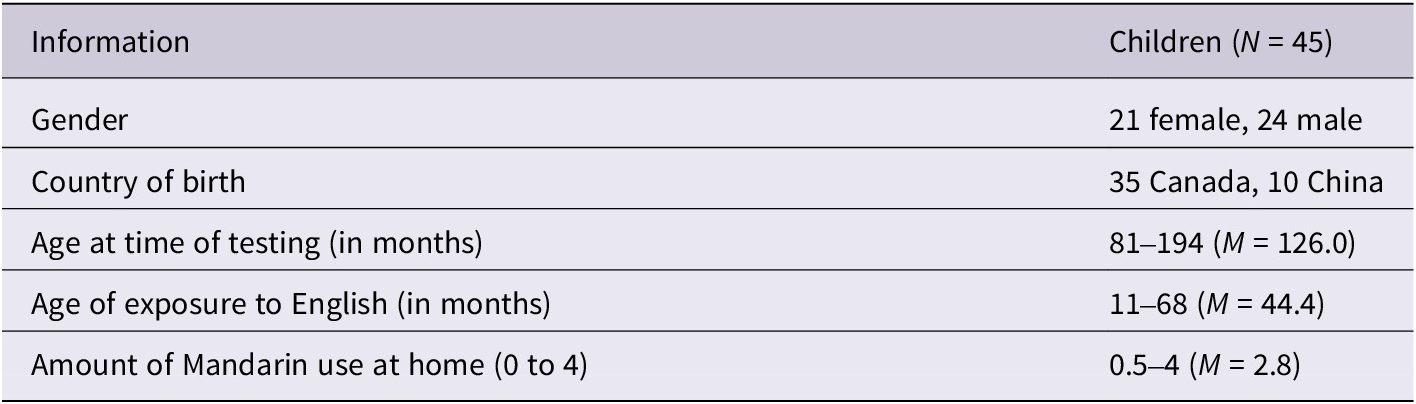
We analysed data collected from 45 child HSs of Mandarin, who, at the time of testing, lived in Alberta, Canada. The children belonged to 32 different families of Chinese origin and were either born in Canada (N = 35) or had immigrated to Canada by age 5;6 (N = 10). They ranged between 81 and 194 months of age (M = 126.0) – that is, 6;9 to 16;2 years old – and began consistent and systematic exposure to English in daycare/preschool/elementary school between 11 and 68 months of age (M = 44.4). At the time of testing, all children used Mandarin to some extent with family members (grandparents, parents, and siblings) at home. In a language background questionnaire, the children’s parents rated how frequently each child spoke and was spoken to in Mandarin with family members on a scale of 0 to 4 (0 being almost only English and 4 being almost only Mandarin), and the children’s Mandarin use scores (averaged across all family members) ranged between 0.5 and 4 (M = 2.8). In terms of HL education, 14 of the children attended Mandarin-English bilingual schools (where both Mandarin and English are used as the medium of instruction); 20 attended after-school Mandarin HL classes, but received all of their regular schooling in English; and 11 received their schooling entirely in English, with no formal or informal Mandarin education. A summary of the children’s demographic information is presented in Table 1.
Demographic information for the children. Age of exposure to English: consistent and systematic exposure at daycare/preschool/elementary school

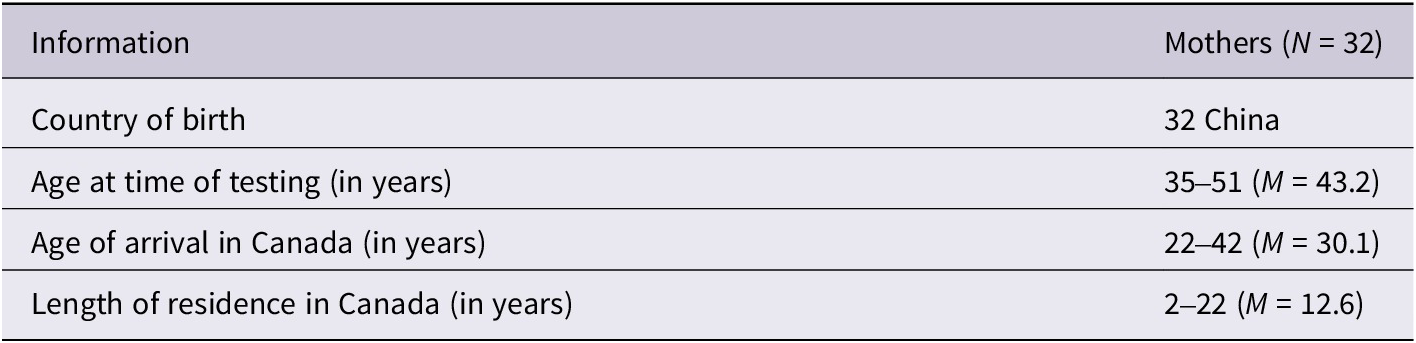
Each child had a first-generation immigrant mother who also participated in the experiment (N = 32). Since some of the children came from the same family, there was a smaller number of mothers than children. All of the mothers were born in China; they ranged between 35 and 51 years of age (M = 43.2). They arrived in Canada between the ages of 22–42 years (M = 30.1), and had resided in Canada between 2 and 22 years (M = 12.6). When asked to rate their own Mandarin and English proficiencies on a scale of 0–4, with 0 being no proficiency and 4 being full proficiency, all mothers rated their Mandarin with a score of 4, and rated their English with a score between 1 and 4 (M = 2.5). A summary of the mothers’ demographic information is presented in Table 2.
Demographic information for the mothers

3.2. Materials
The tasks in the present study are part of a larger battery of linguistic and non-linguistic tasks that were administered to our participants both in Mandarin and in English. In what follows, we will focus on the tasks for which we have reported results in this study.
Elicited wh-question task: Our main task was an elicited production task, which was modelled after previous studies on wh-questions (e.g., Guasti, Branchini, & Arosio, Reference Guasti, Branchini and Arosio2012; Strik & Pérez-Leroux, Reference Strik and Pérez-Leroux2011; Yatsushiro et al., Reference Yatsushiro, Dal Farra, Gonzalez, Hein, Silleresi, Avellana, Huang, Ilori, Krishnan, Pintér, Guasti, Sauerland, Gong and Kpogo2022). Both the children and their mothers completed this task. The task involved a question-and-answer structure between the researcher and the participant and was conducted entirely in Mandarin. It consisted of a total of 27 items: three practice items, eight fillers, and 16 experimental items.
The three practice items consisted of an object-question, a subject-question, and a when-question, to familiarize participants with the task. The eight fillers targeted subject-questions, which have entirely overlapping structures in Mandarin and English (the wh-word is at the front of the sentence in both languages). Of the 16 experimental items, eight targeted object-questions and eight targeted when-questions. All elicited questions were information-seeking questions.
For the object questions, the researcher showed the participant a picture of a boy named John, who was carrying out an activity with his pet (e.g., pushing it). Crucially, the pet was covered (Figure 1), so the participant was invited to ask a question to find out who John was doing the activity with. The expected response was an interrogative sentence containing an object wh-word. Only one placement is allowed in this context: the object must be in-situ (post-verbal). A sample dialogue is provided in (3), with (3b) showing the in-situ placement and (3c) showing the ungrammatical fronted placement.
Sample picture used to elicit object-questions.


To prompt the production of when-questions, the researcher showed the participant a picture of the same boy John (Figure 2), and said that one of his friends had interacted with his rabbit (e.g., the friend had pushed John’s rabbit). The participant was invited to ask a question to find out when this activity took place. The expected response was an interrogative sentence containing the adjunct shénme shíhòu “when.” Two placements are allowed in this context: the when-phrase is most often in-situ (pre-verbal after the subject), but a fronted position is also possible. A sample dialogue is provided in (4), with (4b) showing the in-situ placement and (4c) showing the fronted placement.


In terms of data coding, we assessed only responses containing either in-situ or fronted wh-words. Responses involving in-situ wh-words (for objects or when) were coded as accurate and received 1 point, whereas responses involving fronting were coded as non-accurate/dispreferred and received 0 points. A small percentage of responses (2.5% from the mothers and 7.5% from the children) was coded as NA and was excluded from the calculation. This consisted of the following: the reversal of grammatical relations (involving the use of a subject-question instead of an object-question), alternative responses (such as declaratives, polar questions, passive constructions, relative clauses, when postposed clause-finally, and when-questions with subject drop), incomprehensible responses, responses with English verbs, and no responses. Responses where the experimenter’s verb was substituted for a different Mandarin verb, however, were retained, such as if the experimenter used zhuā “grab,” but the participant produced mō “touch.”
Sample picture used to elicit when-questions.

Vocabulary task: To measure the children’s language dominance, we administered the picture-naming component of the Cross-linguistic Lexical Task (CLT) in two languages: the English CLT (Haman et al., Reference Haman, Łuniewska, Pomiechowska, Armon-Lotem, de Jong and Meir2015) and the Mandarin CLT (Kuo, Reference Kuo, Teng, Chang and Liu2025). In each CLT’s picture-naming component, the child views 64 pictures on a PowerPoint presentation (32 noun targets and 32 verb targets), and must name the noun or verb depicted in each picture. A correct response receives 1 point, and an incorrect response receives 0 points.
Correct responses included the target words along with synonyms and dialectal variants. For example, in the English CLT, for an image of a frog, we accepted both frog and toad; in the Mandarin CLT, for an image of a boy pulling on a rope, we accepted lā, zhuài, and bá, all meaning “pull.” Incorrect responses included mostly no responses, as well as a few semantic deviations. For example, in the English CLT, for an image of a tractor, we rejected truck; in the Mandarin CLT, for an image of a tiger, we rejected shīzi “lion.” We added up the total score for each child’s English CLT and Mandarin CLT and subtracted their Mandarin score from their English score. A positive number indicated better knowledge of English lexical items and thus dominance in English, while a negative number indicated better knowledge of Mandarin lexical items and thus dominance in Mandarin. A number around 0 indicated balanced bilingualism.
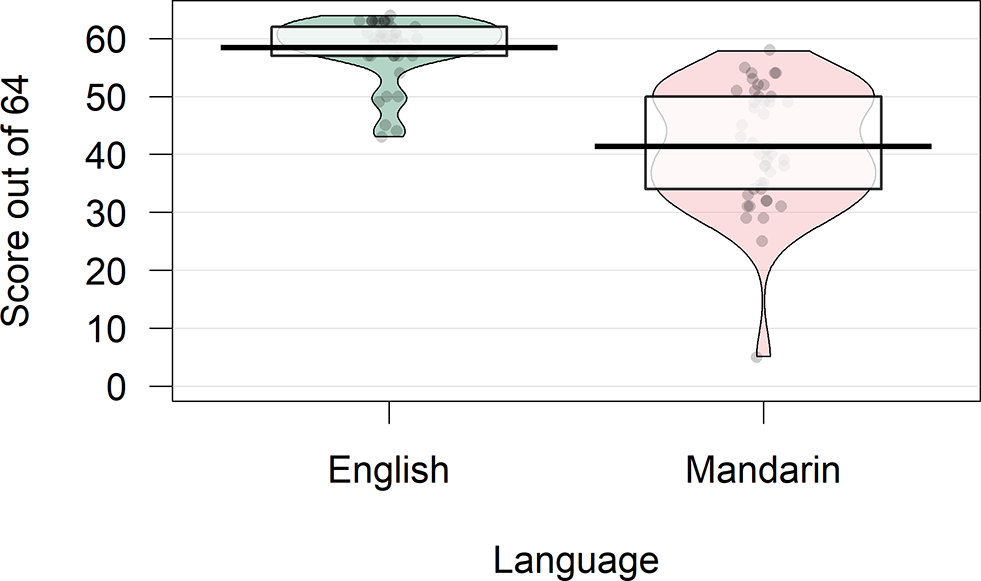
Overall, the children had high English CLT scores (M = 58.4, SD = 5.2), and lower (but also more variable) Mandarin CLT scores (M = 41.4, SD = 10.3). Their dominance scores ranged from −8 to 58 (M = 17.0, SD = 12.2), indicating the children skewed strongly towards dominance in English. Figure 3 presents pirate plots of the children’s English and Mandarin CLT scores. Each point represents an individual child’s score in a language; each language’s box and whisker plot marks the quartiles of scores in that language.
Children’s English and Mandarin CLT scores.

Parental questionnaire: The children’s parents (mothers and fathers) also completed the ALEQ_Heritage (Daskalaki et al., Reference Daskalaki, Chondrogianni, Blom, Argyri and Paradis2019), an adaptation of the Alberta Language Environment Questionnaire (Paradis, Reference Paradis2011). This questionnaire yields basic demographic information about the child and their family, as well as information about the child’s HL exposure and use inside and outside the home.
3.3. Procedures
Testing: Since data collection took place during the COVID-19 pandemic, we conducted our study entirely online via Zoom. We met with our participants twice, once to administer the Mandarin tasks and once to administer the English tasks. Only one language was used and tested in each session, and the language order was counterbalanced.
In both sessions, each child and their mother were asked to be in a quiet room. All the tasks were administered by a research assistant who was a bilingual speaker of Mandarin and English, first to the child, and then to the mother. The order of tasks in each session was: CLT (child); elicited wh-question task (child); elicited wh-question task (mother); and, at the end of the English session, the ALEQ (administered to the mother, and for one child, the father). For the CLT and elicited production tasks, the research assistant used the function “Share screen” to display PowerPoint presentations containing the relevant materials. The ALEQ was administered in an interview format, either in Mandarin or in English (depending on the parents’ preference). All the tasks except the ALEQ were audio-recorded. Each session lasted approximately 50 minutes in total.
Scoring: The Mandarin tasks (vocabulary and wh-questions) were transcribed and scored by two native speakers of Mandarin. A third speaker re-coded 20% of each of the tasks. The results were compared to obtain the percentage of inter-rater agreement. For the Mandarin vocabulary task, there was a 95.6% agreement rate, whereas for the Mandarin wh-question task, it was 100%. A similar procedure was followed for the English vocabulary task: it was transcribed and scored by a native speaker of English, and a second speaker re-coded 20% of the task. The comparison of the two coding assignments revealed a 96.72% agreement rate.
Ethics: The protocols for this study were approved by the ethics board of the University of Alberta (protocol number Pro00105886). In addition to the parental electronic consent, the child participants themselves provided oral assent during both the English and the Mandarin testing sessions.
3.4. Data analysis
We conducted our data analysis in R (R Core Team, 2020). Aside from the base packages, we used lme4 (Bates et al., Reference Bates, Maechler, Bolker and Walker2015) and lmerTest (Kuznetsova et al., Reference Kuznetsova, Brockhoff and Christensen2017) for modelling, and ggplot2 (Wickham, Reference Wickham2016) and yarrr (Phillips, Reference Phillips2017) for visualizations. To compare the children’s and mothers’ rates of wh-fronting in Mandarin (RQ1), we conducted Mann–Whitney/Wilcoxon rank-sum tests for their proportion of in-situ productions for each question type (when-questions and object-questions); note that Wilcoxon rank-sum tests were selected because of the non-normal distributions of our data. To investigate the effects of structural overlap, dominance, and age (RQ2) on the children’s presence and rate of wh-fronting, we conducted a binomial logistic mixed-effects regression with Accuracy (a 1 versus 0 score) as the dependent variable. Our predictors of interest were Condition (object-question versus when-question), Dominance (dominance score), and Age (in months). We also added AoE (age of exposure to English in months) as a covariate, since the children had a wide range of AoEs, and we wanted to ensure that this was not a confounding variable. The reference level for Condition was object-question. Dominance, Age, and AoE, being numeric variables, were scaled and centred. To check whether we could reliably add all three child-level predictors of Dominance, Age, and AoE into our model, we also tested the Kendall’s rank correlation (for non-normal distributions) among the three variables. The correlation between Dominance and Age was τ = 0.12 (p < .001); for Dominance and AoE, it was τ = −0.07 (p = .005); and for Age and AoE, it was τ = 0.18 (p < .001). These indicated extremely weak correlations, so we proceeded with the full set of predictors for our model.
To arrive at our final model for RQ2, we used backward stepwise elimination for our fixed effects. We began with a model that included all four predictors (three predictors of interest and one covariate) and all possible two- and three-way interactions among Condition, Dominance, and Age, as well as random intercepts by ID (each child) and Item (each stimulus item). AoE was not significant as a covariate, so we subsequently removed it from the model for parsimony. Then, we removed each interaction among Condition, Dominance, and Age one at a time if it was insignificant in the model. After paring down to only a significant interaction as well as the individual predictors, we then tested each significant predictor as a random slope by ID to see if it improved model fit, conducting comparisons using the anova() function. The only random slope that improved the model fit was Condition by ID. After adding this random slope, the previously significant interaction was no longer significant, so we removed this interaction from the model. Our final model contained no interactions, random intercepts by ID and Item, and a random slope for Condition by ID.
4. Results
4.1. Comparing children’s and mothers’ productions
RQ1 pertained to how child HSs’ productions of wh-questions compared to their mothers’ productions. To make this comparison, we calculated an in-situ proportion score for each participant in each question condition (object and when), in which we divided the participant’s number of in-situ responses by their total number of in-situ plus fronted responses. Thus, each participant had one proportion score for the object condition and one for the when condition.
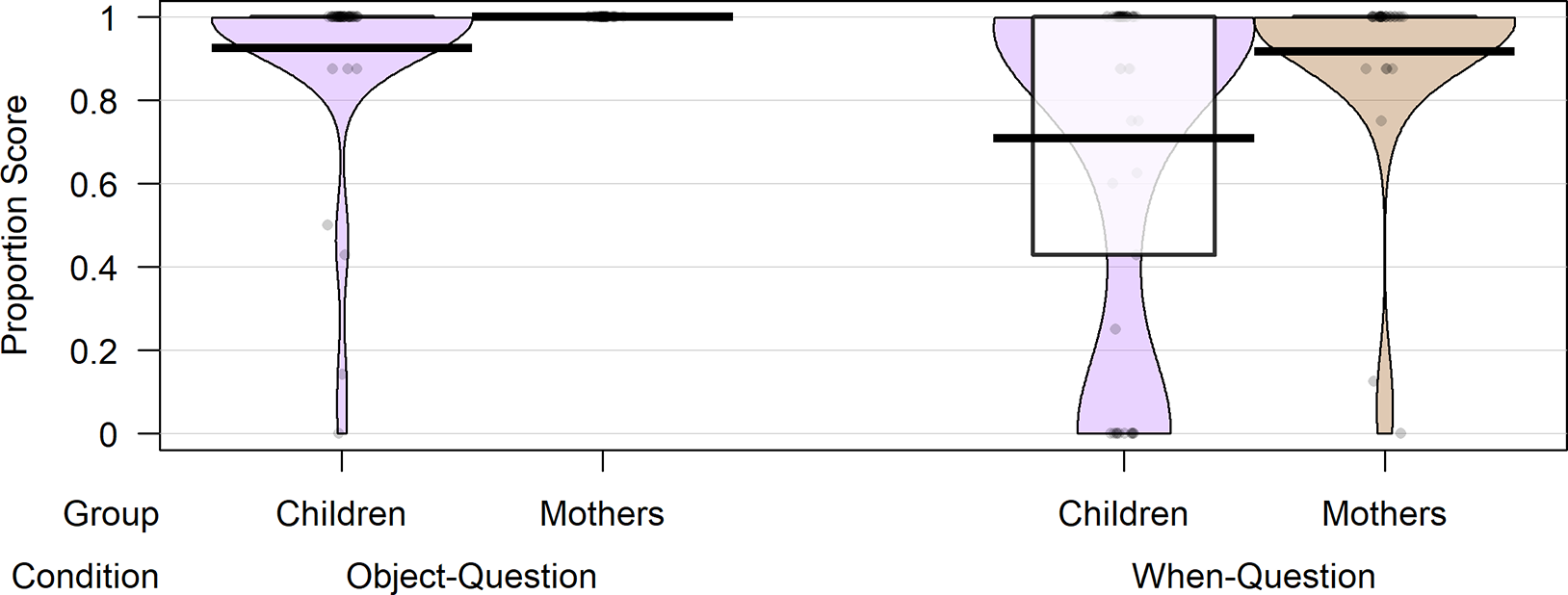
We first describe the mothers’ productions, which were our baseline for comparison. The mothers’ performance aligned with our descriptive assessment of Mandarin wh-question structure: namely, the contrast in optionality between object-fronting and when-fronting. For object-questions, all mothers had an in-situ proportion score of 1 out of 1, indicating that they produced object-questions exclusively in in-situ form. In contrast, most but not all when-questions were produced in-situ, with the mothers having a mean in-situ proportion score of 0.92 (SD = 0.23). We note as well that when-fronting was produced by only seven out of the 32 mothers, indicating that the majority of mothers (25 out of 32) never fronted.
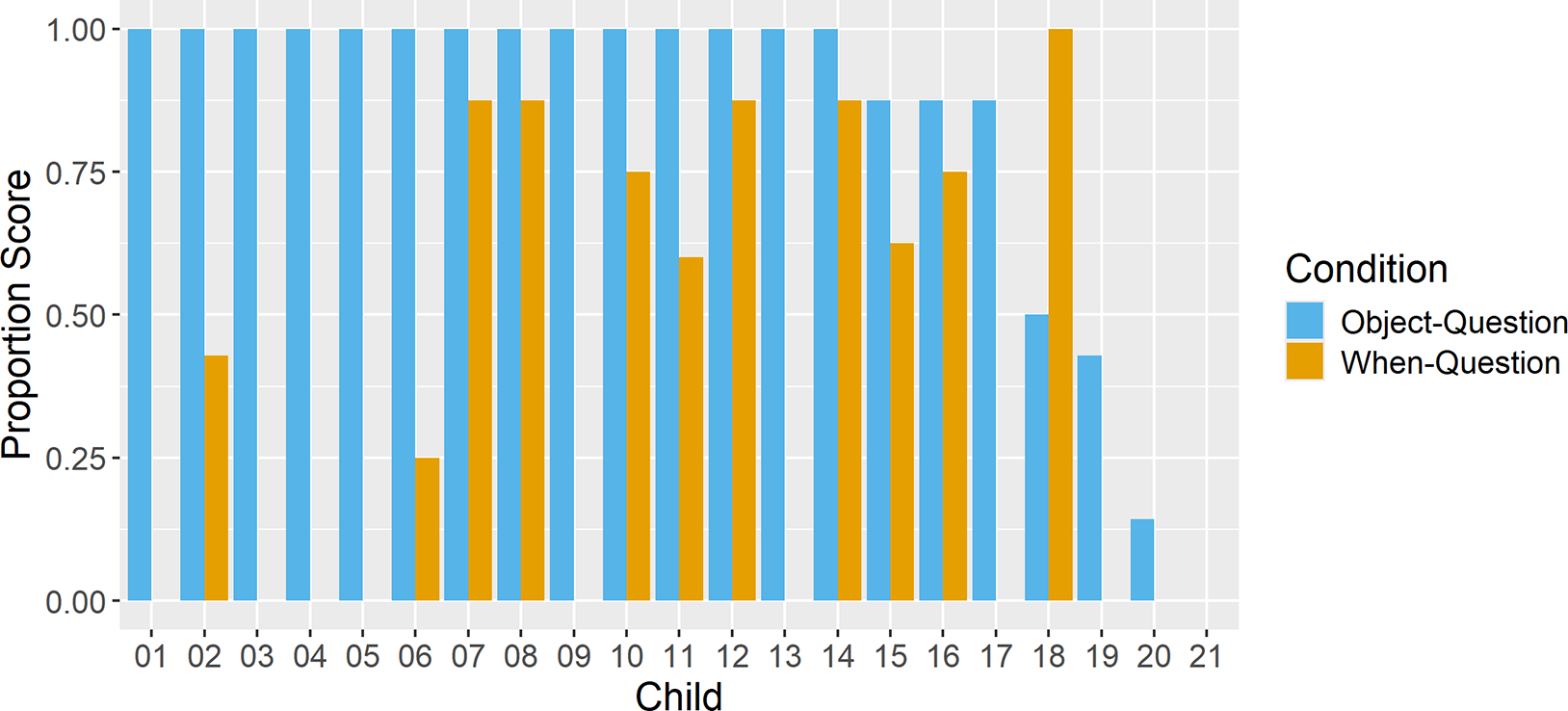
The children, as a group, like their mothers, also demonstrated a preference for in-situ word order in Mandarin wh-questions. Notably, many exclusively produced in-situ questions: out of the 45 children, 38 produced only in-situ in the object condition, 25 produced only in-situ in the when condition, and 24 produced only in-situ for both conditions. This means that only 21 children produced at least one fronted question in at least one of the conditions. Figure 4 presents a visualization of the proportion of in-situ responses by condition for each of the 21 children who produced at least one fronted question; the 24 other children who produced only in-situ questions in both conditions are omitted. Of the 21 children who did front, most fronted when-questions more often than object-questions, although there was a high level of individual variation in the differences between the two conditions.
Children’s proportions of in-situ questions by condition. Only the 21 children who produced at least one fronted question are included.

Despite their overall preference for in-situ word order, the children, as a group, performed differently from their mothers. For object-questions, their in-situ proportion scores ranged from 0–1 (M = 0.93, SD = 0.22); a Wilcoxon rank-sum test revealed that their distribution of scores differed significantly from their mothers’ distribution, z = −2.31, p = .02. For when-questions, their in-situ proportion scores ranged from 0 to 1 (M = 0.71, SD = 0.41); a Wilcoxon rank-sum test again revealed that their distribution of scores differed significantly from their mothers’ distribution, z = −2.36, p = .02. Figure 5 presents a pirateplot comparing the children’s and mothers’ proportion scores by condition. Each point represents an individual’s score for a condition; each condition’s box and whisker plot marks the quartiles of scores for that condition.
Children’s and mothers’ in-situ proportions scores by condition.

We also observed some qualitative differences between the children’s and mothers’ responses. Aside from ungrammatically fronting object-questions, the children also produced two other types of ungrammatical structures under the influence of English, which were absent in the mothers’ data. One was subject-auxiliary inversion, which is not found in Mandarin interrogative structure; see (5) for an example. This was attested in 19 out of 20 fronted object-questions, and in all seven of the children who fronted objects. Another structure was attempted progressive marking with copular shì instead of the correct progressive marker zài, which appears to be an attempted translation of the English progressive marker is; see (6) for an example, which also includes subject-auxiliary inversion. This was attested in eight out of 20 fronted object-questions, in three of the seven children who fronted objects. The fact that both structures co-occurred with fronted object-questions indicates the children were often calquing the entire object-question structure of English into Mandarin: that is, their Mandarin object-questions involved fronting the object, inverting the subject and auxiliary, and sometimes marking the progressive with a copula rather than the progressive marker. Thus, for these children, object-fronting appears to be part of a larger system of the transfer of English question structure in general.


In sum, child HSs performed differently from their mothers in the fronting of Mandarin wh-questions in both quantity and quality. In the children’s generation, wh-fronting was used more frequently, by more participants, and in more contexts compared to the mothers. The mothers never fronted object-questions and rarely fronted when-questions, whereas the children fronted both types of questions at a significantly higher rate. In addition, while the mothers exhibited regularity in the structures of their fronted and in-situ questions, the children exhibited irregularities, including calquing from English.
4.2. Factors affecting children’s Wh-fronting
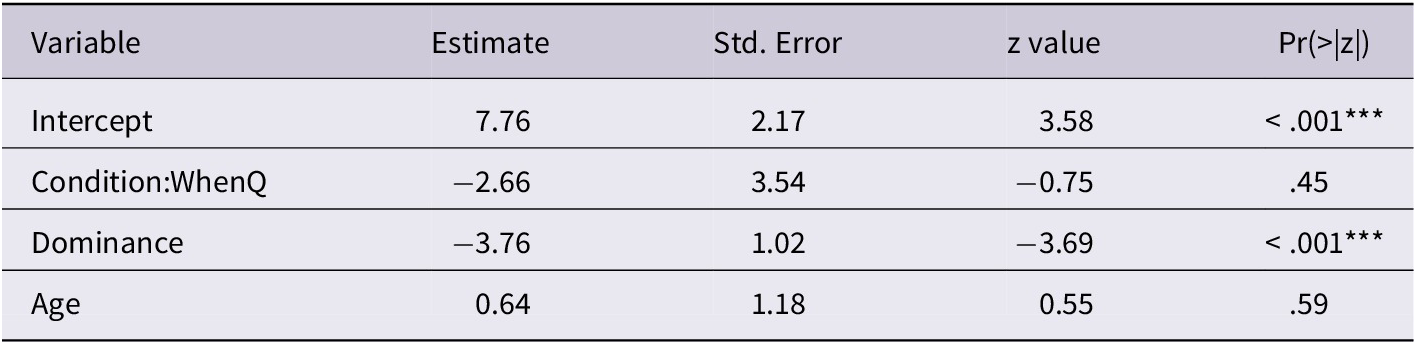
We turn now to RQ2, which was if the children’s production of wh-fronting was affected by structural overlap, language dominance, and age. After conducting model selection for our binomial logistic mixed-effects regression, we arrived at the structure of our final model, which is presented in Table 3. The marginal R2 of the model was .26, indicating the fixed effects explained 26% of the variance in the dataset; the conditional R2 was .94, indicating the fixed effects and random effects together explained 94% of the variance in the dataset.
Binomial logistic mixed-effects model for children’s productions of wh-questions

* p < .05; ** p < .01; *** p < .001. The model includes random intercepts by ID and Item and a random slope for Condition by ID.
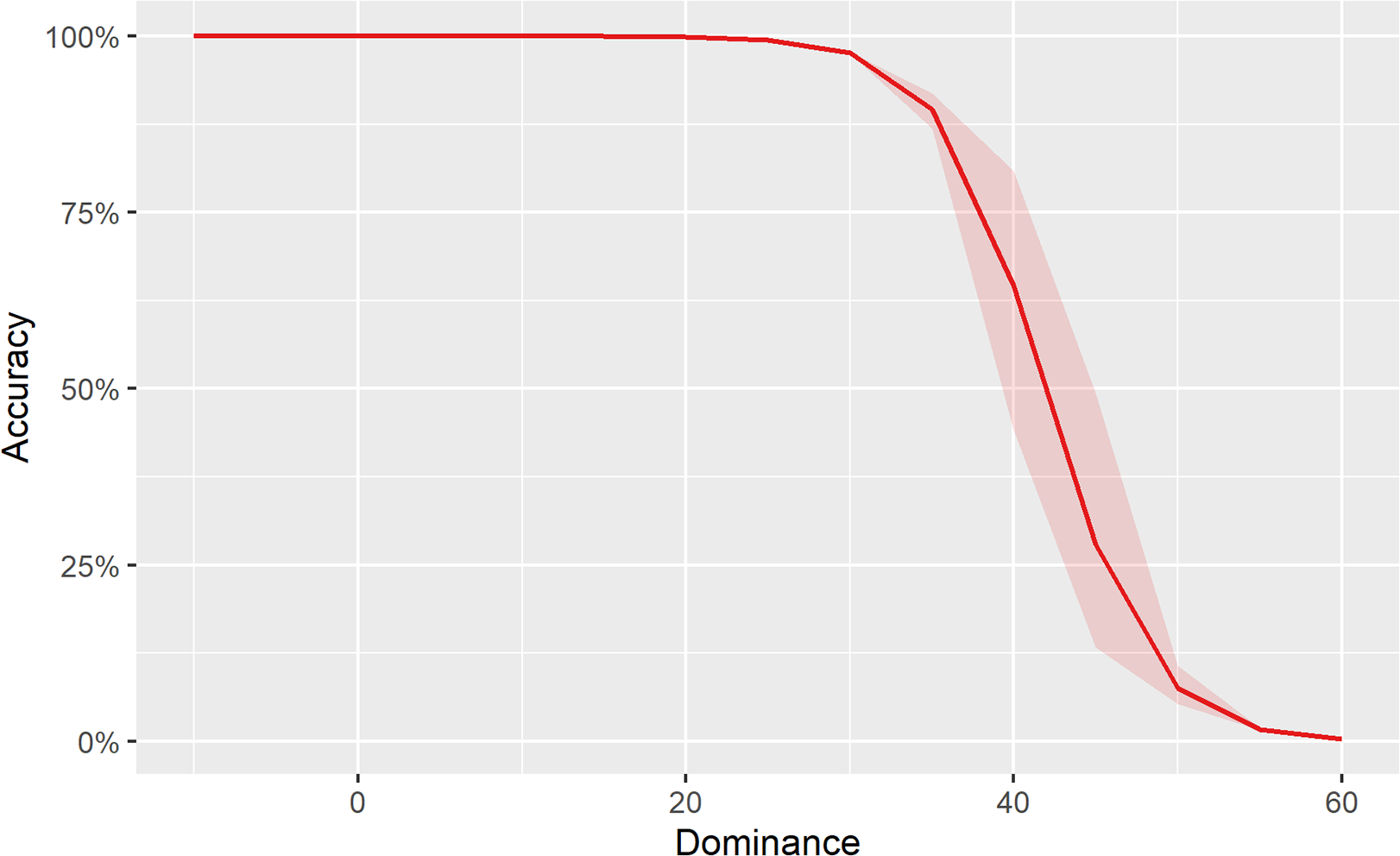
Of the three predictors of Condition, Dominance, and Age, only Dominance was significant in the model (β = −3.76, SE = 1.02, z = −3.69, p < .001). A higher dominance score (indicating stronger dominance in English) was associated with a lower likelihood of producing an in-situ question, and therefore, a higher likelihood of producing a fronted question (Figure 6). Dominance did not interact with either of the other predictors.
Effect of children’s relative English dominance on their accuracy scores.

Condition was not significant (β = −2.66, SE = 3.54, z = −0.75, p = .45). Adding Condition as a random slope by ID, however, did improve the fit of the model, indicating that only some of the children were affected by Condition. In other words, although the children as a group did not behave differently in producing object- versus when-questions, some individual children within the group did show a difference. This is consistent with our descriptive examination of the dataset, which showed that 24 out of 45 children did not front in either of the two conditions, indicating no effect of Condition for those children.
Age was also not significant (β = 0.64, SE = 1.18, z = 0.55, p = .59). This indicates that CLI did not either increase or decrease with age.
Looking further into the 21 children who did front, however, almost all produced a higher proportion of wh-fronting in the when condition than in the object condition. This suggested that, for many of these children, there was an effect of Condition in the expected direction. Therefore, we asked whether the effect of Condition might be significant if we excluded from the dataset the 24 children who exclusively produced in-situ questions. Accordingly, we ran the same model on the subset of 21 children who fronted at least once (noting that this is associated with a reduction in the power of our analysis). In this model, Condition became significant as a predictor in the expected direction (β = −6.24, SE = 1.75, z = −3.57, p < .001); that is, the children were more likely to front when-questions than object-questions. Dominance remained significant (β = −3.25, SE = 0.94, z = −3.45, p < .001), while Age remained non-significant (β = 0.52, SE = 0.56, z = 0.93, p = .35). Thus, the subset model supports our observation that, while not all children front, those who do front are affected by Condition in a manner consistent with our predictions.
5. Discussion
Our study sought to determine whether child HSs of Mandarin experienced CLI from their dominant language, English, in the domain of Mandarin wh-questions (RQ1); and if so, to what degree the children’s CLI was affected by structural overlap, language dominance, and age (RQ2). Different from the vast majority of existing studies on children’s CLI, we used the maternal generation as the baseline for comparison, and recruited school-age children from a wide age range. The inclusion of an intergenerational comparison enabled us to determine if and how the children’s HL differed from the variety of Mandarin spoken by their parents (which may itself differ from the variety spoken in the home country), whereas the inclusion of older children from a wider age range enabled us to examine whether the incidence of CLI changes in older childhood and adolescence. In what follows, we summarize our results and discuss their implications for each research question.
5.1. Intergenerational differences in the production of Mandarin wh-questions
Our comparison between the children’s and mothers’ productions (RQ1) confirmed our predictions, showing that the children fronted wh-questions more frequently and in more types of questions than did the mothers. Specifically, the mothers fronted infrequently, and only for when-questions; whereas the children fronted more frequently, and did so for both when- and object-questions. The observed increase in the rate of wh-fronting in the children’s generation is consistent with a CLI interpretation. To elaborate, in the case of when-questions, the influence of wh-fronting from English may amplify the effect of the low-frequency fronted Mandarin input from the parental generation, resulting in an increase in production in the children’s generation. We note again that the fronted Mandarin input received by the children may include both explicitly fronted when-questions as well as subject-dropped when-questions (which can be ambiguously analysed as fronted). In the case of object-questions, the influence of wh-fronting from English has resulted in fronting in the children even despite the absence of object-fronting in the parental generation. Overall, this is similar to the findings from the intergenerational studies conducted by Deng and Mai (Reference Deng and Mai2024) and Daskalaki et al. (Reference Daskalaki, Blom, Chondrogianni and Paradis2020), in which the parents’ generation only infrequently produces certain syntactic structures in the children’s HL, and the children’s generation produces these structures more frequently and in a greater variety of contexts. Furthermore, in our study, some of the children’s fronted wh-questions also demonstrated English influence in other ways, including subject-auxiliary inversion and progressive marking with a copula. This provides further evidence that CLI is among the factors driving these intergenerational differences.
While the children differed from their mothers at the group level, we also observed that, at the individual level, CLI did not occur for the majority of children. That is, the prevailing trend among child HSs of Mandarin, like their mothers, is a strong preference for in-situ word order. This suggests that older child HSs are, on the whole, successful in acquiring the basic structure of Mandarin wh-questions, much like their monolingual counterparts. This is consistent with earlier research showing that wh-questions are an early and unproblematic domain of acquisition for Mandarin-speaking children (Erbaugh, Reference Erbaugh1982; Guo & Qi, Reference Guo and Qi2024; Miao, Reference Miao1986; Miao & Zhu, Reference Miao and Zhu1992; Qi & Di Biase, Reference Qi and Di Biase2020). In the case of child HSs, it is possible that the Mandarin wh-question structure has already been mostly or fully acquired before the child begins experiencing a reduction in HL input and an increase in English input. Alternatively, it may be that this structure is less susceptible to CLI even when acquired in contexts of reduced input, perhaps because wh-in-situ (which uses the same word order as declaratives) is a relatively non-complex structure, at least compared to wh-fronting. Strik and Pérez-Leroux (Reference Strik and Pérez-Leroux2011), for example, have hypothesized that structural complexity plays a role in CLI, where a language with a less complex structure (such as wh-in-situ) can transfer into a language with a more complex structure (such as wh-fronting), but the opposite should not be able to occur. While our results show that this hypothesis is too strong, a weaker version of the principle may be at play, where the likelihood of transfer from a more complex structure to a less complex structure is significantly reduced.
5.2. The effect of structural overlap, language dominance, and age
For RQ2, we analysed the effects of structural overlap, language dominance, and age on the children’s fronting. These are factors that have been extensively studied in younger children and for other CLI-related phenomena. We found structural overlap to be a contributing factor, but at the individual – rather than group – level, as only a subset of children were affected by differences in condition. Language dominance was a contributing factor in the expected direction, while age did not exert a statistically significant effect. We now discuss the implications of these findings for each predictor.
Structural overlap (operationalized as Condition) was found to have an effect for some children but not others. A little over half of the children performed at ceiling by producing every wh-question in-situ; the remainder of the children varied in their differences between conditions, but overall fronted when-questions more often than object-questions. These results are consistent with the large body of research showing that structural overlap is neither necessary nor sufficient for CLI, given that a few children fronted in the non-overlapping (object) condition, but the majority of children did not front at all, even in the overlapping (when) condition. At the same time, however, since the children who did front were more likely to front in the overlapping condition, this suggests that structural overlap is still a contributing factor, in terms of increasing the likelihood of CLI (in line with Daskalaki et al., Reference Daskalaki, Chondrogianni, Blom, Argyri and Paradis2019; van Dijk, Dijkstra, et al., Reference van Dijk, Dijkstra and Unsworth2022).
Relative language dominance in English was negatively associated with the production of in-situ word order. That is, children who were more dominant in English were more likely to front. This is consistent with prior research showing that language dominance is a contributing factor towards CLI, even in cases without structural overlap (Bosch & Unsworth, Reference Bosch and Unsworth2021; Yip & Matthews, Reference Yip and Matthews2000), such as for object-questions in Mandarin. In addition, the lack of significant interactions between dominance and the other predictors indicates that the effect of dominance on CLI is not necessarily moderated by structure type or whether the children are older or younger. However, our findings also support the assertion that dominance is not a sufficient condition for CLI, given that over half of the children in our study did not front at all, despite the majority also being dominant in English. This suggests that some aspects of HL syntax – at least for some children – are so early or easily acquired that they may be less susceptible to influence from the majority language.
With respect to age, we had hypothesized that if CLI is a temporary phenomenon, then the rate of wh-fronting should decrease as children grow older; if, on the other hand, CLI persists into adolescence, then the rate of wh-fronting should remain the same or even increase with age. Age was not predictive of wh-fronting in our model, meaning that our results were consistent with the second hypothesis. This is in line with studies showing that CLI may lead to permanent divergence of the HL from the monolingual or parental grammar (Bosch & Unsworth, Reference Bosch and Unsworth2021; Cuza, Reference Cuza2016; van Dijk, van Wonderen, et al., Reference van Dijk, van Wonderen, Koutamanis, Kootstra, Dijkstra and Unsworth2022), and conflicts with studies showing that CLI fades away as children grow older and accumulate sufficient HL input (Daskalaki et al., Reference Daskalaki, Chondrogianni and Blom2023; Hao & Chondrogianni, Reference Chondrogianni, Elgort, Siyanova-Chanturia and Brysbaert2023; Jia & Paradis, Reference Jia and Paradis2020).
There are many possible explanations for the lack of an age effect in our population. The first is that, in school-age HSs, age is not solely a proxy for cumulative use of the HL. It is also a proxy for cumulative use of the majority language (since HSs experience a large increase in majority language exposure after starting schooling), and the relative influence of this factor likely depends on the individual child’s experiences with both of their languages. For children who have used the HL frequently in a variety of contexts, older age would correlate with increased cumulative exposure to the HL; thus, for these children, CLI may decrease over time as they accumulate more of the target input. For children who have mainly used the majority language, however, older age would primarily index increased cumulative exposure to the majority language, and very little increase in exposure to the HL. This is likely the case with the specific children in our study, as the vast majority were heavily English-dominant. Thus, for these HSs, the effect of increased cumulative exposure to English over time, combined with very little increase in exposure to the target Mandarin input, would lead to a persistence in CLI. A second possible explanation for the lack of an age effect is that, given wh-questions are such an early-acquired domain in Mandarin, we may have missed the timeframe during which older age correlates with an improvement in performance. That is, we might have found age to be predictive if we had conducted this study on a younger age group. A third possibility is that our sample varies along some other dimensions of individual differences that may confound with age, such as age of arrival in Canada or age of first exposure to English. Thus, to disentangle age effects from the effect of potential individual-level variation in language environment and input, a longitudinal study design may have been more effective.
6. Conclusion
This study was, to our knowledge, the first to investigate CLI in the area of Mandarin wh-questions using an experimental approach, and with child HSs of older age ranges. We elicited the production of object-questions and when-questions in 6;9 to 16;2-year-old child HSs of Mandarin and their first-generation immigrant mothers in Alberta, Canada, focusing on the presence and rate of wh-fronting under the influence of English. The results of our study supported three main conclusions. First, even early-acquired phenomena, such as wh-in-situ in heritage Mandarin, can be subjected to CLI-driven intergenerational change. In our case, the changes are both quantitative and qualitative in nature: on a quantitative level, we observed an increase in the rate of wh-fronting, which is relatively rare in the first-generation parental variety of Mandarin; on a qualitative level, we observed the use of wh-fronting in a larger variety of contexts, which may also be combined with other features of English interrogative structure, such as subject-auxiliary inversion. Second, CLI in older, school-age children can be affected by both the language-level factor of structural overlap as well as the individual-level factor of relative language dominance. However, the effect of these factors is not deterministic – in which the satisfaction of a criterion necessarily entails CLI – but probabilistic, in that they increase the likelihood of CLI occurring. Third, while the (non-)effect of age on CLI is more difficult to interpret, its directionality likely depends on the relative balance of the child’s cumulative use of the HL compared to the majority language. For children who have more dramatically shifted towards majority language use in most contexts, older age is likely to be associated with a persistence of CLI.
6.1. Limitations and future research
We would like to point out a few limitations to our study design, as well as explore some potential directions for future research. First, we acknowledge that it was not possible to fully describe the children’s prior Mandarin input, meaning that there were sources of potential variation that were not controlled for. For example, the children have received Mandarin input from many more sources aside from their mothers, and it is possible that the quantity and quality of wh-fronting in these other sources are very different from those of the mothers.
Second, while we have investigated the impact of structural and child-internal variables on CLI, it is possible that the rate of wh-fronting may also be affected by environmental factors outside of the child, such as the amount or diversity of current or cumulative HL input. We have already briefly discussed the potential effect of the amount of cumulative HL input on CLI (especially as it relates to age), although a deeper discussion on input factors is beyond the scope of our paper. However, this may pose an interesting avenue for future research.
Third, while we found evidence of CLI in the children’s productions in terms of differences from their mothers, our study was not equipped to determine whether the mothers themselves were experiencing CLI in their own productions. In addition, it is possible that the mothers now produce a higher rate of wh-fronting compared to in the past (when they provided input during their children’s acquisition of wh-questions). A potential extension to this research could involve comparing the rate of fronting in first-generation immigrant adults against non-immigrants in the home country, in order to determine the extent of CLI in the parental generation. Furthermore, an exploration of factors in the parents that are similar to those from child CLI research, such as structural overlap, language dominance, and length of residence in the host country, would allow for interesting comparisons in how CLI manifests across generations.
Lastly, we sought to determine how CLI changes over time by using age as a continuous variable. However, as previously mentioned, age is not necessarily a consistent index of HL exposure, as different children can have extremely variable experiences with their HL even at the same age. Thus, future research can consider using a longitudinal design to more specifically control for the age factor.
Data availability statement
The tasks from this study (elicited production, Mandarin and English CLTs, and ALEQ_Heritage), the resulting datasets, and the R script used for statistical analysis are available on the Open Science Framework (OSF) website: https://osf.io/3txbn/.
Acknowledgements
The authors are grateful to all the children and their parents for their participation and enthusiasm. They also thank Dalia Cristerna Román for coordinating the research team, as well as Padgett Hiew and Yuan Yuan Yang for assisting with data collection, transcription, and coding.
Financial support
The authors declare that financial support was received for the research, authorship, and/or publication of this article. This study was supported by the 2020–2024 Social Sciences and Humanities Research Council of Canada (SSHRC). Insight Development Grant: The bilingual development of immigrant children in Western Canada: Predictors and outcomes of crosslinguistic influence, E.D. (PI), J.P. (co-investigator).
Competing interests
The authors declare no competing interests.
Disclosure of use of AI tools
No AI tools were used in the preparation of this manuscript.



 Open access

