


Introduction
There are a number of different models clinicians can draw on in helping clients to understand and manage their distress. Often these models are transdiagnostic, meaning that they ‘apply the same underlying treatment principles across mental disorders without tailoring the protocol to specific diagnoses’ (McEvoy et al. Reference McEvoy, Nathan and Norton2009, p. 21). For any given client, it is often unclear which model to draw upon and there is a degree of overlap between different models.
One of the earliest transdiagnostic models of distress is Lazarus & Folkman's (Reference Lazarus and Folkman1984) model of coping. They proposed that psychological distress occurs when individuals perceive that internal or external stressors exceed their coping resources. Lazarus & Folkman distinguished between two dimensions of coping with stressful situations: problem-focused coping (PFC); direct attempts to resolve the problem causing the distress, and emotion-focused coping (EFC); managing associated emotional responses. Empirical evidence shows that the form of coping used and how effective it is depends on how amenable the situation is to change (Lazarus & Folkman, Reference Lazarus and Folkman1984).
Carver et al. (1989) argued that Lazarus & Folkman's model failed to discriminate between adaptive and maladaptive coping strategies. They created the Coping Orientations to Problems Experienced (COPE) scale that includes EFC and PFC in addition to dysfunctional coping (DC). DC prevents ‘active coping’ and includes focusing on and venting emotions, disengagement, and denial. DC has been related to higher levels of depression and anxiety, whereas PFC and EFC have been associated with lower levels of distress (Li et al. Reference Li, Seltzer and Greenberg1999; Coolidge et al. Reference Coolidge, Segal, Hook and Stewart2000).
A more recent transdiagnostic model is the the Self-Regulatory Exectuive Function (S-REF) model proposed by Wells & Matthews (Reference Wells and Matthews1996). This model suggests that a cognitive attentional syndrome (CAS) underlies how certain coping and thought-control strategies can lead to or exacerbate psychological disorders and levels of distress (Wells, Reference Wells2011). Maladaptive configuration of CAS leads to and maintains distress due to preservative cognitive and attentional strategies that fail to result in changes to beliefs or behaviours. The S-REF model describes three layers of processing in which low-level processing and metacognitive thoughts and beliefs feed into CAS to appraise and perceive threats and stressors. Low-level processing describes automatic and bottom-up processing of information, whereas metacognition is a form of top-down processing that attempts to monitor and control thoughts and affect (Wells, Reference Wells2011). The term ‘metacognition’ was first used by Flavell (Reference Flavell and Resnick1976) and described an awareness and understanding of one's own thoughts. However, as clarified by Hacker (Reference Hacker1998) ‘metacognitive thoughts do not spring from a person's immediate external reality; rather, their source is tied to the person's own internal mental representations of that reality’ (p. 3). Wells (2011) suggested that activation of CAS, for example using worry to control distressing thoughts, leads to a biased focus on negative information and negative affect, which is cognitively demanding and, therefore, impairs the individual's ability to process new information. This can lead to a strengthening of unhelpful metacognitive beliefs and processes, thus maintaining distress. The main aspect of Metacognitive Therapy (MCT; Wells, Reference Wells2011) and the S-REF model that differs from the Cognitive Behavioural Therapy (CBT) model is the focus on negative thinking. CBT focuses on the content of negative automatic thoughts and aims to challenge them. MCT, however, focuses on though processes, such as beliefs and thoughts about thinking (metacognitive beliefs), which can be divided into positive metacognitive beliefs (‘worrying about the future helps me to avoid danger’) and negative metacognitive beliefs (‘I have no control over my worries’). Wells (Reference Wells2011) described two ‘modes’ in which a person can experience their thoughts and beliefs; object mode and metacognitive mode. Object mode describes a mental state in which thoughts and beliefs influence one's perception of the world and of the self, whereas metacognitive mode refers to a state in which one is aware of this influence and can seperate thoughts from reality.
Although intrusive thoughts are experienced by over 80% of the population, those reporting psychological distress tend to perceive them as uncontrollable and experience them at greater levels than non-clinical controls (Wells & Davies, Reference Wells and Davies1994). Research suggests that methods of ‘thought control’ can be divided into five subcategories (Wells & Davies, Reference Wells and Davies1994). Distraction covers both behavioural and cognitive techniques, such as doing or thinking about other things. Social control includes both seeking out and withdrawing from social support. Using worry involves replacing the intrusive thought with other negative thoughts or worries. Punishment can include both physical and mental aspects, such as pinching or insulting oneself after thinking certain thoughts. Reappraisal involves challenging or reanalysing negative thoughts, to gain a different perspective. Distraction, social control, and reappraisal on the Thought Control Questionnaire (TCQ; Wells & Davies, Reference Wells and Davies1994) have been associated with lower levels of distress, whereas worry and punishment have been associated with higher levels of distress (Wells & Davies, Reference Wells and Davies1994; Reynolds & Wells, Reference Reynolds and Wells1999).
Both the concepts of coping and thought control can be used to understand individual responses to, and psychological treatments for, distress across a range of psychological disorders. It is therefore important to identify which coping and thought-control strategies are associated with higher or lower levels of distress. Arguably thought-control strategies could be conceptualized as a combination of EFC and DC. Some thought-control strategies are consistently linked to distress in the literature, particularly worry and punishment strategies (Wells & Davies, Reference Wells and Davies1994; Amir et al. Reference Amir, Cashman and Foa1997), and these may overlap with dysfunctional coping strategies. Other thought-control strategies, such as distraction, social control, and reappraisal, have more positive associations with distress (Wells & Davies, Reference Wells and Davies1994; Reynolds & Wells, Reference Reynolds and Wells1999) and these might be more linked to EFC strategies.
In line with previous research, we hypothesized that PFC and EFC strategies would negatively correlate with levels of distress and DC strategies would positively correlate with levels of distress. We also hypothesized that thought-control strategies would be linked to higher levels of distress, with stronger findings for more dysfunctional strategies like worry and punishment. Finally, we hypothesized positive associations between DC and the thought-control strategies of worry and punishment, and positive associations between EFC and the thought-control strategies of social control, distraction, and reappraisal.
Method
Participants
Convenience sampling was used to recruit participants from outpatient psychological services as they attended for assessment appointments. Participants were attending NHS Primary Care psychological services for mild to moderate mental health issues. The final sample of 68 participants were aged between 20 and 73 years [mean = 39.71 (s.d. = 1.43)]. Of these, 95.6% were white, 58.8% were female and 26.5% were employed. Referral information showed 19.1% were assessed for depression, 19.1% for anxiety, 20.6% for co-morbid anxiety and depression, and 25% for other conditions.
Measures
Clinical Outcomes in Routine Evaluation (CORE-10)
The CORE-10 was used as a measure of global distress and comprises 10 items derived from the 34-item version (Connell & Barkham, Reference Connell and Barkham2007). The items measure depression (‘I have felt despairing or hopeless’), anxiety (‘I have felt panic or terror’), trauma (‘Unwanted images or memories have been distressing me’), physical problems (‘I have difficulty getting to sleep or staying asleep’), functioning (‘I have felt able to cope when things go wrong’), and risk to self (‘I made plans to end my life’) in the last week. Participants were asked to rate ‘how often you felt that way last week’ on a 5-point Likert scale (1, not at all to 5, most or all of the time).
The CORE-10 has been shown to demonstrate good internal reliability, with an α-coefficient of 0.82 for the total measure (Connell & Barkham, Reference Connell and Barkham2007). For this study, the CORE-10 showed high internal consistency, with Cronbach's α = 0.87. The CORE-10 has been shown to correlate strongly with the Beck Depression Inventory (Barkham et al. Reference Barkham, Bewick, Mullin, Gilbody, Connell, Cahill, Mellor-Clark, Richards, Unsworth and Evans2013).
Brief Coping Orientations to Problems Experienced (Brief-COPE)
The Brief-COPE identifies self-reported coping strategies in response to stressful situations. The measure consists of 28 items from the original 60-item measure (Carver, Reference Carver1997), with 14 two-item subscales. These can be divided into: PFC (‘I try to come up with a strategy about what to do’): active coping, planning, and instrumental support; EFC (‘I try to get emotional support from others’): positive reframing, acceptance, humour, religion, and emotional support; and DC (‘I criticize myself’): self-distraction, denial, venting, substance use, behavioural disengagement, and self-blame. Participants were instructed ‘to indicate what you generally do and feel when you experience stressful events. Obviously, different events bring out somewhat different responses, but think about what you usually do when you are under a lot of stress’, and rated their responses on a 4-point Likert scale (0, I usually don't do this at all to 3, I usually do this a lot).
The reliability coefficients of all three subscales of the Brief-COPE have been shown to exceed 0.50, with a median α = 0.70 (Carver, Reference Carver1997). Internal consistency for the classification of the 14 subscales into problem-focused, emotion-focused, and dysfunctional categories (Cooper et al. Reference Cooper, Katona and Livingston2008) has demonstrated high Cronbach's α scores (problem-focused 0.84, emotion-focused 0.72, dysfunctional 0.75). For this study, the three coping strategies showed very good to high internal consistency on the Brief-COPE (all Cronbach's α >0.65).
Thought Control Questionnaire (TCQ)
The TCQ was used to assess methods of controlling unwanted thoughts. The TCQ contains 30 statements that are divided into five distinct six-item subscales: distraction (‘I occupy myself with work instead’), social (‘I talk to a friend about the thought’), worry (‘I dwell on other worries’), punishment (‘I tell myself not to be so stupid’), and reappraisal (‘I try to reinterpret the thought’) (Wells & Davies, Reference Wells and Davies1994). Participants were instructed to ‘indicate how often you use each technique . . . that you generally use to control such thoughts’ when experiencing ‘unpleasant, and/or unwanted thoughts (in verbal and/or picture form), which can be difficult to control’, and rated their responses on a 4-point Likert scale (1, never to 4, almost always).
Each of the five subscales demonstrates moderately high internal consistency, with α-coefficients ranging between 0.64 and 0.79, and low inter-correlation (Spearman's ρ < 0.30), supporting the assertion that each subscale measures a different dimension of thought control (Wells & Davies, Reference Wells and Davies1994). The internal consistency for each subscale of the TCQ was high for this study, with Cronbach's α’s ranging from 0.71 to 0.83.
Demographics
We obtained self-report demographic information and reason for referral to psychological services was obtained from case files.
Procedure
All participants were taking part in a related study of coping with guilt. The eligibility criteria for both studies were the same and required participants to be aged ≥18 years, able to offer informed consent, able to speak/read English to a sufficient standard to accurately complete the questionnaires, and referred to psychological services. Only participants attending for an assessment appointment were eligible for participation, as the study aimed to measure participants’ personal coping strategies before any intervention. Those that had a significant cognitive impairment, were dependent upon alcohol and/or substances, or were at high risk of suicide were not eligible to participate. Participants were not recruited based on their levels of guilt or any other factors relating to this. Participants were informed that the data collected would be used to support a study into guilt for a Clinical Psychology Doctorate and a study of coping for a Master of Science research project and were informed of the aims of both studies. Participants consented to both studies and data was collected simultaneously. Potential participants were approached in the waiting room and given a pack of questionnaires with a pre-paid envelope to return by post. Participants were reminded 2 weeks later by telephone.
Analysis
Where ≤20% of the items for a subscale were incomplete, a total score for both the subscale and the whole measure was prorated by multiplying the mean score for the completed items by the total number of items in the scale/subscale (Enders, Reference Enders2010). Where >20% of the subscale was incomplete, the data from that scale was excluded from analysis. Participants with insufficient data for prorated scores to be calculated for any of the subscales were removed from the analysis completely.
The normality of the data was assessed using Z scores. Data that was non-parametric (CORE-10, Brief-COPE, PFC, TCQ worry, education age) was transformed to reduce the skewness and kurtosis to a more acceptable level and allow for parametric analysis (Field, Reference Field2009).
To ensure that conclusions about the population could be drawn from the regression analysis, a number of assumptions were tested (Field, Reference Field2009). First, all the predictor variables were quantitative, except for employment, which was categorical, with only two categories (employed or unemployed). Additionally, all of predictor variables were independent and had variances >0. None of the correlations between the variables were >0.90 and so the assumption of non-multicollinearity was not violated. Checks for linearity and homoscedasticity indicated that the assumptions were met. The Durbin–Watson test was conducted to check for independent errors. The Durbin–Watson statistic for this regression model was 2.159, indicating independent errors for the predictor variable.
Results
Sample demographics
The final sample included 68 participants. Two participants were completely removed from the original sample as there was not enough data provided for prorated scores to be calculated for any of the measure subscales.
Females reported using worry as a thought-control strategy more frequently compared to males [t 65 = −2.10, p = 0.040; mean = 13.43 (s.d. = 0.56) vs. mean = 11.56 (s.d. = 0.47)]. Employed participants were significantly more likely to use PFC [t 60 = 3.16, p = 0.002; mean = 16.78 (s.d. = 0.81) vs. mean = 12.23 (s.d. = 0.62)] and report lower levels of distress than unemployed participants [t 61 = −3.59, p = 0.001; mean = 18.17 (s.d. = 6.21) vs. mean = 25.87 (s.d. = 8.19)]. The age that participants left education was significantly related to PFC (r = 0.27, p = 0.023).
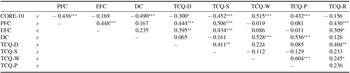
Distress, coping, and thought-control strategies (Table 1)
As hypothesized, PFC was significantly related to lower levels of distress, whereas DC strategies were significantly related to higher distress. However, there was no significant association between distress and EFC strategies.
Correlation matrix of distress, coping and thought control

CORE-10, Clinical Outcomes in Routine Evaluation; PFC, problem-focused coping; EFC, Emotion-focused coping; DC, dysfunctional coping; TCQ, Thought Control Questionnaire; TCQ-D, distraction; TCQ-S, social; TCQ-W, worry; TCQ-P, punishment; TCQ-R, reappraisal.
* p < 0.05, ** p < 0.01, *** p < 0.001.
As predicted, distraction and social thought-control strategies were significantly associated with lower levels of distress, whereas worry and punishment were significantly associated with higher distress. However, there was no significant relationship between distress and reappraisal.
In line with a priori hypotheses regarding associations between thought-control and coping strategies, DC was significantly correlated with the worry and punishment thought-control strategies. Additionally, the EFC subscales were significantly correlated with the distraction, social control, and reappraisal thought-control strategies, as were the PFC subscales.
A multiple regression analysis was conducted with scores on the CORE-10 as the outcome variable. Due to their significant relationship with distress, PFC and DC, and distraction, social control, worry, and punishment subscales, and employment status were included as predictor variables.
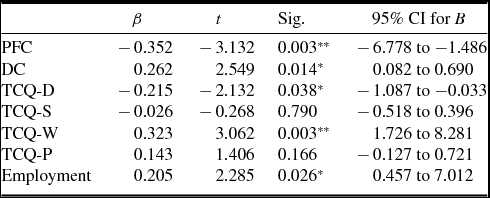
The adjusted R 2 value indicated that 63.2% of the variance in distress could be accounted for by these variables (F 7,53 = 15.69, p < 0.001). The regression model indicated that the use of PFC, DC, worry, and distraction were significant independent predictors of distress, as was employment (see Table 2).
Regression model for predicting distress
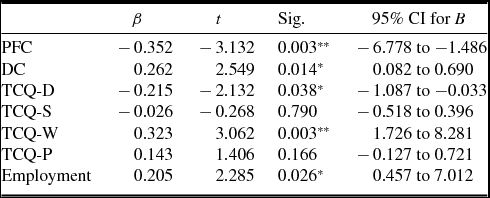
CI, Confidence interval; PFC, Problem-focused coping; DC, dysfunctional coping; TCQ, Thought Control Questionnaire; TCQ-D, distraction; TCQ-S, social; TCQ-W, worry; TCQ-P, punishment.
* p < 0.05, ** p < 0.01.
Discussion
This study aimed to determine which strategies for coping with stressful situations and controlling intrusive thoughts were associated with psychological distress and to investigate conceptual overlap between coping strategies and thought-control strategies. As predicted, the use of PFC strategies were related to lower levels of distress and DC strategies were related to higher levels of distress. However, EFC strategies were not significantly associated with psychological distress, but were associated with PFC, distraction, and social control, each of which were related to lower levels of distress. Also in line with our hypotheses, worry and punishment strategies of controlling thoughts were related to higher levels of distress and were also related to DC. Contrary to predictions, the thought-control strategy of reappraisal was not significantly related to lower distress, although it was positively correlated with the use of EFC.
Associations between PFC and lower levels of distress, and DC and higher levels of distress is consistent with previous research (Li et al. Reference Li, Seltzer and Greenberg1999; Coolidge et al. Reference Coolidge, Segal, Hook and Stewart2000), suggesting that the former may be a more adaptive response to dealing with stressful events. However, it has been acknowledged that PFC may not be helpful in situations where stressors are not amenable to change (Lazarus & Folkman, Reference Lazarus and Folkman1984) and DC can be helpful as short-term strategies for temporarily relieving acute distress (Carver et al. Reference Carver, Scheier and Weintraub1989). Although EFC was not significantly correlated with distress as predicted, it was positively correlated with PFC, supporting Lazarus & Folkman's (Reference Lazarus and Folkman1984) proposal that people use strategies from both types of coping. Findings regarding EFC are mixed, with some reporting associations with distress and others not (Carver et al. Reference Carver, Pozo, Harris, Noriega, Scheier, Robinson, Ketcham, Moffat and Clark1993; Porterfield, Reference Porterfield1987). This may be due to differences in conceptualizing EFC, with studies measuring different aspects of the construct, including emotional support, acceptance, positive reframing, and humour. Some measures of EFC tap into expressions of distress, thus confounding associations between the two (Stanton et al. Reference Stanton, Danoff-Burg, Cameron and Ellis1994).
Associations with lower levels of distress for both distraction and social methods of thought control are consistent with previous research, as are associations with higher levels of distress for both worry and punishment strategies (Wells & Davies, Reference Wells and Davies1994; Amir et al. Reference Amir, Cashman and Foa1997). This suggests that distraction and social control may be more effective at reducing distress than worry and punishment. In line with this argument, distraction and social control were associated with EFC, whereas worry and punishment were associated with DC. It is important to distinguish between distraction, which has been associated with lower distress (Wells & Davies, Reference Wells and Davies1994), and thought suppression, which can have paradoxical effects, as shown by the White Bear experiment (Wegner et al. Reference Wegner, Schneider, Carter and White1987). Distraction uses attentional strategies aimed to divert attention to another thought or activity, whereas thought suppression aims to push a thought away without anything to replace it.
Nonetheless, as with DC, it could be argued that distraction and social thought-control strategies may be effective as short-term strategies, but in the long term, they may exacerbate distress. When considering the S-REF model (Wells, Reference Wells2011), all thought-control methods allow CAS to divert attention away from other information that disproves the intrusive thought and strengthens this response to the thought in the future. CAS causes the individual to become locked in unhelpful techniques, such as threat monitoring, which focuses attention on information that confirms the unhelpful belief and prevents adaptive learning.
We failed to find significant associations between reappraisal and distress. However, previous studies have reported mixed findings in relation to reappraisal (Wells & Davies, Reference Wells and Davies1994; Reynolds & Wells, Reference Reynolds and Wells1999). Reappraisal has traditionally been conceptualized as an adaptive method of coping with distress and helping individuals reappraise maladaptive thinking is a key component of CBT. Mixed findings in relation to reappraisal suggest that this strategy might not be a helpful response for all individuals. This supports the S-REF model and Wells’ (Reference Wells2011) argument that challenging individual negative thoughts leads to activation of the CAS, reducing the amount of attention available to process information that contradicts it. Therapeutic techniques in MCT, such as detached mindfulness and attentional training, are aimed at changing metacognitive processes and may be more effective for some individuals (Wells, Reference Wells2011).
Participants who left education earlier or were unemployed reported using less PFC. It is possible that further education and employment provide additional resources to aid engagement in active coping. Consistent with previous studies, women reported using worry as a thought-control strategy significantly more often than men (Hunt et al. Reference Hunt, Wisocki and Yanko2003), highlighting that we cannot ignore gender differences in coping research. There were no differences in coping or thought-control strategies across different clinical presentations, suggesting that content of distressing thoughts is unlikely to influence an individual's response and supporting the argument for transdiagnostic rather than disorder-specific models.
Limitations and areas for further research
This study is the first to investigate associations between coping strategies and thought-control strategies and examine their independent associations with distress.
However, the cross-sectional design of this study does not allow causal relationships to be determined. Longitudinal research into the effectiveness of coping or thought-control strategies and how they change over time and throughout treatment would address this limitation. It would also be interesting to consider the use of coping and thought-control strategies in a non-clinical sample for clearer evidence regarding adaptive coping strategies, as for most people distress is a transient state, but others become locked in a cycle due to CAS (Wells, Reference Wells2011). Reliance on self-report measures increases the possibility of reporting biases and introduces common-method variance. Informant reports of coping and distress could be used to supplement self-report analysis. The generalizability of the results may be limited by the small, treatment-seeking, and ethnically homogenous sample. Associations found in this study therefore need to be investigated in more diverse samples, including non-white and people not accessing services.
This study aimed to compare coping and thought-control strategies, but when completing the COPE and TCQ, participants were potentially reporting strategies for managing different types of stressor, thus limiting the opportunity for direct comparison. Future studies should ask participants to apply the COPE and TCQ to the same stressor.
Clinical implications
This study highlights particular methods of coping and thought control that are associated with distress. Although we cannot infer causality, our findings suggest that it may be helpful to encourage those seeking help for psychological distress to engage in more PFC, particularly for stressors that are amenable to change. Problem-solving interventions involve defining the problem, considering alternative solutions, identifying potential barriers and ways to overcome them, and planning a course of action (Hawton & Kirk, Reference Hawton, Kirk, Hawton, Salkovskis, Kirk and Clark1989). Our findings also suggest that it might be helpful to discourage individuals from engaging in DC, such as behavioural disengagement, denial, and self-blame, at least as long-term solutions.
In terms of thought control, the findings of this study suggest that treatment should discourage worry and punishment strategies. These findings support the suggestion of the metacognitive model that these thought-control strategies increase distress by diverting attention away from information that may disprove the thought or belief (Wells, Reference Wells2011). Conversely, social control and distraction were associated with lower levels of distress. Arguably, social control and distraction aim to divert attention to another thought or activity and may provide short term relief from distress. However, according to the S-REF model, using detached mindfulness within metacognitive mode to become aware of unhelpful thoughts and separating them from the self or the situation may be more helpful in alleviating distress in the longer term than any strategies, such as distraction, applied in object mode.
Interestingly, reappraisal was unrelated to distress. The neutral findings regarding appraisal could be explained by the positive and negative metacognitive beliefs regarding this strategy. For example, a patient attempts to reappraise a negative thought because they believe that thinking of another perspective will make them feel more positive and they believe that if they cannot control the thought then they are going to ‘go mad’. This keeps the attention focused on the intrusive thought and makes it more likely to be intrusive again in the future and for this technique to be used again to process it. However, the patient believes that they are helping themselves by using this technique and so experiences some short-term relief from distress. This supports Wells’ (Reference Wells2011) argument for process-based therapies, such as MCT, over content-based therapies, such as CBT. By altering the underlying metacognitive processes using MCT, this may have a longer lasting effect on their level of distress, compared to challenging the content of individual negative automatic thoughts using CBT (Wells, Reference Wells2011).
Conclusions
Despite its limitations, this is the first study to explore associations between two well-established transdiagnostic models of distress. It highlights which particular coping and thought-control strategies are associated with higher levels of distress and indicates how concepts from each model might relate to each other. Findings show that although EFC was not directly associated with distress, these strategies were related to PFC which was associated with lower levels of distress. DC was shown to be related to higher distress, demonstrating that these strategies are more maladaptive. The relationship between thought-control strategies and distress was mixed, with punishment and worry related to higher distress and social control and distraction related to lower distress. These associations have been discussed with reference to Wells & Matthew's (Reference Wells and Matthews1996) S-REF model and how techniques such as detached mindfulness in MCT could be used to alleviate distress.
Summary
The relationship between distress, coping, and thought-control strategies was considered. PFC, distraction, and social control techniques were all associated with lower distress and positively related with each other. Conversely, DC, worry, and punishment thought-control strategies were all positively correlated with each other, and were each related to higher levels of distress. The S-REF model is discussed to describe how unhelpful coping and thought-control strategies can maintain and increase distress by locking the individual into a cycle that focuses attention on information that maintains unhelpful metacognitive beliefs.
Acknowledgements
We thank all participants and staff who helped with recruitment, particularly Dr Elizabeth Murphy and Dr Sandra Bucci.
Ethical standards
This study was approved by the National Research Ethics Service (Reference Cooper, Katona and Livingstonref. 12/NW/0395) and by the University of Manchester Research Ethics Committee as part of a larger research project.
Declaration of Interest
None.
-
(1) To consider the relationship between different types of coping and distress.
-
(2) To consider the relationship between different types of thought-control strategies and distress.
-
(3) To identify possible overlap between coping strategies and thought-control strategies.
-
(4) To highlight clinical implications for transdiagnostic models of distress.



Comments
No Comments have been published for this article.