Although this paper is concerned with the development of archaeological fieldwork in seventeenth-century England, it begins on the Giza Plateau in Egypt. In 1638 John Greaves, Professor of Geometry at Gresham College, visited the Giza necropolis and surveyed its monuments. He measured the outer dimensions of the pyramids using the latest surveying techniques. With two companions he climbed to the top of the Great Pyramid, carefully counting 207 steps as they went up (although one of them thought that it was 208 on the way down). Later, after native workers had cleared the sand from the entrance, Greaves and a young Venetian ventured into the interior, having at one point to ‘serpent-like creep upon our bellies’. Once inside they explored and measured the internal passages and chambers to the best of their ability by the limited light of tapers, ignoring the large resident bats and their malodorous droppings. They spent more than three hours within the Great Pyramid, impatiently awaited by a janizary and an English captain, ‘who imagined what they understood not, to be an impertinent and vain curiosity’. Greaves was not the first European to explore the pyramids, which were a well-established stop on the tourist itinerary. Firing a musket at the entrance to experience the echo was apparently standard practice, although Greaves described it in scientific terms as an experiment. What is significant about Greaves is that he wrote an account of his exploration of the Giza complex and published it with illustrations as Pyramidographia in 1646. It was thus one of the earliest detailed descriptions of archaeological fieldwork published in English.Footnote 1
This paper explores the tentative development of archaeological fieldwork by antiquaries in the middle decades of the seventeenth century, a time generally regarded as a fallow period for interest in physical antiquities. The chorographical approach to the past associated with Camden's Britannia is seen as having become subservient to an obsession with genealogy and heraldry and to have developed little until given a fresh impetus in the later seventeenth century by scholars applying the approaches and methods of natural philosophy. The leading light of this renewed interest was John Aubrey, who stumbled across the stone circles at Avebury while out hunting in 1649 and presented the results of his meticulous examination of the site to the newly formed Royal Society in 1663. His subsequent work on ancient monuments and customs – Monumenta Britannia, unpublished in his lifetime – placed a new emphasis on the systematic collection and recording of data relating to archaeological remains.Footnote 2 Another member of the Royal Society, Robert Plot, signalled the new emphasis on physical antiquities in his Natural History of Staffordshire (1686), where he began his chapter, Of Antiquities, with the words:
I intend not to meddle with the pedigrees or descents either of families or lands … nor of the antiquities or foundations of Religious houses … it being my designe in this Chapter, to omit, as much as may be, both persons and actions, and cheifly apply my self to things, and amongst these too, only of such as are very remote from the present Age … such as ancient Medalls, Ways, Lows, Pavements, Urns, Monuments of Stone, Fortifications, &c. whether made of the ancient Britains, Romans, Saxons, Danes or Normans.Footnote 3
In this paper I will plot some of the important developments in archaeological fieldwork that occurred during those apparently fallow decades and show that the transition from Camden to Aubrey was one of gradual evolution. I have argued elsewhere that the historiography of local history has been hampered by a failure to give sufficient weight to unpublished manuscripts.Footnote 4 It is my contention that a bias towards printed works (with the notable exception of Aubrey's magnum opus) has done a similar disservice to studies of the development of archaeology: firstly, because manuscripts circulated widely and could be as influential in antiquarian circles as published works; secondly, because the study of manuscript notes and unpublished works can present a more rounded view of an individual antiquary and the development of his interests over time.
On the other hand, as is the case with Aubrey, it may be difficult to interpret the development of a scholar's ideas and methods in surviving manuscripts compiled at a later date but incorporating the fruits of earlier research. It is also essential to appreciate that few antiquaries developed their interests in isolation; they shared sources and ideas with like-minded friends. Robert Plot's approach to the antiquities of Staffordshire, for example, was no doubt influenced by his association with Walter Chetwynd, who was working on his own history of the county. Chetwynd's work would have covered the subjects eschewed by Plot, but it was never brought to fruition.Footnote 5
After the Restoration, the Royal Society was an important focus of intellectual activity and many antiquaries were members, or closely associated with members. However, I will suggest that the prominence of Aubrey and Plot has led to an over-emphasis on the role of a Baconian ethos and the significance of the Royal Society in the development of fieldwork. As I shall show, the gradual development of a more systematic approach to physical remains involved many antiquaries who had no direct connection with the Royal Society or any obvious interest in natural philosophy.
Finally, in using printed antiquarian sources, we need to be aware how their content was influenced by the context in which they were published. The prevalence of heraldic and genealogical material in county histories through the seventeenth century was strongly influenced by the interests of the provincial gentry, who represented the dominant market for these works. I would suggest that the major contribution of the Royal Society to the development of archaeology as a discipline was the provision of a platform for the publication of field reports. The Philosophical Transactions represented a vehicle for publishing a short antiquarian paper that had not previously existed. Its success changed the publishing climate in London, persuading booksellers that there was a market for short scientific works.
John Greaves, who was Savilian Professor of Astronomy at Oxford by the time he published Pyramidographia, is often taken to be an exemplar of the importance of Baconian natural philosophy in the development of archaeology. His field reports, however, demonstrate a distinctly philological and historical approach to the past. They are embedded in an extensive discussion and analysis of the classical sources relating to the pyramids. As a non-Copernican astronomer, Greaves emphasized old manuscripts and observations rather than the results achieved by modern telescopes. By surveying ancient monuments, he hoped to gain greater understanding of the measurements cited in classical texts. His trip to the Levant was also part of a very traditional antiquarian project. Fluent in Arabic and Persian, Greaves's expedition had been financed by Archbishop Laud, for whom he sought books on the early Christian Church.Footnote 6 From his expulsion from Oxford in 1648 until his death four years later, Greaves spent much of his time staying with the Egyptologist and expert in ancient chronology, John Marsham. Through his friendship with Marsham he was linked to the London circle of antiquaries that included Sir Simonds d'Ewes and John Selden and to a Kentish circle that included William Somner and Sir Roger Twysden. At the same time, through his friendship with the physician George Ent, with whom he had travelled in Italy, he was linked to the founders of the Royal Society. Pyramidographia, Oxford, his antiquarian friends or his scientific friends: all of these provide routes by which John Greaves may have directly or indirectly influenced the young John Aubrey; his life exemplifies the difficulties involved in trying to identify the nature and source of influences in the development of antiquarian thought and practice.
The middle years of the 1650s were undoubtedly significant in the development of Aubrey's understanding of the natural world. He would later credit the publication in 1655 of Inigo Jones's account of Stonehenge with prompting his own research into Avebury, and it was in 1656 that he began work on the Naturall Historie of Wiltshire. In January 1656 John Aubrey and the engraver Wencelaus Hollar arranged to meet William Dugdale. Hollar was in trouble with the authorities after attending a Catholic mass and needed the help of his friends to extricate himself. They probably met at the College of Arms for though Dugdale, as a staunch Royalist, did not hold a heraldic post during the Interregnum, he stayed here when in London, probably through the good offices of Edward Bysshe, who had been appointed Garter King of Arms by Parliament and who used his position to support a number of royalist antiquaries, poets and scholars. Hollar had produced some of the engravings for the Monasticon Anglicanum, a collection of monastic charters illustrated by views of cathedrals and monastic churches, edited by Roger Dodsworth and Dugdale and published in 1655. Other engravings in the volume had been produced by the entrepreneurial Daniel King and the Latin preface had been written by John Marsham, John Greaves's friend. Other members of this circle included the collector Elias Ashmole and William Somner, author of the Antiquities of Canterbury (1640) and a keen student of Anglo-Saxon.Footnote 7
Several of this group of Aubrey's friends and acquaintances appear in accounts of the early development of archaeology, but with little appreciation of the personal interactions that occurred between them. I hope to show that the differences between Dugdale and Ashmole or Somner and Aubrey in relation to physical remains was not as great as is sometimes suggested. In the context of the developing appreciation of visual evidence I want to stress that Hollar and King were integral members of this circle. Some of its members – Aubrey, Ashmole, Bysshe – went on to join the Royal Society after the Restoration, while others did not. With the exception of Aubrey, those who did join the Royal Society do not appear to have been very active members. This was not a purely metropolitan circle. Several of its members were only occasionally resident in London and provide links to the provincial circles that were so important to the development of antiquarian studies. Its members also provide direct and indirect links to earlier groups who played a part in that development, such as the Elizabethan College of Antiquaries and the pre-Civil War Arundel House circle.Footnote 8
One of the great projects undertaken by early Stuart antiquaries was the exploration of the topography of Roman Britain. The identification of English sites mentioned in the Antonine Itineraries had formed the core of William Camden's Britannia. His contemporaries and successors laboured to confirm or contest his identifications. This work was based on a written text and was supported by the antiquaries’ knowledge of the literary sources relating to Roman Britain. It was, however, a project that quickly led to an interest in physical evidence. For example, Somner's challenge in the Antiquities of Canterbury to Camden's identification of Antonine sites in Kent was based partly on etymology and on literary sources, but relied mainly on his knowledge of the local topography and direct observation of Canterbury's surviving wall and gates.Footnote 9
Camden himself visited some of the sites he identified as Roman, although it is not always clear whether he is describing his own observations or those reported to him by others. Such sites included an Iron Age hill fort east of Stonehenge that Camden associated with Vespasian, who commanded a legion in Britain under the Emperor Claudius. With misplaced confidence Camden declared ‘by the forme and manner of making, a man may easily know it was a Romane Campe’.Footnote 10 Camden shared and lent authority to the common misconception that ancient Britons were incapable of building substantial earthworks and consequently ascribed Iron Age forts to the Romans. Camden described Stonehenge itself as ‘a huge and monstrous peece of work’ and included an engraving representing it as a confused jumble of stones.Footnote 11 He did not offer his own theory as to who had built Stonehenge, but he almost certainly considered it to date from no earlier than the Roman conquest, on the grounds both of the supposed incapacity of the ancient Britons to build and the silence of the Roman sources.
Such assumptions misled both Inigo Jones and Walter Charleton, who were each blinkered by their preconceptions when they surveyed the site. Jones, dismissing the ability of the Britons to build such a monument, ascribed it to the Romans and persuaded himself that it was a temple of the Tuscan order. Charleton, an original Fellow of the Royal Society, was influenced by Ole Worm's accounts of Danish monuments to assert that Stonehenge was built by England's Danish invaders.Footnote 12 Similarly, Somner assumed that the remains of a Roman barrow cemetery in Canterbury, later enlarged for use as a medieval motte and bailey, was of Danish origin, suggesting that the name Dungeon Hill was a corruption of Danian Hill.Footnote 13
While antiquaries were hampered by their preconceptions, they did increasingly engage with physical evidence as a result of their Antonine studies. This can be seen by comparing passages from the Description of Leicestershire, published by Dugdale's mentor, William Burton, with his proposed second edition, which remained in manuscript. Such comparison also demonstrates the importance of considering manuscripts as well as printed works. The original text of the Description of Leicestershire was begun in the last years of Elizabeth's reign, when Burton was at the Inns of Court in London, although it was not published until 1622. The proposed second edition was compiled in the two decades preceding the Civil War, when Burton had retired to Leicestershire. It has never been published in its entirety, but survives in a fair copy. It was while he was revising his work on Leicestershire, and contemplating a similar study of Warwickshire, that Burton became acquainted with Dugdale.
After his death Burton's antiquarian papers passed to Walter Chetwynd and consequently became available to Robert Plot, while he was working on Staffordshire. In 1622 Burton published comparatively little material on Roman Leicestershire in the Description. He took the association of the Antonine sites of Ratae and Venonis with Leicester and High Cross from Camden and his description of the four Roman roads that crossed the county was perfunctory. In his preface he stated that of Roman antiquities he would describe ‘such as have come to my knowledge’. Accordingly he gave brief details of the remains of a Roman temple and bathhouse found at Leicester. Like many antiquaries he had an interest in coins, which he was well placed to cultivate once he had settled at Lindley, close by Watling Street. In 1607 he went to view a hoard of coins found at neighbouring Higham. These were predominantly medieval, but included a few Roman examples. He also acquired some coins that had been unearthed during the excavations in Leicester and others that had been ploughed up in the fields around Claybrooke, the Leicestershire parish that lay south and east of High Cross. In the entry for Claybrooke he described two of the coins in detail. He did not include engravings, although his references to richly illustrated books on Roman coinage recently published in Europe indicate that he was exposed to the use of coins as visual evidence.Footnote 14
High Cross was probably never a large settlement and, although Roman remains were found, there were no substantial earthworks or features to explore. By contrast further north along Watling Street was the Antonine site of Manduessendum, which was associated with Mancetter, in Warwickshire. At this site there was a rectangular earthwork straddling the Roman road. This was not mentioned in 1622, suggesting that Burton had not appreciated the actual location of the earthwork and associated the site with Warwickshire. In his revised text the entry for Witherley described how the Roman settlement extended into Leicestershire. This suggests that he had explored the site in the interim and realized that he could claim it as part of Leicestershire's history. His abilities as a surveyor were limited, however. He both over-estimated the area covered by the earthwork and suggested that its shape was squarer than it actually was. His exploration of the site and knowledge of local finds led him to believe that the area of Roman settlement extended far beyond the extant earthwork, although it is difficult now to assess the reliability of his conjectures.
In the early editions of Britannia, Camden had associated Ratby, which lies to the east of Leicester, with the Antonine site of Ratae, although he subsequently corrected the association to Leicester itself. In 1622, under the entry for Ratby, Burton gave only the descent of the manor and an account of the church. Subsequently, his increasing enthusiasm for Roman antiquities and the use of non-literary evidence led Burton to visit Ratby and what he found gave him ‘sufficient grounds’ to support Camden's initial ascription. He included an account of his findings in his manuscript. To the west of the existing town Burton surveyed an area of elevated ground covering around a hundred acres, surrounded by a ditch. At the south end of the enclosure was a rectangular hill fort. In the twentieth century excavation suggested that this was originally an Iron Age hill fort, although its subsequent occupation by the Romans and later incorporation into a medieval deer park have complicated interpretation of the site. Although mistaken in details, Burton's surveys of Mancetter and Ratby do show him using direct observation and comparison of physical remains to elucidate textual records.Footnote 15
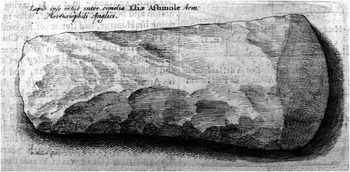
Since Mancetter lay on the route between Dugdale's house and Burton's, it is highly probable that the two men surveyed this site and the nearby hill fort at Oldbury together. Sir Simon Archer, with whom Dugdale worked on the history of Warwickshire, may have accompanied them. We know Archer was interested in earthworks, since one of his earliest surviving antiquarian letters, written in 1627, includes a description of a moated earthwork at Cheswick Green, near his house at Tanworth in Arden. Dugdale would later say that the depth of its trenches suggested that the Cheswick Green earthwork was a Roman fortification, although its small circumference raised doubts in his mind. It was in fact a medieval site.Footnote 16 In considering the Iron Age earthworks at Oldbury, their proximity to Watling Street and Mancetter predisposed the antiquaries to interpret them as further evidence of the Roman occupation. Dugdale reported that worked flints were frequently ploughed up on the site and included an engraving of one of these in The Antiquities of Warwickshire (fig 1). He suggested that such stones, when wedged into wooden staffs, might have been used as weapons by the native Britons at the time of the Roman occupation. This accorded with the assertion in the Roman sources that, at the Conquest, the Britons had no knowledge of metal-working. Dugdale was making intelligent conjectures about the physical evidence, but evaluating them within the context of the literary sources. He presumably imagined that the concentration of the stones at the site was evidence of indigenous resistance to the Roman occupation, although he does not state this. It is noticeable that the flint illustrated by Dugdale was part of the collection of his friend Elias Ashmole, a future member of the Royal Society. Dugdale was a collector of manuscripts, not of objects.Footnote 17
A worked flint from the collection of Elias Ashmole. Engraving: by Wencelaus Hollar for William Dugdale, The Antiquities of Warwickshire (1656)

Linked to the identification of places on the Antonine Itineraries was the attempt by antiquaries to elucidate the routes of Roman roads where they had become obscured over time. Through his association with Burton, Dugdale learnt the importance of visiting archaeological sites rather than relying on evidence such as place names. Where possible with remote sites, however, he liked to get someone local to make an initial visit. An example of this is his investigation of the route of Ryknild Street, which passes through the west of Warwickshire. The precise route of this Roman road around Birmingham remains uncertain to this day. The map of Hemlingford hundred in The Antiquities of Warwickshire shows the road passing on a line east of Edgbaston and west of Aston. References to Kemp Hill in the records to the east of Birmingham, however, led Dugdale to wonder whether the place name was evidence of a Roman camp and a more easterly route for the road. Consequently, in 1653 he asked his friend William Booth, who lived just north of Birmingham in Witton, to explore the area and to see whether there was any evidence of the road or of entrenchments indicative of a camp. Through Booth's neighbour, Mr Willys, he also sought to discover whether there was any evidence of a Roman road coming from Worcester in the vicinity of the Lickey Hills. Since initial enquiries yielded negative results, Dugdale apparently pursued them no further. His description of the line of Ryknild Street in The Antiquities of Warwickshire accords with that on the map, taking it in a straight line from Aston to Alcester.Footnote 18
In April 1657, a year after Dugdale published The Antiquities of Warwickshire, Elias Ashmole travelled from Weedon Bec, in Northamptonshire, to Lichfield, in Staffordshire, seeking to trace the route of Watling Street. Ashmole had spent the previous few weeks staying with Dugdale in Warwickshire and had accompanied him part of the way to London before turning back to seek out the Roman road. This was little used and difficult to trace in places, no longer being the route taken by travellers (that deviated from the straight line of the Roman road to go via Coventry). From the letter Ashmole wrote to his friend reporting what he had found, it is clear that they had come up with the idea of such a survey together during his visit. Dugdale had, for example, thought that ‘the course of Watlingstreete is somewhat bending through Warwickshire’, which Ashmole confirmed through his survey. For the rest of the route he had traced, however, he believed it ran pretty straight. Not having had a compass available, though, he had been unable to take the necessary measurements. He had clearly not gone to Warwickshire equipped for such a survey. Ashmole, the keen collector, was sorry not to have found any Roman coins during his journey, although he had ‘left word with divers to lay up for me what they shall hereafter finde’. In this letter we see a member of the new generation of more scientifically aware antiquaries engaged in a project grounded in the exposition of the Antonine Itineraries that dated back to Camden.Footnote 19
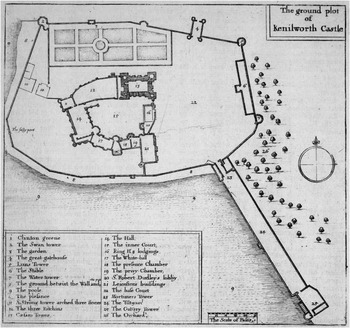
Given their approach to Roman sites, it was natural for his colleagues to encourage Aubrey to carry out a survey of Avebury at this time, and what is unusual is not that Aubrey should survey an archaeological site, but that the evidence of his surveying activity should survive in manuscript. The accuracy of his Avebury plan, which was made using a plane table, suggests the influence of the Royal Society and its promotion of high scientific standards and it stands in stark contrast to Inigo Jones's earlier plan of Stonehenge, which gave the monument a spurious structural regularity. The plan of Kenilworth Castle, included in Dugdale's The Antiquities of Warwickshire in 1656 (fig 2), was produced by similar surveying methods to those used by Aubrey and attempted to achieve a comparable level of accuracy (the misalignment of the garden suggests that this part of the plan was based on memory rather than direct observation).Footnote 20 The Kenilworth plan was probably drawn by Dugdale's son, John, for whom surveying instruments were bought in the summer of 1649. John appears to have been taught the use of such instruments by Walter Blith, the surveyor and agricultural writer, who lived in a neighbouring village. The purchase of his own equipment for John coincides with Blith's departure from Warwickshire to work in eastern England.Footnote 21
Plan of Kenilworth Castle. Illustration: from William Dugdale, The Antiquities of Warwickshire (1656)

In the years preceding the Civil War Blith and Dugdale had both been part of a group of local landowners who were interested in agricultural improvements. The link between agricultural advances and the development of archaeology has been little explored and would benefit from further research. Surveying skills were particularly important to land improvers, but they became increasingly relevant to landowners generally in the seventeenth century. Even if they did not conduct their own surveys, they needed to be able to understand the drawn plans that were increasingly used in preference to written terriers. It was a dispute over the enclosure of his Blyth Hall estate, for example, that first brought Dugdale into acquaintance with William Burton, who arbitrated between him and a neighbouring landowner.
There are various indications that Dugdale's interest in surveying might have been greater than was usual among his contemporaries. The bound cartulary that Dugdale prepared for his heirs included detailed surveys of the estate as he bought it in 1625 and as it was in its enclosed and improved state when he regained control of it in 1647 after the Civil War.Footnote 22 Such volumes of documents relating to an estate are common, but this is perhaps the earliest example to include drawn plans. In his account of his life, prepared in old age for Anthony Wood, Dugdale recalled going to the site of the battle of Edgehill in February 1643 with a ‘skylful Surveyor’ and recording the positions in which the two armies had been deployed and the locations of the mass graves.Footnote 23 In 1653 Dugdale was taking prospects of Warwickshire towns, castles and gentry houses for The Antiquities of Warwickshire using an instrument designed for the purpose. He decided to delay taking that of Aston Hall ‘till Mr Archbolds returne from London, for he is very desirous to see the use of my Instrument, and is a man more than ordinarily affected to such things’.Footnote 24 Forty years later James Fish, a land surveyor in Warwick, asked Dugdale to explain to a mathematical instrument maker how to make the ‘Instrument you were pleased to shew me with which you took the Prospects of Warwick, Coventry, &c’.Footnote 25 This suggests that the equipment used by Dugdale when he worked on The Antiquities of Warwickshire was somewhat innovative.
In 1657 Dugdale obtained a commission to write a history of fen drainage, which resulted in him making a tour of eastern England with Ashmole that summer. As they toured the Fens, they were accompanied for part of the time by Jonas Moore, the mathematician and surveyor of the drainage company. In compiling his History of Imbanking and Drayning (1662), Dugdale was able to rely on the work of professional surveyors such as Moore and had no need to conduct his own surveys. Dugdale and Ashmole were thus able to cover a large area in a few weeks, unencumbered with surveying equipment. This meant, however, that Ashmole was restricted to recording the dimensions of York and Lincoln cathedrals and Selby Abbey by pacing when they travelled north at the end of their trip. Often the rough sketches in surviving manuscripts are of a similar nature, taken on a short visit to a site with little or no equipment, but they should not be taken as evidence of a lack of scientific intent. During the heraldic visitations of the northern counties conducted in the 1660s, Dugdale and Ashmole went out of their way to visit and take notes on earthworks, stone circles, megaliths and other archaeological features, and they solicited information from local gentlemen on sites that they had no time to visit themselves. As they travelled laden with the bulky records of past visitations and their own accumulating papers, they could not afford to add surveying equipment to their packhorse load. Dugdale's sketchy notes and rough drawings of Long Meg, in Cumberland, and Ashmole's similarly sketchy notes on Caer Caradoc, surveyed during the visitation of Shropshire, have led to an unfavourable assessment of their methodology compared to that of Aubrey, but the context in which they were produced was quite different, and the sketches are evidence of a deep interest in field monuments rather than the opposite.Footnote 26
As well as visiting and surveying sites, seventeenth-century antiquaries also carried out excavations. Before the Civil War, Sir John Oglander dug those barrows in the Isle of Wight that he judged to be the ‘moore awntientest’, finding burnt bones and coins. Unfortunately, he did not record in his memoirs how he decided which were the most ancient. Neither do the records that survive record the date of the coins, or their relationship to the barrows.Footnote 27 In The Antiquities of Warwickshire Dugdale refers to the excavation of barrows at Ingleby, in Derbyshire. He provided no details of who conducted the dig or what was found beyond burnt bones and charcoal. The site at Heath Wood, Ingleby, is the only known Viking cremation cemetery in the British Isles and includes fifty-nine barrows. It is located on land that belonged to the Burdetts, a family with close links to the Midlands antiquarian circle of the 1630s that included Burton, Dugdale and Archer. The family home of the Catholic antiquary Sir Thomas Shirley was a few miles away, at Staunton Harold, while the Lincoln's Inn barrister Samuel Roper, who was related by marriage to Dugdale, had an estate on the other side of Derby.Footnote 28 Dugdale would have known this site and may have had access to more details of the excavation, but being outside Warwickshire it was not within the compass of his work to describe it.
Of the various Midlands antiquaries, Samuel Roper was certainly interested in extending his antiquarian activities to the personal excavation of archaeological sites. In the early 1650s he lived in Warwickshire at Monks Kirby in the triangle of land that lies to the south of the meeting of the Fosse Way and Watling Street at High Cross. There he excavated a piece of ground lying close to the church, finding evidence of Roman occupation. Inviting Dugdale to visit him, he promised to show him ‘something of the Roman Encampment and Fortifications’.Footnote 29 There were also a number of tumuli in the vicinity of Monks Kirby. Some of them were on land belonging to the earl of Denbigh, whose estate at Newnham Paddox was within the same parish. Dugdale visited Monks Kirby around Christmas 1653 and discussed Denbigh's pedigree with the earl in relation to what would appear in The Antiquities of Warwickshire. They presumably also discussed the Roman remains that Roper had found. In the course of his consequent correspondence with the earl's steward about the Feilding pedigree, Dugdale wrote:
I pray you intreat my Lord from me to procure the biggest of those tumuli, which are in the close at Monkskirby called Denmarke, on the backside of the barnes, to be dig'd downe to the levell earth. It will be sufficient if only one halfe be dig'd, I meane slitting it in the midst; for I have an opinion that there are at the bottome thereof some urnes, or at least bones and coles; as having bin the buriall places of some Romanes, considering their nerenesse to the via strata, and the Romane brick which hath bin taken up thereabouts.Footnote 30
There were apparently several small mounds in the close mentioned by Dugdale. Although the earl thought them too small to be Roman, he had his workmen dig them all. Nothing was found, but enthusiastically he decided to move on to a larger mound elsewhere in the village. Roman funerary urns were discovered in the vicinity in the early eighteenth century, so it is possible that the earl's enthusiasm was rewarded, but there are no further mentions of this activity in the surviving letters, which were assembled as a collection in the nineteenth century for their relevance to the Feilding pedigree rather than for their archaeological interest.Footnote 31
A more successful barrow excavation took place in 1652, after James Chaloner was appointed by Lord Fairfax to look into the state of the Isle of Man, of which Fairfax had been appointed governor. While on the island he ‘caused’ a barrow ‘to be opened; in which were found 14. rotten Urns or earthen pots, placed with their mouths downwards, and one more neatly then the rest in a bed of fine white sand, containing nothing but a few brittle bones, (as having pass'd the fire) no ashes left discernable’. This account (in a chapter ‘Of the Civill Government’ in Chaloner's A Short Treatise of the Isle of Man)Footnote 32 does not provide much detail; that would not have been appropriate in the context. It is possible that there was a fuller manuscript account of the excavation that has not survived. Since the Isle of Man had not been colonized by the Romans, Chaloner dismissed the possibility of this being a Roman urn burial. Instead, having read Ole Worm's book on Danish antiquities, he had no hesitation in ascribing the site to the Norse occupation of the island. Chaloner's book was illustrated by Daniel King and incorporated by him into his Vale-Royall of England, which was published a few months after The Antiquities of Warwickshire in 1656.Footnote 33 Chaloner's text was prepared for the press in 1653 and members of King's circle in London would have known of his excavation before its publication. They were almost certainly also acquainted with the author. So Aubrey, Ashmole, Dugdale and their friends may well have known more about this excavation than was contained in the published account.
In The Antiquities of Warwickshire, Dugdale's summary of current thinking on barrows was based largely on classical sources and Worm's account of Danish monuments.Footnote 34 He acknowledged the assistance he had received in compiling it from Franciscus Junius, a German philologist who had been part of the Arundel household before the Civil War and was then living in Holland. He also enlisted the help of Edward Bysshe, among others.Footnote 35 His exchanges with Denbigh's steward indicate that he recognized the limitations of literary evidence and the need to engage with physical remains before The Antiquities of Warwickshire was published. The topographical descriptions in Dugdale's record of his 1657 journey show that he was fascinated by the Fen landscape and the evidence of the way in which land use there had changed over the preceding centuries.Footnote 36 Both he and Ashmole noted the number of barrows they encountered. In the Fens these occurred outside the context of proximity to Roman roads and settlements with which they were familiar in the Midlands. In 1658 the publication of Hydriotaphia or Urn Burial by Thomas Browne alerted them to a potential local source of information.
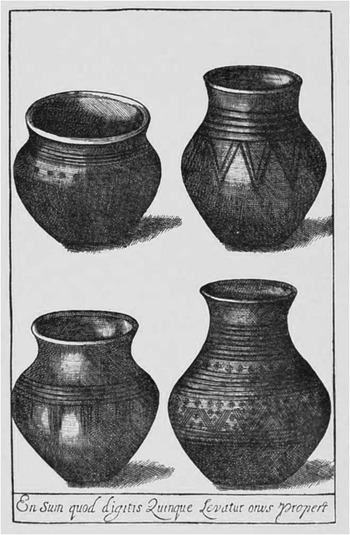
Browne was a doctor in Norwich, who was already well known as the author of Religio Medici and Pseudodoxia Epidemica. Hydriotaphia, a meditation on ancient funeral practices, indicated that he had a practical interest in archaeological remains. Although the book was steeped in literary sources, at its core was the discovery of a large number of funeral urns at a site near the coast in north-east Norfolk. The comparative proximity of an Antonine site at Brancaster and other evidence of Roman occupation in the area, no doubt combined with his own prejudices, led Browne to conclude that the urns were Roman. He did, however, acknowledge the likelihood that the Saxon and Danish inhabitants of Britain also cremated their dead and that, without reliable dating evidence such as coins, he could not be sure that the urns were Roman. Importantly, he provided an engraving, from which the urns have been identified as Saxon (fig 3).Footnote 37
Four Saxon urns. Illustration: from Thomas Browne, Hydriotaphia (Reference Browne1658)

For Dugdale and Ashmole the significant thing was that here was a scholar with local knowledge who might be able to help them to move beyond reliance on the classical sources. Dugdale accordingly wrote to Browne specifically referring to the barrows they had seen in the Fens and asking whether the Romans or Saxons had raised such monuments ‘to cover the Bones or Ashes of some eminent persons’.Footnote 38 Browne responded, saying that he thought such barrows might be Roman, Saxon or Danish and that you could not determine which ‘upon bare and naked view’.Footnote 39 As to their purpose they might be burials or territorial markers. This was the standard view, in line with what Camden had written in Britannia. However, Browne went on, ‘there can be no clear and assured decision without an ocular exploration, and subterraneous enquiry by cutting through one of them either directly or crosswise’.Footnote 40 He believed that the nature of the finds revealed by the excavation would reveal the barrow's purpose.Footnote 41 As we have seen, excavation alone would not necessarily provide a solution. Dugdale continued to correspond with Browne as he worked on his History of Imbanking and Drayning over the following four years, discussing in particular the evidence for Roman drainage of the Fens and their construction of the causeway from Denver to Peterborough. Although the correspondence was predominantly between Dugdale and Browne, it also involved Ashmole, Bysshe and Jonas Moore in the application of practical observations to supplement the literary sources. However, as they were not local landowners, the extent to which they could conduct excavations was limited.Footnote 42
Thus far we have seen that an increased interest in physical evidence was a natural next step for antiquaries who found themselves reaching the boundaries of what literary sources could tell them. This development had begun in the early seventeenth century and appears to have gathered momentum during the Interregnum. This suggests that the growth in archaeological interest among antiquaries ran parallel to the development of natural philosophy, from the publication of Francis Bacon's work to the growth of experimental science in Oxford and London in the 1650s. This impression is reinforced by the presence of early members of the Royal Society, such as Ashmole, Aubrey and Bysshe, within the antiquarian circle on which this paper has focused. Yet this circle also had links to those who objected strongly to the enthusiasm for the predominance of natural philosophy associated with the Royal Society. These doubters of the claims made for the new scientific approach to scholarship included Meric Casaubon, a close friend of William Somner and associate of Dugdale and Marsham. In 1669 Casaubon criticized natural philosophy in the form ‘of late years much cried up in London and elsewhere’ as being ‘prejudicial, if not destructive, to good learning’.Footnote 43
Yet Casaubon was not opposed to the developments in the use of non-literary source materials in antiquarian research. Indeed his account of Roman funeral urns found at a site in Kent, published in 1634, was an early exemplar of a more systematic and scientific approach to physical remains. Having been given some samples, Casaubon had gone out of his way to examine others that had been dispersed. He visited the site and spent some time digging, but failed to find further urns. However, he was able to give an account of the site in relation to the local landscape and known sites of Roman occupation and to provide information he had gleaned from others about the context in which urns had been found. Finally he provided engravings that confirm the identification of the urns as Roman. It is a fine example of an early account of antiquarian fieldwork. Casaubon did not publish his account in its own right, however, but included it in his edition of the meditations of Marcus Aurelius.Footnote 44 In 1658 it was reproduced in full with the engravings in A Commentary on Antoninus his Itinerary, a posthumous publication by another William Burton, this one a Kentish schoolmaster with various links to our London circle.Footnote 45 Casaubon's objection to the more enthusiastic of the natural philosophers was their elevation of observation and experiment above other forms of knowledge and scholarship. For Casaubon the urns supplemented the literary sources on Roman Britain, but they should be considered within the context of those sources. This mirrors the approach of John Greaves towards the pyramids with which we began. It remained dominant in antiquarian circles well into the eighteenth century and provided the context within which archaeological fieldwork continued to develop.
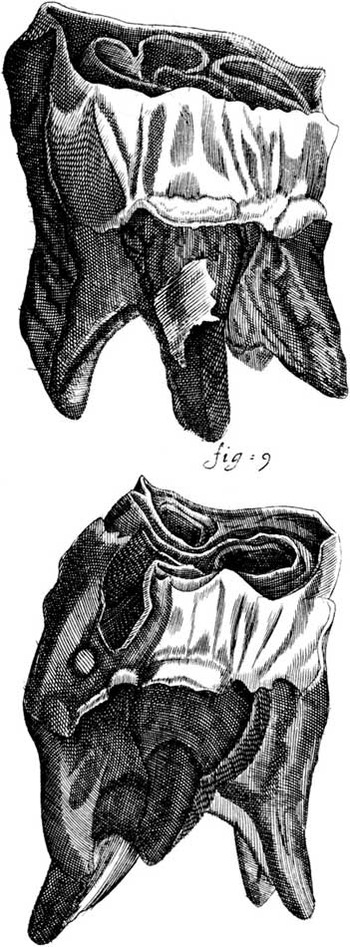
The development of a less restricted approach depended on individuals realizing that some of the remains they were examining pre-dated the written sources. This was where Aubrey shone. His most impressive fieldwork relates to megalithic sites, which he recognized as being older than any written records and so approached on the basis of the physical evidence alone. His work on barrows, camps and other forms of remains was less innovative. Aubrey was not alone in recognizing that some physical remains had to be explored without the support of literary sources. In 1668 William Somner wrote a short treatise on some teeth and bones that had been found in Chartham, Kent. Having described the circumstances of their finding and explaining that they had been identified for him as belonging to a hippopotamus, Somner went on to explore the possibility that the area where they were found had once been under water. Here he too was obliged to go beyond the written records and to rely on his own observations and knowledge of the local topography. He took his reasoning as far as possible with his ‘little skill’ in history and geography, then concluded with the hope that ‘judicious Antiquaries, Naturalist[s] &c.’ would investigate further.Footnote 46
He intended to include engravings of the finds, although only one plate of two of the teeth was completed before his death (fig 4). His treatise was published by his brother the following year. This tract is an appropriate testament to the development of fieldwork in the period covered by this paper. Antiquaries were beginning to take the first tentative steps beyond the written records, applying their own observations to physical remains. Somner's account would not have been written without that development. It would almost certainly not have been published without the stimulus provided by the very existence of the Royal Society. Appropriately, in the light of the future co-operation Somner envisaged between antiquaries and natural philosophers, the teeth were subsequently presented to the Royal Society for their repository. They now form part of the collections of the Natural History Museum.
The Chartham teeth. Illustration: Phil Trans Roy Soc London, B, 22, January 1753

From the viewpoint of modern archaeologists it would no doubt have been better if a more scientific approach to archaeological sites had developed earlier. A great deal of evidence was destroyed in the course of the gradual development of fieldwork, much of which went unrecorded. If a systematic attitude to the investigation and recording of monuments had developed more quickly, less damage might have occurred. However, the dominant members of the Royal Society were not much interested in antiquities and records of their meetings show that it was not a major subject of their concern. This lack of interest led to the formation of the independent Society of Antiquaries in the eighteenth century, providing a new forum for the publication of accounts of physical remains and ensuring that the results of fieldwork became more widely known. The Society and its publications gradually encouraged the development of a more systematic approach to fieldwork which, by the late eighteenth century, was being conducted along far more scientific lines. Its development over the two centuries from the first publication of Camden's Britannia had been a slow process, but perhaps a more complex one than is sometimes portrayed.
ABBREVIATIONS AND BIBLIOGRAPHY
- Abbreviations
- BL
-
British Library, London
- Bodleian
-
Bodleian Library, Oxford
- BRL
-
Birmingham Reference Library
- Merevale
-
Merevale Hall Manuscripts, at Merevale, near Atherstone, Warwickshire
- SRO
-
Staffordshire Record Office
- WRO
-
Warwickshire Record Office