


1 Introduction
Exceptions in phonology have traditionally been dealt with in a number of different ways. While some researchers have used prespecification (e.g. Itô & Mester Reference Itô, Mester and Tsujimura1999, Reference Itô and Mester2001), others have resorted to morpheme-specific constraints (e.g. Pater Reference Pater2000), and yet others have used morpheme-specific rankings (cophonologies) (e.g. Anttila Reference Anttila2002, Inkelas & Zoll Reference Inkelas and Zoll2007). In most cases though, the choice among the three has been constrained by the theoretical premises of the framework employed, with little independent support, meaning that other alternatives would work just as well. This has been a particular issue in the area of ‘stress’. In fact, there is little consensus, if any, among phonologists with respect to the formal treatment of exceptional stress.
In this paper, I argue, based on exceptional stress in Turkish, that the prespecification approach is both theoretically and empirically superior to the other general approaches to exceptionality mentioned above. That is, exceptional information should be encoded in the input. I also show, however, based on new data, that the influence of this prespecified information should be captured not by strict faithfulness to this information (i.e. via undifferentiated prosodic faithfulness constraints), but by correspondence-based prosodic faithfulness constraints (McCarthy & Prince Reference McCarthy, Prince, Beckman, Dickey and Urbanczyk1995, Reference McCarthy, Prince, Kager, Hulst and Zonneveld1999). Crucially, I argue that what is prespecified in the input is not stress or a stressed syllable per se, but (the edges of) a foot, though this foot does not have to be well-formed, nor need it be the foot that actually surfaces; it could have any shape imaginable, in accordance with Richness of the Base (Prince & Smolensky Reference Prince and Smolensky1993). The well-formedness of the foot (and which information belonging to this foot will surface) is ensured on the surface by correspondence-based constraints of an optimality-theoretic (OT) grammar. One advantage of these constraints, therefore, is that they do not have to stipulate perfect identity between input and output forms, as they permit certain kinds of ‘imperfections’, while banning others outright (McCarthy Reference McCarthy2000a, b).
Another advantage of this approach, with respect to Turkish stress in particular, is that exceptions disappear. That is, ‘exceptional’ stress in Turkish is no longer exceptional; rather, both regular and exceptional stress arise from a single grammar, together with simple assumptions about lexical representations. In other words, it is the grammar that generates both exceptional and regular forms in Turkish; although underlying forms are prespecified, given Richness of the Base, no restrictions are imposed on the set of inputs to the grammar. Thus the inputs that are prespecified to account for exceptional stress are predicted to exist by the current proposal, given some theoretical assumptions about the input in OT. The proposal is thus very restrictive, both theoretically, in that cross-linguistic variation is limited to constraint ranking (even in the case of exceptions), and empirically, in that it does not overgenerate, while capturing the forms that occur in Turkish. This, in turn, presents independent evidence for the Richness of the Base hypothesis.
The remainder of this paper is organised as follows: §2 offers an introduction to the Turkish data which is generally presented in the literature. §3 gives a brief overview of the current account, and shows how it captures these data. §4 delves deeper into the proposal by presenting novel data, whose analysis follows naturally from this account, but is problematic for previous accounts. §5 overviews these previous accounts, and compares them to the proposal here. Finally, §6 concludes the paper.
2 Turkish stress system
2.1 Regular stress
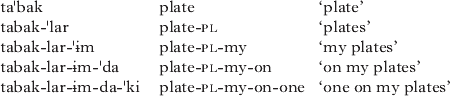
Primary stress in Turkish falls on the final syllable of words (e.g. Lees Reference Lees1961, Lewis Reference Lewis1967, Underhill Reference Underhill1976, Sezer Reference Sezer1983, van der Hulst & van de Weijer Reference Hulst, van de Weijer, Boeschoten and Verhoeven1991, Hayes Reference Hayes1995, Inkelas & Orgun Reference Inkelas, Orgun, Lapointe, Brentari and Farrell1998, Inkelas Reference Inkelas, Kager, van der Hulst and Zonneveld1999, Kabak & Vogel Reference Kabak and Vogel2001). This is illustrated in (1), where stress moves to the right each time a new suffix is added, irrespective of the length of the word or the weight of the syllables involved.
(1)

2.2 Exceptional stress
Non-final stress in Turkish is considered to be exceptional (see e.g. Kaisse Reference Kaisse1985, Reference Kaisse, Brame, Contreras and Newmeyer1986a, van der Hulst & van de Weijer Reference Hulst, van de Weijer, Boeschoten and Verhoeven1991, Inkelas & Orgun Reference Inkelas and Orgun1995, Reference Inkelas, Orgun, Lapointe, Brentari and Farrell1998, Kabak & Vogel Reference Kabak and Vogel2001). There are two types of exceptional stress in Turkish. One involves roots which are prespecified for stress, as seen in (2).
(2)

The other involves a small set of suffixes. The focus in this paper, as with most previous research, is on the latter.
2.2.1 Pre-stressing suffixes
There are two types of exceptional affixal stress in Turkish. One involves pre-stressing suffixes (this is the most widely researched type of exceptional stress in Turkish). The syllable immediately preceding a pre-stressing suffix has primary stress (again irrespective of its rhyme structure), or on certain accounts (e.g. Kabak & Vogel Reference Kabak and Vogel2001) stress placement on or following these suffixes is prevented. This is shown in (3); exceptional suffixes are underlined.
(3)

2.2.2 Stressed suffixes
The other type of exceptional affix involves a smaller set of stressed suffixes. These are always stressed on their first syllable, regardless of this syllable's rhyme structure (compare (4a) with (4b, c)), and irrespective of what follows (see (4d)). All of them are bisyllabic, i.e. there are no monosyllabic stressed exceptional suffixes (see also Inkelas & Orgun Reference Inkelas and Orgun2003). This has important consequences for our analysis, as we will see in the next section.
(4)

Several researchers have attempted to account for these facts, mostly, as mentioned above, focusing on pre-stressing suffixes (e.g. van der Hulst & van de Weijer Reference Hulst, van de Weijer, Boeschoten and Verhoeven1991, Inkelas & Orgun Reference Inkelas, Orgun, Lapointe, Brentari and Farrell1998, Inkelas Reference Inkelas, Kager, van der Hulst and Zonneveld1999, Kabak & Vogel Reference Kabak and Vogel2001). None of these studies consider variability in the production of secondary stress, which, at least in certain varieties, arises when there is more than one exceptional stress-attracting suffix, as in (3d) (see also Babel Reference Babel2006, Revithiadou et al. Reference Revithiadou, Kaili, Prokou, Tiliopoulou, Yağcıoğlu, Değer, Koşaner and Çeltek2006; though see Kabak & Vogel Reference Kabak and Vogel2001, Levi Reference Levi2002, Reference Levi2005, among others, for slightly different approaches). Furthermore, the fact that different phonetic cues are associated with regular vs. exceptional stress has not been accounted for: whereas exceptional stress is cued by both a sharp F0 rise and greater intensity, final prominence involves, at best, only a slight rise in F0 (Konrot Reference Konrot1981, Reference Konrot, Boeschoten and Th. Verhoeven1987, Levi Reference Levi2005, Pycha Reference Pycha2006). In addition, puzzling questions such as why monosyllabic exceptional suffixes are always pre-stressing (i.e. never stressed like those in (4)), and why stressed exceptional suffixes are always bisyllabic and are always stressed on their initial syllable (see (4)), have typically been left unanswered. This paper attempts to answer all of these questions.
3 Overview of the current account
On the current account, a single grammar is offered for the two types of exceptional stress (pre-stressing and stressed exceptional), as well as for regular final stress. I propose that the exceptional stress pattern in Turkish indicates that it is a trochaic language (cf. Inkelas & Orgun Reference Inkelas, Orgun, Lapointe, Brentari and Farrell1998, Inkelas Reference Inkelas, Kager, van der Hulst and Zonneveld1999), given that these suffixes are mostly pre-stressing, and never post-stressing (see (2)), and, if stressed, as in (3), they are always bisyllabic and stressed on the first syllable, never on the second. I also argue that final ‘stress’ in Turkish is not stress at all, but is rather intonational prominence associated with the end of a prosodic word (PWd); thus, formally, it is a boundary tone (see Pierrehumbert Reference Pierrehumbert1980, Pierrehumbert & Beckman Reference Pierrehumbert and Beckman1988, Gussenhoven Reference Gussenhoven2004). This is supported by the fact that regular and exceptional stress in Turkish have different phonetic cues (see above).
The two systems (final vs. exceptional stress) do not, however, belong to different cophonologies (e.g. Inkelas & Orgun Reference Inkelas, Orgun, Lapointe, Brentari and Farrell1998), nor are exceptional affixes morphemes that are targeted by lexically indexed constraints (e.g. Pater Reference Pater2000). I propose, using a single grammar, that Turkish is a trochaic language in which Parse-σ ranks low, and thus, in the absence of feet, Trochaic does not apply (i.e. it is vacuously satisfied). Given a high-ranking constraint FinalProminence, this means that stress (or rather intonational prominence) will more often than not fall on the final syllable of prosodic words, resulting in ‘regular’ stress. On the other hand, certain syllables (i.e. those in exceptional suffixes) are footed in the input, and have to be parsed in the output too, because of high-ranking prosodic faithfulness constraints. Thus Trochaic will take effect, resulting in exceptional stress. Crucially, it is not the location of a stressed syllable or a well-formed (trochaic) foot that is prespecified in the underlying representation of exceptionally stressed morphemes, but rather the edges of feet.
This, then, is the only difference between regular and exceptional suffixes: while both are subject to the same constraints, the latter differ in that they are footed in the input. On the surface, therefore, the two are rather different, in that while regular final stress does not involve foot structure, non-final stress does, although the two are subject to the same grammar.
Turkish is not the only language that combines intonational tone and word stress. There are other languages which behave in similar ways. In particular, ‘default-to-opposite edge’ stress languages present some evidence for a similar system. In these languages, default stress falls on one edge of a word (say the rightmost syllable), whereas some morphemes (or heavy syllables, depending on the language) have to be stressed; when they are present in a word, the opposite edge (for example, the leftmost heavy syllable) attracts primary stress. It could be that these languages, like Turkish, have no foot structure, but instead have default intonational prominence marking one edge (the edge where default ‘stress’ falls), as well as footing (i.e. opposite-edge stress), even though this is not ‘exceptional’ as in Turkish. Given such a foot, intonational prominence will be attracted to this foot, as it will be the strongest constituent within the PWd, since the rest of the PWd, including the syllable that normally bears default stress, is footless. This is possible particularly for languages in which opposite-edge stress falls on a particular morpheme, rather than a heavy syllable. In fact, Gordon (Reference Gordon2000) suggests that default ‘stress’ in most default-to-opposite edge languages (including those where the opposite-edge stress is attracted to heavy syllables) is subject to reanalysis as intonational prominence, rather than stress.
One piece of evidence for analysing the default stress of default-to-opposite edge languages as intonational prominence (with no foot structure) comes from the observation that in some of these languages, there are different acoustic cues for default vs. opposite-edge stress (as is the case with Turkish regular vs. exceptional stress, as discussed above). For example, Chuvash, a Turkic language spoken in Central Russia, puts stress on the leftmost light syllable in a word with only light syllables, but if a heavy syllable is available, then stress falls on the rightmost heavy syllable (in this case, a syllable with a non-central vowel) (Krueger 1961, Gordon Reference Gordon2000). Dobrovolsky (Reference Dobrovolsky, Ohala, Hasegawa, Ohala, Granville and Bailey1999) found, however, that the default light-syllable ‘stress’ in Chuvash is not accompanied by greater intensity, or duration, like true stress is in stress languages, but is instead accompanied only by an F0 peak. Heavy-syllable stress, on the other hand, is accompanied by at least one of two other cues to stress, greater intensity or duration. In other words, as Gordon (Reference Gordon2000) also notes, it seems that the default stress in this language is more like intonational prominence as in Turkish, rather than foot-based stress.
Below, I analyse both types of Turkish stress, regular and exceptional, in more detail; I consider first regular stress.
3.1 Regular ‘stress’
As stated above, I analyse Turkish final stress as final (intonational) ‘prominence’ falling on the last syllable of a PWd. In addition to its descriptive and explanatory power (more on this later), there are two types of independent motivation for this, i.e. evidence for a footless analysis and evidence against a foot-based analysis.
3.1.1 Evidence for an intonational prominence analysis for regular ‘stress’
Evidence for the footless status of regular final prominence includes, first of all, the fact that the acoustic cues for the two types of prominence (final vs. exceptional) are not the same; as mentioned above, whereas exceptional stress seems to be true foot-based stress, in that it is cued by both a sharp F0 rise and greater intensity, final prominence is, at best, marked only a slight rise in F0 (Konrot Reference Konrot, Boeschoten and Th. Verhoeven1987, Levi Reference Levi2005, Pycha Reference Pycha2006). For some speakers, there is no rise at all; there is instead only a plateau (Levi Reference Levi2005). In fact, some studies report no robust phonetic correlates whatsoever for final ‘stress’ (see e.g. Konrot Reference Konrot1981, Reference Konrot, Boeschoten and Th. Verhoeven1987). All of this seems to suggest that final stress in Turkish is nothing more than a slight optional pitch rise, which, unlike non-final (exceptional) stress, is not accompanied by intensity. Languages that mark prominence only by a pitch rise have been classified by various researchers as pitch-accent rather than stress-accent languages. The latter use duration and intensity in addition to F0 (see e.g. Beckman Reference Beckman1986, Ladd Reference Ladd1996 and Hualde et al. Reference Hualde, Elordieta, Gaminde, Smiljanić, Gussenhoven and Warner2002 for more information on the categorisation of languages into stress-accent vs. pitch-accent). In addition, metrical prominence in stress-accent languages is obligatory; every word must have at least one stressed syllable, whereas optionality of the type observed in Turkish regular ‘stress’ is permitted in pitch-accent languages (Hualde et al. Reference Hualde, Elordieta, Gaminde, Smiljanić, Gussenhoven and Warner2002, Hyman Reference Hyman2006). Finally, the fact that non-final (exceptional) stress is not accompanied by duration is not surprising if it is trochaic, as I argue here. Cross-linguistically, trochaic feet tend to be even; i.e. heads are not greater in duration than non-heads or other unstressed syllables, and underlying duration differences, if any, are lost or are minimal (Hayes Reference Hayes1995, Kager Reference Kager1999; though see e.g. Piggott Reference Piggott1995, Reference Piggott1998).
Can we conclude, then, based on the above discussion, that Turkish final prominence involves pitch accent? The answer is no, as pitch accents are intonational tones that appear on or near accented syllables (Gussenhoven Reference Gussenhoven2004). If final prominence in Turkish were pitch-accent, we would expect it to move to the stronger exceptionally stressed syllable in contexts where there is an exceptional (pre-stressing or stressed) suffix, and we would therefore expect no secondary stress (or rather prominence) on the final syllable in such words. This does not, however, seem to be the case; in words with exceptional stress that are long enough, final syllables bear secondary stress (see Revithiadou et al. Reference Revithiadou, Kaili, Prokou, Tiliopoulou, Yağcıoğlu, Değer, Koşaner and Çeltek2006). From this, we can conclude that the intonational tone is not a pitch accent, but is instead a boundary tone, which is phonetically the same as a pitch accent, but is attracted to the edges of prosodic constituents (see e.g. Pierrehumbert Reference Pierrehumbert1980, Pierrehumbert & Beckman Reference Pierrehumbert and Beckman1988 and Gussenhoven Reference Gussenhoven2004 for discussion of how to categorise an intonational tone as a pitch accent vs. a boundary tone).
This fact constitutes an additional criterion for categorising Turkish final prominence as intonational prominence, as intonational prominence of the pitch-accent type might be confounded by ‘stress’, since the two usually co-occur, but a boundary tone can be nothing other than intonational prominence, especially if it occurs in addition to the other type of (trochaic) stress (i.e. in the same word). In fact, Gussenhoven (Reference Gussenhoven2004: 15) argues that while not all languages show the phonetic effects of foot structure, or stress, in the same way, ‘it would be entirely unexpected to find a language that realised stressed syllables in phonetically conflicting ways’. Findings from acoustic studies on Turkish final vs. non-final stress clearly suggest this; in Gussenhoven's words, this is ‘unexpected’ if the two types of prominence are both considered to be ‘stress’ (i.e. foot-based prominence). I have argued in this section that they are not, and that final prominence in Turkish is instead intonational prominence (to be more exact, a ‘boundary tone’, though the categorisation does not seem to matter much for the formal analysis presented here).
3.1.2 Evidence against a foot-based analysis for regular ‘stress’
In addition to the findings outlined above, which seem to indicate that final prominence in Turkish is best analysed as intonational prominence, there is evidence demonstrating that the alternative, i.e. that final prominence is foot-based (i.e. ‘stress’), should be rejected outright. Final prominence in this language resembles neither trochaic nor iambic stress (bounded or unbounded).
It does not resemble iambic stress, because iambic languages favour left-to-right iterative footing (though see Everett Reference Everett2003), and they are argued to always be quantity-sensitive (see e.g. Hayes Reference Hayes1980, Reference Hayes1995, Kager Reference Kager1999; but cf. Altshuler Reference Altshuler2009). In fact, Hayes (Reference Hayes1995) argues that iambic feet are inherently asymmetrical, since the head is durationally enhanced compared to the non-head, making the foot quantitatively uneven (though this has been argued against by Revithiadou & van de Vijver Reference Vijver1998 and van de Vijver Reference Vijver1998, for example). Recall, though, that for Turkish, duration is not a good cue of final (or non-final) prominence; that is, iambs, if posited, would have to be durationally even in this language. Further, Levi (Reference Levi2005) finds that non-final syllables in Turkish verbs are slightly longer in duration than stressed final syllables. So, for verbs, at least, the foot would be a very strange weight-insensitive iamb of the type (HˈL), which is indisputably unattested (see e.g. Hayes Reference Hayes1995). In addition, there are some (borrowed) nouns in Turkish which have inherently long vowels in penultimate position, such as /vaːli/ ‘governor’. Despite the presence of the long vowel in the first syllable, regular stress falls on the final syllable. If Turkish regular stress were to be analysed as iambic, this would, once again constitute a weight-insensitive HˈL parse (i.e. [(vaːˈli)]), which, as mentioned above, is unattested in iambic languages.Footnote 1
A trochaic analysis of final prominence can also be rejected, as this would require a large number of stipulations, such as having final catalexis (preventing null syllables), as in Kiparsky (Reference Kiparsky1991) and Inkelas (Reference Inkelas, Kager, van der Hulst and Zonneveld1999), or proposing syllables for vowel-final words where both the nucleus and the onset are empty, as in Charette (Reference Charette2008). An additional problem for the trochaic analysis would be having two types of trochaic stress in the same language with different cues: exceptional stress being cued by a sharp rise in F0 together with intensity, and final stress being cued only by a slight optional F0 rise.
Aside from displaying no evidence for final stress as trochaic or iambic, Turkish also shows no other evidence for an obligatory foot constituent. For example, it does not place any lower limit on the size of lexical words, thus allowing several words which are smaller than a binary foot (although there is some evidence for minimal word effects in derived words in Turkish; see Itô & Hankamer Reference Itô and Hankamer1989). Given that the well-formed foot is binary across languages (Hayes Reference Hayes1980, Reference Hayes1995), that every PWd must contain at least one foot (Selkirk 1996), and that lexical words are PWds in the unmarked case (McCarthy & Prince Reference McCarthy and Prince1993), one would optimally expect no subminimal words in a language that has foot structure, such as English, in which lexical words are minimally bimoraic. In Turkish, however, examples such as /su/ ‘water’, /de/ ‘say’ and /je/ ‘eat’ are all subminimal, i.e. smaller than a binary foot,Footnote 2 despite the fact that they are all lexical words and can be uttered in isolation, without articles, tense markers, etc., suggesting once again that final stress in Turkish is not foot-based.
3.1.3 Formal analysis of regular stress/final prominence
To summarise so far, though the Turkish stress system has been argued to be trochaic, final prominence is not a result of trochaic stress; rather, it is the effect of a constraint FinalProminence, which places prominence on the final syllable of a PWd in the absence of a foot.
(5)

Parse-σ is ranked very low in Turkish, as shown in (6), so that the effects of the constraint Trochaic are not immediately observable.
(6)

This ranking is exemplified in (7). Notice that even though, on this account, Turkish is treated as a trochaic system, the winner is (d), where all of the high-ranking constraints are vacuously satisfied, as there is no foot available.
(7)
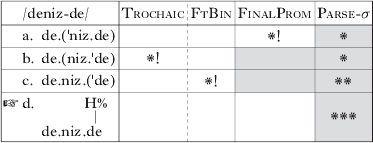
Candidate (a), though trochaic, fatally violates FinalProminence. Candidate (b) violates the undominated Trochaic, as it contains an iambic foot. Candidate (c), despite being trochaic and also satisfying FinalProminence, incurs a fatal violation of the undominated FtBin.Footnote 3 Candidate (d) wins, because it violates none of the high-ranking constraints; it incurs only violations of the lowest-ranking constraint, Parse-σ. In short, in Turkish, not having a foot is better than having a foot and violating foot well-formedness constraints or trochaicity.
Note that, for expository reasons, final stress, or rather prominence, is indicated with a stress mark here and in the rest of this paper, in the interests of having a means of representing this prominence and being consistent with previous literature on Turkish stress/prominence, even though, unlike exceptional stress, it does not result from being the head of metrical stress foot.
3.2 Exceptional stress
As noted above, I assume that pre-stressing and stressed suffixes differ from regular suffixes in that they are footed in the input, as in (8).
(8)
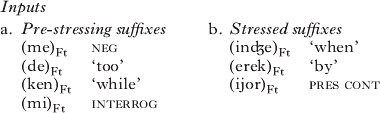
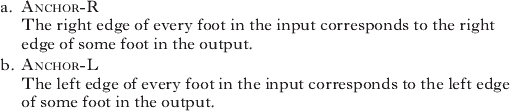
Two high-ranking faithfulness constraints in the grammar ensure that these suffixes are also footed in the output. Following McCarthy (Reference McCarthy, Prince, Beckman, Dickey and Urbanczyk1995, Reference McCarthy2000a), Itô et al. (Reference Itô, Kitagawa and Mester1996) and Crosswhite et al. (Reference Crosswhite, Alderete, Beasley and Markman2003), among others, I formulate these two anchoring constraints (McCarthy & Prince Reference McCarthy, Prince, Beckman, Dickey and Urbanczyk1995) in (9).
(9)
3.2.1 Stressed exceptional suffixes
For bisyllabic exceptional suffixes such as /-inʤe/ in (4), Anchor-R and Anchor-L are both satisfied for the inputs in (8), and, given Trochaic, stress falls on their first syllable, as in (10).
(10)
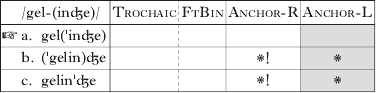
The suffix /-inʤe/ in candidate (a) is situated at both the right and left edges of the foot, just as it is in the input. Therefore, it violates neither Anchor constraint, whereas (b) violates both, as /-inʤe/ is not at the edge of a foot. Candidate (c) also violates these two constraints, as it has no feet.
This is all that is required for the analysis of bisyllabic exceptional suffixes, which constitute the set of stressed exceptional suffixes in Turkish. For monosyllabic exceptional suffixes, all of which are pre-stressing, additional assumptions need to be made, but these, too, follow from the inputs in (8), together with high-ranking FtBin.
3.2.2 Pre-stressing exceptional suffixes
For monosyllabic exceptional suffixes, one of the Anchor constraints will have to be violated, if FtBin is undominated. Otherwise, monosyllabic exceptional suffixes would also surface as stressed. Given that they do not, and that they are pre-stressing, the constraint that is violated must be Anchor-L, i.e. Anchor-R≫Anchor-L.
Our final constraint ranking is, then, as in (11). This ranking is all we need in order to capture the entire stress system of Turkish.
(11)

Tableau (12), for /gel-me-di/ ‘He/she/it didn't come’, illustrates how this ranking accounts for the behaviour of (exceptional) pre-stressing suffixes in Turkish.
(12)
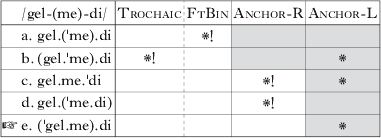
The most faithful candidate, (a), incurs a fatal violation of undominated FtBin. (Note that if /-me/ was bisyllabic, like /-inʤe/ in (10) above, this is the candidate that would have won.) Candidate (b) has a binary foot, but violates another undominated constraint, Trochaic (as well as Anchor-L, though this is not crucial). Candidate (c), the footless candidate, which vacuously satisfies both of the undominated constraints, violates both Anchor constraints, as the suffix /-me/ is neither at the right nor at the left edge of a foot in the output. This is the candidate that would have won if /-me/ was not footed in the input, since the Anchor constraints would then have been satisfied vacuously. Candidates (d) and (e) both violate only one of the Anchor constraints, but given the ranking Anchor-R≫Anchor-L, (e) is the winner, as it violates only the lower-ranked of the two.
3.2.3 Exceptional root stress
Although the focus of this paper is on exceptional affixal stress, exceptional root stress should also be considered briefly, as suggested by a reviewer. This type of exceptionality can be handled in the same way as exceptional affixal stress. The only difference is that parts (i.e. syllables) of roots, rather than suffixes, are footed in the input. This means that one cannot tell solely by looking at individual words like those in (2) whether a single syllable or two syllables are footed in the input. Based only on surface stress patterns, both the derivations in (13a) and (b) would be possible.
(13)

We will revisit the issue of exceptional root stress later in §4.4, where we will also consider how we can establish which of these derivations, (a) or (b), is correct.
3.3 Discussion
Thus far we have shown that the account offered in this paper seems to capture, in a single ranking, both the regular and the exceptional (pre-stressing and stressed) suffixes of Turkish (as well as exceptional root stress). Both the regular and exceptional suffixes are subject to the same constraint ranking; exceptional suffixes are different only in that they are footed in the input. Regular suffixes vacuously satisfy the constraints that act on the foot. In other words, though the grammar is trochaic and feet are binary in Turkish, these considerations become important only if there is an input foot available, for the grammar itself has no mechanism to force syllables to be parsed into feet. If footless languages exist, as is proposed here, a system like Turkish is expected, where the grammar does not assign feet, but, when a foot is available as a result of the lexical specification of a morpheme, other constraints work in principled ways to place stress on the first syllable of that foot, independent of the grammar's ability to assign foot structure.
Furthermore, the current account is not without independent empirical support. The fact that there are no monosyllabic stressed exceptional suffixes in Turkish, and that stressed exceptional suffixes are always bisyllabic and stressed on their first syllable, not on the second, follows directly from the account here. Not only is the material that is footed in the input footed in the output, but this foot must abide by the other high-ranking constraints of the grammar; it needs to be binary and trochaic, and is subject to high-ranking Anchor-R. In a system in which the location of a stressed syllable is prespecified, rather than foot edges (e.g. Alderete Reference Alderete2001), the fact that the two hypothetical exceptional stress patterns are unattested would be left without an explanation (since any syllable could be prespecified for stress; more on this in §5).
The approach to exceptionality taken here avoids one of the most common criticisms directed against prespecification: unlike other prespecification accounts which have come under attack for having too much information specified in the underlying representation (see e.g. Mester & Itô Reference Itô and Hankamer1989, Steriade Reference Steriade and Goldsmith1995), in a correspondence-based account certain predictions can actually be made about which forms occur (or do not occur) in a given language, since URs are not changed to become essentially the same as the data observed. In addition, this approach is in line with the general principles of OT: constraints are universal and violable. This is problematic for an approach that employs morpheme-specific rankings (i.e. cophonologies) or morpheme-specific constraints. Both of these approaches would stipulate that certain morphemes violate or do not violate a given constraint, which would, in turn, prevent us from being able to benefit from constraint violability or from the universal nature of OT constraints (see also Inkelas et al. Reference Inkelas, Orgun, Zoll, Roca and McCarthy1997).
Finally, it should be noted that the analysis proposed here for Turkish could easily be adopted for exceptional stress in other languages. The Anchor constraints in (9) are universal, as with every constraint in OT. However, the specific ranking between the two is language-specific (i.e. parametric), resulting in different patterns of exceptional stress in different languages. Furthermore, the effects of these two constraints are revealed only in languages where at least one of the two ranks relatively high, i.e. languages with exceptional stress. If both constraints rank low in a language, it will have no exceptional stress, irrespective of the shape of the inputs. That is, all cases of exceptional stress in the world's languages, whether stressed, pre-stressing or post-stressing, can likely be accounted for in this way, i.e. without specifying the location of a stressed syllable in the underlying representation, but by specifying underlying foot edges and using the constraints in (9) to ensure that this information is faithfully realised in surface forms.
The two tableaux in (14), for /ev-de/ (home-loc) ‘at home’ and /ev-de/ (home-also) ‘home too’, summarise the current account. Notice that the only difference between the two suffixes in the two tableaux is that the former is unfooted. Phonetically, they are identical.
(14)
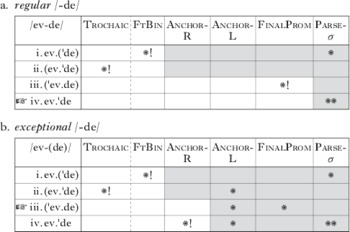
The following section explores the analysis further, focusing mainly on exceptional stress. Although, as mentioned above, final prominence can also arise in the context of exceptional stress, provided that the word is long enough (see e.g. Revithiadou et al. Reference Revithiadou, Kaili, Prokou, Tiliopoulou, Yağcıoğlu, Değer, Koşaner and Çeltek2006), this secondary-level prominence is not marked on the examples here, because, as argued above, final prominence is not ‘stress’, and the focus of this section is on exceptional stress. Therefore, final prominence is marked only when this is the only prominence in a given word.
4. Exceptions to exceptional stress
There are exceptions to exceptional stress in Turkish. For example, pre-stressing suffixes are not always pre-stressing, which presents further evidence for the edge-based prespecification account which I have proposed here, and against alternatives such as the prespecification of a stressed syllable or a binary trochee in the input. In what follows, I will first consider exceptions to pre-stressing exceptional suffixes (§4.1) and exceptions to stressed exceptional suffixes (§4.2), and will then revisit the issue of inputs (§4.3). We will see that none of these are in fact exceptions, but follow from foot edges being prespecified in the input and the constraint ranking in (11) above.
4.1 Exceptions to pre-stressing
Exceptions to pre-stressing occur under two conditions: when a pre-stressing suffix is immediately adjacent to another pre-stressing suffix, and when a pre-stressing suffix is immediately adjacent to a stressed exceptional suffix.
4.1.1 Two immediately adjacent pre-stressing suffixes
The presence of a pre-stressing suffix in Turkish does not always lead to stress on the preceding syllable, as shown in (15). Previous accounts all overpredict, in that every pre-stressing suffix is always expected to be pre-stressing, and if there is more than one of them in a given word, it should always be the stress assigned by the leftmost pre-stressing suffix that wins. The forms in (15) show two immediately adjacent pre-stressing suffixes, with stress on the first of the two suffixes.
(15)

/-me/ is a pre-stressing suffix, yet it is stressed. No previous account of Turkish stress predicts that a pre-stressing suffix can be stressed. In cases where two pre-stressing suffixes are available in a given word, the stress associated with the leftmost pre-stressing suffix is expected to win, for various reasons, such as LeftmostWins (see e.g. Inkelas & Orgun Reference Inkelas, Orgun, Lapointe, Brentari and Farrell1998), or because exceptional suffixes are analysed as PWd-adjoiners, so that the PWd is closed after the first exceptional suffix (see e.g. Kabak & Vogel Reference Kabak and Vogel2001). Thus, on all previous accounts of Turkish stress, the syllable preceding the leftmost pre-stressing suffix should bear stress in (15), with no stress on or after the leftmost pre-stressing suffix (see also §5). The analysis proposed here, though, can account for these cases with no extra stipulations. If inputs are footed, as in (8), the ranking in (11), which accounted for other exceptional cases mentioned in §3, will also generate the correct output in these cases. Consider (16).
(16)
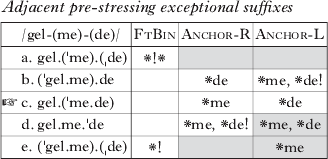
The fact that pre-stressing suffixes are not pre-stressing in certain cases is compatible with the approach employed in this paper: the Anchor constraints can be violated when other relevant constraints are higher-ranked, as in (16). For example, the most faithful candidate, (a), fatally violates FtBin, which is undominated in Turkish. Candidate (b), which is the candidate expected to win on all other accounts of Turkish stress, also loses, because it violates Anchor-L twice, as opposed to the winning candidate (c), which only incurs a single violation of this constraint. In summary, the exceptions to exceptional cases follow directly from the approach taken in this paper, but not under previous accounts (as we will see in §5), or an account that requires strict prespecification of the syllable to bear stress (more on this in §4.3.2). Furthermore, the approach here seems to be theoretically superior, too, as it captures the basic insight of OT that all constraints are universally available and violable, and that there are no language-specific ‘super’ constraints that are never violated (as would be the case in an approach involving morpheme-specific rankings or constraints).
It should be noted, however, that, as one reviewer has observed, the forms in (15) are ‘in free variation with the pattern where the [first] pre-stressing suffix surfaces as pre-stressing’, meaning that [ˈgel-me-ki] and [ˈgel-me-de] are also found, although the forms in (15) were much more common in my consultants’ speech. The presence of free variation here does not pose a challenge for the current account (although the very existence of the forms in (15) is problematic for previous accounts of Turkish stress). Such variation could have a variety of causes, and can be captured in various ways within the current account, such as the partial ordering of constraints (see e.g. Reynolds Reference Reynolds1994, Anttila Reference Anttila, Hinskens, van Hout and Wetzels1997, Reference Anttila2002), in particular the constraints LeftmostWins (Inkelas Reference Inkelas, Kager, van der Hulst and Zonneveld1999) and Anchor-L. This will result in the syllable preceding the leftmost pre-stressing suffix only being stressed in some cases, as LeftmostWins can sometimes be ranked above Anchor-L. This approach has the additional advantage of offering a possible explanation for the debatable status of secondary stress in Turkish, as whenever LeftmostWins is ranked above Anchor-L, only one stress per word will surface. On the other hand, in grammars where Anchor-L ranks above LeftmostWins, not only will secondary stress be present in words that are long enough, but patterns such as (16) will also be observable.Footnote 4
Variation is common in natural languages; a given underlying form may correspond to various surface realisations, and the underlying representations and grammar proposed in this paper are indeed able to capture all those realisations. In fact, such variation can best be accounted for in the grammar here, which assigns such features as trochaicity and binarity, and where only foot edges are specified in the input. If any further specification were made, it would be impossible to capture this variation.
Note, finally, that a form such as [aˈdam-sa-da] ‘if that is also a man’ might at first sight look like a case that is in conflict with the current account. However, this is not the case. It does not in fact involve two immediately adjacent pre-stressing suffixes, as /-sa/ is not a pre-stressing suffix in Turkish; the reason it looks like one in this case is because it follows the null version of the copula /-i/, which attaches to certain suffixes (such as /-sA/, /-dI/ and /-mIʃ/),Footnote 5 and is itself pre-stressing (see e.g. Kabak & Vogel Reference Kabak and Vogel2001). Thus the correct structure is [aˈdam-Ø-sa-da], and the example does not constitute evidence against the current account. I take these cases to involve an empty-headed syllable, with the following foot structure: [a(ˈda.mØ)(ˌsa.da)] (other options would not necessarily be in conflict with the current account).Footnote 6
4.1.2 A pre-stressing suffix immediately adjacent to a stressed exceptional suffix
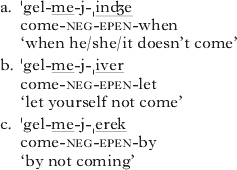
Other combinations are, of course, possible, such as a pre-stressing suffix immediately adjacent to a stressed exceptional suffix, as in (19) and (21) below. These, too, can be accounted for in the current analysis.
If the pre-stressing suffix comes first, then, two binary feet could be created, resulting in two syllables bearing stress. The syllable preceding the pre-stressing suffix bears main stress, as a result of EndRule-L (17).
(17)

Examples are provided in (18).
(18)
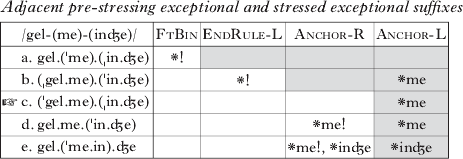
In the tableau in (19) for the form in (18a), the most faithful candidate, (a), violates neither of the Anchor constraints, as the two suffixes are both at the right and at the left edge of a foot, just as they are in the input. But it incurs a fatal violation of undominated FtBin. (d) and (e) fatally violate the Anchor constraints. Of the two remaining candidates, (b) and (c), the latter wins, because it satisfies EndRule-L.Footnote 7
(19)
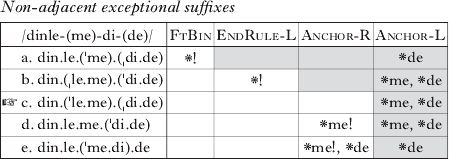
Note in addition that any case where two or more exceptional suffixes are far enough from each other to allow the creation of multiple feet would be accounted for in this way, given EndRule-L. One example is (3d) above: /dinˈle-me-ˌdi-de/. This form would be footed as [din(ˈle-me)(ˌdi-de)]. The same applies if there were more (regular) suffixes between the two exceptional suffixes, as in [din(ˈle-me)di(ˌler-de)]. This is illustrated in (20).
(20)
The other possibility, i.e. the case where a stressed exceptional suffix is immediately followed by a pre-stressing exceptional suffix, is captured in precisely the same way, as illustrated in (21) below. In this case, however, like (16) above, where two pre-stressing suffixes were immediately adjacent, and unlike (19) or (20), it is not possible to create two binary feet. Thus only one foot is created. Unlike (16), though, it is the stress associated with the leftmost exceptional suffix that wins here, as the suffix in (21) is bisyllabic. Footing it and leaving the pre-stressing suffix footless therefore violates fewer Anchor constraints.Footnote 8
(21)
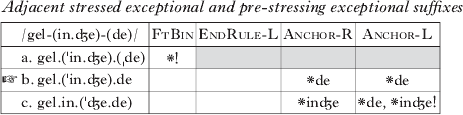
As in (19), the most faithful candidate, (a), loses, since it violates undominated FtBin. Unlike (19) though (but like (16)), the winning candidate violates a higher number of Anchor constraints, as there is no regular syllable here preceding the second exceptional suffix. This is a natural consequence of the constraint ranking in (11): it is better to violate Anchor constraints than have a non-binary foot, since FtBin≫Anchor-L≫Anchor-R.
Notice that the winning candidate in (21) would be (c) if only the last syllable of /-inʤe/ were footed in the input, as in the case in which two pre-stressing suffixes are adjacent, as in (16). For the sake of completeness, we should note that if the current account is correct, we do expect to find such forms, i.e. bisyllabic suffixes whose second syllable is footed, but not the first (as well as those whose first syllable is footed, but not the second). The next section deals with this issue.
4.2 Exceptions to stressed exceptional suffixes
Categorising exceptional stress-driving suffixes into two classes, pre-stressing vs. stressed, is, in fact, too simplistic. Nevertheless, previous research has assumed that pre-stressing suffixes are always pre-stressing, and that stressed bisyllabic suffixes always bear stress on their first syllable. We saw in (16) that the former assumption is not correct. (22) shows that the latter is not correct either: when a stressed suffix is immediately followed by a pre-stressing suffix, it is not always the first syllable of the stressed suffix that bears stress (contra (21)).
(22)
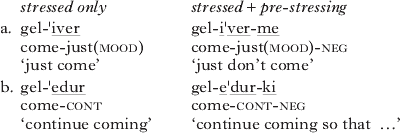
Note that stress shift does not simply occur any time a suffix is attached after stressed exceptional suffixes. It occurs only when a pre-stressing suffix is attached; stress does not shift when regular suffixes are added, as shown in (23).
(23)

Remember also that not all stressed exceptional suffixes behave like those in (22); some, like (24), retain their stress when a pre-stressing suffix is attached (cf. (21)).
(24)
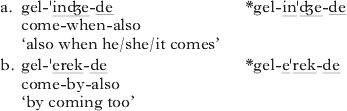
All this shows that, on the surface, there are in fact two types of ‘stressed exceptional suffixes’ in Turkish, not one: those that retain their stress when followed immediately by a pre-stressing suffix (i.e. (24)), and those that lose it (i.e. (22)). I will call these ‘strong stressed’ and ‘weak stressed’ exceptional suffixes respectively. In the input, the two differ in that the former are fully footed, while only the second syllable of the latter is footed.
(25)

The structure of weak stressed suffixes, then, is just like that of pre-stressing suffixes (in that only one syllable is footed in the input). It is thus not surprising that when these forms are immediately followed by a pre-stressing suffix, they behave in the same way as two immediately adjacent pre-stressing suffixes. This is illustrated in (26a); compare this with (16) vs. (21), partially repeated as (26b) and (c). The bisyllabic suffix in (a) behaves more like the monosyllabic suffix in (b) than the bisyllabic one in (c) when immediately followed by a pre-stressing suffix.
(26)
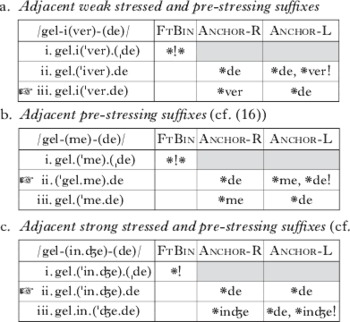
The similarity in the behaviour of weak stressed and pre-stressing exceptional suffixes is not surprising on this account: both have one syllable that is footed in the input.
Notice that this similarity is obscured in an environment where a weak stressed suffix is not immediately followed by a pre-stressing suffix; this may be the reason why previous research has treated weak stressed exceptional suffixes as instances of stressed exceptional suffixes, i.e. as having stress on their first syllable, as with strong stressed suffixes. Consider the tableaux in (27a, b), which illustrate a weak stressed suffix not followed by another suffix, and followed by a regular suffix; examples from (22a) and (23a) respectively.
(27)
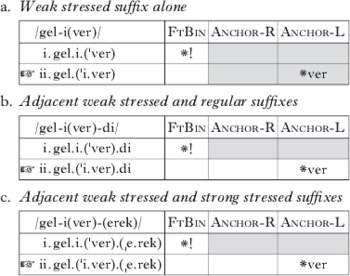
Note that main stress is on the foot associated with /-iver/ when a weak stressed suffix is followed by a strong stressed suffix, as in (c), as in this case it is possible to create two binary feet (EndRule-L ensures that main stress falls on the first foot).Footnote 9 That is, we see the weak behaviour of weak stressed suffixes only when they are immediately followed by a pre-stressing suffix, as in (26a). This follows straightforwardly from the current account. As they are footed in the input only on one syllable, and given Anchor-R≫Anchor-L and the undominated status of FtBin, the syllable preceding this (footed) syllable will be stressed, as in (27). When, however, another pre-stressing form immediately follows (i.e. (26a)), these suffixes are stressed on their second syllable, in order to keep the number of Anchor-L violations to a minimum. This is not the case for strong stressed exceptional suffixes, because they are fully footed in the input.
4.3 More about inputs: deriving affix shape
4.3.1 A predictive account
Note that the underlying representations in (25) are not surprising since, given Richness of the Base, there are no constraints in OT on underlying forms, and thus all well-formedness patterns are the result of constraint ranking (Prince & Smolensky Reference Prince and Smolensky1993). This means that ‘phonology’ is, in a sense, a filter – a filter that takes as input the set of possible entities, and gives as output the set of things that can be uttered in a particular language. The phonology of Turkish which I have argued for in this paper takes into account the set of all possible inputs in terms of footing options, and gives as output only those that actually occur in Turkish. This kind of approach to prosody has a long tradition, and can be traced to pre-OT work. Idsardi (Reference Idsardi1992), for example, argues that (universal) constraints restrict lexical stress (along with rules), using partially constituentised grid representations where constituents need only a single edge marked, unlike Halle & Vergnaud (Reference Halle and Vergnaud1987), Hayes (Reference Hayes1995) or the current paper. The question of how lexical stress should be restricted is also pursued by Revithiadou (Reference Revithiadou1999) and Alderete (Reference Alderete1999); the former uses feet, the latter employs grids. Much like the current proposal, both of these accounts assume, consistent with Richness of the Base, that there are no language-specific restrictions on the input, and thus that restrictions are not placed on underlying representations themselves, unlike Hammond (Reference Hammond1989), Pater (Reference Pater1994) and Inkelas (Reference Inkelas, Kager, van der Hulst and Zonneveld1999), for example. These accounts differ from the current analysis, however, in specifying lexical prominence in the input, rather than foot edges.
It does not matter, then, whether the input is a well-formed bisyllabic trochaic foot or not. All that matters is for there to be all possible inputs, and for the grammar (the ranking) to be able to filter these. If there are inputs where a monosyllable is footed, as with the pre-stressing suffixes in (8a), and inputs where both syllables of a bisyllabic suffix are footed, as with the strong stressed suffixes in (8b), it should also be possible for there to be bisyllabic inputs that are footed on their second syllable only, as in (25b), which will in turn result in the behaviour demonstrated by what we have called ‘weak stressed suffixes’. In other words, the presence of a category ‘weak stressed suffixes’ is something that is not only accounted for, but also predicted by the current account.
In fact, a complete account would also predict the existence of bisyllabic inputs that are footed on their first syllable only. This, too, is observed in Turkish, and is illustrated in (28). Given Anchor-R≫Anchor-L, these suffixes are also pre-stressing, though they are, of course, longer than one syllable.Footnote 10
(28)
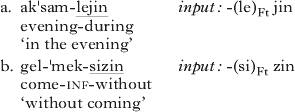
Notice that if these suffixes were fully footed in the input, or footed only on their second syllable, their first syllable would bear stress on the surface (i.e. they would then be categorised with strong stressed or weak stressed suffixes respectively).
Consider now (29). Candidate (c) is the winner, because it only violates the lowest-ranking Anchor-L.
(29)
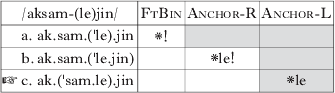
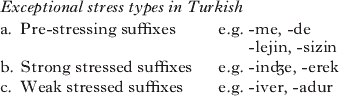
In summary, any theory-neutral account should recognise the three general types of exceptional stress-driving suffixes given in (30), even though (30c) has been overlooked in previous literature.
(30)
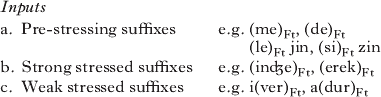
In the account here, what links all of these is that at least one of their syllables is footed in the input: the first (or only) syllable for pre-stressing suffixes, both syllables for strong stressed suffixes and the second syllable for weak stressed suffixes, as shown in (31).
(31)
4.3.2 An account avoiding overprediction
As mentioned above, a strength of the current account is its predictive power: forms such as (31c), which have not been considered in previous accounts of Turkish stress (and cannot possibly be captured by them; see §5), are not only accounted for, but also predicted to occur. Another strength is that the analysis does not overpredict either: there are, for example, no monosyllabic stressed exceptional suffixes in Turkish (i.e. stressed even when material is added to their right), except when another pre-stressing suffix immediately follows. Monosyllabic suffixes are either regular or exceptionally pre-stressing, not exceptionally stressed. Similarly, there are no bisyllabic suffixes that are always stressed on their second syllable, though the converse is attested, i.e. bisyllabic suffixes that are always stressed on their first syllable. This follows directly from the possible set of inputs and the constraint ranking proposed in this paper, and is a natural consequence of the edge-marked inputs (which are not marked for the exact location of stress) and the ranking Anchor-R≫Anchor-L, together with the undominated status of FtBin and Trochaic. It cannot be captured in an analysis which prespecifies an exact syllable for stress (with a corresponding constraint such as Faith(stress)). There is no reason in such a system for there being no monosyllabic stressed exceptional suffixes or bisyllabic exceptional suffixes that are always stressed on their second syllable.
Suppose, for example, that we prespecified the location of exceptional stress (instead of referring to foot edges), as suggested for stressed exceptional suffixes such as (4) by Kabak & Vogel (Reference Kabak and Vogel2001), and as proposed for different languages by various researchers (e.g. Alderete Reference Alderete2001). Although we would then be able to capture the basic behaviour of strong stressed exceptional suffixes, by arguing that they are prespecified in the input with stress on their first syllable (with the corresponding Faith(stress)), we would not be able to offer any explanations as to why there are no bisyllabic exceptional suffixes in Turkish that are prespecified with stress on their second syllable. On such an account, this gap is a complete accident, though its non-existence is predicted by the current account.
Again, on such an account, we would not be able to capture the stress-shifting behaviour of weak stressed exceptional suffixes: should they, for example, be prespecified with stress on their first syllable? Or should they be prespecified with stress on the second syllable? One cannot prespecify a suffix with stress sometimes on the first and sometimes on the second syllable. Similarly, why is it that pre-stressing suffixes are sometimes stressed, i.e. when immediately followed by another pre-stressing suffix? One might argue that all these cases involving stress shift could be captured by referring to ‘clash’ in an account that prespecifies the exact location of stress. There are two problems with such an account: first, for pre-stressing suffixes, a non-existent syllable would have to be specified for stress, as pre-stressing syllables are indeed pre-stressing. Second, there are empirical problems with predicting the correct location of stress. To see this, let us assume for now, as Inkelas & Orgun (Reference Inkelas, Orgun, Lapointe, Brentari and Farrell1998) do (see §5), that pre-stressing suffixes somehow come with a specification that lets them assign stress to the preceding suffix (or that they have to be adjacent to the right edge of a stressed syllable). Now, given that there are two adjacent pre-stressing suffixes in cases where stress shifts, there will be two possible hosts for stress, which are adjacent, as in (32).
(32)

One could argue at this point that the reason that [-me] bears stress here, as indicated in the output, is simply that clash is resolved in Turkish in favour of the rightmost stress-bearing unit. But how will such an account be able to capture the fact that it would have to be resolved in favour of the opposite direction, leftmost, in an example such as (33)?
(33)

And if such an account can somehow refer to the bisyllabicity of (33) to capture its contrast with (32) (though it is not clear how this would be achieved), why would clash be resolved in favour of the rightmost when there is a weak stressed exceptional suffix, as in (34), which is yet another form that is bisyllabic?
(34)

In short, using clash to capture the stress-shifting behaviour of exceptional suffixes (i.e. exceptions to exceptional stress) does not rescue an account that prespecifies the exact location of stress. In fact, this stress-shifting behaviour cannot be captured on any prespecification account that prespecifies more than the edges of underlying feet. An account that prespecifies an entire trochaic foot in the underlying representation, for example, will have the same problems in accounting for the stress-shifting behaviour of certain suffixes and the presence of certain gaps in the data (e.g. monosyllabic stressed exceptional suffixes). If a syllable can be prespecified as being in the non-head position of a trochaic foot (as in Inkelas & Orgun's account), for example, there is no reason for some other syllable not to be prespecified in the head position of such a foot. This is not, surprising: as McCarthy (Reference McCarthy2000a, b) makes clear, faithfulness to feet in Correspondence Theory is different from faithfulness to segments or to other categories in the prosodic structure, such as moras, in that faithfulness to feet occur only indirectly through edges. So the fact that only edge-based faithfulness works for Turkish is to be expected, and provides further evidence for this theory.
4.4 Exceptional root stress
Like most previous literature on exceptional stress in Turkish, much of this paper has been concerned with exceptional affix stress, as this type of exceptionality provides most information on the exact nature of Turkish stress. As mentioned above, however, root exceptionality is handled in the same way in the current account as exceptional affixal stress. The only difference between the two types is that, in the case of exceptional root stress, syllables (of roots), rather than suffixes (or parts thereof), are footed in the input. One might conclude that this implies that it is not possible to tell, solely by looking at individual words, whether a single syllable or two syllables are footed in the input for a word with exceptional root stress. That is, as we saw in §3.2.3, based only on surface stress patterns, either derivation in (13) is possible for /ˈʧanta/ and /fabˈrika/ in (2). However, closer investigation of cases where words with exceptional penultimate stress are immediately followed by a pre-stressing suffix reveals that, like suffixes, roots can be footed either on one syllable or two. (35) illustrates how the two words surface with differing stress patterns in such a condition.
(35)

(36) illustrates this in context within a sentence.
(36)

These examples provide evidence that whereas only the final syllable of /ʧanta/ must be footed in the input (i.e. only one syllable, much like pre-stressing suffixes), both the final and the penultimate syllables of /fabrika/ must be footed (like strong stressed exceptional suffixes), as indicated in (37).
(37)

Given the constraints proposed above for Turkish stress, both words will surface with penultimate stress in the absence of other suffixes; the only way to tell the difference is by looking at cases where the word is immediately followed by a pre-stressing suffix, as we have done here. These effects, which are discussed here for the first time for Turkish, are very interesting, because they seem to show that, even for roots, one needs to specify foot edges in the input, not just lexical prominence, as in much previous work (e.g. Alderete Reference Alderete2001).
It has been suggested in earlier literature that one subcategory of forms with exceptional root stress, particularly those with place names and certain borrowings, can be captured through the ‘Sezer stress rule’ (cf. Sezer Reference Sezer and Clements1981). This rule states that the antepenultimate syllable is stressed if it is heavy and the penultimate syllable is light, and that otherwise stress falls on the penultimate syllable.
The Sezer stress rule makes the correct prediction for many exceptionally stressed roots in Turkish. As Kabak & Vogel (Reference Kabak and Vogel2001) note, however, it also makes incorrect predictions for many others. For example, whereas stress falls on the heavy antepenult in an HLL word such as /ˈan.ka.ra/, it falls on the light penult in another HLL word, /bel.ˈʧi.ka/ (see (2)). Likewise, although both the antepenult and the penult are light in the word /kas.ˈta.mo.nu/, another place name, it is the antepenult that gets stressed, not the penult. In addition, there are place names that are regularly stressed, such as /a.na.do.ˈlu/. One might question at this point whether the pattern predicted by the Sezer stress rule is in fact the general case; although this may appear to be the true, there seems to be evidence suggesting otherwise: in a survey of polysyllabic place names, Çakır (1998) found that, of 206 exceptionally stressed forms with a heavy antepenult and a light penult, only 51 had primary stress on the antepenultimate syllable; the overwhelming majority, 155, were stressed on their penultimate syllable.
In conclusion, if Sezer stress does not hold of Turkish grammar, then the exceptional stress pattern observed in place names should be captured using the same means as for any other exceptional root stress, i.e. through prespecification, as Kabak & Vogel (Reference Kabak and Vogel2001) also propose. Among other things, this has the advantage of reducing the machinery required. As to whether (the edges of) a foot (as in this paper) or the location of a stressed syllable (as in Kabak & Vogel's Reference Kabak and Vogel2001 treatment of exceptional root stress) should be prespecified, I propose that, as with exceptional affixal forms, only foot edges should be specified in the input, as such a system is superior on both formal and empirical grounds. Formally, this has the advantage of offering a uniform analysis of exceptional stress, whereby all exceptional forms are captured via the same mechanism, contraKabak & Vogel (Reference Kabak and Vogel2001), for example, where exceptional affixal stress is treated differently from exceptional root stress, in that only the latter involves prespecification of a stressed syllable. It is also superior on empirical grounds, as prespecifying stress on a certain syllable has certain implications that do not hold. If stress can be prespecified on the penult or antepenult, for example (as with Kabak & Vogel), it should also be possible to prespecify stress on the final syllable. That is, there should be words that are exceptionally stressed on their final syllable, i.e. even in the presence of regular suffixes. In other words, we would expect to find both forms in (38) for ‘to Anatolia’.
(38)
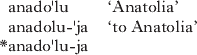
However, no such forms exist in Turkish (Inkelas & Orgun Reference Inkelas and Orgun2003). Their absence follows directly from the grammar proposed here. No matter which syllable is footed in the input, final syllables will never be (exceptionally) stressed, as the language is trochaic and feet are binary. This phenomenon would find no explanation under any other existing account of Turkish stress.
4.5 Summary
I have provided a novel account of Turkish stress system, where both regular and exceptional suffixes (and exceptional roots) are analysed in a unified manner, and ‘exceptions’ are, in reality, not exceptions. I have argued that Turkish stress is trochaic, though Parse-σ ranks low. This means that we are often unable to see the effect of Trochaic, as there is no foot to begin with. Certain suffixes (those that drive exceptional stress), though, are already parsed in the input, i.e. with underlying representations such as (31). Given these underlying representations, there will be two faithfulness constraints, Anchor-R and Anchor-L, which will strive to ensure that the outputs are footed in the same the way as inputs. Given FtBin, one of the Anchor constraints will have to be violated unless the input is already a binary foot (as in the case of the strong stressed suffixes in (31b)). This is Anchor-L in Turkish, as there is no stressed monosyllabic suffix in this language. The ranking of Anchor-R above Anchor-L will result in the pre-stressing behaviour of pre-stressing suffixes and the suffix-initial stress pattern of bisyllabic suffixes footed on their final syllable (i.e. the weak stressed suffixes in (31c)). Note that although this results in a unified analysis of both regular and exceptional stress, in that the two are targeted by the same grammar and same constraint ranking, the two types of stress are empirically different: final (regular) stress is due to boundary tone, and non-final stress involves feet.
I have also shown that there are exceptions to exceptional cases which follow straightforwardly from the analysis employed here, and with no extra stipulations.
5 Previous accounts of Turkish stress
Several different approaches to Turkish stress have been adopted in the literature. For example, regular final stress has been analysed in terms of unbounded right-headed feet (Kaisse Reference Kaisse, Brame, Contreras and Newmeyer1986a, Halle & Vergnaud Reference Halle and Vergnaud1987), bounded right-to-left iambic feet (Barker Reference Barker1989), a final binary trochee with catalexis (Kiparsky Reference Kiparsky1991, Inkelas Reference Inkelas, Kager, van der Hulst and Zonneveld1999) or a system where stress simply falls on the last syllable of a PWd, without any reference to the presence or absence of a foot (Hayes 1991, van der Hulst Reference Hulst and Hulst1999, Kabak & Vogel Reference Kabak and Vogel2001).
Clearly, one reason why so many different options have been proposed for final stress is the observation that Turkish does not have regular secondary stress, meaning that there is little, if any, evidence as to what exactly final stress or prominence is. This makes the analysis of exceptional stress even more interesting, for it also has implications for the correct analysis of regular final stress.
Among researchers working on Turkish stress, exceptional stress involving the pre-stressing forms has been of particular interest, though some researchers have dealt with stressed exceptional suffixes as well. Below, I give an overview some of the major accounts proposed so far, and compare them to the current account.
5.1 A cophonology account
Working in a cophonologies approach, Inkelas & Orgun (Reference Inkelas, Orgun, Lapointe, Brentari and Farrell1998, Reference Inkelas and Orgun2003) and Inkelas (Reference Inkelas, Kager, van der Hulst and Zonneveld1999) analyse pre-stressing suffixes as having an underlying trochaic foot structure that is larger than the suffixes themselves, and includes one syllable to their left. For example, their input for the pre-stressing suffix /-me/ is as in (39a). Notice that the head of the foot is empty.
(39)
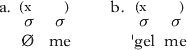
When /-me/ is attached to a stem, the output is as in (39b).
Inkelas & Orgun similarly analyse stressed exceptional suffixes, which are all bisyllabic, as prespecified for a trochaic foot, but here the head of the foot is specified, as in (40) (cf. (39a)).
(40)

That is, they provide a unified account that nicely captures the trochaic nature of both types of these suffixes. In fact, they are the first in the literature to notice the trochaicity of Turkish exceptional stress.
Inkelas & Orgun argue that regularly stressed suffixes belong to a completely different cophonology, which imposes a pattern of fixed word-final stress. They suggest that stress in this cophonology, unlike in the cophonologies targeting pre-stressing and stressed exceptional suffixes, can be generated in a variety of different ways, such as through a right-headed unbounded foot, a final binary iambic foot, a final grid mark or a final binary trochee with catalexis. In sum, on their account each suffix in the language needs to be assigned to a different component of the grammar, depending on whether they are pre-stressing, exceptionally stressed or regularly stressed. In short, there are multiple grammars (e.g. trochaic and iambic), each targeting different suffixes.
The current account is similar to that of Inkelas & Orgun in that exceptional suffixes, whether pre-stressing or stressed, surface within trochees. It differs from their account in significant ways, though. It is the general Turkish grammar that yields trochaic footing on the current account; the inputs are not prespecified as trochees, nor do they need to be. This provides advantages over Inkelas & Orgun's account on both conceptual and empirical levels. On the conceptual level, the current account offers a single grammar that targets both exceptional and regular suffixes. In other words, all suffixes, on our account, are subject to the constraint ranking in (11) above; it is not the case that some suffixes are trochaic and some iambic, for instance. Only foot edges are prespecified: the only difference between exceptional and regular suffixes is that the former come into the computation already footed.
Another way in which the two accounts differ at the conceptual level is that, in the case of monosyllabic exceptional suffixes, Inkelas & Orgun's account posits underlying feet whose head is not specified, but whose dependent is, which is unexpected, as dependents, whether phonological or syntactic, are by their very nature, dependent on heads (although see Idsardi Reference Idsardi1992 for a similar approach). Heads can occur alone. Specifying heads only, on Inkelas & Orgun's account, would, however, predict monosyllabic exceptional suffixes that are stressed. It would be a mystery, in other words, why monosyllabic exceptional suffixes are pre-stressing, if we are not able to prespecify the single syllable available as the dependent constituent of a foot. In the current account, however, these syllables are not specified as the head or dependent: only the foot edges are specified; heads are assigned by the grammar. Furthermore, the application of Anchor-R and FtBin ensures that material that is located at the right edge of a foot in the input is located at the right edge of a (binary) foot on the surface, the edge that corresponds to the dependent syllable, given that the grammar is trochaic. In other words, at no point in the derivation does the current account need to posit dependents without heads.
The two accounts differ on the empirical level, too: unlike the Inkelas & Orgun account, certain unattested patterns are accounted for in the analysis here. That only the edges of feet are prespecified in the input, and that the grammar takes care of the rest (e.g. binarity and trochaicity), ensures that no matter how diverse input forms are, there will be no exceptionally stressed monosyllabic suffixes on the surface (i.e. stressed despite more affixes being added to their right, e.g. *[gel-ˈme-di-ler]), and no bisyllabic suffixes that are stressed on their second syllable, e.g. *[gel-inˈʤe]. By contrast, on Inkelas & Orgun's account, only certain forms are allowed to occur in the input, such as (39a) and (40). It is not clear, however, why a form like the mirror image of (39a), such as (41a), or a form like (41b) (cf. (40)), should not occur.
(41)
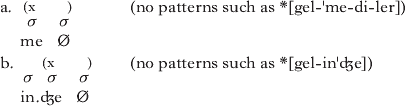
In other words, if affixes can be specified in the non-head position of a trochaic foot, why can they not be specified in the head position as well? Or if a foot can be specified on an affix with a syllable at the left edge whose segments are not specified, why can the same not apply at the right edge? Unless this is captured in the grammar (which Inkelas & Orgun opt not to do), it does not seem possible to explain such a gap based on the lexicon; that is, forms such as (41) should also exist, thereby resulting in monosyllabic exceptional suffixes that are stressed and bisyllabic exceptional suffixes that are stressed on the second syllable, both of which are unattested in Turkish.
In sum, we have seen that Inkelas & Orgun's account has a number of conceptual and empirical problems. Nevertheless, it is important to emphasise that it is the first account of Turkish stress to truly capture the trochaic spirit of the language, and that it provides a unified analysis of pre-stressing and stressed exceptional suffixes.
5.2 Cyclic Stress Assignment with Clash Resolution
Other researchers have assumed a single phonology. One such account, van der Hulst & van de Weijer (Reference Hulst, van de Weijer, Boeschoten and Verhoeven1991), provides a unified analysis of regular and exceptional (though only pre-stressing) stress. The authors account for regular stress by means of Cyclic Stress Assignment, which places primary stress on each new suffix that is added, producing a clash between the newly added suffix and the preceding one. Stress Clash Resolution later resolves this problem by removing the left-hand stress. For exceptional stress, they argue that pre-stressing suffixes such as the negative marker /-me/ are ‘unstressable’, and thus do not create a stress clash, giving two equally prominent stresses on the word in (42), the leftmost of which is selected by a Word Stress Rule.
(42)
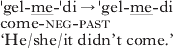
As with other approaches, however, there are problems with this account. First of all, since it views pre-stressing suffixes as ‘unstressable’, it is not clear why they are stressed when two of them are immediately adjacent, as in [gel-ˈme-de] in (16). Attributing the pre-stressing nature of these suffixes to the possibility that they are ‘unstressed’ (and thus that they escape clash) predicts them to be unstressed in this environment, too. In fact, in such cases, their account would predict the word stress to fall on the suffix preceding the leftmost pre-stressing suffix, for this is the only non-unstressable suffix (and is at the same time the leftmost one).
Another problem with this account is that it treats exceptional stress and final stress as the same. As acoustic studies of Turkish stress have demonstrated, however (see §3.1.1), the two have very different phonetic cues, with exceptional stress being cued by F0 rise and intensity, and final prominence only by a slight optional F0 rise.
The account runs into another problem when stressed exceptional suffixes are considered. One would have to say that in a strong stressed exceptional suffix like /-inʤe/, the second syllable is unstressed. But it is not clear, why, in a bisyllabic suffix, the second syllable should be unstressed while the first is stressed, and, crucially, why there are no bisyllabic suffixes in which it is the first syllable that is unstressed. The analysis of weak stressed suffixes would pose even more difficulties, because their stress can shift, as we showed in §4.2 above, i.e. they can bear stress on both their first and second syllables. In such cases, should they still be stated to be unstressable on the second syllable, even though this is sometimes stressed? In the van der Hulst & van de Weijer account, this and similar questions are left unanswered.
5.3 An extraprosodicity account
Kabak & Vogel (Reference Kabak and Vogel2001) analyse pre-stressing suffixes as ‘Phonological Word Adjoiners’ (PWAs), which, unlike regular affixes, cannot attach inside the PWd, and must therefore adjoin to it. Since, on their account, regular stress is assigned to the final syllable of the PWd, exceptional stress is merely regular stress followed by a PWA.
(43)
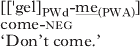
This proposal presents a unified analysis of regular and exceptional (pre-stressing) suffixes. It does, however, have several problems. First, though the unified account effectively allows for a single grammar, the fact that the proposal treats exceptional stress as exactly the same as regular stress is problematic, in that the two have completely different phonetic cues, as noted in §3.1.1.
Second, since stress assignment occurs within the PWd, and pre-stressing suffixes are proposed by Kabak & Vogel to be outside this domain, stress is not expected after the syllable preceding the leftmost pre-stressing suffix (i.e. their PWA), as the leftmost pre-stressing suffix closes off the PWd, and thereby falls outside the domain in which stress is assigned, along with any following syllables. This is problematic, because secondary stress is not predicted after the leftmost PWA. However, it is in fact found in words containing more than one exceptional suffix, as illustrated in (44) (cf. (3d)).
(44)

On Kabak & Vogel's account, which views the entire sequence /-me-di-de/ as being outside the domain of the PWd, there is no way of capturing secondary stress. Rather, their analysis predicts that there will be no stress, primary or secondary, after the first pre-stressing suffix.
Third, Kabak & Vogel attempt to account for stressed exceptional suffixes (which are all bisyllabic, as mentioned above) by prespecifying the exact location of stress, unlike pre-stressing suffixes. This is problematic for several reasons. First of all, it would add additional machinery (see also Inkelas & Orgun Reference Inkelas and Orgun2003), as pre-stressing and stressed exceptional suffixes would be treated differently, despite the fact that there is good evidence for the two types of affixes to be treated in a unified manner, as both seem to be trochaic. Second, and more importantly, such a prespecification account would predict, as with the Inkelas & Orgun account above, that there should be bisyllabic exceptional suffixes in Turkish that always bear stress on their second syllable, as well as monosyllabic exceptional stressed suffixes: if one can prespecify stress on the first syllable of bisyllabic suffixes, the same should apply to (at least some) monosyllabic suffixes as well. Similarly, there should be bisyllabic exceptional suffixes with stress on their second syllable. As mentioned above, however, no such forms are attested in Turkish. No explanations are offered in Kabak & Vogel's account for these gaps. That is, there is no principled reason why only the initial syllable of a bisyllabic suffix should (or can) be prespecified. On our account, on the other hand, an explanation of the gaps follow straightforwardly from the edge-marked inputs, and the attested inventory is exactly the one that is predicted.
Note that Kabak & Vogel have no means of avoiding reference to prespecification in accounting for the behaviour of stressed exceptional suffixes, as they are stressed, and therefore cannot be argued to be outside of the PWd, as they would then not surface as stressed. And since simply prespecifying the location of a stressed syllable is unable to account for the gaps mentioned above, it seems more promising to prespecify foot edges and let the grammar do the rest, as in the current account. But once this is done for bisyllabic exceptional suffixes, one might question the motivation for treating monosyllabic exceptional suffixes differently, for example by arguing that they are PWAs. This is in fact another way of indicating prespecification, in that the relevant suffixes are morphologically specified as being outside a PWd.
Finally, there seems to be no independent motivation for the PWd-adjunction analysis. As Kabak & Vogel acknowledge, other phonological processes such as vowel harmony are not sensitive to the PWd boundaries that they posit. For example, all the suffixes in (44) harmonise to the root-final vowel, even though they are all claimed by Kabak & Vogel to be outside the PWd of the root. This is despite the fact that there is other evidence that the domain of vowel harmony in Turkish is the PWd, rather than the Phonological Phrase, for example: as Kabak & Vogel note, the second member of a compound or an adjective+noun sequence such as (45) does not harmonise with the first member.
(45)
The presence of vowel harmony in (44), as opposed to (45), seems to indicate, then, that all suffixes in (44), including those that are pre-stressing, are within the PWd (see also Goad & White Reference Goad, White, García Mayo and Hawkins2009).
In sum, what is appealing about the Kabak & Vogel (Reference Kabak and Vogel2001) account is that it treats regular and pre-stressing suffixes in a unified manner, and avoids positing multiple grammars. It covers much of the Turkish vocabulary in an economical way. However, it faces a number of problems, such as not being able to predict the occurrence of certain forms, as well as overpredicting in the case of other data. Furthermore, stressed exceptional suffixes are treated differently from pre-stressing exceptional suffixes, despite evidence strongly favouring a unified treatment of the two. All in all, then, the edge-based prespecification account proposed here seems to better capture what is present and what is not present in the Turkish data than the Kabak & Vogel account, and does so more economically.
5.4 Syntactic accounts
Newell (Reference Newell2005) follows Kabak & Vogel in proposing a domain-based explanation, but expands on this by suggesting that exceptional forms constitute a morphosyntactic class, each falling outside of a spell-out domain, in that they are either in vP or CP. As in Kabak & Vogel's account, for Newell no stress assignment can possibly occur after the first pre-stressing suffix. This is problematic for the same reason that it is problematic for other accounts considered above: pre-stressing suffixes are sometimes stressed (see §4), and secondary stress is observed when there are two pre-stressing suffixes in a word that are far enough from each other to create separate binary feet.
A more serious problem with this account is related to its basic premise: these forms do not constitute a morphosyntactically natural class. Rather, this holds only for some of the forms. Newell only considers a subclass of these affixes (those that attach to verbs) and only in certain contexts (when they attach to verbs only or when they attach to sentences only), even though they can appear in almost any syntactic position; that is, many pre-stressing suffixes that can attach to a verb can also attach to a noun or an adjective, etc., which cannot be accounted for in a syntactic analysis.
One example would be the behaviour of the pre-stressing suffix /-de/, for instance. Though it is true, as Newell (Reference Newell2005: 52) observes, that /-de/ can attach to verbs, connect sentences and perhaps head a CP projection (and thus occur above the clause), it can also appear in examples like [ˈben-de] ‘me too’, or sentences like [ˈben-de gel-ˈdi-m] (I-too arrive-past-1sg) ‘I also arrived’, where it is evident that /-de/ does not sit above the clause or does not attach a CP, VP or IP projection. The same can be said for most other pre-stressing suffixes in Turkish. Just because some of them happen to form a morphosyntactically natural class, we cannot argue that morphosyntax is the force behind exceptionality. The issue seems to be clearly phonological, and one that requires prespecification of one type or another. Table I lists the exceptional suffixes and their grammatical attributes; as can be seen, it is impossible to categorise them as a class on the basis of their morphosyntactic properties. Furthermore, some are inflectional, whereas others are derivational.
Exceptional suffixes in Turkish.

Note finally that, as in Kabak & Vogel's model, syntactic accounts would have to treat stressed exceptional suffixes differently from pre-stressing exceptional suffixes, probably through prespecification (as they are stressed), which would, then, result in the same problems faced by Kabak & Vogel. Questions such as why there are no bisyllabic suffixes which are always stressed on the second syllable and why there are no monosyllabic suffixes that are always stressed would be left unanswered, and the similarity in behaviour between bisyllabic and monosyllabic exceptional suffixes would also go unnoticed.
In summary, no previous account has been able to capture the range of behaviour exhibited by the exceptionally stressed forms of Turkish. And where they do capture certain forms, they do it in ways that are much less economical than the account proposed here.
6 Conclusions
To conclude, the present account captures, within a single grammar, both regular and exceptional (pre-stressing and stressed) suffixes of Turkish. Both the regular and exceptional suffixes are subject to the same constraint ranking; exceptional suffixes are different only in that they are already footed in the input (prespecified for foot edges). Regular suffixes vacuously satisfy the constraints of the grammar that act on the foot. In other words, though the grammar is trochaic and feet are binary in Turkish, these considerations become important only if there is an input foot available, for the grammar itself has no mechanism to force syllables to be parsed into feet.
All things considered, then, it seems that a correspondence-theoretic prespecification account, one that prespecifies foot edges in the input, is best suited for accounting for exceptionality in stress assignment, at least in the case of Turkish. It provides the most parsimonious explanation of what does and does not occur. Other approaches to exceptionality fail to provide a principled analysis of Turkish stress, and are bound to leave certain issues unexplained, such as why there are no monosyllabic stressed exceptional suffixes in Turkish, and why stressed exceptional suffixes are always bisyllabic, and always stressed on the first syllable rather the second.
Not only have these issues been captured with no extra stipulations in the account presented here, but the explanation, types and the distribution of different exceptional suffixes all follow naturally as well. That is, the assumption that some syllables are footed in the input automatically implies that there will be two prosodic faithfulness constraints, Anchor-R and Anchor-L, which ensure that a suffix (or part of a suffix) that is footed in the input will also be footed in the output. Given the undominated status of FtBin, one of the Anchor constraints will, of course, have to be violated for monosyllabic exceptional suffixes, resulting in the pre-stressing behaviour of the pre-stressing suffixes. For bisyllabic exceptional suffixes, on the other hand, a greater variety of behaviours is expected, for, given that they have two syllables, they could be either fully footed or footed on the first or the second syllable only. This is exactly why, on the current account, only bisyllabic suffixes can be stressed, in addition to being pre-stressing or stress shifting (i.e. our weak stressed suffixes). This generalisation cannot be captured under any account other than a prespecification account of the type proposed here.
However, prespecification of some kind is needed. The exceptional behaviour of these suffixes cannot be captured by using other means, such as appealing to morphosyntax; these suffixes do not form a natural class in terms of morphosyntax (see §5.4). They do not form a natural class in terms of their segmental properties either: regular and pre-stressing suffixes can have exactly the same phonetic properties, and yet be contrastive. For example, /-de/ (as well as many other Turkish suffixes) can be either a regular or a pre-stressing suffix depending on whether it is footed in the input. It seems reasonable, then, to conclude that the underlying presence or absence of a foot is contrastive in languages like Turkish, i.e. /-de/ and /-(de)/ are minimal pairs. This fact would perhaps be widely accepted now if alphabets had a way to represent feet, in addition to segments.



