Introduction
The triarchic model of psychopathy (Patrick, Fowles, & Krueger, Reference Patrick, Fowles and Krueger2009) was formulated to reconcile alternative historic conceptions of psychopathy and provide a basis for integrating findings from studies using different assessment measures, with consideration given to developmental perspectives and findings. The three constituent constructs of the model are boldness, meanness, and disinhibition. These constructs have been shown to have distinct and robust nomological networks – that is, specific, reproducible patterns of convergent and discriminant validity with measures of other relevant constructs (Cronbach & Meehl, Reference Cronbach and Meehl1955), including brain-response and task-behavioral measures. The triarchic constructs have thus been conceptualized as clinically relevant “neurobehavioral traits,” basic dispositions related to clinical symptomatology that can be indexed using measures from behavioral and neurophysiological modalities as well as through report-based measures (Patrick, Durbin, & Moser, Reference Patrick, Durbin and Moser2012; Patrick, Iacono, & Venables, Reference Patrick, Iacono and Venables2019). As such, the triarchic model constructs also provide referents for relating psychopathic symptomatology to neurobiology and biologically based behavior patterns (Patrick & Drislane, Reference Patrick and Drislane2015).
The construct of boldness is most closely linked to conceptualizations of “primary” psychopathy described by Cleckley (Reference Cleckley1941, Reference Cleckley1976), Lykken (Reference Lykken1957, Reference Lykken1995), and Karpman (Reference Karpman1941), and involves fearlessness, social potency, stress resilience, and high self-assurance. Boldness corresponds to the low range of the neurobehavioral dimension of threat sensitivity and is associated with reduced defensive (fear) reactivity in relation to aversive cues or situations (Dvorak-Bertsch, Curtin, Rubinstein, & Newman, Reference Dvorak-Bertsch, Curtin, Rubinstein and Newman2009; Esteller, Poy, & Moltó, Reference Esteller, Poy and Moltó2016) and unimpaired performance under threat (Yancey, Bowyer, Foell, Boot, & Patrick, Reference Yancey, Bowyer, Foell, Boot and Patrick2019). Meanness, on the other hand, encompasses propensities toward callousness, lack of emotional sensitivity, deliberate cruelty, proactive aggression, exploitativeness, and deficient attachment – features represented in most conceptualizations of psychopathy and its variants (Patrick & Drislane, Reference Patrick and Drislane2015). Meanness appears to correspond to the low pole of a neurobehavioral dimension of affiliative tendency (Viding & McCrory, Reference Viding and McCrory2019). Consistent with this, functional neuroimaging and electrocortical studies have demonstrated negative associations for meanness (callousness) with neural and behavioral indicators of empathic processing, such as fear-face recognition and reactivity (Brislin et al., Reference Brislin, Yancey, Perkins, Palumbo, Drislane, Salekin and Patrick2018; Brislin & Patrick, Reference Brislin and Patrick2019; Jones, Laurens, Herba, Barker, & Viding, Reference Jones, Laurens, Herba, Barker and Viding2009; Marsh et al., Reference Marsh, Finger, Mitchell, Reid, Sims, Kosson and Blair2008). Finally, the triarchic construct of disinhibition encompasses characteristics of impulsivity, irresponsibility, stimulation seeking, low frustration tolerance, and anger/reactive aggression. Disinhibition is thought to represent dispositional proneness to externalizing problems, including impulsive-antisocial (“Factor 2”; Hare, Reference Hare2003) features of psychopathy, child and adult symptoms of antisocial personality disorder, and substance use disorders (Krueger et al., Reference Krueger, Hicks, Patrick, Carlson, Iacono and McGue2002). Disinhibition represents the low pole of a neurobehavioral dimension of inhibitory control, which is associated with weaknesses in the ability to restrain behavior and regulate emotions – functions known to be mediated by frontal brain regions (Patrick et al., Reference Patrick, Durbin and Moser2012; Venables et al., Reference Venables, Foell, Yancey, Kane, Engle and Patrick2018).Footnote 1
The triarchic model across development
A major goal of the triarchic model was to link together the literatures on early temperament, juvenile conduct problems, and adult psychopathy through reference to dispositional constructs that could be measured across the lifespan while retaining relevance to the prediction of adult psychopathy. For many years, psychopathy was studied primarily in adult samples (Frick, Bodin, & Barry, Reference Frick, Bodin and Barry2000; Hare, Reference Hare, Reid, Dorr, Walker and Bonner1980). It was only within the last 25 years that researchers began to extend the conceptualization of psychopathy downwards into childhood and adolescence (see Frick, O'Brien, Wooten, & McBurnett, Reference Frick, O'Brien, Wooten and McBurnett1994), with a particular emphasis on callous unemotionality (CU) as a predictor of stable, severe conduct problems (Frick & White, Reference Frick and White2008). This more recent body of research has provided insight into the possibility of intervening early in life, prior to the onset of adult psychopathy, when features of this condition may be more amenable to change (Frick, Ray, Thornton, & Kahn, Reference Frick, Ray, Thornton and Kahn2014). Building on the CU literature, one of the major goals of the triarchic model was to provide a framework for research on how adult psychopathy develops from earlier precursors – including, but not limited to, CU tendencies, which are analogous to triarchic meanness. Relatedly, the model encourages research on the extent to which psychopathic traits remain stable or change across time and influence the expression of problem behaviors across development.
Although the existing child psychopathy literature provides important information about temperamental and environmental influences on callousness (meanness), this trait does not exist in a vacuum; given theorized differences in neural systems for the three triarchic traits and their contrasting neural and behavioral correlates, it becomes important to investigate overlap versus distinctiveness in their etiologies and developmental trajectories. In particular, the triarchic model considers weak affective-behavioral restraint in infancy (i.e., “difficult temperament”; Patrick et al., Reference Patrick, Fowles and Krueger2009) to be an important precursor of both meanness and disinhibition to the extent that it reflects poor executive functions and emotion dysregulation (disinhibition) and promotes coercive interactions and interferes with secure attachment (meanness). Additionally, temperamental fearlessness in infancy is theorized to contribute to both boldness and meanness, with its multifinal expression guided by the adequacy (boldness) versus failure (meanness) of socialization processes. Overall, the triarchic model is explicitly developmental in nature and provides a theoretical framework for understanding longitudinal temperamental and experiential processes contributing to varied presentations of psychopathy in adulthood (Patrick et al., Reference Patrick, Fowles and Krueger2009).
A number of recent studies have provided evidence for the reliability and separability of the triarchic traits in adolescence and begun to delineate developmental precursors that may contribute to these traits in young adulthood. Somma, Borroni, Drislane, and Fossati (Reference Somma, Borroni, Drislane and Fossati2016) found good internal consistency and 3-month test–retest reliability for each triarchic trait in three samples of Italian high school students. Moreover, the individual traits were associated with measures of normal-range (e.g., Five-Factor Model) personality in patterns that mirrored prior findings in adults (Poy, Segarra, Esteller, López, & Moltó, Reference Poy, Segarra, Esteller, López and Moltó2014). Subsequent work similarly found that the triarchic traits were associated with theoretically relevant criterion measures in Greek-Cypriot adolescents – that is, boldness was associated with secure attachment and low anxiety, fear, and hostility; meanness with CU, hostility, low sympathy, lack of attachment, and antisocial symptomatology; and disinhibition with impulsivity, anxiety, hostile aggression, insecure attachment, and multiple forms of externalizing symptomatology (Kyranides, Fanti, Sikki, & Patrick, Reference Kyranides, Fanti, Sikki and Patrick2017; see Sica, Ciucci, Baroncelli, Frick, & Patrick, Reference Sica, Ciucci, Baroncelli, Frick and Patrick2020, for parallel findings in an Italian adolescent sample). Further, Kyranides et al. (Reference Kyranides, Fanti, Sikki and Patrick2017) showed that the triarchic traits were physiologically differentiable in adolescence: boldness was correlated with low resting heart rate and blunted cardiac reactivity to violent films, whereas meanness was associated with reduced startle potentiation during violent films. Recent work has even extended the known nomological network of the triarchic model to middle childhood (Green, Palumbo, Shishido, Kesner, & Latzman, Reference Green, Palumbo, Shishido, Kesner and Latzman2020; Palumbo, Patrick, & Latzman, Reference Palumbo, Patrick and Latzman2020), finding that boldness was related to lower concurrent internalizing psychopathology and social problems; meanness was associated with increased externalizing and social problems, as well as internalizing in some studies; and disinhibition was related to greater internalizing, externalizing, social problems, and attention problems. Further, in children, the triarchic traits appear to moderate the adverse influence of poor parenting on social problems, with boldness representing a protective factor and meanness and disinhibition exacerbating the relationship (Green et al., Reference Green, Palumbo, Shishido, Kesner and Latzman2020).
One study to date, by Dotterer et al. (Reference Dotterer, Waller, Cope, Hicks, Nigg, Zucker and Hyde2017), examined developmental precursors of the triarchic traits. Findings provided evidence that greater resiliency and lower negative affectivity during childhood/adolescence predicted higher boldness in young adulthood, and lower reactive control in early childhood predicted higher disinhibition in young adulthood. By contrast, meanness in young adulthood was not consistently preceded by distinct child or adolescent risk factors.
Taken together, prior work has provided reliable support for the differentiability of boldness, meanness, and disinhibition in youth and has begun to explicate the developmental precursors of these traits. However, a great deal of research remains to be done, particularly with regard to assessing the triarchic model traits repeatedly over a longer developmental period and examining concomitant and longitudinal relations with neural systems variables and clinical symptomatology, as well as changes in heritability over time.
Operationalizing the triarchic model
Most research on the triarchic model has utilized the Triarchic Psychopathy Measure (TriPM; Patrick, Reference Patrick2010), a 58-item self-report inventory that was developed to operationalize the triarchic constructs in adults. Extensive work has demonstrated the reliability and validity of the TriPM in adult samples (Sellbom, Lilienfeld, Fowler, & McCrary, Reference Sellbom, Lilienfeld, Fowler, McCrary and Patrick2018), with a small but growing literature on its utility in adolescent samples. The use of large-N longitudinal studies provides many opportunities to examine the development of psychopathy from a triarchic perspective, but no study to date has administered the TriPM at multiple time points.
Importantly, however, the TriPM constitutes only one operationalization of the triarchic model traits; these trait constructs can also be measured using sets of items from more commonly used personality and psychopathology questionnaires. For example, using a consensus-rating approach, Drislane et al. (Reference Drislane, Brislin, Kendler, Andershed, Larsson and Patrick2015) developed effective triarchic scales using items from the Youth Psychopathic Traits Inventory and demonstrated their convergent and discriminant validity in relation to both child and adult psychopathy and normal-range personality inventories. A similar approach has been employed to develop triarchic scales using items from various other inventories including the Multidimensional Personality Questionnaire (Brislin, Drislane, Smith, Edens, & Patrick, Reference Brislin, Drislane, Smith, Edens and Patrick2015), the NEO Personality Inventory – Revised (Drislane, Brislin, Jones, & Patrick, Reference Drislane, Brislin, Jones and Patrick2018), the Minnesota Multiphasic Personality Inventory (Sellbom et al., Reference Sellbom, Drislane, Johnson, Goodwin, Phillips and Patrick2016), the Personality Inventory for DSM-5 (Drislane et al., Reference Drislane, Sellbom, Brislin, Strickland, Christian, Wygant and Patrick2019), and the Psychopathic Personality Inventory (Hall, Drislane, Patrick, Morano, & Poythress, Reference Hall, Drislane, Patrick, Morano and Poythress2014). Such efforts have allowed for investigation of psychopathy and its distinctive facets in datasets collected for other purposes.
Building on these efforts to develop triarchic scales using items from individual inventories, Brislin et al. (Reference Brislin, Patrick, Flor, Nees, Heinrich, Drislane and Schumann2019) constructed and validated a triarchic disinhibition scale using items from questionnaires administered to participants in the European IMAGEN project, a large-scale longitudinal study. Although no single questionnaire in this study provided adequate content coverage of the triarchic construct of disinhibition, ratings of items from different questionnaires for their construct relevancy (see Hall et al., Reference Hall, Drislane, Patrick, Morano and Poythress2014) revealed several that appeared pertinent to the construct of disinhibition. This candidate item set was refined on the basis of psychometric analyses to yield a final scale measure of disinhibition consisting of 22 items from five questionnaires. Psychometric properties of the IMAGEN-Disinhibition scale were examined at ages 14 and 16, and concurrent and longitudinal analyses were conducted using other questionnaires and interview-based ratings as criterion measures. The IMAGEN-Disinhibition scale was also administered to a separate undergraduate sample and validated in relation to brain response measures known to correlate with other operationalizations of triarchic disinhibition.
Overall, results from this study by Brislin et al. (Reference Brislin, Patrick, Flor, Nees, Heinrich, Drislane and Schumann2019) demonstrated that the IMAGEN-Disinhibition scale, composed of individual items from different questionnaires, provided a reliable and valid index of triarchic disinhibition within the IMAGEN project, despite the absence of explicit psychopathy measures in this dataset. The scale is now being used in follow-up work to explicate the development of triarchic disinhibition over time and its associations with functional neuroimaging measures and clinical symptomatology.
The current study
The current study was undertaken to operationalize the three trait constructs of the triarchic model in another large-scale longitudinal dataset – collected for the University of Southern California Risk Factors for Antisocial Behavior (USC RFAB) project – to set the stage for future investigations of the development of psychopathic traits using this dataset. The USC RFAB project includes a number of design features that make it valuable for examining antisocial behavior through a developmental lens. The sample for this study consists of monozygotic and dizygotic twins and triplets assessed approximately every 2 to 3 years, beginning at ages 9–10 (Wave 1) and ending at ages 19–20 (Wave 5). Data from multiple measures and informants (i.e., self-, parent-, and teacher-report) were collected at each time point to assess biological and social influences on externalizing psychopathology – particularly antisocial behavior – across development.
To date, the RFAB study has helped to elucidate genetic, physiological, and behavioral aspects of externalizing psychopathology and antisocial behavior (Baker, Jacobsen, Raine, Lozano, & Bezdjian, Reference Baker, Jacobsen, Raine, Lozano and Bezdjian2007; Gao, Tuvblad, Schell, Baker, & Raine, Reference Gao, Tuvblad, Schell, Baker and Raine2015; Niv et al., Reference Niv, Ashrafulla, Tuvblad, Joshi, Raine, Leahy and Baker2015; Tuvblad, May, Jackson, Raine, & Baker, Reference Tuvblad, May, Jackson, Raine and Baker2017), with a number of published works focusing specifically on psychopathy (e.g., Sobhani, Baker, Martins, Tuvblad, & Aziz-Zadeh, Reference Sobhani, Baker, Martins, Tuvblad and Aziz-Zadeh2015; Tuvblad et al., Reference Tuvblad, Wang, Patrick, Bernsten, Raine and Baker2019; Tuvblad, Bezdjian, Raine, & Baker, Reference Tuvblad, Bezdjian, Raine and Baker2013; Wang, Baker, Gao, Raine, & Lozano, Reference Wang, Baker, Gao, Raine and Lozano2012). These papers primarily utilized the Child Psychopathy Scale (CPS; Lynam, Reference Lynam1997), which was administered at each assessment wave. However, the CPS was not developed to index psychopathy according to the triarchic model and its items are not organized into subscales reflecting the triarchic trait constructs. As a result, research on the triarchic model using the RFAB dataset has been limited to cross-sectional analyses of Wave 5 (i.e., ages 19–20), at which time the TriPM was administered (see Tuvblad et al., Reference Tuvblad, Wang, Patrick, Bernsten, Raine and Baker2019).
As a basis for utilizing the RFAB dataset to address previously unexamined questions regarding the etiologies of the triarchic model traits and their developmental trajectories and interplay across time, we sought to develop triarchic scale measures using items drawn from content-relevant inventories administered at all study assessment points, similar to the approach used by Brislin et al. (Reference Brislin, Patrick, Flor, Nees, Heinrich, Drislane and Schumann2019). The availability of triarchic scale measures in this longitudinal-twin dataset can allow for future examinations of the etiology and developmental course of the triarchic traits over an extended time period (i.e., from ages 9–10 through 19–20), and further advance knowledge of their nomological networks in relation to variables from diverse contexts and modalities of measurement – including self- and other-rated attributes, life experiences, family and other social relationships, cognitive and affective task performance, psychophysiological response, and clinical symptomatology. As such, the current work represents a key first step toward use of this unique dataset to undertake multimodal investigations of the development of psychopathy from a triarchic model perspective, with implications for early identification and proactive intervention.
We report here on the development of RFAB-Triarchic (-Tri) scales at Wave 3 (ages 14–15) and their validation at both Waves 3 and 5 (ages 14–15 and 19–20). We present findings regarding the psychometric properties of these scales within each of these time points, and their stability and specificity across the two time points. We also report evidence for the convergent and discriminant validity of the scales in relation to clinical criterion measures, both concurrently (within each time point) and longitudinally (across time points). Broadly speaking, we predicted that the three RFAB-Tri scales would relate selectively to their TriPM counterparts, both concurrently (at Wave 5) and prospectively (from Wave 3 to Wave 5), and show theory-consistent relations with clinical criterion measures. Specifically, we hypothesized that:
(1) RFAB-Boldness would relate selectively to TriPM Boldness and be associated with lower levels of anxious-depressive (internalizing) symptomatology and perhaps increased levels of some externalizing symptoms, such as substance abuse (Drislane et al., Reference Drislane, Sellbom, Brislin, Strickland, Christian, Wygant and Patrick2019; Hicks, Iacono, & McGue, Reference Hicks, Iacono and McGue2014) and property-related offenses (Drislane et al., Reference Drislane, Sellbom, Brislin, Strickland, Christian, Wygant and Patrick2019; Gray et al., Reference Gray, Blumenthal, Shuker, Wood, Fonagy and Snowden2019);
(2) RFAB-Meanness would relate selectively to the Meanness scale of the TriPM and the callous-unemotional symptom facet of the Antisocial Process Screening Device (APSD; Frick & Hare, Reference Frick and Hare2001) and be associated in particular with exploitative and destructive forms of externalizing behavior; and
(3) RFAB-Disinhibition would relate selectively to the Disinhibition scale of the TriPM and the Impulsivity facet of the APSD, and show positive associations with externalizing problems of various types including antisocial, impulsive, and substance use behaviors.
Method
Participants
Participants were twins and triplets from the University of Southern California's RFAB project (Baker et al., Reference Baker, Tuvblad, Wang, Gomez, Bezdjian, Niv and Raine2013). As noted earlier, data collection for the RFAB project occurred over five waves, beginning when participants were aged 9–10 years of age, and continuing every 2 to 3 years through age 19–20. The sample was representative of the ethnic and socioeconomic diversity of the greater Los Angeles area (see Baker, Barton, & Raine, Reference Baker, Barton and Raine2002 and Baker, Barton, Lozano, Raine, & Fowler, Reference Baker, Barton, Lozano, Raine and Fowler2006 for details on recruitment and initial inclusion criteria). We developed triarchic scales for the RFAB dataset using data from Wave 3, at which point participants were 14–15 years of age, and validated these scales using data from this wave as well as Wave 5 (age 19–20). Importantly, the triarchic scales were developed without reference to the criterion measures used to validate them. The Wave 3 sample as a whole consisted of 1,185 individual twins and triplets (N = 594 families), of whom 51.2% were female; the racial/ethnic composition of this sample was 32.2% Caucasian, 33.4% Hispanic, 12.2% Black, 4.1% Asian, and 18.1% of mixed race. Approximately 80.8% of Wave 3 participants (N = 957) returned for testing at Wave 5; relative to Wave 3 participants as a whole, those who returned for Wave 5 included a higher proportion of females (χ2 = 24.82, p < .001) but did not differ significantly in racial/ethnic composition (χ2 = 7.40, p = .12). Because some individuals participated in Wave 5 but not Wave 3, the total number of participants in Wave 5 was 1,101 (N = 587 families), of whom 46.2% were female; the racial/ethnic composition of this sample was 32.6% Caucasian, 32.8% Hispanic, 12.6% Black, 3.8% Asian, and 18.2% of mixed race. Participants were included in the current study if they had full questionnaire data for one or more of the analyses conducted at one wave or the other, or across the two waves. This resulted in 927 subjects for analyses in Wave 3, 1,009 for analyses within Wave 5, and 718 for longitudinal (Wave 3 to Wave 5) analyses. As documented in the Results section, ns within these three sets of analyses varied as a function of the availability of data for variables included in each analysis.
Procedure
At Waves 3 and 5, questionnaire measures pertaining to the twins’ personality and mental health were completed by each participant and their parent as part of a larger study protocol that included semi-structured interviews and neurophysiological assessments. Current analyses focused on the youth (i.e., twin participant) self-report data from these two study waves.
Measures used as sources of candidate items for self-report RFAB-triarchic scales
Child psychopathy scale (CPS; Lynam, Reference Lynam1997)
The CPS is a 50-item inventory that assesses affective-interpersonal and impulsive-antisocial features of psychopathy in children and adolescents in accordance with the model of this clinical condition represented in the Psychopathy Checklist – Revised (PCL-R; Hare, Reference Hare1991). Each participant completed the self-report version of the CPS at Waves 3 and 5, responding to each item on a two-point scale (0 = no, 1 = yes), with the option to decline to answer any question.
Achenbach System of Empirically Based Assessment (ASEBA; Achenbach, Reference Achenbach1991)
Items from age-appropriate self-report versions of inventories from the ASEBA system were also considered for inclusion in the RFAB triarchic scales, to provide coverage of aspects of the triarchic psychopathy constructs lacking in the CPS. At Wave 3, each participant completed the 1991 version of the Youth Self-Report (YSR; Achenbach, Reference Achenbach1991) questionnaire, a 112-item ASEBA inventory that assesses various types of behavioral, social, and emotional competencies in children aged 11–17.
At Wave 5, each participant completed the Adult Self-Report questionnaire (ASR; Achenbach & Rescorla, Reference Achenbach and Rescorla2003), a parallel ASEBA measure designed for use with adults aged 18–59.
Wave 3 criterion measures
Antisocial Process Screening Device (APSD; Frick & Hare, Reference Frick and Hare2001)
The APSD is a 20-item inventory that assesses antisocial characteristics and behaviors in children and adolescents. The self-report version (Muñoz & Frick, Reference Muñoz and Frick2007) was administered to participants at Wave 3 of the RFAB project. Like the CPS, the APSD is based on the model of psychopathy represented in the PCL-R, although evidence has also supported a three-factor structure for the APSD, consisting of CU, narcissism, and impulsivity (Frick et al., Reference Frick, Bodin and Barry2000). The self-report version of the APSD has evidenced validity in relation to criterion measures of impulsivity, conduct problems, and other forms of externalizing behavior in adolescent participants (Loney, Frick, Clements, Ellis, & Kerlin, Reference Loney, Frick, Clements, Ellis and Kerlin2003; Muñoz & Frick, Reference Muñoz and Frick2007) and in relation to psychopathic traits as assessed by the TriPM in young adults (Drislane, Patrick, & Arsal, Reference Drislane, Patrick and Arsal2014). Scales reflecting the three factors and the total APSD score were computed as self-report criterion measures of psychopathic tendencies at Wave 3. Reliability for the total score was in the acceptable range (α = .74) while reliabilities for individual subscales were lower (αs = .52 for CU, .64 for narcissism, and .54 for impulsivity).
YSR Internalizing and Externalizing
The Internalizing composite was created by summing scores for items from the YSR's Anxious-Depressed, Withdrawn-Depressed, and Somatic Complaint scales, and the Externalizing composite was created by summing scores for its Rule-Breaking and Aggressive Behavior scales, after excluding nine items included in the Wave 3 RFAB-Tri scales (see Supplement for further details). These procedures resulted in the creation of 26- and 24-item YSR Internalizing and Externalizing composites, respectively, for use as Wave 3 criterion variables in the analyses reported below. Reliability for these symptom composites were good, αs = .85 and .84, respectively.
Wave 5 criterion measures
Triarchic Psychopathy Measure (TriPM; Patrick, Reference Patrick2010)
The TriPM is a 58-item questionnaire developed specifically to index the three trait constructs of the triarchic model of psychopathy (Patrick et al., Reference Patrick, Fowles and Krueger2009). It includes a 19-item Boldness scale that indexes the general factor of a multiscale inventory developed to index this psychopathy facet (Patrick et al., Reference Patrick, Iacono and Venables2019). The other two TriPM scales, Meanness (19 items) and Disinhibition (20 items), correspond to scales that index the callous aggression and disinhibition factors of the Externalizing Spectrum Inventory (ESI; Krueger, Markon, Patrick, Benning, & Kramer, Reference Krueger, Markon, Patrick, Benning and Kramer2007; for details regarding scales developed to index the ESI factors, see Patrick, Kramer, Krueger, & Markon, Reference Patrick, Kramer, Krueger and Markon2013). TriPM Meanness includes items from the ESI's relational aggression, empathy (-), destructive aggression, physical aggression, excitement seeking, and honesty (-) subscales, whereas TriPM Disinhibition includes items from the ESI's Irresponsibility, Problematic Impulsivity, Theft, Alienation, Boredom Proneness, Impatient Urgency, Fraudulence, Dependability (-), and Planful Control (-) scales. In prior research, TriPM Disinhibition has typically been uncorrelated with TriPM Boldness but moderately related to TriPM Meanness (rs = .4 to .5); Meanness and Boldness tend to be modestly correlated (rs = .1 to .2). Reliabilities for the TriPM scales in the RFAB Wave 5 sample were high (αs = .82 to .85).
ASR Internalizing and Externalizing
At Wave 5, Internalizing and Externalizing composites were computed using items from the adult counterpart to the YSR, the ASR, which differs somewhat in terms of items covering these two forms of psychopathology. In accordance with the ASEBA adult forms manual (Achenbach & Rescorla, Reference Achenbach and Rescorla2003), items from the ASR's Anxious/ Depressed, Withdrawn, and Somatic Complaints scales were included in the Internalizing composite, and items from the ASR's Aggressive Behavior, Rule-Breaking Behavior, and Intrusive Behavior scales were used to create the Externalizing composite, after omitting eight items included in the Wave 5 RFAB-Tri scales (see Supplement). This resulted in 36- and 30-item Wave 5 ASR Internalizing and Externalizing composites, respectively. Reliabilities (αs) for these composites were .92 and .87, respectively.
Antisocial behavior (ASB) measure
A questionnaire pertaining to engagement in antisocial behavior, developed for the RFAB project specifically, was also completed by participants at Wave 5. Individual items assessed whether the participant had ever participated in various specific behaviors (e.g., “Have you ever taken something from a car that did not belong to you?”; 0 = no, 1 = yes). For the purposes of analysis, items were grouped by content to form narrower scales indexing proneness toward Callous Behavior (four items; α = .60) and Unreliable/Impulsive Behavior (12 items; α = .65), as well as broader scales indexing engagement in Violent Antisocial Behavior (eight items; α = .64) and Nonviolent Antisocial Behavior (34 items; α = .88). The Violent Behavior scale encompassed narrower subscales of Physically Hurt Others (four items; α = .47) and Use of Weapon (four items; α = .49), and the Nonviolent scale encompassed narrower subscales of Stealing (16 items; α = .82), Property Damage (three items; α = .46), Fraud (nine items; α = .60), Selling Drugs (two items; α = .51), Disorderly Conduct (two items; α = .47), and Reckless Driving (two items; α = .37). Each scale was computed as the sum of constituent item scores; in the case of the Nonviolent Antisocial Behavior scale, scores for its subscales were unit-weighted to represent them equally in the overall scale score. In addition to these scales, two other dichotomous variables were created to reflect a personal history of legal trouble – scored based on affirmative responses to “Have you ever been in trouble with the police?” and/or “Have you ever been arrested?” – and a family history of legal trouble (“Have any of your relatives ever been to jail?”).
Substance abuse (SU) measure
Participants also completed a questionnaire assessing their lifetime use of a variety of substances, including cigarettes, alcohol, prescription medications (for non-medical reasons), marijuana, and other illicit (“street”) drugs, as well as drug-related arrests. The current analyses examined dichotomous lifetime use of each substance (0 = no, 1 = yes) and age at first use of each substance in years.Footnote 2 Composite variables were also created reflecting dichotomous overall use of any drug (i.e., prescription, marijuana, or other) and age at first use of any drug (marijuana or other, in this case, as age of first prescription use was not recorded).
Data analytic strategy
The RFAB-Tri scales were developed using data from the Wave 3 assessment, applying a construct rating and scale refinement approach described in prior published papers (Brislin et al., Reference Brislin, Drislane, Smith, Edens and Patrick2015, Reference Brislin, Patrick, Flor, Nees, Heinrich, Drislane and Schumann2019; Drislane et al., Reference Drislane, Brislin, Kendler, Andershed, Larsson and Patrick2015, Reference Drislane, Brislin, Jones and Patrick2018; Hall et al., Reference Hall, Drislane, Patrick, Morano and Poythress2014). A detailed description of the construct rating procedure and steps in scale construction and refinement is provided in the online article Supplement. The resultant RFAB-Tri scales consist of 10 items for Boldness (four worded in the direction of high boldness), 10 for Meanness (six worded in the direction of high meanness), and 12 for Disinhibition (eight worded in the direction of high disinhibition). Table A of the online Supplement describes the thematic content of items comprising each scale.
Following development of the RFAB-Tri scales using data from Wave 3, scores for each were computed for this wave and also for Wave 5, utilizing items from the ASR in place of their YSR counterparts at the latter wave. Reliabilities of the three scales were quantified at each wave using Cronbach's α and coefficient omega (ω). Temporal stabilities were quantified by examining correlations (Pearson's rs) for each scale across Waves 3 and 5, and the specificity of these associations was evaluated using ordinary least squares (OLS) regression models in which scores for the three RFAB-Tri scales at Wave 3 were entered as predictors of scores for each, in turn, at Wave 5.
The final RFAB-Tri scales were also examined for concurrent validity in relation to the criterion measures available at each wave. For the Wave 3 criteria – ASPD and YSR scores – associations were examined in terms of (a) simple bivariate associations for each RFAB-Tri scale alone, and (b) comparative associations when all three scales were included jointly as predictors in regression models. Given the continuous nature of APSD total and subscale scores, Pearson's rs and OLS regression coefficients and multiple correlations (βs, Rs) were used to quantify associations with these measures. Version 22.0 of the SPSS statistical package (IBM Corp., 2013) was used to perform analyses of these types. In contrast, YSR Internalizing and Externalizing consisted of symptom-count variables with highly skewed distributions. Accordingly, negative binomial regression models were used to compute incidence rate ratios (IRRs) for each Wave 3 RFAB-Tri scale in two ways: (a) as the sole predictor of either YSR Internalizing or Externalizing (as a counterpart to a simple bivariate correlation), and (b) together with the other two traits in a joint NB prediction model (analogous to a regression analysis). Analyses of this type were performed using the “MASS” package (Venables & Ripley, Reference Venables and Ripley2002) in the R statistical environment (v.3.5.1; R Core Team, 2018).
At Wave 5, continuous TriPM scale scores served as direct criterion referents for evaluating the convergent and discriminant validity of the RFAB-Tri scales as measures of the three triarchic traits; the RFAB-Tri scales were evaluated as individual predictors of each TriPM scale using Pearson's rs, and as joint predictors using OLS regression. Pearson's rs and OLS regression analyses were also used to quantify associations of the RFAB-Tri scales with age of first use of alcohol and other substances, given the continuous-score nature of these variables. Logistic regression analyses (performed via SPSS version 22.0; IBM Corp., 2013) were used to quantify associations with the “ever used” variables for each substance category and the two “ever arrested” ASB variables (self, relatives), given their dichotomous-score nature. Negative binomial (NB) regression models were used to quantify associations of the RFAB-Tri scales, individually and jointly, with the other ASB variables due to their count nature. NB regression models were also used to quantify associations with ASR Internalizing and Externalizing symptom-count scores, as was done with their YSR score counterparts at Wave 3.
Finally, longitudinal relations of the Wave 3 RFAB-Tri scales with Wave 5 criterion measures were examined. The same analyses described for the Wave 5 concurrent relations were repeated, substituting Wave 3 scales as predictors. All statistical effects were evaluated for significance using a conservative alpha of p < .005.
Results
Item content of final RFAB-Tri scales
The final self-report based RFAB-Tri scales are composed mostly of items from the CPS, along with a smaller number of items from the age-relevant ASEBA measure (i.e., YSR for Wave 3; ASR for Wave 5; see Table A of Supplement). Consistent with the constructs as defined within the triarchic model (Patrick et al., Reference Patrick, Fowles and Krueger2009), the RFAB-Boldness items target characteristics of assertiveness/ persuasiveness, calmness/confidence, and fear versus fearlessness. The RFAB-Meanness items reflect characteristics of callous aggressiveness, kindness versus cruelty, and capacity for remorse. Lastly, the RFAB-Disinhibition items assess characteristics of impulsiveness, impatience, and irritability.
Psychometric properties of RFAB-Tri scales in Waves 3 and 5: Reliabilities, scale intercorrelations, and temporal stability of scores
Reliability coefficients for the RFAB-Tri scales were highly similar for the two study waves. At Wave 3 (ages 14-15), Cronbach's αs for RFAB-Boldness, Meanness, and Disinhibition (comprising 10, 10, and 12 items, respectively) were .66, .69, and .72, respectively, and ω coefficients were .67, .70, and .73. Corresponding αs at Wave 5 (ages 19–20) were .72, .68, and .72, and ωs were .74, .68, and .72.
Intercorrelations among the three triarchic scales at Wave 3 coincided with expectations based on prior work: RFAB-Meanness was correlated to a moderate positive degree with Disinhibition (r = .42, p < .005) and to a slight positive (though nonsignificant) degree with Boldness (r = .06, p = .08), whereas RFAB-Boldness and Disinhibition were uncorrelated (r = −.02, p = .51). At Wave 5, RFAB-Meanness was correlated to a similar positive degree with Disinhibition (r = .39, p < .005), but was uncorrelated with Boldness (r = −.02, p = .525). RFAB-Boldness at Wave 5 was somewhat negatively correlated with Disinhibition (r = −.18, p < .005).
As shown in Table 1, RFAB-Boldness and Disinhibition showed moderate stability from Wave 3 to Wave 5, rs = .50 and .48, respectively, ps < .005. RFAB-Meanness showed somewhat lower stability across time, r = .32, p < .005. The specificity of these associations was good: Wave 3 Boldness was the sole independent predictor of Wave 5 Boldness in a multiple regression model (β = .50, p < .005). Wave 3 Meanness was the only significant independent predictor of Wave 5 Meanness (β = .28, p < .005), with the association for Wave 3 Disinhibition falling below our significance threshold of .005 (β = .09, p < .05). Finally, Wave 3 Boldness and Disinhibition were each independent predictors of Wave 5 Disinhibition, with Wave 3 Disinhibition showing a robust positive association (β = .45, p < .005) and Boldness showing a weak negative association (β = −.11, p < .005).
Wave 3 to Wave 5 Risk Factors for Antisocial Behavior (RFAB)-Triarchic scale scores: stability coefficients

Note. N = 713. Rs and βs ≥ .20 are bolded.
* p < .005, †p < .05.
Concurrent relations of RFAB-Tri scales with criterion measures at Waves 3 and 5
Wave 3 RFAB-triarchic scales: Concurrent relations with criterion measures of psychopathy and internalizing/externalizing symptomatology
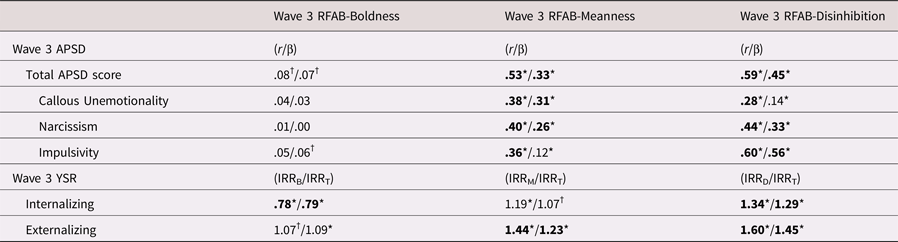
At the zero-order level (r), Wave 3 RFAB-Meanness and Disinhibition were moderately positively correlated with each of the APSD subscales, as well as with the total score (see Table 2, upper part). In contrast, RFAB-Boldness was uncorrelated with any APSD subscale, although it showed a weak positive association with ASPD total score. In the multiple regression model, Wave 3 RFAB-Meanness and Disinhibition both emerged as independent predictors of each APSD subscale and of the total score (βs = .12 to .56, ps < .005). RFAB-Disinhibition was a particularly strong predictor of APSD impulsivity (β = .56, p <.005), whereas RFAB-Meanness was most strongly predictive of APSD callous unemotionality (β = .31, p < .005). RFAB-Boldness contributed at only a modest level (short of .005 significance) to prediction of one APSD subscale, impulsivity (β = .06, p = .032), as well as to total APSD scores (β = .07, p = .009).
Concurrent relations of Wave 3 Risk Factors for Antisocial Behavior (RFAB)-Triarchic scales with Wave 3 criterion measures: psychopathy and internalizing/externalizing symptomatology

Note. Ns = 896 for Antisocial Process Screening Device (APSD) and 780 for Youth Self-Report (YSR) analyses. IRRB,M,D = incidence rate ratio from models including a single RFAB-Triarchic scale predictor (Boldness, Meanness, or Disinhibition); IRRT = incidence rate ratio for a given predictor when other RFAB-Triarchic scales were also included in the model. rs and βs > .20 and IRRs > 1.20 or < .80 with ps < .005 are bolded. Multiple Rs for APSD models = .67, .50, .62, and .40, respectively.
* p < .005, †p < .05.
When entered as sole predictors into separate NB regression models, all three RFAB-Tri scales were related to the YSR Internalizing composite, with RFAB-Boldness relating negatively and Meanness and Disinhibition relating positively (see Table 2, lower part). When all three RFAB-Tri scales were entered as joint predictors in NB regression models, this association was maintained for RFAB-Boldness, with an IRR of .79 (p < .005). In other words, an increase by one standard deviation (SD) in RFAB-Boldness score above the mean was associated with a 21% decrease in internalizing symptoms as measured by the YSR. The observed association for Disinhibition when entered as a sole predictor for YSR Internalizing (IRR = 1.34, p < .005) was also maintained when all three scales were entered as predictors in the model (Disinhibition IRR = 1.29, p < .005), indicating a 29% increase in YSR Internalizing for a 1SD increase in RFAB-Disinhibition score above the mean – but was attenuated by comparison for RFAB-Meanness (IRR = 1.07, p < .05). When each RFAB-Tri scale was entered into the NB regression model as a separate predictor of YSR Externalizing, RFAB-Meanness and Disinhibition showed moderate positive relations, along with a weak positive association for Boldness. When all three RFAB-Tri scales were included as predictors, this pattern of relations was largely maintained, with RFAB-Disinhibition emerging as the strongest independent predictor (IRR = 1.45, p < .005).
Wave 5 RFAB-Tri scales: Concurrent relations with criterion measures of psychopathy and internalizing/externalizing symptomatology
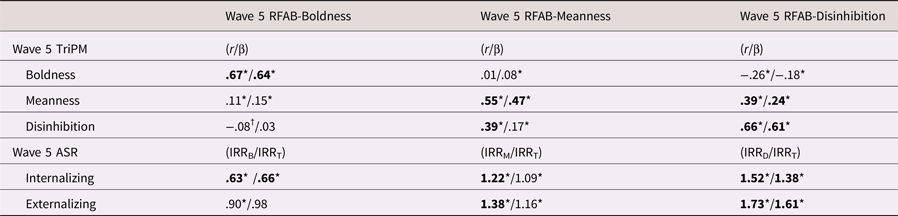
As shown in Table 3 (upper part), each Wave 5 RFAB-Tri scale was most strongly predictive of its corresponding Wave 5 TriPM scale at the zero-order level (rs = .55 to .67, ps < .005) and in regression models that included the other RFAB-Tri scales as concurrent predictors (βs = .47 to .64, ps < .005). In the regression model for TriPM Boldness, modest secondary associations were evident for RFAB-Meanness and RFAB-Disinhibition, in opposing directions (βs = .08 and −.18, respectively, ps < .01). In the regression model for TriPM Meanness, RFAB Disinhibition emerged as a secondary positive predictor (β = .24, p < .005), and in the model for TriPM Disinhibition, RFAB Meanness emerged as a secondary positive predictor (β = .17, p < .005).
Concurrent relations of Wave 5 Risk Factors for Antisocial Behavior (RFAB)-Triarchic scales with Wave 5 criterion measures: psychopathy and internalizing/externalizing symptomatology

Note. Ns = 975 for TriPM and 1,009 for ASR analyses. IRRB,M,D = incidence rate ratio from models including a single RFAB-Triarchic scale predictor (Boldness, Meanness, or Disinhibition); IRRT = incidence rate ratio for a given predictor when other RFAB-Triarchic scales were also included in the model. rs and βs > .20 and IRRs > 1.20 or < .80 with ps < .005 are bolded. Multiple Rs for TriPM models = .69, .61, and .68, respectively.
*p < .005,
† p < .05.
When entered as single predictors in separate NB regression models, each individual RFAB-Tri scale was significantly predictive of ASR Internalizing scores, with RFAB-Boldness relating negatively (IRR = .63, p < .005) and RFAB-Meanness and Disinhibition relating positively (IRRs = 1.22 and 1.52, ps < .005; see Table 3, lower part). When all three scales were entered together as predictors of internalizing, similarly robust associations were evident for RFAB-Boldness and Disinhibition (IRRs = .66 and 1.38, respectively, ps < .005), but the positive association for Meanness became weaker in magnitude (IRR = 1.09, p < .005). For ASR Externalizing scores, the single-predictor models yielded sizable positive associations for RFAB-Meanness and Disinhibition (IRRs = 1.38 and 1.73, ps < .005) and a negative relationship for RFAB-Boldness (IRR = .90, p < .005). When all three RFAB-Tri scales were included as predictors of ASR Externalizing, RFAB-Disinhibition retained its strong predictive association (IRR = 1.61, p < .005), whereas relations for RFAB-Meanness and Boldness became weak and negligible, respectively (IRRs = 1.16 and .98, ps < .005 and >.10).
Wave 5 RFAB-Tri scales: Concurrent relations with criterion measures of antisocial behavior and substance use
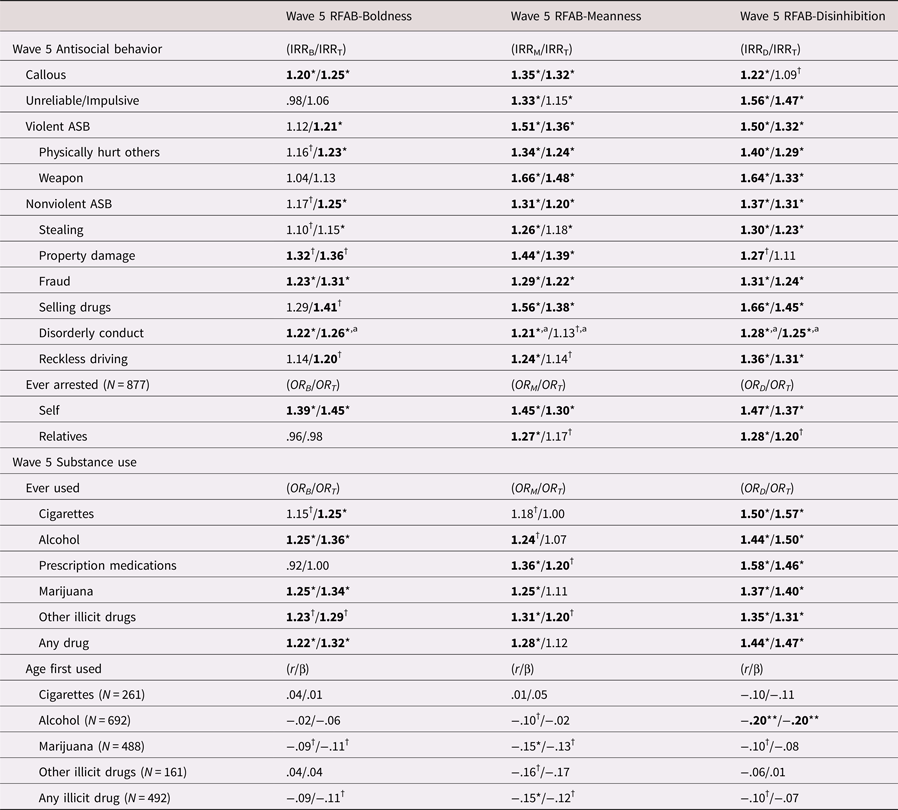
As shown in Table 4 (upper part), RFAB-Meanness and Disinhibition were weakly to moderately related to most forms of antisocial behavior, both when the scales were entered individually into single-predictor NB regression models (IRRs = 1.21 to 1.66, ps < .005), and when entered together into joint-predictor models (IRRs = 1.15 to 1.48, ps < .005). The only exceptions were that RFAB-Meanness did not significantly predict history of disorderly conduct or reckless driving in the joint NB models for these ASB variables, and RFAB-Disinhibition did not significantly predict callous behavior or engagement in property damage in the joint models for these variables. Of note, RFAB-Boldness was weakly to moderately related to most forms of antisocial behavior, and these relations were generally strengthened when accounting for the other RFAB-Tri scales in joint regression models. The exception was that RFAB-Boldness was unrelated to unreliable/impulsive behavior or use of a weapon, either in the single- or joint-predictor models for these variables. Logistic regression was used to evaluate predictive associations with two dichotomous ASB variables: personal history of arrest, and having a relative with an arrest history. Each RFAB-Tri scale significantly predicted increased likelihood of personal arrest history in both single- and joint-predictor logistic regression models for this ASB variable (ORs [odds ratio] = 1.30 to 1.47, ps < .005), with Boldness exhibiting the strongest independent predictive association. By contrast, for family history of arrest, RFAB-Meanness and Disinhibition, but not Boldness, evidenced significant predictive associations (IRRs = 1.27 and 1.28, ps < .005) in single-predictor models, which became weaker (ORs = 1.17 and 1.20, ps < .05) in the joint-predictor model.
Concurrent relations of Wave 5 Risk Factors for Antisocial Behavior (RFAB)-triarchic scales with Wave 5 criterion measures: antisocial behavior and substance use

Note. Ns = 823 or as indicated for Antisocial Behavior variables; 990 or as indicated for Substance Use variables. ASB = antisocial behavior. “Any drug” (for “ever used” variable) = prescription medications, marijuana, or other illicit drugs; “Any illicit drug” (for “age first used” variable) = marijuana or other illicit drugs. IRR/OR B,M,D = incidence rate ratio or odds ratio from models including a single RFAB-Triarchic scale predictor (Boldness, Meanness, or Disinhibition); IRR/OR T = incidence rate ratio or odds ratio for a given predictor when other RFAB-Triarchic scales were also included in the model. IRRs/ORs > 1.20 or < .80 with ps < .05 are bolded. Multiple Rs for “Age First Used” models = .11, .21, .19, .17, and .19, respectively.
*p < .005,
† p < .05.
a The iteration limit was reached while fitting theta for these models.
As shown in Table 4 (lower part), RFAB-Disinhibition emerged as the strongest predictor of having used substances of all types – including cigarettes, alcohol, prescription medications (for non-medical reasons), marijuana, and other illicit drugs, both in single-predictor logistic regression models (ORs = 1.35 to 1.58, ps < .005) and in joint-prediction models (ORs = 1.31 to 1.57, ps < .005). That is, a 1SD increase over the mean of RFAB-Disinhibition was associated with a 31 to 57% increase in the odds of having ever used these various substances. RFAB-Boldness predicted use of marijuana and other illicit drugs at a level similar to Disinhibition, and also evidenced significant or trend-level (p < .05) associations with use of all other substances except prescription medications, in both single- and joint-predictor models. By contrast, RFAB-Meanness exhibited significant or trend-level (p < .05) prediction for four of the six substance variables in single-predictor logistic models; in joint-predictor models, it showed weak (ps < .05) prediction for two substance use variables (prescription medications, illicit drugs other than marijuana) and negligible prediction (ps > .10) for the other four. RFAB-Meanness showed a significant zero-order association with earlier age at first use of marijuana and illicit drugs overall (both rs = −.15, ps < .005), in addition to weaker associations (ps < .05) with age at first use of alcohol and other illicit drugs. RFAB-Disinhibition was significantly associated with earlier age at first use of alcohol (r = −.20, p < .005) and marginally for marijuana and illicit drugs overall (ps < .05). However, in joint-prediction (OLS regression) analyses, only the association for RFAB-Disinhibition with earlier age at first use of alcohol remained significant, with marginal (p < .05) independent associations of Meanness with marijuana and illicit drugs overall. RFAB-Boldness showed weak associations with earlier age at first use of marijuana at the zero-order level, and of both marijuana and illicit drugs more broadly in the regression model (r for each = −.11, ps < .05).
Longitudinal relations of RFAB-Tri scales with criterion measures at Wave 5
Wave 3 RFAB-Tri scales: Longitudinal relations with criterion measures of psychopathy and internalizing/externalizing symptomatology
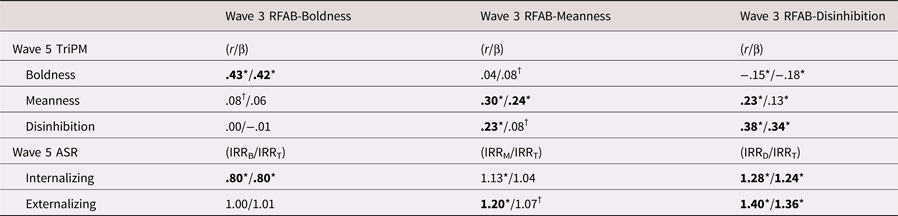
As shown in Table 5 (upper part), a pattern of predictive associations similar to that for Wave 5 RFAB-Tri scales emerged for the Wave 3 RFAB-Tri scales as predictors of Wave 5 TriPM scores, with the magnitudes of rs and Bs expectably attenuated due to the moderate-level temporal stability of RFAB-Tri scores across the two waves. In regression models, Wave 5 TriPM Boldness was predicted most strongly by Wave 3 RFAB-Boldness, and secondarily (in the reverse direction) by Wave 3 Disinhibition (βs = .42 and −.18, respectively, ps < .005). Wave 5 TriPM Meanness was predicted most robustly by Wave 3 RFAB-Meanness, and to a secondary degree by Wave 3 RFAB-Disinhibition (βs = .24 and .13, ps < .005). In the case of Wave 5 TriPM Disinhibition, significant independent prediction was observed only for Wave 3 RFAB-Disinhibition (β = .34, p < .005).
Longitudinal relations of Wave 3 Risk Factors for Antisocial Behavior (RFAB)-Triarchic scales with Wave 5 criterion measures: psychopathy and internalizing/externalizing symptomatology

Note. Ns = 698 for Wave 5 TriPM scales and 718 for Wave 5 ASR scales. IRR/ORB,M,D = incidence rate ratio or odds ratio from models including a single RFAB-Triarchic scale predictor (Boldness, Meanness, or Disinhibition); IRR/ORT = incidence rate ratio or odds ratio for a given predictor when other RFAB-Triarchic scales were also included in the model. rs and βs > .20 and IRRs > 1.20 or < .80 with ps < .05 are bolded. Multiple Rs for TriPM models = .46, .32, and .39, respectively.
*p < .005,
† p < .05.
When examined individually in single-predictor NB regression models, Wave 3 RFAB-Boldness and Disinhibition each showed moderate associations – negative and positive, respectively (IRRs = .80 and 1.28, ps < .005) – with Wave 5 ASR Internalizing, and these associations were maintained in the joint NB model incorporating all three RFAB-Tri scales as predictors (IRRs = .80 and 1.24, ps < .005). Wave 3 RFAB-Meanness was related weakly to Wave 5 ASR Internalizing as an individual predictor (IRR = 1.13, p < .005) and negligibly when examined together with Boldness and Disinhibition (IRR = 1.04, p > .10). In NB regression models for Wave 5 ASR Externalizing, Wave 3 RFAB-Meanness and Disinhibition each showed significant positive associations when examined as individual predictors; when examined together in a joint model, the predictive association for Disinhibition remained significant (IRR = 1.36, p < .005), but the association for Meanness was reduced (IRR = 1.07, p < .05). Wave 3 RFAB-Boldness was not associated with Wave 5 ASR Externalizing either alone or independently from the other RFAB-Tri scales.
Wave 3 RFAB-Tri scales: Longitudinal relations with criterion measures of antisocial behavior and substance use
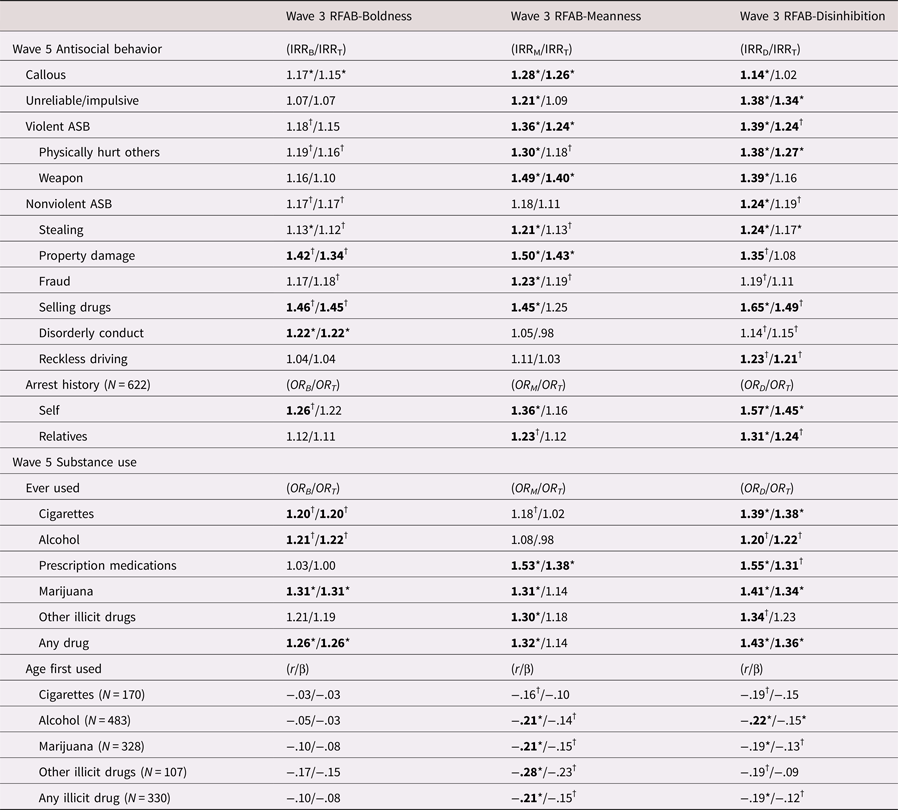
As in the concurrent Wave 5 models, Wave 3 RFAB-Meanness and Disinhibition each showed weak to moderate associations with most forms of Wave 5 antisocial behavior, both when the Wave 3 scales were entered into NB models as individual predictors (IRRs = 1.14 to 1.65, ps < .005) and when examined as co-predictors (IRRs = 1.17 to 1.43, ps < .005; see Table 6, upper part). Concurrently observed associations that did not extend to longitudinal regression analyses included unreliable/impulsive behavior, nonviolent antisocial behavior, selling drugs, disorderly conduct, and reckless driving for Wave 3 RFAB-Meanness, and callous behavior, use of a weapon, and fraud for Wave 3 RFAB-Disinhibition. When examined as an individual predictor, Wave 3 RFAB-Boldness showed significant (p < .005) associations with Wave 5 callous behavior, stealing, and disorderly conduct, and weaker (p < .05) associations with Wave 5 physically hurting others, overall violent ASB, property damage, selling drugs, and overall nonviolent ASB. All these associations, apart from that with Wave 5 overall violent ASB, were maintained in joint NB regression models. Single-predictor logistic regression analyses revealed associations for each Wave 3 RFAB-Tri scale with Wave 5 personal arrest history, with only a weak effect for Boldness, but independent prediction was evident only for Wave 3 Disinhibition in the joint-predictor logistic regression for this ASB variable (OR = 1.45, p < .005). For family history of arrest, predictive relations were evident for both Wave 3 RFAB-Meanness and Disinhibition in the single-predictor analyses, but only weakly for Disinhibition in the joint analysis.
Longitudinal relations of Wave 3 Risk Factors for Antisocial Behavior (RFAB)-Triarchic scales with Wave 5 criterion measures: antisocial behavior and substance use

Note. Ns = 594 or as indicated for antisocial behavior variables; 707 or as indicated for substance use variables. ASB = antisocial behavior. “Any drug” (for “ever used” variable) = prescription medications, marijuana, or other illicit drugs; “any illicit drug” (for “age first used” variable) = marijuana or other illicit drugs. IRR/ORB,M,D = incidence rate ratio or odds ratio from models including a single RFAB-Triarchic scale predictor (Boldness, Meanness, or Disinhibition); IRR/ORT = incidence rate ratio or odds ratio for a given predictor when other RFAB-Triarchic scales were also included in the model. IRRs/ORs > 1.20 or < .80 with ps < .05 are bolded. Multiple Rs for “age first used” models = .22, .25, .25, .33, and .25, respectively.
* p < .005,
† p < .05.
Results for Wave 3 RFAB-Tri scales as predictors of Wave 5 substance use variables paralleled those for the Wave 5 concurrent analyses in some ways, but differed in others (see Table 6, lower part). Wave 3 RFAB-Disinhibition was again the strongest independent predictor of ever having used cigarettes or illicit drugs as a whole, and Wave 3 Boldness and Disinhibition were similarly predictive of marijuana use history. However, in contrast with results from the Wave 5 concurrent analyses, dichotomous history of alcohol use was predicted similarly by Wave 3 Boldness and Disinhibition; prescription medication use was predicted slightly more strongly by Wave 3 Meanness than Disinhibition; and use of other illicit drugs was not predicted independently by any Wave 3 RFAB-Tri scale. Wave 3 Meanness and Disinhibition were also more similarly predictive of age at first use of alcohol, marijuana, and overall illicit drugs than in the Wave 5 concurrent analyses, where Wave 5 Meanness appeared most predictive for marijuana and overall illicit drugs and Disinhibition for alcohol.
Discussion
Despite the triarchic model's initial conceptualization within the developmental literature, the majority of relevant work to date has centered on adults, and research seeking to understand the separability and differential correlates of the triarchic traits across childhood and adolescence is only just beginning. The current study provides an important addition to the literature by establishing measures of the triarchic model traits in a rich dataset consisting of child participants tested at five successive age points, and by demonstrating convergent and discriminant validity of these measures in relation to other measures of psychopathy and psychopathology. Specifically, this study utilized data from the USC RFAB study, a large longitudinal-twin investigation that includes myriad measures from different assessment modalities (i.e., self-report, parent and teacher ratings, clinical interview, task behavioral, physiological), allowing for a unique opportunity to examine psychopathy within a developmental framework. Findings from the present study shed light on how the triarchic traits manifest throughout development and how they relate to different forms of psychopathology across time.
Operationalization of triarchic model traits in the RFAB study dataset
One major aim of the current study was to develop scales for indexing the triarchic traits at Waves 3 and 5 (ages 14–15 and 19–20) of the RFAB study, to permit examination of their temporal stability from mid-adolescence to adulthood and to allow for twin-etiologic analyses in the future. Using an approach that has proven effective in prior work (Brislin et al., Reference Brislin, Drislane, Smith, Edens and Patrick2015, Reference Brislin, Patrick, Flor, Nees, Heinrich, Drislane and Schumann2019; Hall et al., Reference Hall, Drislane, Patrick, Morano and Poythress2014), we created scale measures of boldness, meanness, and disinhibition composed of items from the CPS along with a smaller number of items from age-appropriate ASEBA measures. Despite their brevity (10–12 items each), the scales provided effective content coverage of the triarchic traits and showed acceptable internal consistencies at both Waves 3 and 5.
In line with findings for other triarchic scale measures (e.g., Brislin et al., Reference Brislin, Drislane, Smith, Edens and Patrick2015; Drislane et al., Reference Drislane, Patrick and Arsal2014; Hall et al., Reference Hall, Drislane, Patrick, Morano and Poythress2014), a moderate positive correlation was evident between the RFAB-Meanness and Disinhibition scales, both at Wave 3 and at Wave 5. RFAB-Meanness and Boldness were correlated to a nonsignificant positive degree at Wave 3, and to a near-zero degree at Wave 5. RFAB Boldness and Disinhibition were correlated negligibly at Wave 3, but somewhat negatively at Wave 5. In past studies with adult community samples that have used other triarchic scale measures, boldness and meanness have often been correlated to a modest positive degree, and boldness and disinhibition have typically been uncorrelated (Drislane & Patrick, Reference Drislane and Patrick2017). The significant (albeit modest) negative association between RFAB Boldness and Disinhibition at Wave 5 is the finding that contrasts most with results for other Tri scale sets in adult samples. Of note, however, a significant negative correlation was also evident between TriPM Boldness and Disinhibition in the Wave 5 sample (r = −.14, p < .001). This suggests that this unexpected negative correlation at Wave 5 reflects idiosyncratic characteristics of the RFAB participant sample at this assessment point rather than differential functioning of the RFAB-Tri scale versions relative to their TriPM counterparts.
Each scale also showed significant temporal stability from Wave 3 to Wave 5. Observed stability coefficients for RFAB-Boldness and Disinhibition (~.5 in each case) were commensurate with those reported in a prior study that examined the temporal stability of conceptually similar psychopathic trait measures from age 17 to age 24 (Blonigen, Hicks, Krueger, Patrick, & Iacono, Reference Blonigen, Hicks, Krueger, Patrick and Iacono2006). Somewhat lower temporal stability (.32) was evident for the RFAB-Meanness score across these two time points. This finding is interesting in light of evidence for an impact of family environmental influences on callous-unemotional tendencies at younger ages of life (Hyde et al., Reference Hyde, Waller, Trentacosta, Shaw, Neiderhiser, Ganiban and Leve2016; Pardini, Lochman, & Powell, Reference Pardini, Lochman and Powell2007), and other evidence indicating that the contribution of such environmental influences to antisocial proclivities does not extend into adulthood (Krueger et al., Reference Krueger, Hicks, Patrick, Carlson, Iacono and McGue2002). The implication is that the lower stability of RFAB-Meanness scores from Wave 3 to Wave 5 might reflect a decrease in the role of family influences, such as parenting style (Pardini et al., Reference Pardini, Lochman and Powell2007), in callous-unemotional proclivities from mid-adolescence to young adulthood.Footnote 3 Importantly, each Wave 3 RFAB-Tri scale related selectively to its Wave 5 counterpart when controlling for Wave 3 scores on the other two triarchic scales (e.g., Wave 3 Meanness related selectively to Wave 5 Meanness when controlling for Wave 3 Boldness and Disinhibition). Taken together, the observed reliability, stability, and specificity of the RFAB-Tri scales appear consistent with those reported in the literature for other triarchic scale measures.
Situating the RFAB-triarchic scales in a nomological network
A further aim of this study was to examine associations of the triarchic traits as indexed by the RFAB-Tri scales with external criterion measures both in adolescence (Wave 3) and in young adulthood (Wave 5). Results were largely consistent with hypotheses. Importantly, the Wave 5 RFAB- Tri scales – and the Wave 3 RFAB-Tri scales, at expected smaller levels – showed strong and selective associations with their Wave 5 TriPM counterparts in bivariate correlations and multiple regression models.
Consistent with the strong correspondence between the RFAB-Tri scales and their TriPM counterparts, the RFAB scales largely exhibited patterns of associations with concurrently assessed criterion variables similar to those previously found for the TriPM (for reviews, see Patrick & Drislane, Reference Patrick and Drislane2015; Sellbom et al., Reference Sellbom, Lilienfeld, Fowler, McCrary and Patrick2018). In line with the idea of boldness being protective against internalizing psychopathology (Patrick, Reference Patrick and Patrick2018; Patrick et al., Reference Patrick, Fowles and Krueger2009), RFAB-Boldness at Waves 3 and 5 was robustly and negatively related to overall anxious-depressive symptomatology assessed concurrently. By contrast, RFAB-Boldness was inconsistently related to externalizing symptomatology as a whole, showing a slight positive association at Wave 3 and a slight negative association at Wave 5. With regard to other measures of psychopathy and antisocial behavior, Wave 3 RFAB-Boldness was weakly positively correlated with overall APSD scores (r = .08, p < .05), but not with any APSD subscales, in line with findings from a prior study of young adults (Drislane et al., Reference Drislane, Patrick and Arsal2014). At Wave 5, however, RFAB Boldness was positively related to some forms of concurrently assessed antisocial behavior, particularly when controlling for the other RFAB-Tri scales; indeed, Boldness emerged as the strongest unique predictor of fraudulent behavior and personal arrest history. RFAB-Boldness also showed significant or near-significant associations with use of all substances except prescription medications, and was related to use of marijuana and other illicit drugs at levels similar to Disinhibition. These results are in line with other work showing boldness to be related to lower reactive control (cautious restraint) and greater substance use, in addition to higher resiliency (Dotterer et al., Reference Dotterer, Waller, Cope, Hicks, Nigg, Zucker and Hyde2017; Hicks et al., Reference Hicks, Iacono and McGue2014). While disinhibition is more obviously related to a lack of cautious restraint, boldness appears to relate to it as well through features of venturesomeness and low social inhibition.
RFAB-Meanness evidenced unique predictive relations, over and above other RFAB-Tri scales, with concurrently assessed externalizing but not internalizing symptomatology at Wave 3; in contrast, at Wave 5, it was related to both forms of psychopathology. It may be that adversarial encounters and undesired consequences arising from callous-aggressive proclivities are conducive to the emergence of internalizing problems of certain types across time. As expected, Wave 3 RFAB-Meanness showed a selective association with the callous-unemotional symptom facet of the APSD at Wave 3, both at the bivariate level and in regression models controlling for the other traits. Wave 5 RFAB-Meanness was also related to most forms of concurrently assessed antisocial behavior, with associations strongest in relation to callous, violent, and destructive forms of antisocial behavior – in line with the triarchic model's characterization of meanness as involving callous aggressiveness (Patrick et al., Reference Patrick, Fowles and Krueger2009). Like Boldness, Meanness showed a unique predictive association with personal arrest history, but – unlike Boldness (though similar to Disinhibition; see below) – showed some evidence of an association with family arrest history.
In contrast to Meanness, RFAB-Disinhibition was uniquely predictive of concurrently assessed externalizing and, to a lesser extent, internalizing symptomatology at both Waves 3 and 5, demonstrating larger effects than those for Meanness. These findings accord with the idea that trait disinhibition reflects general proneness to externalizing problems (Patrick et al., Reference Patrick, Fowles and Krueger2009; Yancey, Venables, Hicks, & Patrick, Reference Yancey, Venables, Hicks and Patrick2013) and includes an element of deficient affect-regulation (Patrick et al., Reference Patrick, Fowles and Krueger2009; Perkins, Sörman, McDermott, & Patrick, Reference Perkins, Sörman, McDermott and Patrick2019) that is directly conducive to internalizing problems (Venables et al., Reference Venables, Hicks, Yancey, Kramer, Nelson, Strickland and Patrick2017). Consistent with this notion, Wave 3 RFAB-Disinhibition alone showed a selective association with the Impulsivity facet of the APSD. At Wave 5, Disinhibition showed positive associations with most forms of antisocial behavior, with the strongest unique effects for unreliable/impulsive deviancy, stealing, drug-selling, and reckless driving. RFAB-Disinhibition was also the strongest concurrent predictor of use of substances of all kinds, including cigarettes, prescription medications, and other illicit drugs. These findings are consistent with prior work in adults showing that disinhibition represents a liability to diverse forms of externalizing psychopathology, including both antisocial and substance-related problems (Iacono, Carlson, Taylor, Elkins, & McGue, Reference Iacono, Carlson, Taylor, Elkins and McGue1999; Krueger et al., Reference Krueger, Hicks, Patrick, Carlson, Iacono and McGue2002, Reference Krueger, Markon, Patrick, Benning and Kramer2007). Like meanness, disinhibition also showed a unique predictive association with personal arrest history and some evidence of an association with family arrest history. The finding that family arrest history was associated jointly with disinhibition and meanness accords with the suggestion (Patrick & Vaidyanathan, Reference Patrick and Vaidyanathan2011) that these traits may underlie to an important degree the well-documented phenomenon of family transmission of antisocial behavior (Frisell, Lichtenstein, & Långström, Reference Frisell, Lichtenstein and Långström2011; Hicks, Krueger, Iacono, McGue, & Patrick, Reference Hicks, Krueger, Iacono, McGue and Patrick2004).
While some published work has reported longitudinal predictive relations for the trait of disinhibition in adolescence with later internalizing and externalizing problems (Brislin et al., Reference Brislin, Patrick, Flor, Nees, Heinrich, Drislane and Schumann2019), the current study is the first to evaluate longitudinal associations of all three triarchic traits with these broad categories of psychopathology, and with antisocial behaviors and substance abuse specifically. Scores on each of these traits at Wave 3 contributed uniquely to problems of particular types at Wave 5. From Wave 3 to Wave 5, RFAB-Boldness showed unique associations with internalizing symptomatology (negatively), callous behavior (positively), and disorderly conduct (positively), as well as trend-level (p < .05) positive associations with physical aggression and most forms of nonviolent antisociality. These findings suggest that in addition to its adaptive aspects, the trait of boldness is also associated with certain maladaptive and antisocial behaviors (e.g., Almeida et al., Reference Almeida, Seixas, Ferreira-Santos, Viera, Paiva and Costa2015; Lilienfeld et al., Reference Lilienfeld, Patrick, Benning, Berg, Sellbom and Edens2012). Wave 3 Meanness showed unique predictive relations with callous, instrumental-aggressive, and destructive forms of antisocial behavior as well as with non-medical use of prescription medications at Wave 5, and was uniquely related at a trend level (p < .05) to general externalizing symptomatology. These findings for Meanness are in line with prior work demonstrating that adolescents high in callous-unemotional traits experience less distress related to the consequences of their behavior and are at elevated risk for later conduct problems, delinquency, and substance use (Baskin-Sommers, Waller, Fish, & Hyde, Reference Baskin-Sommers, Waller, Fish and Hyde2015; Frick & White, Reference Frick and White2008; Wymbs et al., Reference Wymbs, McCarty, King, McCauley, Vander Stoep, Baer and Waschbusch2012). Finally, Wave 3 Disinhibition showed the strongest unique predictive association with Wave 5 externalizing symptomatology, and, to a lesser degree, uniquely and positively predicted Wave 5 internalizing symptomatology – in contrast to the negative association for Boldness. From Wave 3 to Wave 5, RFAB-Disinhibition also predicted unreliable/impulsive deviancy, physical aggression, stealing, personal history of arrest, and use of most types of substances, as well as showing trend-level (p < .05) associations with drug-selling, reckless driving, and family history of arrest. Broadly, results corroborate the notion that disinhibition is a liability factor for a range of externalizing problems (Yancey et al., Reference Yancey, Venables, Hicks and Patrick2013; Young et al., Reference Young, Friedman, Miyake, Willcutt, Corley, Haberstick and Hewitt2009).
These findings contribute to the existing literature in important respects. They help to address current debates (e.g., Lilienfeld et al., Reference Lilienfeld, Patrick, Benning, Berg, Sellbom and Edens2012; Miller & Lynam, Reference Miller and Lynam2012) regarding the clinical relevance of boldness by showing that this facet of psychopathy predicts later occurrence of certain antisocial and substance use behaviors, while also protecting against the later emergence of internalizing problems. They demonstrate specificity in predictive associations for meanness, akin to the well-established construct of callous unemotionality (Frick et al., Reference Frick, Ray, Thornton and Kahn2014), with later emergence of instrumental-aggressive and destructive antisocial behavior. In addition, they highlight the importance of trait disinhibition – which has received relatively limited attention in the child antisocial behavior literature (Wygant, Pardini, Marsh, & Patrick Reference Wygant, Pardini, Marsh, Patrick and Patrick2018) – to the later emergence of both physically aggressive and nonaggressive forms of antisocial behavior, along with substance use of various types.
Limitations and future directions
Some limitations of the current study warrant mention. One is that the number and range of criterion measures available at Wave 5 was greater than at Wave 3. As such, the reported associations between the RFAB-Tri scales and criterion measures at Wave 3 do not provide as complete picture of the manifestation of the traits at this point (age 14–15) as was possible at Wave 5 (age 19–20). Additionally, compared with the RFAB-Boldness and Disinhibition scales, RFAB-Meanness showed lower stability from Wave 3 to Wave 5. As suggested in the preceding section, this could reflect a shift in the determining role of family environmental influences on Meanness scores from the earlier to the later wave. However, other possible explanations are that participants lacked insight into certain aspects of this trait or were hesitant to endorse them at one age point versus the other. In the future, utilizing multi-informant data (i.e., parent and child) to examine the development of the triarchic traits may provide a clearer picture of how each construct presents over time. With regard to meanness, such an approach could better capture both the internal experience of low emotionality and the behavioral expression of lack of empathy, providing a more comprehensive assessment of this triarchic trait. It will also be valuable in future work to directly evaluate whether differences in the role of shared (e.g., family) environmental influences at different ages account for the lower temporal stability of RFAB-Meanness.
In developing the three RFAB-Tri scales and demonstrating their effectiveness as measures of the triarchic model of psychopathy, the current work sets the stage for valuable follow-up work with this large-scale dataset. In particular, the RFAB study holds great potential for clarifying the etiologic role the triarchic traits play in clinical problems of various types given its longitudinal and twin-participant features and its inclusion of measures from multiple modalities, including self-report, clinical-diagnostic, task-performance, psychophysiological, and neuroimaging data. The availability of effective triarchic scale measures in this dataset will also allow for future systematic progress in characterizing the nomological network of the triarchic model traits with respect to domains of neurobiology and behavioral performance, and in evaluating the etiologic basis of relations of neural, behavioral, and clinical-problem variables with boldness, meanness, and disinhibition (Venables et al., Reference Venables, Hicks, Yancey, Kramer, Nelson, Strickland and Patrick2017; Yancey et al., Reference Yancey, Venables, Hicks and Patrick2013; see also Palumbo et al., Reference Palumbo, Patrick and Latzman2020). Given evidence that the triarchic traits represent core biobehavioral dispositions related to diverse forms of psychopathology (Nelson, Strickland, Krueger, Arbisi, & Patrick, Reference Nelson, Strickland, Krueger, Arbisi and Patrick2016; Patrick et al., Reference Patrick, Durbin and Moser2012, Reference Patrick, Kramer, Krueger and Markon2013a,Reference Patrick and Vaidyanathanb), the current work will not only facilitate future research on psychopathy, but also allow for further investigation of the role of heritable biological liability factors and accumulating experiential influence in the emergence and course of other psychopathological conditions.
Supplementary Material
The supplementary material for this article can be found at https://doi.org/10.1017/S0954579420002060
Funding Statement
The work reported in this article was supported by U.S. Army grant W911NF-14-1-0018 (C.J.P.) and National Institute of Mental Health grants F31MH122096 (E.R.P.) and T32MH93311-08 (E.R.P.). The USC RFAB twin study was supported by NIMH grant R01-MH58354. The content of this paper is solely the responsibility of the authors and does not necessarily represent the official views of the U.S. Government, Department of Defense, Department of the Army, Department of Veterans Affairs, or U.S. Recruiting Command.
Conflicts of Interest
None