IntroductionFootnote 1
One might well wonder what time Banks is actually chasing in the exhilarating song, ‘Chasing Time’. What compels her to steer away from ‘straight time’ with such alacrity? And, how does music eroticise her act? Born in 1991, Azealia Banks hails from Harlem, New York. Accounts of her childhood and youth reveal a rags-to-riches story, involving an abusive mother and a struggle to make ends meet by dancing at a strip club in Queens.Footnote 2 At just 20 she burst onto the international music scene with her acclaimed debut single, ‘212’ (2011). Garnering much attention owing to her versatile rapping style and sexually explicit lyrics,Footnote 3 Banks rapidly gained a reputation as an unruly artist: turning to Twitter, she incited a steady stream of controversies. For example, while her open contempt of feminism has received widespread media attention and criticism,Footnote 4 her frequent use of anti-gay slursFootnote 5 has led to accusations of homophobia despite her own declared bisexuality.Footnote 6 Confrontational behaviour is not uncommon among celebrities, who feel compelled to air their everyday life experiences on various social media platforms.
Banks's persona is negotiated through articulations of revolt and self-assertion as much on-stage as off-stage. Her musical style is eclectic, with striking connections between a genre-defiant signature and an air of social disobedience. In a 2011 review of the track, ‘212’, Michael Cragg of The Guardian described the combination of her musical styles as tantamount to ‘a startling three and a half minutes of attitude’. Similarly, Banks's visual performances have chipped away at an array of norms. The music and video recordings of ‘Chasing Time’ (2014) exemplify this, warranting an inspection of how Banks straddles the line between accommodating and opposing norms in hip hop and pop. Visually, the performance oscillates between qualities that are unremarkable and confrontational within the span of a few minutes. We want to argue that the disruptive aspects of her performance pose a challenge to gendered and racialised representations of women in hip hop.Footnote 7 Mysogyny still abounds in many hip hop videos, normalising the objectified female body, despite an increasing number of artists who present themselves in ways that challenge gendered stereotypes. As Tricia Rose argues, hip hop ‘as it has evolved in the commercial arena […] promotes sexist and demeaning images of women as its bread-and-butter product. The fact of hip hop's primary trade in explicit and sustained sexist images cannot reasonably be quibbled over’.Footnote 8 Banks confronts this state of being in ‘Chasing Time’, aided by various audiovisual devices that entice and unsettle. By first considering her subjectivity in the sound recording, we intend to unravel the production techniques, vocal features and aesthetics that disclose a range of strategies in play.
Sonic styling
In the pipeline since 2011, Banks's debut album, Broke With Expensive Taste (2014), was finally launched in November, 2014. The album's third official single, ‘Chasing Time’, produced by Pop Wansel, was released on 22 September 2014, and leaked online the day before. Drawing together a wealth of sounds from hip hop and EDM, the notable musical elements include intricate beats, the juxtaposition of rap and sung vocals, greatly varying sonic textures, and extensive use of effects. This prompts an investigation of subjectivity alongside genre and style, which is integral for working out the meaning and message of an individual sound recording.
Allan F. Moore has observed the similarity between style and language, arguing that musical sounds constitute different words in different languages.Footnote 9 One might say that sonic styling and language usage in ‘Chasing Time’ involves carefully regulated patterns of subjectivity; this includes everything from the choice and utilisation of microphones, filters and effects, to its ‘airbrushed’ expression in terms of auto-tune, pitch correction and compressors. At the start of the song, Banks offers a brief passage of rapped vocals. This functions as a strategy of ‘tone-setting’,Footnote 10 which relates to how sonic features can prepare the listener for specific responses. The rap vocals of the introduction, positioned to the rear of the mix, define the track's hip hop flavour. If one removes these vocals, the stylistic features of the track reveal little of Banks's skill as a rapper until the second verse, with the track operating in an electro-pop style up until that point. It is her rap vocals at the beginning of the track that expose her identity as a rapper, which in turn guide the listener's interpretation.Footnote 11
Gendered subjectivity in popular music is contingent on styles and genres, as verified by Banks's tone-setting, and moreover her personal narrative, which is articulated through notions of self-assertion, eroticisation and musical flair.Footnote 12 In the wake of hip hop's recent queer history, it is worth noting that the last decade has witnessed the dismantling of hegemonic structures, as numerous performers have pushed for diversification in terms of style, image and lyrical content. The potential for subverting the misogynistic cultural structures of hip hop from within the genre was pointed out 25 years ago by Robin Roberts, who suggested that rap's emphasis on lyrics ‘tailors it to a political agenda, for listening to the words requires thoughtful attention’.Footnote 13 Since then a number of female artists have eroded hip hop's misogyny through their images, lyrics and performances. In tandem with queer female hip hop artists, such as Iggy Azalea, Angel Haze and Nicki Minaj,Footnote 14 Banks has contributed to the gradual political subversion of the genre from within, drawing attention to alternative articulations of gender, sexuality and ethnicity through her skills as a rapper and lyricist. Identifying the culturally located meanings of gender in language, Freya Jarman stresses that ‘linguistic ability has been prized since the very roots of rap music’.Footnote 15 This is significant in relation to the myth of ‘male linguistic superiority’, where it is broadly acknowledged that males are often afforded superior language skills compared with females, who are brushed off as emotional chatterboxes. Jarman asserts that such ‘assumptions maintain their cultural hegemony’.Footnote 16 Given the male-dominated nature of the rap genre, and its organisation around the mastery of language, Banks's broadly acknowledged lyrical prowess and rap virtuosity challenges – if not subverts – the stereotype of male linguistic superiority in hip hop.Footnote 17
Banks's rapping skills are articulated vis-à-vis the non-verbal sonic intricacies that underpin a playfulness and boldness in expression. Moreover, her virtuosic performance is as much about delivery as technical mastery. Philip Auslander maintains that virtuosity ‘resides in the originality and audacity of conception and execution’.Footnote 18 In ‘Chasing Time’, this is borne out by Banks's way of teasing, where the synth accompanying her rap vocals is morphed by a filter effect that transforms in sound from bass-heavy and mellow to bright and piercing by altering the frequency range over the course of the introduction leading into the first verse. In a sense, this foreshadows the way in which the track propels the listener through ever-changing sonic textures, stylistic soundscapes and lyrical moods.
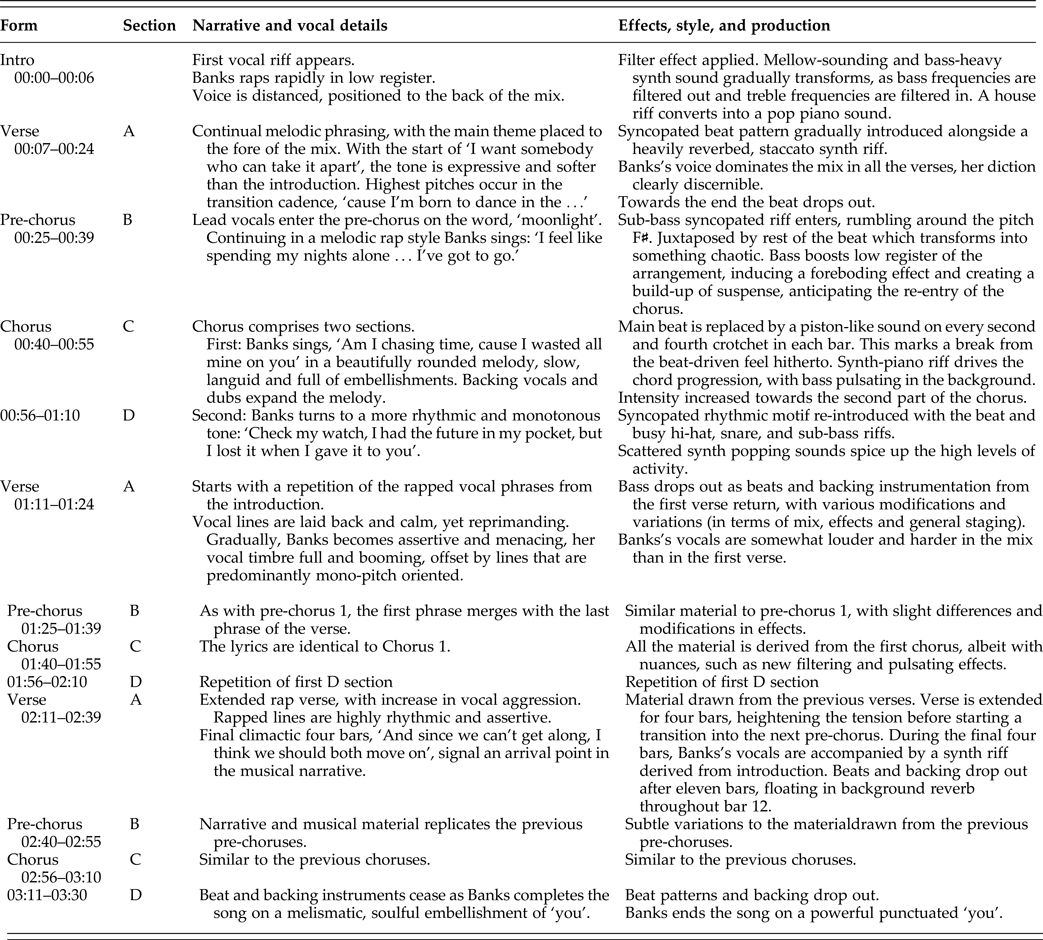
Throughout ‘Chasing Time’ a tension exists between doubt and self-assertion. The song is about broken relationships: the protagonist speaks to a current or former partner, declaring that their relationship is over. This is terminated on Banks's own terms. Grappling with matters of failed love and wasted time, the narrative fluctuates between uncertainty and self-confidence. The two-part choruses offer recourse for considering the ways in which such opposing emotions are navigated both lyrically and musically. In the first part of the choruses (C), Banks sings, ‘am I chasing time?’ in a slow-paced, alluring, ornamented melodic hook – her question lingering on alongside the final extended note of the phrase (Table 1). In stark contrast, though, the second part of the choruses (D) marks a change in attitude with the more assertive lyrics: ‘check my watch, I had the future in my pocket but I lost it when I gave it to you’. Banks's shift in attitude from the uncertain to the assertive is anticipated by a build-up during part C. This sonic material harks back to the synth treatment of the introduction, where a filter effect gradually introduces treble frequencies to a pulsing synth, and builds the sonic tension towards an inevitable climax. Release comes with a ‘drop’, a technique commonplace in various styles of electronic music, and the transition to part D is emphasised by the reintroduction of the beat.
Song structure: ‘Chasing Time’
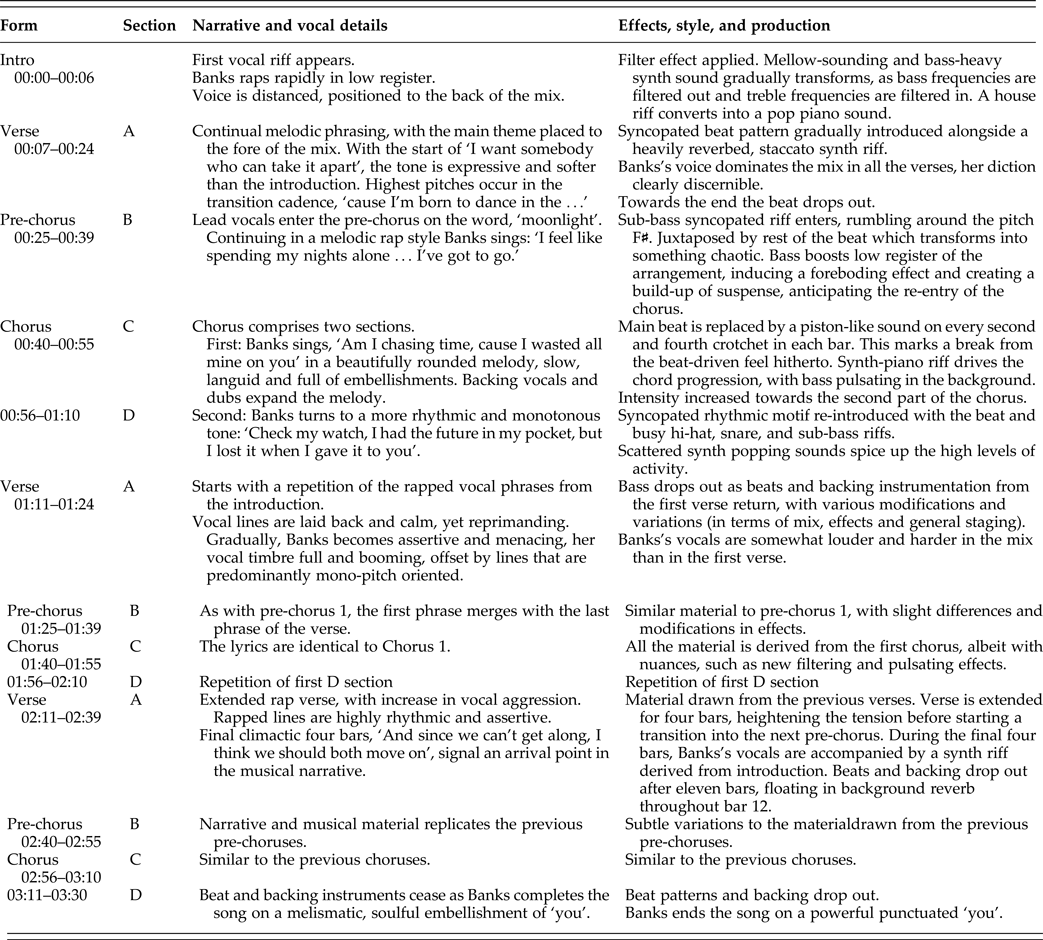
Contributing further to the sense of a clear distinction between the first and second parts of the choruses is the specific vocal treatment. An air of uncertainty in part C is evident in several tracks of backing vocals that operate in counterpoint to the lead vocal, offering alternate rhythmic emphases. Backing vocals deviate from the lyrics on eerie ooh sounds, thus creating an impression of doubt or ambiguity implied by the questioning tone of the lyrics. In contrast, the backing vocals in part D follow the lead vocal more closely melodically, rhythmically and lyrically to create a monotonous and incessant expression of the song-character's dissatisfaction over time wasted (Table 1).
Our prime musicological task is to work out how words and music stylise Banks's subjectivity in a blending of hip hop and pop idioms verbally and sonically. Her sense of self-assertion transpires through a particular kind of sonic styling. Indeed, a number of qualities in the recording of ‘Chasing Time’ capture Banks's rebellious persona and iconoclastic will to disrupt the status quo of musical style in rap music. Discernible here is a vocal flexibility that aestheticises her persona. A stylistic hybridisation results from the blatant importation of elements from house and dance music into a hip hop/R'n‘B style, which suggests a defiance of genre norms. From another perspective, ‘Chasing Time’ might be characterised as an example of ‘pop blandness’, with Banks's proficiency for genre-busting more evident in other songs.Footnote 19 Nonetheless, the convergence of pop, hip hop and EDM idioms in ‘Chasing Time’ leaves much room for assessing Banks's articulation of identity vis-à-vis the lyrics. For example, the flowing, melodic delivery in the chorus hook, ‘am I chasing time?’, is catchy and memorable, centred around the third, fourth and fifth degrees of a B♭ minor scale (D♭, Eb, F). This is juxtaposed with the rap rhymes of the verses, magnifying an expansive timbral register. Remarkably, the energised rapped verses are harnessed by Banks's percussive linesFootnote 20 as she asserts her rights by ordering her former partner to scram and get lost. In such moments, a variety of details come to the fore as the artist addresses the listener. The aggressive attitude (as evident in the lyrics) is heightened by the sound production that reinforces the distinction between differing vocal expressions; the prevalence of self-assertion in these parts relates to the perceived prominence of Banks's voice and its spatial positioning in the mix and fluctuations in sonic texture.
Conceptualising sonic spatial placement within the virtual space of a mix, Moore identifies ‘prominence’ as an important aspect, outlining four proxemic zones, the intimate, personal, social and public.Footnote 21 His list of criteria determine the positioning of the persona within the sonic space, including degrees of intervening musical material, of separation between voice and environment, lyrical content and vocal sound clarity. Banks's vocals in the rap verses fall somewhere between the intimate and personal zones. This is apparent in the speech-like rap vocals, with audible intakes of breath, vocal placement towards the front of the mix and lyrics that describe the termination of a relationship between the protagonist and the ‘you’ in the narrative. During the video, this direct mode of address is controlled by the camera framing and editing, such as at the end of the second verse with a close-up of Banks waving goodbye to her scorned lover (01:26).
So far we have suggested that the personal feel of the rap verses is in stark contrast to the choruses. This is partly due to a move from multi-tracked vocals in the choruses to a single, foregrounded lead vocal in the verses. Such a distinction is further evident in the textural and timbral changes. In contrast to the choruses, the texture is brighter and more lucid in the rap verses due to the absence of the bass. Thus, the rapping in the second and third verses is defined by the voice's separation from the rest of the track. Banks's lines tend to dominate the transparent textures owing to her compressed, crisp vocals which contrast with the rest of the mix (featuring a high dose of reverb and effects). Ultimately, it is the production of the rap verses that profiles Banks's agency by foregrounding her voice and sonically accentuating the confronting and self-assertive sentiments of the lyrics.
Sonic styling in ‘Chasing Time’ therefore forms part of a general strategy of subversion that pushes and pulls at the boundaries of a male-dominated hip hop genre. Finely regulated, Banks's singing style ascertains the biometrics of her ‘vocal print’ through a range of devices. The result is an augmented sense of reality that sharpens the human/machine binarism. In this sense, the recorded performance, with all its innovative frills, becomes a potent marker of creative endeavour and, moreover, a queer sensibility, an aspect we dwell on later in the article. Paired with an excessive audiovisual aesthetic and a whimsical propensity to self-presentation, the entire effect is considerably magnified. Banks's rap style, risqué lyrics and in-your-face attitude is thus intentionally hyperbolised through the video's signifiers, which we will now turn to.
Artifice into futurity
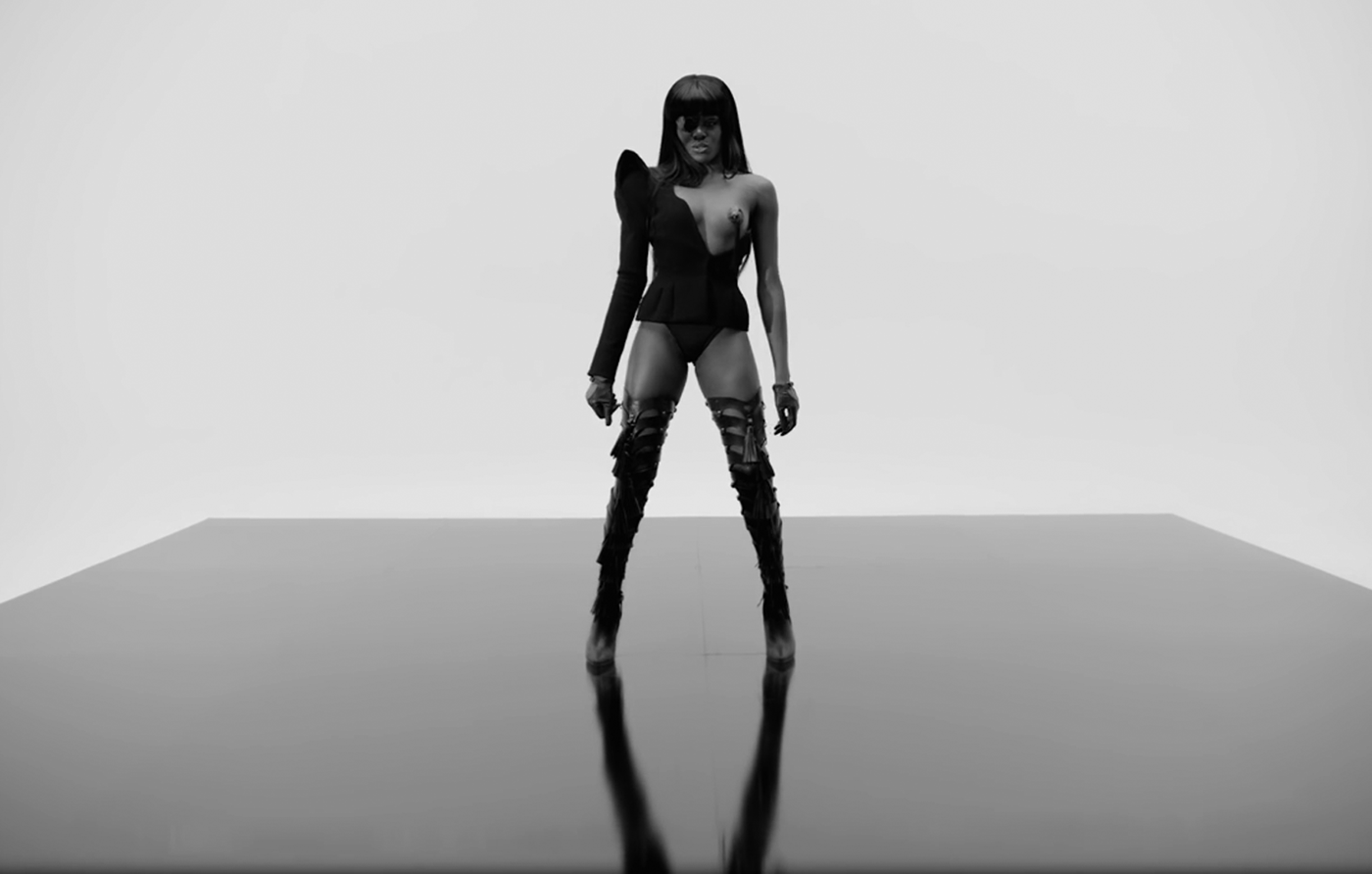
Directed by Marc Klasfeld, the video of ‘Chasing time’ is rife with intertextual references to the visual imagery of hip hop and R'n‘B icons of the 1990s,Footnote 22 as her performance exhibits a queer sensibility, the implications of which are brought to the fore by retro-futuristic costumes and effects, vogue choreography and enticing visuals. Our employment of the term ‘queer’ is not a synonym for non-hetero sexualities, but rather, as Doris Leibetseder suggests, an indicator for ‘a plural version of multiplicity and variety of different forms of human existence’.Footnote 23 Queerness thus pertains to modes of being that oppose dichotomous ways of thinking about gender, race, sexuality and so on; it is ‘a mechanism for plurality, with actions and performances involved that require critical attention […] the term “queer” can be activated as a verb, as much as an adjective’.Footnote 24 Throughout ‘Chasing Time’ Banks inspires new realities, activating notions of queerness that are predicated on one's experience of time and space in new ways.Footnote 25 The articulation of alternative ways of being is central to Banks's performance in ‘Chasing Time’, conceded to by various aesthetic manifestations. Shot entirely against a blank background, the focus of the video falls primarily on Banks, and her costuming, choreography, make-up and intense visual editing and effects. The nondescript background puts into stark relief a performance that entices and teases, and the camerawork and particular use of visual effects accentuate the temporal and spatial manipulation that goes into producing pop videos. This is discernible in scenes where Banks is shown seated on a platform suspended in air (approximately 00:43–00:48), pulsating spheres floating around her, as the hovering camera amplifies the effect of suspension. The effect is further accentuated by the musical material (00:43) when the beat drops out to expose Banks's slow-paced, legato melody. Complementing the ambiguous mood of the video, the minimalist, gloss-surfaced background works alongside excessive costuming and visual effects to inscribe a futuristic aesthetic. All through the production, the futuristic and sci-fi visuals are expertly airbrushed and digitally eroticised with elaborate camera work (framing, tracking, placement/perspective) and editing that highlight the changing modalities of femininity. Her eye-catching attire varies from an oversized jumpsuit to skin-revealing, tight-fitting leather outfits. Perhaps most memorable are the scenes of Banks in a sci-fi pirate costume, evoking impressions of the dominatrix (see Figure 1).Footnote 26 With her left breast exposed and her outfit consisting of thigh-high leather boots, leather gloves and an eye patch, she opts for a pirate look that verges on parody. The erotic allure of these visuals resides somewhere between retro-futurism and state-of-the-art aesthetics. The highly fashionable dress codes are also rendered hyperbolic by Banks's movements to the music, the immediacy of which is heightened by the stark background and highly polished floor space.
Dominatrix look from the ‘Chasing Time’ music video.
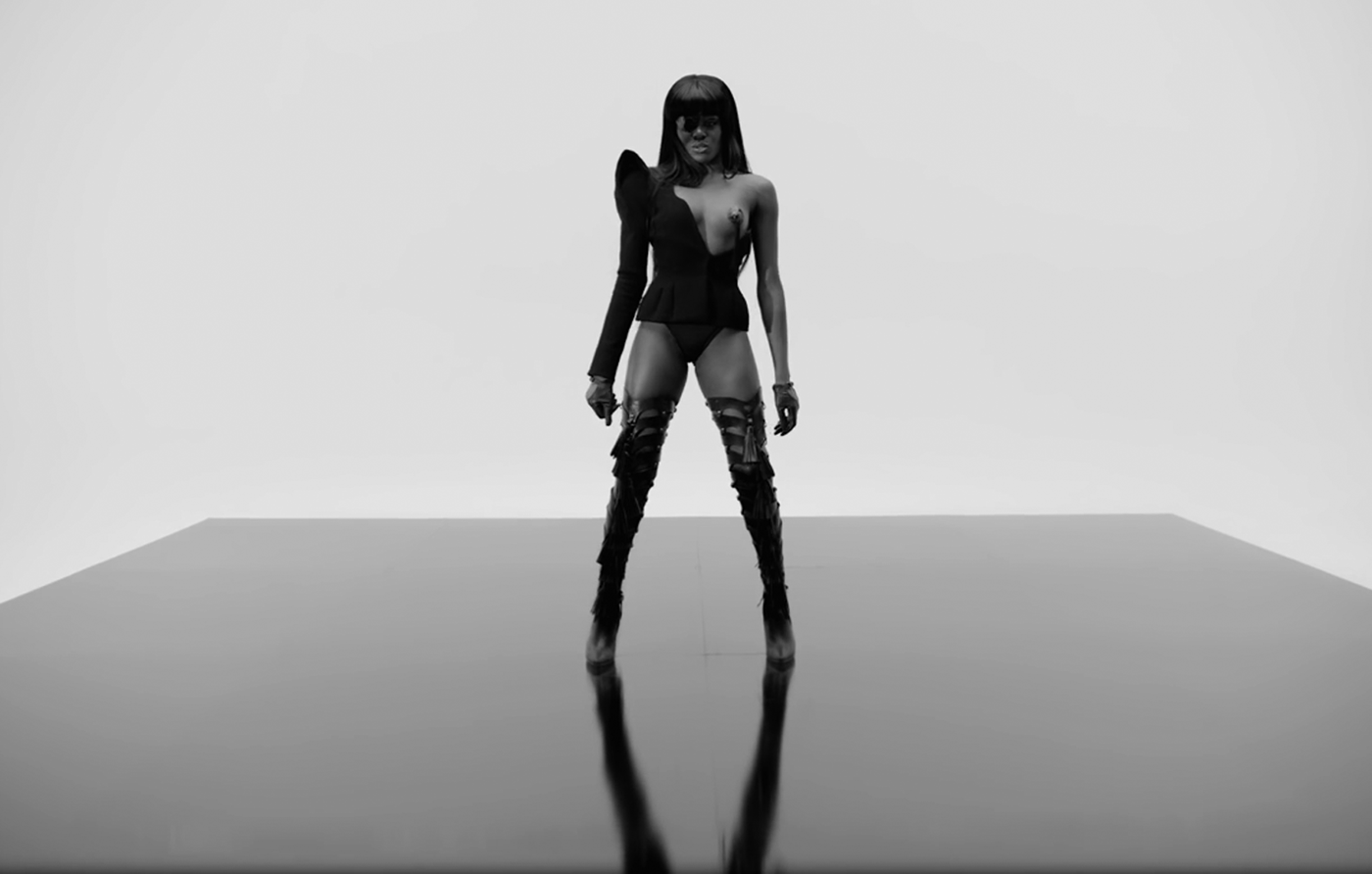
Banks's dominatrix character first appears at the start of the second verse, significantly at the point where she starts rapping. The corresponding introduction of these two elements opens up a space for the feisty lyrics, which are delivered via a meticulously crafted visual display of eroticised femininity. Banks raps as she struts around the set, writhing her hips in response to the music; scoldingly, she orders her former lover to leave her alone, thus reasserting her independence. Consolidating her rap skills alongside a provocative visual representation, she draws attention to a queering of female stereotypes in hip hop.
It is the artist's digitised audiovisual features that help queer the persona in music videos. Multi-tracking, diverse instrumentation and a wealth of effects expose the art of record production in queer ways. In addition, displays of excess contribute a camp aesthetic.Footnote 27 The video of ‘Chasing Time’ sustains a level of excess through sonic intricacies, stylistic abundance and processes of transformation that seems intentional in their theatricality. The overarching suspense brought on by the ever-shifting sonic textures is regulated within the individual parts of the song through countless devices, such as filter effects that morph the frequency range of central instruments, all in ways that revel in gestures of impertinence. This is what defines the performance's camp aesthetics. Sonically, there are camp qualities in the synth parts of the choruses, where the gradual sonic transformation builds up anticipation, drawing the listener in before the climactic reintroduction of the busy beat. In tandem with Banks's frequent costume changes and the visual effects, the sonic restlessness of the track entices and captivates. Also, the hyperbolic structures of vocality and production facilitate an eroticisation of the performer through sheer over-aestheticisation. This is underpinned by a narrative on female empowerment that raises the concerns of misogyny in hip hop and the objectifying of the female body, all of which is executed through a flamboyancy that is subversive and teasing, intended to delight and revolt.
In a study that problematises the politics of representation in music videos, Rana A. Emerson points out the hegemonic and counterhegemonic themes that occur in videos by black female performers. Generally, complex representations underline the tensions between the structural constraints of race and gender, on the one hand, and resistance and self-affirmation, on the other.Footnote 28 Black female performers often re-appropriate explicit images of black female sexuality. Emerson suggests that the ‘sometimes explicit representations of Black women's sexuality actually exemplify a process of negotiating those contradictory and often conflicting notions and, more significantly, represent an attempt to use the space of the music video to achieve control over their own sexuality’.Footnote 29 There is proof of this in the staging of Banks's performance in ‘Chasing Time’, not least in the dance routines that veer away from norms.
The choreography is organised across two separate, cross-edited scenes. These are distinguished by contrasting colour schemes – black costumes against white background vs. white costumes against black background – and introduce the possibility of parallel universes, which is made increasingly tenable by the sci-fi theme of the video. Directing the spectator towards a future of pluralities, Banks reconfigures gender norms and embraces conflicting articulations of subjectivity. José Esteban Muñoz has insisted that it is exactly such a rejection of the present and insistence on potentiality for another world that instates aspects of queerness.Footnote 30 Muñoz identifies moments of ecstasy and contemplation as disrupting straight time and getting us to step outside the norm.Footnote 31 In ‘Chasing Time’, images are slowed down or sped up at various points to call attention to the elasticity of time in music video. By inviting the viewer to partake in a process of re-imagining, then, Banks ponders over her own desire to chase time, propelling us into a queer space, where hope promises futurity.
Much attention is directed to the group of young black male dancers, their bodies stylised through costumes, camerawork and editing as they engage the viewer in the spectacle of dance. Scenes featuring the group choreography are most prominent during the post-choruses (approximately 01:58–02:13), where the physicality of frenzied movements emphasise the busy, even chaotic, character of the sonic production. While the dancers occasionally establish flirtatious eye contact with the camera (1:29–30), the focus is more on bodily movements in sequences where eye contact with the gaze of the camera lens is averted. Offering up the male dancers as objects of desire to complement Banks, ‘Chasing Time’ addresses a multifaceted gaze within a space where dominant forms of representation have traditionally denied it access. Thus, the aestheticisation of the dancers’ bodies functions as erotic signifier, reconfiguring the black, male body by displacing its naturalised role as epicentre of power within the genre.
Confirmed as much by the choreography as the musical performance, Banks is leader of the pack. During the rap verses, the sonic production foregrounds her assertive vocals. In these moments the movements of her troupe are virtually suspended as she claims attention. At one point during the second verse, all of the male dancers gather around a shape-shifting monolith (from approximately 01:16), seemingly frozen in admiration. This sculpture might be read as a metaphor for Banks's dominating, ever-shifting presence, which is made all the more obvious by a short sequence where she appears in its place, with the male dancers still frozen in a semi-circle around her. Banks walks backwards away from the camera, albeit leaning slightly towards it, yet teasingly out of reach.
Through a wealth of audiovisual devices, Banks's performance connotes female empowerment and the disciplining of erotics on her terms. The retro-futuristic aesthetic of ‘Chasing Time’ taps into the possibilities of a queer ideality that ‘can be distilled from the past and used to imagine a future’.Footnote 32 Simultaneously, the video pertains to the dynamics of gender, race and sexuality in music video. Hence, body politics are central to the appeal of audiovisual performances, where the technologised status of the performer gains momentum.
Aesthetics of gender and race production in videography
Impressions of gender and race in pop videos need to be understood in terms of their historicity as much as their mediation. Generally, artistic processes are commonly associated with self-portraiture and activated by structuring principles of gendered and racialised production. In Music Video and the Politics of Representation Diane Railton and Paul Watson remark that ‘race is not simply a result of bio-cultural heritage, but rather the product of particular discursive formations which become inscribed upon the body through processes of representation’.Footnote 33 Patterns of racial imagery that emerged from Victorian discourses of colonialism and imperialism continue to inform the ways in which blackness is represented in music video, where hypersexuality is often ‘inscribed in the fact of the black body itself’.Footnote 34 Our reading of Banks's performance in ‘Chasing Time’ and her queer politics of representation suggests that she contests the taboos and stereotypes of black sexuality and the female body.
Important is Banks's motive for subjugating the Other as part of her strategy. As a generic device for indexing performativity, she turns to hip hop to establish her authority.Footnote 35 Banks knows full well that gender and race matter in video production; after all, music videos are theatricalised enactments of the Self and connect the audio recording to visual narratives in the name of entertainment. In this sense, Banks's performance begs questions relating to transgression in gendered performativity. Our findings indicate that fissures of bodily display are intricately controlled by the technologies of the recording itself, whereby the queering of signs and figurations stimulate hyperbolic invocation. Banks illustrates this by articulating a position that is replete with paradoxes. To an excessive extent, ‘Chasing Time’ eroticises, hyperembodiesFootnote 36 and queers human features through state-of-the-art techniques. As such, Banks's persona is embedded within the production techniques themselves, which intersect with a legacy that has packaged females in the excessive tropes of the sexual commodity.
During the video of ‘Chasing Time’ an array of techniques circumscribes the politics of the body, such as the use of monochrome, a popular device in cinematic and pop video history. From the outset of her career, black and white visuals served as a trademark of Banks's videos, such as ‘212’ and ‘Luxury’. Interestingly, the editing techniques of ‘Chasing Time’ highlight elements of musical performance alongside the composite of multi-shots of Banks and her entourage. Deborah Willis and Carla Williams have provided an account of the visual techniques that traditionally document the unclothed black female body. In many of the subjects of their photographic study, The Black Female Body: A Photographic History, they consider the role of agency in terms of taking control and confronting identity constructs.Footnote 37 From this it becomes evident that the implementation of monochrome heightens the performance in terms of action, space and context, and in ‘Chasing Time’ black-and-white filming supplements the ontological profiling of Banks's body, stylising her act as art. Quite vividly, the use of monochrome theatricalises categories of ethnicity, gender and sexuality in tandem with musical style. As a result, the graphic quality of colour regulation in ‘Chasing Time’ prompts wider questions of self-reflexivity within a constructed performance-space.
Pop videos often conjure up visceral feelings of sensuality. This in itself implies that the rendering of the body visually is of political importance. Judith Butler has insisted that the visual domain is never ‘neutral to the question of race; it is itself a racial formation, an episteme, hegemonic and forceful’.Footnote 38 In its frenzied, hyperbolic state, the body on display can denote erotic sensuality in the name of artistic endeavour. ‘Chasing Time’ showcases the black female body as Banks resists, confronts, and queers the hegemonic norms of mainstream hip hop videos.Footnote 39 In tandem with her risqué lyrics – derogatory terms, such as ‘nigga’ and ‘bitch’ are employed – she hyperbolises their meaning with contempt. Consciously, Banks wrestles with the history of her African American heritage, attending to the spectacle of excess, where race and gender are boldly defined through the nuances of filming technology that manipulate and design it.
All this brings us to the politics of spectatorship. How are black female artists perceived when disidentifying with black male rappers in their videos? And, upon queering their act, how do they negotiate the heteronormative site of scopophilia? For all intents and purposes, Banks's stripped down, hypersexed look confronts the gaze by, let us say, a strategy of ‘overkill’. She accosts the issue of Western culture's long-standing tradition of mapping availability onto the black female body, which in the late 20th and 21st centuries is instated by the aesthetics and norms of music videos.Footnote 40 A more than subtle nod to pornographic culture is implied when she stages her dominatrix persona in a scene exposing her left breast (see Figure 1). Banks's excess is rooted in the unconventional and ‘not safe for work' poses, mediated via a rapid visual line-up of wardrobe changes. These spell out the hyperbolic ingredients of the spectacle: the costume shifts, the dance routines, the make-up and hair styling, the CGIFootnote 41 devices and the monochrome effects. The inferences of a virtual utopic world are framed by the affective structures of Banks's queer performance. Intrinsically, the urge to chase time has a distinct ecstatic quality to it, awash with utopian connotations.
One might say her queer tactics arise from a deep-rooted scepticism towards conformity, straightness and nationality. This is illustrated in an interview with Playboy in March 2015, where Banks reveals her disdain for American mainstream culture, stating ‘I hate everything about this country’.Footnote 42 The specifics of her on- and off-stage utterances and her very sound hint at a narrative of queer becoming, all of which has to do with temporality. Gender (in)difference, she knows, will reach out to an audience that identifies with survival and transformation. She is eager to prove that she is not bound to conventions and norms. There is something Warholian about her ludic poise in the video of ‘Chasing Time’; queer utopian aesthetics, from the garish art design of the video's sets and her imagery to her hip hop performance style, emanate from a desire to captivate the popular within or without its subtext. Thus, Banks's queer world is devoid of emotional connections, demonstrating that pop aesthetics are central to the artistic practices that go into gender production, where the urge to render the world queer is about realising the limitations of political and societal control. In other words, her modality of queerness, predicated upon musical virtuosity and hyperembodied display, offers an escape route from dead-end straight time into spaces where temporalities are expressed differently. Self-fashioning defines her gender construction, as the camera dissects her piece by piece, and the elasticity and duplicity of her iconography is made both visible and audible by the mechanisms behind the production (2:45–2:49 and 2:55–2:58). Most relevant is the way in which her body is disassembled and then morphed into new formations.
The iconography of ‘Chasing Time’ complements the musical material, the effect of which has a strong bearing on the way gender and blackness is disseminated. Pop supercharges constructs of identity in the audiovisual event, which owes much to the employment of digital technologies. ‘Chasing Time’ is a prime example of digital video art, where the technologies employed provide a commentary on gender and race. Because of the advances in techniques of compositing, artists can disrupt and resignify aspects of their identity that matter to them. Crucially, Banks's performances correlate to the pursuit of new forms of displaying the gendered and racialised body and a problematising of the cultural tropes of black femininity. In particular, her special brand of hip hop, with all its hybridity, is a protest against male authority in this genre. Central to this is a political acknowledgment of the female body, which reorients the signifiers of gendered and racial pride. In this sense, Banks stands for a new ‘urban reality’, a mixing of elements that complicate the origins of hip hop and push forward its course. From this, audiovisual styling emerges as a bold statement on the sexism and racism of her cultural surrounds as she engages directly with LGBTQ culture.
Erotics and body politics
So far we have established that music videos are a powerful medium for immersing the body in music. Bearing this in mind, we further consider the constructions of erotic desire in ‘Chasing Time’ through analogic and digital processes.Footnote 43 Undeniably, countless instances of erotic display reinforce ideas of hetero-patriarchy, as much as stereotypes of race. Yet Banks goes against the grain by adjusting normative perceptions of black female embodiment. Deviating from the hip hop tradition as queer rapper, she maximises a wealth of audiovisual signifiers within a context where females have been subjugated.
As part of the group of young black female queer celebrities to surface in the 2010s, who have pursued the objectives of their predecessors, Missy Elliott, Grace Jones, Lil Kim, Foxy Brown and Skin from Skunk Anansie, Banks employs queer tactics.Footnote 44 Her performativity tugs at the acceptable figurations of displaying excess flesh, which owes much to a queer sensibility that is marked by drag. This is as obvious in the angry rap lines as in the look and the music: ‘damn, nigga, damn, took a chance on you, doubled and dipped again, and, scram, nigga, scram’. Sonically, her corporeality invokes gender and sexual tropes that resist heteronormative constraint. Earlier in the song's narrative, as we have indicated, she detaches herself from the man who ostensibly has messed with her. Scorn, in this sense, becomes sexually exploitative through raunchy iconography and boastful lyrics that fashion her act. This is perhaps most discerning in the hyperbolic invocation of body parts in the animated pornographic duplicative imaging, all of which threaten the construction of beauty standards we are used to. Flirtatiously, the video makes full use of the camera angles to get her message across.
Banks stages her vocality through as many articulative variants as are found in the visual gestures and movements. As such, the technological vocal treatment complements the microstructures of camera editing. Indeed, this discloses a vocal attitude that reinforces a wealth of strategies. For instance, Banks's style of bragging is inscribed by the tiniest details of digital editing, the result of which is a profound manifestation of fetishistic manipulation.Footnote 45 One might say that at the juncture of digitised sound and imagery, a camp aesthetic erodes gender norms while at the same time ritualises her African American identity. This is because, queerly, she converts her subjectivity into an ambiguous text, a camp text that, in its ostentation, resists normative characterisation through the effect of seamless flow.
‘Chasing Time’ is undoubtedly a lush video, the result of a spate of intricate effects, edits and processes that we have hitherto discussed. Its materiality is the by-product of a highly developed, industrialised context that privileges the body to an extremity. Moreover, the video's erotics, while intended to entertain, cast a shadow over the modalities of femininity and their continual battle in an industry that is constrained by the tight control of the white male gaze. The fast growth of the hip hop fashion system in the 2000s therefore necessitates a discussion of the numerous trends that frame young enterprising artists. Central to this is a consideration of the development of a personal style that thrives on queerness. Banks's self-fashioning defies the performative aspects at the core of male-dominated hip hop; her erotic display in ‘Chasing Time’ is a response to darkness, gender and sexuality. As such, her queering thwarts the male gaze by rejecting the vision of dark-skinned girls as a cultural trope.Footnote 46 That is to say her personal set of erotics converts into a dramatised embodiment of a new mode of digitised representation that reinscribes properties of corporeality in provocative ways. As Robin James has insisted in her studies of R'n‘B black female singers, the aesthetics of the robo-diva highlight white hetero-patriarchy's general angst around technology and a loss of control.Footnote 47
Mischievous gestures underline the particularities of camp play through excessive visual technologies that tug at the signifiers commonly associated with black female pop artists. Exploiting notions of race and gender, Banks edges into a danger zone where ideals of homogeneity are frequently violated,Footnote 48 igniting the formidable bond between the erotic and the demonic – darkness and lust – when it comes to erotic representation in music.Footnote 49 In the lines, ‘dealing with the devil, you ain't never ever gonna be mine’, this is best demonstrated where the camera cuts to a close-up of her face at the moment her right eye starts glowing a bright red to signify the fire within her. Notwithstanding the devilish stare that invites the viewer to join her in a metaphorical dance macabre, she frees herself from any commitment. Breaking into the pre-chorus singing, ‘I'm born to dance in the moonlight’, her performance is made erotic by the ephemerality of her affections and desires. Albeit compelling, the glowing, red eye, in contrast to the monochrome of the rest of the video, creates a sinister effect of profound ambivalence.
The blurring between parody and camp brings to the fore an element of playfulness. Camera and editing tricks dissect Banks's body inch by inch, displaying body parts at random, a radical effect that emanates from the exaggerated scenes of near nudity.Footnote 50 The erotically queer camp aesthetics in ‘Chasing Time’ emerge as a political tool for managing race as well as gender. Banks's performance, frame by frame, reveals that her stylised poses do not merely refer to her various constructions of femininity, but rather signify subjectivities beyond the bounds of the body. The erotics of her performance unsettle the precedents of hip hop and rap by alienating the conventions of the sexualised female body. Her display also advances a corporeality that parodies idealised femininity in the form of a negation that is superfluous and, for some, certainly denigrating. This is epitomised by the shots of her opening wide her legs, in a way that suggests both pain and pleasure, always on her terms. In the role of femme fatale, Banks purports to the aesthetics of pornography, her body straining under the acrobatics of sexual positioning. Such a demonstration is threatening and belies a degree of self-obsession and hyperembodied manifestation. Hyperembodied imagery of this sort reminds us of the meticulous digitisation, engineering, transforming and editing of the body through technological manipulation, a prime aesthetic function for luring spectatorship. Indeed, such graphic display pushes at the boundaries of decorum by eroticising and troubling the body. Relentlessly, Banks articulates her own personal gendered and racialised taxonomy. A strong sense of self-pleasure is made explicit by the gestures afforded to her hands, legs, thighs, arms, crotch and lips. During ‘Chasing Time’ a palette of clichés are transmogrified into escapist acts of staging queerness, where the politics of transgression subject the female body to modification and re-signification by an endless stream of production effects. Strikingly, the rhetorical and aesthetic assemblage of the black female body is subordinated to excessive visual titillation at the same time a degree of distancing is assigned to disidentification by Banks's abject display of social behaviour.
Conclusion
Banks makes up for lost time by literally chasing it. On her journey she catches up with it and contorts it into something queer. Her moment of triumph appears in the final second of the video (3:31), when she points defiantly into the camera lens: it does matter if one gets lost in time in order to remove oneself from the strictures of heteronormativity and racism. Such an exhibition of control completes a narrative that is enriched by the vicissitudes of queerness and blackness, as the wounds of vulnerability are teased out by hyperembodied display. Effectively, the space Banks occupies is about queer futurity; it is about the sexual politics that bind elements of negative and positive affect, at times, self-denigration, hate, contempt, scorn and loathing, and at other times, hope, confidence, respect and pride. Chasing time, strictly on her terms, surpasses the here and now as she presents us with a variant of queerness that is prescriptive; the desire for gender politics is well worth fighting for.
Our study also identifies the camp aesthetics in Banks's performance, which function as a rejection of the constraints that often prevent us from perceiving life in new ways. With relish, Banks makes a detour from a straight mode of temporality. Proclaiming her desire for somebody who can take it apart, she engages with alternative realities, encouraging the viewer to entertain the notion of parallel universes, pluralistic desires and untold possibilities. All the while, Banks's performance is disciplined by various production techniques and aesthetic interventions. Technologically manipulated mannerisms spell out the erotics of queer desire. In such moments, there is a sense that her agency lends itself to the risqué business of over-exposure within a space that vilifies and objectifies the body. An erotic sensibility emanates from a mix of things: powerful images, musical gestures, production tricks and lyrics within an arena that traditionally excludes women. Above all, fetishised body parts and multiple representations are controlled by a vocal agility that confronts the heteronormative gaze by stretching the limits of erotica.
A fine divide exists between appeal and disavowal. Toying with this Banks calls into question norms of femininity and race by engaging with assumptions of desire. One way to navigate this is through strategies of gender transgression and hyperembodied display. The popularity of her style owes as much to deviance and aggression as musical virtuosity, and this is navigated by her eliciting specific reactions. Banks extends her pleasures by ‘improper’ dressing, excessiveness and ‘lewd behaviour’ as she taunts one gaze for the other. If her prime objective is to engage with a narrative that resignifies the black female body, she projects a disruptive portrait of the black female post-human subject, all spliced up and hyperembodied. In due time, Banks reconfigures gender, race and sexuality not only for her benefit, but also for the rest of us.