



Introduction
Circular features made from mammoth bone associated with late Upper Palaeolithic artefact assemblages and dating to c. 22 kya and later (Soffer Reference Soffer, Vasil'ev, Soffer and Kozlowski2003) are found widely across Eastern Europe. These features are characterised by a concentrated ring of mammoth bones several metres in diameter, and are almost always surrounded by a series of large pits that are interpreted variously as evidence for the storage of food or bone fuel, rubbish disposal or simply as quarries for loess used to construct the features (Soffer Reference Soffer1985). The circular features themselves are widely considered to be the remains of dwellings that offered shelter during long, full-glacial winter seasons or possibly year round (Soffer Reference Soffer1985; Pidoplichko Reference Pidoplichko1998; Iakovleva Reference Iakovleva2015).
Kostenki 11 is one of the best known sites associated with mammoth-bone features. The site is adjacent to the Don River near Voronezh, on the eastern margin of the Central Russian Upland. Two such features were discovered at Kostenki 11 during excavations in the 1950s and 1960s (Rogachev & Popov Reference Rogachev, Popov, Praslov and Rogachev1982). In 2014, survey work at the site revealed a new mammoth-bone feature located near the museum building. Three further excavation seasons followed, exposing a well-preserved circular mammoth-bone structure in association with three large pits.
Here, we report on the first results of a programme of flotation carried out during the 2015 excavation season. This represents the first time that such a method has been applied systematically to both the interior and exterior occupation surfaces of a circular feature and its associated pits. The aims of this flotation programme were to:
• Recover ancient plant or other organic remains, including any evidence of plant foods.
• Investigate the fuel choices made by the occupants of the site.
• Recover any evidence that might contribute to the identification of activity areas within the site, including lithic microdebitage and other cultural remains that would enhance our understanding of site function.
Archaeological context
Kostenki 11 (also known as Anosovka 2) is located at 51°23′08″ north, 39°03′05″ east. The site was discovered by A.N. Rogachev in 1951, but was not excavated until the early 1960s, when Rogachev exposed 150m2, uncovering the first mammoth-bone feature near the modern surface of the site in layer Ia (K11-Ia) (Rogachev & Popov Reference Rogachev, Popov, Praslov and Rogachev1982; Popov et al. Reference Popov, Anikovich, Hoffecker, Dudin, Pustovalov, Chernyshev, Anikovich and Platonova2004; also see the online supplementary material (OSM)). This structure is now preserved in situ in the State Archaeological Museum-Preserve at Kostenki. A second mammoth-bone feature was discovered in 1970, located 17m north-east of the first (Rogachev & Popov Reference Rogachev, Popov, Praslov and Rogachev1982). Around one-third of this structure was excavated, together with one large pit. The remainder of the structure now lies beneath modern buildings on private land. Further details on the archaeological context are supplied in the OSM.
The third mammoth-bone feature
The newly discovered mammoth-bone structure reported here is located approximately 20m west and slightly upslope of the first discovered structure, also in layer K11-Ia (Figure 1; Dudin & Fedyunin Reference Dudin, Fedyunin, Platonova and Lisitsynin press). At the time of discovery, this area was covered with birch, pear and cherry trees, together with shrubby undergrowth. As the uppermost bones of the structure lay within 0.6m of the modern ground surface, and partly within the B-horizon of the modern soil, much of layer K11-Ia was disturbed by modern tree and shrub roots and animal burrows. Nonetheless, the bones themselves were remarkably well preserved and appeared to lie largely intact and undisturbed in their original positions (Figures 2 & S5–6).
A) Relative locations of three mammoth-bone features from Kostenki 11-Ia (image credit: I.V. Fedyunin of LLC ‘Terra’). Feature 1 is preserved today in the Kostenki Museum; B) plan of the third mammoth-bone structure as it appeared at the end of the 2015 excavation season. Sampling locations for floated sediments are indicated by black rectangles (plan by E.M. Ikonnikova & A.E. Dudin).

Photograph taken from the museum roof in July 2017, looking north-west towards the third mammoth-bone structure; the two visible scales are 5 and 6m long, respectively (photograph by A.E. Dudin).
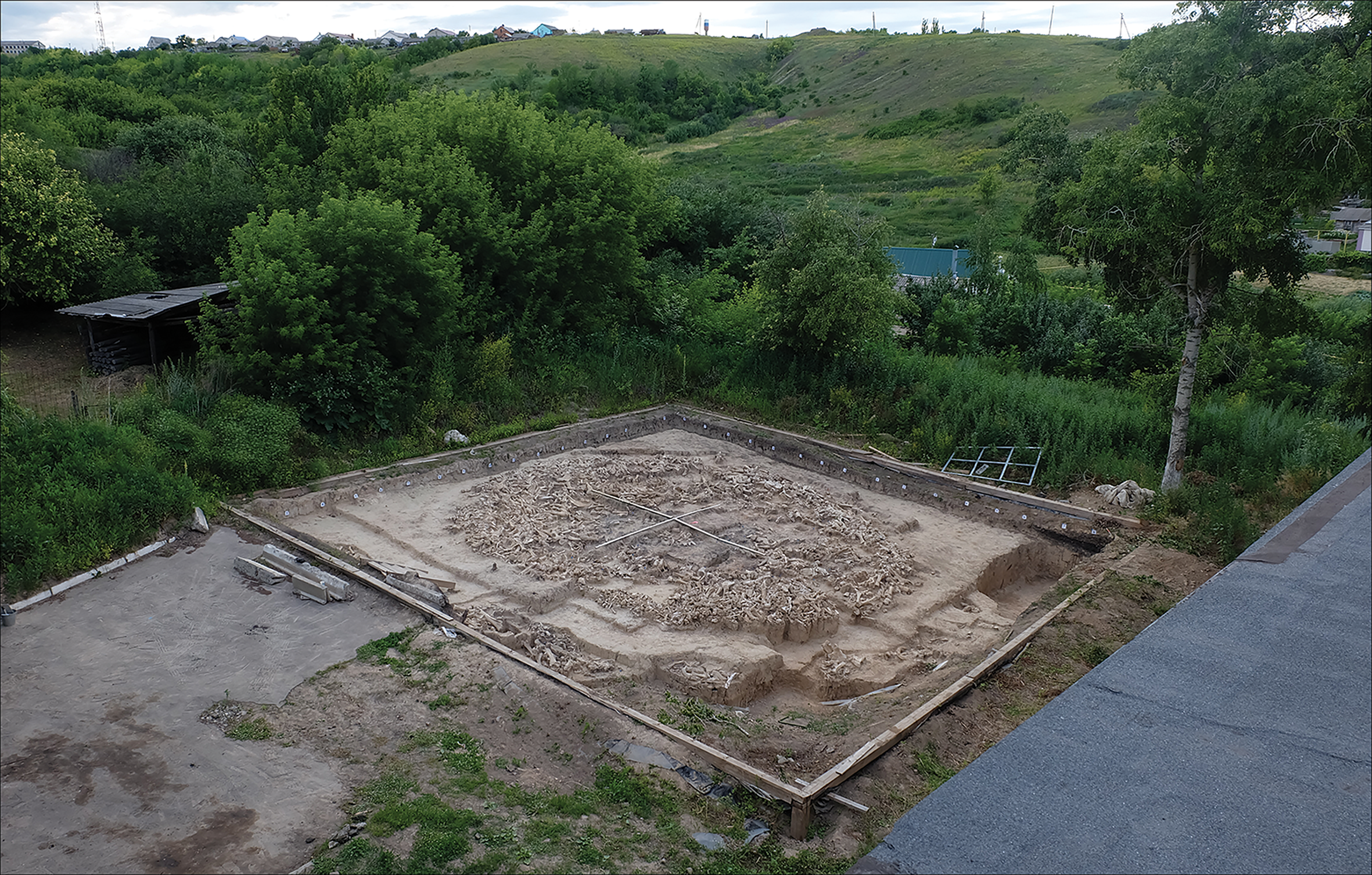
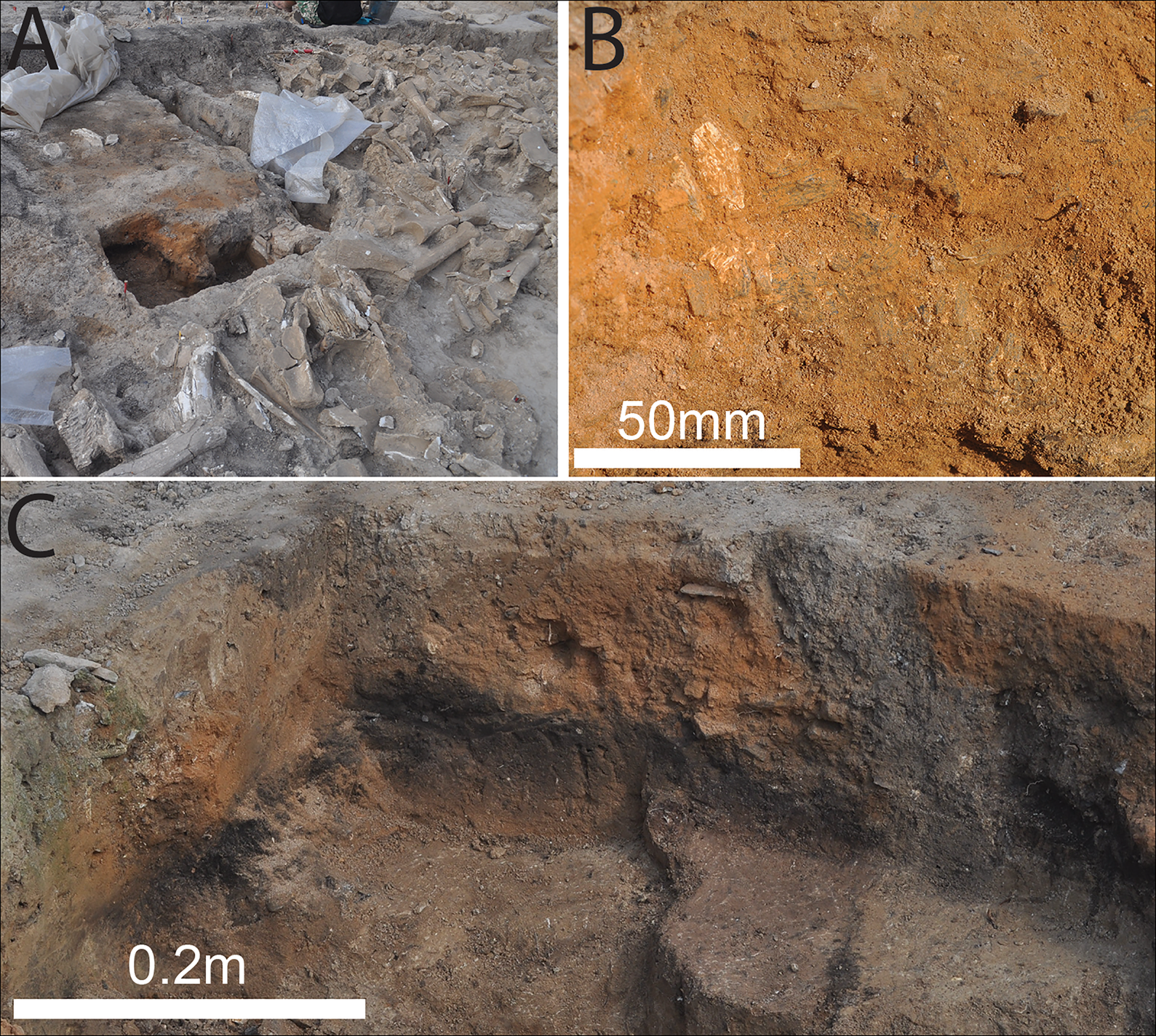
The mammoth-bone circle is large, with a diameter of approximately 12.5m and is positioned on an east-facing slope with an incline of approximately six degrees. The bones form a continuous circle that has no obvious entrance. A large area of combustion deposits was discovered in the south-east quadrant of the structure, comprising layers of rubified loess mixed with burnt bone and charcoal (Figure 3). At least three large pits 1–2m in diameter were discovered on the south-eastern margins of the circle, each containing large mammoth bones (Figure 4). The lithic assemblage collected in 2015 from the vicinity of the structure comprises 1275 pieces of which 190 (15 per cent) are retouched (Fedyunin Reference Fedyunin2016). This assemblage is similar to that found associated with the first mammoth-bone structure at Kostenki 11, and has been attributed to the Zamyatnin Culture (Rogachev & Popov Reference Rogachev, Popov, Praslov and Rogachev1982)—a poorly defined grouping of lithic assemblages that show clear differences from earlier Gravettian industries (Popov et al. Reference Popov, Anikovich, Hoffecker, Dudin, Pustovalov, Chernyshev, Anikovich and Platonova2004; Sinitsyn Reference Sinitsyn and Sanz2015; Bessudnov Reference Bessudnov, Panin, Timireva, Kurenkova and Kononov2016). Although a detailed faunal report for the third structure is not yet available, an initial assessment indicates that the assemblage consists almost exclusively of mammoth bones, with other species only rarely represented. A preliminary examination of the third circular structure and its interior at the end of the 2015 season identified 51 mammoth mandibles and 64 crania (Fedyunin Reference Fedyunin2016), indicating a minimum number of individuals considerably higher than the >40 animals represented at the first mammoth-bone feature (Popov et al. Reference Popov, Anikovich, Hoffecker, Dudin, Pustovalov, Chernyshev, Anikovich and Platonova2004).
Images of the combustion deposits within the mammoth-bone circle: A) view looking north towards the combustion deposits immediately prior to sample collection; B) close-up of rubified layer showing densely packed charred bone fragments including white calcined pieces; C) cross-section of a combustion feature part-way through excavation. The thick rubified layer overlies a thin black deposit that fades to sterile loess below. The pale sediments cutting through the rubified layer on the right-hand side of the section are the result of animal burrowing; a lithic is visible to the left, protruding from the section (photographs by A.J.E. Pryor).
Aerial photograph of the new mammoth-bone structure at Kostenki 11, taken using a drone during excavations in 2015 (photograph by A. Yu. Pustovalov & A.M. Rodionov). Sampling locations are indicated by the black squares and rectangles. The location of the burnt deposits and pit features are also shown (image prepared by A.J.E. Pryor).

Chronology
Six conventional radiocarbon dates on bone and ivory from the first mammoth-bone feature span a range from 12 000–19 900 radiocarbon years BP (Popov et al. Reference Popov, Anikovich, Hoffecker, Dudin, Pustovalov, Chernyshev, Anikovich and Platonova2004). It is unclear, however, which, if any, of these dates are reliable. Similar mammoth-bone structures from Eastern Europe date predominantly to after the Last Glacial Maximum, spanning approximately 21 000–18 000 years BP (Iakovleva & Djindjian Reference Iakovleva and Djindjian2005). Meanwhile, sites associated with the Zamyatnin lithic industry have been assigned to the post-Gravettian, Last Glacial Maximum or later periods, but are otherwise poorly dated. Furthermore, their cohesiveness as a lithic cultural unity has long been debated (Bessudnov Reference Bessudnov, Panin, Timireva, Kurenkova and Kononov2016).
For this current project, three new AMS radiocarbon dates were obtained on fragments of charcoal—rather than bone or ivory—extracted by flotation during the 2015 season. These fragments were analysed by the INSTAAR Laboratory for AMS Radiocarbon Preparation and Research at the University of Colorado. Six further samples of mammoth bone and one charcoal sample, all collected during the summer of 2014, were dated by L. Lbova at the experimental AMS Radiocarbon Laboratory, Centre for Cenozoic Geology at the Institute of Archaeology and Ethnography of the Siberian branch of the Russian Academy of Sciences, Novosibirsk (Dudin et al. Reference Dudin, Fedyunin, Platonova and Lisitsynin press). As discussed below and in the OSM, these new dates correspond with the oldest of the bone-based dates obtained previously for the first mammoth-bone structure, and confirm that the third structure is the oldest known circular mammoth-bone feature built by modern humans on the Russian Plain.
Materials and methods
To evaluate differences between areas and features associated with the site, 32 sediment samples totalling 148 litres (l) were collected from the following 11 locations within and around the mammoth-bone structure:
• Five approximately 0.30 × 0.30m sondages of various depth located within the mammoth-bone circle.
• A small sondage, 0.70 × 0.15m and 0.20m deep, excavated through the combustion deposits in the centre of the structure; samples were taken from distinct layers within the deposit.
• Three pits on the outer margins of the structure; samples were collected from exposed vertical sections (pit 2) or, when vertical sections were not available, from whichever sediments were available at the time of sampling (pits 1 and 3).
• And two approximately 0.30 × 0.30m sondages outside of the structure, located away from obvious pit features.
No stratigraphic divisions were noted in the 0.30 × 0.30m sondages, or during collection of samples from the pits. In these locations, samples were therefore collected as arbitrary, horizontal spits between 50–150mm deep. The 32 samples vary in size from 0.1 to 10l (300–10 000cm3), according to how sediments were divided into units during excavation. While these sample sizes are relatively small, systematic flotation programmes have only rarely been conducted at Palaeolithic sites (e.g. Beresford-Jones et al. Reference Beresford-Jones, Johnson, Pullen, Pryor, Svoboda and Jones2010), and our sample sizes are considerably larger than the 100–1000cm3 samples reported from a similar mammoth-bone feature at Mezhyrich, Ukraine (Soffer et al. Reference Soffer, Adovasio, Kornietz, Velichko, Gribchenko, Lenz and Suntsov1997: 59; Marquer et al. Reference Marquer, Lebreton, Otto, Valladas, Haesaerts, Messager, Nuzhnyi and Péan2012), the only other site with circular mammoth-bone features to have been investigated using flotation. Excavation in each sondage typically ceased upon encountering large bones extending across more than 50 per cent of the sondage area, as such bones were apparently related to the circular structure and were left in situ. In the deepest sondage (3), excavation ceased at 0.45m below ground surface upon encountering a lithic belonging to cultural layer K11-II.
Flotation
Samples were floated using a combination of bucket flotation and a standard field-built flotation tank. The light and heavy fractions were extracted using 0.50mm and 1mm meshes, respectively. Analysis of lithic debitage is useful for characterising local knapping activities, as it is likely to be discarded at the knapping location, even when larger flakes, tools and cores have been removed for use elsewhere. Microlithic debitage, including chips (pieces <20mm) and minute lithics (pieces <10 mm), were therefore extracted after flotation, and analysed following the methods described by Nadel (Reference Nadel2001) (Table 1).
Summary of flotation samples and results.

* Approximate figures.
Results
Dating
The three AMS radiocarbon dates measured at the University of Colorado on charcoal from sondage 5, sondage 2 and the combustion deposits produced dates of 20 670±160 BP (CURL-21040), 20 360±150 BP (CURL-21043) and 20 620±150 BP (CURL-22804), respectively (Table 2). Two of the bone-based dates measured in Novosibirsk match these results closely, forming a cohesive group of five dates with a calibrated date range of 25 063–24 490 cal BP (at 95.4 per cent probability when modelled using the Combine function in OxCal version 4.3 and the IntCal 13 atmospheric curve; Bronk Ramsey Reference Bronk Ramsey2009; Reimer et al. Reference Reimer2013; also see the OSM). As the dated samples were taken from widely spaced locations across the site, the stratigraphic integrity of the bones and samples is affirmed and a chronological link between the charcoal and human occupation of the site is strongly supported. Two further, bone-based dates (NSKA 885 and 889) are slightly more recent (Figure 5; see the OSM), and may indicate either a second phase of occupation or the incomplete removal of contaminants (see discussion in the OSM). Two more bone dates from the Novosibirsk laboratory failed to produce usable results (Table 2), while the charcoal date from Novosibirsk is too recent to be considered as a group alongside the other results and is probably contaminated. The five cohesive bone and charcoal dates confirm both the human occupation of the structure at the onset of the Last Glacial Maximum in Greenland-Stadial 3, and that the third feature at K11-Ia is the oldest circular mammoth-bone structure associated with modern humans yet discovered on the Russian Plain (see the OSM).
Old and new radiocarbon dates for Kostenki 11-Ia (Rogachev & Popov Reference Rogachev, Popov, Praslov and Rogachev1982; Popov et al. Reference Popov, Anikovich, Hoffecker, Dudin, Pustovalov, Chernyshev, Anikovich and Platonova2004), calibrated in OxCal version 4.3.2 using the IntCal13 calibration curve (Bronk Ramsey Reference Bronk Ramsey2009; Reimer et al. Reference Reimer2013). The δ18O curve from the NGRIP ice core is also shown. The new dates match closely with the oldest bone-based date measured on the first discovered mammoth-bone complex.

Radiocarbon dates for the third mammoth-bone feature from K11-Ia (calibrated using OxCal version 4.3 and the IntCal 13 atmospheric curve; Bronk Ramsey Reference Bronk Ramsey2009; Reimer et al. Reference Reimer2013).

Lithic debitage
The lithic debitage assemblage from the heavy fractions comprised 338 mostly minute lithics <10mm in size, and a few chips up to 20mm. Following Nadel's (Reference Nadel2001) terminology, the debitage comprised microflakes and microblades with bulbs of percussion and striking platforms; angular fragments (also termed ‘shatter fragments’; Newcomer & Karlin Reference Newcomer, Karlin, Sieveking and Newcomer1987); and some burnt pieces. Cortex was also present on some lithics. Preliminary analysis of the chips indicates the use of hard hammer knapping and, to a lesser extent, probable tool retouch using soft (wood or antler) hammers characterised by microblades with thin bulbs of percussion and pointed striking platforms.
Debitage from the combustion deposits includes both burnt and unburnt chips, confirming a degree of post-depositional mixing of deposits within the circle, which could relate to anthropogenic activity (e.g. trampling, hearth rake-out), or may have occurred after the site was abandoned. Density estimates extrapolated from the samples taken from the mammoth-bone circle and pits vary from 123–1178 lithics per m2 (1.2–6.0 lithics per litre of sample), being greatest towards the central and northern parts of the circle, in sondages 2 and 5 (Figure S2 in the OSM). No significant difference, however, was found between lithic densities in the pit fills and the sondages inside the mammoth-bone circle (p = 0.376). Lithic chip densities in samples from the sondages outside the mammoth-bone circle were substantially lower, with approximately 0.2 lithics per litre in the north-east sondage and none in the south-west sondage. This dramatic fall in lithic chip density indicates that activity at Kostenki 11 focused tightly around the pits and within the mammoth-bone circle.
The discovery of minute lithic debitage inside the mammoth-bone circle at Kostenki 11 is significant, as, for the first time, it allows the intensity and spatial patterning of knapping activities at a mammoth-bone structure to be reconstructed. This is because small debris were probably left behind at the knapping location even when the tools, larger flakes and cores were cleared away or removed for use elsewhere (Clark Reference Clark1986). Limited comparative data are available concerning the densities of minute debitage retrieved using flotation. While wet sieving at Mezhyrich, for example, produced “several thousand smaller sized tiny flint chips and splinters”, no information on lithic density is provided (Pidoplichko Reference Pidoplichko1998: 129). Comparative lithic density data are, however, available from the internal floors of brush huts found at the Epipalaeolithic site of Ohalo II in Israel (dated to 19 500 radiocarbon years BP), which provide a useful reference point for interpreting the Kostenki 11 data from dwellings of a similar age. Here, the flotation of samples from internal dwelling floors 0.10–0.30m thick yielded lithic chip densities that varied from 1000–5000 microblades and flakes per m2 and from 10 000–27 000 chips per m2 (Nadel Reference Nadel2001)–at least ten times that recorded at Kostenki 11. Irrespective of the duration of occupation of these sites, it is clear that the intensity of flint-knapping activities at Kostenki 11 was far lower than that occurring inside the huts at Ohalo II. The significance of this for understanding site function at K11-Ia is explored below.
Burnt bones
A total of 4.1l of non-lithic heavy residue was extracted from the samples, comprising almost entirely bone and ivory fragments 1–15mm in size. Most of these fragments were burnt, ranging in condition from partially/fully carbonised to calcined (representing categories 1–6; Stiner et al. Reference Stiner, Kuhn, Weiner and Bar-Yosef1995). The largest quantities of bone and ivory fragments were found in samples from the combustion deposits, where they comprised between 3–18 per cent of the volume of floated material, compared with 1–8 per cent in other samples (Figure S3). As with the lithic distribution, no significant differences were observed between bone densities within samples taken from the pits and those collected from inside the mammoth-bone circle (p = 0.849). Likewise, the density of bone residue drops dramatically in samples from the sondages excavated outside of the circle.
Bosch et al. (Reference Bosch, Nigst, Fladerer and Antl-Weiser2012) propose eight models for interpreting burnt bone fragments at Palaeolithic sites, distinguishing between scenarios including bones burned naturally, while roasting meat, during marrow and fat extraction, in waste disposal and when burned deliberately for fuel. In applying their criteria to the assemblage from the newly discovered structure, we note the high proportion of carbonised and calcined bones, the small size of the burnt fragments and the paucity and highly fragmented nature of the accompanying wood charcoal. A visual inspection of the burnt bone fragments also indicates an approximately even division between fragments of spongy and dense cortical bone. Combined, this evidence suggests the deliberate burning of bone either as a source of fuel or for waste disposal (cf. Beresford-Jones et al. Reference Beresford-Jones, Johnson, Pullen, Pryor, Svoboda and Jones2010).
Charcoal assemblage
Fragments of degraded charcoal and microcharcoal were recovered from all sampled contexts, representing the first such evidence from K11-Ia. The abundance of charcoal is positively correlated with the abundance of bone residue in every sampled context located inside the mammoth-bone circle (r2 = 0.73, p = 0.002), with clear concentrations of both charcoal and bone in the hearth and around the middle and northern edges of the circle (sondages 2 and 5), respectively. Meanwhile, the samples from sondages 1, 3 and 4 towards the western and eastern periphery of the circle produced much lower concentrations of material (Figure S4). The co-occurrence of bone and charcoal residues and their dispersal throughout the site suggests that they were subject to similar depositional and post-depositional processes, potentially including hearth rake-out and trampling. No significant differences were observed between charcoal concentration in samples taken from the pits and those collected from inside the mammoth-bone feature (p = 0.502). Only a trace amount of charcoal was recovered from the sondages dug outside the mammoth-bone circle.
The charcoal assemblage includes 474 fragments sized >2mm. While the largest fragment measures >10mm on its longest axis, most are much smaller, around 3mm3. The assemblage includes no vitrified remains, although many pieces show significant distortion of the internal structures caused by burning at high temperatures (Théry-Parisot Reference Théry-Parisot2002). Charcoal preservation is nonetheless sufficient to allow for 409 pieces to be identified as belonging to coniferous tree species, including Pinus spp. and Picea/Larix sp. No charcoals from deciduous hardwood species were identified. Conifer charcoal fragments preserving sufficient transverse sections show consistently narrow growth rings of between 0.10 and 0.20mm wide (Figure 6A–B), suggesting generally difficult growing conditions for the trees (Beresford-Jones et al. Reference Beresford-Jones, Taylor, Paine, Pryor, Svoboda and Jones2011). Charcoal fragments with wider growth rings (up to 0.45mm and many cells wide) were occasionally observed, suggesting that some trees were able to grow more quickly in the vicinity of Kostenki in the prelude to the Last Glacial Maximum. Twelve charcoal fragments deriving from the central part of stems or from narrow-stemmed wood (that may have been used as kindling; Figure 6C) exhibit tightly curved growth rings, although the lack of outer cortex elements precludes any distinction between the two.
Charred materials from Kostenki 11: A) charcoal fragment that is a single growth ring wide; B) most charcoal showed consistently narrow growth rings. In this fragment, average ring width was 0.13mm; C) charcoal fragment with tight ring curvature deriving from the centre of the stem. Based on ring curvature, the stem was at least 6mm in diameter; D) examples of seeds (currently unidentified); E–F) scanning electron microscope images of charcoal fragments lacking cellular structure, tentatively identified as crushed soft plant tissue (photographs by A.J.E. Pryor).
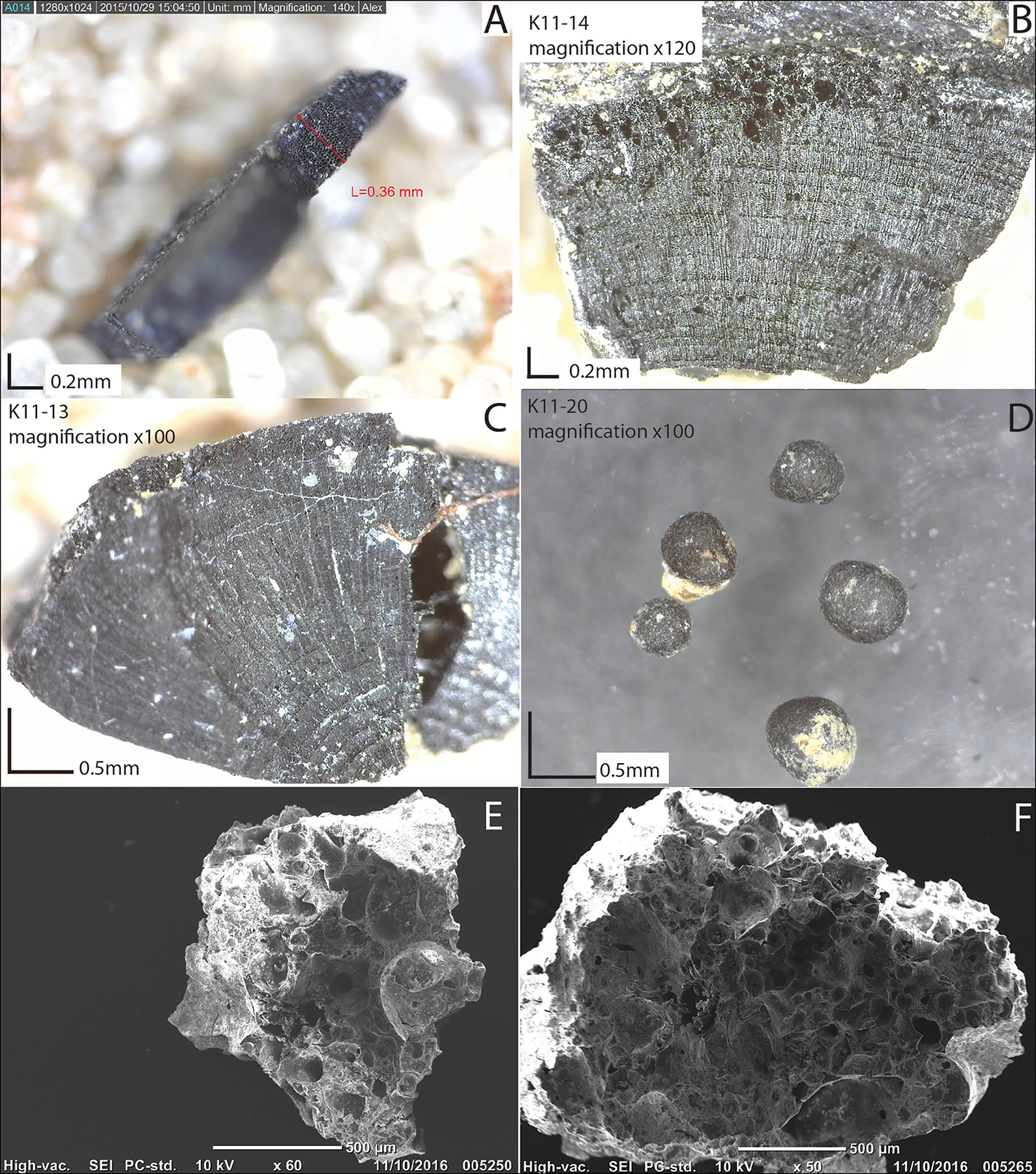
The charcoal assemblage also includes 37 pieces (around 7 per cent of the >2mm fraction) that lack a visible cellular structure when viewed with a light microscope (Figure 6E–F). These charcoals exhibit a cratered appearance with few discernible features, suggesting possible identification as parenchymous plant tissue (cells specialised in the storage of starch). When viewed under a scanning electron microscope, around 25 per cent of these pieces were identified as degraded conifer wood—a typical result when attempting to identify charred archaeological parenchyma (Hather Reference Hather1993: 3; Pryor et al. Reference Pryor, Steele, Jones, Svoboda and Beresford-Jones2013). Of the remaining fragments, several exhibit partly preserved vessel elements, features that occur in flowering plants (Angiosperms) and not in the conifers that comprise the entirety of the Kostenki 11 charred wood assemblage. Although no other characteristics useful for identification were observed, these unusual morphologies are comparable to pieces of charred soft non-woody plant tissue reported previously from the Gravettian site of Dolní Vĕstonice II (Pryor et al. Reference Pryor, Steele, Jones, Svoboda and Beresford-Jones2013). These also lack a clearly discernible cellular structure and are tentatively identified as the remains of starchy plant materials processed for consumption by grinding and mashing. Although the number of such fragments from Kostenki 11 is smaller and the pieces are less well preserved, their presence increases the number of sites from which charcoals showing this particular morphology are known; we mention them here as an encouragement to future research into charred soft plant tissues at Palaeolithic sites.
Over 50 small, charred seeds were also found within the sampled contexts, and in particularly large numbers in samples from sondage 3. Their seed-coat morphologies have not survived, leaving only minute, rounded or sub-rounded, and ellipsoid or globular spheres of parenchyma 0.50–0.70mm in diameter and mostly lacking any further structure (Figure 6D). It therefore remains unclear whether these seeds are present due to deliberate plant-gathering activities by the inhabitants of Kostenki 11, or whether they were incorporated accidentally into the assemblage, for instance through the presence of in situ plants inside the mammoth-bone circle at the time of burning.
Fills of the three large pits
The concentrations of lithic debitage, bone debris and charcoal in samples taken from the three large pits are statistically indistinguishable from the sediments located inside the mammoth-bone circle. The pit fills therefore appear to derive from sediments subjected to the same intensity of cultural activity as those inside the circle. This pattern may result from some form of deliberate rubbish disposal, although there is no evidence for the dumping of hearth deposits that was identified in pit 5 at Mezhyrich (Soffer et al. Reference Soffer, Adovasio, Kornietz, Velichko, Gribchenko, Lenz and Suntsov1997). Hence, it seems more likely that the pits at Kostenki were in-filled either deliberately by the site's inhabitants or by the post-depositional displacement of sediments from the cultural layer following site abandonment. This finding does not preclude the pits being used for different purposes, such as the storage of food and bone prior to becoming in-filled (e.g. Soffer et al. Reference Soffer, Adovasio, Kornietz, Velichko, Gribchenko, Lenz and Suntsov1997).
Discussion and conclusions
Lithic typologies and radiocarbon dating evidence have hinted at complex population dynamics on the mid to late Upper Palaeolithic Central Russian Plain (Reynolds et al. Reference Reynolds, Lisitsyn, Sablin, Barton and Higham2015; Sinitsyn Reference Sinitsyn and Sanz2015; Bessudnov Reference Bessudnov, Panin, Timireva, Kurenkova and Kononov2016). The new radiocarbon dates for K11-Ia increase our understanding of these dynamics by confirming a human presence on the Central Russian Plain at 51oN during Greenland Stadial 3—a period of intense cold when similar latitudes in Europe were already abandoned in the face of the Last Glacial Maximum. Despite this cold, the widespread distribution of charcoal and burnt bone at Kostenki 11 indicates the availability of wood and the sustained use of mixed-fuel (wood and bone) fires. Bone has often been considered the primary fuel at mammoth-bone sites, due to an apparent lack of charcoal and presumed climatic constraints on tree growth (Pidoplichko Reference Pidoplichko1998 and references therein). As long ago as the 1960s, however, Pidoplichko (Reference Pidoplichko1998) argued on taphonomic grounds that wood must have been an important fuel at Mezhyrich, and Marquer et al. (Reference Marquer, Lebreton, Otto, Valladas, Haesaerts, Messager, Nuzhnyi and Péan2012) have since demonstrated the use of firewood at that site via charcoal recovered by flotation. Kostenki 11 is therefore the second site with circular mammoth-bone features at which habitual wood burning has been identified using flotation, and in a context some 5000 years older. The charcoal data also add to a growing corpus of macrofossil evidence that indicates the survival of trees in mammoth steppe environments on the Central Russian Plain throughout the last glacial cycle (Tzedakis et al. Reference Tzedakis, Emerson and Hewitt2013). The availability of deadwood fuel supplies is a prerequisite for many modern hunter-gatherers in high-latitude cold climates (Pryor et al. Reference Pryor, Pullen, Beresford-Jones, Svoboda and Gamble2016). The presence of conifer trees near Kostenki—perhaps located in low-lying, moist and sheltered areas in the ravines near to the site—would have been an important resource that attracted hunter-gatherers to the area during the glacial period. These trees were perhaps critical to human persistence in this region, while other such areas of Northern Europe were abandoned.
The distribution of the minute lithic debitage at K11-Ia demonstrates a clear focus of activity within rather than outside the mammoth-bone circle, although the intensity of these activities appears strikingly low when compared with the Epipalaeolithic dwellings at Ohalo II. The use of lithic production and repair as a proxy for domestic activity more generally entails a number of uncertainties. For example, surfaces may have been swept clean, or hides may have been laid down to collect lithic debris for disposal elsewhere; yet no evidence for dumping has been noted in the pits or the excavated area around the structure, where minute lithic densities are equivalent to, or substantially below, those found inside. The relative scarcity of minute debitage seems incongruous for a putative dwelling, in which knappers could be expected to have regularly produced and repaired lithic tools while seeking refuge by the fire.
The unexpected finding of apparently short-duration or low-intensity occupation at K11-Ia raises important questions regarding the function and use of circular mammoth-bone structures more generally, which required a considerable investment of time and energy to build. Although Iakovleva (Reference Iakovleva2015) has argued convincingly that examples such as Mezin and Mezhyrich functioned as dwellings, K11-Ia is now known to be a significantly older site that exhibits several features, in addition to the low intensity of lithic working, which are harder to reconcile with this interpretation. These features include a large-diameter internal area that would have been difficult to roof, and a paucity of evidence for any prey species other than mammoth to provide food and hides for clothing. Such problems have been noted at some other similar sites, which has stimulated a long history of debate concerning the role of the structures as monumental architecture or possible ceremonial features (e.g. Allsworth-Jones Reference Allsworth-Jones and Pidoplichko1998; Gavrilov Reference Gavrilov2015); in a future article, we will argue that their function as food-storage facilities should be given further consideration. As demonstrated here, sieving and/or floating for the fine fraction has the potential to provide the spatially resolved data necessary to clarify how humans actually used these spectacular mammoth-bone sites, making them less enigmatic and more accessible to archaeological investigation.
Acknowledgements
We thank the Leverhulme Trust that funded this research, undertaken as part of the project ‘Seasonality, Mobility and Storage in Palaeolithic Hunting Societies’ (RPG-2013-318). We are grateful to the two anonymous reviewers, whose comments improved this paper; to members of the Kostenki 11 excavation teams; to Scott Lehman and Patrick Cappa at the radiocarbon laboratory, University of Colorado; to Natasha Reynolds for guidance in modelling of radiocarbon dates; to Alice La Porta for her thoughts and comments on the microlithic debris; to Jake Rowlands for discussions about lithic chip densities and bone burning; to Hayley Goodes for assistance with the scanning electron microscope; and to members of the Storage Project steering committee (Martin Jones, Tamsin O'Connell and Philip Nigst).
Supplementary material
To view supplementary material for this article, please visit https://doi.org/10.15184/aqy.2020.7



