1. Introduction
Palaeodiversity was strongly affected at the Devonian–Carboniferous (D–C) boundary, as a consequence of the Hangenberg Crisis interval (Fig. 1), which extended from the end of the Famennian (from the base of the middle Siphonodella praesulcata conodont Zone) to the base of the Tournaisian (entry of the ammonoid Gattendorfia) (Kaiser et al. Reference Kaiser, Becker, Steuber and Aboussalam2011). On a global scale, the stratigraphic interval under consideration is marked by significant lithological changes such as the development of black shales and sandstones in marine carbonate environments and hiatuses (Kaiser et al. Reference Kaiser, Becker, Steuber and Aboussalam2011), whose causes are still hotly disputed (Caplan & Bustin, Reference Caplan and Bustin1999; Streel et al. Reference Streel, Caputo, Loboziak and Melo2000; Kaiser et al. Reference Kaiser, Becker, Steuber and Aboussalam2011) but are probably related to major sea-level changes (Becker, Reference Becker1996).
Distribution of significant brachiopod genera present in the uppermost Famennian–Hastarian interval. The regional Kinderhookian Substage (not illustrated here) is essentially equivalent to the Western European Hastarian Substage (Heckel & Work in Menning et al. Reference Menning, Alekseev, Chuvashov, Davydov, Devuyst, Forke, Grunt, Hance, Heckel, Izokh, Jin, Jones, Kotlyar, Kozur, Nemyrovska, Schneider, Wang, Weddige, Weyer and Work2006). Conodont and ammonoid zonations are adapted from Kaiser et al. (Reference Kaiser, Becker, Steuber and Aboussalam2011). Abbreviations: cren. – crenulata; D–C – Devonian–Carboniferous; L – lower; M – middle; post. – postera; S. – spiriferinides; St. – stropalosiinides; Stru. – ‘Strunian’; U – upper.

In terms of biostratigraphy, the D–C boundary corresponds to the first occurrence of the conodont Siphonodella sulcata (Fig. 1) in the current GSSP of La Serre (southern France), but recent research has shown that the evolutionary lineage from S. praesulcata to S. sulcata is inadequate to define this boundary (Corradini & Kaiser, Reference Corradini, Kaiser, Henderson and MacLean2009; Kaiser, Reference Kaiser2009; Corradini et al. Reference Corradini, Kaiser, Perri and Spalletta2011).
Judging from the stratigraphical record of brachiopods, the Hangenberg Crisis seems to have been less severe than the end Frasnian Crisis as no extinction of brachiopod orders occurs at the D–C boundary. Significant post-crisis recovery took place during the Tournaisian (Sun & Baliński, Reference Sun and Baliński2011), especially within the spiriferides and the productidines, and similar recoveries have been documented in other fossil groups, notably goniatites (Kullmann, Reference Kullmann2002) and trilobites (Brauckmann, Chlupáč & Feist, Reference Brauckmann, Chlupáč and Feist1993).
The purpose of this paper is to refine the biostratigraphic potential of some rhynchonellides, spiriferides, spiriferinides, productidines and strophalosiidines (Brachiopoda) known around the D–C boundary that were previously discussed by Nicollin & Brice (Reference Nicollin and Brice2004). The history of the brachiopods in the aftermath of the Hangenberg Crisis is discussed briefly.
2. Brachiopod genera with stratigraphic value at the Devonian–Carboniferous boundary
Although the current GSSP of the base of the Carboniferous is under review as a result of recent studies on conodonts (see Section 1), it is worth remembering that selected brachiopod genera are valuable biostratigraphic tools in neritic facies, which were unfavourable for ammonoids and conodonts, owing to their short stratigraphical range and their extensive geographical distribution (Brice, Legrand-Blain & Nicollin, Reference Brice, Legrand-Blain, Nicollin, Becker and Kirchgasser2007).
During the last decades, our knowledge of the brachiopod faunas from the uppermost Famennian–Hastarian interval has increased significantly in various parts of the world (see references herein) but despite all these efforts, it still remains incomplete. For example, brachiopods from the Franco-Belgian Basin, i.e. the type area of the ‘Strunian’ (Streel, Brice & Mistiaen, Reference Streel, Brice and Mistiaen2006) and the Hastarian (Hance & Poty, Reference Hance and Poty2006), remain imperfectly known despite several recent studies (Legrand-Blain, Reference Legrand-Blain1991, Reference Legrand-Blain1995a ; Brice, Reference Brice1997).
We focus here mainly on the genera that occur with certainty within the uppermost Famennian on the basis of conodont and goniatite data (Fig. 1). In spite of the problems inherent in the present definition of the D–C boundary (see above), we accept the level recently proposed by Kaiser (Reference Kaiser2009) for the D–C boundary in the current GSSP (La Serre), which is now placed within bed 84, whereas it was previously placed at the base of the bed 89 (Paproth, Feist & Flajs, Reference Paproth, Feist and Flajs1991). This modification has some consequences for the age of the brachiopod faunas reported from La Serre by Legrand-Blain & Martínez Chacón (Reference Legrand-Blain and Martínez Chacón1988). For the references to the authors who erected the genera listed below, their description and their classification, see Brunton et al. (Reference Brunton, Lazarev, Grant, Jin and Kaesler2000), Savage et al. (Reference Savage, Manceñido, Owen, Carlson, Grant, Dagys, Sun and Kaesler2002), Carter & Johnson (Reference Carter, Johnson and Kaesler2006) and Carter et al. (Reference Carter, Johnson, Gourvennec, Hou and Kaesler2006).
2.a. Rhynchonellides
Rhynchonellides have been used for the biostratigraphy of the Famennian Stage on a worldwide scale. Among the genera listed below and included in Figure 1, five (Araratella, Centrorhynchus, Hadyrhyncha, Novaplatirostrum and Rozmanaria) disappeared at the end of the Devonian, whereas four survived into the Tournaisian (Axiodeaneia, Hemiplethorhynchus, Sedenticellula and Shumardella), and two occur for the first time in the basal Tournaisian (Macropotamorhynchus and Rhynchopora). Other rhynchonellide genera that may have biostratigraphic potential are also briefly discussed.
2.a.1. Superfamily Rhynchotrematoidea
The Rhynchotrematoidea comprises genera that are characterized internally by dental plates that are sometimes fused to the valve walls, a usually long dorsal median septum (rarely absent) and a variably developed septalium. Within this superfamily, only two genera, Nekhoroshevia (Trigonirhynchiinae) and Hemiplethorhynchus (Ripidiorhynchinae), both belonging to the Family Trigonirhynchiidae, crossed the D–C boundary. No new genera appeared during the Tournaisian and the whole superfamily became extinct during the Viséan.
Three representatives of the Family Trigonirhynchiidae (characterized by the presence of dental plates and a median septum, septalium covered or uncovered) are selected here. Centrorhynchus (Trigonirhynchiinae according to Nicollin & Brice, Reference Nicollin and Brice2004) includes medium- to large-sized shells, subpentagonal in outline, with a prominent fold and sulcus, ventral flanks sometimes slightly concave and strong, subtriangular ribs arising at the beaks, and a posteriorly covered septalium. The genus first occurs within the middle Famennian and disappears close to the D–C boundary. It has a worldwide distribution: Europe (Rozman, Reference Rozman1962; Conil et al. Reference Conil, Dreesen, Lentz, Lys and Plodowski1986; Halamski & Baliński, Reference Halamski and Baliński2009), North Africa (Brice, Legrand-Blain & Nicollin, Reference Brice, Legrand-Blain and Nicollin2005), Asia (e.g. Abramian, Reference Abramian1957; Martynova, Reference Martynova1961; Brice, Reference Brice1971), North America (Sartenaer, Reference Sartenaer1970; Carter & Kammer, Reference Carter and Kammer1990) and Australia (Veevers, Reference Veevers1959). Centrorhynchus has in some cases been misidentified as Ptychomaletoechia, which is externally very similar (Sartenaer, Reference Sartenaer1970). The latter was reported in the Tournaisian of China (e.g. Tan, Reference Tan, Tan, Dong, Jin, Li and Yang1987; Chen & Shi, Reference Chen and Shi1999) but, according to Sun & Baliński (Reference Sun and Baliński2011), the Tournaisian species included in this genus, namely ‘Ptychomaletoechia’ kinlingensis (Grabau in Chu, Reference Chu1933), needs to be revised as it is externally quite different from typical Ptychomaletoechia species. The cosmopolitan genus Macropotamorhynchus (Trigonirhynchiinae) is characterized by small shells with a weak fold and sulcus, covered by strong, angular ribs arising at the umbones and a posteriorly covered septalium. It is diagnostic of the Tournaisian, notably in Europe (Sartenaer, Reference Sartenaer1970), North America (Carter, Reference Carter1987, Reference Carter1991; Carter & Kammer, Reference Carter and Kammer1990), China (Sun & Baliński, Reference Sun and Baliński2011) and North Africa (Brice, Legrand-Blain & Nicollin, Reference Brice, Legrand-Blain and Nicollin2005, Reference Brice, Legrand-Blain, Nicollin, Becker and Kirchgasser2007). Hemiplethorhynchus (Ripidiorhynchinae) has a rather weak fold and sulcus and numerous fine to medium, angular ribs originating at the beaks and an uncovered septalium. It is generally considered as a Tournaisian genus with a wide geographic distribution (see Brice, Legrand-Blain & Nicollin, Reference Brice, Legrand-Blain and Nicollin2005), but it is known from the latest Famennian of southern China (Tan, Reference Tan, Tan, Dong, Jin, Li and Yang1987).
2.a.2. Superfamily Camarotoechioidea
The Camarotoechioidea, characterized internally by strong dental plates, a long dorsal median septum and a short, generally uncovered septalium, disappeared in the Tournaisian, in which only some genera belonging to the Leiorhynchinae (Leiorhynchidae) subsisted.
Rossirhynchus (= Septemirostellum according to Savage, Reference Savage and Kaesler2002a ; Leiorhynchidae), which includes dorsibiconvex shells, subpentagonal in outline, with steeply rounded flanks and strong, angular ribs, is known from the Tournaisian of Iran (e.g. Gaetani, Reference Gaetani1964; Bahrammanesh et al. Reference Bahrammanesh, Angiolini, Antonelli, Aghababalou and Gaetani2011) and Australia (Roberts, Reference Roberts1971). However, further investigations are needed to establish its precise stratigraphic extension and, thus, it is not included in Figure 1. Rossirhynchus was previously reported from the Tournaisian of South America (Argentina, Chile), but the species assigned to it was recently transferred to the endemic genus Azurduya by Cisterna & Isaacson (Reference Cisterna and Isaacson2003).
2.a.3. Superfamily Pugnacoidea
Representatives of the Family Rozmanariidae, of which Novaplatirostrum, Hadyrhyncha and Rozmanaria are selected here, are characterized by shells that are smooth or only bear low ribs and lack or have a low dorsal median septum; this family vanished at the end of the Famennian.
Novaplatirostrum includes medium-sized, flattened, equibiconvex shells with a large, low fold and shallow sulcus arising at about the three-quarter point of the shell length, and few, low simple ribs restricted to the anterior median part of the valves. Until now, it has only been reported from the uppermost Famennian of Germany (Sartenaer, Reference Sartenaer1997) and Poland (Halamski & Baliński, Reference Halamski and Baliński2009). Hadyrhyncha has a medium-sized, ovate shell with a dorsal sulcus and ventral fold arising at the mid-length, and weak, rounded ribs; it occurs in the upper to uppermost Famennian of the Czech Republic (Havlíček, Reference Havlíček1979), in the uppermost Famennian of Poland (Halamski & Baliński, Reference Halamski and Baliński2009) and in the upper Famennian of Morocco (Sartenaer, Reference Sartenaer1998). Rozmanaria includes small-sized, smooth shells transversely ovate in outline, with a dorsal sulcus and ventral fold that are very strong anteriorly. It is known from the upper Famennian of Russia (Rozman, Reference Rozman1962) and in the uppermost Famennian (UD V–VI) of Germany (Weyer, Reference Weyer1972) and Poland (Halamski & Baliński, Reference Halamski and Baliński2009). Shumardella (Petasmariidae) is characterized by a small-sized, dorsibiconvex, subtrigonal shell with a strong fold and sulcus, which bear a few strong ribs arising at the umbones. It is a typical Tournaisian genus, although it was reported within the ‘Etroeungt Zone’ in the southern Ural Mountains by Krestovnikov & Karpyshev (Reference Krestovnikov and Karpyshev1948). It is well known within the Kinderhookian of North America (Carter, Reference Carter1987, Reference Carter1988, Reference Carter1991) and in the basal Tournaisian of North Africa (Brice, Legrand-Blain & Nicollin, Reference Brice, Legrand-Blain and Nicollin2005).
2.a.4. Superfamily Stenoscismatoidea
The Stenoscismatoidea, which appeared in the Pragian, flourished mainly during the Carboniferous and the Permian.
Sedenticellula (Stenoscismatidae, Stenoscismatinae) includes medium-sized shells covered by simple, bifurcating or intercalating, low, narrow ribs arising at or very near the umbones; as in the other members of the Stenoscismatoidea, it possesses particular internal features such as a dorsal camarophorium and a ventral spondylium. Its oldest occurrence is reported within the uppermost Famennian (Lower to Middle praesulcata zones) of southern France (Legrand-Blain & Martínez Chacón, Reference Legrand-Blain and Martínez Chacón1988) but, during the Tournaisian, it seems to be restricted to the Kinderhookian (or possibly the early Osagean) of the USA (Carter, Reference Carter1988, Reference Carter1991).
2.a.5. Superfamily Lambdarinoidea
The oldest record of these micromorphic rhynchonellides with a usually bilobed or cordiform outline is from the lower Famennian of Poland (Baliński, Reference Baliński1982). The Family Lambdarinidae shows a distinctive radiation that seems to have taken place just after the D–C boundary with the appearance of the genera Lambdarina and Dacryrina (see Baliński & Sun, Reference Baliński and Sun2008 for more details). The latter could be valuable index fossils but in order to extract them from limestones and marls they need to be silicified (Baliński & Sun, Reference Baliński and Sun2008) and thus, their biostratigraphic utility is probably reduced.
2.a.6. Superfamily Rhynchoporoidea
Members of the Rhynchoporoidea typically have an endopunctate shell, which is quite exceptional among rhynchonellide brachiopods. Rhynchopora (Rhynchoporidae, Rhynchoporinae) has a transversely subpentagonal outline, with a fold and sulcus that become prominent anteriorly, a rectangular tongue and numerous ribs. This genus occurs at the base of the Tournaisian (sulcata Zone) of southern France (Legrand-Blain & Martínez Chacón, Reference Legrand-Blain and Martínez Chacón1988) and in the Kinderhookian of the USA (e.g. Carter, Reference Carter1988, Reference Carter1991), but extends to the Permian (Savage, Reference Savage and Kaesler2002b ). Araratella (Araratellidae according to Sartenaer & Plodowski, Reference Sartenaer and Plodowski2003) is very useful for recognizing the D–C boundary owing to its short stratigraphical range (uppermost Famennian) and its wide geographical distribution (see Sartenaer & Plodowski, Reference Sartenaer and Plodowski2003 for more details).
2.a.7. Superfamily Rhynchotetradoidea
The Rhynchotetradoidea include shells characterized internally by a variably developed spondylium, a strong dorsal median septum and an uncovered septalium. This superfamily originated in the Famennian and had a long evolutionary history, becoming extinct in the Middle Jurassic. Their first radiation took place in the Tournaisian with the origination of several new genera among the rhynchotetradid subfamilies Rhynchotetradinae and Axiodeaneiinae, as well as among the Tetracameridae. On the basis of Savage's (Reference Savage and Kaesler2002c ) data, cosmopolitan genera such as Rhynchotetra (Rhynchotetradinae) and the tetracamerids Tetracamera, Rotaia and Yanishewskiella first occurred in the lower part of the Tournaisian, but further investigations are needed to establish their stratigraphic extension in various parts of the world. Carter (Reference Carter1991) provided information related to the stratigraphic range of the three first genera in North America, and of those only Rhynchotetra has its first occurrence close to the D–C boundary (Kinderhookian).
Both genera of the Subfamily Axiodeaneiinae (Rhynchotetradidae), which share an elongate outline and a sessile spondylium, are of some interest for recognizing the D–C boundary interval. Axiodeaneia, characterized by a narrowly elongate outline, a biconvex profile, low, very coarse angular ribs covered by thin radial striae and a low tridentate tongue, spans the interval from the base of the Kinderhookian to that of the Osagean in North America (Carter, Reference Carter1987, Reference Carter1988, Reference Carter1991). The genus is also reported at the top of the Famennian and at the base of the Tournaisian in South China (Guangxi) by Li et al. (Reference Li, Tan, Sun and Baliński2011) and in basal Tournaisian strata of Central Europe (Havlíček, Reference Havlíček1979). Paraphorhynchus, which differs from Axiodeaneia in having a high serrate tongue, rounded ribs and a shorter dorsal median septum, is known from the latest Famennian to the Kinderhookian in North America (Carter, Reference Carter1991). Savage (Reference Savage and Kaesler2002c ) reported the genus in Europe, the Urals, Novaya Zemlya and Kazakhstan, but without stratigraphic information, while Bahrammanesh et al. (Reference Bahrammanesh, Angiolini, Antonelli, Aghababalou and Gaetani2011) recorded its presence in the Tournaisian of North Iran. However, the stratigraphic range of the genus in the areas listed above needs to be clarified.
2.b. Spiriferides
Members of this order (Fig. 1) are generally predominant within the brachiopod associations of the Famennian–Tournaisian interval and are particularly diverse. The end of the Famennian marked the extinction of two typically Devonian superfamilies (Adolfioidea, Cyrtospiriferoidea), but also the development of the first spiriferide prismatic shell layer among the ulbospiriferids (Theodossioidea), which is a characteristic feature of the Carboniferous–Permian Spiriferoidea, Paeckelmannelloidea and Brachythyroidea (Carter & Gourvennec, Reference Carter, Gourvennec and Kaesler2006a ). The Mississippian is characterized by important radiations among the spiriferide superfamilies Martinioidea, Spiriferoidea and Paeckelmannelloidea (see fig. 1102 in Carter & Gourvennec, Reference Carter, Gourvennec and Kaesler2006a ). No genera of the superfamilies Delthyridoidea and Reticularioidea are selected here. The Delthyridoidea underwent a long decline after their acme in the Lower Devonian and became extinct in the Mississippian (Viséan); besides the long-ranging genus Tylothyris (see Nicollin & Brice, Reference Nicollin and Brice2004), only one new genus (Texathyris; presently known only from Texas) appeared during the Tournaisian (top of the Kinderhookian, see Carter, Reference Carter1991). The evolutionary history of the Reticularioidea is quite similar to that of the Delthyridoidea. They also had their acme in the Lower Devonian and almost disappeared during the Pennsylvanian but underwent a last radiation in the early Permian before becoming extinct at the end of this period (Carter & Gourvennec, Reference Carter, Gourvennec and Kaesler2006a ). Some elythid genera (Kitakamithyris, Toryniferella) have already been discussed by Nicollin & Brice (Reference Nicollin and Brice2004).
2.b.1. Superfamily Adolfioidea
This superfamily, known from the Wenlock (Johnson, Reference Johnson and Kaesler2006a ), became extinct at the end of the Famennian. It includes several genera that seem to be restricted to the upper Famennian such as the adolfiid Volgospirifer from the Russian Platform (Tsyganko, Reference Tsyganko2008) and the echinopiriferids Enchondrospirifer (Afghanistan; Brice, Reference Brice1971) and Sergunkovia from the Urals and Central Asia (Nalivkin, Reference Nalivkin1979), but to our knowledge, only Rigauxia (Echinospiriferidae), which first occurred in the Frasnian, has been reported in the uppermost Famennian of the Middle East (Brice, Reference Brice1971, Reference Brice1999; Kebria-ee & Taghvaei, Reference Kebria-ee and Taghvaei2010) and Western Europe (García-Alcalde & Menéndez-Álvarez, Reference García-Alcalde and Menéndez-Álvarez1988). This genus includes small- to medium-sized shells covered by simple ribs on the flanks and the fold and in the sulcus, with subradial and tuberculate capillae.
2.b.2. Superfamily Theodossioidea
The Theodossioidea, which include shells devoid of a fold and sulcus (or with these features only poorly developed) and without a delthyrial plate, had their acme in the Upper Devonian, but became extinct during the Tournaisian, in which the only representatives are in the Family Palaeochoristitidae that originated during the upper Famennian.
Eochoristites (Palaeochoristitidae), including moderately biconvex shells with usually simple ribs on the flanks and strong simple or divided ribs in the sulcus, is known from the uppermost Famennian of China (Xu & Yao, Reference Xu, Yao and Yu1988), but is an especially valuable guide for the lower part of the Tournaisian in North Africa (Havlíček, Reference Havlíček, Seidl and Röhlich1984; Legrand-Blain, Reference Legrand-Blain1995a ; Brice, Legrand-Blain & Nicollin, Reference Brice, Legrand-Blain and Nicollin2005). In southeastern China, the genus also occurs in the Hastarian (Chen & Shi, Reference Chen and Shi1999; Chen, Reference Chen2004; Sun & Baliński, Reference Sun and Baliński2011), but is mainly a guide for the Ivorian (Y. Sun, pers. com.).
2.b.3. Superfamily Cyrtospiriferoidea
Cyrtospiriferoids, which generally have a well-developed delthyrial plate, are emblematic of the Emsian–Famennian interval. They became extinct at the end of the Famennian. Among the Family Cyrtospiriferidae, two genera are valuable for recognizing the upper part of the Famennian. Sphenospira (Cyrtospiriferinae) is known from the upper Famennian in North America (Cooper, Reference Cooper1954). Sphenospira julii (Dehée, Reference Dehée1929), an index species of the uppermost Famennian, is reported from Eurasia (e.g. Afanasjeva et al. Reference Afanasjeva, Alekseeva, Grunt, Lazarev, Komarov, Manankov, Pavlova, Rozman, Suur'suren, Ushatinskaya and Erlanger2003; Nicollin & Brice, Reference Nicollin and Brice2004; Halamski & Baliński, Reference Halamski and Baliński2009; Grechishnikova & Levitskii, Reference Grechishnikova and Levitskii2011), and doubtfully in North Africa (Brice, Legrand-Blain & Nicollin, Reference Brice, Legrand-Blain and Nicollin2005). Dichospirifer (Cyrtiopsinae) is known from the upper and uppermost Famennian of Eurasia (Abramian, Reference Abramian1957; Brice, Reference Brice1971; Plodowski & Kononova, Reference Plodowski and Kononova1994; Kebria-ee & Taghvaei, Reference Kebria-ee and Taghvaei2010; Grechishnikova and Levitskii, Reference Grechishnikova and Levitskii2011), western North America (Johnson, Reference Johnson and Kaesler2006b ) and North Africa (Nicollin & Brice, Reference Nicollin and Brice2001; Brice, Legrand-Blain & Nicollin, Reference Brice, Legrand-Blain and Nicollin2005).
2.b.4. Superfamily Ambocoelioidea
Among the ambocoelioids, the upper Famennian is marked by the origination of a new family, the Eudoxinidae, which groups together small to very large forms that are notably devoid of dental adminicula. Nevertheless, the ambocoelioids were not particularly diverse during the Mississippian and comprise some long-ranging genera such as Crurithyris (Ambocoeliinae), which is generally considered as an opportunistic eurytopic taxon characteristic of stressful and/or dysaerobic environments (Campi & Shi, Reference Campi and Shi2007), and Verneuilia (Verneuiliidae).
Eudoxina (Eudoxinidae) includes medium to large shells, thinly to very thinly ribbed, rounded in outline, with a poorly to moderately developed fold and sulcus containing fine to very fine ribs. It is restricted to the base of the Kinderhookian in the USA (Illinois, Iowa) (Carter, Reference Carter1988, Reference Carter1991) and to the same stratigraphic level in Russia (Kalashnikov, Reference Kalashnikov1974; Fotieva, Reference Fotieva1985) and the Ukraine (Poletaev, Reference Poletaev1975). In China, the genus is tentatively reported at the top of the Famennian (Sun & Baliński, Reference Sun and Baliński2011).
2.b.5. Superfamily Martinioidea
In contrast to the ambocoelioids, in which diversity scarcely changed between the Upper Devonian and the Mississippian, martinioids had a significant radiation during the Mississippian with the appearance of large forms.
Only Eomartiniopsis is selected here; it includes shells that are characterized by a rounded outline, a fold and sulcus weakly rounded to moderately developed, and are devoid of ribs or have only a few ones on the flanks. It is doubtfully reported in the upper to uppermost Famennian of Poland by Halamski & Baliński (Reference Halamski and Baliński2009), but is known from the base of the Kinderhookian to the Osagean in North America (Carter, Reference Carter1988, Reference Carter1991), in the Tournaisian succession of North Africa (Brice, Legrand-Blain & Nicollin, Reference Brice, Legrand-Blain and Nicollin2005; Mottequin & Legrand-Blain, Reference Mottequin and Legrand-Blain2010), Russia (e.g. Fotieva, Reference Fotieva1985) and Australia (Roberts, Reference Roberts1971).
2.b.6. Superfamily Spiriferoidea
Representatives of the Superfamily Spiriferoidea, which are characterized by a denticulate hinge line, appeared in the course of the upper Famennian, during which they were associated with the last members of the cyrtospiriferoids (e.g. Sphenospira).
Among the Family Spiriferidae, we have selected three genera of the Subfamily Prospirinae, namely Parallelora, Prospira and Unispirifer, which represent valuable guides for the D–C boundary. Parallelora includes medium-sized shells with flanks covered by rounded, simple or bifurcating ribs and with a few sulcal ribs, usually simple, and a rectangular ventral interarea. This genus first occurs in the upper Famennian and crosses the D–C boundary. During uppermost Famennian times, Parallelora is known from the Middle East (Plodowski, Reference Plodowski1970), China (Xu & Yao, Reference Xu, Yao and Yu1988), Russia (Nalivkin, Reference Nalivkin1979), North Africa (Legrand-Blain, Reference Legrand-Blain1995a ; Brice, Legrand-Blain & Nicollin, Reference Brice, Legrand-Blain and Nicollin2005) and North America (Carter, Reference Carter1974, Reference Carter1991). Prospira is characterized by small- to medium-sized shells, subquadrate to subpentagonal in outline, with simple ribs on the flanks and a narrow fold and sulcus, with usually simple lateral ribs (except the median one) originating by bifurcation of the sulcus-bounding ribs. It spans the interval ranging from the uppermost Famennian to the Tournaisian. During the uppermost Famennian, the genus occurs in Western Europe (García-Alcalde et al. Reference García-Alcalde, Menéndez-Álvarez, García-López and Soto1985; Conil et al. Reference Conil, Dreesen, Lentz, Lys and Plodowski1986; Legrand-Blain, Reference Legrand-Blain1995a ; Brice, Reference Brice1997), the Middle East (Brice, Reference Brice1971, Reference Brice1999; Kebria-ee & Taghvaei, Reference Kebria-ee and Taghvaei2010) and North Africa (Brice, Legrand-Blain & Nicollin, Reference Brice, Legrand-Blain and Nicollin2005). In North America (Carter, Reference Carter1991) and Australia (Roberts, Reference Roberts1971), Prospira is a characteristic Tournaisian form. Unispirifer includes medium- to large-sized shells with numerous usually simple ribs on the flanks and with a sulcus bearing median ribs that may bifurcate (other sulcal ribs are usually simple). It is known from the uppermost Famennian, notably in Afghanistan (Brice, Reference Brice1971, Reference Brice1999) and Western Europe (Conil et al. Reference Conil, Dreesen, Lentz, Lys and Plodowski1986; Legrand-Blain & Martínez Chacón, Reference Legrand-Blain and Martínez Chacón1988). It became cosmopolitan during the Tournaisian: North America (e.g. Carter Reference Carter1988, Reference Carter1991), North Africa (Havlíček, Reference Havlíček, Seidl and Röhlich1984; Mergl & Massa, Reference Mergl and Massa1992; Legrand-Blain, Reference Legrand-Blain1995a ; Brice, Legrand-Blain & Nicollin, Reference Brice, Legrand-Blain and Nicollin2005), Europe (Sartenaer & Plodowski, Reference Sartenaer and Plodowski1996), South China (Sun & Baliński, Reference Sun and Baliński2011), Russia (Shilo et al. Reference Shilo, Bouckaert, Afanasjeva, Bless, Conil, Erlanger, Gagiev, Lazarev, Onoprienko, Poty, Razina, Simakov, Smirnova, Streel and Swennen1984; Poletaev, Reference Poletaev2006; Afanasjeva, Reference Afanasjeva2008) and Azerbaijan (Grechishnikova & Levitskii, Reference Grechishnikova and Levitskii2011). Eobrachythyris (Sergospiriferinae), characterized by an equidimensional shell with a few simple lateral ribs and smooth sulcus or with a median rib, is known mainly from the upper and uppermost Famennian of Europe (D. Brice, unpub. data), the Middle East (Brice, Reference Brice1971, Reference Brice1999; Kebria-ee & Taghvaei, Reference Kebria-ee and Taghvaei2010) and North Africa (Brice & Nicollin, Reference Brice and Nicollin2000), but also occurs in the Hastarian of Algeria (Brice & Nicollin, Reference Brice and Nicollin2000).
2.b.7. Superfamily Paeckelmannelloidea
This superfamily originated in the course of the Famennian, as was the case for the Spiriferoidea, and its representatives share with representatives of the latter denticulate hinge lines and capillate microornament. These features may indicate that both superfamilies may derive from a common ancestor (Carter & Gourvennec, Reference Carter, Gourvennec and Kaesler2006a ).
Although Carter (Reference Carter and Kaesler2006) considered Voiseyella (Strophopleuridae, Strophopleurinae), which is characterized by small, strongly biconvex and transverse (mucronate) shells with a smooth, narrow fold and sulcus and bearing numerous simple lateral ribs, as only Tournaisian–Viséan in age, it was reported in the uppermost Famennian of Europe (Legrand-Blain & Martínez Chacón, Reference Legrand-Blain and Martínez Chacón1988; Legrand-Blain, Reference Legrand-Blain1995a ), Russia (see discussion in Legrand-Blain, Reference Legrand-Blain1995a ), Afghanistan (Plodowski, Reference Plodowski1968) and North Africa (Brice, Legrand-Blain & Nicollin, Reference Brice, Legrand-Blain and Nicollin2005).
Celsifornix (Strophopleuridae, Bashkiriinae) includes medium-sized, strongly transverse shells with a high ventral interarea, flanks covered by simple costae and a moderately developed fold and sulcus that bear some costae. This genus was first described in the Tournaisian (top of the Kinderhookian and base of the Osagean) of the USA (Illinois, Missouri) by Carter (Reference Carter1974) and reported in the Tournaisian of China, notably by Tan (Reference Tan1986) and Baliński & Sun (Reference Baliński and Sun2010), where its first occurrence is very close to the D–C boundary (Sun & Baliński, Reference Sun and Baliński2011).
2.b.8. Superfamily Brachythyridoidea
The Brachythyridoidea group together shells with a narrow hinge line, and thus a typically ovate outline, that are devoid of internal plates in both valves (Carter & Gourvennec, Reference Carter, Gourvennec and Kaesler2006a ). Like the Spiriferoidea and the Paeckelmannelloidea, they appeared during the Famennian. They underwent a radiation during the Tournaisian with the appearance of new genera within the Family Skelidorygmidae (Phragmobrachythyris, Skelidorygma).
The cosmopolitan genus Brachythyris (Brachythyrididae) is reported within the uppermost Famennian, notably in southern China (Xu & Yao, Reference Xu, Yao and Yu1988) and the southern Ural Mountains (Krestovnikov & Karpychev, Reference Krestovnikov and Karpyshev1948), and crossed the D–C boundary. Several lower Tournaisian occurrences were reported in Western Europe (Legrand-Blain, Reference Legrand-Blain1995a ), North America (Carter, Reference Carter1988, Reference Carter1991) and Kazakhstan and the Urals (Fotieva, Reference Fotieva1985).
2.c. Spiriferinides
2.c.1. Superfamily Syringothyridoidea
Representatives of this superfamily are characterized by large shells generally transverse in outline, a high ventral interarea and, in some cases, the presence of a syrinx. Syringothyridoids first occurred during the upper Famennian but flourished in the Carboniferous and early Permian (Carter & Gourvennec, Reference Carter, Gourvennec and Kaesler2006b ).
Only the cosmopolitan genus Syringothyris (Syringothyrididae, Syringothyridinae), which includes punctate shells with a smooth fold and sulcus, and a syrinx, is considered here. Although its representatives were particularly abundant during the Mississippian, several uppermost Famennian occurrences were reported in Europe (Legrand-Blain & Martínez Chacón, Reference Legrand-Blain and Martínez Chacón1988), China (e.g. Xu & Yao, Reference Xu, Yao and Yu1988; Ma, Zong & Sun, Reference Ma, Zong and Sun2011), North America (Carter & Kammer, Reference Carter and Kammer1990; Carter, Reference Carter1991) and North Africa (Brice, Legrand-Blain & Nicollin, Reference Brice, Legrand-Blain and Nicollin2005). Syringothyris was reported particularly in lower Tournaisian successions of Western Europe (Legrand-Blain & Martínez Chacón, Reference Legrand-Blain and Martínez Chacón1988; Legrand-Blain, Reference Legrand-Blain1995a ), the southern Urals (Nalivkin, Reference Nalivkin and Stepanov1975), China (Sun & Baliński, Reference Sun and Baliński2011) and North America (Carter, Reference Carter1991).
2.d. Productidines and strophalosiidines
The suborders Productidina and Strophalosiidina are parts of the Order Productida. Representatives of the Suborder Chonetidina are not discussed here even though they are generally abundant near the D–C boundary (Legrand-Blain & Martínez Chacón, Reference Legrand-Blain and Martínez Chacón1988; Afanasjeva, Reference Afanasjeva2002). As stressed by Racheboeuf (in Brice et al. Reference Brice, Carls, Cocks, Copper, García-Alcalde, Godefroid and Racheboeuf2000), because of their particular morphological features and occurrences in various palaeoenvironments, chonetidines have real, potential biostratigraphic value, but those of the uppermost Famennian–Hastarian remain poorly known.
Teeth and dental sockets disappeared during the upper Famennian in the Productidina, but persisted in many taxa within the Strophalosiidina (Brunton et al. Reference Brunton, Lazarev and Grant1995). Dorsal spines, known from the Middle Devonian onwards within the Echinoconchoidea in which they are arranged as circular bands, independently appear in various families of the Productoidea during the Famennian and the Tournaisian (Poletaev & Lazarev, Reference Poletaev and Lazarev1995). Among the ribbed Productidina, ribs tend to arise at the umbones from the Tournaisian onwards (Brunton & Lazarev, Reference Brunton and Lazarev1997).
In contrast to the rhynchonellides, spiriferides and spiriferinides, in which the internal features can be easily studied by serial sectioning, the identification of productidines and strophalosiidines requires perfectly preserved specimens showing the internal faces of the valves (e.g. details of the hinge line) and the details of the ornamentation (e.g. dorsal spines, etc). Their internal morphology can also be studied by transverse serial sectioning, but it is generally not sufficient for a precise description. Moreover, the generic identification can also vary from one author to another. For example, Producta curtirostra Winchell, Reference Winchell1865, from the Kinderhookian of the USA, was assigned to Rugauris by Muir-Wood & Cooper (Reference Muir-Wood and Cooper1960), to Sentosia? by Nalivkin (Reference Nalivkin1979) and to Whidbornella by Carter (Reference Carter1988). Owing to the difficulties in identifying productidines and strophalosiidines at the generic level, their biostratigraphical potential is commonly overlooked.
2.d.1. Superfamily Productoidea
Among the Family Productellidae, several cosmopolitan genera (e.g. Productina) appeared at the top of the Famennian (Brunton & Lazarev, Reference Brunton and Lazarev1997) but did not extend beyond the lower Tournaisian. Orbinaria and Planoproductus are probably present in the current GSSP of the D–C boundary, within the uppermost Famennian and at the base of the Hastarian, respectively (Legrand-Blain & Martínez Chacón, Reference Legrand-Blain and Martínez Chacón1988). Some genera seem to be known exclusively from the Famennian, such as Dorsirugatia in Mongolia (Lazarev & Suur'suren, Reference Lazarev, Suur'suren and Grunt1992; Lazarev in Brunton & Mundy, Reference Brunton and Mundy1993; Brunton & Lazarev, Reference Brunton and Lazarev1997) and Iniproductus in Russia (Kuzbass) (Brunton & Lazarev, Reference Brunton and Lazarev1997). Argentiproductus, whose type species is of late Viséan age, spans the interval of the uppermost Famennian to the Serpukhovian (see Brunton & Mundy, Reference Brunton and Mundy1993 for details). Brunton & Lazarev (Reference Brunton and Lazarev1997) indicated that this genus first occurred around the D–C boundary. To our knowledge, its oldest occurrences are reported in the uppermost Famennian of the Urals by Nalivkin (Reference Nalivkin1979) and within the lower part of the Kinderhookian in Illinois by Carter (Reference Carter1988). In South China, Argentiproductus is known from the middle part of the Tournaisian (Sun & Baliński, Reference Sun and Baliński2008, Reference Sun and Baliński2011), whereas in Western Europe, the genus, which is common during the Viséan, has been reported from the Ivorian of Ireland (Mottequin, Reference Mottequin2010).
Among the Family Productidae, the oldest genera (with ribbing usually absent or weak, and never developed at the umbo) are known from the Famennian. The disappearance of the articulation and the development of dorsal spines are progressive phenomena (Poletaev & Lazarev, Reference Poletaev and Lazarev1995). However, the observation of such important generic features is not always possible and the generic identifications remain problematic, as is notably the case for the distinction between the genera Nigerinoplica (with teeth) and Spinocarinifera (without teeth). Representatives of Spinocarinifera from northern France and Belgium (Legrand-Blain, Reference Legrand-Blain1991), all devoid of teeth, occur in uppermost Famennian and lower Hastarian strata. The stratigraphic range of Semiproductus spans the interval of the uppermost Famennian to the top of the Tournaisian (Poletaev & Lazarev, Reference Poletaev and Lazarev1995). Moreover, some genera with a particular external morphology (for example, a ventral median row of strong spines) are more easily identifiable and could be of the greatest interest in recognizing the D–C boundary. These are Mesoplica, Leioproductus (North America, Asia) and Acanthoproductus (Kazakhstan), which do not seem to cross the D–C boundary. Mesoplica sensu stricto, with low rounded costae not arising at the umbo, was cosmopolitan during the uppermost Famennian (Muir-Wood & Cooper, Reference Muir-Wood and Cooper1960). Mesoplica sensu lato, with different details of ornamentation, occurs within Hastarian beds in France (Brice, Legrand-Blain & Nicollin, Reference Brice, Legrand-Blain and Nicollin2005) and in the lower Kinderhookian of North America (Carter, Reference Carter1991; Legrand-Blain, Reference Legrand-Blain1991).
2.d.2. Superfamily Echinoconchoidea
Among the Sentosiidae, Sentosia was cosmopolitan during the uppermost Famennian and locally persisted during the lower Hastarian (Legrand-Blain, Reference Legrand-Blain1995a ; Poletaev & Lazarev, Reference Poletaev and Lazarev1995). Bagrasia (probably a junior synonym of Ericiatia) was reported in the uppermost Famennian and the Hastarian of Russia (Lazarev, Reference Lazarev1990) and North Africa (Legrand-Blain, Reference Legrand-Blain1995a , b).
2.d.3. Superfamily Linoproductoidea
Some species, previously assigned to Ovatia (Monticuliferidae), from the uppermost Famennian and Tournaisian of Russia (Poletaev & Lazarev, Reference Poletaev and Lazarev1995), and possibly also from the Kinderhookian of North America (Carter, Reference Carter1972) and the uppermost Famennian – Hastarian of northern France (Nicollin & Brice, Reference Nicollin and Brice2004), were included in Krekarpius (Schrenkiellidae) on the basis of the spine distribution by Lazarev (Reference Lazarev2004) (see also Brunton, Reference Brunton and Kaesler2007). However, Ovatia has been recently reported in the uppermost Famennian of northwestern China by Zong, Ma & Sun (Reference Zong, Ma and Sun2012).
2.d.4. Superfamily Strophalosioidea
Among the Family Araksalosiidae, several genera are valuable index fossils of the Famennian (Araksalosia, Hamlingella, Kahlella) but most of them have a restricted geographical distribution. Araksalosia is known from the uppermost Famennian of Mongolia and Transcaucasia (Abramian, Reference Abramian1957; Lazarev, Reference Lazarev1989). Hamlingella occurs within the uppermost Famennian of Western Europe (Goldring, Reference Goldring1970; Legrand-Blain, Reference Legrand-Blain1995a ), North Africa (Legrand-Blain, Reference Legrand-Blain1995a ; Brice, Legrand-Blain & Nicollin, Reference Brice, Legrand-Blain and Nicollin2005), Russia (Rzhonsnitskaya, Reference Rzhonsnitskaya, Sokolov, Kalmikova and Dohakova1988) and Transcaucasia (Abramian, Reference Abramian and Akopiana1974). Until now, Kahlella has only been reported in the upper(most) Famennian of the Algerian and Moroccan Sahara (Brice, Legrand-Blain & Nicollin, Reference Brice, Legrand-Blain and Nicollin2005, Reference Brice, Legrand-Blain, Nicollin, Becker and Kirchgasser2007). Acanthatia occurs in the upper(most) Famennian in Australia (McKellar, Reference McKellar1970), North America (Stainbrook, Reference Stainbrook1947), Russia (Bublichenko, Reference Bublichenko1971) and doubtfully in North Africa (Legrand-Blain, Reference Legrand-Blain, Arbey and Lorenz1995b ; Brice, Legrand-Blain & Nicollin, Reference Brice, Legrand-Blain and Nicollin2005). In North Africa, it was also reported in the lower Tournaisian by Mergl & Massa (Reference Mergl and Massa1992) and, tentatively, by Brice, Legrand-Blain & Nicollin (Reference Brice, Legrand-Blain and Nicollin2005). According to the latter, the assignment of North African species to Acanthatia remains tentative as they have apparently no cicatrix. The geographic and stratigraphic distribution of Whidbornella is quite similar to that of Acanthatia. Whidbornella is known from the uppermost Famennian in Western Europe (Legrand-Blain, Reference Legrand-Blain1995a ) and North Africa (Legrand-Blain, Reference Legrand-Blain1995a , Reference Legrand-Blain, Arbey and Lorenz b ; Brice, Legrand-Blain & Nicollin, Reference Brice, Legrand-Blain and Nicollin2005), and is also reported in the basal Kinderhookian of the USA by Carter (Reference Carter1988). Steinhagella is a valuable index genus for the upper(most) Famennian of Western Europe (Legrand-Blain, Reference Legrand-Blain1995a ), North Africa (Brice, Legrand-Blain & Nicollin, Reference Brice, Legrand-Blain and Nicollin2005) and Russia (Lazarev, Reference Lazarev1989).
Among the Family Chonopectidae, Chonopectus (chonetoid in appearance) is reported from the Russian Famennian and the Kinderhookian of the USA (see Brunton & Mundy, Reference Brunton and Mundy1986 and Lazarev, Reference Lazarev1989).
3. Brachiopod diversity at the D–C boundary
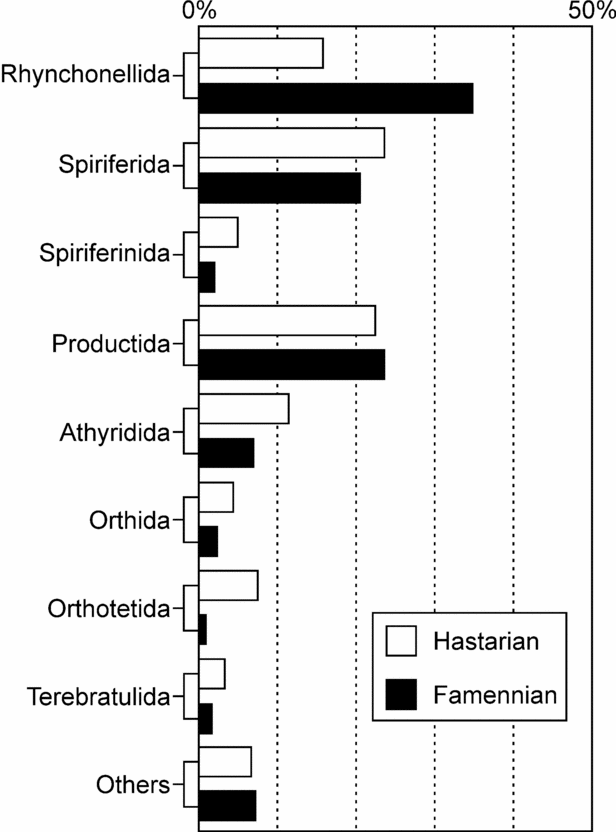
During the Late Devonian, brachiopod diversity was significantly affected at the end of the Frasnian by the extinction of the orders Pentamerida and Atrypida and by severe losses among the other more important orders (Baliński, Reference Baliński, Copper and Jin1996; Copper, Reference Copper2002; Mottequin, Reference Mottequin2008a ). In contrast to other benthic macrofaunas such as the corals (Poty, Denayer & Mottequin, Reference Poty, Denayer and Mottequin2011), the post-extinction brachiopod recovery was rapid in the lower Famennian but, despite their great abundance, their diversity was quite low. New cosmopolitan genera appeared at this time particularly among the spire-bearers (athyridides, spiriferides) and the rhynchonellides concomitantly with new species of pre-existing and generally long-ranging orthide and orthotetide genera (Baliński, Reference Baliński2002; Mottequin, Reference Mottequin2008b ). Nevertheless, Devonian brachiopod diversity reached a nadir during the Famennian with 203 genera in comparison with 460 at the Emsian (Curry & Brunton, Reference Brunton and Kaesler2007), but spiriferides and non-chonetidine productides increased significantly during this stage. In broad terms, the Famennian is characterized by brachiopod faunas dominated by the Rhynchonellida, the Spiriferida and the Productida (including the Chonetidina as an important suborder at this time) (Curry & Brunton, Reference Curry, Brunton and Kaesler2007) (Fig. 2).
Relative proportions of different brachiopod orders recorded from the Famennian Stage (Upper Devonian) and the Hastarian Substage (Lower Carboniferous, base of the Tournaisian Stage) (modified from Curry & Brunton, Reference Brunton and Kaesler2007). The Order Productida includes the suborders Chonetidina, Productidina and Strophalosiidina.

The uppermost Famennian (‘Strunian’) is characterized by radiations among several brachiopod orders such as the Productida, Spiriferida, Spiriferinida and Rhynchonellida, which developed morphological features heralding the early Mississippian brachiopod faunas (Gosselet, Reference Gosselet1857; Cooper, Reference Cooper1954; Conil et al. Reference Conil, Dreesen, Lentz, Lys and Plodowski1986; Simakov, Reference Simakov and Walliser1990). In common with major groups of invertebrates such as ammonoids (Kullmann, Reference Kullmann2002), corals (Poty, Reference Poty1999), stromatoporoids (Fagerstrom, Reference Fagerstrom1994) and fishes (Friedman & Sallan, Reference Friedman and Sallan2012), brachiopods suffered extinctions during the Hangenberg Crisis such as the disappearance of the last cyrtospiriferoids. It is clear that the development of euxinic conditions in basinal and shelf locations, which were responsible for the deposition of the Hangenberg Black Shale and its equivalents, followed rapidly by a major sea-level drop (Hangenberg Sandstone and its equivalents; see Kaiser et al. Reference Kaiser, Becker, Steuber and Aboussalam2011), affected the brachiopod faunas at the D–C boundary. However, owing to hiatuses recorded on the platforms, the detailed timing of the brachiopod extinctions is difficult to locate precisely. However, the real impact of this crisis on the brachiopods is still in debate as, for example in South China, there would be no evident sign of brachiopod extinction related to the Hangenberg Crisis (Y. Sun, pers. com.).
Based on comprehensive studies, Sun et al. (Reference Sun, Ma, Zhang, Wang, Rong, Fang, Zhou, Zhan, Wang and Yuan2006) and Sun & Baliński (Reference Sun and Baliński2011) have shown that the brachiopod diversity, in South China, reached a nadir during the lower part of the Hastarian and a peak in the upper part of the Hastarian, although c. 60% of the genera known from the uppermost Famennian survived into the lower Tournaisian, including mainly long-ranging genera (e.g. Schizophoria, Leptagonia) and some ‘Strunian’ elements (e.g. Paralellora, Syringothyris). In various parts of the world (e.g. North Africa, Armenia), the siliciclastic environments of the uppermost Famennian were colonized by large, multispinose araksalosiides (Strophalosiidina) (Lazarev, Reference Lazarev1989; Legrand-Blain, Reference Legrand-Blain1995a , b), which became extinct at the end of the Devonian and were subsequently replaced by less spinose and smaller representatives of the Quadratiinae (Legrand-Blain, Reference Legrand-Blain1995a ).
According to Curry & Brunton (Reference Curry, Brunton and Kaesler2007), the Hastarian is marked by a severe decline of the rhynchonellides (16% of the total brachiopod diversity) (Fig. 2), which subsequently declined further in the Carboniferous. The initial increase in brachiopod diversity during the Tournaisian can largely be attributed to the success of the Productida, in which the Chonetidina became less abundant leaving the morphologically diverse true productidines and strophalosiidines to flourish in various environments (Curry & Brunton, Reference Brunton and Kaesler2007).
4. Conclusions
Selected genera of the rhynchonellides, spiriferides, spiriferinides, productidines and strophalosiidines are very useful for correlations in neritic environments near the D–C boundary, in conjunction with foraminifers and rugose corals, where usual marker fossils (ammonoids and conodonts) are absent or rare. This is especially the case in mixed siliciclastic-carbonate depositional environments of Western Europe and North Africa. Further work is required to reach a better assessment of the aftermath of the Hangenberg Crisis on brachiopod diversity. A revision of the faunas from classical areas (e.g. the Franco-Belgian Basin, Germany, UK) is required because, owing to their rapid evolution and their large geographic distribution, brachiopods are prime tools for research dedicated to event palaeontology and palaeobiogeography.
Acknowledgements
We are very grateful to Yualin Sun and to an anonymous reviewer for their critical reviews and thoughtful suggestions which improved the manuscript and to George Sevastopulo, who advised on linguistic aspects of the paper. B. Mottequin acknowledges the Fonds national de la Recherche scientifique (FNRS) for its support (grant no. 90293959/R.FNRS.2498). This paper is a contribution to the International Geoscience Programme (IGCP) Project 596 – Climate change and biodiversity patterns in the Mid Palaeozoic.