I. INTRODUCTION
Nearly a half-century before the financial crisis of 2008, there was another time (1959 to 1967, the period covered by this paper) when reforming the world monetary system was on everyone’s lips. Many academics and policy makers were formulating plans for its reconstruction before illiquidity, speculation, and loss of confidence brought the system to a predicted ruin. In fact, the end of the Bretton Woods system came between 1968 and 1973.Footnote 1 Not since the Great Depression was the fear of a total financial meltdown so real. This paper examines two competing proposals for reforming the system, and the two economists, Robert Triffin and Fritz Machlup, who led the charge, one for centralized reserves and a common currency, the other for flexible exchange rates, first introduced by Friedman (Reference Friedman1953). In his statement before the US Congress, Triffin (Reference Triffin1959) articulated the problem that would become known as the “Triffin Paradox.” As the marginal supplier of the world’s reserve currency, and as the global economy expanded, the United States could continue to supply reserve assets to foreigners by running a current account deficit and issuing dollar-denominated obligations to fund it. If the United States ever stopped running balance-of-payments deficits and supplying reserves, the resulting shortage of liquidity would pull the global economy into a contractionary spiral. Nevertheless, Triffin warned that, if the deficits continued, excess global liquidity risked fueling inflation. Moreover, the buildup in dollar-denominated liabilities might cause foreigners to doubt whether the United States could maintain gold convertibility or might be forced to devalue, thus undermining confidence in both the dollar and the monetary system depending on the dollar. Triffin would call for a radical reform of the system in Gold and the Dollar Crisis (1960). The US President John F. Kennedy would recommend Triffin’s book to Secretary of the Treasury Douglas Dillon (Triffin Reference Triffin1981). Fred Bergsten of the US National Security Council and the Brookings Institution would call Gold and the Dollar Crisis “the most influential book ever written on the international monetary system” (Bergsten Reference Bergsten and Feldstein1994, p. 44).
Nevertheless, we know in the end that flexible exchange rates prevailed and that the underlying system was not reformed. We know also that Triffin believed that the outcome was the result of Machlup’s influence on influential policy makers and academics who had strong policy-making ties (Triffin Reference Triffin1960, p. 8). Contemporary literature, much of it written by insiders to the reform debates, affirms Machlup’s influence and that of the group he led, the thirty-two non-governmental economists also known as the Bellagio Group.Footnote 2 Robert Solomon, a member of the Federal Reserve and an American representative working with the Group of Ten,Footnote 3 said of the Bellagio Group,
One can discern [in their work] two areas of divergence from the content of the reports of the Group of Ten and the International Monetary Fund. More stress was placed on the desirability of changing exchange rates as a means of balance of payments adjustment. And more concern was expressed about the instability that could arise from the ‘overhang’ of foreign exchange reserves.… In general the report of the Bellagio Group holds up well in the light of subsequent developments (Solomon Reference Solomon1977, p. 71).
Former historian of the International Monetary Fund Margaret DeVries wrote, “In 1963–64 a group of 32 academic economists and public officials identified three basic problems of the Bretton Woods system: liquidity, adjustment and confidence in reserve media. For the next decade, discussions of the system’s shortcomings centered around these three problems” (DeVries Reference Devries1987, p. 80). Richard Cooper, senior economist for the US Council of Economic Advisors and Deputy Assistant Secretary of State for international monetary affairs, thought the Bellagio Group exposed central bankers to the evolution in academic thinking, and may have played some role in persuading central bankers that flexible exchange rates might be workable (Cooper Reference Cooper, Little and Olivei1999, p. 9).
Bordo and Eichengreen (Reference Bordo and Eichengreen1998, p. 24) attribute to the Bellagio Group the advocacy of the creation of a special reserve asset before the publication of the 1963 IMF annual report and 1964 report of the Group of Ten study group. An amendment to the IMF Articles of Agreement creating Special Drawing Rights (SDRs) came finally in 1968. In his essay “Le groupe de Bellagio: origins et premiers pas (1960–1964),” for Michel Dumoulin’s Economic Networks and European Integration (2002), Jerome Wilson also finds that the Bellagio Group anticipated the work of the Ossola Group on Special Drawing Rights.
How did Machlup and the Bellagio Group come to influence the terms of the discussion of monetary system reform? What impact did the presentation of the problem in terms of liquidity, adjustment, and confidence (what we call “framing” the problem in the social sciences) have on the move from the gold-exchange standard to flexible exchange rates, and on the adoption of the special reserve asset known as the SDR (Special Drawing Rights) to guard against future financial crises? Answering these questions is the aim of this paper.
In the economic literature, liquidity and confidence were and are two related, even intertwined, factors, influencing how economists and policy makers felt about a third factor: the likelihood and speed of payments adjustment. Both Machlup and Triffin took up these factors in their writing. Triffin sought to raise confidence in reserve media by replacing commodity money with fiduciary money guaranteed by a lender of last resort (Triffin Reference Triffin1960, pp. 146–147). Machlup argued that securing confidence would, all by itself, restore balance in the payments position of the United States because the renewed inflow of private capital would wipe out the deficit (Machlup Reference Machlup1966b).
Confidence itself has a long history in the monetary theory literature, where it is linked to expectations and uncertainty. In “Money as a Substitute for Confidence,” Ritzmann (Reference Ritzmann1999) identifies two early, divergent views of confidence that he associates with contemporaries Henry Thornton and David Ricardo. From a Thorntonian perspective, value derives from subjective confidence in the reliability of one’s fellow men, social institutions, and established rules of behavior. From a Ricardian perspective, the value of money is regulated by the mechanics of the quantity theory, occasionally distorted by irregular and transitory aberrations in velocity of money. We see these two sides of the confidence coin in Machlup and Triffin. For Machlup, expectations are based on interpretations of reality or future reality, an internal or Thorntonian view. For Triffin, expectations are based on specific actions or the results of actions (data, not feelings), an external or Ricardian view.
Dequech (Reference Dequech1999) argues that degree of confidence is a function of uncertainty perception and uncertainty aversion, the latter attributable to the Keynesian notion of “animal spirits.” Uncertainty perception depends on the level of knowledge about the existence of uncertainty itself and on the institutional factors that increase or decrease uncertainty. Uncertainty aversion makes us want to “hold money as a store of wealth” to lull “our disquietude” (Keynes Reference Keynes1936, p. 148). For Machlup, individuals control how much uncertainty they can tolerate for how long through market mechanisms; for Triffin, publicly accountable institutions can circumscribe uncertainty and restore confidence.
The paper begins with a review of the critical balance-of-payments problems facing the world after WWII, and a broad discussion of alternative policy options and their advocates (Section II). The Triffin and Machlup arguments are made in sections III and IV. Section 5 discusses Machlup’s leadership role in the Bellagio Group conferences to build consensus around confidence as the root cause of financial instability and the confrontation of ideas in the conferences as well as in the journals of the days. Section VI returns to the questions posed in the introduction and draws conclusions. Taking an historico-biographical approach, the paper draws on the published works of Triffin and Machlup as well as on their personal papers, housed at Yale University and the Hoover Institution, respectively.
II. A CRISIS IN CONFIDENCE—BALANCE-OF-PAYMENTS PROBLEMS, SOLUTIONS, AND THEIR ADVOCATES
From 1946 to 1973, exchange rate policy was dominated by the Bretton Woods financial system. It differed from the prior period’s gold-exchange standard in three ways. Instead of pegged exchange rates, Bretton Woods established adjustable exchange rates to eliminate balance-of-payments deficits, subject to the existence of what was known as “fundamental disequilibrium” (although the term was associated with crisis, and countries sought to avoid sending a message of crisis to their trading partners). Capital controls were permitted in order to curb potentially volatile international capital flows. The International Monetary Fund was created with the mandate to monitor national economic policies, extend balance-of-payments financing to countries at risk, sanction governments responsible for policies that destabilized the international system, and compensate countries that were adversely affected (Eichengreen Reference Eichengeen2008, pp. 91–92). In practice, despite the adjustable peg, parity changes were rare. Exchange controls substituted for the absence of an adjustment mechanism until the restoration of current-account convertibility in 1959.
Under the Bretton Woods financial system, the universally accepted reserve asset for international payments was gold, but gold supplies were limited, and new gold stores were under the control of countries (fundamentally South Africa and Russia) where gold was mined. Hence, US dollars and British pounds sterling (the latter only after 1958) were established by the Bretton Woods Agreement as substitute currencies for international payments, although convertible to gold upon request. The dollar was also a medium for the financing of foreign trade through the Eurodollar market, which permitted high interest-bearing, US dollar-denominated, short-term deposits at foreign banks or foreign branches of American banks that were not subject to US bank reserve requirements. The Eurodollar market was actively promoted in Britain as a way to continue Britain’s international financial leadership role. According to Toniolo, most central banks at this point (early 1960s) took a positive attitude toward the Eurocurrency market because it provided them with a flexible, high-yield investment outlet and temporary cover for liquidity imbalances, and used the Eurocurrency market (Bank for International Settlements, Bank of Italy) for this purpose (Toniolo Reference Toniolo2005, pp. 460–461). The central banks’ attitude of benign neglect of the Eurodollar market began to change in 1967–1968, following international monetary events that accelerated the pace of short-term capital flows: the Middle East War of 1967, the sterling devaluation of 1967, the gold crisis of March 1968, and the French franc crisis later in the same year. Having grown to a huge size, the Eurocurrency market was heavily dependent on monetary policies in the US, as concern spread about the war in Vietnam and Johnson’s Great Society program.
From 1958 to 1968, a whole series of agreements, regime rules, and institutions were needed to ensure the Bretton Woods financial system worked. Institutions included the International Monetary Fund, Working Party No. 3 of the Organisation for Economic Cooperation and Development, and the Bank for International Settlements, which was tasked with problems of money and exchange. Agreements and regime rules included swap agreements between central banks, 1961–1962; the General Agreement to Borrow, 1962; the Gold Pool, 1964; and Special Drawing Rights (SDRs) of the International Monetary Fund, 1965–1967. Nevertheless, maintaining the system’s viability for as long as possible was highly desirable, given the high rate of growth in international trade. To support such trade required the creation of increasing international liquidity, primarily in the form of central bank reserves. Insufficient means of international payments would obviously reduce trade and therefore output growth and therefore employment. Full employment and growth required trade liberalization. Individual countries would proceed with a program of trade liberalization only if they felt comfortable with a level of reserves believed to be capable of cushioning the domestic economy from international monetary shocks (Toniolo Reference Toniolo2005, pp. 351–352). Hence, the provision of international liquidity largely depended on the US balance-of-payments deficit, though managing the size of those deficits was critical to confidence in the international currency. This had not been a problem, given the dollar shortage that prevailed through much of the 1950s, when the US ran balance-of-payments surpluses. The problem began to manifest when US purchases from Japan and western Europe, as well as the country’s overseas investments and military expenditures, led to larger US balance-of-payments deficits (Toniolo Reference Toniolo2005, p. 353).
The US and Europe shared a common fear: the balance-of-payments effects of short-term money flows (increasingly those through the Eurodollar market, as well as the ability of central bankers to cash in dollars for gold at any time). Both sides of the Atlantic feared that the ratio of dollar liabilities to American-held gold might one day increase to a level that caused a loss of foreign confidence in the dollar and a run on the US Treasury gold window.
American policy makers saw loss of confidence as a threat to national economic well-being and foreign policy. Presidents Dwight Eisenhower, John F. Kennedy, and Lyndon Johnson considered US payments deficits a problem as critical to US security as the nuclear threat. Kennedy calculated that the US payments deficit in 1962 was equal to the cost of maintaining US troops in Europe, and weighed the advantages of eliminating the deficit by recalling the troops or negotiating with the French as the US had with Germany to pay for the troops via US armaments purchases, thus allowing the US to use the cash received to retire the deficit (Gavin Reference Gavin2004). Cold War presidents were concerned that the Soviet Union might pursue an alliance with Germany or that France might pursue an alliance with Germany, pushing the US out of European affairs.
European policy makers feared restrictions on, or termination of, all sales of gold by the US monetary authorities; restrictions on international payments through the introduction of foreign exchange controls and prohibitions of capital transfers; import restrictions of all sorts; the blocking of deposits of foreign nationals; the end of convertibility; and elimination of key currencies from the official reserves of central banks and, consequently, a drastic reduction in “liquidity” everywhere and, ultimately, reductions in production and employment resulting from import restrictions and export reduction. Many high French officials believed that the international monetary system was rigged in favor of the Americans. De Gaulle criticized America’s “exorbitant privilege” and threatened to liquidate the French government’s dollar balance. France was, at that time, a large creditor of the US Treasury (Eichengreen Reference Eichengeen2008, p. 115). France’s ambassador to the US, Hervé Alphand, had told de Gaulle that Kennedy was receiving all kinds of dangerous advice on monetary policy from his advisors. Controls and a gold embargo were being considered. Europe was already deeply engaged in building an external monetary policy to end dependency on the USA and on the US dollar as the pivotal international currency, which involved reforming the international monetary system to base it on a neutral, non-dollar standard (Dyson and Featherstone Reference Dyson and Featherstone1999, p. 83).
For all practical purposes, fixing Bretton Woods without actually reforming it would boost confidence and enhance trade; hence, the plethora of minimalist, exchange rate-oriented approaches, and, ultimately, the victory of floating rates. As Eichengreen and James (Reference Eichengreen, James, Bordo, Taylor and Williamson2003, p. 515) have argued, “a consensus on the need for monetary and financial reform is likely to develop when such reform is seen as essential for the defense of the global trading system.” The energy of economists from the Group of Ten countries around exchange-rate solutions can be partially explained by the Group of Ten’s responsibility for macroeconomic policy under the IMF. As important a factor was the continued pressure toward European integration and particularly intra-Europe trade at this time. The six members of the European Coal and Steel Community (France, Belgium, Luxembourg, West Germany, the Netherlands, and Italy) pursued regional integration of the goods markets with the European Economic Community, but left macroeconomic policy making in the hands of the member states. However, the balance-of-payments chapter of the Rome Treaty, signed in 1957, made it fundamental for all member states to adopt economic policies that would ensure balance-of-payments equilibrium (Emminger 1958, p. 93). In the exploration of alternative solutions to problems with the Bretton Woods financial system, governments needed to decide whether they wanted to have an independent monetary policy, which required a flexible exchange rate, or to forego an autonomous monetary policy in the interests of having a stable and predictable exchange rate. In the spirit of Hefeker (Reference Hefeker1996) and Frieden (1994), what might be called an interest-group approach to exchange-rate policy preferences, given capital mobility, would suggest that large, export-competing, traded goods producers like Germany would be open to flexible rates. At the same time, countries like France and England, as well as banks and firms, that were heavily involved in international trade and investment, and cared deeply about the predictability of the exchange rate, were in favor of fixed exchange rates anchored by gold. Italy, a weak state with weak institutions, looked to European integration to impose greater fiscal and monetary discipline (Dyson and Featherstone Reference Dyson and Featherstone1999). Economic integration was important to small open economies like Belgium and the Netherlands, both of which also pursued a stable exchange-rate policy. Integration was avidly pursued by democratic regimes (social democrats in Germany; Christian democrats in Italy, Belgium, and the Netherlands). During the 1960s, the French official position polarized between two views on reform: those advocating a return to gold and a policy of hoarding gold as an insurance and bargaining resource to diminish US power in Europe (exemplified by Jacques Rueff, Maurice Couve de Murville, and Charles De Gaulle); and those seeing the solution in developing a European monetary personality with a common or parallel currency and a composite reserve unit to replace the dollar (exemplified by Triffin, Andre de Lattre, and Giscard d’Estaing).
Among the economists generating significant public attention with a solution to the problems of Bretton Woods was Jacques Rueff, a monetary economist and advisor to Charles de Gaulle. He argued that the current gold-exchange regime should be replaced by a pure gold standard, holding that international deviation from the gold standard had caused the global financial meltdown in 1933. He had first gained de Gaulle’s trust in 1958–1959 when Rueff’s austerity plan to stabilize the French economy succeeded in its aims. Privately, Rueff did not believe that US deficits were caused by Cold War commitments, but by the United States’ practice of financing its external deficit by increasing its IOUs or international liabilities rather than by losing gold. He argued for a rise in the price of gold sufficient for the US to repay what it owed to foreign central banks. He argued further that other participating nations should fix the gold value of their currencies. No central bank should be permitted to lend to the US or any other debtor country the currency against which it had already created credit in the domestic economy. In a study of the French position from 1960 to 1968, Bordo, Simard, and White (1994) establish that, while the French did promote and support a currency standard tied to gold, they used proposals to return to an orthodox gold standard as well as conversions of its dollar reserves into gold as tactical threats to induce the United States to initiate the reform of the international monetary system towards a more symmetrical and cooperative gold-exchange standard regime.
Sir Roy Harrod of Oxford University, a specialist in international economics and policy, had predicted the kind of crisis that befell the Bretton Woods Agreement twenty years later: gold supplies could not keep pace with world trade. He found himself a strange bedfellow of Rueff and economist Michael Heilperin, arguing for a semi-automatic gold standard, where the price of gold would be increased to $70/ounce, creating a one-time liquidity cushion of $40 billion. Harrod foresaw that, without raising gold reserves, the development of world trade would be impeded by a shortage in international liquidity, encouraging policy makers to maintain tighter, deflationary monetary policies, increasing the likelihood that such policies would be transmitted internationally.
Along with Xenophon Zolotas, head of the central bank of Greece, some European economists, including Friedrich Lutz of Switzerland, and US policy makers, including Assistant Secretary of the Treasury for Monetary Affairs Robert Roosa, were more than happy to exchange the dominant reserve currency position for a basket of multinational currencies backed by gold.
Others, led by Triffin, preferred to centralize reserves under an expanded International Monetary Fund. Still others, led by Machlup, Harry Johnson, and Milton Friedman, among others, sought to eliminate gold completely (Machlup wanted to reduce the price of gold to drive it out of hoarding and into central banks), and set exchange rates free to float.
During this period, the International Monetary Fund and its associated agencies, as well as the deputies of the Group of Ten (finance and treasury officials from the leading industrial countries), were engaged in multiple studies of the seriousness of the liquidity problem and the adjustment mechanisms necessary to alleviate or resolve payments imbalances.
III. ROBERT TRIFFIN AND THE TRIFFIN PLAN
Born in Belgium and educated at the Catholic University of Louvain, Triffin left for the US in 1935 to undertake graduate studies at Harvard University. In his brief biography in the Banca Nazionale del Lavoro Quarterly Review, Triffin acknowledged Josef Schumpeter, his dissertation advisor, as a major influence on his understanding of pure economic theory (Triffin Reference Triffin1981). He studied fiscal policy from a Keynesian perspective with John Williamson (whose national key-currencies perspective Triffin would not share) and Alvin Hansen (whose perspective on “fundamental disequilibrium” Triffin would embrace). Like Hansen, Triffin believed that a country’s balance of payments might arise from significant internal imbalances (deep recession, low output, high unemployment), which could outweigh balance-of-payments considerations and point toward major policy changes (Endres Reference Endres2005).
From 1942 to 1946, Triffin was chief of the Latin American section of the Board of the Federal Reserve System and one of the US “money doctors” who argued against a passive monetary policy geared externally to respond automatically to changes in the balance of payments, and for activist monetary policies that insulated the national economy from international disruptions (Heilleiner Reference Helleiner2003; Flandreau Reference Flandreau2003). From 1946 to 1949, Triffin played various roles at the International Monetary Fund, first as Director of Exchange Control Division, Observer, later as US Representative to the Intra-European Payments Committee of the Organisation for European Economic Cooperation (which became the Organisation for Economic Cooperation and Development) from 1948 to 1951, and served as US Alternate Representative to the European Payments Unit from 1950 to 1951. He became a professor of economics at Yale University in 1951, where he remained until 1977 (Blaug Reference Blaug1985).
Triffin found fault both with the classical gold standard and with the Bretton Woods gold-exchange standard. He in no way trusted the pre-1914 classical gold standard to be self-managing, with payments imbalances settled simply by shipments of gold and central bankers as passive facilitators (Trifin Reference Triffin1947, pp. 49, 53). The existence of fractional reserve banking requirements (officially at 33%) led to multiplier effects in the credit base, speeding up adjustment but, at the same time, exaggerating the amount of expansion or contraction, and affecting both investment and output. Triffin argued that those nations heaviest hit by adjustment burden were not big countries with payments imbalances, but the small raw material exporting nations that depended on them (Triffin Reference Triffin1947, p. 60).
Likewise, Triffin found that the Bretton Woods system’s key-currency approach was fundamentally unstable, dependent as it was on the degree of confidence held in a currency. Because confidence itself depended on many factors, including the monetary and fiscal policies of national authorities, the use of national currencies as international reserves of national monetary authorities interfered with parity adjustments by reserve currency countries when needed. For that reason, national moneys could not sustain their position as liquidity stabilizers or as international media for financing or payments adjustment. Major key-currency countries would, therefore, fall from grace, and would not provide the basis for a sound international financial order. In Europe and the Money Muddle, Triffin had argued that the growth of foreign countries’ reserves had taken place in recent years largely as a result of a vast redistribution of net reserves from the United States to the rest of the world, and that such a movement could not continue indefinitely without eventually undermining confidence in the dollar itself (Triffin Reference Triffin1957, pp. 296–297). Triffin considered the very survival of the gold-exchange standard to be increasingly precarious, “because central banks are being called upon to finance debtor countries’ policies in which their own governments have no voice, and with which they may profoundly disagree” (Triffin Reference Triffin and Triffin1965, pp. 349–350). Disputing the thesis of colleagues Depres, Kindleberger, and Salant (that the United States had become the financial intermediary or central banker for Europe, and that American deficits reflect a mutually advantageous and equilibrating function), Triffin contrasts his plan’s calls for centralized reserves as a merger of sovereignties for sound expansion of the international economy with the DKS troika for whom the United States as lender of last resort results in a surrender of sovereignty (Triffin Reference Triffin1966, pp. 9–14).
Triffin’s prescription was to replace gold and foreign currency reserves by gold-guaranteed deposit accounts at the International Monetary Fund, replacing the gold-exchange standard with a credit reserve standard based on gold. First of all, this would enable the IMF to control the expansion of world reserves, adjusting them to the noninflationary requirements of the growth of world trade and production, rather than to the vagaries of the US balance of payments and the private gold market. To guard against inflationary abuses of the fund’s lending capacity, Triffin suggested that a qualified vote of two-thirds or more of the total weighted voting power be required to authorize IMF lending susceptible to increasing world reserves by more than 3, 4, or 5% a year (Triffin Reference Triffin1978a, p. 3). Secondly, Triffin suggested that the expansion of International Monetary Fund lending capacity be used for three key purposes: to finance traditional stabilization assistance to deficit countries, subject to the adoption of agreed readjustment policies; to offset speculative switches from some currencies into others or into gold; and to accelerate the financing of development in the Third World through the purchase of obligations of the World Bank, its affiliates, and newly emerging regional development banks (Triffin Reference Triffin1978a, p. 3).
Triffin’s recommendations for the reform of the system changed somewhat over the twenty-year period, including and especially the role of gold in the system. Triffin’s Reference Triffin1959 proposal would have required all members to hold a certain proportion of their gross monetary reserves in the form of IMF deposits. All would have to agree to accept such deposits in settlement of their international claims without limit, but would have the right to convert at any time into gold, if they so wished, any deposits accrued to their fund account in excess of their minimum requirement (Triffin Reference Triffin1960, p. 106). He considered a minimum requirement of 20% to be acceptable and achievable mostly through net claims of $2.6 billion already held by members of the fund and by transfers to the fund of about one-third, or $5.3 billion, of the $15.8 billion in foreign-exchange reserves then in existence. Only a handful of countries—primarily the United States, which held no foreign-exchange reserves—would have had to satisfy their minimum deposit requirements by gold transfers ($3.4 billion, or less than 10% of the $37.9 billion in world monetary gold holdings at the time). Of total gold reserves of $56.2 billion, a minimum of 20% or $11.2 billion would have been held in fund deposits, but countries could have retained, if they wished, 61%, or $34.5 billion, in gold, and 19%, or $10.5 billion, in foreign exchange (Triffin Reference Triffin1978a, p. 6).
While Triffin thought these provisions would be adequate at the time, he advised that safeguards would have to be put in place to maintain the fund’s liquidity, both against unforeseen conversions of excess deposits into gold and against the increasing gap between the probable level of world gold stocks and the desirable expansion of overall monetary reserves (Triffin Reference Triffin1978a, p. 114). Triffin offered a solution to the problem: raise the 20% deposit requirement to a higher ratio of gross monetary reserves, or impose higher deposit requirements on the portion of each member’s reserves that exceeds the average ratio of world monetary gold to world imports (Triffin Reference Triffin1960, p. 114).
Triffin saw the world economy as fundamentally multilateral and interdependent; hence, coordination by a world body was an indispensable precondition (Triffin would first propose the IMF, but he offered the OECD as an alternative). This precondition was also a potential disadvantage of Triffin’s credit-exchange standard. There was no world trust in the IMF or OECD, a central coordinating body that might limit the discretion of individual member nations to make their own policy decisions.
Members of the Monetary Committee of the European Economic Community, whose president Otmar Emminger was also chair of the deputies of the Group of Ten, found fault with Triffin’s prescription for change, although not with his diagnosis. Dr. Emminger would write that the Triffin Plan would encourage continued US deficits by putting the International Monetary Fund in charge of correcting short-term imbalances. The International Monetary Fund continued to be linked too closely with the US for European comfort. Triffin, on the other hand, suggested an alternative scheme: reserves might be deposited with the OECD or EEC. He went so far as to suggest that the US and Canada join the EEC (Triffin Papers, MS 874, Box 1, folder 1).Footnote 4 Triffin appears to have had detractors in Europe: were they suspicious of his relationship with the US as US policy makers (e.g., Treasury Secretary Douglas Dillon) were suspicious of his European ties? Triffin suggests that his contemporaneous roles on behalf of the US and European Community created problems at times (Triffin Reference Triffin1981, p. 245).Footnote 5 Nevertheless, in his article “An Economist’s Career: Why? Why? How?” in the Banca Nazionale del Lavoro Quarterly Review (1981), Triffin identified two issues that had dominated his research and his life: worldwide monetary reform of the crumbling gold convertible dollar exchange standard; and regional monetary cooperation.
IV. FRITZ MACHLUP AND ADDITIONS TO MONETARY RESERVES
Machlup’s interest in international monetary economics grew out of his 1923 dissertation on the gold-exchange standard, Die Goldkernwahrung, produced under the supervision of Ludwig von Mises at the University of Vienna and published in 1925, followed by Die neuen Wahrungen in Europa in 1927, a book in which he described the adoption of the gold-exchange standard by one country after another (Machlup Reference Machlup1982). Machlup continued work on the transfer problem (1930), the price of gold (1941), and the theory of foreign exchanges (1939)—the last three of which were reprinted in International Payments, Debts and Gold (Machlup Reference Machlup1964a). While Machlup has been classified generally as a ‘neoclassical’ economist, Langlois and Koppl (Reference Langlois and Koppl1991) and Koppl (Reference Koppl1992) have positioned Machlup far from the neoclassical and Austrian mainstream. Machlup (Reference Machlup1966a) was the first economist to attribute adjustment and liquidity to a failure of confidence, and to argue that a restoration of confidence would render adjustment and liquidity moot. His former student John Williamson attributes Machlup’s belief in the importance of confidence to the role confidence played in collapse of the gold-exchange standard during the Great Depression (Williamson Reference Williamson and Dreyer1978, p.167).
Beginning in the 1950s, Machlup began looking at the confusion of terms in international trade—deficit and surplus, trade balance and imbalance, dollar shortage and dollar glut—arguing these terms, which had taken on a negative, even pessimistic interpretation, were not a consequence of structural obstacles but of national economic policies adopted. In Equilibrium and Disequilibrium: Misplaced Concreteness and Disguised Politics (1958), Machlup argues that the most prevalent use of the equilibrium concept in economics is as a methodological device in abstract theory, a “useful fiction” that is a part of a mental experiment designed to analyze causal connections between “events” or “changes of variables.” Equilibrium is not an operational concept, nor an evaluative one nor a balance of forces, which might easily be confused with goodness or harmony; most importantly, it is not a value judgment by which equilibrium comes to mean conformance with certain objectives that organized society is asked to pursue. Focusing on the purely analytical concept of equilibrium in economic theorizing—that is, one of disturbance and adjustment—Machlup proposes a four-step adjustment model in which steps 1 (initial equilibrium) and 4 (final equilibrium) are methodological devices in a mental experiment designed to analyze causal connections between a disturbing change (Step 2) and an adjusting change (Step 3) (Machlup Reference Machlup1958, p. 115).
Machlup intended his model to be used in trade and balance-of-payments issues, where the deficit is an adjustment, or an equilibrating change, following an antecedent disequilibrating change; for example, increased government spending, expansionary monetary policy, devaluation of a trading partner’s currency, or receipt of foreign investment (Machlup Reference Machlup1982, p. 22). Machlup would use his partial-equilibrium-adjustment model as a framework for the Bellagio Group discussions, where a specific exchange-rate regime would be proposed as a disequilibrating change, and the equilibrating impacts inferred in terms of fundamental postulates, operations, and institutions needed to implement the regime.
For Machlup, the French (and German) focus on payments adjustment had a simple explanation: for many years the United States had spent, lent, and invested abroad more than it had received, and had paid for it partly in dollars, which the monetary authorities of many nations were prepared (some of them reluctantly) to hold in their monetary reserves. Some of the foreign spending and investing in the United States had been for purposes that the French government did not approve, particularly the war in Vietnam and the takeover of foreign firms, including industrial concerns in France. It followed, then, that the French would regard adjustment as the most urgent requirement. However, Machlup argued, would discontinuance of the Vietnam war and the US takeovers in Europe erase the payments deficit of the United States or, instead, lead to offsetting changes in other items of the balance, such as reductions in American exports or imports (as could well happen if spending and investing abroad were replaced by increased spending and investing at home) (Machlup Reference Machlup1966b, p. 2)?
A second feature in the French position had been the downgrading of all plans for the creation of new reserves and borrowing facilities. The affluence of the Bank of France that followed the devaluation of 1958 made it hard for the French to appreciate any talk about a present or imminent shortage of reserves in the world. If some nations had been unable to get a share of this abundance or even to avoid payments deficits, they evidently had not been “living right” (Machlup Reference Machlup1966b, p. 2).
To the American argument that the creation of a new reserve asset was needed only to take the place of the annual additions to foreign dollar reserves necessitated by the payments deficits of the United States, the French reply was that the deficit must be stopped, and a plan for the creation of international liquidity would only delay serious efforts to achieve payments adjustment. While Machlup argued that the French position was understandable, he saw the problem differently: the American difficulties in achieving balance are not, in fact, connected with the absence of an arrangement that provides safeguards against future contingencies. “Such contingencies, as I see them (or fear them) are less likely to arise from inadequate liquidity than from inadequate confidence” (Machlup Reference Machlup1966b, p. 2).
The American position, as Machlup saw it, rested on two optimistic suppositions: first, that the payments deficits could and would be eliminated in short order; second, that the dollar was as good as gold and would remain so even if the deficit should last for another few years. Granting these assumptions, the problems of adjustment and confidence are not so troublesome, and the provision of liquidity is the first order of business (Machlup Reference Machlup1966b, pp. 2–3). The liberalization of foreign trade since 1950 and the return to convertibility in 1956—both so important for the growth of world trade and prosperity—were possible only thanks to the ample provision of liquidity to the countries concerned. If the deficit of the United States is now eliminated and nothing takes its place, the annual increments to reserves will be confined to acquisitions of gold by monetary authorities. Little can be expected from this source if the present private demand for gold continues. However, if aggregate reserves fail to increase, several more countries will suffer deficits in their international payments. To stop losses in their reserves, countries may adopt illiberal commercial policies and place new restrictions on convertibility. World trade and finance would then be halted and might be reversed. To avoid this, the nations must agree on a method of creating adequate annual increments in world liquidity with no time to lose (Machlup Reference Machlup1966b, p. 3).
Machlup saw the weakness of the American position in its assumptions. The American attitude regarding the problem of confidence was understandable, given its debtor position: one can hardly expect a debtor, in a situation regarded as precarious by some of his creditors, to propose and urge that measures be taken to safeguard against a loss of confidence in his ability to pay; hence, the government of the United States refused to recognize that the confidence in the dollar is or may be shaken. Machlup argued that it is wrong to assume that confidence can be safeguarded by refusals to talk about safeguards, or that the balance of payments of the United States and confidence in the dollar are separate problems. Instead, he argued that the weakening of confidence in the dollar had caused the deficit in the balance of payments, and that attempts to reduce the deficit would prove futile without an increase in confidence to staunch the outflow of private short-term capital (Machlup Reference Machlup1966b, p. 3).
Changes in confidence in the convertibility of the gold and foreign exchange value of a currency are usually reflected in changes in the flow of private short-term capital. Given that short-term capital also moves in response to interest-rate differentials, it is not always possible to disentangle the two factors; nevertheless, from 1951 to 1966, the movements were so dramatic that there could be no question about its cause. From 1951 to 1959, private short-term capital had moved into the United States every year except 1954; the flow was reversed in 1960, and there followed substantial outflows for five years (Machlup Reference Machlup1966b, pp. 4–5). For this reversal in the flow of funds, there is no other explanation than a decline in confidence in the unrestricted convertibility of the dollar at fixed exchange rates and a fixed gold equivalent. However, to look only at movement of short-term capital is to underestimate the actual effect of the decline in confidence. Long-term capital is, as a rule, guided by many more factors than are significant for the flow of short-term funds, but expectations regarding the future convertibility and stability of the dollar are certainly not insignificant (Machlup Reference Machlup1966b, p. 5). Machlup argued that securing confidence would, all by itself, restore balance in the payments position of the United States because an inflow of private capital would wipe out the deficit (Machlup Reference Machlup1966b, p. 6).
Arguing that there were many systems that could secure confidence, Machlup broke them into four types: 1) collective international guarantees; 2) exchanging all official holdings or official excess holdings of dollars against debts (‘reserve units’) of an international agency; 3) ‘locking in’ fixed amounts or proportions of dollars in the official reserves of the financially most developed countries; and 4) making gold less desirable as an asset to hold than dollars, by providing for a slowly declining price of gold (perhaps through gradually increasing seignorage charges). Machlup argued that making gold less desirable by decreasing its price would strengthen the dollar not only as the currency in which to trade, invest, hold savings deposits, and hold working balances, but also as official reserve currency. In fact, one of the objectives that could be realized with any of the four systems of securing confidence described above was to reduce the dollar from its present position as unlimited reserve currency. Doing this would exclude or minimize the possibility of financing a payments deficit of the United States by voluntary or involuntary loans from central banks of other countries (Machlup Reference Machlup1966b, p. 6).
To what extent did the world surplus of reserves add to confidence? Machlup argued it was not a final amount but annual additions to reserves that had a positive impact on confidence. Using the example of his wife’s desire to add annually to her wardrobe, Machlup argued that the central banker does not care whether his reserve ratio (to his liabilities or to the total money supply) is 47% or 74%; he cares that his reserves increase, however modestly, and do not decrease (Machlup Reference Machlup1966c, p. 27). Machlup argues that justification of additions to reserves is a matter of politics, because, in countries suffering losses in foreign reserves, the authorities will eventually adopt policies that restrict international trade and capital movements. One way to avoid the restriction is to avoid the causes (or pretexts) for their imposition—that is, deficits in the balances of international payments—but, Machlup argues, the easiest way to avoid or reduce deficits and avoid restrictive policies is to provide for annual additions in official reserves (Machlup Reference Machlup1966c, p. 30). Some countries may patiently put up with higher interest rates, some with effective wage stops, and some even with unemployment when confronted with a deficit in their balance of payments; an “adequate” increase is, therefore, not a quantitative measurement but a matter of political judgment.
V. TRIFFIN AND MACHLUP AT THE BELLAGIO GROUP CONFERENCES
At the annual meeting of the World Monetary Fund in Washington, DC, on October 2, 1963, then Secretary of the Treasury and Governor of the International Monetary Fund Douglas Dillon announced at a press conference the launching of two studies on “the outlook for the functioning of the international monetary system,” one to be undertaken by government economists of the Group of Ten; the other study was to be made by International Monetary Fund economists. The New York Times reporter Edwin Dale, who was at the press conference, asked Secretary Dillon whether the Group of Ten intended to hold hearings, particularly whether individual economists outside the governments would be heard (Triffin Reference Triffin and Dreyer1978b, p. 147). The answer was no, accompanied by a remark about academic economists having had their say to no result. Three academic economists attending the fund meeting as guests (Machlup, William Fellner, and Triffin) felt challenged to embark on a study themselves, involving economists of widely divergent views with no problem or proposal considered “out of bounds” (Machlup Reference Machlup1964a, p. 8). Hence, the idea for a series of conferences was born. In fact, nearly every exchange-rate policy advocate invited to join what became known as the Bellagio Group conferences (after the location of the Rockefeller estate in Lake Como, Italy) had a preferred solution to the payments imbalance problem, and had played an active public policy role before moving into academe (and some of these, as previously noted, were now serving on one or another committee for European integration). Each of the members represented one of the Group of Ten industrial countries (United States, the United Kingdom, Canada, France, West Germany, Italy, The Netherlands, Belgium, Sweden, Japan, and Switzerland) or one of the official observers to Group of Ten activities: the Bank for International Settlements (BIS), European Commission, International Monetary Fund, and Organization for Economic Cooperation and Development. These countries had also agreed to participate in the General Arrangements to Borrow, pledging to provide standby credits amounting to $6 billion so that supplementary supplies of their currencies would be available in the event of a monetary crisis. Hence, the Group of Ten countries were important, hugely vested financially, and often found themselves at odds with the development agenda of the International Monetary Fund of which they were members. The ministers of finance and Central Bank governors represented their countries at Group of Ten annual meetings (held in conjunction with the annual meetings of the International Monetary Fund and the World Bank). The day-to-day unsung labor of the Group of Ten was the domain of the Treasury, and central bank officials known as the deputies of Group of Ten. As the economists invited to join the Bellagio Group would come to work closely with the deputies of the Group of Ten, the fact that their backgrounds were identical or nearly so was fortuitous.
Some of the same economists important to international monetary system reform as members of the so-called Group of 32 non-governmental economists (the Bellagio Group) were also involved in European Economic and Monetary Unification, especially the Belgian, French, German, and Italian economists. These included Jacques Rueff, monetary economist and close advisor to French President Charles de Gaulle; German economists Herbert Giersch, member of the Kiel Institute of World Economics, and Egon Sohmen; Belgian economists Triffin and Alexandre Lamfalussy; and Italian economist Pierre Uri.
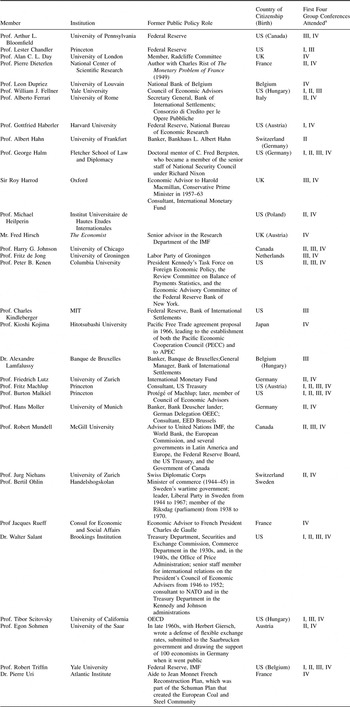
See Table 1, “Attending Bellagio Group members, their institutional affiliations, and public policy experience.” The economists’ ongoing network of relationships with policy-making institutions made the academic economists a very powerful think-tank and lobby. Ultimately, the Bellagio Group found itself assigned to work on adjustment and special reserves issues by Otmar Emminger.
Attending Bellagio Group members, their institutional affiliations, and public policy experience

Note: aThe first four Bellagio Group conferences were held as follows: I in Princeton, NJ on December 18 and 19, 1963; II at the Villa Serbelloni in Bellagio, on Lake Como, Italy on January 17 through January 23, 1964,; III in Princeton, NJ on March 21 and 22, 1964); and IV at the Villa Serbelloni in Bellagio, Italy from May 29 through June 6, 1964.
Source: Machlup, F. International Monetary Arrangements: The Problem of Choice (1964a) and author’s research into former public policy roles.
With support from the Ford and Rockefeller foundations, as well as Princeton University, four initial conferences were planned. The first was an experiment designed to isolate the assumptions underlying the major policy recommendations to determine where the policies diverged. With only ten members and five observers, this conference was held at Princeton, December 18 and 19, 1963. A second conference, held from January 17 through January 23 at the Villa Serbelloni in Bellagio, on Lake Como in Italy, enumerated the positive assumptions made by an “advocate” and the reasons he preferred his plan to alternative systems. The inquiry took the form of hearings: one or two protagonists were asked to submit to cross-examination by the rest of the group. Based on notes taken during these sessions, drafting committees worked every night on the formulation of statements of assumptions made in the advocacy of each major policy system. In the weeks that followed, members were asked to state their positions concerning each of the assumptions listed. Revised versions of the lists of assumptions were discussed during the third conference in Princeton, March 21 and 22. Further revised and re-edited lists of assumptions were again distributed, this time with questionnaires inviting answers on each assumption before the fourth and last conference, again held at Villa Serbelloni in Bellagio from May 29 through June 6, 1964. The task of this conference was not only to determine the final versions of the lists of assumptions but also to write a report of the conference results (Robert Triffin Papers, MS 874, box 12, folder 2).
The scheduling of the conferences and the publication of its final report in June 1964 were timed to coincide with the Group of Ten’s report on the functioning of the international monetary system published in August 1964, and with the report presented at the annual meeting of the International Monetary Fund in Tokyo in September 1964. Thereafter, there was much sharing of drafts between the Bellagio Group, members of the Group of Ten, and the International Monetary Fund, particularly Working Party 3 of the Organisation for Economic Cooperation and Development, as well as mutual meetings and conferences. The governmental and non-governmental reports were discussed and compared at a two-day session of the American Bankers Association conference prior to the fund’s Tokyo meeting. Further, the annual meeting of the American Economic Association in December 1964 was devoted to a comparative analysis of the reports of the Group of Ten, International Monetary Fund, and Group of 32 economists (Bellagio Group). The papers presented at the meeting were published in the Papers and Proceedings of American Economic Review, May 1965 (Robert Triffin Papers, MS 874, box 12, folder 2).
We learn from Triffin’s handwritten notes from a conference in Caracas in 1964 that Group of Ten members saw the usefulness of the Bellagio Group as a non-governmental, independent think-tank. Otmar Emminger found the Bellagio Group conferences invaluable to policy deliberations. Rinaldo Ossola, chairman of the Ossola Committee on Creation of Reserve Assets (Special Drawing Rights) of the Group of Ten, liked the Bellagio Group’s connection between liquidity and payments adjustment, and Robert Roosa, deputy secretary of the US Treasury and member of the Ossola Group, found the Bellagio Group’s contribution important to the “evolution” of emerging public policy (Robert Triffin Papers, MS 874, box 12, folder 2). Emminger, Ossola, Roosa, and van Lennep, chairman of Working Party 3 of the Organisation for Economic Cooperation and Development, would become exceptionally close working partners with the academic economists of the Bellagio Group, joining them for seminars some eighteen times through 1977.
Machlup set the prerequisites for discussion at the outset: common definitions; clarity around assumptions; recognition of values and judgments; and dedication to the discussion of exchange-rate policies in terms of three problems: payments adjustment, liquidity, and confidence. Machlup posited three common sources of disagreement in the expressed opinions of reputable economists: word meanings; differences in factual assumptions about the past or present; and differences in value judgments. Differences in factual assumptions about the future raised interesting questions about underlying adjustment mechanisms and their macroeconomic impact. In undated notes written in preparation for the first conference on December 18–19, 1963, Machlup wrote,
Semantic or terminological differences can be resolved without great difficulties. Cleared specifications of intended meanings may remove most of the prevailing misunderstandings. For example, arguments for or against flexible exchange rates will depend on whether ‘flexible’ is to mean (1) ‘temporarily pegged but adjustable by unilateral decision,’ (2) ‘floating in a free market with some limited official selling and buying operations,’ or (3) ‘freely floating in a free market without official stabilizing sales and purchases’ (Fritz Machlup Papers, box 282, folder 6).
These thoughts were captured in International Monetary Arrangements: The Problem of Choice (1964a).
Assumptions betraying political attitudes were especially important to Machlup, who saw that judgments about what is politically “unacceptable” or “impossible” might be responsible for wide disagreement among economists. He held that economists should frankly state what their recommendations would be if the constraints of ‘political feasibility’ were removed. Finally, Machlup warned against confusing political assumptions with value judgments: “To state that a certain objective is ‘good’ or ‘bad’ is one thing; it is another to assume that this objective is ‘wanted’ by a majority of the people or legislators. The former is a value judgment, the latter a factual assumption …” (Fritz Machlup Papers, box 282, folder 6).
Because the impact of exchange-rate policy on payments adjustment, liquidity, and confidence was given priority, it was essential that economists share a common understanding of these terms (Machlup Reference Machlup1964a, pp. 43–45). Machlup engaged the economists at the first “test” conference in drafting definitions, and considering causes and frequency issues that might create variants of each term. For example, payments imbalances were sorted into three types, depending on frequency and cause. Continuing or persistent disturbances arose from changes in “real” supply/demand conditions. Such imbalances cannot be financed indefinitely by the deficit country out of its own reserves nor through loans supplied by surplus countries, but require fundamental shifts in the allocation of labor and capital, a redistribution of national expenditures, or a change in exchange rates. A second type of imbalance arises between countries because of differences in rates of monetary expansion relative to economic growth, leading to a spillover of excess purchasing power from the faster expanding country to foreign markets. This type of imbalance is also persistent and continuous, but is not due to real demand/supply conditions. Balance can be restored by elimination or restraint of the monetary expansion that caused the disturbance, combined with a change of exchange rates. A third type of disturbance may be classified as temporary or reversible, and likely to disappear on its own, without changes in relative costs, prices, interests rates, or other market reactions or policy measures induced by the effects of the disturbance on the monetary mechanism. Examples include crop failures that contribute to current-account deficits or lags in a country’s production to changes in consumer tastes.
While differences of opinion existed as to the adequacy or inadequacy of the supply of monetary reserves, conferees agreed that the current system of providing for the growth of reserves gave no assurance for future growth. Each plan for international monetary reform advocated by Bellagio Group members had its own unique solution to the creation or provision of currency reserves (Machlup Reference Machlup1964a, pp. 53–58).
Conferees agreed that problems of confidence in reserve media arise for two reasons: monetary authorities may want to change the composition of their reserves by substituting one reserve asset for another; or they may not wish to take up more of a particular asset they already hold and convert additional amounts acquired in the course of intervention in the foreign exchange market. In either case, the presentation of a large dollar or sterling claim for conversion into gold might trigger a copycat reaction, causing other holders to run down their dollar or sterling balances as well, leading the US or UK to take drastic action to defend its gold reserves (Machlup Reference Machlup1964a, pp. 58–65).
Conferees were asked to examine the assumptions underlying the four major policy approaches, in terms of their impact on payments adjustment, liquidity, and confidence: the semi-automatic gold standard (the first choice of Rueff, Heilperin, Dierterlen, Hahn. and Harrod); centralization of international reserves (the first choice of Triffin, Day Lamfalussy, Uri); multiple currency reserves (Bernstein, Lutz, Fellner, Malkiel); and flexible exchange rates (with a growing German—Giersch, Sohmen, and Halm—and US—Friedman, Johnson, and Machlup—following) (Machlup Reference Machlup1964c, pp. 71–74).
A Report on International Monetary Arrangements: The Problem of Choice (1964a), edited by Machlup, makes clear that no transcript of the meetings was made and no notes were kept that would identify specific economists with specific assumptions and exchange-rate policies. There were two reasons for this: economists already had first- and second-choice policies (Harrod had six plans himself), and it was assumed that economists might change their minds as the rigorous comparison of policies, institutions, and operations proceeded. Hence, in the discussion of assumptions shared and divergent that follows, as well as in the published Report, assumptions are associated with policy references, not with the names of specific economists. From the Report we learn that Bellagio Group conferees unanimously found the current gold-exchange system unsustainable because it required a progressive increase in the ratio of the liquid liabilities of reserve-currency countries to their gold holdings, which threatened the value of the reserve holdings of other countries, undermining confidence in the stability of the system.
Supporters of centralized reserves and multiple currency reserves policies shared the assumption that the current gold-exchange standard and semi-automatic gold standard were based on the same haphazard approach to gold production, and did not ensure against excessive or deficient holdings. They also shared the assumption that, under existing and foreseeable circumstances, the adjustment mechanism would fail to work fast enough to enable countries to finance their deficits with available international reserves and borrowing facilities, with the result that satisfactory growth of world trade and capital movements could not be reconciled with full employment and stable prices. Hence, gold-based systems could meet neither liquidity nor adjustment tests.
Economists in the flexible rates camp agreed that the fixed rates of the current gold-exchange and proposed semi-automatic gold systems require that adjustments be effected through changes in domestic price levels, domestic employment, or restrictions on international transactions. These fixed rates allowed imbalances to be cushioned only by the accumulation or dissolution of international reserves, leading to delayed adjustment or to alternative solutions like tariffs or aid continuance tied to military purchases (as in the US case).
Supporters of centralized reserves required each country or each major reserve holder to keep a fixed proportion of its gross international reserves in the form of gold-value-denominated sight deposits at the International Monetary Fund or other international center, providing liquid assets that could be used to reduce or eliminate a payments imbalance. Advocates of flexible rates argued against centralized reserves under an expanded International Monetary System that the planned system would provide additional liquidity of a credit nature, but would not solve, would not even address, the adjustment problem. By contrast, advocates of flexible rates sought to achieve balance between international receipts and payments through self-adjustment of the exchange rate to the existing supply-and-demand situation in foreign-exchange markets.
Bellagio Group members carried the debate on policy options into their own publications. A supporter of the Triffin Plan (first choice) and fixed exchange rates with coordinated policies (second choice), Charles Kindleberger of MIT argued, “Many economists, but few bankers or central bankers, recommended flexible exchange rates as a means of eliminating, as they saw it, all the problems of adjustment, liquidity and confidence” (Kindleberger Reference Kindleberger1970, p. 216). He noted that many economists saw the Triffin solution as “the first-best solution economically,” but “most of them think that it is politically out of the question. Nationalism is too strong.”
An advocate of flexible rates, Harry Johnson of the University of Chicago argued, “The main argument for flexible exchange rates at the present time is that they would make this surrender of sovereignty unnecessary, while at the same time making unnecessary the progressive extension of interventions in international trade and payments that failure to resolve this issue necessarily entails” (Johnson Reference Johnson1969, p. 97).
Outside the Bellagio Group, the argument against the Triffin Plan was made by Oscar Altman, then at the IMF, who attacked Triffin’s assessment of the liquidity needs of growing international trade, and argued that demands on the IMF with an expanded mandate would rest on important exchange guarantees, involve intervention in the money markets of the US and UK and perhaps other countries, and involve changes in IMF assets from currency and short- to medium-term loans to long-term investment (Altman Reference Altman1961, p. 187). Leland Yeager took fault with the Triffin Plan for focusing on the liquidity problem with high potential for inflation and providing no mechanism to resolve balance of payments problems (Yeager Reference Yeager1961, p. 312). J. Herbert Furth (Reference Furth1962, p. 424) argued that the Triffin Plan would make its appeal to nationalists outside the reserve currency countries because it promises the end of US and UK financial dominance; to inflationists inside the reserve currency countries because it condones large deficits; and to adherents of central planning because it substitutes planning for market forces.
More serious to the fate of the Triffin Plan was the response of the European Economic Community to the plan, which would have extended the powers of the IMF to intervene to offset short-term payments imbalances. The Monetary Committee of the European Economic Community did not like this solution. It seemed to Emminger, in his role as president of the Monetary Committee, as though Triffin were permanently excusing US deficits by offering the IMF as a solution (Robert Triffin Papers, MS 874, Box 1, folder 1). However, that was not the end of the Triffin Plan.
In its March 1964 conference deliberations, the Bellagio Group had put together a consensus platform on improving the efficiency of the adjustment mechanism. Planks included the continued addition to reserves in the hands of the international monetary authorities, and the importance of international reserve assets other than gold (“credit reserves”), whose volume, composition, and policies regarding balance-of-payments problems would be coordinated by the monetary authorities of large reserve-holding countries. Conferees also agreed that stability of the international monetary system would be improved by agreement among the major countries on the long-run rates of change in total reserves held by participating countries and on the “normal” composition of these reserves; on the terms and criteria for extending special credit facilities to participating countries to cope with strains and crises resulting from international capital movements; and on the need to choose an international body to manage reserve use (e.g., International Monetary Fund, Group of Ten, etc.).
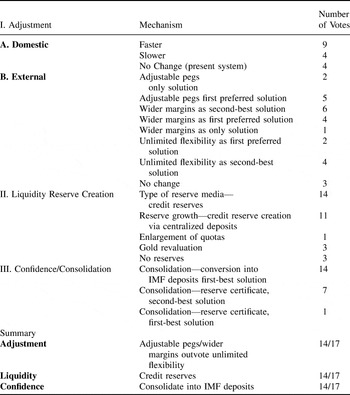
During each Bellagio Group conference, Machlup took the temperature of the members via surveys—asking them how their opinion on liquidity, adjustment, and confidence had changed, or how their exchange-rate regime choices had changed. Most of the surveys were mailed back to Machlup well after the conference and many were not returned at all. Machlup had promised confidentiality and made no transcript of the conference meetings. Nevertheless, during the fourth conference, held May 29 through June 6, 1964, Machlup asked the Bellagio conferees to consider and rank order their preferred exchange-rate solutions, and adjustment, liquidity, and confidence mechanisms that would effectively knock out the payments adjustment, liquidity, and confidence problems. Robert Triffin calculated the results on-site, as his handwritten notes reveal. The Triffin Plan with modified, flexible exchange rates emerged as the number 1 choice of conferees; the Triffin Plan alone emerged as number 2 (Robert Triffin Papers, MS 874, Box 12, folder 2). See Table 2, “Adjustment, liquidity, and confidence mechanisms preferred by group—Triffin’s calculations based on Machlup Survey, 4th Conference, May 29 through June 6, 1964.”
Adjustment, liquidity, and confidence mechanisms preferred by group – Triffin’s calculations based on Machlup Survey, May 29 through June 6, 1964

Source: Robert Triffin Papers, MS 874, Box 12, folder 2.
In this respect, aspects of the Triffin Plan (specifically increased credit reserves under the control of the International Monetary Fund as international reserve center) would become embedded in the Bellagio Group’s recommendations to the Group of Ten. In November 1965, Otmar Emminger made a formal request that the Bellagio Group examine the adjustment process in further detail, specifically: 1) whether a set of standards could be formulated for the adjustment policies of members of the Group of Ten against which they would have to justify their national policies; and 2) whether objective criteria could be developed for the respective responsibilities of surplus and deficit countries (Robert Triffin Papers, MS 874, box 11, folder 26). The extended Bellagio Group’s meetings on balance-of-payments adjustment issues resulted in a set of papers published as Maintaining and Restoring Balance in International Payments (Fellner, Machlup, and Triffin Reference Triffin1966). In all, there were seventeen joint meetings of officials and academic economists, focused on specific issues or solutions to problems, continuing through 1977, including: December 1964 Bellagio; January 1966 Zurich; April 1966 Princeton; March 1967 Bellagio; September 1967 Rio de Janeiro; March 1968 Bologna; March 1969 Lugano; September 1969 Princeton; March 1970 Torremolinos; January 1971 Taormina; September 1971 Washington, DC; March 1972 Cascais; January 1973 Vienna; February 1974 Versailles; January 1975 Basel; and March 1977 Basel.Footnote 6
VI. CONCLUSION
Machlup’s leadership of the Bellagio Group conferences gave him incomparable reach and influence. For the Bellagio Group conferences, Machlup chose academic economists who were associated in print with a specific exchange-rate policy, most of whom had prior public policy experience, all of whom represented the countries of the Group of Ten. He built close relationships with the chair of the deputies of the Group of Ten, Otmar Emminger; chair of Working Party 3 of the Organisation for Economic Co-operation and Development, Emile van Lennep; and chair of the Ossola Committee on the creation of reserve assets, Rinaldo Ossola—leading them to view the Bellagio Group conferences as an opportunity to get valuable feedback on perceived problems and recommended solutions before the publication of their own studies.
Just as Machlup had invited Triffin and Fellner to be co-leaders of the first four Bellagio Group conferences, he continued to extend invitations to academics and former policy makers, including those with very different policy prescriptions from his own, to be co-leaders of future Bellagio, Joint Conferences of Officials and Academics, and the BurgenstockFootnote 7 conferences, extending the policy and intellectual reach of the conferences and ensuring that policy rivals had the opportunity to put their arguments through the same rigorous framing and methodological analysis to determine impact on payments adjustment, liquidity, and confidence.
Machlup also had access to conferences organized by others, such as the American Economic Association, the American Banking Association, the American Enterprise Institute, and the Claremont-McKenna conferences, that sought to draw the Bellagio and Burgenstock members into discussion before larger and more international audiences. In addition to the conferences themselves, as senior editor of the Princeton Finance Section at Princeton University, Machlup was able to publish many dozens of papers on the international monetary system, including his own papers and those submitted by economists associated with the Bellagio and Burgenstock group conferences.
In methodology and framing, Machlup had a distinctive advantage. In addition to his insistence on recognition and elimination of definitional problems, values and judgments, logical fallacies, and other issues that made argumentation difficult, Machlup persuaded the Bellagio conferees that all policies should be examined and ultimately chosen or rejected because of their comparative ability to influence one of three final outcomes: impact on payments adjustment, liquidity, or confidence. Focus on outcomes (rather than on values-driven equilibrium or the elusive fundamental disequilibrium) resulted in strategies for cooperative action.
While it was not until March 1973 that the Group of Ten nations announced that they would let their currencies float or peg them to various regional arrangements, Machlup did much to build support for flexible exchange rates among academics, bankers, business leaders, and policy makers, easing the way for acceptance of market-mediated policy change. Triffin’s conclusion that the Triffin Plan proved more immediately useful on a regional level (for the development of the European Reserve Fund in the process towards a European Monetary System) than on a global scale ignores the final outcome. The decision recommended by the Bellagio Group to the Group of Ten, specifically to opt for a hybrid solution that puts the primary focus on market mechanisms (flexible rates) with SDRs as a potential backup, is a reflection of the importance of liquidity, as well as payments adjustment, to confidence in the system as a whole.