Introduction
The inter-relationship between personality, personality disorder (PD) and psychotic disorder has been a topic of theoretical speculation and scientific study within psychiatry since the separation of the psychoses and neuroses by Kraepelin in the late nineteenth century. Indeed Kraepelin identified the deterioration of a patient's personality as one of the syndromic features of dementia praecox. Freud considered the personality deterioration associated with psychoses sufficiently severe to preclude psychotherapy. Some researchers have argued that PD is not accurately discernable in patients with schizophrenia (Docherty et al. Reference Docherty, Fiester, Shea, Frances and Hales1986) whilst others have reported its influence in early life (Peralta et al. Reference Peralta, Cuesta and de Leon1991), presentation (Lindstrom et al. Reference Lindstrom, von Knorring and Ekselius2000) and outcome (McGlashan, Reference McGlashen1986; Tyrer & Seivewright, Reference Tyrer, Seivewright and Tyrer2000). Despite these widely differing views it is clear that categorical PD, as defined by the revised DSM-IV (APA, 2000), is in principle sufficiently distinguishable to allow its independent identification in those with psychotic disorders. The null hypothesis is that those with psychosis should have similar prevalence rates for PD as those in the general population, unless the expression of psychotic mental illness fundamentally affects personality expression or its detection. Studies of PD co-morbidity with other mental disorders are indeed able to both accurately identify PD and quantify its effects on outcome (Newton-Howes et al. Reference Newton-Howes, Tyrer and Johnson2006). If the same is true in psychosis, understanding prevalence rates will encourage its identification and consideration in prognosis and management.
Method
Inclusion and exclusion criteria
General inclusion criteria
Inclusion criteria were predetermined and deliberately broad to ensure complete capture of information. Papers were considered for inclusion if:
(1) they were written in English;
(2) they were published in a peer-reviewed journal;
(3) they presented information on patients assessed for both PD and psychotic disorder using a peer-reviewed instrument;
(4) the patients were 18 years of age or older;
(5) they had outcome data presented after at least 4 weeks, this being the minimum time considered necessary to see a change in presentation.
Diagnostic inclusion criteria
Because some evidence suggests a common aetiology for the chronic psychotic disorders, it was decided to keep the inclusion criteria for psychotic mental illnesses broad. To this end, the following conditions were included in the ‘schizophrenia’ group:
(1) ‘core’ schizophrenia;
(2) schizoaffective disorder;
(3) schizotypal disorder (see below, this section);
(4) cycloid psychoses (if numbers are available);
(5) other psychoses (e.g. delusional disorder).
All categories required diagnosis by a peer-reviewed instrument or a qualified clinician using research International Classification of Diseases (ICD) or DSM criteria.
Argument exists as to whether a categorical or dimensional approach to personality is the most appropriate (Livesley, Reference Livesley1991; Tyrer, Reference Tyrer2005). Although many authors consider the categorical approach (‘order’ versus ‘disorder’) to be too limited, it is nonetheless the current clinical approach to diagnosis and subsequent management of all mental disorders. Therefore, as this review was designed to identify the prevalence of PD to aid in clinical management, it was decided to take a categorical approach to personality pathology. Previous research by this group suggested that identification of specific subtypes of personality may not be practical in this review. It is also current opinion that the severity of personality pathology, rather than a particular subtype, may have greater long-term importance (Tyrer, Reference Tyrer and Johnson1996, Reference Tyrer, Seivewright and Tyrer2000) and this view is supported by some outcome studies (Verheul et al. Reference Verheul, van den Bosch, Koeter, de Ridder, Stijnen and van den Brink2003). For these reasons PDs were collected and aggregated. As with the psychosis group, all diagnoses required definition using a peer-reviewed instrument or according to clinician research ICD or DSM criteria.
The one exception was schizotypal PD. This has been classified differently by the two major classification systems, the DSM identifying it as a PD, whereas the ICD-10, after considering the new research evidence, now places this disorder alongside schizophrenia. In this review, schizotypal PD was categorized with the schizophrenias in line with emerging evidence (Torgersen et al. Reference Torgersen, Edvardsen, Øien, Onstad, Skre, Lygren and Kringlen2002).
Exclusion criteria
As the electronic search strategy was deliberately very broad (see Search strategy section) the majority of papers were excluded at the screening stage as obviously containing no relevant information. Papers published on human subjects without ethical approval were also excluded.
Search strategy
Medline, PsycINFO and EMBASE were searched electronically from 1950, 1806 and 1974 respectively. The search terms ‘schizophrenia’, ‘schizoaffective’, ‘delusional’ and ‘psycho$’ were combined with ‘personality disorder’ and ‘borderline’ on 12 July 2005. All the abstracts were reviewed by two researchers (G. N. H. and U. N.) and any papers suggestive of fulfilling the criteria were read in full. The references of every paper were read in attempt to identify further potential papers. No hand search of the literature was carried out, as previous experience by an author (G. N. H.) in conducting a similar review did not find any extra papers by hand searching. The grey literature was not searched as it was considered unlikely to provide extra data.
Data extraction
Data were extracted and checked by two researchers independently. Any disagreement was discussed with a third researcher to resolve disagreement. The third researcher made the final decision as to whether a paper warranted inclusion based on the inclusion and exclusion criteria. The corresponding author was contacted for more information if it appeared that relevant raw data may be available but were not published within a particular report.
Data compilation
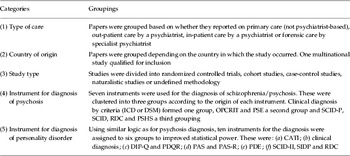
It was agreed that data would need to be appropriately grouped in order to allow statistical analysis. A major limitation in systematic review and compilation of data in both psychosis and personality research is the wide number of instruments used to confirm a diagnosis. Schizophrenia diagnoses were grouped into three broad groups while the instruments for diagnosing PD were grouped into six (Table 1). Type of care and study type were also grouped (Table 1) but country of study remained individual. Methodology was recorded as described by the authors of the study included. Such compilation was designed to maximize statistical power without skewing reported prevalences.
Predetermined categories considered likely to alter the prevalence rates in published studies and grouping

ICD, International Classification of Diseases; DSM, Diagnostic and Statistical Manual of Mental Disorders; OPCRIT, Operational Criteria Checklist; PSE, Present State Examination; SCID-P, Structured Clinical Interview for DSM-IV, patient version; SCID, Structured Clinical Interview for DSM-IV; RDC, Research Diagnostic Criteria; PSHS, Psychiatric Symptom and History Schedule; CATI, Coolidge Axis II Inventory; DIP-Q, DSM-IV and ICD-10 Personality Questionnaire; PDQR, Personality Diagnostic Questionnaire Revised; PAS, Personality Assessment Schedule; PAS-R, Rapid Personality Assessment Schedule; PDE, Personality Disorder Examination; SCID-II, Structured Clinical Interview for DSM-IV Axis II Disorders; SIDP, Structured Interview for DSM-III Personality Disorder.
Statistical analyses
We were interested in the effects of diagnosis instruments and other categorical variables on the proportion of PD amongst diagnosed schizophrenics in the 20 studies. This was assessed by two-level logistic regression with random effects, an appropriate regression method for data where the response variable is a proportion and considerable heterogeneity exists across studies.
The variables considered were diagnosis, instruments for both schizophrenia and PD, type of care, type of study and country in which the study was conducted. We firstly fitted a baseline model without any variable to quantify the magnitude of the heterogeneity between studies by variance at the study level. The intra-study correlation (ICC) was calculated as a descriptive measure of heterogeneity. We then assessed effects of variables one at a time to quantify how much variation among studies was attributed by each variable. This was realized by comparing the study-level variance between the baseline model and the model with the variable of interest fitted. Mean effects of each variable in terms of odds ratio (OR) on the outcome were also estimated in the model. The 95% confidence interval (CI) was obtained based on the model estimates. The significance of variance was tested using the generalized Wald test. We used the program mlwin version 2.0 (Rasbash et al. Reference Rasbash, Browne, Goldstein, Yang, Plewis, Healy, Woodhouse, Draper, Langford and Lewis2000) for the analysis.
Results
General
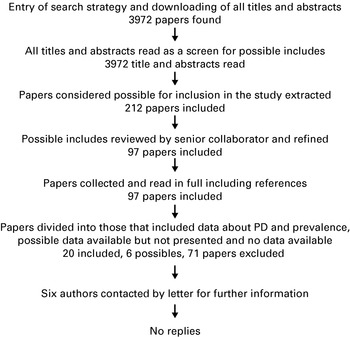
The initial search revealed 3972 papers for review. This was in line with the expected number considering the very broad search strategy. Of these papers, 212 were considered to be possible includes. These ‘possibles’ were reviewed by the most senior author (P.T.) and 115 discarded as highly unlikely to contain useful information (Fig. 1).
Flow diagram of the results of the search strategy. PD, Personality disorder.

Of these papers, 20 presented data about categorical PD in patients with chronic psychotic mental illnesses. The majority of papers did not differentiate by subtype of PD, but four papers (Oldham et al. Reference Oldham, Skodol, Kellman, Hyler, Doidge, Rosnick and Gallaher1995; Hodgins et al. Reference Hodgins, Toupin, Cote and Schlensinger1996; Lindstrom et al. Reference Lindstrom, von Knorring and Ekselius2000; Moran & Hodgins, Reference Moran and Hodgins2004) only examined antisocial PD in the psychotic population under consideration. It was not, therefore, possible to differentiate prevalence by personality subtype. Each paper suffered from methodological difficulties, making combination of results impossible (Newton-Howes et al. Reference Newton-Howes, Tyrer, Moore and Nur2007). Six papers alluded to the fact that the authors may have such information and the corresponding author of each was contacted by mail. No author was able to provide data to enable inclusion in this review. This meant that the final analysis included 20 papers with an aggregate of 6345 patients in total.
Raw prevalence data
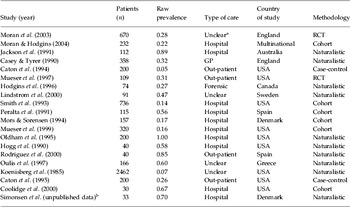
The raw data were highly heterogeneous, with a prevalence spread from 4.5% to 100%. The individual prevalences are presented in Table 2.
Papers included in the review and raw prevalences

GP, General practitioner; RCT, randomized controlled trial.
a The paper did not specify whether care was primarily provided by a community general doctor, specialist or within a hospital.
b Conducted in 2006.
Median prevalence rates from the combined data
The overall prevalence from this review gives a co-morbidity rate of 39.5% (95% CI 25.2–55.8%). Despite wide CIs, the prevalence is somewhat similar to the 40–60% co-morbidity of PD in bipolar disorder and related psychoses in secondary care (Keown et al. Reference Keown, Holloway and Kuipers2002; Loftus & Jaeger, Reference Loftus and Jaeger2006; Mantere et al. Reference Mantere, Melartin, Suominen, Rytsala, Valtonen, Arvilommi, Leppamaki and Isometsa2006) and also similar to the 37–53% prevalence of PD in those attending drug and alcohol services (Bowden-Jones et al. Reference Bowden-Jones, Iqbal, Tyrer, Seivewright, Cooper and Weaver2004). This suggests that there is no special predilection for those with schizophrenia to have concurrent PD beyond that expected for patients with severe mental illness.
Multilevel model analysis of heterogeneity
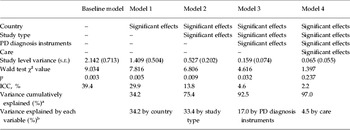
Table 3 summarizes statistics of study-level variances from fitting series of two-level models. The baseline model without including any study characteristic variables suggested highly significant variability of the PD prevalence across studies, with the ICC estimated as 39.4%. Taking into account the association between country of study and the diagnosis, model 1 showed significant effects of country that reduced the study level variance by 34.2%. Showing simultaneous significance of country and study-type effects, model 2 presented a further reduction of the study level variance by 75.4% by the two variables jointly over the baseline model with 33.4% solely by study type. By the same principle, instruments for PD diagnosis attributed to the variability by 17%, which brought the total variance down by 92.5% together with the other two variables, shown in model 3. By including the fourth variable of patient care, model 4 showed an insignificant variance at study level with a small ICC of 2.2%. This suggested that country of study, study type, instruments for PD diagnosis and patient care jointly explained all study-level variability. Instruments for schizophrenia diagnosis did not show any significant association with the PD prevalence in the analysis.
Variance among studies explained by the four variables country of study, study design, nature of instruments used to diagnose personality disorder, and nature of care

PD, Personality disorder; s.e., standard error; ICC, intra-study correlation.
a In comparison with the baseline variance 2.142.
b Difference in variance cumulatively explained between two neighbouring models.
Independent effects of variables
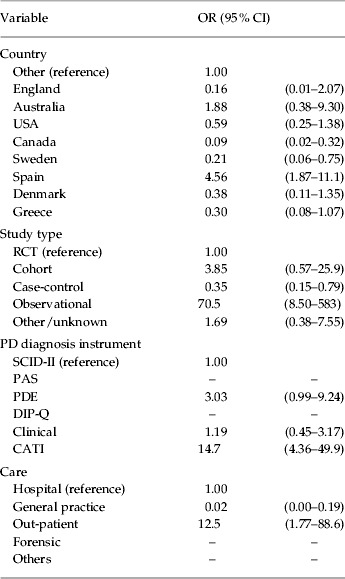
The mean effects of each variable independently after controlling for others are presented in Table 4, obtained from model 4 in Table 3.
ORs of main variables and details of individual variances at study level with 95% CIsFootnote a

OR, Odds ratio; CI, confidence interval; PD, personality disorder; SCID-II, Structured Clinical Interview for Diagnostic and Statistical Manual of Mental Disorders (DSM) Axis II disorders (First et al. Reference First, Spitzer, Gibbon and Williams1994); PAS, Personality Assessment Schedule (Tyrer & Alexander, Reference Tyrer and Alexander1979); PDE, Personality Disorder Examination (Loranger et al. Reference Loranger, Susman, Oldham and Russakoff1985); DIP-Q, DSM-IV and ICD-10 Personality Questionnaire (Ottoson et al. Reference Ottosson, Bodlund, Ekselius, Grann, von Knorring, Kullgren, Lindstöm and Söderberg1998); CATI, Coolidge Axis II Inventory (Coolidge & Merwin, Reference Coolidge and Merwin1992).
a In the data, England, PAS and other cares are confounded. Other confounders are Sweden and DIP-Q and other cares, forensic and SCID-II instruments.
This model shows that the studies carried out in Canada and Sweden are significantly less likely to have a co-morbid diagnosis of PD compared with the international study (Moran & Hodgins, Reference Moran and Hodgins2004), whereas Spanish studies were four times as likely to lead to a diagnosis of PD (OR 4.56, 95% CI 1.89–11.1). As expected, observational studies led to higher rates of PD diagnosis although, more surprisingly, case-control studies were less likely to lead to a diagnosis of PD in the psychotic population compared with the methodology of the randomized control trial used in two studies. Although the instrument used to diagnose PD accounted for some variability (17%) the pattern of effect was unclear. This was partly due to confounding with other variables (e.g. PAS and country) and partly due to the low number of uses of some of the instruments [e.g. Coolidge Axis II Inventory (CATI); Coolidge & Merwin, Reference Coolidge and Merwin1992]. As expected, primary-care patients were significantly less likely to have a co-morbid PD diagnosed when compared with patients cared for by psychiatrists. Interestingly, hospital patients, presumably those less well than out-patients, had lower rates of personality pathology diagnosed, possibly due to the more florid nature of their psychosis. The instrument used to diagnose psychosis did not affect the prevalence rate of PD.
Discussion
This paper has endeavoured to define more accurately the prevalence of a categorical diagnosis of PD in the psychotic population by amalgamating the prevalences reported in the literature. This process has identified a number of weaknesses in the reported literature, so making it difficult to draw accurate conclusions. First, despite the obvious value in understanding the prevalence of co-morbidities in psychosis there is a relative dearth of reported information in the literature. Even after the initial search was screened for likely papers, only 10% (20 out of 212) presented usable prevalence rates. Second, a wide number of instruments were used to confirm the diagnosis of both PD and schizophrenia (seventeen instruments in total). As prevalence rates rely on clear and accurate diagnosis, this heterogeneity weakens the conclusions that can be drawn from any individual paper or combination thereof. Despite this, however, instruments used for diagnosis are becoming more reliable and consistent, minimising this problem. Third, statistical analysis showed that the raw data were widely dispersed, potentially leading to overfitting in the multilevel models. Although there are these limitations on this modelling it nonetheless provides the most accurate combined picture of the data to date and confirms the finding of the univariate analysis.
From the data presented a number of conclusions can be drawn. Most importantly, although an understanding of co-morbidity is important, it is poorly reported, making its practical application to practising clinicians and services difficult. The information and analysis also suggest that the diagnosis of personality pathology is confounded by country of study, care, study methodology and the PD diagnosis tool. The level of variance found is, in many cases, understandable. For example, the higher rates in out-patients are perhaps a reflection of the underlying presentation of the psychotic phenomenology. As patients become floridly psychotic (and require hospital care) the sensitivity of the diagnosis of PD diminishes. Similarly the higher prevalence rates in observational studies are possibly a reflection of study design. The stability of PD diagnosis is also relevant; personality malfunction is much more common in younger people (when schizophrenia usually develops) and becomes less over time (Skodol et al. Reference Skodol, Johnson, Cohen, Sneed and Crawford2007). The cause of the influence of the country of study and unusually low rates in case-control studies and general practice patients is less clear. Factors such as training of psychiatrists, cultural pressures or chance may explain such findings.
The lack of ability to be able to draw a clear prevalence rate for PD in the schizophrenia population may be due to the difficulties of diagnosis of PD itself in this population or a reflection of the difficulty in accurately defining and identifying this group. It is also possible that, as suggested by Kraepelin and others, personality dysfunction is a part of the syndrome of schizophrenia and therefore ultimately impossible to accurately identify as a separate ‘disorder’. This highlights the potentially different formulations of the problem of personality diagnosis across countries, cultures and axis I diagnoses. Nonetheless, being able to clearly identify patients with disordered personality characteristics further enables the treating clinician to make accurate prognoses of outcome and more clearly identify how services should be developed, highlighting the importance of considering the description of personality when both treating patients with schizophrenia and designing studies of the psychotic population.
Acknowledgements
The authors would like to thank Ula Nur and Alexandra Moore for their help in designing the search strategy and reviewing the papers identified by the literature search.
Declaration of Interest
None.