For many years now, international news has been forcing Westerners to wonder how, and even whether, a majority-Muslim state can become a successful liberal democracy. These questions were already familiar to political scientists, who had long recognized majority-Muslim societies as a crucial test case for the broader debate over the limits of liberal political theory.Footnote 1 In looking at points of friction between liberalism and the beliefs and practices of the second-largest religious denomination in the world, we are forced to examine potential tensions between liberal theory's commitments to universal normativity on the one hand and respect for cultural and religious diversity on the other.Footnote 2
Some of the most globally influential Islamic thinkers and actors of recent decades, from Khomeini and Qutb in the twentieth century to Zarqawi and Al-Baghdadi in the twenty-first, have famously asserted that a truly “Islamic government” must enforce all the illiberal laws of the divine law literally interpreted, that to deny this is to deny “the eternal validity of the faith itself,” and hence that no true Muslim may ever seek political guidance from liberal theory.Footnote 3 The vast majority of Western scholars reject these claims even while acknowledging the broad historical Islamic consensus that God's law does provide comprehensive guidance for human life, including political life.Footnote 4 Some have defended the possibility of Islamic liberalism by pointing to Islamic “textual authorities … derived from the Qur'an and the Sunna” that already “contain concepts comparable to modern [liberal] doctrines of democracy, pluralism, [and] human rights.”Footnote 5 But others have pointed out that, since “political liberalism is committed to a certain form of secularism,” an Islamic religious-political framework may incorporate any number of liberal-sounding doctrines without yet becoming truly liberal.Footnote 6 The best arguments for the possibility of an authentically Islamic liberalism have therefore contended, in a manner often compared to John Locke's arguments about Christianity, that Islam itself (properly interpreted) ought to lead a modern Muslim to accept secular liberal politics.Footnote 7 Liberals across the political spectrum, both within the academy and without, have endorsed this last position even while admitting that its interpretation of Islam is neither self-evident nor fully worked out. They grant and even insist, in the words of one of the most politically prominent of them, that “the most vital work” in liberalism's confrontation with Islamic “radicalism” must still “be done within the Islamic world itself,” by “responsible Islamic leaders” and “Muslim scholars” who will teach the correct (liberal) interpretation of Islam.Footnote 8 In fact, almost all Muslim as well as non-Muslim academics who defend the compatibility of Islam and liberal politics refer in some way to this reinterpretation of traditional texts in light of liberal political theory. Whether they themselves begin a politically liberal exegesis of Islamic religious sources, or call on others to do so, they are remarkably united in making the possibility of such an exegesis a linchpin of their arguments.Footnote 9
The centuries-long tradition of Islamic political philosophy has received surprisingly little attention in this recent debate over Islamic liberalism.Footnote 10 Yet one of the founders of that tradition once faced a dilemma quite similar to that faced by the “responsible Islamic leaders” and “Muslim scholars” whom liberals today wish to encourage. Abū-Naṣr Alfārābi (ca. 870–950) believed that his community had much to learn from a political philosophy of non-Islamic origin, namely that of ancient Greece, yet he knew that some of his coreligionists might object violently to the idea that a community ruled by God's law needs any such extra-Islamic political guidance.Footnote 11 And like so many liberals, Alfarabi thought that the solution to this problem would require the reinterpretation of traditional texts by religious authorities properly trained in political philosophy. This article seeks to bring Alfarabi into the contemporary conversation by showing how he understood the difficulties faced in his day by Greek “political science” (which includes what we would call political theory or political philosophy),Footnote 12 and by analyzing his sketch of the new political science that he thought a community like his own would need—one indebted to Greek sources but also adapted to the particular needs of that community. Naturally, the major differences between the Islam of Alfarabi's day and that of our own, and between Greek political philosophy and modern liberal theory, preclude any simplistic application of Alfarabi's approach to our modern situation. Nonetheless, I will argue that a sympathetic look at his writings can offer us a unique perspective on the political-religious projects proposed by today's liberal theorists and actors, and so can enrich our debates over the limits of liberal theory.
Political Science and Divine Law
Alfarabi discusses “political science” in chapter 5 of his work Enumeration of the Sciences (Iḥṣā’ al-ʿulūm, hereafter ES). The work as a whole lists all the arts and sciences that are “well known” in his own day,Footnote 13 and chapter 5 groups together this contemporary “political science” with the art of “jurisprudence” and the art of “dialectical theology” or apologetics (fiqh, kalām: 76–84).Footnote 14 This “political science” is said to be a normative science, aimed at distinguishing the “virtuous” arrangements of “cities and nations” (mudun, umam) from their defective arrangements; “jurisprudence” is said to be the art of interpreting a certain religious “law” (sharīʿa); and apologetics is said to be the art of verbally defending that same law. The religious law in question belongs to a particular “nation” (umma) and prescribes, not only what we would call religious doctrines and practices, but also “the actions by which there are mutual dealings in cities” (mudun), that is, political practices (80). All three of these sciences or arts therefore have some relation to politics, but their respective teachings about it are evidently at odds with one another. For the “well-known” political science of Alfarabi's day, which is made up mostly of Platonic doctrines along with a few Aristotelian, teaches that a “virtuous city” must be ruled by an unbroken succession of equally competent kings adept in both “theoretical” and “practical philosophy,” and that any other political community is necessarily “non-virtuous” (79–80).Footnote 15 And in Alfarabi's Islamic community, in which the law-based arts of jurisprudence and apologetics are “well-known,”Footnote 16 the political injunctions of a single authoritative “lawgiver” (Muhammad) are considered permanently binding on future generations, without any expectation of an unbroken succession of philosopher-kings with “the same attributes and qualifications” as that lawgiver (80, 79).Footnote 17 The version of Greek political science current in Alfarabi's day would therefore judge his own political-religious community to be “non-virtuous.”
In the same chapter of ES, Alfarabi records the claim of many contemporary theologiansFootnote 18 that their community's divinely revealed law should not be “examined by opinions, deliberation, or human intellects” but rather accepted with childlike submission, even if some of its teachings may seem to conflict with the findings of “the sciences” (81–82).Footnote 19 For, they say, if the law taught only matters that human reason can discover on its own, then “people would trust in their intellects and would have no need for prophecy or revelation. But that is not what is done among them” (81*). Although Alfarabi himself clearly rejects these theologians’ arguments, he reminds his readers here that the public recognition of the law as divinely revealed is his community's standard practice (“what is done among them”), and that at least some other members of the community would consider it blasphemous to criticize that law on the basis of a merely human “political science.”Footnote 20 He adds that according to certain religious apologists, such a blasphemous critic should be considered an “adversary,” threatened with “something abhorrent,” and even treated like an “enemy” in “struggle” (jihād) or “warfare” (83–84).Footnote 21 A student of ancient Greek political science in Alfarabi's own community would thus be in serious danger of being seen as “impious” and perhaps even of provoking violent backlash.Footnote 22 This is by no means to say that Alfarabi considers such a conflict between science and religion to be an ineradicable feature of human life: we will see that in his view, this conflict stems from particular deficiencies in the “well-known” political and religious sciences of his day.Footnote 23 Others have indeed observed what a low regard Alfarabi has for contemporary apologetics, his description of which borders on caricature.Footnote 24 But it has not been sufficiently noted that his judgment on contemporary political science is in its own way just as harsh.
We see this when we compare ES's description of political science to the only other systematic description of political science in Alfarabi's extant works, a description that occupies the second half of his Book of Religion (Kitāb al-milla, hereafter BR).Footnote 25 This alternative description of political science borrows extensively and sometimes word for word from ES's description of the “well-known” political science of Alfarabi's day, but it also modifies it extensively (101–13): the political science it describes is, as far as I can tell, an invention of Alfarabi himself.Footnote 26 This new political science is necessary to the survival of what Alfarabi calls a “virtuous” religious community (a community described in the first half of BR), for the “jurists” in this “virtuous” community must study this new political science as an essential part of their training (99–101 with 104–5).Footnote 27 Alfarabi's “virtuous” community is thus one in which, although the religious law certainly does regulate politics (see 94–96), the potential for conflict between political science and accepted interpretations of that law has been eliminated. The remainder of this article will compare BR's new political science to ES's old one in order to see how Alfarabi thought the dangerous deficiencies of the political science of his day could be remedied.Footnote 28 The differences between these parallel passages in BR and ES are sometimes as slight as the alteration of a single word in a paragraph otherwise copied verbatim from one text to the other, but Alfarabi scholars are familiar with the need to apply such close-grained analysis to his texts.Footnote 29 I will argue that these changes, examined together, reveal a coherent project of adapting the Greek political science of Alfarabi's day to the needs of an Islamic community.
Accommodating Islamic Doctrines
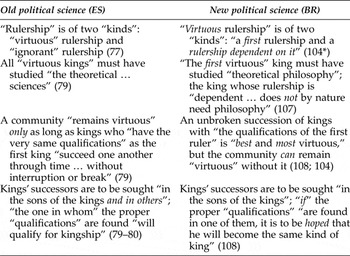
Alfarabi's new political science eliminates the main source of contention between the old political science and a community founded on divine law. This can be seen from the differences between a few passages in ES and BR that I have collected as table 1. (All tables may be found at the end of this article; in all tables, I have displayed key phrases excerpted from passages that otherwise largely parallel one another, italicizing words that highlight the differences between the two texts.)
A new possibility for a “virtuous” community

As table 1 shows, where ES's political science stipulated that a “virtuous” community required an unbroken, and hence in principle nonhereditary, succession of philosopher-kings, BR's new political science introduces an alternative variety of “virtuous” government. In the latter, the “kings” of the virtuous community may follow a merely hereditary succession because they are bound to the “tradition” (sunna) or “law” (sharīʿa) that the first legislator-king established and so do not need to reproduce his qualifications (104; see 96).Footnote 30 The new political science maintains in principle the Platonic standard for the best conceivable political community but makes a significant modification to the Platonic teaching by allowing a second type of community to be called “virtuous” as well. Since this second type is precisely the sort of law-based community that we have seen Alfarabi himself lives in, the new political science has eliminated, or at least significantly watered down, the most religiously offensive element of the Platonic political doctrines “well-known” in his day: while no Muslim believes there has in fact been an unbroken succession of prophet-kings equal to Muhammad, the thought that there may one day be an imam equal to Muhammad is present in at least certain forms of Shi'ism, and even a Sunni could grant that “the best time was the lifetime of the divine lawgiver, [and] the best arrangement” in principle “would be to have an uninterrupted line of divine lawgivers.”Footnote 31 Yet the original and more offensive Platonic doctrines were a more accurate reproduction of the explicit teachings of Plato himself, which maintained (as Alfarabi reminds us elsewhere) that the “complete injustice and extreme evil” common to all political life would never “slacken or vanish” outside the city described in the Republic, the city ruled solely and directly by philosopher-kings.Footnote 32
Did Alfarabi make this change because, as a Muslim, he could see that Plato's views on politics needed to be emended in order to account for the manifestly “virtuous” Islamic community? Or did he think that Plato's views, while still true, were simply too radical to be spoken openly in that community? The precise status of Islamic religious doctrine in Alfarabi's own thought remains a contested question in the literature, and this article will not attempt to settle it.Footnote 33 We can however see at least this: in Alfarabi's view, even someone fully convinced by Plato's political science ought to accept BR's significant emendation to that science as a reasonable accommodation to new circumstances. For as Alfarabi asserts elsewhere, Plato himself recommended (especially in his Letters) that his students should work gradually to shift “cities and nations” away from their “ways of life and corrupt laws” and in the direction of those “virtuous ways of life and correct laws” which he outlined, not in his Republic, but in his Laws.Footnote 34 The seemingly Platonic political science of ES, which relays only the absolutist demands of the Republic and (remarkably) does not even mention the term “laws,” would then represent an incomplete and overly doctrinaire reading of the full and genuine Platonic political science. The latter, to repeat, does offer a radical critique of all political life outside the city of philosopher-kings, including of communities governed by the “traditional” rulership under law that BR calls “virtuous.” Yet it also teaches its students about the political dangers of giving voice to such a critique. According to Alfarabi's Plato, a “philosopher” when addressing “the multitude” (i.e., most ordinary people) ought not to speak like Socrates, who had indeed offered a radical and open critique of the moral and political opinions of “his own people” and so had received execution at their hands, but ought rather to speak like the rhetorician Thrasymachus.Footnote 35 By appropriate use of moral and political rhetoric, a student of Plato can avoid the fate of Socrates while working “gradually” to improve existing imperfect communities; “as an example of this,” says Alfarabi, Plato pointed to “his own people.”Footnote 36 The “conservative” rhetoric of Alfarabi's Plato requires a “provisional,” that is, merely rhetorical, “acceptance of the accepted [moral and political] opinions” of one's “own people.”Footnote 37 A true Platonist in an Islamic or any other community is therefore prepared to dilute his own political opinions in order to make them publicly acceptable and hence publicly beneficial.Footnote 38
Now according to Alfarabi, one of the rhetorical tactics that Plato himself employed was to speak certain offensive truths in such a way that no one would believe him to be serious.Footnote 39 One of these truths appears to have been Plato's radical and open critique of all political life outside the city of his Republic: Plato avoided causing much offense because he was easy to dismiss as a utopian dreamer who held political life to unrealistically high standards of virtue and otherworldly happiness. Yet since Plato wrote, new political-religious communities like Alfarabi's own have arisen in which citizens really believe that their community, at least in principle or in its original and pristine form, does or can meet the highest standards of human virtue and pursuit of otherworldly happiness.Footnote 40 Where the utopian “Platonic radicalism” has a new and more believable counterpart in “Quranic radicalism,”Footnote 41 the teaching of the Republic now runs the risk of sounding blasphemous rather than merely silly. In such circumstances, Alfarabi's Plato would himself have approved of adaptations to his own teaching that bring it into closer harmony with the new “accepted opinions” about the “virtuous” character of the community ruled by divine law.
The new political science thus makes significant modifications to the letter of ES's political science and of the original Platonic political science, but it does so in the spirit of the latter. For Alfarabi, precisely a convinced Platonist ought to recognize the need for flexibility in the application of Platonic doctrines and hence for such adaptations of those doctrines as his own new political science offers.
Guiding the “Virtuous” Community
By avoiding conflict with the basic moral-political opinions of “his own people,” Alfarabi prepares a new political science that can gain public acceptance in a community like his own and so can give practical guidance to that community. We will now look at several ways in which that new political science is adapted to offering such guidance.
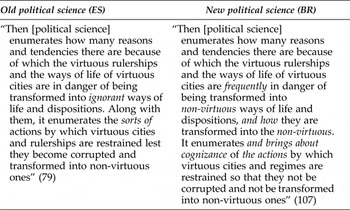
Table 2 shows the first of these ways: as can be seen from its parallel passages, the new political science appears to be more urgently concerned with guarding against the danger of political degeneration than the old one was. The new political science will follow the old one in describing that danger, but it will warn more insistently against it, describe in greater detail “how” it takes place, and not only “enumerate” but also “bring about cognizance of” the ways that it can be prevented—that is, make those ways widely known among the whole citizen body rather than only among a few political scientists.Footnote 42
Guarding against political degeneration

One reason for the urgency of the new political science's concern with degeneration is indicated when it speaks of degeneration into “non-virtuous” ways of life rather than merely “ignorant” ones. For at the beginning of BR, where Alfarabi repeats ES's distinction between “virtuous” and “ignorant” rulers, he also mentions two new “non-virtuous” categories of ruler: the “errant” and the “deceptive” (93–94; cf. 77).Footnote 43 The merely “ignorant” rulers were those who pursued wealth, pleasure, glory, or any other of what Alfarabi calls the “ignorant goods”; the “most virtuous” among these rulers are those who pursue such a good for their whole community rather than themselves alone, but even these remain “ignorant” rather than “virtuous” in the full sense of the term (93).Footnote 44 The “errant” rulers, on the other hand, sincerely but mistakenly believe that they and their community are pursuing “ultimate happiness,” i.e., that they form the “virtuous” community that BR sketches (93–94). Strikingly, Alfarabi does not say that these “errant” rulers all belong to the above-mentioned category of “the most virtuous of the ignorant rulers,” which implies that the goal they pursue for their whole community may not even rise to the level of being one of the “ignorant goods”: it may for example be the fruitless sacrifice of those goods in pursuit of a merely imaginary end.Footnote 45 Alfarabi avoids paying any compliment to the “errant” fanaticism that destroys such earthly goods as “health and bodily well-being,” “wealth,” and “honor,” which he considers “necessary” for even the most virtuous individual or at least for even the most virtuous community (93; see 101, 96). As for the category of “deceptive” rulers, they too claim to be pursuing “ultimate happiness” for their community but are deliberately lying in order to pursue “ignorant goods” for themselves at their people's expense (93). These political pathologies of religious fanaticism and religious hypocrisy are new to “al-Farabi's own monotheist world,” where the aspiration to otherworldly virtue has moved out of philosophic utopias to find a home in real political communities,Footnote 46 and they threaten to deprive those communities of the indispensable earthly goods that less lofty-minded pagans had unashamedly pursued. For this reason, at least, the danger of political degeneration is one that the new political science must be more urgently concerned to avert.
Of course, a thoroughgoing Platonist might wonder why Alfarabi should be so concerned to avert a degeneration that has already taken place. For the community described in BR, which believes itself to be “virtuous” but fails to meet the rigorous Platonic definition of the term, must be regarded by such a Platonist as one of the “errant” communities of Alfarabi's description. But precisely a Platonist should also be able to see why Alfarabi ascribed a certain type of “virtue” to those “ignorant” rulers who do show public-spiritedness or dedication to the common good (however imperfectly understood), for that dedication can reasonably be called the virtue of “justice,” as Alfarabi suggests through a series of metaphors borrowed from Plato.Footnote 47 A community governed by divine law can certainly foster this qualified form of “virtue” at least as well as, and perhaps better than, any pagan community could (see 95). Preventing the new community from degeneration will therefore require maintaining this public-spiritedness while making sure that the common good it pursues remains, at the very least, at the level of those genuinely necessary goods that the “most virtuous” pagan communities also pursued.
Alfarabi does not consider this an easy task, for (among other reasons) the very divine law that can promote a high degree of public-spiritedness has the potential also to undermine it: it may encourage believers to concentrate on private self-improvement rather than active citizenship in their community. We can gather this from the fact that the old political science taught that “the way” (the only way) for virtue “to exist in a human being” is “that the virtuous actions and ways of life be distributed in cities and nations … and practiced in common” (76–77*), while the new political science no longer says that this practice of virtue “in common” is necessary for individual virtue and even flatly admits that a virtuous person can live in a nonvirtuous community, although he or she must “migrate” to a virtuous community if one should come into being (104; cf. 102–3).Footnote 48 Since this word for “migrating,” hijra, is the traditional Islamic term for Muhammad's flight from corrupt Mecca to Medina, where he would found the “virtuous” Islamic community, we can gather that a religious community that looks up to such a founder would find unbelievable the old political science's claim that individual virtue absolutely requires citizenship in a virtuous community.Footnote 49 Islam has in this respect undermined a teaching that (in Alfarabi's view) had never reflected the real views of Plato or Aristotle, neither of whom he thinks believed that individual perfection actually depends on civic perfection.Footnote 50 But the religious dissemination of this philosophic truth, especially in conjunction with “virtuous” religion's clear teachings on otherworldly rewards and punishments for individual virtue and vice (see 94–96), has the potential to foster a kind of apolitical moralism in place of any public-spirited devotion to a community that one does not see as necessary to one's own salvation.
The new political science will take steps to minimize this dangerous potential of “virtuous religion,” first by including a prosaic explanation of why political communities are necessary at all—the old political science had felt no need to discuss this question (cf. 101–3 with 76–77)—and then by offering a new teaching on the relation between virtue and citizenship. According to the new political science, a virtuous individual is “part” of a “virtuous city” even if there is no such city to be found on earth; if he should live his whole life in an “ignorant city,” he will do so only as a kind of foreigner who is in truth a citizen of another and better city, who longs to “migrate” (hajara) to such a city if ever he can, and who recognizes his own life outside that city as significantly crippled even if “virtuous” (104; also 103).Footnote 51 By presenting even transpolitical human perfection as a higher kind of citizenship, the new political science encourages citizens of a potentially “virtuous” community to work toward building up that community rather than withdraw into apolitical religiosity. The logical status of this rhetorical move is called into question by BR's brief admission (contrary to its apparent drift) that a virtuous individual might in fact live in a nonvirtuous city “voluntarily or involuntarily,” but its political importance remains just as clear in any case (cf. 104).
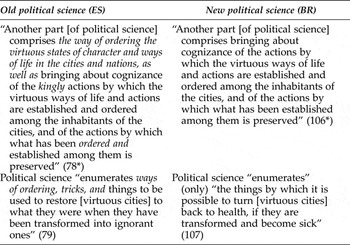
Active citizenship is also fostered through another set of changes that the new political science makes to the old. In this case, as the parallel passages in table 3 show, the new political science omits elements of the old rather than expanding on it. Where the old political science taught that civic virtue is “established,” “preserved,” and “restored” by the “ordering” and “tricks” of one or more “kingly” political geniuses, the new one offers a more pared-down and hence more ambiguous teaching about the origins of civic virtue, leaving unclear whether that virtue actually depends on such geniuses or simply on the actions of the citizen body as a whole. The reason for this change becomes clearer in light of two more: the new political science, instead of speaking of the “natural qualifications” of potential kings, speaks only of their “qualifications” (cf. 108 with 79–80), and where the old one is said to investigate six basic moral phenomena (“voluntary actions,” “ways of life,” “dispositions,” “moral habits,” inclinations,” and “states of character”), the new one is said to investigate only five of these, with “inclinations” omitted (cf. 76 with 101). In other words, the new political science displays a new degree of reticence regarding the “natural” and hence unchangeable psychological basis of moral virtues,Footnote 52 and also regarding the ways in which such virtues may be determined by a single king's political “ordering.” In both cases it avoids repeating teachings of the old political science that could potentially undermine the citizens’ belief that they themselves, rather than long-dead political geniuses or unchangeable nature, are responsible for their own virtue both as individuals and as a community. It will thus encourage them to work to live up to that responsibility rather than fall into any quietistic (and hence antipolitical) moral resignation.
Power to the citizens?

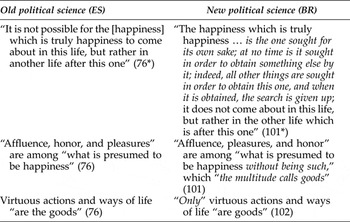
Finally, table 4 shows another set of changes that follow again from the new community's aspiration to be truly “virtuous.” As we see there, the new political science insists more emphatically on the distinction, already present in the old one, between the “virtue” that constitutes “true happiness” on the one hand and the “ignorant goods” pursued by most or all real political communities on the other (see similarly 102, 103; cf. 76). The precise relation between the two remains unclear: at one point BR does speak of “happiness in this life and in the afterlife,” suggesting against all its other statements that there is a this-worldly happiness worthy of the name (113; cf. 101).Footnote 53 But without working out precisely what truth lies behind the new political science's newly emphatic statements, we can see their rhetorical importance from Alfarabi's claim that earthly or “ignorant” goods are especially attractive to “the multitude,” that is, to most ordinary people in any community—even in a “virtuous” community that aspires to attain moral heights previously depicted only in philosophic utopias (see 101). The new political science will support that aspiration as much as possible by adopting a still more forceful version of the hortatory moral rhetoric for which Plato and Aristotle are “well-known” even today, for it must now preach virtue to a broader audience of people more inclined to find their satisfaction in life's simpler pleasures.
Denigrating earthly goods

Securing the Status of Human Reason
A final novelty in BR's political science is that its description concludes with a long account of cosmology that has no parallel at all in ES's (108–13).Footnote 54 Here the new political science is said to produce and teach a set of cosmological doctrines as well as “bring about cognizance of” them, that is, disseminate them widely.Footnote 55 According to these generally Neoplatonic doctrines, the cosmos is a hierarchy in which everything “rules” something inferior to itself and/or is “ruled by” something superior (108–10). (The political terms scattered throughout this cosmology distinguish it from the “well-known” metaphysical science of Alfarabi's day described in an earlier chapter of ES.)Footnote 56 This structure of the cosmos is said to correspond analogically to the ordered structure of the “virtuous city,” whose “first ruler” rules that city as God rules the cosmos. Moreover, this first ruler is said to put his city into its own proper order by consciously imitating the larger cosmic order just described, which he has come to understand through his own “cognizance of theoretical philosophy” (111–13). This passage of BR thus effectively claims, first, that the study of “theoretical philosophy” would lead one to see the cosmic order that this passage briefly describes, and second, that from a philosophic contemplation of that order one could somehow deduce the proper ordering of the virtuous city—that is, deduce the subject matter of political science. It also asserts that the new political science will produce, teach, and disseminate these same claims. Now, neither BR nor ES had previously given any indication that their political science was derived from cosmological observations; both texts presented it rather as beginning from an investigation of human moral affairs (cf. 101–8, 76–78).Footnote 57 But since the content of Alfarabi's own cosmological understanding remains another vexed question in the literature, we cannot settle here his actual view of the relation between cosmology and politics.Footnote 58 We can however be confident that, according to BR, the new political science will demand both that certain theoretical doctrines be disseminated as the philosophical/scientific truth, and that the new political science itself be disseminated as derivative from such doctrines.
Why would Alfarabi have seen these steps as necessary to the task of the new political science? We recall that the main threat posed to the public status of political science in his own day came from certain theologians’ claims that human reason is incompetent to examine critically the content of the divine law, or rather of the divine law as they understand it (80–83). Such antirationalist apologetics, which find echoes in the writings of recent antiliberal Islamic thinkers,Footnote 59 are according to Alfarabi used to “defend” religious doctrines against those who “oppose” them (80–81)—presumably who oppose them in the name of human reason. Since BR's “virtuous” community is to be one in which human reason is publicly looked up to for guidance in interpreting the divine law, such antirationalist apologetics must have lost any significant political or social traction in that community: the apologetic art of kal ām “well-known” in Alfarabi's day, resting as it does on the denigration of human reason, is entirely absent from BR's description of the “virtuous” community (cf. 80–84 with 96–101). In order to make such an arrangement possible, Alfarabi seems to have thought it necessary that not only the political but also the cosmological teachings of “virtuous religion” should be supported by the sciences “well-known” in that community, so that the incentive to “defend” religion by denigrating human reason could be eliminated or at least made politically insignificant. For the cosmological teachings of the new political science are indeed virtually identical to those of BR's “virtuous religion” (cf. 108–10 with 94–95).Footnote 60 The whole educated part of BR's community would therefore be able to see, in the words of one of Alfarabi's great students, that “demonstrative reflection does not lead to differing with what is set down in the Law.”Footnote 61 This also explains why the new political science must emphasize that its source is “the Ancients,” thus downplaying all the changes that are the subject of this article (see 103, 106). In both political and cosmological matters, the new political science will seek to secure the public status of human reason as such against the theological critique to which it is subject in Alfarabi's day.
All this could best be accomplished if a recognized authority on theoretical philosophy were to present the new political science's cosmological doctrines as the conclusions of his or her own theoretical studies while also presenting a political teaching as derivative from them. It is worth remarking that precisely this is the format of each of Alfarabi's two great political works, Virtuous City and Political Regime: both begin with cosmological doctrines that “stress [the] hierarchic structure of nature,” conclude with political teachings apparently derivative from those doctrines, and address a broad educated audience.Footnote 62 The many differences in detail between these two works, as well as between them and his less cosmological Selected Aphorisms, certainly deserve to be studied further. For now, we can say that this article's findings have lent greater plausibility to Mahdi's hypothesis that Virtuous City and Political Regime offer two alternative paradigms for what the new political science, outlined in BR and responding to the need sketched in ES, could look like in practice.Footnote 63
The New Community
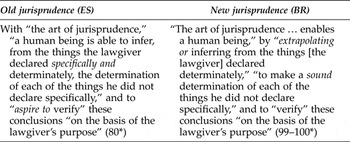
As we saw in ES, a political-religious community like Alfarabi's own needs a class of “jurists” who interpret and apply its divine law, and as we saw in BR, the jurists of the “virtuous” community (unlike those of Alfarabi's day) are to be trained in BR's new political science (cf. 99–101 with 80). That is, they will study a modified version of Platonic-Aristotelian political science, one updated to the specific needs of their religious community and significantly adapted so as not to conflict with that community's basic beliefs. All the changes we have seen from ES to BR can be summed up as contributions toward making that new political science suitable for the instruction of these jurists. These new jurists will be able to adopt the new political science while still meeting, as no disciple of the old political science could have, the understandable requirement that all jurists must have the “correct” “belief in the opinions of [their] religion,” or as we would say, that they be considered orthodox within their religious community (100). And as table 5 shows, their new political training will make them more competent precisely as interpreters of that community's divine law: we learn there that the jurists of BR can “extrapolate” further from less “specific” legal dictates, and do so more “soundly” or accurately, than can the jurists of Alfarabi's day described in ES.
An improved jurisprudence

A lengthy passage in BR, with no counterpart in ES, describes these jurists’ need for extensive philological and literary training in order to interpret the divine law's many ambiguous passages (100–101). From this we can infer that their new task of reconciling their own prophetic legislator-king's utterances with the demands of even the new political science may require a certain hermeneutical latitude. Nonetheless, since Alfarabi considers reverence for that legislator and the sacred text of his law to be an indispensable part of what holds that community together, these philosophic jurists must be at most its unacknowledged legislators (see 94–96).Footnote 64 They must exercise the “prudence,” directed toward particular circumstances, that Alfarabi attributes to the legislator-king himself but that he indicates is also needed as a supplement to the latter's necessarily general laws; these jurists are then the few “kingly” individuals, mentioned in ES but not in BR, whose actions are always needed in order to prevent political degeneration (see 104–6 with 99–100; cf. again 78–79 with 106–7).Footnote 65 By contrast, the community's actual “kings”—whom we might call the chief executives, and who receive the community's greatest public honors—“do not need” to be students of philosophy (96; cf. 107 with 101).Footnote 66 From their apparently secondary position in the community, the new philosophic jurists will revive the Platonic project of improving politics gradually within the limits of the possible. It is this project that, in his Islamic context, Alfarabi seeks to “reestablish when it has become confused or extinct.”Footnote 67
Conclusions
Alfarabi envisioned a religious community in which properly educated jurists would reinterpret traditional religious texts to bring them into greater harmony with a political philosophy of non-Islamic origin. A thorough comparison of this project of his with contemporary liberals’ similar hopes for “responsible Islamic leaders” would require first an adequate treatment of the differences between their respective situations and goals, which would of course exceed the limits of this article. Still, we have seen enough of Alfarabi's project to bring out some questions it raises about its modern analogues.
Alfarabi saw that bringing his political-religious community under the guidance of some version of Greek (primarily Platonic) political philosophy would require a major transformation of that community. But that transformation as he envisioned it would still leave intact many of the community's existing features and especially most of its publicly held beliefs, including belief in the divinely revealed character of its political-religious law and in the promotion of true virtue and otherworldly happiness as the highest goal of that law. What makes this most relevant to us today is that Plato, in Alfarabi's view, had denied that such beliefs could be true. Liberal theory, too, cannot help but deny the truth of illiberal religious-political beliefs like those of Khomeini, Qutb, and their followers: despite its attempts to be “metaphysically neutral,”Footnote 68 it can hardly avoid denying the theological claim that God forbids us to be liberals, even and precisely when that claim seems to be gaining political traction in significant parts of the Islamic world. But for Alfarabi's Plato, denying the truth of such views is not in itself a sufficient ground for publicly attacking them or their political consequences. Against the dogmatic Platonism of his day, Alfarabi insisted that intelligent Platonists should make significant accommodations to views that they reject if they wish to have a salutary effect on the community that holds those views. Nor did he propose accommodating such views because he had any rosy view of life in this type of community: on the contrary, he pointed emphatically to the dangerous pathologies that can arise when political life is held to a moral and religious standard that Plato himself might have considered unrealistically high. Nonetheless, he thought that a Platonist who wanted to minimize the danger of those pathologies, and to promote whatever limited degree of “virtue” could in fact be promoted in an Islamic community, would see the need to modify Platonic political science in order to make it both acceptable to such a community and of greater practical value there.
Certainly, the specific features of Alfarabi's project could never be imported into an analogous liberal project: among many other difficulties, his new political science's cosmological teachings are incompatible with modern science, so the relationship between faith and reason will necessarily be understood differently in modern times than it could have been in the “virtuous community” that he imagined. But his challenge to the “well-known” Platonism of his day poses an analogous challenge to the “well-known” liberalism of ours. Can we be as flexible and adaptive in modifying liberal doctrines for an illiberal context as Alfarabi was in modifying Greek doctrines for his own context? Are we willing to compromise on central elements of liberal theory, resting satisfied with the salutary effect that a modified liberalism may have on a community whose politics remain in crucial respects illiberal? This question has only recently begun to be raised among liberal theorists, and as far as I can tell it is conspicuously absent from their treatments of the prospects for Islamic liberalism.Footnote 69 But why should today's liberal theory be more doctrinaire than Alfarabi's Platonic philosophy? And if an Islamic liberalism could indeed adapt and modify liberal doctrines as Alfarabi's Islamic Platonism adapted and modified Platonic doctrines, then how can it do so while still preserving the original spirit of liberalism, as Alfarabi also tried to do for Platonism? The texts examined in this article point us to questions like these; a more thoroughgoing study of Farabian political thought, in dialogue with modern liberal theory, would help to answer them. That such a study will be important and fruitful for political theory today is this article's chief conclusion.