Whey, the greenish translucent liquid obtained from milk after precipitation of casein, is one of the major disposal problems of the dairy industry, because of the high volumes produced and due to its high biochemical oxygen demand (Prazeres et al., Reference Prazeres, Carvalho and Rivas2012). The public concern for the control of environmental pollution has prompted the search for the most convenient, economical and efficient way to take advantage of the by-products of the dairy industry, instead of being discarded. So, a productive and economically profitable alternative is to use whey in animal feed.
Whey is characterized by its high nutritional value due to proteins, B group vitamins and free amino acids. It also contains lactose as structural carbohydrate, which constitutes the substrate that allows the growth and multiplication of lactic acid bacteria (LAB). A potential application includes its use to produce higher value compounds by fermentation. In addition to the bio-activity inherent to many of the whey proteins, the enzymatic hydrolysis of the same generates bioactive peptides. It has been shown that some of these peptides improve the immune response and have antimicrobial, antihypertensive, anti-inflammatory and anti-tumor properties (Hakkak et al., Reference Hakkak, Korourian, Ronis, Johnston and Badger2001; Gauthier et al., Reference Gauthier, Pouliot and Saint-Sauveur2006; Michaelidou and Steijns, Reference Michaelidou and Steijns2006; Saito, Reference Saito2008).
Whey is an attractive feed resource for domestic animals, especially pigs. During the first weeks of life and after weaning, piglets become the most sensitive link in the productive chain due to their inability to successfully resolve infectious processes, mainly respiratory and intestinal pathologies. Subtherapeutic use of antibiotics has widely been applied to solve postweaning problems, increasing the risk of developing antibiotic resistance. However, the European Community has completely banned the use of antibiotics as growth promoters since 2006, advocating probiotics as a non-polluting alternative to maintain health standards and productive performance. Probiotics are defined as living microorganisms that, when administered in adequate amounts, have a beneficial effect on the consumer health (Hill et al., Reference Hill, Guarner, Reid, Gibson, Merenstein, Pot, Morelli, Canani, Flint, Salminen and Calder2014). Some studies have indicated that probiotics increase weight gain and feed conversion ranges, decrease the incidence of diarrhea and increase growth in stress situations (Lan et al., Reference Lan, Lee and Kim2016; García et al., Reference García, Payros, Pinton, Dogi, Laffitte, Neves, González Pereyra, Cavaglieri and Oswald2018; Lu et al., Reference Lu, Zhang, Zhao, Ge, Wang, Jun and Ren2018). Previous studies demonstrated the effects of weaning on the intestinal ecosystem, including intestinal inflammation, functional changes in the small intestine (shortening of the villi and crypt depth), deleterious effect on intestinal barrier function and imbalance of gut microbiota (Campbell et al., Reference Campbell, Crenshaw and Polo2013; García et al., Reference García, Dogi, Ashworth, Berardo, Godoy, Cavaglieri, de Moreno de LeBlanc and Greco2016a; Pluske et al., Reference Pluske, Turpin and Kim J2018). The beneficial properties of L. rhamnosus RC007 in healthy animals and in different models of gut inflammation were previously described (Dogi et al., Reference Dogi, García, de Moreno de LeBlanc, Greco and Cavaglieri2016; García et al., Reference García, Payros, Pinton, Dogi, Laffitte, Neves, González Pereyra, Cavaglieri and Oswald2018).
The aim of the present work was to evaluate the effect of whey fermented by L. rhamnosus RC007 (fermented whey, FW) on the gut immune system of healthy mice, studying pro and anti-inflammatory cytokines and some cells involved in the innate immunity. This study was conducted for the further development of feed additives for pig production, taking advantage of a waste product as a growth culture medium.
Materials and methods
Whey and heat treatments
Whey was obtained from an artisanal cheese factory located in San Ambrosio, Córdoba, Argentina. Its microbiological and physicochemical characteristics are described in the online Supplementary File. Three different heat treatments were evaluated in order to reduce the microbiological charge with the less protein precipitation. Whey was treated at 65 °C, 80 °C or 100 °C for 30 min. Routine microbiological assessment was performed in order to confirm microbial inactivation after heat treatment.
Lactic acid bacteria strain and growth in cheese whey
Lactobacillus rhamnosus RC007 isolated from maize silage was obtained from the collection center at the National University of Rio Cuarto, Argentina. Overnight fresh culture of this strain inoculated in heat treated W or MRS broth was performed. Bacterial growth was evaluated by taking an aliquot every 2 h and plating on MRS agar. Decrease in pH was followed with a digital pH meter. Further details are in the online Supplementary File Materials and Methods.
Evaluation of fermented whey effects on healthy mice
Inbread 18 BALB/c mice (female, 5 weeks old, weighing 20 to 25 g) were divided into three groups (n = 6): control group: animals received daily orally 0.1 ml of PBS; FW group: animals received daily orally 0.1 ml of fermented whey; W group: animals received daily orally 0.1 ml of whey without fermentation with probiotic bacterium. Animals were housed in the animal facility center of the National University of Río Cuarto in accordance with international sanitary and ethical guidelines and kept in an environmentally controlled room with 12 h light/darkness cycles. After 10 d mice were sacrificed by cervical dislocation.
Histological studies
The small intestines from mice were removed and prepared for histological studies following standard methodology (Dogi and Perdigón, Reference Dogi and Perdigón2006). The number of goblet cells and the number of intraepithelial lymphocytes (IEL) were counted after stained with hematoxylin and eosin.
Determination of cytokine in intestinal fluids
The intestinal contents were collected from small intestines with 1 ml PBS and immediately centrifuged at 5000 g for 15 min at 4 °C. The supernatants were recovered and stored at −80 °C until cytokine determination using Cytometric Bead Array (CBA) (BD Bioscience, San Diego, EE.UU). The concentration of IL-10; IL-6 and TNFα from the intestinal fluid of each mouse was obtained and the results were expressed in relation to the protein concentration measured in the sample. Total protein content of the samples was determined using the Bio-Rad Protein Assay based on the method of Bradford (Bradford, Reference Bradford1976).
Statistical analyses
Six mice of each group were sacrificed according to the experimental protocols and samples were collected. The experimental protocol was performed two times. Comparisons were accomplished by an ANOVA general linear model followed by a Tukey's post hoc test and, unless otherwise specified, P < 0.05 was considered significantly different.
Results and discussion
Whey preparation and fermentation
The composition of W varies according to the milk used, the methods of curd coagulation and the cheese produced. Values are usually in the following range (g/l): 45–50 lactose, 6–8 soluble proteins, and 4–5 lipids. The characterization of the cheese whey used in this study is shown in online Supplementary File Table S1. The heat treatment (80 °C for 30 min) applied to W was sufficient to pasteurize the whey medium as no further cell growth was detected in the W when plating in the corresponding culture medium, in order to evaluate enterobacteria, lactobacilli and total anaerobes counts.
Whey fermentation by LAB to produce new fermented additives could be an interesting alternative to solve whey discard. Lactobacillus rhamnosus RC007 was able to grow in whey without any supplement, reaching 1 × 10⁸ CFU/ml after 16 h (online Supplementary File Table S2). Similar results were obtained by Lavari et al. (Reference Lavari, Páez, Cuatrin, Reinheimer and Vinderola2014) evaluating different dairy by products as culture medium for lactic acid bacteria.
Evaluation of fermented whey effects on healthy mice
Considering the intention of organizations and the EU to end all use of antibiotics as growth promoters by 2006, the need for novel strategies to modulate the gastrointestinal environment assumes top priority. Among the proposed alternatives, probiotics are good candidates that improve digestive mechanisms, stimulate the immune system and improve weight gain (Dogi et al., Reference Dogi, Maldonado Galdeano and Perdigón2008; Wang et al., Reference Wang, Yu, Gao, Li and Qiao2009; Lan et al., Reference Lan, Lee and Kim2016; García et al., Reference García, Dogi, de Moreno de LeBlanc, Greco and Cavaglieri2016b). Previous studies demonstrated the beneficial properties of L. rhamnosus RC007, being able to stimulate gut immune system and to limit intestinal inflammation induced by TNBS and by the mycotoxin deoxynivalenol (Dogi et al., Reference Dogi, García, de Moreno de LeBlanc, Greco and Cavaglieri2016; García et al., Reference García, Payros, Pinton, Dogi, Laffitte, Neves, González Pereyra, Cavaglieri and Oswald2018). For the in vivo assays, L. rhamnosus RC007 was grown in W during 16 h. After that, mice orally received or not the FW.
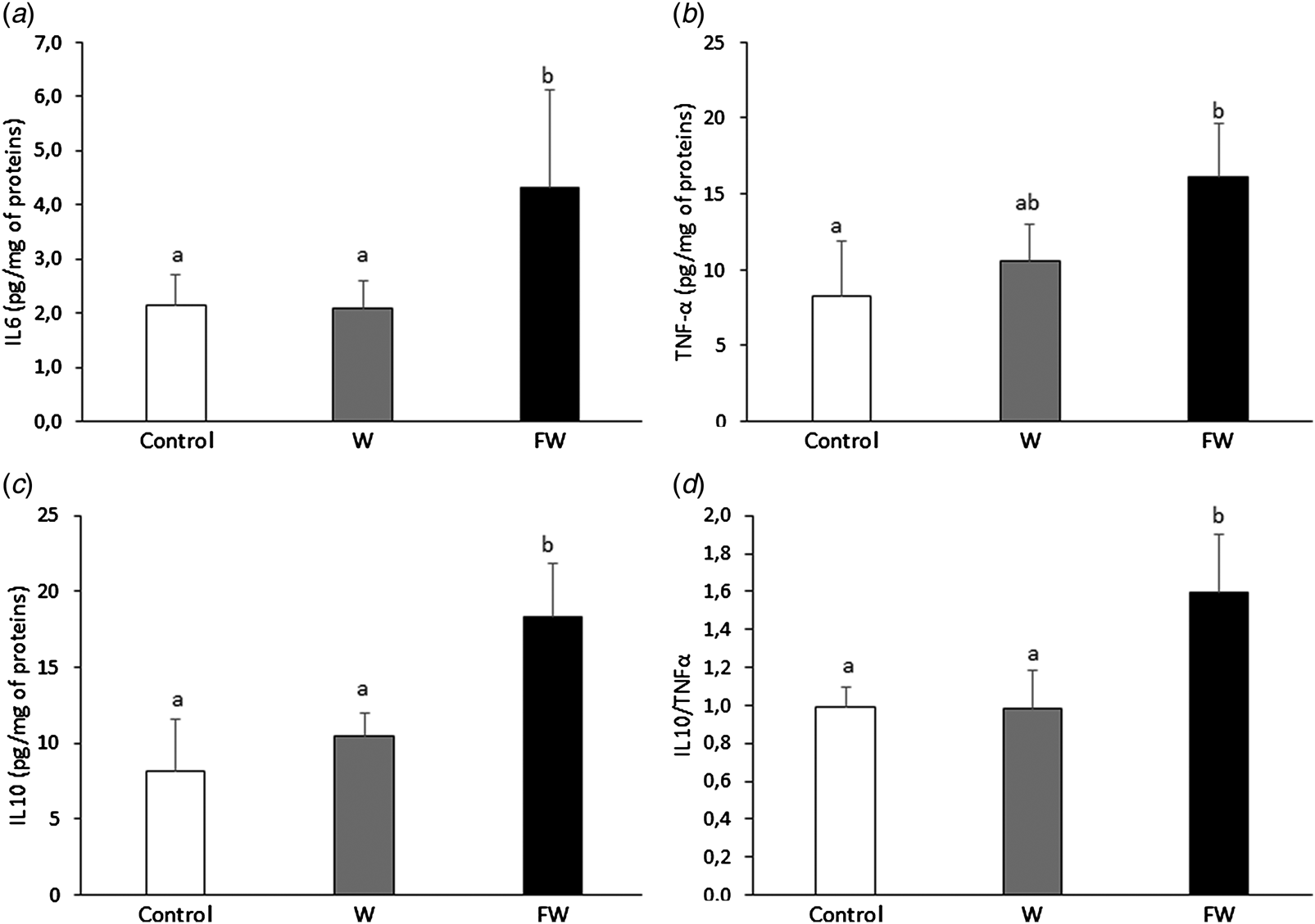
Weaning is one of the most stressful challenges pigs meet in their lives and it can induce dysfunctions of the intestinal and immune system. This compromises the health, growth, and feed intake of piglets, especially during the first week after weaning (Campbell et al., Reference Campbell, Crenshaw and Polo2013). The modulation of the immune response in the gut was evaluated by analyzing the production of certain cytokines. At the end of the experimental period, a significant increase in TNFα, IL-6 and IL-10 in intestinal fluids from mice that received FW was observed compared to the control group (Fig. 1a–c). Administration of W alone, without fermentation with L. rhamnosus RC007, was not able to increase the luminal concentrations of these cytokines. Previous studies demonstrated that L. rhamnosus RC007 administrated during 10 d to healthy mice was able to increase the number of IgA+ cells in small intestine (Dogi et al., Reference Dogi, García, de Moreno de LeBlanc, Greco and Cavaglieri2016). Secretory IgA (s-IgA) is the main mechanism of protection given by the gut associated lymphoid tissue that prevents the entry of potentially harmful antigens, and also interacts with mucosal pathogens without potentiating damages (Cerutti et al., Reference Cerutti, Chen and Chorny2011; Brandtzaeg, Reference Brandtzaeg2013; Corthesy, Reference Corthesy2013). An increasing number of probiotic strains have been shown to increase s-IgA. We did not determine s-IgA. However, it has been reported that IL-6 plays a critical role in vivo in the development of local IgA antibody responses. IL-6 secretion by Peyer's patch dendritic cells in response to some strains of Lactobacillus sp. promoted IgA+ B cells to differentiate into IgA-producing plasma cells (Kawashima et al., Reference Kawashima, Ikari, Tomoko, Yasuyuki, Yoshiro, Naoki and Tsuji2018). The increase in IL-6 observed in the present work could be involved in this process.
Cytokine concentrations in small intestinal contents. Cytokine concentrations in the small intestine content were determined by Cytometric Bead Array. Experimental group were Control group: animals received orally 0.1 ml of phosphate buffered saline (PBS); FW group: animals received orally 0.1 ml of FW; whey (W) group: animals received orally 0.1 ml of W without fermentation with probiotic bacterium. Results are expressed as concentration of each cytokine in pg/mg of proteins: a) IL-6; b) TNF-alpha and c) IL-10. The ratio between IL-10 and the pro-inflammatory cytokine TNFα was also analyzed (d). Each bar represents the mean ± sd (n = 6, from 2 independent experiments). a,bMeans values without a common letter differ significantly (P < 0.05).

TNFα is a cytokine known to be induced by probiotics administration; it is the most important cytokine in the innate immune response, and it is produced mainly by monocytes and macrophages, but also by epithelial cells (Roulis et al., Reference Roulis, Armaka, Manoloukos, Apostolaki and Kollias2011). Castillo et al. showed induction of TNFα production, along with IFNγ and IL-10 in healthy mice fed with L. casei (Castillo et al., Reference Castillo, Perdigón and de Moreno de Leblanc2011). Lactobacillus fermentum treatment also resulted in increased expression of TNFα associated with increased neutrophil infiltration which can contribute to resolution of infection (Lukic et al., Reference Lukic, Strahinic, Milenkovic, Golic, Kojic and Topisirovic2013). The ratio between the anti- and pro-inflammatory cytokines (IL-10/TNFα) in the small intestine fluids was also evaluated and the results showed that the mean values increased significantly in the group of mice that received FW compared to the control and W groups (Fig. 1d). IL-10 is a pluripotent cytokine and the most important anti-inflammatory cytokine found in the immune response. All the activities of IL-10 lead to the inhibition of the production of pro-inflammatory mediators while enhancing the production of anti-inflammatory mediators (de Moreno de LeBlanc et al., Reference de Moreno de LeBlanc, Castillo and Perdigón2010).
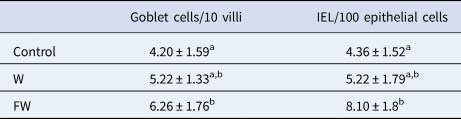
Concerning the intestinal barrier, both cells producing the mucous layer and immune cells (IEL) were studied because they are the first line of host defense against noxious agents and infections. Administration of FW was able to increase the number of IEL and goblet cells in small intestine (Table 1 and online Supplementary File Fig. S1). Intraepithelial lymphocytes are effector cells of innate immunity important for both skin and gastrointestinal barrier restoration (Strbo et al., Reference Strbo, Yin and Stojadinovic2014). Goblet cells reside throughout the length of the small and large intestine and are responsible for the production and maintenance of the protective mucus blanket by synthesizing and secreting high-molecular-weight glycoproteins known as mucins (Deplancke and Gaskins, Reference Deplancke and Gaskins2001). Previous study demonstrated that weaning induces structural and functional changes in the small intestine of pig, with a decrease in the number of goblet cells and IEL (García et al., Reference García, Dogi, Ashworth, Berardo, Godoy, Cavaglieri, de Moreno de LeBlanc and Greco2016a). Administration of FW to weaned piglets could restore this negative effect and improve gut innate immunity.
Counts of goblet cells and intraepithelial lymphocytes in small intestines of mice that received the different treatments

Each point represents the mean of n = 6 ± sd. Different superscript letters show significant differences (P < 0.05) between treatments.
In conclusion, the results showed that whey fermented by the probiotic bacterium L. rhamnosus RC007 stimulated the gut immune system of mice, potentially allowing the gut to respond more quickly to face noxious stimuli such pathogenic microorganisms or toxic agents. Fermented feed additives could be an interesting alternative in pig production and would help to solve the problem of whey discard.
Supplementary material
The supplementary material for this article can be found at https://doi.org/10.1017/S0022029919000980
Acknowledgements
This study was carried out with grants from FONCYT-PICT.