Introduction
Stizophyllum Miers (Bignonieae, Bignoniaceae) is a small genus of Neotropical lianas, distributed from Mexico to Brazil, occurring in wet to dry forests (Lohmann and Taylor, Reference Lohmann and Taylor2014). The genus is monophyletic (Lohmann, Reference Lohmann2006), and all species are pollinated by bees, and dispersed by wind (Gentry, Reference Gentry1974). Three species are currently recognized (Lohmann and Taylor, Reference Lohmann and Taylor2014): S. inaequilaterum Bureau & K. Schum., S. perforatum (Cham.) Miers and S. riparium (Kunth) Sandwith.
Nuclear microsatellite markers (nSSRs) are short tandem repeats of DNA (Powell et al., Reference Powell, Machray and Provan1996). These markers have been widely used to estimate genetic diversity parameters (Palma-Silva et al., Reference Palma-Silva, Lexer, Paggi, Barbará, Bered and Bodanese-Zanettini2009; Hmeljevski et al., Reference Hmeljevski, Nazareno, Bueno, dos Reis and Forzza2017), gene flow, population genetic structure (Barbará et al., Reference Barbará, Martinelli, Fay, Mayo and Lexer2007; Lexer et al., Reference Lexer, Marthaler, Humbert, Martinelli and Versieux2016), demography (Pinheiro et al., Reference Pinheiro, de Barros, Palma-Silva, Fay, Lexer and Cozzolino2011), and phylogeography (Collevatti et al., Reference Collevatti, Terribile, Lima-Ribeiro, Nabout, Oliveira, Rangel, Rabelo and Diniz-Filho2012; Tóth et al., Reference Tóth, Köbölkuti, Pedryc and Höhn2017). Although these markers are extremely informative for genetic studies, they were only isolated for a single species of Bignoniaceae (Figueira et al., Reference Figueira, Ramelo, Ogasawara, Montanari, Zucchi, Cavallari and Foglio2010). Here, we developed and characterized nSSRs markers for Stizophyllum riparium using genomic data and examined their transferability.
Experimental
Genomic DNA of one individual of S. riparium (Nogueira 170) was extracted from silica-dried leaf material using the Invisorb Plant Mini Kit (Invitek, Berlin, Germany). The genomic library was constructed following Nazareno et al. (Reference Nazareno, Carlsen and Lohmann2015), and sequenced on an Illumina HiSeq 2000 system (Illumina Inc., San Diego, CA, USA) at the University of São Paulo (Brazil). We used a Perl script to clean raw reads and exclude reads with low Phred scores and with more than three uncalled bases (see Nazareno et al., Reference Nazareno, Carlsen and Lohmann2015).
The nuclear genome was separated from the chloroplast genome using de novo assembly, based on sequence coverage. Contigs with coverage lower than 10x corresponded to the nDNA, since organelles have high-copy numbers and the DNA derived from organelles is oversampled in the total genomic sample sequenced (Nazareno et al., Reference Nazareno, Carlsen and Lohmann2015). The remaining de novo contigs were assembled into larger contigs in Sequencher 5.3.2 (Gene Codes Inc., Ann Arbor, MI, USA) based on at least 20 bps overlap and 98% similarity. The UNIX ‘grep’ function was used to find reads and assemble them. We used a Perl script to look for motifs commonly found in plant DNA (Kalia et al., Reference Kalia, Rai, Kalia, Singh and Dhawan2011) using a threshold of 10 repeats for dinucleotide, eight repeats for trinucleotide and four repeats for tetra-, penta- and hexanucleotides.
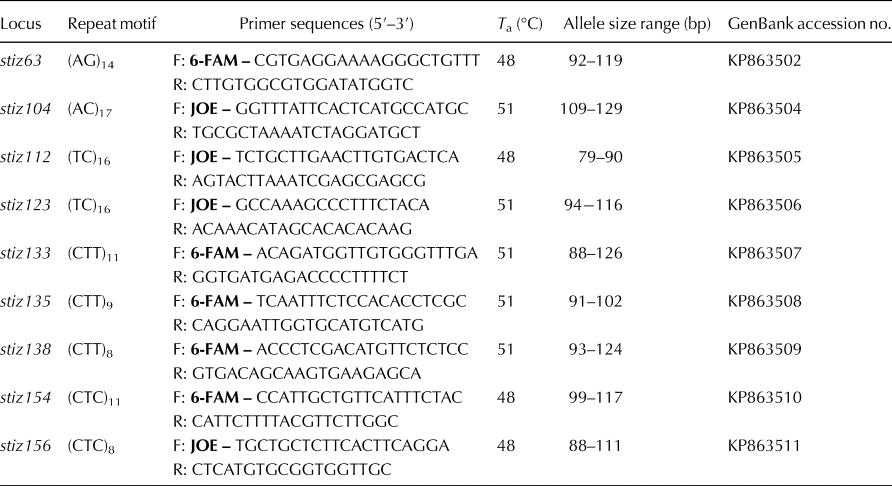
Primer pairs for a total of 202 nSSRs (online Supplementary Appendix S1) were designed using Primer3web 4.0.0 (Rozen and Skaletsky, Reference Rozen and Skaletsky1999), with the following parameters: primer size 18–23 bp, annealing temperatures 50–62°C, with GC content 40–80%. A set of 32 nSSR primers for nSSR with the most common nucleotide repeats was synthesized (i.e. AG, AC, TC and AAG; see Morgante and Olivieri, Reference Morgante and Olivieri1993; Kalia et al., Reference Kalia, Rai, Kalia, Singh and Dhawan2011). PCR amplifications were performed in a final volume of 10 µl that contained 15 ng of genomic DNA, 10 mM of each primer with forward primers labelled with 6-FAM or JOE fluorescent dyes (Macrogen, Seoul, South Korea, Table 1), 25 mM MgCl2 (Promega Corporation, Madison, WI, USA) and 5 µl 1x of KAPA2G® Fast RedyMix (Kapa Biosystems, Wilmington, MA, USA). The cycling conditions were as follows: an initial denaturation step of 3 min at 94°C, followed by 30 cycles of 30 s at 94°C for denaturation, 30 s at the specific annealing temperature for each primer pair (Table 1), 72°C for 60 s and final extension of 5 min at 72°C. To test the utility of the primers, PCR products were detected using a 1.0% agarose gel electrophoresis with a 100-bp range DNA ladder (Promega Corporation).
Nuclear microsatellite markers developed for Stizophyllum riparium, including the repeat motif, forward (F) primer sequence labelled with 6-FAM or JOE fluorescent dyes and reverse (R) primer sequence, annealing temperature (T a), allele size range and GenBank accession numbers

The synthesized primers were used to check for polymorphisms in 57 individuals from three populations representing the limits of the species distribution (online Supplementary Appendix S2). DNA was extracted from silica-dried leaf material or herbarium specimens using the Invisorb Plant Mini Kit. The amplicons with fluorescent labels were resolved to genotype on an automated DNA sequencer, ABI 3500 XL (Applied Biosystems, Foster City, CA, USA) with GeneScan 500 Rox Size Standard (Applied Biosystems).
All polymorphic nSSRs were tested for cross-amplification in six individuals of S. inaequilaterum and S. perforatum (online Supplementary Appendix S2). The PCR conditions and the visualization of the amplicons were as previously described. When bands of the expected size were visualized, amplifications were considered successful.
The nSSR profiles were analysed using GeneMarker (Holland and Parson, Reference Holland and Parson2011). For each nSSR, the number of alleles (A), the effective number of alleles (A e), the observed heterozygosity, unbiased expected heterozygosity (H e) and Hardy–Weinberg equilibrium (HWE) were estimated using GenAlEx 6.41 (Peakall and Smouse, Reference Peakall and Smouse2006). Polymorphic information content (PIC) was estimated using the formula PIC = 1–Σ(Pi)2. Gametic disequilibrium was tested for each population using FSTAT (Goudet, Reference Goudet1995). In order to avoid false-positives, P-values ( = 0.05) were adjusted by applying a sequential Bonferroni correction for multiple comparisons (Rice, Reference Rice1989). To check the presence of null-alleles, we used Micro-Checker 2.2.3 (Van Oosterhout et al., Reference Van Oosterhout, Hutchinson, Wills and Shipley2004).
Results and discussion
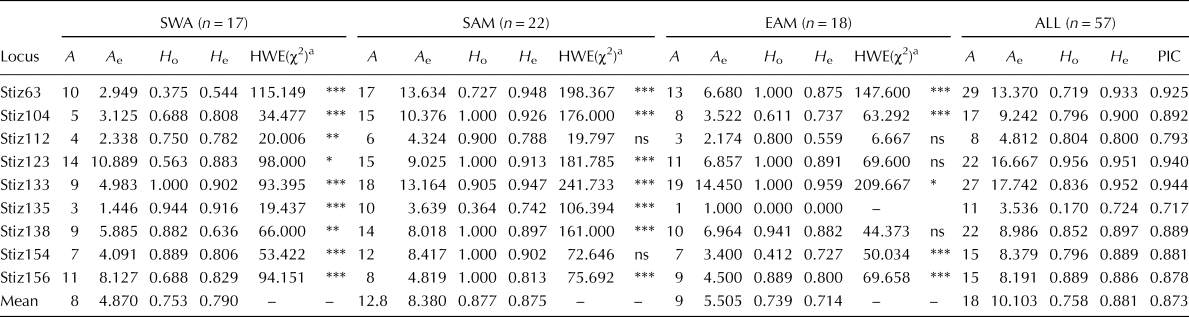
Nine primer pairs amplified successfully (Table 1), with A ranging from eight to 29 and H e varying from 0.724 to 0.952 for all populations (Table 2). No significant deviation of HWE in terms of heterozygosity deficiency was detected for any loci (Table 2). PIC values ranged from 0.717 to 0.944 and no pairs of nSSR loci were found to be in significant genotypic disequilibrium after Bonferroni correction (P < 0.0001). Null alleles were detected (see online Supplementary Appendix S3). All nSSR markers successfully amplified for S. inaequilaterum and S. perforatum (online Supplementary Appendix S4).
Characterization of the nine nuclear microsatellite markers in three Stizophyllum riparium a populations (sample size, n = 57)

A, number of alleles; A e, effective number alleles; H o, observed heterozygosity; H e, unbiased expected heterozygosity; n, sample size for each population; PIC, polymorphic information content.
Statistical deviation from HWE is indicated as *P < 0.05, **P < 0.01, ***P < 0.001 and ns, not significant.
a Voucher and locality information are provided in online Supplementary Appendix S2.
The nine polymorphic markers developed in this study showed high rates of polymorphism, and are suitable for population genetics studies. Highly polymorphic markers are fundamental tools to ensure accurate estimation of the genetic diversity parameters and the genetic structure of populations (Pinheiro et al., Reference Pinheiro, de Barros, Palma-Silva, Fay, Lexer and Cozzolino2011). Most genetic studies within tribe Bignonieae to date were conducted at macroevolutionary scales (e.g. Fonseca and Lohmann, Reference Fonseca and Lohmann2015), with microevolutionary studies being still scarce in Bignoniaceae. The set of nSSR markers developed here will be useful for future population genetics studies of Stizophyllum species, including cpSSR markers (Beyer et al., Reference Beyer, Nazareno and Lohmann2017).
Supplementary material
The supplementary material for this article can be found at https://doi.org/10.1017/S1479262119000108
Acknowledgements
The authors thank CAPES (Comissão de Aperfeiçoamento de Pessoal do Nível Superior) for a scholarship to M.B., CNPq (Conselho Nacional de Desenvolvimento Científico e tecnológico) for a Pq-1B grant to L.G.L. (310871/2017-4), and FAPESP (Fundação de Amparo a Pesquisa do Estado de São Paulo) for a scholarship to A.G.N. (2013/12633-8), a regular research grant (2011/508559-2), and a collaborative FAPESP-NSF-NASA Dimensions of Biodiversity Grant (2012/50260-6) to L.G.L. The authors also thank the curators of EAC, MO, NY, P and RB herbaria for allowing us to study their specimens.