




No CrossRef data available.
Effects of continuing medical education on improving physician clinical care and patient health: A review of systematic reviews
Published online by Cambridge University Press: 04 August 2005
Abstract
Objectives: The objective of physician continuing medical education (CME) is to help them keep abreast of advances in patient care, to accept new more-beneficial care, and discontinue use of existing lower-benefit diagnostic and therapeutic interventions. The goal of this review was to examine effectiveness of current CME tools and techniques in changing physician clinical practices and improving patient health outcomes.
Methods: Results of published systematic reviews were examined to determine the spectrum from most- to least-effective CME techniques. We searched multiple databases, from 1 January 1984 to 30 October 2004, for English-language, peer-reviewed meta-analyses and other systematic reviews of CME programs that alter physician behavior and/or patient outcomes.
Results: Twenty-six reviews met inclusion criteria, that is, were either formal meta-analyses or other systematic reviews. Interactive techniques (audit/feedback, academic detailing/outreach, and reminders) are the most effective at simultaneously changing physician care and patient outcomes. Clinical practice guidelines and opinion leaders are less effective. Didactic presentations and distributing printed information only have little or no beneficial effect in changing physician practice.
Conclusions: Even though the most-effective CME techniques have been proven, use of least-effective ones predominates. Such use of ineffective CME likely reduces patient care quality and raises costs for all, the worst of both worlds.
Keywords
Information
- Type
- GENERAL ESSAYS
- Information
- International Journal of Technology Assessment in Health Care , Volume 21 , Issue 3 , July 2005 , pp. 380 - 385
- Copyright
- © 2005 Cambridge University Press
Educators, researchers, and policy-makers have analyzed over the past 5 decades appropriate use of medical care. Most research previously focused on overuse (18;27;30) but now includes underuse, misadventure, medical errors, and malpractice (11;20;26). Overuse leads to preventable increased risk of iatrogenic disease and wasted resources. Underuse, including poor patient adherence, has adverse health and quality of life effects and may lead to greater long-term expenditures than would have been needed.
Inappropriate health services use begs the question of why this occurs, that is, the disparity between available information on effective care and use in daily medical practice. For many diseases and treatments, randomized control trials (RCTs), meta-analyses, and widely distributed clinical practice guidelines derived from this evidence define best care and expected benefits.
One hypothesis for inappropriate medical service use where scientific evidence supports clinical efficacy is use of relatively ineffective continuing medical education (CME) tools and techniques. CME are activities to improve physician knowledge, attitudes, and skills, to keep them current with the latest advances that improve patient-care processes and outcomes, to help them accept or reject new practices, and convince them to discontinue use of existing care of lesser effectiveness. CME can be face-to-face or at a distance, and educators can be human or devices such as computers. Patient treatment adherence is equally problematic, and ways to improve it are known also but will not be discussed further (22).
The objective of this review is to present systematic research results that previously quantified effects, mainly by formal meta-analysis, of specified CME techniques on physician-care processes and improvements of patient health outcomes. Previous analyses and reviews have discussed effects of individual CME techniques, but almost none reviewed all techniques and compared estimates of benefits derived by meta-analyses.
METHODS
We searched Medical Literature Analysis and Retrieval System On-Line, Database of Abstracts of Reviews of Effects, Cochrane Collaborative, Cinahl, Excerpta Medica Database, Psychinfo, Canadian Medical Association Infobase, National Guidelines Clearinghouse, evidence-based medicine reviews, American College of Physicians Journal Club, HealthSTAR, and related databases from 1 January 1984 through 30 October 2004, using multiple search terms for efficacious CME programs and techniques that alter physician behavior and/or patient outcomes. Searches were limited to English-language peer-reviewed journals, supplemented with reviews of bibliographies from published articles. Reviewed re-analyses were selected for inclusion based on their being a formal meta-analysis or other structured review, preferably with calculated effect sizes. Literature reviews alone were excluded. Physicians are the focus as they are the prime decision-makers for care recommendations and allocating health resources. The search found (i) twenty-six systematic reviews quantifying or synthesizing effectiveness of CME methods to change physician practice and/or patient health outcomes and (ii) one study estimating cost-effectiveness of CME programs.
RESULTS
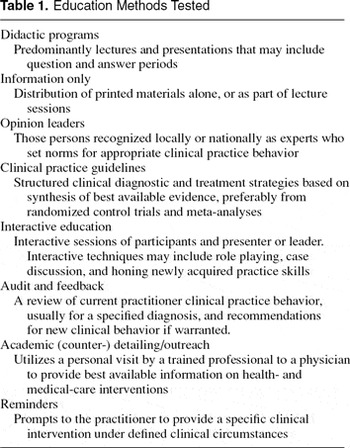
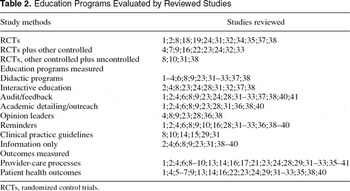
The twenty-six systematic reviews serve as the basis for this examination of effects of CME techniques on physician clinical-care processes and patient health outcomes (1;2;4;6;8–10;13;14;16;17;21;23;24;28;29;31–33; 35–41). There may be some bias as some reviews used some of the same original trials in their analysis. This bias may tend to overstate somewhat the power of the original authors' conclusions. All used quantitative or combined quantitative and qualitative methods. Eight educational techniques were reviewed, individually, or in combination (Table 1). Twelve reviews (46.2 percent) were of RCTs exclusively, nine (34.6 percent) reviewed RCTs plus other control designs, and five (19.2 percent) included RCTs plus other control and uncontrolled studies. Eight were formal meta-analyses (10;14;16;21;28;39;40). Reviews examined at least one form of didactic or interactive education.

All reviews tested effects of CME techniques to change provider behavior (care processes); sixteen tested effects on patient health outcomes. Reminders (n =19), audit and feedback (n =18), and didactic presentations (mainly lectures; n =14) were the most common techniques studied. Twenty-one reviews examined effects of multiple education tools (Table 2) (1;2;4;6;8;9;21;23;24;36;38;41). Results describing education methods reported here are those of the authors of the original review.

Techniques to Change Physician Clinical Practice Behavior
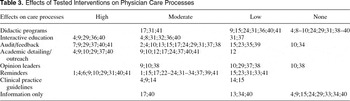
Every CME technique exhibited a range of effectiveness across reviews in changing physician clinical practices (Table 3). The distributions of effects, from low to high, were those described by the authors of the original reviews. Didactic techniques and providing printed materials alone clustered in the range of no-to-low effects, whereas all interactive programs exhibited mostly moderate-to-high beneficial effects. The most commonly used techniques, thus, generally were found to have the least benefit.

The most-effective education tools were interactive programs among practitioners and educators—audit and feedback on optimal versus actual care provided, diagnosis-specific care reminders for best care, academic detailing, and other outreach programs on best practices, clinical practice guidelines, and to a lesser extent, opinion leaders. Thus, both least- and most-effective CME techniques are well-defined.
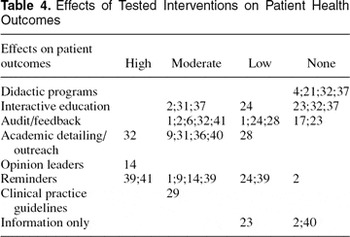
Eight formal meta-analyses (1;2;8;31;32;36–38) reanalyzed results of RCTs of techniques to change physician practice; two also included effects on patient outcomes (Table 4) (36;37). Thomson O'Brien et al. (36–38) found moderate-to-high effect of interactive programs in changing physician care and low or no effect of didactic programs. Davis et al. (8) estimated a nonsignificant standardized effect size of 0.34 (95 percent confidence interval [CI], -0.27–0.97) for didactic programs and a significant standardized effect for interactive and mixed education programs of 0.67 (95 percent CI, 0.01–1.45). The meta-analysis by Austin et al. (1) concluded that reminders were effective in altering physician practices for cervical cancer screening (odds ratio [OR], 1.180; 95 percent CI, 1.020–1.339) and tetanus immunization (OR, 2.819; 95 percent CI, 2.664–2.975).

The meta-analysis of twelve RCTs by Balas et al. (2) found a significant effect on physician practices of audit and feedback (OR, 1.091; 95 percent CI, 1.045–1.136). The Walton et al. (39) review of reminders found significantly reduced time to achieve therapeutic control (standardized mean difference, -0.44; 95 percent CI, -0.70–0.17), reduced toxicity levels (risk difference, -0.12; 95 percent CI, -0.24–0.01), reduced adverse medication reactions (risk difference -0.06, 95 percent CI,–0.12 to 0.00), and reduced length of hospital stays (standardized mean difference, -0.32; 95 percent CI, -0.60–0.04. Silagy et al. (32) found interactive education and reminders for smoking cessation moderately effective in altering physician practices (OR, 1.44; 95 percent CI, 1.29–1.60).
Shea et al. (31) found from their meta-analysis of sixteen RCTs of computer-based clinical reminders across six preventive services adjusted OR of 1.77 and 95 percent CI of 1.38–2.27. Reminders improved vaccinations (OR, 3.09; 95 percent CI, 2.39–4.00), breast cancer screening (OR, 1.88; 95 percent CI, 1.44–2.45), colorectal cancer screening (OR, 2.25; 95 percent CI, 1.74–2.91), and cardiovascular risk reduction (OR, 2.01; 95 percent CI, 1.55–2.61), but not cervical cancer screening (OR, 1.15; 95 percent CI, 0.89–1.49) or other preventive services (OR, 1.02; 95 percent CI, 0.79–1.32). In addition, the meta-regression analysis of 108 RCTs by Stone et al. (34) found organization change the most-effective tool to increase screening services.
Education Techniques That Improve Patient Outcomes
Multiple reviews of audit and feedback, academic detailing, and physician reminders found each moderately or highly effective in improving patient health outcomes (Table 3). One review each, for opinion leaders (37) and academic detailing/outreach (38), also found a large effect on patient outcome. Silagy et al. (32) estimated a modest effect of interactive education techniques (OR, 1.35; 95 percent CI, 1.09–1.65). Stone et al. (34) concluded economic incentives were the best motivator of patient behavior change, reminders were moderately effective, and information alone had no effect.
Are Programs to Change Practitioner Behavior Cost-Effective?
The one cost-effectiveness study, of education outreach/counterdetailing for two interventions, concluded (i) CME for angiotensin-converting enzyme inhibitors for heart failure was highly cost-effective at $2,062 per life-year saved, and (ii) reducing selective serotonin reuptake inhibitor use in favor of tricyclic antidepressants found cost per patient of outreach ($82) was greater than the savings from changing physician behavior ($75) (34).
DISCUSSION
New and effective health-care interventions continue to become available and generally are diffused relatively quickly to all high-income countries. But, less-effective care is not necessarily discarded nor is the more-effective rapidly accepted into clinical practice. Continuing wide variation in medical practice, among and within countries, means progress is slow in integrating clinical advances. These rapid changes are stressful to both physicians and prospective patients, perhaps due to lack of personal experience with the new modalities, about adopting the new and discarding the old. Continuing medical education is an important way for practitioners to understand and use new care modalities. However, the CME tools and techniques most commonly used are the least-effective ones in helping physicians adapt to new diagnostic and therapeutic interventions.
Burgeoning knowledge from RCTs and meta-analyses of CME is clear on the most-effective techniques that alter medical-care processes and patient health outcomes—interactive education, audit and feedback, reminders, academic detailing, and other outreach programs, and somewhat less so, clinical practice guidelines and opinion leaders. In addition, combining techniques, for example, interactive education plus academic detailing, leads to even greater effect than either achieves alone (23;40). The literature is also clear on the least-effective education methods—didactic lectures and distributing printed materials alone. But even a technique of low-efficacy can become useful when combined with interactive tools (17). Thus, it is apparent that insufficient information on the most-effective physician continuing education methods is not the main problem.
POLICY IMPLICATIONS
This review shows clearly that commonly used continuing medical education alone is insufficient to change clinical practice behavior and resulting patient health outcomes. The cost is enormous relative to the benefits of continued reliance mainly on didactic techniques and distributing printed materials alone; thus, the verdict must be that the large majority of these activities do not provide good value for money. But, relying on effective education techniques alone is insufficient. As Grol (16) emphasized, there must be parallel awareness first, that no single approach to professional education works best under all circumstances. Second, educators must use approaches that focus on teams and organizations within unique practitioner social, political, and economic environments.
Clear models exist that can improve the likelihood of successful integration of new knowledge into clinical practice. For example, Stone et al. (34) described key features for success such as valued members transmitting the information, targeting group interests and motivations, using collaborative teamwork, tailoring interventions to audience needs, and enlisting peer and senior management support. Successful implementation also requires awareness of local health-care organization needs, evidence of suboptimal use of effective care, and sound estimates of costs of changing behavior (15;25). Thus, means and methods to translate new knowledge into practice are available at both health system and individual physician levels (15;40).
The remaining issue is implementation by educators, funders, and physicians. Multifaceted policies are needed for such complex policy development and implementation. Certainly, organization, delivery, and financing changes will be needed in all countries to support such changes within each country's unique health and medical-care system. The Institute of Medicine has suggested changes needed for the United States (21;22). Rarely discussed, though, are financial, organizational, physician, patient, and payer incentives (positive and negative) that can help speed the process of changing practice patterns across countries and health systems to encompass more fully the best scientific evidence into clinical care. For example, in countries that use some form of fee-for-service, physicians who provide care based on best evidence could be paid more than those who do not. Physician salaries or capitation amounts could be partially dependent on care provided based on diagnosis-specific guidelines already learned and require justification when not following evidence-based guidelines. They could also receive more CME credits when exposed to effective CME techniques. CME credits are often needed for re-certification or income increases. Payers or insurers could reimburse physicians for their time and/or direct cost of attending educational programs that used known effective techniques, for example, lecture plus audit and feedback, but not for attending lectures alone. Patients who adhere to physician recommended treatment would have their visit and pharmaceutical prescription copayment refunded. Pharmaceutical firms that do not use known effective CME techniques could not claim a tax deduction for costs of CME programs they sponsor. Thus there are multiple options for implementation. Whichever group or types are chosen, health systems must choose methods and means to get timely and effective care to patients within increasingly constrained national health-care expenditures.
CONTACT INFORMATION
Bernard S. Bloom, PhD, Research Professor (bsbloom@mail.med.upenn.edu), Department of Medicine, University of Pennsylvania, 3615 Chestnut Street, Philadelphia, Pennsylvania 19104-2676, USA
References
Austin SM,
Balas EA,
Mitchell JA,
Ewigman BG.
1994;
Effect of physician reminders on preventive care: Meta-analysis of randomized clinical trials.
Proceedings—the Annual Symposium on Computer Applications in Medical Care
120:
121–
124.Google Scholar
Balas EA,
Austin Boren S,
Brown GD, et al.
1996
Effect of physician profiling on utilization: Meta-analysis of randomized clinical trials.
J Gen Intern Med.
11:
584–
590.Google Scholar
Berger ML,
Nebenfuhr P,
Murray RK.
2000
The value of disease management—approaching the industrialisation of modern medicine.
Dis Manage Health Outcomes.
8:
181–
184.Google Scholar
Bero LA,
Grilli R,
Grimshaw JM, et al.
1998
Closing the gap between research and practice: An overview of systematic reviews of interventions to promote the implementation of research findings.
BMJ.
317:
465–
468.Google Scholar
Bloom BS,
Smith WP,
Weitz D,
LaMont B.
1997
The diagnostic and treatment approach to two common conditions by the members of a community health maintenance organization.
Am J Manage Care.
3:
733–
736.Google Scholar
Buntinx F,
Winkins R,
Grol R,
Knotternerus JA.
1993
Influencing diagnostic and preventive performance in ambulatory care by feedback and reminders. A review.
Fam Pract.
10:
219–
228.Google Scholar
Chassin MR,
Korsecoff JB,
Park RE, et al.
1987
Does inappropriate use explain geographic variations in the use of health services? A study of three procedures.
JAMA.
258:
2533–
2537.Google Scholar
Davis D,
O'Brien MA,
Freemantle N, et al.
1999
Impact of formal continuing medical education: Do conferences, workshops, rounds, and other continuing education activities change physician behavior or health care outcomes?
JAMA.
282:
867–
874.Google Scholar
Davis DA,
Taylor-Vaisey A.
1995;
Translating guidelines into practice: A systematic review of theoretic concepts and research evidence in the adoption of clinical practice guidelines.
CMAJ
157:
408–
416.Google Scholar
Davis DA,
Thomson MA,
Oxman AD,
Haynes RB.
1995
Changing physician performance: A systematic review of the effect of continuing medical education strategies.
JAMA.
274:
700–
705.Google Scholar
Fendrick AM,
Ridker PM,
Bloom BS.
1994
Improved health benefits of increased use of thrombolytic therapy.
Arch Intern Med.
154:
1605–
1609.Google Scholar
Fendrick AM,
Smith DG,
Chernew ME,
Shah SN.
2001
A benefit-based co-pay for prescription drugs: Patient contribution based on total benefits, not drug acquisition cost.
Am J Manage Care.
7:
861–
867.Google Scholar
Freemantle N,
Harvey EL,
Wolf F, et al.
2000
Printed educational materials: Effects on professional practice and health care outcomes.
Cochrane Database Syst Rev.
(2): CD000172.Google Scholar
Grimshaw J,
Freemantle N,
Wallace S, et al.
1994
Developing and implementing clinical practice guidelines.
Qual Health Care.
4:
55–
64.Google Scholar
Grimshaw JM,
Thomas RE,
MacLennan G, et al.
2004
Effectiveness and efficiency of guideline dissemination and implementation strategies.
Health Technol Assess.
8:
iii–iv
1–
72.Google Scholar
Grol R.
2001
Improving the quality of medical care: Building bridges among professional pride, payer profit and patient satisfaction.
JAMA.
286:
2578–
2585.Google Scholar
Haynes RB,
Davis DA,
McKibbon A,
Tugwell P.
1984
A critical appraisal of the efficacy of continuing medical education.
JAMA.
251:
61–
64.Google Scholar
Heffler S,
Levit K,
Smith S, et al.
2001
Health spending growth up in 1999; Faster growth expected in the future.
Health Aff (Millwood).
20:
193–
203.Google Scholar
Hellinger FJ.
1996
The impact of financial incentives on physician behavior in managed care plans: A review of the evidence.
Med Care Res Rev.
53:
294–
314.Google Scholar
Ibrahim SA,
Kwoh CK.
2000
Underutilization of oral anticoagulant therapy for stroke prevention in elderly patients with heart failure.
Am Heart J.
140:
219–
220.Google Scholar
Institute of Medicine.
2001.
Crossing the quality chasm: A new health system for the 21st century.
Washington, DC:
National Academy Press;
Institute of Medicine.
2000.
To err is human: Building a safer health system.
In: Kohn LT,
Corrigan JM,
Donaldson MS, eds.
Washington, DC:
National Academy Press;
Johnston ME,
Langton KB,
Haynes RB,
Mathieu A.
1994
Effects of computer-based clinical decision support systems on clinician performance and patient outcome: A critical appraisal of research.
Ann Intern Med.
120:
135–
142.Google Scholar
Lomas J.
1988
Haynes RB. A taxonomy and critical review of tested strategies for the application of clinical practice recommendations: From “official” to “individual” clinical policy.
Am J Prev Med.
4
(Suppl):
77–
94.Google Scholar
Mason J,
Freemantle N,
Nazareth I, et al.
2001
When is it cost-effective to change behavior of health professionals?
JAMA.
286:
2988–
2992.Google Scholar
McGlynn EA,
Asch SM,
Adams J, et al.
2003
The quality of health care delivered to adults in the United States.
N Engl J Med.
348:
2635–
2645.Google Scholar
Miller NF.
1946
Hysterectomy: Therapeutic necessity or surgical racket.
Am J Obstet Gynecol.
51:
804–
810.Google Scholar
Morrison A,
Wertheimer AI,
Berger ML.
2000
Interventions to improve antihypertensive drug adherence: A quantitative review of trials.
Formulary.
35:
234–
255.Google Scholar
Oxman AD,
Thomson MA,
Davis DA,
Haynes RB.
1995;
No magic bullets: A systematic review of 102 trials of interventions to improve professional practice.
CMAJ
153:
1423–
1431.Google Scholar
Peterson OL,
Andrews LP,
Spain RS,
Greenberg BG.
1956
An analytical study of North Carolina general practice.
J Med Education.
(Pt 2):
1–
165.Google Scholar
Shea S,
DuMouchel W,
Bahamonde L.
1996
A meta-analysis of 16 randomized control trials to evaluate computer-based clinical reminder systems in preventive care in ambulatory settings.
J Am Inform Assoc.
3:
399–
409.Google Scholar
Silagy C,
Lancaster T,
Fowler G.
1994
Effectiveness of training health professionals to provide smoking cessation interventions: Systematic review of randomised controlled trials.
Qual Health Care.
3:
193–
198.Google Scholar
Soumerai SB,
McLaughlin TJ,
Avorn J.
1990
Quality assurance for drug prescribing.
Qual Assur Health Care.
2:
37–
58.Google Scholar
Stone EG,
Morton SC,
Hulscher ME, et al.
2002
Interventions that increase use of adult immunizations and cancer screening services.
Ann Intern Med.
136:
641–
651.Google Scholar
Thomson O'Brien MA,
Oxman AD,
Davis DA, et al.
2000
Audit and feedback: Effects on professional practice and health care outcomes.
Cochrane Database Syst Rev.
(2):
CD000259.Google Scholar
Thomson O'Brien MA,
Freemantle N,
Oxman AD, et al.
2001
Continuing education meetings and workshops: Effects on professional practice and health care outcomes.
Cochrane Database Syst Rev.
(2):
CD003030.Google Scholar
Thomson O'Brien MA,
Oxman AD,
Davis DA, et al.
2000
Educational outreach visits: Effects on professional practice and health care outcomes.
Cochrane Database Syst Rev.
(2):
CD000409.Google Scholar
Thomson O'Brien MA,
Oxman AD,
Haynes RB, et al.
2000
Local opinion leaders: Effects on professional practice and health care outcomes.
Cochrane Database Syst Rev.
(2):
CD000125.Google Scholar
Walton RT,
Harvey E,
Dovey S,
Freemantle N.
2001
Computerised advice on drug dosage to improve prescribing practice.
Cochrane Database Syst Rev.
(1):
CD002894.Google Scholar
Wensing M,
Grol R.
1994
Single and combined strategies for implementing changes in primary care: A literature review.
Int J Qual Health Care.
6:
115–
132.Google Scholar
Yano EM,
Fink A,
Hirsch SH,
Robbins AS,
Rubinstein LV.
1995
Helping practices reach primary care goals: Lessons from the literature.
Arch Intern Med.
155:
1146–
1156.Google Scholar
Education Methods Tested
Education Programs Evaluated by Reviewed Studies
Effects of Tested Interventions on Physician Care Processes
Effects of Tested Interventions on Patient Health Outcomes
 You have
Access
- 326
- Cited by