Introduction
Because the organic industry has seen a recent surge in momentum, the question of what factors encourage its development has become increasingly important. Consumer interest in organic products has increased in the past decades, mainly due to an increase in health-consciousness (Hughner et al., Reference Hughner, McDonagh, Prothero, Shultz and Stanton2007), and the organic food industry has seen an increase in retail sales from US$11 billion in 2004 to US$27 billion in 2012 (Onken et al., Reference Onken, Bernard and Pesek2011; Osteen et al., Reference Osteen, Gottlieb and Vasavada2012). This growth, however, has led to the concern that the demand for organic ingredients is out-pacing domestic supply. A study by the US Department of Agriculture's Economic Research Service (Greene et al., Reference Greene, Dimitri, Lin, McBride, Oberholtzer and Smith2009) finds that, in 2004, 44% of organic handlers reported shortages of supplies, with 13% reporting being unable to meet market demand, and 38% reporting importing at least a portion of their organic ingredients. Additionally, in the United States Department of Agriculture (USDA) survey of organic producer-handlers, problems with organic procurement and supply ranked as one of the highest barriers to growth (Oberholtzer et al., Reference Oberholtzer, Dimitri and Greene2008). Some articles discuss domestic shortages of specific ingredients and products, such as almonds (Associated Press, 2012) and milk (Barclay, Reference Barclay2012), while others make more general statements that the current organic farmland cannot keep up with the growing demand for organic food (Faber, Reference Faber2006; Dimitri and Oberholtzer, Reference Dimitri and Oberholtzer2009; Sahota, Reference Sahota2009; The Daily Meal, 2011).
As a response to this possible shortage, many organizations (e.g., Stonyfield, Organic Valley and the Organic Trade Association) have taken an interest in promoting the organic sector and recruiting new organic operators (Faber, Reference Faber2006; Greene et al., Reference Greene, Dimitri, Lin, McBride, Oberholtzer and Smith2009; Associated Press, 2012). For example, the Organic Trade Association has a ‘How to Go Organic’ section on its website. Given the interest in promoting organic, as well as the fact that research has linked organic agriculture to regional economic development (Darnhofer et al., Reference Darnhofer, Schneeberger and Freyer2005), it is important to analyze and understand the factors associated with areas that have high numbers of organic operations. Hotspot identification allows for a systematic definition of an area with a ‘high’ number of organic operations. In our case, a hotspot (also sometimes called a ‘cluster’) refers to geographically close counties that have positively correlated, high numbers of organic operations.
Existing literature addresses both factors affecting the formation of hotspots in general, and factors affecting the development of the organic industry. Several papers mention factors such as proximity to urban centers and receptiveness to organic as factors associated with increased organic operations (Eades and Brown, Reference Eades and Brown2006; Schmidtner et al., Reference Schmidtner, Lippert, Engler, Haring, Aurbacher and Dabbert2012). Papers discussing the formation of general hotspots also mention lower transportation costs, more labor market pooling, and knowledge spillovers as reasons for cluster formation (Ellison et al., Reference Ellison, Glaeser and Kerr2007; Delgado et al., Reference Delgado, Porter and Stern2012; Kamath et al., Reference Kamath, Agarwal and Chase2012). However, none of the literature addressing the organic industry, to our knowledge, discusses the role of the organic certifying agent in the formation of hotspots of organic operations. Examining this role is important because the services provided by the organic certifying agent may be indicative of the level of communication among organic operations, and between organic operations and their communities, which may further indicate networking and knowledge spillover opportunities. Knowledge spillovers are particularly important in the organic industry, and play an important role in its formation as like-minded scientists, farmers and extension agents collaborated to generate and share knowledge about organic farming. Knowledge transfers and spillovers continue to play a large role in the development of alternative farming practices in the USA, while organizations such as the Organic Conversion Information Service and Farming Connect provide services to enhance knowledge transfers within the organic industry abroad (Hassanein, Reference Hassanein1999; Little, Reference Little2007).
The purpose of this paper is to quantify the role of organic certifying agents on the development of the organic industry. To do this, we determine how county-level certifier characteristics are associated with the probability that a county is in a hotspot of organic operations. To identify hotspots of organic operations, we use the Local Moran's I, which is a test statistic useful for investigating the null hypothesis that the number of organic operations are not correlated over county lines (more generally stated, that there is no spatial autocorrelation in the distribution of organic operations). We then use a logistic regression, combined with the results of the Local Moran's I analysis, to determine how characteristics of organic certifying agents are associated with the probability of hotspots and coldspots of organic operations. In general, we find that, after controlling for a number of demand- and supply-related factors, a strong outreach presence by private organic certifiers is positively associated with organic hotspot formation. This and other results are discussed and detailed below after providing first some background information and explaining our quantitative methods.
Background Information
Organic
In this paper, ‘organic operations’ refers to production and handling operations that are certified organic by USDA accredited certifiers. These operations are subject to more restricted production methods (National Organic Program) than their conventional counterparts, typically incur higher input costs (Emerging Issues in the US Organic Industry/EIB-55 Economic Research Service/USDA, 2008) and require more specialized labor (Klonsky and Tourte, Reference Klonsky and Tourte1998) than conventional agriculture operations, and use their own resources more frequently than conventional agriculture operations (Argiles and Brown, Reference Argiles and Brown2010; Schmidtner et al., Reference Schmidtner, Lippert, Engler, Haring, Aurbacher and Dabbert2012). In addition, others demonstrate that while hotspots are present in both the organic and the conventional agriculture sector, they are not necessarily consistent with one another (Marasteanu and Jaenicke, Reference Marasteanu and Jaenicke2013).
Research on clustering sometimes addresses hotspots as they specifically pertain to the organic sector. Some, for example, find that hotspots of organic production are more likely to form close to urban centers (Eades and Brown, Reference Eades and Brown2006), and others find the presence of spatial autocorrelation in the distribution of organic farming (Schmidtner et al., Reference Schmidtner, Lippert, Engler, Haring, Aurbacher and Dabbert2012). While scarce, most of the research on the impact of organic hotspots typically finds them to be beneficial to economic development, making it important to analyze and understand what drives their formation (Jaenicke et al., Reference Jaenicke, Goetz, Wu and Dimitri2009; Naik and Nagadevara, Reference Naik and Nagadevara2010). Organic farming is argued to have a stronger benefit on local economies than does non-organic farming because monies spent on generally higher amounts of labor may stay within the local economy (Lockeretz, Reference Lockeretz1989) and/or because organic farms may capture more added value or use a shorter supply chain (Banks and Marsden, Reference Banks and Marsden2001; Darnhofer, Reference Darnhofer2005). Some studies link organic agriculture to regional economic development. For example, some argue that organic farming (or agroecology) is linked to sustainable rural development (Banks and Marsden, Reference Banks and Marsden2001; Pugliese, Reference Pugliese2001), while others conclude that organic farming can support a ‘reconfiguration of on-farm activities’, which can itself lead to ‘greater involvement in the local economy’ (Darnhofer, Reference Darnhofer2005).
The economic intuition behind why clustering is beneficial to economic development is primarily centered on positive agglomeration externalities, which can come in the form of higher availability and specialization of inputs (e.g., workers and suppliers) and the opportunity for increased information sharing and knowledge spillovers, which can lead to cost reductions and advantages in competition (Barkley and Henry, Reference Barkley and Henry1997; Duranton and Puga, Reference Duranton and Puga2003). Other examples of externalities include quicker flows of goods, which leads to better industry organization (Barkley and Henry, Reference Barkley and Henry1997), and fewer barriers to entry, which can promote innovation (Duranton and Puga, Reference Duranton and Puga2003). Clustering has also been found to promote local economic and business growth as manufacturers take advantage of the existing agglomeration (Delgado et al., Reference Delgado, Porter and Stern2012; University of Wisconsin-Extension's Center for Community Economic Development).
Certifying agents
The National Organic Program (NOP) accredits both private and government agents as organic certifiers (Organic Trade Association). According to the NOP, there are currently 82 USDA accredited organic certifying agents, 48 of which are based in the USA (National Organic Program). These agents are allowed to issue organic certificates to production and handling operations who comply with USDA Organic guidelines. Some of the private agents, such as California Certified Organic Farmers and Oregon Tilth, note on their websites that they provide outreach services, such as workshops or education to the community, in addition to organic certification services, whereas others, such as Organic Certifiers and Baystate Organic, do not.
Certifiers who publicly note outreach opportunities (e.g., provide workshops, services and education to the community) may be indicative of increased networking opportunities and communication among their organic-certified clients and between their clients and the local community. These networking opportunities are particularly important as several sources cite variables related to interaction (i.e., input–output linkages and knowledge spillovers) as factors that promote industry hotspots in other sectors (Ellison et al., Reference Ellison, Glaeser and Kerr2007; Kamath et al., Reference Kamath, Agarwal and Chase2012). Although we do not have data on the interaction among certified organic operations, we do have data on the organic certifying agent, and we can use information on the services associated with the certifier to account for interaction opportunities.
Table 1 lists the top 31 organic certifiers on the USDA's NOP list of certifiers (i.e., those with 100 or more certified organic clients), and notes which have outreach opportunities listed on their websites. For example, seven of the top ten certifiers publicly note private outreach opportunities, but only ten of all 31 top certifiers publicly note private outreach opportunities.
Organic certifiers that have more than 100 certified operations.

Table 1 also shows that a large portion of the certifying agents are run by state governments. A few of the top certifiers (e.g., Idaho, Texas and Washington State Departments of Agriculture and Iowa Department of Agriculture and Land Stewardship) are, in fact, state departments of agriculture. Unlike private certifiers, state departments of agriculture do not focus solely on organic operations. The Washington State Department of Agriculture, for example, focuses on producers, distributors and consumers of all food and agriculture in the state, and works on issues such as food safety, pesticides and fertilizers and protection of natural resources. These additional focuses may be another opportunity for knowledge spillovers between certified organic operations and the non-organic agricultural community. Thus, state-run certifiers might be associated with greater opportunities for the development of the organic sector. To assess this possibility, we also analyze if and how government certifiers are associated with hotspots and coldspots of organic operations.
Cluster/hotspot formation
A large section of research on clusters/hotspots investigates the factors impacting their formation in a wide range of industries. Some papers cite specific agglomeration benefits, such as lower transportation costs, more labor market pooling, and knowledge spillovers, as reasons for cluster formation (Ellison et al., Reference Ellison, Glaeser and Kerr2007; Kamath et al., Reference Kamath, Agarwal and Chase2012), while others find that clustering is driven by workforce heterogeneity (Goetz, Reference Goetz1997; Davis and Schluter, Reference Davis and Schluter2005). Other factors cited as influencing cluster formation include input–output linkages, labor market pooling, knowledge spillovers, specialization, diversity of a region, as well as demand conditions, availability of inputs (human, technological and infrastructure), number and effectiveness of suppliers, regional policy addressing local rivalries, presence of entrepreneurship and innovation and concentration of firms (Delgado et al., Reference Delgado, Porter and Stern2012).
Research also finds that certain socio-economic characteristics affect cluster formation. For example, low labor costs, higher education levels and higher unemployment rates, combined with a large population, are found to have a positive effect on the likelihood of cluster formation in the food manufacturing industry at the state level (Goetz, Reference Goetz1997). In addition, low skills and wages are found to have a positive effect on the likelihood of cluster formation in the food manufacturing industry at the county level, while state-level fiscal policies are found to negatively affect the formation of clusters in the food manufacturing industry (Goetz, Reference Goetz1997).
Methodology
Hotspot identification
To measure and statistically test for spatial association, we use the Local Moran's I to identify statistically significant (i) organic hotspots, which contain counties with positively correlated high numbers of organic operations; (ii) organic coldspots, which contain counties with positively correlated low numbers of organic operations; and (iii) outliers, which feature counties with negatively correlated numbers of organic operations. The Local Moran's I test statistic, which is used to test the null hypothesis of no spatial autocorrelation, is a common method used to test for and identify spatial autocorrelation, and has been used to identify hotspots of organic operations in existing literature (Eades and Brown, Reference Eades and Brown2006; Schmidtner et al., Reference Schmidtner, Lippert, Engler, Haring, Aurbacher and Dabbert2012).
The Local Moran's I test statistic is defined as follows (Anselin, Reference Anselin1995, Reference Anselin1999; Lesage, Reference Lesage1998):
 $${I_i} = ({x_i} - \bar X){{\rm \Sigma} _{\,j \ne i}}{w_{ij}}({x_j} - \bar X),$$
where xi
is the attribute level for section i,
 $\bar X$
the mean attribute level for the entire area, and w
ij
the weighting value between sections i and j.
The sections, indexed by i, are US counties; the entire area is the USA; the attribute level for county i is the count of organic operations; and the weighting matrix is a queen contiguity matrix, which means that the weight between two counties takes a value of 1 if the counties are adjacent or share a corner, and 0 otherwise. Spatial weighting matrices (with w ij as the elements) are generally based on contiguity or true distance. Distance-based matrices help account for the size differences between sections (in our case, the size difference between counties). Two common distance-based matrices are the row-standardized distance band weighting matrix and the row-standardized inverse distance weighting matrix. A distance band weighting matrix assigns a weight of 1 between two counties if they are within a certain distance threshold of each other, and 0 otherwise (Lesage, Reference Lesage1998; Anselin, Reference Anselin1999). Row-standardization implies that the elements in every row are standardized to sum to 1. The distance threshold is typically defined to be the minimum distance such that every county, in our case, has a neighbor (GeoDa Center). An inverse distance weighting matrix uses the inverse of the distance between two counties as their weight, and can also be constrained by a distance band (Lesage, Reference Lesage1998; Anselin, Reference Anselin1999). Although, for ease of estimation, we present the maps generated using a contiguity-based matrix, we find that the cluster maps generated using an inverse distance weighting matrix, yield similar results.
The value of the Local Moran's I, itself, does not give very much information; however, it can be used to identify hotspots, coldspots and outliers in the following way: According to ESRI (ARCGIS Resource Center), if the value Local Moran's I for county i (I
i
) is greater than the average Local Moran's I for the whole USA (
 $\displaystyle{{\sum\nolimits_i {{I_i}}} \over n}$
, where n represents the number of counties in the USA), then it is part of a cluster of similar values. If the attribute values are ‘high’, then it is part of a hotspot, and if the attribute values are ‘low’, it is part of a coldspot. To determine whether the attribute values are high or low, the local mean is compared with the global mean. The local mean refers to the mean number of organic operations for the counties neighboring the county of interest (county i). To determine, which counties are ‘neighbors,’ we use the weighting matrix. In the case of a queen contiguity matrix, a county's neighbors are the counties that are adjacent to it, or that share a corner with it. The global mean refers to the average number of organic operations for all US counties. If the local mean is higher than the global mean, we have a ‘high-to-high’ area, and a hotspot is identified; and if the local mean is lower than the global mean, we have a ‘low-to-low’ area, and a coldspot is identified. Conversely, if the Local Moran's I for a county is less than the average Local Moran's I for the whole country, then it is part of a cluster of dissimilar values, or an outlier. In this case, the attribute value of the county of interest is compared with the local mean in order to determine whether the outlier is high-low or low-high.
The final step is to determine whether or not the hotspots, coldspots and outliers identified are statistically significant. To do this, a permutation method is implemented in GeoDa (GeoDa Center), which takes the following steps: The observation (the number of organic operations) in the county for which we want to calculate the significance is kept as it is, and all other observations are assigned a vector of random numbers which is used to relocate them in space such that they produce a random spatial distribution. A Local Moran's I for the county of interest is then calculated based on this random spatial distribution, and the process is repeated multiple times using different random number seeds. The P-value is based on the probability that the actual Local Moran's I for the county of interest is equal to the values calculated during the permutations (GeoDa Center). Unlike using a z-score to test for significance, this method does not compute the significance of the Local Moran's I analytically; however, it provides the advantage of being able to test for the robustness of our results by comparing results generated using different seeds and varying the number of permutations. For better interpretation, we also perform this analysis not just for all organic operations collectively, but also for organic production, handling, crops and livestock operations separately.
Cluster formation
To determine the factors affecting the formation of clusters, we use a logit model in which the dependent variable is binary. We let Y j = 1 with probability p when county j is in a hotspot as defined by the Local Moran's I, and Y j = 0 with probability (1 − p) when it is not in a hotspot. To form the regression model, we parameterize the conditional probability such that p j ≡ Pr[Y j = 1|X j ] = F(X j θ), where X j is a vector of county-level independent variables, θ is a vector of parameters to be estimated. A logit model arises when F(.) is the cumulative density function for a logistic distribution (Cameron and Trivedi, Reference Cameron and Trivedi2005).
Data
To define the observed dependent variable, Y j , we start with the publicly available list of certified organic operations from the National Organic Program and obtain the number of organic operations in each county. The list contains the names and locations of all certified organic operations, along with information such as certifying agent, primary scope (i.e., handling, crops and livestock), phone number and products produced. These data are used to estimate the local Moran's I statistic that identifies hotspots, coldspots and outliers for organic operations. In other words, the identification of hotspots (or coldspots) corresponds to the binary variable Y j .
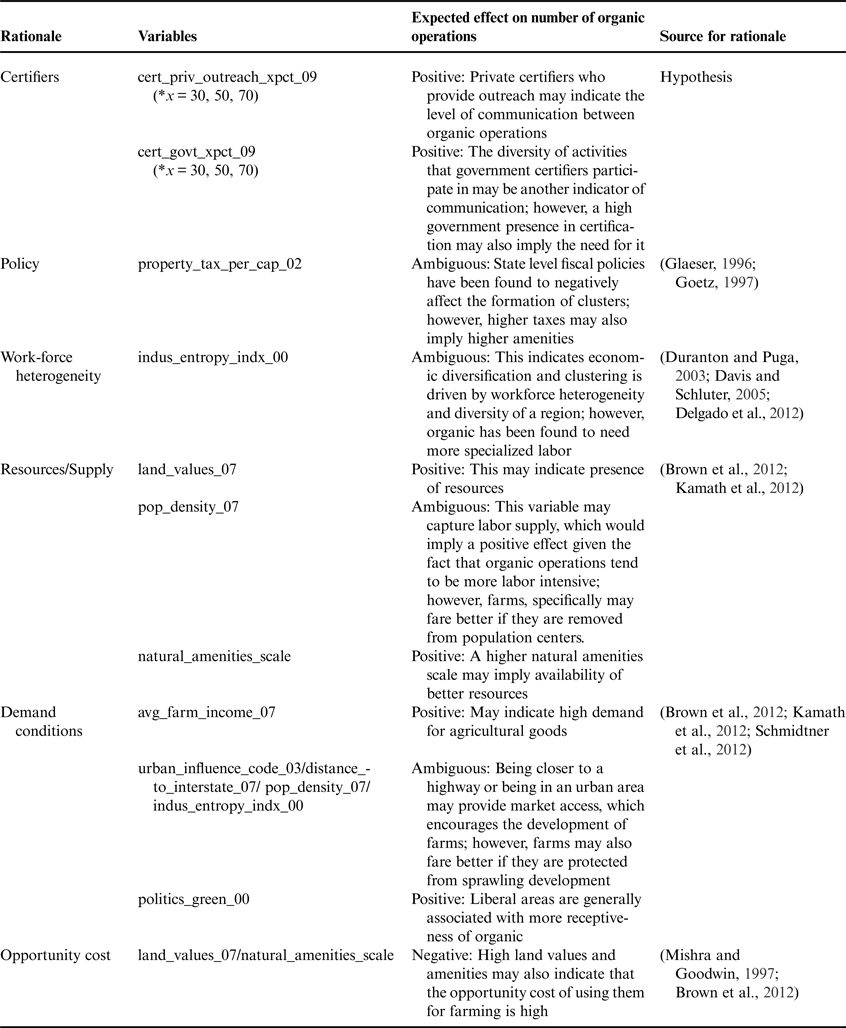
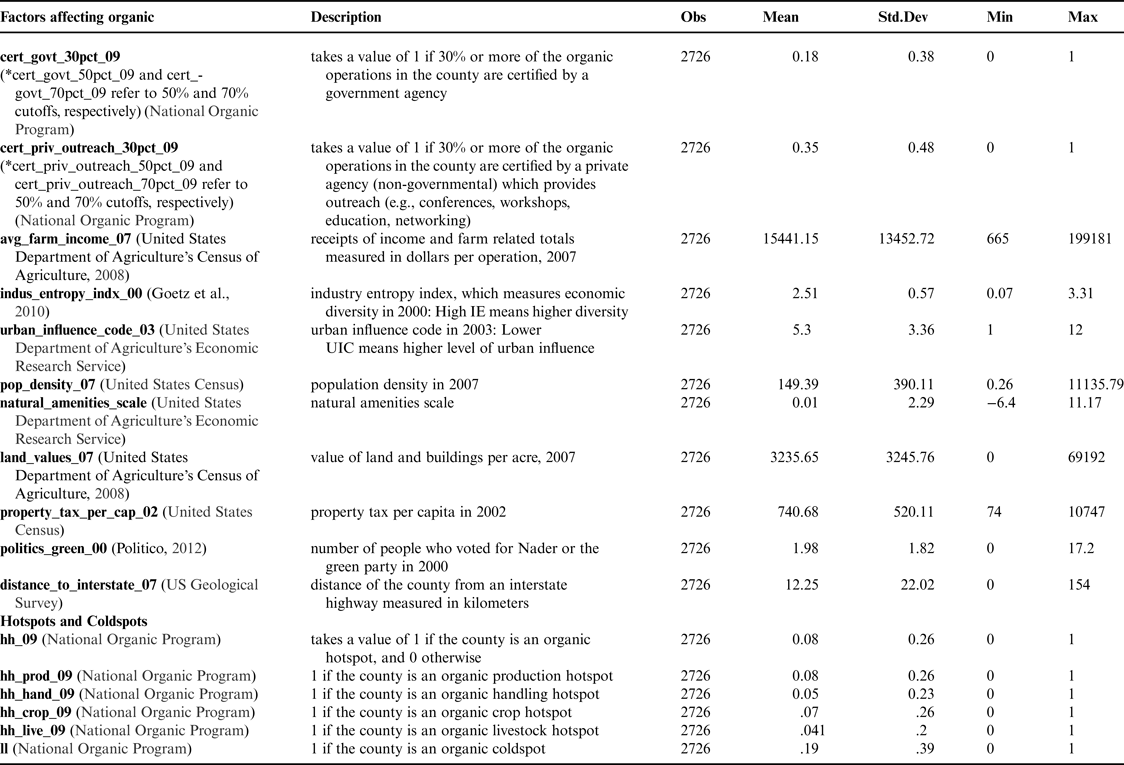
Our hypothesis is that outreach by organic certifiers and government-run certification may affect organic hotspot formation. However, as noted in the background section on cluster formation, many other factors may also affect hotspots. To identify the elements of X , the vector that comprises the covariates in the logistic regression, we rely on previous research. In addition to our hypothesis, previous research suggests that covariates should be included that relate to policy, workforce heterogeneity, production resources or supply conditions, demand conditions and opportunity cost of alternatives. Table 2 identifies variables that fit these rationales, and briefly discusses the expected effect on the number of organic operations and hotspot formation. It is important to note that Table 2 serves to justify the inclusion of our independent variables, and that the rationales are heavily based on literature relating to general industry clusters. Table 3 provides summary statistics for variables used in the analysis.
Factors affecting the presence of hotspots/organic industry development.

Summary statistics.

Data on the factors identified in Table 2 that potentially affect the formation of organic hotspots come from publicly available sources such as the US Census (United States Census) and the USDA's Census of Agriculture (United States Department of Agriculture's Census of Agriculture, 2008). Information regarding whether or not the organic certifying agent is a state or local-government agency or whether or not it publicly notes outreach opportunities for its participants is found on each individual certifier's website. More specifically, we create an indicator variable that takes a value of 1 if more than a certain percentage of certified organic operations in the county are certified by agents who publicly note private outreach services and 0 otherwise. It is important to note that these indicator variables capture a percentage, not a count, of operations in the county certified by these agents. It is also important to note that, due to USDA organic regulations regarding conflict of interest (Subpart F – Accreditation of Certifying Agents. Code of Federal Regulations, 2012), we are not claiming that this variable captures outreach services that are provided by the certifier itself—this variable only captures certifiers who publicly report being associated with the outreach services. To examine the robustness of this variable, we examine variations in this variable where the thresholds for county-level percentage of organic operations by outreach-oriented private certifiers are 30, 50 and 70%. We use this same technique for government-run certifications. That is, we create and include a dummy variable that takes a value of 1 if more than a certain percentage (again, 30, 50 or 70%) of organic operations are certified by state or local government agencies. Table 3 lists and describes all the variables used in our analysis, lists their source, and provides brief summary statistics.
We estimate the logit for several models with different dependent variables (organic hotspots, organic-production hotspots, organic-handling hotspots and organic coldspots), but the same specification. By comparing results across these four models, we can focus on the roles of organic certifiers in the different models, rather than the individual results and discuss the roles of the organic certifiers in a relative sense. We also perform a secondary analysis with the restriction that all counties included in the estimation have at least one certified organic operation.
Results
Figure 1 shows the hotspot maps for all organic operations, organic production and organic handling, respectively. The maps for all organic operations and organic production and crops show similar distributions. Large hotspots are present in parts of Wisconsin and Southeastern Minnesota, with the largest hotspot located along the West coast. Other hotspots are located in parts of Maine, New Hampshire, Vermont, Massachusetts, upstate New York and Southeastern Pennsylvania, with some small hotspots located in other parts of the Midwest and West. A large area of coldspots is centered on many Southern states, and covers many areas from Texas to Virginia, whereas smaller coldspot areas are present in the West, Midwest, Alaska and Hawaii. Outliers are scattered throughout the country. Organic handling hotspots are located mostly on the West Coast, upper Midwest and parts of the Northeast and New England, whereas organic handling coldspots are few and scattered. Organic livestock hotspots are found mostly on the West Coast and New England, whereas coldspots are few and scattered. These maps are similar to those generated in other studies focusing on organic agriculture in the USA (Eades and Brown, Reference Eades and Brown2006); however, they provide insight by identifying coldspots, and breaking up organic agriculture into different categories, which has not, to our knowledge, been done in previous research.
Organic hotspots, coldspots and outliers (based on operation counts for the continental USA)*. (A) All organic operations (crops, livestock and handling). (B) Organic production (crops and livestock only). (C) Organic handling. (D) Organic crops. (E) Organic livestock. *Notes: Gray, not significant; red, hotspot; blue, cold-spot; purple, low-high; pink, high-low.

The hotspots identified by the Local Moran's I statistic and presented in Fig. 1 are then used to construct the dependent variables for the logistic regressions that help identify factors affecting the formation of organic hotspots. Table 4 presents the results of these regressions, with several different dependent variables: Hotspots of organic operations in general, hotspots of organic production, hotspots of organic handling, hotspots of crops and hotspots of livestock, respectively. In addition to presenting the coefficient estimates with indicators of statistical significance, Table 4 also presents each variable's marginal effects, which allow us to see how the probability of being in a hotspot changes for a unit increase in the independent variables. For all types of organic hotspots, with the exception of livestock hotspots, we see positive significant marginal effects for the certifier–outreach variable, cert_priv_outreach_xpct_09, and for the government-certifier variable, cert_govt_xpct_09, our two main variables of interest. For both variables, the strongest marginal effects occur when 50% is used as the threshold. For organic livestock hotspots, cert_govt_xpct_09 is only significant when the 50% threshold is used.
Organic hotspot formation (continental USA), no restrictions (2726 counties).

* Significant at 10%, ** significant at 5%, *** significant at 1%.
To further clarify the interpretation of the marginal effects, we draw attention to the following specific result in Table 4: The marginal effect of cert_priv_outreach_30pct_09 is 0.10997533 for hotspots of all organic operations. This marginal effect means that as cert_priv_outreach_30pct_09 changes from 0 to 1, which happens when 30% or more of the organic operations in a county are certified by a private certifier that publicly emphasizes outreach, the probability that a county is in a hotspot increases by roughly 11%. If, instead, a 50% threshold is used, then the probability that a county is in a hotspot increases by roughly 12.8% when 50% or more of the organic operations are certified by a private certifier that publicly emphasizes outreach. Finally, if a 70% threshold is used, then the probability that a county is in a hotspot increases by roughly 9% when 70% or more of the organic operations are certified by a private certifier that publicly emphasizes outreach. It is interesting to note that the probability of being in a hotspot, in this case, goes down when we increase the threshold from 50 to 70%. The reason for this seemingly counter-intuitive result may be that it is capturing a lack of available certification options for the operations within the county. More specifically, if 70% or more of organic operations within a county are certified by agents that publicly emphasize outreach, it may imply that the operations do not have many options outside of outreach-oriented agents.
Regardless of whether 30, 50 or 70% threshold is used, the outreach variable has the strongest association with organic hotspots, and this relationship is true for all types of organic operations, as well as organic production and handling operations. The outreach relationship is strongest for organic production operations (where 50% or more of the organic operations being certified by a private certifier that publicly emphasizes outreach is associated with a 13.2% increase in the likelihood of being in a hotspot), and weakest for organic livestock (where 70% or more of the organic operations being certified by a private certifier that publicly emphasizes outreach is associated with a 2.1% increase in the likelihood of being in a hotspot).
Table 4 also consistently shows that, with the exception of the case of livestock operations, the government certifier variable is positively associated with organic hotspots, though not as strongly as certifier outreach. This association is again stronger for organic production operations than it is for livestock. Perhaps the most interesting result related to the state certifier variable is that it has the strongest association with reducing the likelihood of being in a coldspot. The last part of Table 4 shows that as cert_govt_50pct_09 changes from 0 to 1, which happens when 50% or more of the organic operations in a county are certified by a government-run certifier, then the probability that a county is in a coldspot decreases by roughly 116.3%. The certifier-outreach variable is also strongly associated with a lower probability of coldspots. Thus, an effective state-level strategy to reduce an existing coldspot could be to install and promote a state-run certification agency where one was not previously active, and/or to encourage currently operating organic certifiers to provide more outreach.
While the other covariates in X help control for and isolate the effects of the certifier-outreach and government-certifier variables, they also have economic interpretations as noted in Table 2. For the most part, the estimation results in Table 4 are consistent with previous literature and our expectations. The marginal effects results are also consistent across hotspot type and across threshold levels for the certifier-outreach and government-certifier variables. For example, we expected several covariates to be positively associated with organic hotspot formation. The positive significant marginal effect for avg_farm_income_07 (not significant for livestock) is consistent with the rationale that high farm income may indicate higher demand for agricultural products. The positive significant marginal effects of natural_amenities_scale and land_values_07 07 (not significant for livestock) are consistent with the resources rationale. The positive significant marginal effect of politics_green_00 is consistent with the receptiveness-to-organic rationale.
On the other hand, the negative significant marginal effects of distance_to_interstate_07 and urban_influence_code_03 (which is not significant for organic production hotspots or livestock, and not significant for crops when using the 30 and 50% cutoffs), along with the positive significant effects of indus_entropy_indx_00 (only significant for livestock) are generally consistent with the rationale that organic clusters fare better closer to urban centers because of higher market access and demand. The negative significant marginal effect of pop_density_07 (which is not significant for organic handling hotspots) is generally consistent with the rationale that organic operations fare better in areas that are farther away from pressure toward urban development. The mixed results for property_tax_per_cap_02 (negative for crop hotspots, positive for livestock hotspots) fit into two separate rationales.
The organic coldspots results in Table 4 can also be easily matched with the rationales in Table 2. It is important to note, however, that the positive coefficients in Table 4 point toward stronger associations with coldspots and are likely negative for hotspots. The positive significant marginal effect of indus_entropy_indx_00 is consistent with the rationale that organic operations require more specialized labor. The positive significant effect of urban_influence_code_03 is consistent with the rationale that organic operations fare better away from sprawling development. On the other hand, negative coefficient estimates in the coldspot portion of Table 4 point toward factors that are inversely related to coldspots. The negative significant marginal effect of land_values_07 is consistent with the resources rationale, while the positive significant marginal effect of natural_amenities_scale is consistent with the opportunity cost rationale. The negative significant marginal effect of property_tax_per_cap_02 is consistent with the rationale that higher taxes may imply higher amenities, while the negative significant marginal effect of politics_green_00 is consistent with the receptiveness to organic rationale.
Table 5 shows the results of a similar analysis with an added constraint on the data. When limiting our observations to include only counties with more than 0 organic operations, we find very similar results for all types of organic hotspots and for coldspots. However, while cert_priv_outreach_xpct_09 still has a positive and significant marginal effect on all types of hotspots, cert_govt_xpct_09 does not (with the exception of the 50% cutoff for all organic and for organic production and crops). Neither type of certifier has a significant effect on organic coldspot formation (with the exception of the negative and significant marginal effect of cert_govt_xpct_09 at the 30% cutoff).
Organic hotspot formation (continental USA), using only counties with organic operations (1691 counties).

* Significant at 10%, ** significant at 5%, *** significant at 1%.
We briefly discuss some supplemental results that are not reported in the tables, but that may provide some additional insight. First, when breaking up our estimations by region (Midwest, Northeast and West—we do not include South because of the relative lack of hotspots in the region), we find some variation in the association of the outreach and government variables with hotspots. For brevity, we only discuss the results associated with counties that have at least one organic operation, and with the 50% cutoff. When looking at the Midwest, we find that outreach has a positive and significant association with all types of hotspots, while government only has a positive and significant association with general, production and crop hotspots. Both outreach and government have slightly different effects when looking at the West. Outreach has a positive and significant association with all types of hotspots with the exception of livestock hotspots, with the statistically significant marginal effects being larger than those in the Midwest. Government has a positive and significant association only with production hotspots, and has smaller marginal effects. In the Northeast, the role of the certifier seems to be weaker, and government, rather than outreach, has a more positive association with hotspots. In fact, outreach only has a negative and significant association with handling hotspots. Government has a positive and significant association with production and livestock hotspots. Secondly, when adding an additional binary independent variable that captures the region of the certifying agent to our original models, we find that the presence of certifiers who both provide outreach and whose services are concentrated in one region has a positive and significant association with all types of hotspots with the exception of handling hotspots. In the future, it would be interesting to examine these differences in more detail.
Conclusions
In this paper, our aim is to investigate the county-level factors that are associated with organic hotspot formation, while paying particular attention to the role of the organic certifying agent. Our results indicate that a high presence of private organic certifying agents who are associated with outreach opportunities and a high presence that are state or local-government agents are consistently positively associated with the presence of hotspots, and negatively associated with the presence of coldspots. This result is fairly robust: It holds no matter whether the hotspots are defined as all organic operations or as some subset of production or handling operations. It also holds no matter whether the threshold for an outreach presence (or a government-certifier presence) is 30, 50 or 70% of all operations in a county. Supplemental analyses do suggest, however, that these associations may be stronger in the Midwest and West than in the Northeast. In short, we believe that these results represent the first documentation of its type that the form and nature of organic certifiers has some role in the formation of the organic sector.
These results are interesting and important for public and private organizations who want to encourage organic hotspot formation or promote organic agriculture more generally. In particular, the USDA has documented a growing disparity between US domestic organic production and consumer demand. The USDA also has a number of organic-related grant programs (e.g., National Institute of Food and Agriculture's Organic Agriculture Research and Extension Initiative, Organic Transitions Program and the Sustainable Agriculture Research and Education program) that generally promote organic agriculture. Based on our results, the USDA could expand the focus of some of these programs to encourage organic certifiers to expand outreach. Our results further suggest that non-government organizations that are interested in promoting organic agriculture (e.g., Stonyfield, Organic Valley and the Organic Trade Association) would perhaps benefit by working more closely with certifiers.
This paper not only provides new and interesting insight into the formation of organic hotspots, but also encourages further discussion and analysis of the role that the certifying agent plays in the development and impact of the organic food sector. First, once data on organic operations becomes available for more years, it would be interesting to see if/how our results change if we lag the outreach and government variables. It would also be interesting to see if/how pre-NOP (prior to the establishment of current organic guidelines in 2002) certification activities impact organic hotspot formation in the post-NOP period (after 2002). In the future, we can expand on this research and quantify the economic impact of organic hotspots and coldspots. We could further isolate the indirect economic impact of characteristics related to the organic certifiers, and also investigate the role that spatial spillovers play in organic hotspot formation.