Introduction
Mochalov et al. (Reference Mochalov, Dmitrenko, Rudashevsky, Zhernovsky and Boldyreva1998) studied samples from chromitites of the Chirynaisky dunite-harzburgite complex in the Koryak Highland (Far East Russia), describing the new mineral hexaferrum for solid solutions of the platinum-group elements (PGE) with Fe “… substantially rich in Ru (Fe,Ru), Os (Fe,Os), or Ir (Fe,Ir), with Fe > Ru, Fe > Os, and Fe > Ir …” specifying that they all have the hcp structure. As pointed out in a critical review abstract by Kovalenker (in Jambor et al., Reference Jambor, Kovalenker and Roberts1999) the authors’ use of hyphenated Levinson-type names, such as hexaferrum-(Ru) is not correct as these are species names, and these names were not approved by the Commission on New Minerals, Nomenclature and Classification of the International Mineralogical Association. Unfortunately, Kovalenker averaged all 11 compositions (in the style for these abstracts) that ranged widely from Fe–Ru > Os, Fe–Os > Ru, and Fe–Ir > Ru, Os and there have been no other published critical evaluations of this mineral other than by Cabri (Reference Cabri and Cabri2002, p. 45–46).
More recently, there have been a number of studies by Joaquín Proenza and his group at the University of Barcelona on the Loma Peguera and Loma Larga chromitites, in the central part of Loma Caribe peridotite, Cordillera Central of the Dominican Republic (e.g. Proenza et al., Reference Proenza, Zaccarini, Rudashevsky, Cabri, Garuti, Rudashevsky, Lewis, Longo, Galı, Labrador, Tauler and Bloise2008; McDonald et al., Reference McDonald, Proenza, Zaccarini, Rudashevsky, Cabri, Stanley, Rudashevsky, Melgarejo, Lewis, Longo and Bakker2010, Aiglsperger et al., Reference Aiglsperger, Proenza, Galí, Rius, Longo and Domenech2017a,Reference Aiglsperger, Proenza, Font-Bardia, Baurier-Aymat, Galí, Lewis and Longob). The ultramafic rocks consist mostly of harzburgite, dominantly clinopyroxene-rich harzburgite (modal content up to 5% Cpx) with small amounts of dunite and lherzolite, considered to represent the mantle sequence of an ophiolite (Lewis and Jimenez, Reference Lewis, Jimenez, Mann, Draper and Lewis1991; Lewis et al., Reference Lewis, Draper, Proenza, Espaillat and Jimenez2006; Marchesi et al., Reference Marchesi, Garridob, Proenza, Hidas, Varas-Reus, Butjosa and Lewis2016) and have been heavily serpentinized with a well-developed nickel-rich laterite having formed over them. During a review of data in Aiglsperger et al. (Reference Aiglsperger, Proenza, Galí, Rius, Longo and Domenech2017a) a re-examination of hexaferrum was deemed appropriate together with reports of related minerals from California (Barkov et al., Reference Barkov, Martin, Shi and Feinglos2008), Oregon (Stockman and Hlava, Reference Stockman and Hlava1984), and Pakistan (Ahmed and Bevan, Reference Ahmed and Bevan1981).
We present a re-evaluation of the Mochalov et al.’s definition of hexaferrum, partly based on new data, to show that the Ir-rich end-member may be considered a unique mineral species.
Background
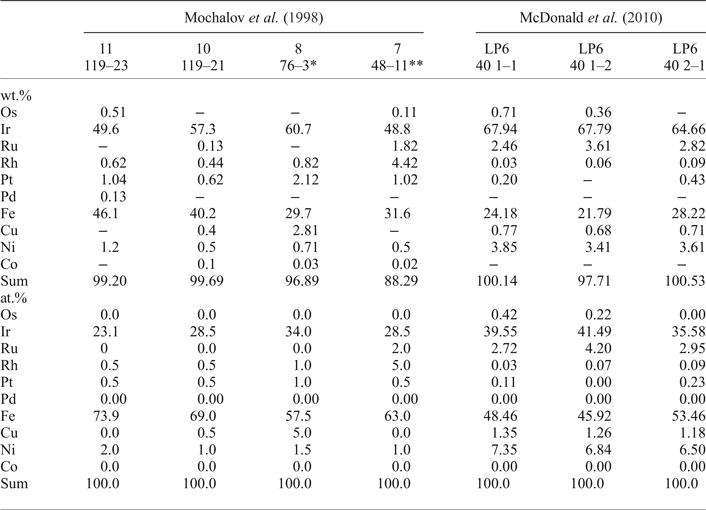
Mochalov et al. (Reference Mochalov, Dmitrenko, Rudashevsky, Zhernovsky and Boldyreva1998, fig. 7a,b) plotted all their analyses of hexaferrum on a partial Ru–Os–Ir ternary diagram with a miscibility gap drawn on the binary diagrams Ru–Fe and Os–Fe (translation supplied as Supplementary material) “between phases of hexagonal and cubic symmetry …” using data compiled in Savitsky (Reference Savitsky1984). Mochalov et al. (Reference Mochalov, Dmitrenko, Rudashevsky, Zhernovsky and Boldyreva1998) describe a continuous compositional range for the Ru- and Os-rich varieties and report a more restricted range of compositions for the Ir-rich variant. They also specifically state that the Ir-rich variant's compositional range is compatible with the high-temperature phase relations in the Fe–Ir system but do not explain why they plotted analyses of an essentially (Fe,Ir) hcp mineral in the cubic Ir corner of the Ru–Os–Ir ternary (Fig. 7b, Mochalov et al., Reference Mochalov, Dmitrenko, Rudashevsky, Zhernovsky and Boldyreva1998). Four analyses of the (Fe,Ir) mineral are reproduced in Table 1 together with the cell dimensions of two grains. Cell parameters (in Å) for the Ru, Os and Ir variants were reported to be: a = 2.64, c = 4.20; a = 2.59, c = 4.16, and a = 2.61, c = 4.22, respectively.
Representative compositions from electron probe microanalysis of ‘hexaferrum (Ir)’.

*grain X-rayed: a = 2.606 Å, c = 4.215 Å; c/a = 1.617; **grain X-rayed: a = 2.617 Å, c = 4.226 Å; c/a = 1.615; – = not reported.
The Ru and Os varieties of hexaferrum formed during serpentinization by oxidation of laurite (as described) and also probably of erlichmanite, respectively, though Mochalov et al. (Reference Mochalov, Dmitrenko, Rudashevsky, Zhernovsky and Boldyreva1998) do not specifically describe any evidence for the latter, either in polished section or by analyses as none have S. The Ru variant is described as pseudomorphs after laurite, which is perfectly understandable whereby cubic laurite is altered and re-crystalized as hexagonal Ru-rich hexaferrum. In contrast, the Ir-rich ‘hexaferrum’, besides being rarest, is only described in close association with cubic iridian taenite and Os-rich hexaferrum. The authors also reported that hexaferrum (presumably all three variants) is associated with “….. iridosmine (sic), rutheniridosmine, osmiridium (sic), laurite, and, occasionally, tulameenite, and solid solutions of the composition (Fe, Rh, Ir) and (Ni, Fe, Ir).” In other words, hexaferrum in their samples is associated with many more PGE alloys than with Ru and Os sulfides.
Mochalov et al. (Reference Mochalov, Dmitrenko, Rudashevsky, Zhernovsky and Boldyreva1998) also noted that the (Fe,Ir) mineral was the rarest and that “The abundance of micro-fractures and inclusions of iridian taenite precluded us from making measurements of its reflectance and microhardness values.”, but no lines attributed to taenite show on the two X-ray powder patterns (Mochalov et al., Reference Mochalov, Dmitrenko, Rudashevsky, Zhernovsky and Boldyreva1998, table 6). By analogy, garutiite (Ni,Fe,Ir), the hexagonal Fe- and Ir-bearing polymorph of native Ni, was also described as having a similar X-ray pattern to hexaferrum, another member of the osmium group in the space group P63/mmc (McDonald et al., Reference McDonald, Proenza, Zaccarini, Rudashevsky, Cabri, Stanley, Rudashevsky, Melgarejo, Lewis, Longo and Bakker2010) and is similarly considered to be a secondary mineral formed at low temperatures during post-magmatic processes.
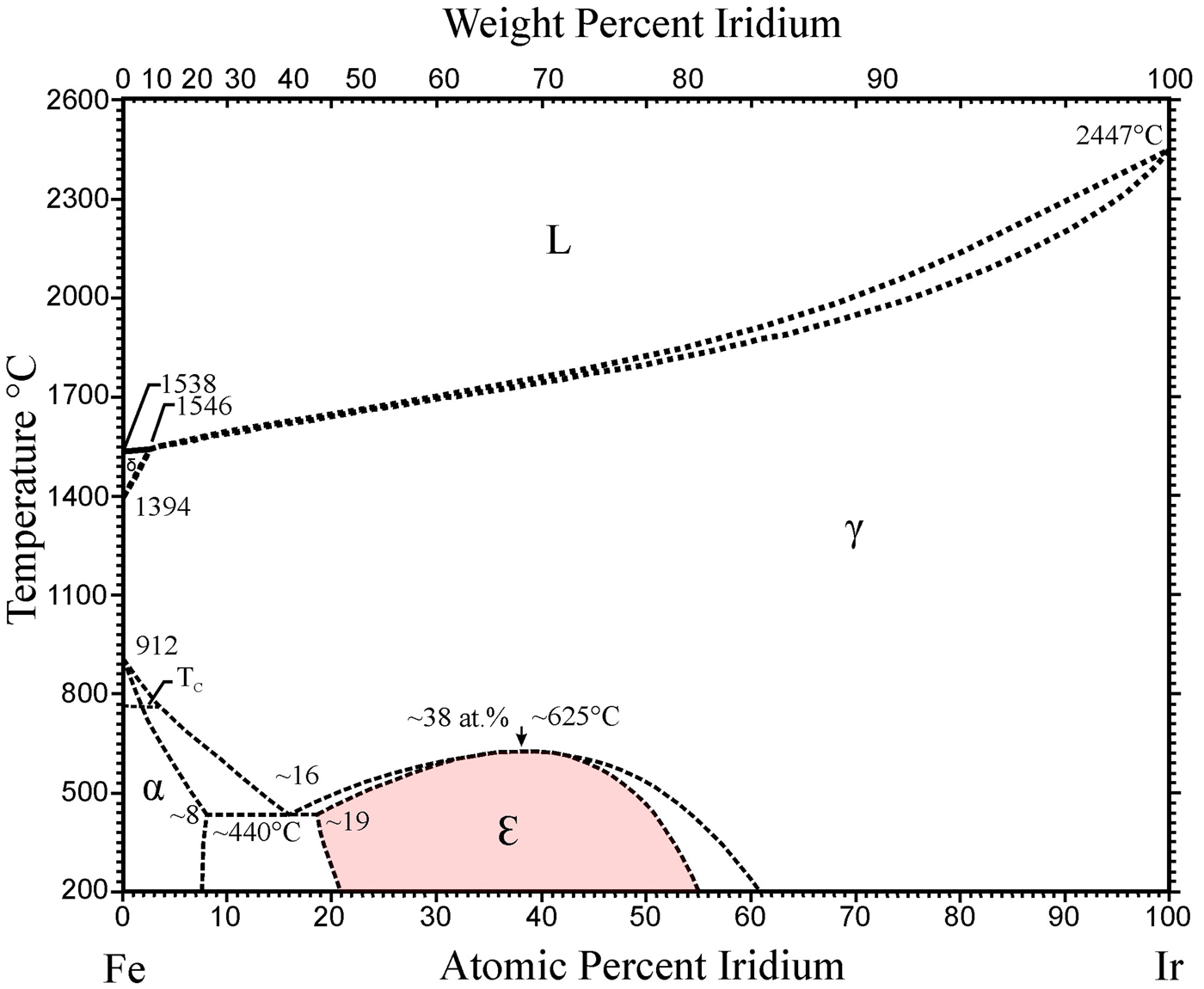
Significantly, Mochalov et al. (Reference Mochalov, Dmitrenko, Rudashevsky, Zhernovsky and Boldyreva1998) define the Fe–Ir mineral having an iron content ranging “from 55 to 77 at.%, which is compatible with the stability areas observed for the ε- and γ-phases in the system Fe–Ir (Re: “Noble metals 1984”)” but they mistakenly plot the mineral in the Fe-free Ru–Os–Ir ternary whereas the ε-phase reported by Raub et al. (Reference Raub, Loebich and Beeskow1964) is a binary hcp alloy in the Fe–Ir system with iron content ranging from about 45 to 79 at.% at 200°C (Swartzendruber, Reference Swartzendruber1984).
Phase relations
Binary phase relations are essential for understanding how the compositional fields of what was described as hexaferrum by Mochalov et al. (Reference Mochalov, Dmitrenko, Rudashevsky, Zhernovsky and Boldyreva1998) may extend into the Fe–Ru–Ir ternary system as there are no experimental data for this ternary. Literature data reviewed in Savitsky (Reference Savitsky1984) was used by Mochalov et al. (Reference Mochalov, Dmitrenko, Rudashevsky, Zhernovsky and Boldyreva1998) and an updated compilation is given in Lyakishev (Reference Lyakishev1997). More accessible might be the critical reviews and calculated phase diagrams by Swartzendruber (Reference Swartzendruber1984) on the Fe–Ir binary, based on the experimental data of Raub et al. (Reference Raub, Loebich and Beeskow1964). Swartzendruber and Sundman (Reference Swartzendruber and Sundman1983a) review the Fe–Ru binary and Swartzendruber and Sundman (Reference Swartzendruber and Sundman1983b) review the Fe–Os binary. Harris and Cabri (Reference Harris and Cabri1973; Reference Harris and Cabri1991) review the experimental and mineral data in the Ru–Ir binary as well as the Ru–Ir–Os ternary and Makovicky and Karup-Møller (Reference Makovicky and Karup-Møller1997) and Karup-Møller and Makovicky (Reference Karup-Møller and Makovicky2002) review relevant systems in their high-temperature experimental investigation of the Fe–Os–S system. Related data can also be found in Bax et al.’s (Reference Bax, Slawik, Pauly and Mücklich2015) study of the Ru–Fe–Al system.
The Fe–Ir binary diagram of Raub et al. (Reference Raub, Loebich and Beeskow1964) that was critically reviewed and redrawn by Swartzendruber (Reference Swartzendruber1984) is reproduced in Fig. 1. It is noteworthy that the mineral chengdeite (Ir3Fe), a very rare cubic mineral (Pm3m) reported by Yu (Reference Yu1995) is not shown in Swartzendruber (Reference Swartzendruber1984) nor reported in Makovicky and Karup-Møller (Reference Makovicky and Karup-Møller1997). Swartzendruber (Reference Swartzendruber1984) extends the solubility of Fe in Fm3m iridium to 61 at.% Ir and to 8 at.% Ir in ɑ-Fe on the Ir–Fe binary at 200°C. This binary is essential for understanding that the so-called Ir-rich ‘hexaferrum’ of Mochalov et al. (Reference Mochalov, Dmitrenko, Rudashevsky, Zhernovsky and Boldyreva1998) is identical to the ε-phase of Raub et al. (Reference Raub, Loebich and Beeskow1964). There is nothing wrong with the data characterizing the mineral in Mochalov et al. (Reference Mochalov, Dmitrenko, Rudashevsky, Zhernovsky and Boldyreva1998) except that they mistakenly plotted all their analyses of hexaferrum as well as this binary Fe–Ir mineral in the Ru–Os–Ir system, which is impossible for these minerals as Fe is an essential component for all of them (Table 1).
Phase relations in the assessed Fe–Ir binary system (after Swartzendruber, Reference Swartzendruber1984).

The related Fe–Ni–Ir ternary system contains several binary phases, some of which are known as terrestrial minerals (awaruite ~Ni3Fe and chengdeite Ir3Fe), some as extraterrestrial minerals (kamacite ɑ-(Fe,Ni), taenite ~Fe3Ni and tetrataenite ~FeNi) and others are only known as phases in the synthetic Ni–Ir binary system (Ni3Ir, NiIr, and NiIr3). The important Fe–Ni binary that has been studied by many over decades was thoroughly critically assessed by Swartzendruber et al. (Reference Swartzendruber, Itkin and Alcock1991) and more recently revised by Yang et al. (Reference Yang, Williams and Goldstein1996) at low temperatures by including a study of meteoritic minerals experimentally determining phase boundaries at 200°C. Thus phase boundaries may be set using both studies as follows (at.% Fe): kamacite, ɑ (Fe,Ni) at 96.6 and awaruite (FeNi3) at 35.6 and 15.0. For the purpose of including them in the ternary, taenite is located at Fe0.7Ni0.3 and tetrataenite at FeNi. Yang et al. (Reference Yang, Williams and Goldstein1996) studied compositions at the interface of meteoritic minerals but only give compositional limits for ɑ-(Fe,Ni) and refer to a spinodal region between 53.4 and 73.0 at.% Fe at ~200 °C. For the Ir–Ni system, there is complete solution at high temperatures except that Archangelskaya et al. (Reference Archangelskaya, Kuprina and Polkopina1984) observed ordering in the solid solution field and formation of three phases at ~1000 to 1250°C (in at.% Ni): Ni3Ir (73–77), NiIr (28–54) and NiIr3 (23–30).
Mineral occurrences of Fe–PGE alloys
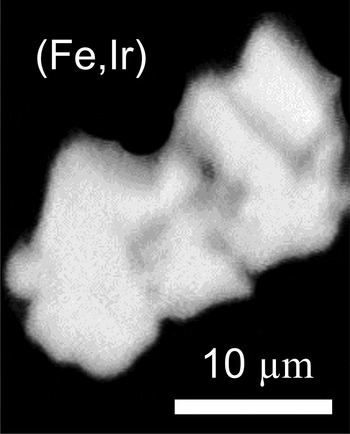
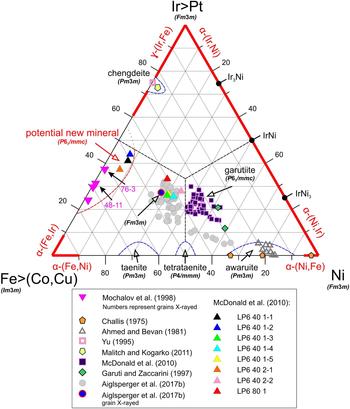
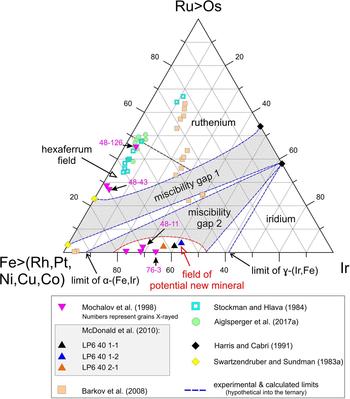
Understanding that the ε-phase of Raub et al. (Reference Raub, Loebich and Beeskow1964) corresponds to the Fe–Ir mineral first described by Mochalov et al. (Reference Mochalov, Dmitrenko, Rudashevsky, Zhernovsky and Boldyreva1998) led to an examination of the literature for reports of related PGE alloys. McDonald et al. (Reference McDonald, Proenza, Zaccarini, Rudashevsky, Cabri, Stanley, Rudashevsky, Melgarejo, Lewis, Longo and Bakker2010) record the average composition for the related mineral garutiite [hcp (Ni,Fe,Ir), n = 42 from 27 grains] as well as for associated ‘hexaferrum’ (n = 16 from 4 grains). Examination of the raw data for ‘hexaferrum’ of McDonald et al. (Reference McDonald, Proenza, Zaccarini, Rudashevsky, Cabri, Stanley, Rudashevsky, Melgarejo, Lewis, Longo and Bakker2010) reveals that three analyses plot within the ε-phase field of the Fe–Ir binary (Table 1) and five plot close to garutiite (one of which was found to have Fm3m symmetry), but on the Fe side of the Ni–Fe–Ir ternary (Fig. 3). An image of one of these three grains (LP6 40 1–1) is given in Fig. 2 and its composition is plotted in Figs 3 and 4. Likewise, there are relevant analyses by Stockman and Hlava (Reference Stockman and Hlava1984) from Alpine ophiolites in Oregon and by Barkov et al. (Reference Barkov, Martin, Shi and Feinglos2008) from placer grains probably derived from similar rocks in California that plot in the hexaferrum and ruthenium fields of the Fe–Ru–Ir ternary.
Back-scattered electron image of grain LP6 40 1–1.

Minerals and phase relations in the Fe–Ni–Ir ternary diagram. Bold orange lines represent the extent of experimentally-derived solid solution.

Minerals and phase relations in the Fe–Ru–Ir ternary diagram.

In addition to garutiite from Loma Peguera, two analyses by Garuti and Zaccarini (Reference Garuti and Zaccarini1997) from the Vourinos complex (Greece) in their table 4 (VS5a-3-1 and VS5a-3-4) also plot within or close to the garutiite field in the related Ni–Fe–Ir ternary diagram (Fig. 3). Another mineral that plots in the Ni–Fe–Ir system is iridian awaruite, reported by Ahmed and Bevan (Reference Ahmed and Bevan1981) from the Sakhakot-Qila complex (Pakistan). The Ni–Fe–Ru alloy of Ahmed and Bevan (Reference Ahmed and Bevan1981) may represent a new mineral in yet another ternary (Ni–Fe–Ru).
The data from all the above can be best shown plotted on a Fe–Ru–Ir ternary diagram where Fe is greater than any of Rh, Pt, Ni, Cu and Co (or their sum) and Ru is greater than Os (Fig. 4). The phase boundaries on the Ru–Ir binary are taken from Harris and Cabri (Reference Harris and Cabri1991), on the Fe–Ru binary from Swartzendruber and Sundman (Reference Swartzendruber and Sundman1983a), and on the Fe–Ir binary from Swartzendruber (Reference Swartzendruber1984). The tentative delineation of phase fields in the ternary shows that minerals plotting in the area of the ε-phase are separated from hexaferrum and ruthenium by two miscibility gaps.
Discussion and proposals for mineral nomenclature
Clearly, minerals whose analyses plot within the Ru–Os–Fe ternary (where Os and Ru are <50 at.%) and in the Ru > Os–Ir–Fe ternary (where Ru <50 at.% and Ir is < ~46 at.% and Fe ranges from ~ 82 to 50 at.% on the Fe–Os binary) are hexaferrum, in agreement with Mochalov et al. (Reference Mochalov, Dmitrenko, Rudashevsky, Zhernovsky and Boldyreva1998) and shown by them to have an hcp structure. However, we believe that a new name is needed for hcp (Fe–Ir) alloys with compositions ranging from about Fe0.82Ir0.18 to Ir0.52Fe0.48 (with minor substitutions of other PGE and base metals), equivalent to the hcp ε-(Fe,Ir) phase known in the Fe–Ir binary system. The compositional range given by (Raub et al., Reference Raub, Loebich and Beeskow1964) in the pure Fe–Ir system is from Fe0.81Ir0.19 to Ir55Fe45, suggesting that an Ir-dominant Fe alloy may also occur in nature. At the same time, hexaferrum can be revised to simply being hcp (Fe,Ru) and (Fe,Os).
It may be argued that all compositions of the originally described hexaferrum, i.e. Fe > Ru, Fe > Os and Fe > Ir are a single species equivalent to the ultra-high-pressure polymorph of (Fe,Ni)-2H that is believed to be the dominant phase in the Earth's inner core because there is only one crystallographically distinct site in the unit cell, and its dominant occupant is Fe in (Fe,Ru)-2H, (Fe,Os)-2H, and (Fe,Ir)-2H. However, this point of view is contradicted by the mineralogical data whereby these alloys formed at close to ambient pressure and temperature, some under conditions of tropical weathering and therefore are not phases stable at ultra-high-pressure. Secondly, and significantly, no analyses plot in the miscibility gaps guided by the phase relations on the binary systems (slightly curved to accommodate a few borderline analyses), as was done for the Os–Ru–Ir–Pt combined ternaries (Cabri et al., Reference Cabri, Harris and Weiser1996, fig. 2). Also noteworthy is that analyses of alloys in this quaternary system, currently numbering in the thousands, have confirmed the projected phase relations, slightly refining the miscibility gap boundaries. This gives further confidence in the proposed ternary solubility boundaries.
Also of interest are three analyses of Barkov et al. (Reference Barkov, Martin, Shi and Feinglos2008) that plot between miscibility gaps 1 and 2 in the central part of Fig. 4. These may represent yet another new mineral for which crystallographic data are required. It is also noteworthy that none of these analyses plot within either miscibility gap, adding even greater confidence in the interpretation of mineral compositional ranges as shown in Fig. 4.
Because phase relations in the related Fe–Ni–Ir system have not been studied, the limits for the composition of garutiite and related minerals in this ternary system are less well understood. Iridian awaruite with up to 10.4 at.% Ir reported by Ahmed and Bevan (Reference Ahmed and Bevan1981) from the Sakhakot-Qila complex (Pakistan) gives some insight into the extent of the awaruite field when plotted in the Ni–Fe–Ir ternary.
Similarly, the Ni–Fe–Ru mineral of Ahmed and Bevan (Reference Ahmed and Bevan1981) for which they concluded based on optical properties that the mineral may not have cubic symmetry and therefore may represent the Ru analogue of garutiite.
In conclusion, the definition of hexaferrum by Mochalov et al. (Reference Mochalov, Dmitrenko, Rudashevsky, Zhernovsky and Boldyreva1998) needs to be revised, restricting the name hexaferrum for the Ru- and Os-rich variants, in contrast to the Ir-rich variant that requires a new name. New phase equilibria studies to constrain the alloys and proposed miscibility gaps in the Fe–Ni–Ir–Ru quaternary are needed, but will probably be challenging because of the high temperatures.
Acknowledgements
We would like to dedicate this article to the memory of Hazel Prichard for her many contributions to our knowledge of PGE and PGM. The first author in particular, has known Hazel since first meeting her by spending an afternoon reviewing and discussing her data on her Shetland Island samples in 1987. LJC is grateful to Andrei Barkov and Anna Vymazalová for help with the Russian literature and we also thank Joaquín Proenza for providing the BSE image of Fig. 2. We are also grateful for comments and suggestions by Associate Editor Brian O'Driscoll, Andy McDonald, and two reviewers (Andrei Barkov and an anonymous reviewer) to which we have responded accordingly but take responsibility for the final version.
Supplementary material
To view supplementary material for this article, please visit https://doi.org/10.1180/mgm.2018.86.