1. Introduction
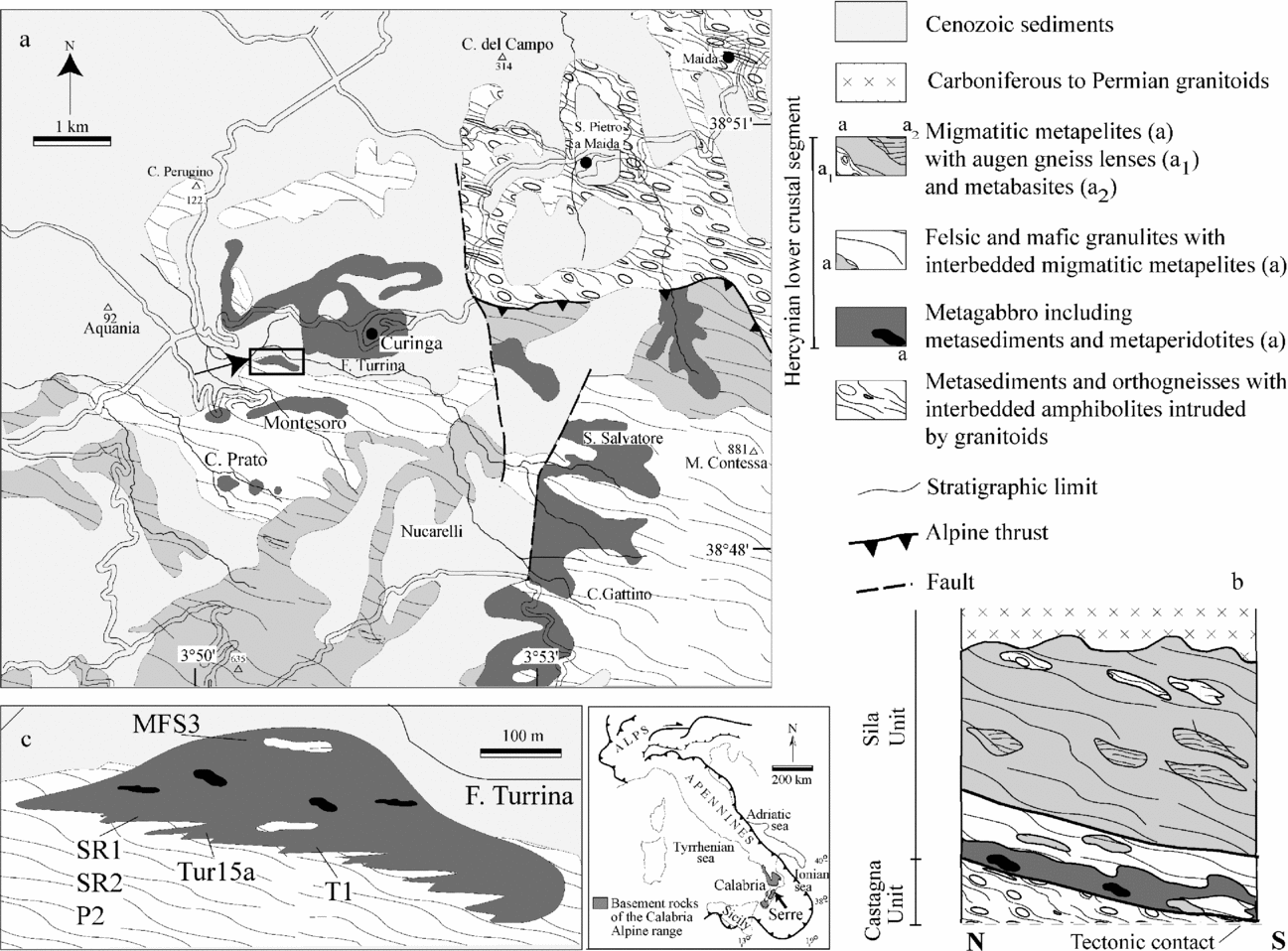
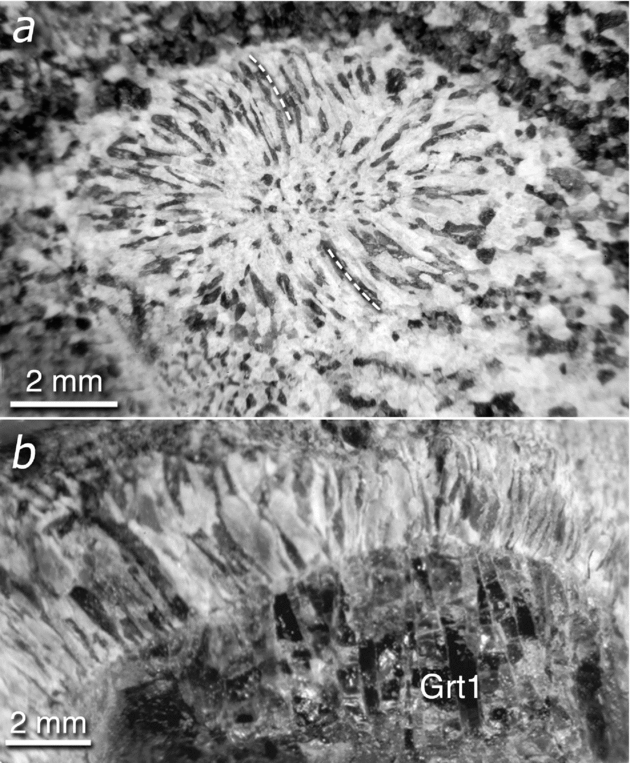
The study of metamorphic textures is key to understanding the evolution of metamorphic terranes. When they are preserved, they provide information about changes in P, T and a(H2O) during metamorphic evolution. Mafic granulites and metagabbros at the base of the lower crustal section of the Serre (southern Calabria, Italy) preserve a spectrum of petrogenetic features indicating a multi-stage evolution. The main metamorphism was Variscan and peaked at about 300 Ma (Schenk, Reference Schenk1984). Metagabbros cropping out along the Turrina River have been studied in detail (Fig. 1). They preserve an intrusive contact, which has been affected by Alpine tectonics. Elongate, boudinaged or rounded centimetric garnet occurs in the vicinity of the overlying host rocks. It may be replaced by lamellar symplectite of Pl+Am+Opx (mineral abbreviations according to Kretz, Reference Kretz1983; Am – amphibole; Fig. 2a) or mantled by 0.5–1 cm symplectitic coronas of Pl+Am+Opx (Fig. 2b). Sets of fractures affect the porphyroblastic garnet but not the symplectites. Samples containing mantled garnet have been studied, since relict mineral assemblages survive within garnet, and reaction textures, which formed before and after the fractures, can be distinguished. The paper focuses on the description of coronas and symplectites partially replacing garnet, amphibole and pyroxenes, as well as on the chronological sequence of the reaction textures which formed at different times under different physical conditions. Estimates of the P–T conditions and the P–T path experienced by metagabbros, first inferred from the reaction structures, are constrained by thermobarometric calculations by using conventional and Thermocalc (ver. 3.25 of Powell & Holland, Reference Powell and Holland1994) procedures. The chemical compositions of minerals with the largest grain size have been used for thermobarometry to minimize the effects of retrograde diffusion. This favours the chance of correct retrieval of peak metamorphic conditions and retrograde P–T paths for granulites (Frost & Chacko, Reference Frost and Chacko1989). The derived metamorphic path provides new information on the tectonothermal evolution of the lower crustal section of the Serre.
(a) Geological map of the study area; (b) schematic section of the lower crustal segment of the Serre. The box within (a) indicates the Turrina outcrop (c); labels indicate the sampled sites.

Macrophotos of porphyroblastic garnet (Grt1) replaced (a) and rimmed (b) by radial symplectite of Pl+Am+Opx in the metagabbro. In (a), symplectite seems to have started in synkinematic conditions and progressed under static conditions.

2. Geological setting and lithology
A nappe pile of crystalline rocks that formed during the Alpine s.l. orogenesis crops out in northern Serre (Paglionico & Piccarreta, Reference Paglionico and Piccarreta1978). The upper nappe consists of about 20 km of the Hercynian crust (Schenk, Reference Schenk, Salisbury and Fountain1990; Acquafredda et al. Reference Acquafredda, Fornelli, Micheletti and Piccarreta2003). It is composed, from the bottom, of: (1) a 7–8 km thick lower crustal segment, (2) a ∼10 km thick ‘layer’ of granitoids (Caggianelli & Prosser, Reference Caggianelli and Caggianelli2002) emplaced at ∼300 Ma (Schenk, Reference Schenk1984), (3) middle- to low-grade metamorphic rocks of the upper crust. A thick mylonitic zone separates the upper nappe from the underlying one east of Curinga (Fig. 1a).
The lower crustal segment includes, from the bottom (Fig. 1): (1) felsic and mafic granulites (including layered metagabbros) with rare metaperidotites and metapelites and (2) metapelites with intercalations of metabasites, rare marbles and acidic orthogneisses (e.g. Paglionico & Piccarreta, Reference Paglionico and Piccarreta1978; Schenk, Reference Schenk1984). The basal mylonites east of Curinga, however, overprint migmatitic metapelites (Fig. 1a), which Spiegel (Reference Spiegel, Meschede and Kuhlemann2003) compares to the migmatites of the top of the lower crustal segment. U–Pb data on zircon (upper intercept and in situ analyses) for mafic and acidic orthogneisses at the base and the top of the lower crustal segment, respectively, give Precambrian to Early Cambrian as the emplacement age of the protoliths (Schenk, Reference Schenk, Daly, Cliff and Yardley1989; G. Senesi, unpub. Ph.D. thesis, Univ. Bari, 1999; Micheletti et al. Reference Micheletti, Barbey, Fornelli, Piccarreta and Deloule2007). The metapelites and the metabasites show evidence of anatexis and of pre-granulite-facies stages in the form of inclusions in the mafic minerals (Paglionico & Piccarreta, Reference Paglionico and Piccarreta1978; Schenk, Reference Schenk1984; Acquafredda et al. Reference Acquafredda, Fornelli, Paglionico and Piccarreta2006). Some retrograde effects are present. Acquafredda et al. (Reference Acquafredda, Fornelli, Paglionico and Piccarreta2006) interpreted the metamorphic evolution in the uppermost metapelites as being due to contractional and subsequent extensional tectonics. Consequently, prograde Barrovian conditions were followed by lower pressure conditions due to tectonic denudation. On the contrary, Schenk (Reference Schenk, Salisbury and Fountain1990) suggested a continent–continent collisional context as a likely geotectonic setting in which the Variscan plutonism and tectonic uplift of the lower crustal segment took place.
The metagabbros consist of medium- to coarse-grained banded rocks in which layers, lenses and streaks of two-pyroxene plagioclase ± Am rocks alternate with metahornblendite and metapyroxenite. Green or brown amphiboles characterize the rock types. Modal layering is defined by variations in plagioclase–pyroxene–amphibole ratios and by individual layers bounded by sharp basal contacts. Subophitic and pegmatoidal grain textures are preserved. Some large clinopyroxene crystals of the matrix are internally recrystallized to a sieve texture comprising exsolved orthopyroxene, sometimes with amphibole overprint. They have been interpreted as portions of layered metagabbros (Moresi et al. Reference Moresi, Paglionico, Piccarreta and Rottura1979) locally preserving intrusive contact with the felsic granulites. In the study area, various kinds of mafic granulites crop out: (1) plagioclase-rich types dominate, in which aggregates of pyroxenes and variable proportions of amphibole impart the layered appearance; (2) porphyroblastic garnet-bearing mafic granulites which appear confined to the vicinity of the host felsic granulites. In the latter, elongate crystals of garnet, which might be boudinaged and completely replaced by coarse-grained radial symplectite (Fig. 2a), and rounded and fractured porphyroblasts (up to 6–7 cm) mantled by a 0.5–1 mm wide corona (Fig. 2b), occur. In the matrix, consisting of green and brown amphibole–clinopyroxene and/or orthopyroxene–plagioclase (peak assemblage), the mineral phases are in mutual contact or are separated by coronas and symplectites. The metagabbros include layers and lenses of the surrounding metasediments as well as boudins and metric stratoid bodies of metaperidotite and are characterized by veins, patches and dykes of fine-grained to pegmatitic leucosomes.
3. Chronology of reaction textures and interpretation
A succession of mineral reactions is shown by inclusions in and overgrowths on garnet, pyroxenes and amphiboles. They provide information on changes of P–T–a(H2O) during the multi-stage metamorphic evolution. A deformation stage and the mutual relationships between reaction textures indicate the relative age of the metamorphic stages. Some samples, preserving the most complete information on the metamorphic evolution, have been studied. They contain green-brown or brown amphiboles.
On the whole, the observed textures indicate multi-stage dehydration and decompression, which are more evident in the green-brown amphibole-bearing rock types (Tur15a, SR1, SR2, P2), and a final rehydration.
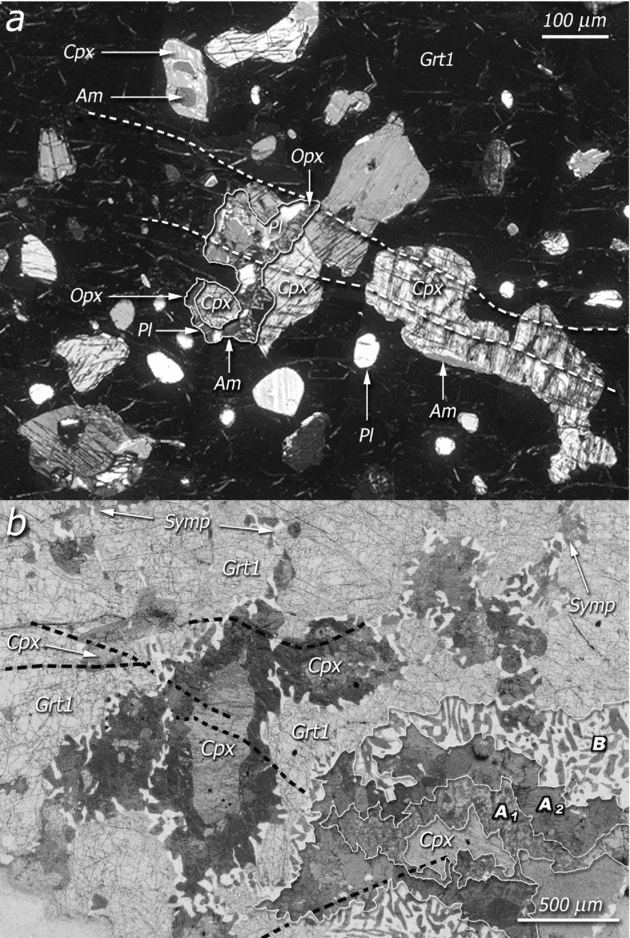
(1) The studied samples contain variable proportions of amphiboles, but rock-types with completely anhydrous assemblages are also present. The drop-like inclusions of plagioclase, amphibole and clinopyroxene in the porphyroblastic garnet (Grt1, Fig. 3a), as well as the relict amphibole in the pyroxenes (Fig. 3a), record pre-peak amphibolite-facies conditions (Paglionico & Piccarreta, Reference Paglionico and Piccarreta1978; Schenk, Reference Schenk1984).
(2) The stabilization of orthopyroxene or a two-pyroxene-rich assemblage, due to partial consumption of amphibole in the matrix, bears witness to a prograde transition to the metamorphic peak under granulite-facies conditions and documents the first dehydration experienced by the metagabbros.
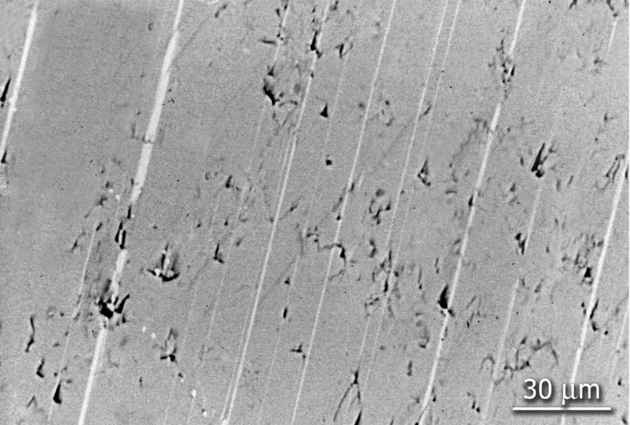
(3) Coronas and symplectites around some large crystals of clinopyroxene within Grt1 and matrix (Fig. 3a, b), as well as the exsolution of orthopyroxene in clinopyroxene (Fig. 4), formed successively. Coronas between clinopyroxene and garnet differ in texture and composition: (a) two-layer coronas of orthopyroxene (inner) and plagioclase (outer), (b) granular symplectite of orthopyroxene, plagioclase and amphibole (Fig. 3a) and (c) two-layer coronas (Fig. 3b) of orthopyroxene (inner) and coarse-grained amphibole (outer). All of the above reaction textures as well as Grt1 and matrix were affected by fractures (Figs 3a, b, 5). The pre-fracturing textures (a, b, c) may be considered as indicative either of isothermal decompression or of temperature increase (e.g. Harley, Reference Harley1988, Reference Harley1989). Thermobarometric computations (see below) indicate that the above textures reflect the post-peak first decompression experienced by the metagabbros. During this decompression, fluids with different a(H2O) were locally present, accounting for the different composition of coronas and symplectites.
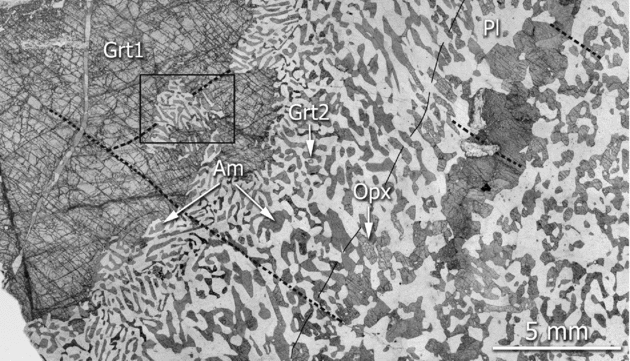
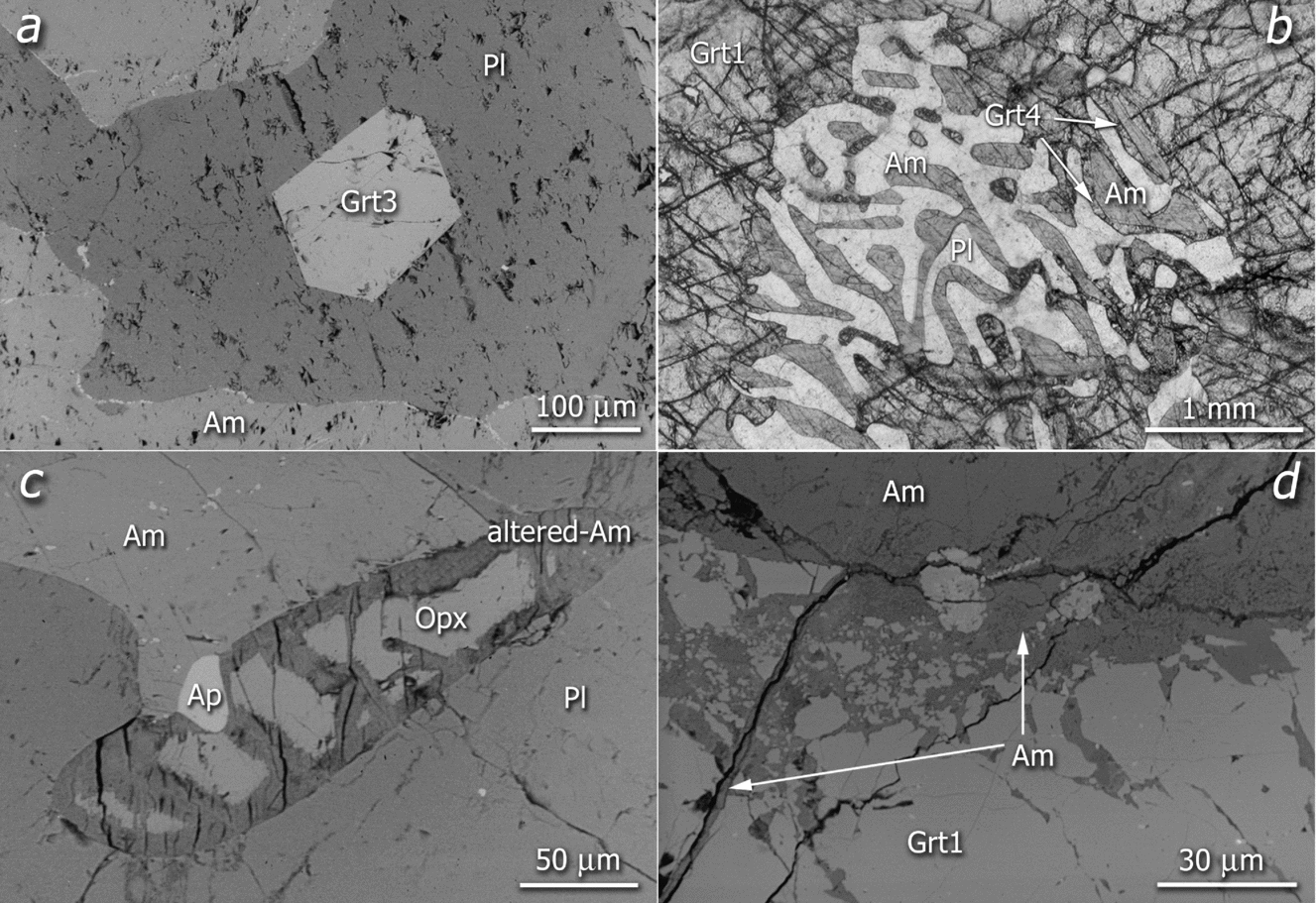
(4) Symplectites formed on the rims of the porphyroblastic amphibole of the matrix and around Grt1 as post-fracturing reaction textures. This is clearly shown in Figure 2a, where Grt1 is completely replaced by a radial symplectite, and in Figures 3 and 5, where the fractures affecting Grt1 and matrix are mostly erased in the symplectites. During the later stage some fractures of Grt1 were filled by symplectitic aggregate of Pl+Am+Opx (Fig. 3b). In addition, the plagioclase-rich symplectite rimming Grt1 formed later than the pre-fracturing two-layer corona around clinopyroxene (Fig. 3b). In fact, it forms deep embayments both in the garnet and in the corona around clinopyroxene. The symplectites rimming the porphyroblastic amphibole, or forming lenticular aggregates between layers dominated by amphibole in the matrix, consist of Opx+Pl, Opx+Pl+opaques (Paglionico & Piccarreta, Reference Paglionico and Piccarreta1978; Schenk, Reference Schenk1984) and Opx+Pl+Am+Spl±Bt. The symplectites mantling Grt1 consist of Pl–Am–Opx and a few euhedral garnet crystals; the modal proportions of the minerals and the texture change from the matrix towards Grt1. In sample SR1 the outermost coarse-grained lamellar symplectite (Fig. 5), consisting of 43% Pl, 20% Am and 37% Opx (grain counting on enlarged microphotos), is followed by a layer richer in amphibole (50% Pl, 42% Am, 8% Opx) and finally, by a worm-like symplectite, composed of 55% Pl, 30% Am and 15% Opx. The worm-like symplectite fills spectacular embayments in Grt1 (Fig. 5), suggesting it was the principal reactant. Schenk (Reference Schenk1984) in the same context also describes coronas mostly formed by Pl+Opx around Grt1. The outer coarse-grained symplectite is considered to have formed before the inner fine-grained worm-like symplectite. The coarse-grained and worm-like layers contain very small euhedral crystals of garnet within the plagioclase, which are considered as Grt2 and Grt3, respectively (Figs 5, 6a). A new garnet (Grt4) forms after the production of the worm-like symplectite; it forms thin rims and coronas between amphibole or orthopyroxene and plagioclase of this symplectite (Fig. 6b).
(5) Subsequent rehydration under amphibolite-facies conditions is indicated by moats and veins rimming and cross-cutting the orthopyroxene of the symplectite around Grt1 (Fig. 6c), veins of plagioclase + amphibole cross-cutting fractures of porphyroblastic garnet (Fig. 5), amphibole filling cracks of Grt1 (Fig. 6d) and replacement of pyroxenes by amphibole in the matrix.
(a) Grt1 (Tur15a) including: drop-like plagioclase, amphibole and clinopyroxene as well as large crystals of clinopyroxene, with remains of amphibole (top left), rimmed by symplectite of Pl+Am+Opx (middle part). The white dashed lines indicate a set of fractures. Crossed polarized light. (b) Fractured Grt1 (SR2) including large crystals of clinopyroxene which are also present in the matrix (bottom right). Clinopyroxene is rimmed by two-layer corona (bottom right for details) of Opx (A1)+Am (A2), which in turn is separated from Grt1 by a later-formed symplectite (B) of Pl–Am–Opx inducing deep embayments in both garnet and corona and also filling some fractures (Symp). Fractures (black dashed lines) cross-cutting garnet, clinopyroxene and its corona are evident, whereas they have been mostly erased in the later-formed Pl-rich symplectite. Plane polarized light.

SEM photo showing exsolution of orthopyroxene within the clinopyroxene included in Grt1 (Tur15a).

Grt1 rimmed by outer coarse-grained and inner worm-like symplectites; the latter induces deep embayments in Grt1 (SR1). Symplectites consist of variable proportions of plagioclase, amphibole and orthopyroxene. The outermost rim of the coarse-grained layer (right of thin discontinuous line) is richer in Opx. A few small euhedral crystals of garnet (Grt2) occur in the coarse-grained outer layer. Fractures (dashed lines) affecting Grt1 and remains of the matrix (Opx+Am+few Pl) between the two symplectitic aggregates are preserved as traces in the symplectites. A vein of Pl+Am cuts across the Grt1 (left). The box includes the texture represented in Figure 6b. Plane polarized light.

(a) SEM photo of euhedral garnet (Grt3) within worm-like symplectite (SR1); (b) plane polarized microphoto showing garnet (Grt4) rimming amphibole in the worm-like symplectite (see box in Fig. 5). SEM photos of: (c) corona and veins of altered amphibole rimming and crossing orthopyroxene with apatite (Ap) of the worm-like symplectite (SR1); (d) Grt1 (SR1) is deeply fractured and late-formed amphibole fills the fractures.

In the brown amphibole-bearing samples examined (T1), Grt1 includes brown amphibole, plagioclase and orthopyroxene and is rimmed by coarse-grained symplectite of Opx+Pl+Am; in addition, symplectitic aggregates of Pl+Opx + opaques + minor Cpx rim the amphibole.
The formation of orthopyroxene-bearing symplectites rimming amphiboles within the older granulitic assemblage of the matrix (peak assemblage) suggests a new dehydration stage (see also Schenk, Reference Schenk1984). The reaction textures produced by the partial breakdown of the porphyroblastic garnet were attributed to decompression (Paglionico & Piccarreta, Reference Paglionico and Piccarreta1978; Schenk, Reference Schenk1984) and this is confirmed by thermobarometric results (see below). Thus a new decompression and a new dehydration under granulite-facies conditions occurred after fracturing of garnet. Microstructural evidence elucidating the relative chronology of these textures is lacking, however. The possibility that they formed at the same time cannot be ruled out. Local variation of H2O and SiO2 activities determines whether symplectites are amphibole-bearing or not.
4. Chemistry
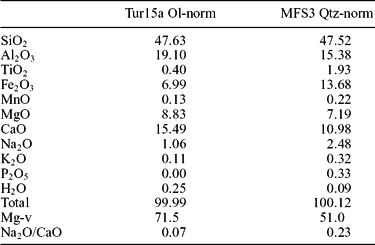
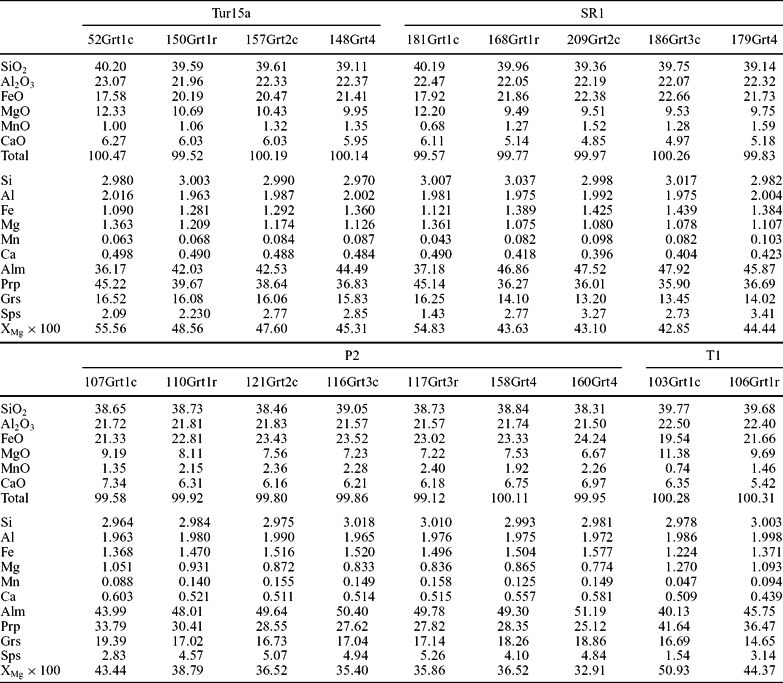
The metagabbros contain no quartz but can be both Ol (Tur15a)- and Qtz (MFS3)-normative (Table 1). Some modifications of the original chemistry, however, are to be considered, since they experienced partial melting and segregation of trondhjemitic melts (Rizzo, Piluso & Morten, Reference Rizzo, Pilsuo and Morten2005). Samples containing green (Tur15a, SR1, P2) and brown (T1) amphibole have been analysed for mineral chemistry. The variability of the chemical composition accounts for the different XMg × 100(Mg/(Mg + Fe) × 100) of the mafic minerals and of the Ca-contents of the plagioclase in the matrix of the studied samples. The Mg values (Mg/(Mg + Fe) × 100) of the rocks reach 71 in sample Tur15a, which has very low Na2O/CaO ratio and contains garnet, clinopyroxene, amphibole and orthopyroxene with the highest XMg. The chemistry of the phases is given in Tables 2, 3, 4 and 5. Minerals were analysed on polished thin-sections by using a Cambridge S360 electron microscope equipped with a LINK AN 10.000 Si (Li) energy dispersive detector. Operating conditions were 15 kV accelerating potential and a probe current of about 1 nA. EDS intensities were converted into wt% oxides using ZAF 4/FLS quantitative analysis software.
Chemical analyses of two representative samples from the Turrina area

Selected chemical analyses of garnet (formula calculated on 12 O) in the studied samples

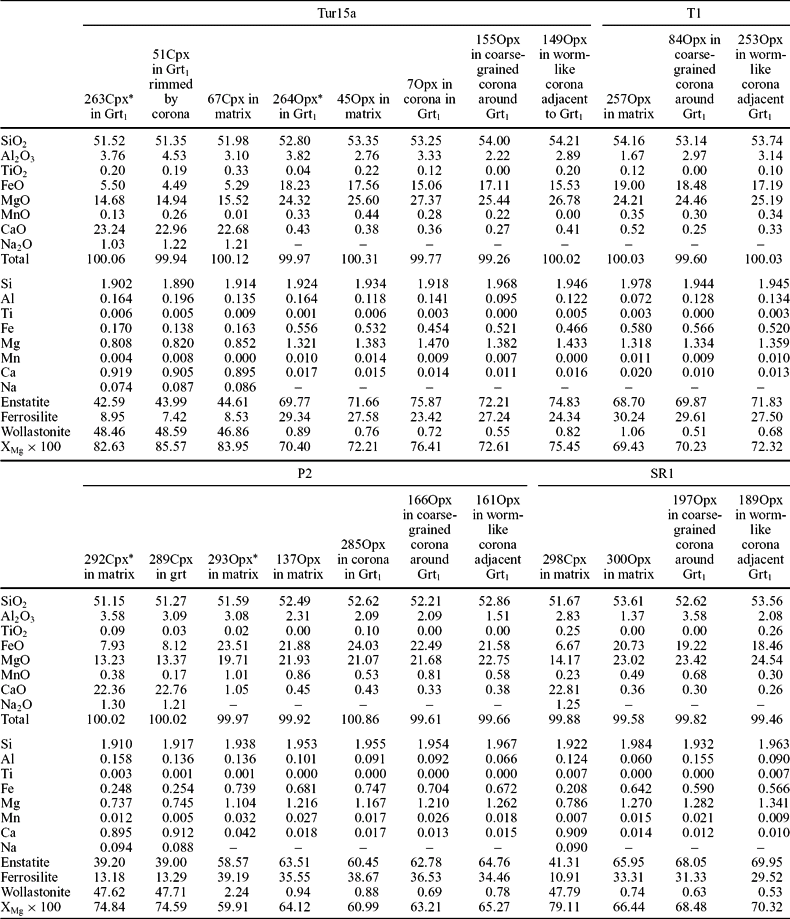
Selected chemical analyses of clinopyroxene and orthopyroxene (formula calculated on 6 O) in the studied samples

* – Cpx and exsolved Opx
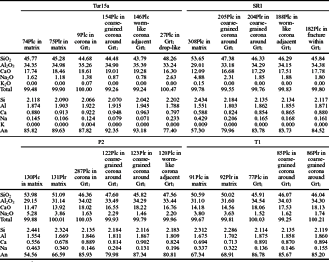
Selected chemical analyses of plagioclase (formula calculated on 8 O) in the studied samples

c – core; r – rim.
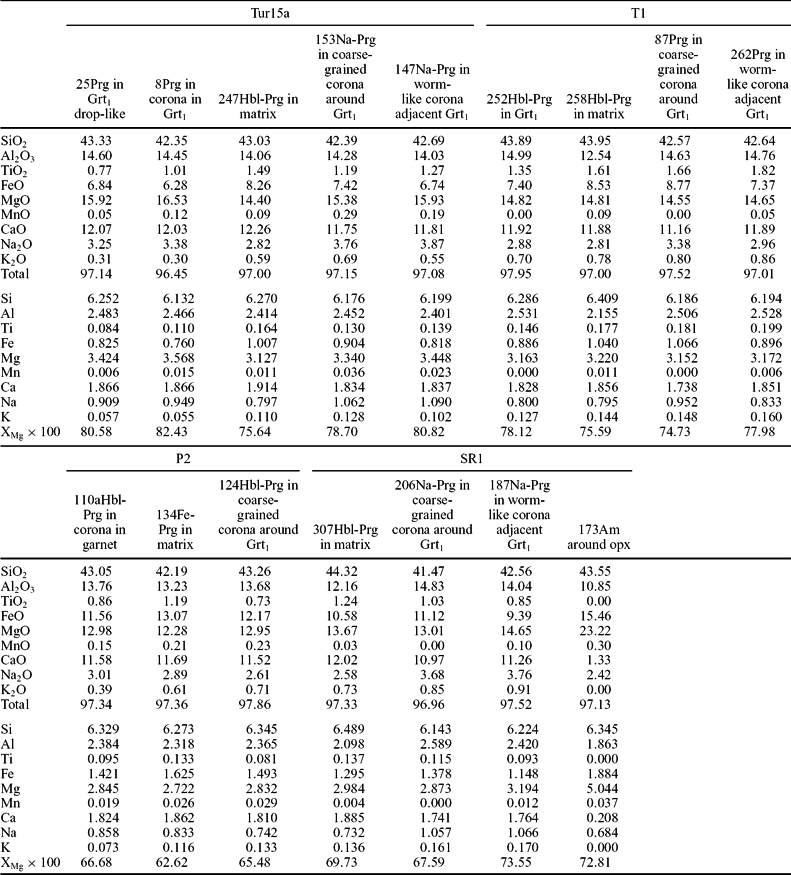
Selected chemical analyses of amphibole (formula calculated on 23 O) in the studied samples

Prg – pargasite; Hbl-Prg – pargasitic hornblende; Na-Prg – sodic pargasite; Fe-Prg – ferro-pargasite.
4.a. Green amphibole-bearing metagabbro – Samples TUR15a, SR1–P2
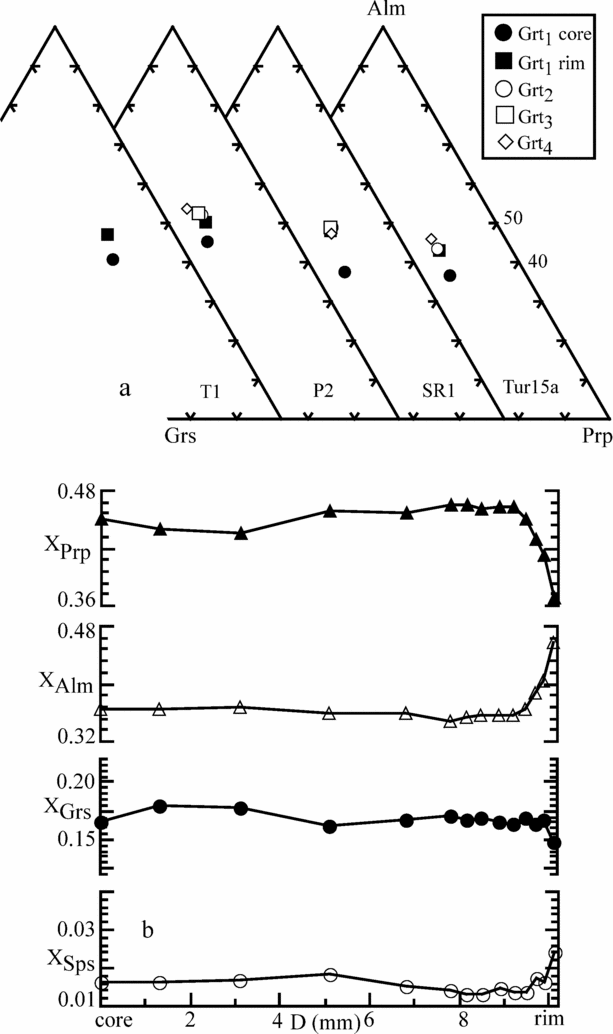
The garnet is close to almandine–pyrope-type rich in grossular (Table 2, Fig. 7a, b). Grt1 cores record XPrp 0.43–0.45 in samples Tur15a and SR1, and 0.34 in sample P2 with their rims showing lower XPrp 0.35–0.37 in samples Tur15a and SR1 and 0.31 in sample P2 (Table 2). Grt2, Grt3 and Grt4 show XPrp 0.35–0.39 (Tur15a and SR1) and 0.25–0.31 (P2).
(a) Plot of almandine–pyrope–grossular components of the garnet in the studied samples. Grt1 rim, Grt2, Grt3 and Grt4 show comparable compositions. (b) Compositional zoning profile across Grt1 in sample Tur15a; D – distance.

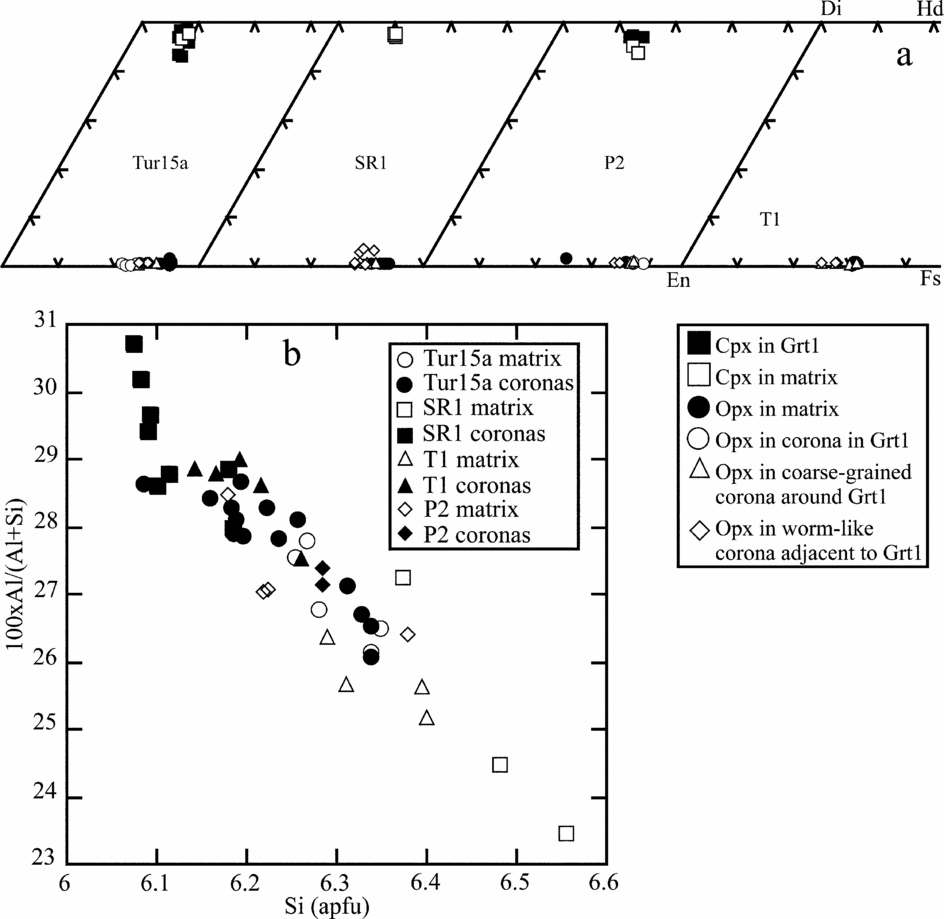
Orthopyroxene is richer in enstatite than in the ferrosilite component (Table 3, Fig. 8a). The orthopyroxene of the symplectites around Grt1 is slightly more enstatite-rich (Tur15a, SR1) or enstatite-poor (P2) than the matrix orthopyroxene (Fig. 8a).
(a) Quadrilateral plot of diopside–hedenbergite–enstatite–ferrosilite for clino- and orthopyroxene of the studied samples. The orthopyroxene of coronas and symplectites, apart from the ambiguities of sample P2, is richer in enstatite than the orthopyroxene of the matrix. (b) 100 × Al/(Al + Si) v. Si (apfu) plot for amphiboles of coronas and symplectites around clinopyroxene and porphyroblastic Grt1 and for amphiboles of the matrix. The amphiboles from the matrix tend to be Si-richer.

Plagioclase from the matrix is weakly zoned (Table 4) from An85 (core) to An89 (rim) in Tur15a and from An54 to An75 in P2. An content ranges from 91 to 94 in symplectite around Grt1 of Tur15a, from 82 to 89 in symplectite around Grt1 of P2, and from 85 to 89 in symplectite around the clinopyroxene inclusions. The drop-like inclusions in Grt1 of Tur15a have An contents ranging from 77 to 81.
Clinopyroxene is diopside with minor augite, according to Morimoto's classification (Reference Morimoto1988), without significant differences in the diverse textural sites (Table 3, Fig. 8a). XMg ranges from 73 to 85 and Wo from 46 to 48; the lowest and highest XMg are those relative to samples P2 and Tur15a, respectively. Porphyroblastic clinopyroxene in the matrix and the larger grains in Grt1 show about 5% of exsolved lamellae of Opx. The integrated composition shows XMg and Wo contents of 71–82 and 44–46, respectively; the highest XMg values, again, are found in Tur15a.
Amphiboles are mainly pargasite, pargasitic hornblende, Na-pargasite and minor edenite and tschermakitic hornblende according to Leake's classification (Reference Leake1978). Pargasitic hornblendes and pargasites prevail in matrix, whereas pargasites and Na-pargasites dominate in symplectites. The lowest and the highest XMg in the different textural sites are relative to P2 and Tur15a, respectively (Table 5). The TiO2 content ranges from 1.27% to 1.49%, being lower in symplectites than in matrix (Tur15a). Several element substitutions have taken place (edenitic, Ti-tschermakitic, tschermakitic), indicating, on the whole, a tendency towards higher Si contents in the matrix than in the corona amphiboles (Fig. 8b).
Magnetite occurs both as intergranular small grains and within amphiboles, plagioclase and Grt4 of the worm-like symplectite around Grt1.
4.b. Brown hornblende-bearing metagabbro – Sample T1
Grt1 shows a plateau with XMg 50–51 and a distinct Fe-richer rim (XMg 44). Mn increases from 0.05 to 0.09 apfu and Ca decreases from 0.51 to 0.44 apfu towards the rim (Table 2, Fig. 7a).
Orthopyroxene is slightly richer in enstatite within the symplectites than in the matrix (Fig. 8a). XMg ranges from 68 to 72 and Al from 0.07 to 0.13 apfu (Table 3).
Plagioclase within Grt1 and within the symplectite is the most calcic with An85–87, whereas it has An67–69 in the matrix (Table 4).
Amphiboles are pargasites in symplectites and pargasitic hornblendes in the matrix. They have XMg 78–83 within garnet and range from 73 to 78 in the symplectite around Grt1 and in the matrix (Table 5). Their Si-content is mostly higher in the matrix than in symplectite (Fig. 8b). The amphibole included in Grt1 is Ti-poorer than in the matrix, while the amphibole of the symplectites is Ti-richer (Table 5).
The comparable compositions of orthopyroxene and plagioclase within Grt1 and outer symplectite suggest that they might result from interception of extensions of symplectite within Grt1.
5. Dehydration–decompression reactions
Taking into account the textures occurring in the green amphibole-bearing samples, some reactions occurring during prograde and decompression stages may be described.
5.a. Prograde stage and first dehydration
The drop-like inclusions of plagioclase, amphibole and clinopyroxene in the porhyroblastic garnet, as well as the remains of amphibole in pyroxenes (Fig. 3a) of the sample Tur15a, suggest the reaction:

where ‘i’ stands for drop-like inclusions in Grt1 and remnants in pyroxene of the matrix, and ‘m’ for the mineral phases of the matrix.
5.b. First decompression
Symplectites of Opx+Pl (An85–89)+Prg and/or Na-Prg (Fig. 3a) and coronas of Opx+Pl(An85–89) between clinopyroxene inclusions and host Grt1, as well as coronas of Opx+Prg around clinopyroxene in Grt1 and matrix (Fig. 3b), necessitate the presence of quartz, which is absent in these samples. Harley (Reference Harley1988) and Pattison et al. (Reference Pattison, Chacko, Farquhar and MacFarlane2003) suggest that such symplectites and coronas might form by infiltration of fluids or melts. In the case under study, the formation of plagioclase and/or amphibole implies participation of (Si–Na)-carrying fluids which caused local hydration.
Thus such reactions as:

might be described, depending on local a(SiO2) and a(H2O). Grt1 contiguous to coronas having XPrp 41–42 (as opposed to 45 in the core) can also be a product of the above reactions.
5.c. Second dehydration
Symplectites rimming the porphyroblastic amphibole of the matrix might be explained through the reaction:

and through the reaction conserving part of H2O:

depending, possibly, on the variable diffusivity of the vapour phase.
5.d. Second decompression
The coarse-grained symplectite around Grt1 most likely involved different reactions between Grt1 and minerals from the matrix, depending on the mineral adjacent to the Grt1. Figure 3b, for instance, indicating a former contact between garnet and amphibole of the two-layer corona around clinopyroxene, suggests the reaction:

with amphibole of the corona having lower cationic Si (Fig. 8b); ‘m’ and ‘c’ stand for matrix and corona, respectively.
Schenk (Reference Schenk1984) describes coronas consisting mainly of orthopyroxene and Ca-rich plagioclase, with minor biotite and pargasitic hornblende, which commonly are attributed to reacting garnet or garnet + clinopyroxene in presence of quartz or SiO2 (Harley, Reference Harley1989). Accordingly, variable a(SiO2) and a(H2O) assisted the partial breakdown of the porphyroblastic Grt1.
The inner worm-like symplectite which induced spectacular embayments in Grt1 (Figs 5, 6b) probably formed through the reaction:

The regrowth of Grt4 in the worm-like symplectite suggests the persistence of the ‘Grt in’ conditions and the simplified reaction:

The above reactions are qualitative and simplified since: (1) minerals might have not equilibrated simultaneously, (2) some of the mineral compositions have been altered during the multi-stage evolution, (3) different reactions operated during the formation of some textures depending on the adjacent reacting phases, and (4) the system was open to some chemical components.
6. Thermobarometry
Conventional computation and Thermocalc software (version 3.25 of Powell & Holland, Reference Powell and Holland1994) have been used to evaluate the physical conditions at the various metamorphic stages. Minerals in apparent equilibrium were selected for the conventional estimates. Calibrations of Hbl–Pl and Al-in-Hbl (Holland & Blundy, Reference Holland and Blundy1994; Anderson & Smith, Reference Anderson and Smith1995) have been considered to estimate the pre-peak conditions. The calibrations of Harley (Grt–Opx, Reference Harley1984), Ellis & Green (Grt–Cpx, Reference Ellis and Green1979) and Nickel & Brey (Cpx–Opx, Reference Nickel and Brey1984) for temperature estimates and of Harley & Green (Grt–Opx, Reference Harley and Green1982) for pressure estimates have been used at peak and post-peak conditions.
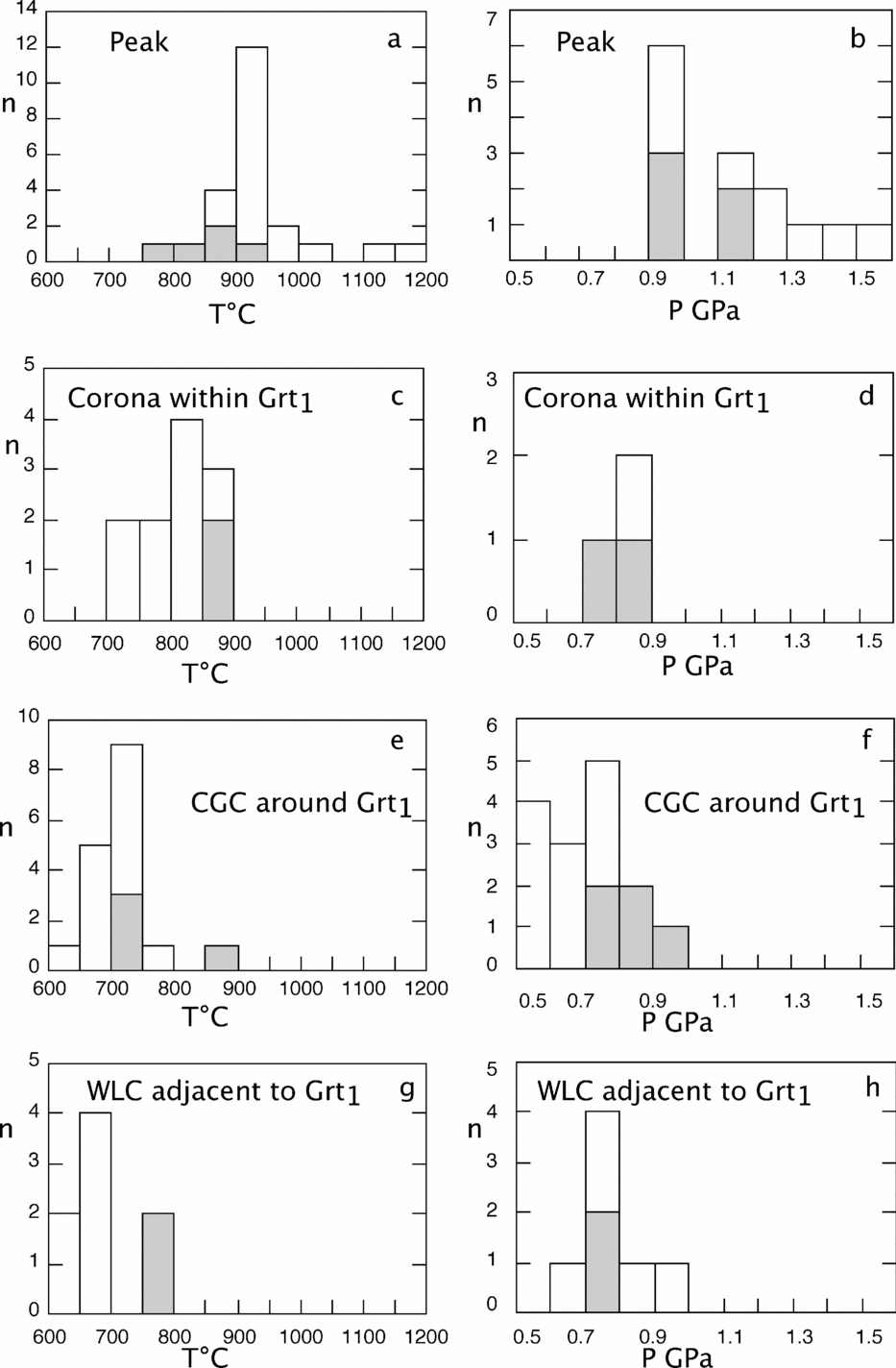
The following pairs have been considered: (1) Grt1–Opx matrix–Cpx with the integrated composition of the larger inclusions in Grt1 or in matrix (core–core) at reference P and T of 1.0 GPa and 800 °C for the prograde stage; (2) rim–rim of adjacent Grt1–Cpx inclusions without considering the exsolved Opx, at P = 0.8 GPa and T = 800 °C for the coronitic assemblages within Grt1; (3) Grt1rim–Opx, Grt2–Opx, Grt3–Opx and Grt4–Opx at reference P–T of 0.7 GPa and 700 °C for the coronas around Grt1. The calculated P and T are reported in the form of histograms in Figure 9; the ranges of the most frequent estimates are given in Table 6.
Histograms of T (left) and P (right) estimates during the granulite-facies conditions at peak and post-peak stages deduced from conventional (white areas) and Thermocalc (grey areas) procedures; n indicates the number of estimates. CGC and WLC indicate the coarse-grained and worm-like coronas around Grt1.

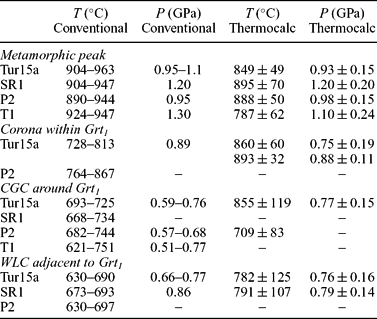
Ranges of the most frequent values of P–T estimates (deduced from Fig. 9) by conventional and thermocalc approaches for the studied samples

CGC – coarse-grained corona; WLC – worm-like corona.
The parageneses that can be considered as representatives of the various metamorphic stages were selected for use with the Thermocalc software. The phase activities were computed using the same conditions as for conventional estimates. H2O-activity = 0.4 has been adopted, even if its variability is evident from the reaction textures, to give comparable results. In any case, computations with H2O-activity between 0.2 and 0.6 did not give significantly different results. Assemblages giving at least a set of three independent reactions with the minimum error (standard deviation for P<0.24 GPa, for T<125 °C) were selected; the selected results are reported in Table 6 and Figure 9.
The P–T estimates for the prograde assemblage included in Grt1 give unrealistic results (P<0.5 GPa and T>800 °C), which are neither in agreement with the occurrence of relict kyanite in the felsic granulites hosting the metagabbros (Schenk, Reference Schenk, Salisbury and Fountain1990) nor with the results relative to peak and post-peak estimates.
The spread of estimates and the relatively large errors in some Thermocalc results indicate the lack of textural and chemical equilibria due to the complex metamorphic history causing adjustment of the mineral assemblage to changing conditions. This adjustment was incomplete and occurred over a wide range of P–T conditions, with geothermometers and geobarometers indicating quenching under different conditions. The above effects are of more limited extent for the peak assemblage when porphyroblastic phases are considered. Sixteen out of 23 core–core T values are centred around 930 °C, and most of the P values range from 0.95 to 1.2 GPa (Fig. 9). The results for the fine-grained symplectites are less certain. T and P realistic estimates are: 800–900 °C and 0.75–0.9 GPa for the corona formation within Grt1 (first decompression); 700–750 °C and 0.7–0.8 GPa for the coarse-grained layer around Grt1; 650–700 °C and 0.7–0.8 GPa for the worm-like symplectite (Table 6, Fig. 9). In many cases, however, both conventional and Thermocalc results provide similar information on the relative change of P–T conditions during metamorphic evolution, which are consistent with the sequence and interpretation of the reaction textures. Independent estimates of pressures can be made on the basis of the experimental data of Green & Ringwood (Reference Green and Ringwood1967) on the occurrence of garnet and disappearance of plagioclase in basaltic compositions. The comparison of the peak conditions with the experimental data indicates: (1) pressure above the ‘garnet in’ curve (>0.7–0.8 GPa) at ≈900 °C for the olivine tholeiite (B) composition, with Mg-value 66, compared with Mg-value 71 for sample Tur15a; (2) pressure below and near the corresponding plagioclase-out curve (≤1.0 GPa), as Grt1 contains drop-like inclusions of plagioclase. In addition, it should be considered that: (1) the metagabbros as well as the hosting metasediments underwent partial melting and segregation of melts (Rizzo, Piluso & Morten, Reference Rizzo, Pilsuo and Morten2005); and (2) some of the proposed reactions cannot take place in silica-undersaturated systems. These facts might suggest that those reactions occurred in pristine silica-saturated environments, in systems characterized by local presence of Si-bearing fluids or melts, or where the reactants are richer in silica than the products. In this case, since real pressures depend on silica activity (Harley, Reference Harley1989), P estimates of metamorphic peak and first decompression of ≈1.15 and 0.95 GPa at 900 and 850 °C, respectively, based on the Perkins & Newton (Reference Perkins and Newton1981) Grt–Opx–Pl–Qtz geobarometer, are maximum constraints.
The occurrence of garnet within the symplectites around the porphyroblastic garnet indicates maintenance of ‘garnet in’ conditions at lower P, as indicated by the lower XMg of garnet and the very high An-content of plagioclase. On the basis of Green & Ringwood's (Reference Green and Ringwood1967) data, this implies P>0.5 GPa at T≈700 °C.
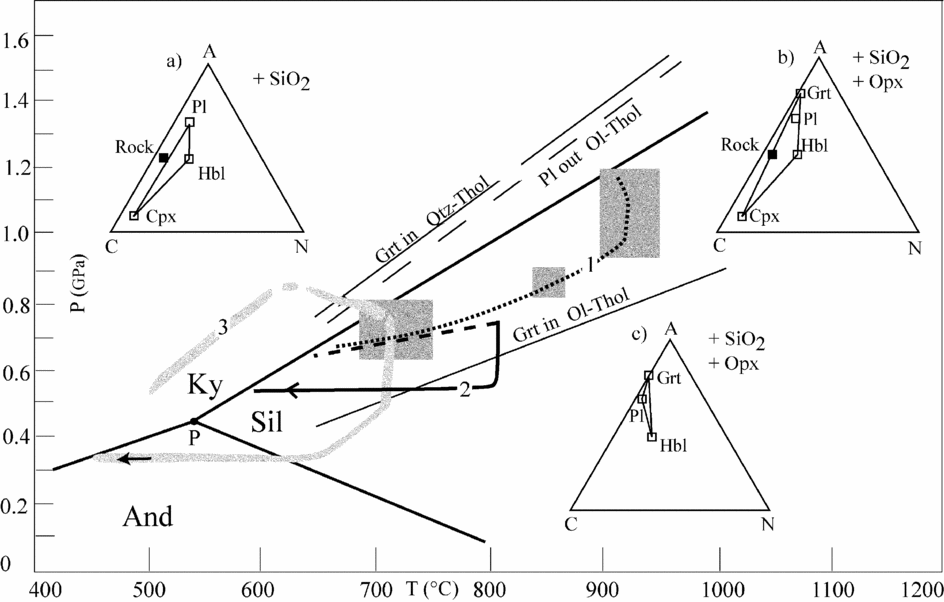
Preferred P–T estimates are: ≈1.1 GPa and 900 °C for the metamorphic peak; ≈0.8–0.9 GPa and ≈850 °C for coronas between Cpx and Grt1 post-dating the peak; 0.7–0.8 GPa and 650–750 °C for the coarse-grained radial and worm-like symplectites around Grt1. Retrogression continued with rehydration at lower temperatures (Fig. 10).
Approximate P–T–t path (1) for the metagabbro, compared to the path deduced by Schenk (Reference Schenk, Daly, Cliff and Yardley1989, (2)) and Acquafredda et al. (Reference Anderson and Smith2006, (3)) for the lower (1, 2) and upper (3) part of the lower crustal section of the Serre. Triple point after Pattison (Reference Pattison1992). The grey rectangles represent the ranges of P–T estimates. The ACN chemographic plots have been constructed for sample Tur15a: (a) earlier assemblage; (b) peak assemblage; (c) symplectitic assemblages around Grt1 (second decompression). If the garnet contiguous to the symplectite Pl–Opx–Am around the clinopyroxene inclusions (first decompression) is a product of the reacting Cpx and Grt1 (reaction 2), the topology is the same as represented for the second decompression, apart from the different chemistry of the involved phases.

7. Conclusions
Multi-stage dehydration–decompression has been documented in the metagabbros of the lower crust section of the Serre on the basis of microtextural evidence and thermobarometric data. The resulting assemblages, which may be anhydrous or contain variable proportions of amphiboles, reflect local variation of H2O-activity as indicated by the formation of: Pl–Opx, Pl–Opx–Am or Pl–Am coronas and symplectites around clinopyroxene and garnet; Pl+Opx+Ilm (Schenk, Reference Schenk1984), Pl–Opx, Pl–Opx–Am–Spl–Bt rimming the amphiboles of the granulitic matrix.
Evidence has been provided for a clockwise P–T path from prograde to isothermal decompression and isobaric cooling (Fig. 10). This path differs from the one proposed by Schenk (Reference Schenk, Daly, Cliff and Yardley1989).
The P–T conditions of the metamorphic peak as well as the metamorphic evolution are different. Fabric characteristics, reaction textures, and their formation order, as well as the different thermobarometric calibrations used, might account for the discrepancies. The evolution proposed here is in agreement with the reconstruction advanced by Acquafredda et al. (Reference Acquafredda, Fornelli, Paglionico and Piccarreta2006) for the migmatites of the uppermost part of the lower crustal segment: (1) a prograde stage in the stability field of kyanite up to P-peak (≥0.8 GPa in the uppermost part and P≈1.1 GPa in the lowermost part) characterized by a thermal gradient of about 25 °C/km; (2) two stages of decompression with the earlier stage nearly isothermal and the latter characterized by significant decrease of temperature; (3) a deformation episode separating the two decompressional stages and nearly isobaric cooling. The estimates of P and T at the different evolutionary stages in the uppermost and lowermost part of the lower crust segment are in agreement with the 7–8 km thickness of the segment (Schenk, Reference Schenk1984). The estimates of P-peak at the base of the lower crust segment imply a Hercynian crustal thickening of about 35 km, as opposed to the thickness of about 20 km presently evaluated (Schenk, Reference Schenk1984; Acquafredda et al. Reference Acquafredda, Fornelli, Micheletti and Piccarreta2003). The granitoids intruded at about 300 Ma (Schenk, Reference Schenk1984) in the uppermost migmatites and crystallized at 0.5–0.6 GPa (Caggianelli, Prosser & Del Moro, Reference Caggianelli, Caggianelli and Del Moro2000). These pressures are quite similar to those estimated in the uppermost migmatites at the end of the first stage of decompression (Acquafredda et al. Reference Acquafredda, Fornelli, Paglionico and Piccarreta2006). Accordingly, a significant crustal thinning earlier than or contemporary with the emplacement of granitoids (Del Moro, Fornelli & Piccarreta, Reference Del Moro, Fornelli and Piccarreta2000; Caggianelli, Prosser & Del Moro, Reference Caggianelli, Caggianelli and Del Moro2000; Acquafredda et al. Reference Acquafredda, Fornelli, Paglionico and Piccarreta2006) should have occurred. Thus, the contractional regime changed into an extensional one earlier than or at about 300 Ma ago. The Late Variscan decompressional stages mark the initial phases of the exhumation of the lower crust of the Serre.
Acknowledgements
This work was financially supported by the University of Bari (2006, G. Piccarreta). G. Trotti is thanked for graphical assistance. The authors are grateful to two anonymous referees and to D. Pyle for the constructive criticism. J. Holland and L. Snyder are thanked for editorial assistance.